Search & find:
Media, press releases, events for your editorial coverage

Services for connected eBike mobility: Bosch presents the Connected Biking Platform

24.03.2026

Press release

Electrified mobility

Services for connected eBike mobility: Bosch presents the Connected Biking Platform

Stuttgart/Reutlingen – Modern eBike mobility is seamlessly integrated into people’s everyday digital lives. This gives rise to new opportunities for companies from the bike, mobility and service world: the development of attractive digital offers for their customers, optimised processes and innovative business models. With the Connected Biking Platform, Bosch eBike Systems now offers a digital basis for the development of new eBike services and provides with standardised interfaces and expertise. Our Connected Biking Platform is becoming a central component of the digital ecosystem around the eBike. We are creating opportunities for industry players to develop their own digital offerings. The first partners are already connected and are shaping connected eBike mobility together with us....Claus Fleischer, CEO of Bosch eBike Systems From connectivity to new possibilities The connected eBike is at the centre of the new platform. The system continuously records important information such as status, configuration, use and service data via the Bosch ConnectModule. This creates a level of knowledge about the entire life cycle of the eBike, from delivery to operation and remarketing. For secure integration, Bosch eBike Systems provides a modular toolbox of standardised interfaces and digital modules. For example, partners can use this information for their own applications via Cloud APIs for the ConnectModule and the eBike Flow app. Added value for the bike industry: development, service and new offers These insights into the complete life cycle of an eBike open up new ways for the entire bike industry to simplify processes and continuously enhance the riding experience for end customers. New models can be specifically adapted to real use profiles, maintenance and support are strengthened with efficient service, and app providers can develop innovative digital offerings. eBike manufacturers receive valuable insights into the actual use of their connected models based on the comprehensive information base. Knowledge about stock levels, functions used or the system status helps in developing future models and equipment in a more targeted manner. Operational processes can also be simplified: test fleets can be managed efficiently and transport to retailers can be secured with the tracking option. In addition, eBike manufacturers can develop their own apps or subscription services and place their own branded content directly in the eBike Flow app via “Content Cards”. Specialist dealers benefit from the option of being able to organise their own rental or test fleets even better on this basis. The overview of the location and availability of each eBike makes management much more efficient and also increases theft protection. App and service providers can connect their services to the eBike Flow app via the Connected Biking Platform and therefore reach a large, active eBike community. Once integrated, the interface enables seamless exchange between the two platforms. This creates a consistent experience for shared users and a valuable basis for the further development of our own services. Partners such as komoot are already connected here. New potential for fleet operators, leasing providers and insurance companies The Connected Biking Platform also opens up new options for professional mobility service providers: fleet operators can manage their eBikes more efficiently and minimise breakdowns, leasing providers can transparently track the value retention of their models, and insurance companies can minimise damage risks. The result is more reliable sharing services, transparent leasing conditions and comprehensible insurance rates. Fleet operators receive real-time information on the location, state of charge and use of each individual eBike. In the event of theft, the eBike can be located and the motor support disabled. Partners such as Papin and Tilia already have these options: for example, they can plan and control use, service and charging processes centrally. This enables proactive maintenance, reduces downtime and simplifies operation across many wheels. The fleet therefore remains reliably available. Mobility platforms can offer a complete solution with dashboards and booking apps for fleet and rental management with a clear competitive advantage. The advantage is a single, standardised interface for all eBikes with the smart system from Bosch. Partners such as allride (AMAG Group), Connected Cycle , Friiway , Joyride , OKGO and Velo de Ville are already using the Connected Biking Platform to help fleet and hire providers manage their eBikes or support dealers in selling eBikes through subscription models – without them having to invest in their own solutions. Leasing providers can transparently track the condition and service history of each eBike over the entire contract term. This ensures value retention, facilitates the technical appraisal during return and makes the evaluation of returns faster and more objective – the ideal basis for profitable remarketing. Leasing partners can also offer additional digital services by integrating them into the eBike Flow app. This creates a seamless experience for customers: they benefit from digital theft protection and can view their contract data directly in the eBike Flow app. Leasing providers are therefore given the opportunity to optimise customer lifecycle management and initiate follow-up leasing. Insurance companies benefit from alarm and GPS tracking functions that can help prevent theft and recover stolen bikes more quickly. A digital theft report also bundles all relevant data on the eBike and the incident. This enables significantly faster, partially automated claims processing and helps to calculate risks or rates accurately in future, based on real information. The Connected Biking Platform as the digital backbone of the eBike industry A reliable and secure technical basis is needed so that the variety of digital services for eBikers in the sector can continue to grow. The protection of personal data and information security are also a top priority for Bosch eBike Systems when working with its partners and are an integral part of the company’s principles. Modern encryption technologies and a system architecture are used to ensure that each eBike is individually protected. In addition, all data processed by Bosch eBike Systems is stored on European servers in accordance with strict European data protection law. Over-the-air updates also make it possible to keep security up to date at all times. The protection and conscious control of personal data by the user are at the centre of this. With the Connected Biking Platform, Bosch eBike Systems is creating a digital backbone that sets new standards. This offers partners countless options for shaping digital mobility. The Connected Biking Platform forms the basis for an ecosystem that grows with you. It is already providing compelling offers from the first partners, and simultaneously forming the foundation for tomorrow. “With the extensive components of our Connected Biking Platform, we are creating a real win-win situation: customers and partners can implement ideas easily, quickly and reliably, and therefore create a wide range of digital offers from which the constantly growing community of eBikers can benefit. The future of eBiking is happening now,” says Gregor Dasbach, Head of Digital Business at Bosch eBike Systems. Further information on the possibilities of the Connected Biking Platform can be found here.

Smart everyday helpers: How Bosch products and services promote quality of life  ...

03.09.2025

Press release

Smart Home

Smart everyday helpers: How Bosch products and services promote quality of life ...

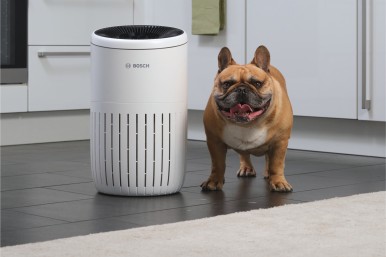
Berlin, Germany – At IFA in Berlin, Bosch is showcasing products and solutions that not only make everyday life easier, but also contribute to comfort, well-being, and safety. At the center of the Bosch booth in hall 1.1 is the “Bosch Powerhouse,” full of innovations for home living, cooling, and heating. Here visitors can experience how Bosch is using “Ready #LikeABosch” to redefine everyday life – as smart, sustainable, and very close to people.AI: friend and helper for baking, cooking, and baby care AI recipe conversion for Cookit: Cooking and baking are becoming unlimited pleasures: the AI recipe converter automatically takes freely accessible online recipes from food blogs, cooking platforms, or recipe portals and turns them into guided Cookit recipes . This saves Cookit users time as they prepare millions of recipes according to their own personal taste. The AI recognizes ingredients, preparation steps, and cooking times and automatically adapts the instructions to the Cookit functions for an optimum cooking experience. Those instructions can be tailored to users’ preferred portion size, dietary preferences, or available ingredients. However, the vision goes far beyond Cookit: Bosch is set to extend its AI-supported services to other connected kitchen appliances such as ovens and cooktops in the future. AI-browned in the Series 8 oven: The automatic dish recognition function in the premium Series 8 ovens now identifies up to 100 dishes and automatically selects the optimum settings. This makes baking, cooking, and roasting effortless – for everything from coffee cake to baked brie. Users can concentrate on other things while the oven takes care of the settings for guaranteed perfect results – now in a new matte design. AI enables parents to sleep without worries: The intelligent Bosch Revol crib can be used to monitor a child’s vital signs, such as heart and respiratory rate. Its software also signals in good time if a stuffed animal or blanket is covering the child’s airway or if the child is crying. A gentle rocking motion can help the child fall back into a peaceful sleep. Users can decide for themselves whether the data the crib records is ultimately stored in encrypted form on Bosch servers or remains offline within their own four walls. Small devices, big effect: Bosch is bringing power into the kitchen and household Winning every test of strength: Bosch’s new Series 8 food processor is the most powerful food processor made in Europe 1 . The 1,800 watt motor with Bosch 3D planetary mixing supports even the most demanding baking projects, offering eight times more kneading cycles without overheating. Its elegant mixing bowl can hold 6 liters – enough space for 2.8 kilograms of bread dough, or 10 baguettes. More than just hot air: The XXL Series 6 air fryer prepares dishes as much as 65 percent faster and uses up to 70 percent less energy than conventional cooking methods 2 . In addition, this modern frying technology uses much less oil for tastier, healthier results. Vacuuming and mopping on command: The four variants of the Spotless vacuum and mopping robot adapt flexibly to different households. In the Bosch Home Connect app 3 , users can configure all the necessary settings for their cleaning robot; for example, they can set it to start at a particular time. They can also activate voice commands in the app so that the Spotless can be controlled via Alexa, Google Home, or Apple HomeKit. Saving energy, making everyday life easier: the new large Bosch appliances Quiet support for everyday moments: With a noise level of just 57 decibels in exhaust mode at the highest normal setting, the Series 6 and Series 8 hoods are currently Bosch’s quietest integrated design hoods. They’re the perfect addition to any modern home – remaining out of sight when not in use and providing extra storage space. Energy-efficient washing and drying: The Series 8 heat-pump dryer offers the best energy efficiency (class A) and uses up to 78 percent less energy compared to conventional dryers 4 . With Air Max Dry for better drying performance, Cool Dry for gentler drying, and a self-cleaning condenser, the appliance offers a convenient, environmentally friendly solution for everyday use. Smart functions such as Smart Dry and Smart Start are available via the Home Connect app. The new Series 8 washing machine has a capacity of 11 kilograms and is 20 percent more efficient than energy efficiency class A. It uses i-DOS with detergent scan for precise dosing, while Active Water Plus and Mini Load save water and energy when doing small loads. Iron Assist reduces creases by up to 50 percent 5 – for less ironing and more convenience. “Invented for life” – in a home that thinks for itself Motion detector with integrated light: The Motion Detector II [+M] has a detection range of up to 13 meters. Weatherproof and suitable for outdoor use, it has a filter that prevents false alarms from small animals. The integrated light goes on automatically when it detects movement in low ambient light for greater safety in the dark. Additional sensors for temperature, vibration, and brightness enable smart automation for things like lighting, heating, or shade. Thanks to its compatibility with Matter, it can be used both in the Bosch Smart Home system and in Matter systems – future-proof and with maximum flexibility. Smarter starts when renewable energy is available: Bosch’s connected dishwashers, washing machines, and dryers think for themselves. Thanks to the Smart Start function , the appliances start automatically whenever a particularly large amount of renewable energy is available or when electricity prices are low. Digital maintenance functions and updates via the Home Connect app ensure a long service life and consistently high levels of efficiency. Cool technology for improved well-being Cleaning, dehumidifying, and cooling the air: The Air 1000 air purifier is a compact helper for small rooms up to 23 square meters in size, while the larger Air 4000 is designed for rooms measuring up to 62.5 square meters. The latter has already been named test winner by Stiftung Warentest, a German consumer testing group. Both devices effectively remove pollutants, allergens, and fine particulates from the indoor air. The Dry 4000 dehumidifier offers reliable performance for humid rooms: it removes up to 16 liters of moisture per day, quietly and efficiently, from rooms as large as 33 square meters. On hot days, the Cool 4000 portable air conditioner provides rapid cooling in rooms up to 35 square meters in size, with three automatic modes for maximum comfort. Air purifiers and single-split air conditioners have also been available in Matter-certified versions since the summer. Whisper-quiet heating and cooling: The Compress 5800i AW is the quietest heat pump in the Bosch portfolio – ideal for densely built-up areas. With the natural refrigerant R290 and five performance classes from 3.9 to 11.6 kilowatts, it offers a future-proof solution for heating, cooling, and hot-water generation. That little something extra: intelligent services for a connected home 24/7 protection for home and yard: With the new Security+ service from Bosch Smart Home, your home is protected around the clock. In the event of burglary, fire, or water damage, an emergency-call control center is always available and coordinates with the police, fire department, or personal emergency contacts, even if the house occupants can’t be reached. This service integrates seamlessly into the existing Bosch Smart Home system, expanding its functionality with professional support and smart camera functions such as intelligent audio analysis and extended cloud storage. Everything in a single app: The new bookable Home+ upgrade enables the central control of up to three Bosch Smart Home systems in a single app. This multisystem control lets users keep an eye on their home, vacation home, and commuter apartment at all times or provide help for relatives remotely. Home+ also offers smart functions such as intelligent audio analysis via the Eyes Indoor Camera II, which reliably detects noises such as glass breakage or alarms from conventional smoke detectors and informs users immediately via the app. Extended cloud storage is also included. Home+ will be available from the end of 2025 onward. All-In+ from Bosch: Renting home appliances flexibly instead of buying them is sustainable, transparent, and convenient. With All-In+, all offers include delivery, installation, and repair. Users can choose between new appliances and refurbished ones – this ensures not only maximum flexibility, but also a smaller ecological footprint. All-In+ from Bosch is the advancement of BlueMovement: with a new name, sharper focus, and innovative service bundles, All-In+ from Bosch makes premium appliances more accessible than ever before. Customers can choose between various subscription models, with the most important services always included. High-quality secondhand appliances: Giving used appliances a second life and thus protecting the environment and conserving resources is a trend that’s on the rise around the world. In 2024, 54 percent of people in Germany bought a secondhand product, while in India it was 59 percent and in the U.K. 63 percent in the same period. Q-Trust can create transparency: this certificate for used Bosch appliances confirms that they still work and provides further information such as the number of use cycles. Customers with a smaller budget thus get the opportunity to buy Bosch-brand appliances at low cost with full transparency.1 Food processor designed and produced in Europe with the highest wattage: 1,800 watts. 2 Tested during the preparation of a portion of moderately heavy food (300 g) and compared to a conventional 71 liter oven with an A+ energy rating. 3 Some of the functions can be used only if the device is connected via the internet to a Home Connect account and a SingleKey ID account. Home Connect is a service provided by Home Connect GmbH. Learn more at www.home-connect.com . 4 Energy savings of a modern Bosch heat-pump dryer (WRB247C40) with 9 kg drying capacity and 78 kWh (energy consumption according to Regulation (EU) 2023/2534) compared to an old conventional Bosch dryer with 9 kg drying capacity from 2015 (WTG86400) with 349 kWh (energy consumption also determined for comparison according to Regulation (EU) 2023/2534). 5 Test no. E-0124-PT-24 of the German Institutes of Textile and Fiber Research Denkendorf (DITF) dated June 3, 2024, relating to crease reduction in commercial cotton garments (T-shirts and business shirts) in the Iron Assist (or smartFinish) program in accordance with DIN EN ISO 15487 in comparison with textiles that have not been treated with Iron Assist.

For safer roads: Bosch teams up with Microsoft to explore new frontiers with gen ...

28.02.2024

Press release

Automated mobility

For safer roads: Bosch teams up with Microsoft to explore new frontiers with gen ...

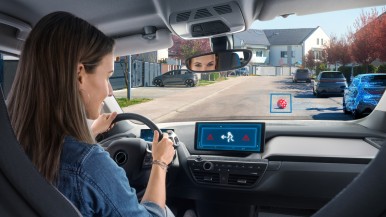
Stuttgart, Germany – It’s a scenario that no driver ever wants to see: a ball rolling out into the road. The chances are it will be followed immediately by a child in hot pursuit, oblivious to any traffic. But while human drivers can assess this situation using their contextual knowledge, today’s assisted and automated driving systems still have to learn how to do it. Bosch is pursuing the use of generative AI in terms to further improve automated driving functions. As part of this, Bosch and Microsoft are exploring opportunities to collaborate and leverage the power of generative AI. “Bosch is working on bringing a new dimension of AI applications into the vehicle,” said Dr. Stefan Hartung, chairman of the Bosch board of management, at this year’s Bosch Connected World (BCW) AIoT industry conference in Berlin. The expectation is that generative AI will enable vehicles to assess situations and react accordingly, and in this way keep road users even safer. Greater safety on the roads is also the wish of 60 percent of respondents to this year’s Bosch Tech Compass, a worldwide representative Bosch survey on the subjects of technology and AI. Bosch is working on bringing a new dimension of AI applications into the vehicle,...says Dr. Stefan Hartung, chairman of the board of management. Generative AI to make road traffic safer The two companies anticipate that a collaboration would take the performance of automated driving functions to the next level. They would like to see generative AI help enhance convenience in the vehicle and to provide greater safety for all road users. To achieve this, Bosch's comprehensive understanding of vehicles and automotive-specific AI expertise will be invaluable, as well as their access to vehicle sensor data to feed the generative AI. “In our unwavering commitment to safer roads, Microsoft is eager to explore collaboration opportunities with Bosch to pioneer the realm of generative AI,” said Uli Homann, Microsoft CVP and Distinguished Architect. Even today, when it comes to training systems for automated driving, AI quickly comes up against its limits. Today’s driver assistance systems can detect people, animals, objects, and vehicles, but in the near future generative AI could help determine whether a situation could potentially lead to an accident. Generative AI utilizes vast amounts of data to train systems for automated driving, enabling them to draw improved conclusions from this data. For example, it could deduce whether an object on the road ahead is a plastic bag or a damaged vehicle part. This information can be used either to communicate directly with the driver – such as by displaying a warning – or to initiate appropriate driving maneuvers, such as braking while switching on the hazard warning lights. Bosch and Microsoft have already partnered to develop a universal software platform for seamlessly connecting cars and the cloud, and are looking forward to work together to identify new opportunities to bring cutting-edge AI technology to their customers and the autonomous vehicle industry. Generative AI as a boost to innovation “Generative AI is a boost to innovation. It can transform industry in much the same way as the invention of the computer,” says Dr. Tanja Rueckert, member of the Bosch board of management and chief digital officer. The new 2024 Bosch Tech Compass shows this as well: 64 percent of respondents believe that AI is the technology with the greatest importance for the future. In comparison, only 41 percent of respondents were of the same opinion just one year ago. Generative AI is a boost to innovation. It can transform industry in much the same way as the invention of the computer,...says Dr. Tanja Rueckert, member of the Bosch board of management and chief digital officer. From manufacturing to everyday office work, generative AI is already being used in many areas at Bosch. In addition to Microsoft, the company is working with several partners, including AWS, Google, and Aleph Alpha. The Bosch Group’s venture capital unit, Bosch Ventures, invested in the AI company Aleph Alpha last year. Bosch also announced it would collaborate with the startup on finding new use cases both for Bosch associates and customers. “Bosch and Aleph Alpha want to learn from each other, benefit from each other’s know-how, and work together on cross-domain use cases,” Rueckert says. This partnership is now bearing its first fruits in North America: in collaboration with Aleph Alpha, Bosch is debuting AI-based speech recognition on behalf of a premium car manufacturer. In this solution, a chatbot understands and answers breakdown service calls with the help of natural language processing, which also recognizes dialects, accents, and moods. The call is taken directly, reducing the driver’s waiting time to a minimum. As many as 40 percent of calls can be processed and resolved automatically; for more complex queries, the bot transmits all relevant information to a service center agent who takes over the case immediately. From the AI search engine to manufacturing AI experts at Bosch are currently working on well over 120 specific applications that these new AI models open up for the company’s associates and customers. Such applications include the generation of software program code or powerful chatbots and voicebots to support technicians or interact with consumers. Another is AskBosch, the in-house AI-assisted search engine launched at the end of 2023. It offers faster natural-language access to a wide variety of data sources – sources scattered over the intranet, say. In addition to externally available data, AskBosch also includes internal data sources, so Bosch associates can research information specific to the company. Generative AI also ensures greater speed in manufacturing: in initial projects in two Bosch plants in Germany, generative AI creates synthetic images in order to develop and scale AI solutions for optical inspection and optimize existing AI models. Bosch expects that this will reduce the time needed for planning, launching, and ramping up AI applications from the current six-to-twelve months to just a few weeks. Following successful piloting, this service for generating synthetic data is to be offered to all Bosch locations. 2024 Bosch Tech Compass: setting the pace in the use of AI As AI is used in more and more areas of life, professional development is becoming increasingly important: 58 percent of respondents to the Bosch Tech Compass are convinced of this. This opinion is particularly prevalent in USA at 63 percent (Germany: 54 percent, China: 52 percent). Here, too, Bosch is setting the pace in the use of artificial intelligence and is getting its associates on board. In 2019, Bosch launched a training program, initially aimed at bringing 30,000 associates up to speed on the subject of AI. Up to now, some 28,000 associates have taken part in the program. Like the Bosch AI code of ethics, which sets ethical guidelines for dealing with artificial intelligence, this program has been supplemented with content about generative AI. For all the results of the 2024 Bosch Tech Compass, click here . About the survey: For the representative survey, people aged 18 and over in seven countries (Brazil, China, Germany, France, India, the U.K., and the U.S.) were polled online on behalf of Robert Bosch GmbH by the market researchers Gesellschaft für Innovative Marktforschung mbH (GIM) in December 2023. In Germany, France, and the U.K., at least 1,000 people were polled per country; in Brazil, China, India, and the U.S., it was at least 2,000 people each. The random samples are representative of their respective countries in terms of region, gender, and age (Brazil, Germany, France, U.K., U.S.: 18 to 69 years / China, India: 18 to 59 years).


German industry proposes new development standard for safe automated driving

21.11.2023

Press release

Automated mobility

German industry proposes new development standard for safe automated driving

Stuttgart, Germany – Four years ago, the German automotive industry joined forces with 21 partners in a project to develop the world’s first structures for the verification of safety standards for automated vehicles in an urban environment. The results of the joint Verification and Validation Methods (VVM) project are now available. The findings of the pre-competitive research project, funded by the German Federal Ministry for Economic Affairs and Climate Action and initiated by the VDA flagship initiative autonomous and connected driving, will be discussed in detail at the final presentation at the Carl Benz Arena in Stuttgart today.The higher the level of automated driving and the more complex a system’s area of application, the more factors need to be taken into account during development. The first SAE Level 3 systems for freeway driving and an SAE Level 4 system for driverless parking have already been approved. Expanding the use of these systems to other applications – such as urban traffic – means that the vehicle and system become much more complex and subject to far stricter requirements. This explains the need for suitable verification and validation methods, which was the focus of the VVM project’s efforts. The challenge of urban traffic “Pedestrians, cyclists, motorized two-wheelers, intersections with limited visibility: one of the biggest challenges for automated driving systems is coping with traffic in an urban environment, which is characterized by a huge volume of road users, traffic light systems, traffic signs, and vehicles,” says Roland Galbas from Bosch, the coordinator of the VVM consortium project. “For future vehicles to be able to handle even extremely rare scenarios, they will need comprehensible structures and processes that not only enable the safe operation of a system in exceptional situations, but can also verify that maneuvering is done safely.” “The essence of the VVM research project is to verify that automated driving functions react safely and reliably, and that they also benefit customers in terms of precision and quality,” says Dr. Mark Schiementz from BMW, the co-coordinator of the project. “In addition to compliance with regulations, the guiding principle behind the German automotive industry’s work is not only to get technological progress onto the roads as quickly as possible, but also to provide safe vehicles and systems that can be relied on at all times. And this reliability starts right from the development of these systems.” Approval for road use requires verifiable safety Right from the very beginning of the design and development of automated driving functions, safety is the overriding consideration. And safety functions must be verified before a vehicle can be approved and certified for use in road traffic. To be able to provide this verification, the 21 project partners have jointly developed a model comprising a suite of procedures, methods, and tools. This allows a “security argumentation” to be employed to verify that the system is safe to use. To develop the methodology for this model, the partners worked together in several subprojects. If it were applied industry-wide, the defined model would provide the basis for verifying the safety of automated vehicles. “The models developed here make it possible for the first time to provide all automakers with the same structures for the verification and validation of automated driving systems in urban areas. This may then also lead to industry-wide standards that could make road traffic even safer for all road users,” explains Dr. Helmut Schittenhelm, project coordinator at Mercedes-Benz. Technology pioneer from Germany The VVM project’s methodological approach is the world’s first standard to also take industrial processes into account, once again underscoring the German automotive industry’s pioneering role in automated driving. The world’s first regulation for fully automated driving (SAE Level 4) came into force in 2021, when Germany enacted a law to that effect. In 2022, a corresponding regulation outlining the technical details was passed to allow such vehicles to be registered and operated on German roads. These latest developments are yet another example of how the German automotive industry is tackling the complexity of automated driving and making it more manageable. At the end of its project term, and building on the results of its Pegasus and SetLevel predecessor projects, VVM now delivers the world’s first consistent methodical approach to safety for automated driving in an urban environment, enabling industry-wide collaboration and value creation. The scenario-based safety verification approach pursued in the project could help to set global standards once it has been approved by the authorities. VVM has created a reference system for the industry that is relevant for the future, closes a methodological gap for practical validation, and secures the pioneering role of German industry in international competition on automated driving.

How connectivity can make city traffic safer and more efficient

26.09.2023

Press release

Automated mobility

How connectivity can make city traffic safer and more efficient

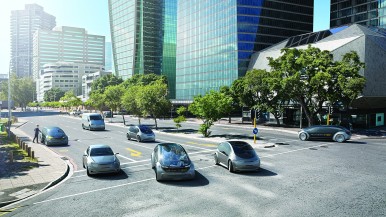
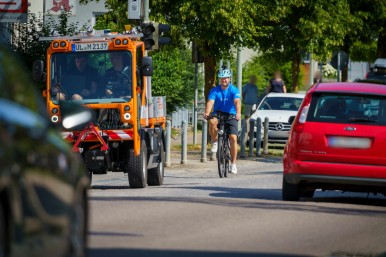
Stuttgart, Germany – The digital transformation, increasing urbanization and automation, as well as the need for greater energy efficiency and climate action are tough challenges currently facing the mobility sector. In the three-year LUKAS research project, Bosch, InMach, IT-Designers, Mercedes-Benz, Nokia, Ulm University, and the University of Duisburg-Essen are researching how to improve traffic efficiency and safety in future mixed traffic scenarios of urban traffic environments. LUKAS is the abbreviation of the German name "Lokales Umfeldmodell für das kooperative, automatisierte Fahren in komplexen Verkehrssituationen” (local environment model for cooperative automated driving in complex traffic situations). Reliable communication between automated and non-automated traffic participants as well as within the infrastructure plays a key role here. The project was funded by the German Federal Ministry for Economic Affairs and Climate Action (BMWK) with 5.2 million euros as part of its program for new vehicle and systems technology.Using data from the local environment for more safety and efficiency To increase traffic efficiency and safety in future mixed traffic scenarios of urban traffic environments, the LUKAS research project uses all the information available within the local environment. This includes, for example, information from infrastructure sensors, connected cars and commercial vehicles, and mobile devices such as smartphones used by pedestrians or cyclists. This concept provides anonymized data from traffic participants and stationary objects, including values such as position, extent, and possibly the travel speed and direction of movement. The preprocessed sensor information is relayed to an edge server, which is directly connected to the 5G network near the junction and provides data transmission with minimal delay times. A fusion algorithm on the edge server is able to create a comprehensive model of the local surroundings and use this as the basis to plan maneuvers for connected traffic participants. Object information from the server's environment model is fed back to the road users. This expands their overview to include areas that they cannot detect themselves. "The edge server uses methods of artificial intelligence (AI), among others, to calculate an optimized, cooperative maneuver and then sends instructions to the connected participants. This approach makes it possible to increase the overall energy efficiency of a traffic scenario and the safety of traffic participants, especially those who are vulnerable...explains Dr. Rüdiger Walter Henn, head of the LUKAS project at Bosch, the consortium leader. LUKAS pilot installation in Ulm-Lehr To run the tests, which took place in a public area in the suburb of Ulm-Lehr, the consortium used a pilot installation supported by the city of Ulm and operated by Ulm University. The selected area contains a junction with a right-of-way street turning off and a side street entering. The buildings there obscure the right-of-way, which makes this street situation particularly interesting for real traffic scenarios. "This installation gives us excellent opportunities to use real traffic situations to test the approaches we have researched and developed, so we can very quickly draw conclusions about their suitability for practical use," explains Dr. Michael Buchholz, who heads the Electric Mobility and Connected Driving/Connected Infrastructure research groups at the Institute of Measurement, Control and Microtechnology at Ulm University and is responsible for the pilot installation. The lampposts in the vicinity of the junction are equipped with video, lidar, and radar sensors to detect and classify the flowing traffic. The object information is sent to the edge server via a 5G network from the partner Nokia. Due to data protection reasons, persons and vehicles are not able to be identified. The edge server hosts the global environment model, several evaluated variations of cooperative maneuver planning, and a warning module for pedestrians and cyclists. Connectivity makes travel safer and more efficient To depict cooperative use cases in mixed traffic, Bosch, Mercedes-Benz, and Ulm University bring in connected, partially automated passenger cars. InMach provides a connected prototype of a street sweeper. Special smartphone apps from IT-Designers GmbH and Nokia make it possible to connect pedestrians and cyclists with the edge server. IT-Designers collects data using a video drone to assist in the simulation of the traffic scenarios, while the University of Duisburg-Essen supports the project with traffic flow simulations. All tested use cases verified the benefits of the LUKAS approach in terms of increasing traffic efficiency and safety. Simulation results from AI-based planning algorithms lead researchers to expect a significant increase in the traffic flow. Studies by the partner Mercedes-Benz show a significant reduction in fuel consumption and a decrease in the time required to pass through the junction in comparison to conventional driving. By delaying oncoming traffic to allow for cooperative behavior, participants passing stationary vehicles and vulnerable traffic participants crossing the road are protected in obscured areas. Thanks to the new technology and cooperative scenario planning, traffic participants recognize early on which driving strategy will enable them to behave safely and efficiently. The results of the LUKAS project have allowed the partners of the consortium to gain informative experience about connected, cooperative driving and incorporate this into the development of new products. The approach developed by LUKAS can help make automated driving in urban mixed traffic safer and more efficient for all traffic participants.

Many applications made easy: Bosch launches cost-effective motion sensor BMI323

20.10.2022

Press release

Sensortec

Many applications made easy: Bosch launches cost-effective motion sensor BMI323

The BMI323’s combination of simplicity with an excellent price-performance ratio will open up new applications for IMUs...said Dr. Stefan Finkbeiner, CEO at Bosch Sensortec. Tiny MEMS motion sensors are all around us. They make consumer products easier to use and improve how our smartphones and other gadgets interact with us. These sensors are precise, compact and power-efficient, however, until now, they have been complex for basic applications. To address this issue, Bosch Sensortec is launching the BMI323, an affordable Inertial Measurement Unit (IMU) with excellent performance and integrated features enabling a shorter development time. "The BMI323’s combination of simplicity with an excellent price-performance ratio will open up new applications for IMUs," said Dr. Stefan Finkbeiner, CEO at Bosch Sensortec. "These will include standard consumer products, such as toys, gaming controllers, remote controls, wearables, fitness trackers, smartwatches as well as tablets and laptops." Like its predecessor BMI160, the new BMI323 is a general-purpose, low-power IMU that combines precise acceleration and angular rate (gyroscopic) measurement with intelligent integrated features that are triggered by motion. Its integrated features make development faster and easier for OEMs. For example, the BMI323 already includes Bosch Sensortec’s plug-and-play step counter software, so customers don’t need to spend time developing their own algorithms. Other features include motion detection that can turn subsystems on or off when a device, such as a TV remote control, is put down or picked up, thus reducing overall power consumption. Compared to the BMI160, the BMI323 provides improved accelerometer performance as well as lower power consumption. In high-performance mode, using both the gyroscope and the accelerometer, the BMI323 has a current consumption of 790µA compared to 925µA on the BMI160, which represents a reduction of nearly 15%. The 6-axis BMI323 has a self-calibrating 16-bit triaxial gyroscope, a 16-bit triaxial accelerometer, and a 16-bit digital temperature sensor housed in a miniature 2.5 x 3.0 x 0.83 mm3 (14-pin) LGA package that is pin to pin compatible with the BMI160 and others. The BMI323 is the first IMU device announced by Bosch Sensortec to include the new I3C interface, in addition to the I2C and SPI interfaces. Availability: The BMI323 is available now. Website: https://www.bosch-sensortec.com/products/motion-sensors/imus/bmi323/ Contact person for press inquiries: Katharina Sorg phone: +49 711 811-26074 Twitter: @BoschMEMS

IAA Transportation: Bosch intends to grow further with climate-neutral powertrains

19.09.2022

Press release

Mobility

IAA Transportation: Bosch intends to grow further with climate-neutral powertrains

Stuttgart/Hannover, Germany – From climate action and cost pressure to driver shortages, the global transportation and logistics industry is facing enormous challenges. Bosch delivers appropriate solutions to meet these challenges. As it moves toward the goal of climate-neutral freight transport, the technology company is steadily expanding its powertrain portfolio. In addition to diesel powertrains, which will continue to play a vital role in commercial vehicles for some time to come, Bosch also offers battery-electric and fuel-cell powertrains. The company has now incorporated another option, the hydrogen engine, to fill the gap in alternative powertrains, particularly for heavy construction vehicles and agricultural machinery. “Climate action is moving freight transport in more diverse directions. We expect alternative powertrains to drive major growth in our business over the course of the decade,” said Dr. Markus Heyn, member of the Bosch board of management and chairman of the Mobility Solutions business sector, at this year’s IAA Transportation in Hannover. In a world full of uncertainties, sales in Bosch’s Mobility Solutions business sector have grown by 6 percent so far this year after adjusting for exchange-rate effects. Bosch generates one-fourth of its sales revenue from commercial-vehicle technology, ranging from vans to 40-ton trucks. In addition to powertrains, the other pillars of Bosch’s commercial-vehicle business are driver assistance systems and connectivity. Climate action is moving freight transport in more diverse directions. We expect alternative powertrains to drive major growth in our business over the course of the decade...Dr. Markus Heyn, member of the Bosch board of management and chairman of the Mobility Solutions business sector Bosch is bringing new energy to commercial-vehicle powertrains According to Bosch forecasts, over 80 percent of all trucks weighing six metric tons or more will still be diesel-powered in 2025. Powertrain diversity will subsequently increase and, by 2035, half of all new commercial vehicles will be electric, powered either by battery or hydrogen. “A technology-neutral approach is particularly useful in commercial vehicles. Depending on the application, there will be more than one climate-neutral option for the truck powertrain,” Heyn said. At Bosch, 3,400 engineers alone are working on the truck powertrain of the future. No other company offers as many electromobility options as Bosch: from e-bikes to construction machinery, and from silicon carbide chips to complete drive modules. This strategy is paying off: Bosch already has 30 major orders from manufacturers for battery-electric powertrains. Bosch also has big plans for the fuel cell. By 2025, the company aims to have over 40,000 Bosch fuel-cell systems on the road. To support this goal, Bosch also manufactures the stacks itself and is establishing global production capabilities close to its customers, specifically at its plants in Anderson (USA), Wuxi (China), and Bamberg (Germany). Fuel cells are not the only way to power trucks using hydrogen; there are also H2 engines. Bosch develops the control units and injection technology required for these engines and has already acquired a major project in India. Bosch is teaching trucks to drive Bosch is in its element not only in hardware, but also in software. Half the R&D associates in the Mobility Solutions business sector are software engineers. Among other things, this promotes the development of automated driving. Bosch has 1,100 engineers working on this topic, and it supplies software, sensors, vehicle computers, and actuators from a single source. “Automated driving is coming, due in part to the acute driver shortage. And nowhere does automated driving make more economic sense than in commercial vehicles,” Heyn said. Across Europe, there is already a shortage of 400,000 drivers. Bosch aims to implement driverless operation on freeways by the end of the decade. In 2025, a vehicle computer that enables sensor data to be processed in real time will go into large-scale production at a European truck manufacturer. Bosch technology will make the electronics architecture in future commercial vehicles significantly more powerful, thereby delivering the basis for the software-defined truck. On the road toward automated driving, the company is doing good business with driver assistance systems. Best example: corner radar sensor in trucks. This market will grow by 40 percent over the next few years, Bosch by almost 60 percent. The company’s efforts here are driven by various factors, including the legal requirements for preventing road accidents with commercial vehicles. For example, the turn assistant function will be a mandatory feature in Europe from 2024. Bosch prepares to launch logistics platform In its work on the future of freight transport, Bosch is also looking beyond the hood. Bosch has joined forces with U.S.-based cloud provider Amazon Web Services (AWS) to operate a software platform that bundles not only its own logistics services but also third-party services. Integrating these solutions delivers a boost in efficiency. Instead of using the multitude of independent solutions currently on offer, logistics companies and freight forwarders across the globe will have quick and easy access to digital services from a single source. “We will be launching our logistics platform in India within the next few weeks and then in Europe and the U.S. at the beginning of next year,” Heyn said. One example of Bosch services for the transportation and logistics industry is logistics monitoring. Bosch service centers monitor the condition of critical or even medically vital goods – between 30,000 and 40,000 truckloads annually. During the coronavirus pandemic, Bosch also took on the monitoring of vaccine shipments. There is also high demand for secure truck parking, a service that can be used to reserve truck parking spaces. Bosch already offers 100 suitable areas along the highways in eleven European countries. Bookings tripled in 2021 alone. Bosch is also expanding its service portfolio to include a retrofit solution for the keyless access system for commercial vehicles, which will be launched in 2023.BOSCH AT IAA TRANSPORTATION 2022 Panels with Bosch experts at the IAA Conference: Tuesday, September 20, 14:15 – 15:15 CEST in the Industry Forum: Presentation: “How to manage the operational challenges of multi-brand commercial EV fleets” by Michael Köhler, Senior Vice President Business Unit Battery at Robert Bosch GmbH Tuesday, September 20, 17:30 – 17:45 CEST on the Main Stage: Keynote: “Powertrain solutions for future transportation” by Jürgen Häusser, Vice President Product Management Commercial Vehicle & Off-Road at Robert Bosch GmbH Wednesday, September 21, 17:00 – 19:00 CEST at the Cummins booth (hall 20, booth A12): “Open dialog on the hydrogen engine” with Dr. Andreas Kufferath, Engineering System Diesel Powertrain at Robert Bosch GmbH Thursday, September 22, 11:30 – 12:00 CEST on the Main Stage: Presentation: “Global digitization in logistics” by Mariella Minutolo, Executive VP Progressive Mobility Players at Robert Bosch GmbH FOLLOW the Bosch IAA 2022 highlights at www.bosch-iaa.com and on Twitter: @BoschPress, #BoschIAA

GAIA-X 4 moveID project develops basis for secure mobile data exchange

08.09.2022

Press release

Business/economy

GAIA-X 4 moveID project develops basis for secure mobile data exchange

Stuttgart, Germany – Which parking garages currently have vacant charge spots available? Where are free parking spaces in the city center? And how can this information be digitally transmitted, and services billed, across providers? The answer to these and similar questions calls for secure data exchange between the vehicles and their environment. It is precisely this foundation that a research project consisting of universities, automotive suppliers, and system providers is now in the process of building, with Bosch leading the consortium. Over the next three years, the GAIA-X 4 moveID project is set to develop the necessary standards and technological concepts to enable the secure exchange of information between providers of mobility applications and their customers. The goal is to create decentralized digital vehicle identities. This is an important prerequisite for the mass use of electric vehicles, automated driving, and the establishment of connected cities. GAIA-X 4 moveID is supported to the tune of 14 million euros by the German Federal Ministry for Economic Affairs and Climate Action – covering half of the project costs.Connectivity for digital services across the board “An integrated and transparent system architecture for the exchange of data on the road that incorporates different products and players simply isn’t available today. While it’s true that some companies out there already offer services, those services are tailored for specific applications, vehicles, or customer groups,” explains Peter Busch, project manager at the consortium leader Bosch. They often map the infrastructure, for example, but they rarely provide information about availability due to a lack of connectivity between the many independently operating service providers. “Open standards are needed so that users, for example, can find all available charging stations or pay for charging processes,” Busch says. It’s important to always ensure that the data is processed securely and that individual providers don’t exploit it solely for their own purposes. For Busch, this is the only way that the necessary user confidence can grow and a broad range of all available services, such as so-called deep parking (use of otherwise unavailable parking spaces), can be created. That is why the consortium is building on the European GAIA-X system, which defines the technological, economic, and legal framework for a secure and trustworthy data infrastructure. GAIA-X relies on decentralization and the interplay of different cloud providers under common guidelines. In this spirit, the GAIA-X 4 moveID project is using open source software for its developments and making them available to all providers for various business models. Vehicles are becoming marketplaces The standards that GAIA-X 4 moveID is pursuing will allow vehicles to securely and independently exchange information with other vehicles and their environment without an “intermediary.” The vehicles’ “infrastructure partners” include charge spots, barriers, traffic lights, and parking lots. The research project will use internationally recognized hardware and software to develop management and administrative services to facilitate the interaction and trade between different players. This will enable providers to connect a great many services, such as news, entertainment, and navigation, with the car’s system, especially in automated driving. The market for services related to connected parking alone is estimated to be worth ten billion euros annually worldwide. What’s more, the ability to navigate directly to a vacant parking space significantly reduces congestion and emissions. After all, today, about a third of downtown urban traffic is people looking for parking spaces. The availability of information is also a crucial factor for the success of electromobility. It is estimated that about half of newly registered cars in Europe will be electric by 2030. “Their drivers need to know that they’ll be able to find a charge spot quickly whenever they need one. And that requires connected systems,” Busch says. Extensive data exchange as a basis for automated driving The mass use of automated vehicles is conceivable only if cars are able to quickly and reliably communicate with their environment. The data exchange this requires will enable climate-friendly traffic control based on the volume of traffic at any given moment. This will allow cities to regulate incoming traffic to particular areas in real time, thus preventing congestion. However, this method, known as zoning, requires that vehicles be able to immediately recognize changing conditions and to reroute accordingly. Zoning is being demonstrated with test vehicles – for the first time across borders – in the Germany-France-Luxembourg (Merzig/Saarbrücken) test area as part of the GAIA-X 4 moveID project. The cars receive dynamic information regarding their approach to defined zones.The project partners: Robert Bosch GmbH Materna Information & Communications SE Denso Automotive Deutschland GmbH Continental Automotive Technlogies GmbH WOBCOM GmbH ecsec GmbH HTW Saar (University of Applied Sciences) Atos Information Technology GmbH Chainstep GmbH Peaq Technology GmbH Zeppelin Universität gGmbH (Zeppelin University) Datarella GmbH 51nodes GmbH Bigchain DB GmbH Fetch.ai Research & Development GmbH ITK Engineering GmbH Deutsche Zentrum für Luft- und Raumfahrt e.V. (German Aerospace Center) Airbus Defence and Space GmbH Delta Dao AG

Live fantastic #LikeABosch

31.08.2022

Press release

Business/economy

Live fantastic #LikeABosch

Stuttgart, Germany – Continuing its successful #LikeABosch brand campaign, Bosch is turning to the pioneers of German hip-hop: DIE FANTASTISCHEN VIER have produced a new version of the campaign song, to which they have written new lyrics. They also star in the new commercials. Bosch has shifted the focus of its new campaign to consumer goods for relaxed, convenient, and sustainable living. This is the first time, under the claim “Live fantastic #LikeABosch,” that Bosch’s Household Appliances, Power Tools, Smart Home, and Thermotechnology divisions have presented their products designed for “everyday needs” in a joint campaign. The “Live fantastic #LikeABosch” campaign, targeted at Germany, Austria, and Switzerland, is to run on TV, YouTube, and social media from September 1, 2022. In addition, Amazon Prime Video will be airing the TV commercials during its coverage of the Champions League. Bosch and DIE FANTASTISCHEN VIER will be presenting their joint project at IFA in Berlin.Live fantastic #LikeABosch The new round of the successful #LikeABosch campaign has a lot to live up to: #LikeABosch is one of the most successful marketing campaigns worldwide, and has won over 30 national and international awards since its launch in 2019, including the German Advertising Film Award. More than 15 million people, or one in five Germans, watched the first #LikeABosch rap video. The second highlight video, “Heat smart #LikeABosch,” was the most viewed German YouTube advertising video of 2019. Bosch wants to build on this success with the latest round of its campaign: comprising a 90-second music video and seven TV commercials, its reach will be increased by placing it online, on social media, and Amazon Prime Video. The focus of “Live fantastic #LikeABosch” is on products and solutions that make life easier, smarter, healthier, and more sustainable. These include power tools, appliances for the kitchen, home, and garden, smart home products, and heat pumps. “In many respects, the new campaign is a first for Bosch. It’s the first time we have put a total of four divisions at the center of a major campaign. In addition, we have DIE FANTASTISCHEN VIER on board – a partner that is both prominent and eloquent, witty and authentic. The band skillfully transposes this into the commercials to show how Bosch products improve and simplify everyday life,” says Boris Dolkhani, the head of Bosch corporate marketing communications and strategy. Fantastic cast For the latest round of its campaign, Bosch is relying on prominent support and proven expertise: DIE FANTASTISCHEN VIER are the founders of German-language hip-hop. They brought hip-hop to Germany and made it a household name. This is the first time that the four hip-hop artists have written and recorded a campaign song in their style for a company. They are also the stars of the Bosch commercials. The commercials were directed by Lars Timmermann, who worked with DIE FANTASTISCHEN VIER on the music video of their hit single “Zusammen.” Connections were key to the partnership: “Just like Bosch, DIE FANTASTISCHEN VIER come from southwest Germany. While neither the band nor the company have ever been geographically limited to this region, they’ve never completely detached themselves from it either: success needs roots. In addition, Bosch and DIE FANTASTISCHEN VIER share the aspiration to make life better – be it with technology, music, or the pursuit of greater sustainability. Bosch and DIE FANTASTISCHEN VIER are a perfect match,” Dolkhani says. The “Live fantastic #LikeABosch” campaign also builds on contributions by the creative agency Jung von Matt, the production company CZAR, and, on the part of the band, Radar Media. It also involves the agencies MediaCom, Lemundo, segmenta communications, Lucky7even, and the publisher falkemedia.

The New Door/Window Contact II and Door/Window Contact II Plus

31.08.2022

Press release

Smart Home

The New Door/Window Contact II and Door/Window Contact II Plus

Stuttgart – Combining security and energy efficiency with a new design, the Door/Window Contact II and the Door/Window Contact II Plus are the latest additions to the Bosch Smart Home. Their sensors reliably detect open doors and windows, and trigger an alarm in the event of a break-in whenever the alarm system is activated. In combination with smart thermostats, the Door/Window Contacts also prevent unnecessary energy loss when ventilating, especially during the cold autumn and winter months, thus ensuring sustainable and energy-saving heating. In addition to the new design and the familiar functions, the new Door/Window Contacts offers many other options for making a home even safer and more convenient. The Door/Window Contact II Plus offers built-in vibration detection to further enhance security.Security and Energy Efficiency in One Like their predecessor, the new Door/Window Contact II and II Plus are versatile assistants in the Bosch Smart Home. In addition to the status display in the app, they also help residents to heat the home sustainably and efficiently. In combination with smart radiator thermostats, the preselected temperature in the room is automatically lowered as soon as a window is opened for ventilation. This avoids unnecessary heating, thus simultaneously reducing the burden on the owner’s budget and the natural environment. In addition, the Door/Window Contact II and II Plus serve as important components of the Bosch Smart Home alarm system. As soon as the system is activated, the Door/Window Contacts warn of open doors and windows via a message in the app, thus helping to prevent break-ins. In the event of a break-in, the Door/Window Contacts immediately trigger an alarm as soon as doors or windows are opened without authorisation. The alarm is forwarded to the networked smoke detectors and Twinguards, which sound a loud siren. At the same time, integrated Philips Hue or LEDVANCE lights flash red, integrated Bosch Smart Home cameras are activated, and the residents are notified via app so they can react quickly. Furthermore, the Door/Window Contact II and II Plus also serve as clever control elements in the Bosch Smart Home. This is ensured by a new button on the top of the devices. The app can individually assign specific actions or scenarios to the button, which can then be triggered by either a long or short press on the button. For example, residents can program a Door/Window Contact II attached to the front door to trigger their “leave home” scenario, which activates the alarm system, switches off the lights, lowers the heating, and locks the front door soon afterwards via a smart door lock. If residents want to open a window to get some fresh air at night without triggering the alarm when the alarm system is activated, a double click on the button of the Door/Window Contact II or II Plus is all it takes to temporarily pause the alarm system for a single opening and closing of a window. The Right Door/Window Contact for Every Situation Both versions of the Door/Window Contact II or the Door/window Contact II Plus detect the unauthorised opening of windows and doors. The Door/Window Contact II Plus provides even more security because it triggers an alarm at the slightest vibration when burglars first begin tampering with a window – and even before they can get it open. The built-in vibration detector makes the Door/Window Contact II Plus particularly well-suited for outdoor use because the vibration sensor can also detect the attempted theft of the Door/Window Contact. The sensitivity of the vibration sensor can be adjusted in five stages to suit conditions at the location where it is installed. Thanks to its tiny 3mm small magnet, the standard model of the Door/Window Contact II is especially suitable for inconspicuous mounting. Both versions of the new Door/Window Contact II are available in white and anthracite, so they blend discreetly into any residential surroundings. Further Features Protection class IP45 enables both indoor and outdoor use Convenient status query via voice control using Amazon Alexa or Google Assistant Long service life thanks to 3V lithium battery Quick and easy installation thanks to included adhesive product and intuitive step-by-step instructions in the app Availability From September 2022 in Germany, Austria, France, Spain, Italy, Great Britain, the Netherlands, Belgium and Luxembourg. From November 2022 in Portugal, Sweden, Denmark, Norway, Finland and Switzerland. Prices in Germany Door/Window Contact II (white or anthracite): €42.95 RRP incl. 19% VAT Door/Window Contact II Multipack (3 pieces, white): €119.95 RRP incl. 19% VAT Door/Window Contact II Plus (white or anthracite): €52.95 RRP incl. 19% VAT Door/Window Contact II Plus Multipack (2 pieces, white): €99.95 RRP incl. 19% VAT Requirements A Bosch Smart Home Controller and an installed Bosch Smart Home App are required in order to use the Door/Window Contact II and Door/Window Contact II Plus.

Bosch develops first 3D-printed ceramic microreactor

30.06.2022

Press release

Business/economy

Bosch develops first 3D-printed ceramic microreactor

Ludwigsburg / Immenstadt, Germany – A 3D-printing premiere: together with the Karlsruhe Institute of Technology (KIT) and the chemicals company BASF, Bosch has successfully produced the first-ever 3D-printed microreactor made of technical ceramics. Microreactors are devices for housing chemical reactions. In terms of heat, stability, and corrosion, few materials can withstand the extreme conditions caused by high-temperature chemical reactions. “To control and monitor a chemical reaction, a reactor needs to have hardness, heat resistance, and complex structures inside,” says Klaus Prosiegel, sales manager at the Bosch startup Advanced Ceramics, based in southern Germany. “3D-printed technical ceramics bring these excellent properties to the table.”Many applications for technical ceramics The market research company Data Bridge forecasts that the global market for technical ceramics will be worth around 16 billion euros by 2029. This versatile material is in demand in a wide range of industries: in medicine, it is used in bipolar scissors, which can cut tissue and stop bleeding at the same time. Electric current flowing through the two metallic halves of the scissors heats the tissue and seals it. An insulator made of technical ceramics ensures that the two metallic blades do not cause a short circuit when the scissors are closed. This makes surgery faster and safer. In energy technology, the extreme heat resistance and ion conductivity of technical ceramics makes them ideal for use in fuel-cell stacks, among other applications. In mobility, distance sensors that help with parking are also made of technical ceramics. Another area of application is grinders for fully automatic coffee machines. Here, the material’s extreme durability and hardness ensures that the grinding effect remains the same over time, with no material abrasion that could affect the taste of the coffee. “We have products on the market in all these areas,” Prosiegel says. Premiere: 3D-printed ceramic reactor Bosch Advanced Ceramics was well aware that technical ceramics are also very well suited for chemical reactions. “The challenge, however, was to find a process that was capable of producing the complex structures inside a ceramic reactor,” Prosiegel says. To solve this task, the startup’s ten-strong team combined their company’s two core competencies: technical ceramics and 3D printing. "We’ve successfully employed 3D printing to produce ceramic components that can’t be made by conventional means,” he says. BASF is now using this microreactor in basic research, since it allows to monitor chemical reactions under ideal temperature conditions. Furthermore, it requires fewer raw materials and less energy than large reactors. Experts can analyze these small-scale results and extrapolate them for large-scale implementation. “This is just like a chef trying out a new recipe on a small scale first before putting the dish on the menu,” Prosiegel says. That is why the next step is to print 10 to 20 more reactors with the same design for BASF. In view of the conceivable further potential applications for technical ceramics in the chemicals sector, Prosiegel sees a bright future ahead: “After all, almost every laboratory crucible is made of technical ceramics,” he says. It will be a while before he and his colleagues run out of work. We’ve successfully employed 3D printing to produce ceramic components that can’t be made by conventional means....Klaus Prosiegel, Sales Manager Bosch Advanced Ceramics Bosch startup platform grow Bosch Advanced Ceramics is part of grow, Bosch’s in-house startup platform. With locations in Europe, the Middle East, Africa, Southeast Asia, India, China, Japan, North America, and South America, grow is the global home for startups within the technology company. Worldwide, the startup platform currently has ten projects in the incubation phase. Further information on Bosch Advanced Ceramics is available online.

25.04.2022

Press release

Smart Home

Smart Home Meets Smart Mobility: BMW and Bosch Smart Home start a joint campaign

BMW drivers are able to control their Bosch Smart Home easily, safely and conveniently via the integration of Apple CarPlay and the Siri voice assistant while driving. With the new BMW operating system 8 in the i4, drivers can simply say "Hey Siri" to activate the digital voice assistant. For the first time it is no longer necessary to press the microphone button on the steering wheel. A joint campaign by Bosch and BMW shows the clever connection between Smart Home and the Digital Car, which links intelligent home and digital mobility. Access to Bosch Smart Home devices is also possible using the voice assistant called Google Assistant in Android Auto and the Amazon Alexa Car Integration.With Apple's HomeKit and Apple CarPlay, lights or temperatures can be adjusted seamlessly and intelligently, and the status of doors and windows can be checked. “We are pleased to be able to show solutions in our joint campaign with Bosch that make life easier. In addition to the driving experience, the focus of our customers is increasingly on the BMW digital ecosystem. Our aim is to provide convenient and reliable access to your Smart Home devices and functions while in the vehicle”, says Stephan Durach, SVP Connected Company Development, Technical Operations. We are pleased to be able to show solutions in our joint campaign with Bosch that make life easier. In addition to the driving experience, the focus of our customers is increasingly on the BMW digital ecosystem. Our aim is to provide convenient and reliable access to your Smart Home devices and functions while in the vehicle...Stephan Durach, SVP Connected Company Development, Technical Operations The campaign focuses on comfort and safety for BMW drivers with Smart Home control. The benefits of the integration of Apple CarPlay in the BMW vehicle and the corresponding access to Bosch Smart Home products are made clear in the "Living the smart life" campaign. In four different short films, three friends get into their BMW i4 and drive off. After a short while, the flatmates ask themselves in different scenarios whether their blinds at home are closed, the lights are switched off or the alarm system is active. Instead of going back to look, they ask Siri via Apple CarPlay. Siri does not only respond to commands, but also to questions. For example, flatmate Audrey asks the following question in the clips: "Hey Siri, are all the windows at home closed?" The films illustrate how easily and conveniently Bosch Smart Home devices can be controlled via the integration of Apple CarPlay in the BMW vehicle and how everyday routines can be performed easily while driving - almost as if you were at home. "The smart solutions from Bosch Smart Home are designed to make everyday life easier for our customers at all levels," says Christian Thess, Managing Director of Bosch Smart Home. "We are pleased to have the option of Apple CarPlay control via Siri. BMW drivers can thus conveniently access their homes using familiar voice commands and easily ensure a higher level of security and sustainability in their own homes while on the move." The control fits seamlessly into their mobility and brings further benefits. Users with Smart Homes thus act more sustainably, as they can disconnect unused devices from the power supply while they are absent. They also have access to security-relevant features at all times and can thus protect their home ideally. Click here fore the video. The smart solutions from Bosch Smart Home are designed to make everyday life easier for our customers at all levels. We are pleased to have the option of Apple CarPlay control via Siri. BMW drivers can thus conveniently access their homes using familiar voice commands and easily ensure a higher level of security and sustainability in their own homes while on the move....Christian Thess, Managing Director of Bosch Smart Home