Search & find:
Media, press releases, events for your editorial coverage

A look into the past, a ride into the future: Bosch celebrates three decades of  ...

04.11.2025

Press release

Two Wheeler

A look into the past, a ride into the future: Bosch celebrates three decades of ...

Milan, Italy – Thirty years ago, Bosch launched its first production-ready motorcycle ABS system on the market, marking a major milestone in the evolution of rider safety. Since then, Bosch has continuously advanced two-wheeler safety, evolving from foundational ABS units to sophisticated systems such as Motorcycle Stability Control (MSC) and cutting-edge rider assistance technologies. “At Bosch, our mission over the past 30 years has been clear: to make riding safer through innovation, precision, and intelligent technology,” said Geoff Liersch, head of Two-Wheeler & Powersports at Bosch, at EICMA 2025. At the trade fair, Bosch presents its latest advancements in two-wheeler and powersports technology, celebrating three decades of continuous innovation while offering a glimpse into the connected and intelligent riding experience of the future.Bosch’s work on motorcycle ABS began in 1986, building on passenger-car technology that was launched in 1978, and culminated in the first production motorcycle equipped with Bosch ABS in 1995, the Kawasaki GPZ1100 ABS. The company’s sustained commitment led to the establishment of a center of competence for two-wheeler safety technology in Japan in 2007, forming the foundation of a global development hub and a specialized engineering pool. Subsequent milestones include the launch of motorcycle ABS 9 in 2009, the arrival of the compact and lightweight ABS 10 light and base designed for emerging markets in 2016, and the ABS 10 enhanced package tailored to high-performance bikes in 2018. The development of inertial-measurement-based MSC in 2013 marked the start of Bosch’s expansion into advanced active safety systems for motorcycles. Enhancing motorcycle safety beyond ABS Bosch’s Motorcycle Stability Control system, or MSC, provides critical protection in situations where motorcyclists are particularly vulnerable, such as when leaning into bends and during dynamic maneuvers. Combining wheel-speed sensors and a high-frequency inertial measurement unit (IMU), MSC evaluates vehicle dynamics up to 100 times per second to manage braking and acceleration control, even when a motorcycle is pitched and rolled on a corner. Beyond cornering functions, Bosch continues to develop value-added features enabled by MSC, including rear-wheel lift-up control, vehicle hold control for use on slopes, and rear-wheel slide control for performance on the racetrack. A Bosch Accident Research study indicates that, if every motorcycle were equipped with MSC, ABS combined with MSC could prevent or mitigate more than 30 percent of motorcycle accidents involving personal injury in Germany alone. Making these benefits accessible to a broader global audience, Bosch introduced MSC for smaller vehicles in 2023 and is ready to supply MSC solutions to markets where smaller-displacement bikes predominate, including India, China, and ASEAN countries. Since introducing its first production-ready motorcycle ABS system three decades ago, Bosch has continuously advanced two-wheeler safety. Today, ABS is not just a standard; it is a cornerstone of modern motorcycle safety systems. This evolution is reflected in global regulations: the European Union mandated ABS for motorcycles over 125 cc in 2016, followed by India in 2018. Singapore will take this commitment a step further, becoming the first country worldwide to require ABS on all new motorcycles, including those under 125 cc, starting April 1, 2027. This progressive move highlights the growing global focus on rider protection and sets a benchmark for other countries. Bosch continues to lead in this space, providing advanced solutions and integrating connectivity features to enhance both safety and the riding experience across all motorcycle segments. A ride into the future: Bosch innovations at EICMA 2025 At EICMA 2025, Bosch is also showcasing its innovations of today in hall 18, booth E66. In anticipation of the new EU regulation mandating a digital passport for every battery starting February 2027, Bosch is at the forefront of supporting motorcycle manufacturers with robust solutions. The Digital Battery Passport is designed to meet the EU requirements, providing full transparency on a battery’s condition throughout its lifecycle via static and dynamic data. Bosch offers comprehensive digital services that enable OEMs to fulfill these new documentation requirements and manage crucial battery data securely. This solution seamlessly integrates data from multiple sources, offering clear and user-friendly access for OEMs, workshops, dealers, and riders. It also streamlines compliance and enhances battery management. To complement the Digital Battery Passport, Bosch is introducing Battery in the Cloud , a service designed to help motorcycle manufacturers continuously monitor, predict, and improve battery health. This innovative system creates a digital battery twin in the Cloud, which accurately reflects the real battery’s condition using sophisticated data analysis and AI-based models. As a result, it’s possible to detect stress factors and anomalies early on, significantly reducing failures and extending battery life. Battery in the Cloud provides precise insights and forecasts on battery performance and reliability, which supplies manufacturers and owners with critical information. Furthermore, the usage certificate generated by the system confirms the battery’s condition in a tamper-proof manner, providing crucial support for residual value estimation when reselling the vehicle. Further elevating the connected riding experience, Bosch is presenting the Connectivity Cluster 4.2” Round, the latest addition to its expanding Connectivity Cluster series. Addressing the common need for a second display for navigation, which often requires separate holders, this innovative cluster seamlessly integrates connectivity functions. Simply by connecting their smartphone to the Connectivity Cluster, riders gain access to essential features such as navigation, music, and telephony, all while the cluster displays crucial riding information such as warning messages and current speed. Bosch powers two-wheel mobility with advanced drive systems To address the increasing shift toward electrified mobility, Bosch has developed a range of solutions tailored to different two-wheeler segments. Its vehicle control unit and integrated electric drive are designed to enable electric mobility with 6 kW. For smaller vehicle classes, which are particularly popular in markets such as India and southeast Asia, Bosch offers additional in-hub drive systems and corresponding controller solutions. The new Bosch 3 kW drive control unit supports manufacturers in bringing electrification to compact vehicle segments. This unit combines the inverter, engine management, and vehicle control functions within a single compact component. When paired with a wheel hub motor, it enables comfort features such as smoother acceleration and cruise control for maintaining speed. The system’s electric traction control manages motor torque to prevent rear-wheel slip during acceleration, enhancing riding safety. One-throttle ride improves powertrain efficiency by enabling regenerative braking when the rider releases the throttle, extending the electric range by up to 8 percent. Built to withstand harsh conditions, the 2 kW drive control unit features a robust design with high vibration tolerance and IP67 protection, ensuring reliable performance in any weather and on any terrain.

The right information at the right time: Bosch debuts compact five-inch TFT disp ...

21.09.2022

Press release

Two Wheeler

The right information at the right time: Bosch debuts compact five-inch TFT disp ...

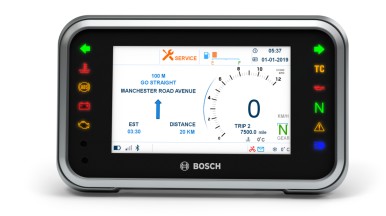
Stuttgart, Germany – When riding a motorcycle, having the right information at the right time can sometimes be a lifesaver. But while riders have to be constantly aware of their speed and vehicle information, they must not take their eyes off the road. With both the new the TFT Cluster 5” and Connectivity Cluster 5” from Bosch, riders can see all the information they need at a glance. Motorcyclists should be able to enjoy the ride while having all the information they need at a glance. We also want to give our customers the freedom to customize our products. With the TFT Cluster 5”, we’ve found the right way to do this...says Geoff Liersch, head of the Two-Wheeler & Powersports unit at Bosch. TFT Cluster 5”: optimum readability, compact design Because the Bosch TFT Cluster 5” is freely programmable, manufacturers are completely at liberty to tailor it to their design and handling specifics. Customers can also install the five-inch display in the more confined space available in various vehicle segments. And this is something they appreciate: Suzuki has opted for Bosch’s new TFT Cluster 5” in the new generation of its V-STROM 1050/1050DE, which it is launching worldwide. “Motorcyclists should be able to enjoy the ride while having all the information they need at a glance. We also want to give our customers the freedom to customize our products. With the TFT Cluster 5”, we’ve found the right way to do this,” says Geoff Liersch, head of the Two-Wheeler & Powersports unit at Bosch. The new Suzuki V-STROM 1050/1050DE featuring the Bosch TFT Cluster 5” will get available in the market in January 2023. The bright display of this variant, without Bluetooth and networking option, means readability is good in all weather conditions. Connectivity Cluster 5”: connected companion for every tour By adding connectivity functions to the TFT Cluster 5”, Bosch has created the Connectivity Cluster 5”. In the past, motorcyclists often had to use a second display – and attach it to the vehicle using a separate mount – so that they could look ahead and use navigation information. This is where the Bosch Connectivity Cluster 5” can help: by connecting their smartphone to the Connectivity Cluster 5”, riders can access functions such as navigation, music, and telephony. At the same time, the cluster displays important information such as warning messages or current speed. As a leading supplier of motorcycle safety systems, Bosch has sought for years to make motorcycles first and foremost safer, but also comfortable – without diminishing riding enjoyment. Connectivity plays an important role here: not only between rider and motorcycle, but also between the vehicle and its surroundings. Motorcycle displays form the interface between general riding information and the ability to display and control advanced vehicle functions such as rider assistance systems. Bosch motorcycle displays: safety across the board From electric motorcycles to e-scooters to powersports vehicles such as all-terrain vehicles (ATVs): Bosch’s five-inch TFT Cluster and Connectivity Cluster can be integrated into various vehicle types. These units can also display all the extra information the riders of electric vehicles need, such as battery level and remaining riding range. Bosch began large-scale production of its motorcycle displays in 2017. Pictures of the TFT Cluster 5” in the new Suzuki V-STROM 1050/1050DE can be downloaded here: https://www.globalsuzuki.com/globalnews/2022/0905.html

Bosch at CES 2022: smart technology to make everyday life safe, convenient, and  ...

13.12.2021

Press release

Smart Home

Bosch at CES 2022: smart technology to make everyday life safe, convenient, and ...

Stuttgart, Germany, and Las Vegas, NV – Technology for all walks of life: at CES in Las Vegas, Bosch will be presenting connected, smart, and sustainable products and services for a better life – at home and on the road. From January 4 through 7, 2022, you will find Bosch at CES in the Central Hall, Booth #16103.CES Innovation Awards: Honoree for smart connected biking solution For its smart connected biking solution, Bosch eBike Systems has been named a CES® 2022 Innovation Award honoree in the “Vehicle Intelligence & Transportation” category. The CES® Innovation Awards are given by the Consumer Technology Association (CTA). Smart connected biking solution – e-bike riding enjoyment 2.0: The new systems generation from Bosch eBike Systems merges the physical experience of riding an e-bike with the digital experience provided by connectivity and an app. This smart system comprises the new eBike Flow app, an LED user interface, color display, rechargeable battery, and drive unit. Over-the-air updates mean it can be continuously enhanced. The eBike Flow app opens up a range of new digital features for e-bikes, such as automatic activity tracking and personalized riding modes. Whether on the daily commute or a leisurely ride, the result is more enjoyment over longer distances. A Bosch must-see Bosch show car: The future of mobility is automated, connected, electrified, and personalized. In the future, more and more vehicles will be electrically powered. They will increasingly be connected with other road users and their surroundings, and provide personalized, cloud-based services for their occupants such as wrong-way driver alerts or road condition updates. The show car will demonstrate Bosch systems expertise and extensive know-how in software and hardware. For example, Bosch is developing central computers for the electronics architecture of the future. These vehicle computers will be used for assisted and automated driving, controlling vehicle motion, as well as for cockpit functions and body electronics. Over-the-air updates will keep cars’ functions constantly up to date. Virtual visor – the transparent digital sun visor: Conventional sun visors shield car drivers from dazzling light. But folding them down often also blocks significant areas of a driver’s field of vision. Bosch has solved this problem with a new, transparent LCD solution that replaces opaque visors. The virtual visor is connected to the interior monitoring camera, which detects the position of the driver’s eyes. Using AI-based intelligent algorithms, the virtual visor analyzes this information and darkens only the portion of the windshield through which the sun or other light sources would dazzle the driver. The rest remains transparent, leaving the driver’s view of the road unobstructed. SoundSee – intelligent ears for the ISS: Although barely bigger than a lunch box, Bosch’s SoundSee is brimming with start-of-the-art artificial intelligence (AI). SoundSee can be found on the ISS (international space station). Installed on board Astrobee, NASA’s autonomous free-flying robot, SoundSee’s integrated microphones pick up ambient noise in space. Using AI, the Bosch technology then analyzes the audio data in order to detect potential anomalies and to flag areas requiring maintenance work. SoundSee was developed together with Astrobotic as part of a NASA research partnership. Software-based solutions for the mobility of today and tomorrow Solutions for the software-defined vehicle: Software is playing an increasingly central role in automotive engineering. After all, future connectivity, automation, and personalization functions will more than ever be brought about by software. Even now, Bosch annually puts more than 200 million control units running its proprietary software into vehicles worldwide. To achieve this, the company can draw on profound software, electronics, and systems expertise, and use this to develop application-specific vehicle software and the hardware to match for automotive applications of all kinds, from driver assistance and infotainment to the powertrain. Bosch plans to pool the development of application-independent basic software and middleware, as well as cloud-based software modules for over-the-air software updates, at its wholly owned subsidiary ETAS. Advanced driving module – pre-integrated components for electric cars: To make the development of electric cars less complex, and thus improve efficiency for automakers, Bosch offers pre-integrated modules such as its ADM advanced driving module. The ADM combines powertrain, brakes, and steering to form an integrated unit that automakers can incorporate faster and more cost-effectively into their vehicles. In addition, simplified interfaces and a standard software architecture ensure the best possible communication between the components, and provide the basis for new features. TPA technician process assistant – a digital handyman: The TPA technician process assistant is part of a connected after-sales ecosystem in which humans and machines exchange data as needed to efficiently repair and maintain vehicles. The system, which is continuously learning and evolving, is a hands-free, platform-agnostic solution that works with tablet, PC, and wearables. With the help of AI, moreover, a knowledge base has been created on the basis of information taken from traditional servicing operations. If more expertise is needed, a connection can be set up between an expert and the “eyes and ears” of the technician working on the vehicle. This helps improve accuracy and efficiency when servicing and repairing today’s ever more complex vehicles. Nevonex – connecting agriculture: Agriculture currently faces the challenge of securing food production in a changing climate. Here, Nevonex can help farmers by providing the necessary expert knowledge in the form of digitalized services. Nevonex allows these third-party services to be used in all makes of agricultural machinery – for example, to automate machine settings or optimize crop-planting processes. Bosch’s research here focuses on harnessing data from these processes to optimize subsequent process steps. The aim is to use edge computing to make robust, AI-based services available for farmers. A breath of fresh air – Bosch solution for better urban air quality: To improve air quality in cities, at airports and train stations, and in business parks, Bosch offers innovative solutions that precisely record and simulate emissions. Bosch air-quality monitors provide precise readings for nitrogen oxides, particulates, humidity, and temperature – in other words, important information for gauging local air quality. The data is then uploaded to the cloud and evaluated. Knowing precisely what pollutants are in the air, where they are, and where they are spreading to allows countermeasures to be taken quickly, for better air at all times. Smart solutions that improve convenience and security in the home Bosch heating and cooling solutions for a perfect climate in the home: Thanks to state-of-the-art inverter technology, the highly efficient Climate 5000 3.0 ductless mini-split air-source heat-pump system offers ample heating and cooling capacity. This heat pump is suitable for most residential buildings due to its ability to heat efficiently, even in frigid outdoor temperatures. The Climate 5000 3.0 features improved energy efficiency and humidity control, creating a comfortable indoor climate. In addition, its built-in air filtration system purifies the air and reduces volatile organic compounds (VOCs) and other harmful gases and odors. Bosch is also launching the Inverter Ducted Split (IDS) Premium Connected heat-pump system on the market. This solution offers high efficiency and particularly innovative connected features. Using a wireless internet connection and an IoT platform means that installers and homeowners can register it in the app. It also makes installation and troubleshooting easy. With the EasyAir app, installers and homeowners can access data remotely, allowing them to monitor energy consumption and appliance status. Connected thermostats – smart and simple heating control: With its BCC50 and BCC100 connected thermostats, Bosch offers a simple and smart all-in-one control for heating, air-conditioning, and ventilation systems. Users can program their own heating and cooling schedules, for example. The controls are set directly on the thermostat, by using the Bosch Connected Control app, or by voice command. Intelligent oven – cooking with a voice assistant: What temperature? Direct heat or steam? Finding the right setting can be tricky. But whether it’s a quick supper or fine dining, an intelligent Bosch oven will do the trick. The voice assistant Alexa is standing by with advice, and will not only recommend the best oven setting, but also switch the oven on if required – all you have to do is ask. Recipes inspired by a digital look inside the fridge: No idea what to eat? Fridge always full of leftovers? That’s now a thing of the past. Now food can be entered into a digital fridge inventory – manually, by synchronizing with the Home Connect shopping list, or via a camera in the fridge. The Home Connect app will then know exactly what’s in the fridge and provide recipe ideas based on the provisions available. A surefire recipe for new ways to treat your taste buds, as well as for less food waste. Bosch Cookit – all-around culinary talent: Cookit offers a whole new dimension of flexibility in the kitchen. Whether guided cooking, automatic programs, or manual cooking, the multifunctional food processor with cooking function has the right level of support for everyone. And now it has become even more flexible: the new “My Recipe” function allows Cookit to save personal recipes. The recipe, with all ingredients, quantities, temperatures, and special tips, is entered in the Home Connect app, which then relays it to the Cookit. The food processor with cooking function will then guide the user through the preparation steps as often as required. Bosch sensors – unshakeable, untiring, and incredibly flexible BME688 – monitors air quality and protects forests: Whether at home, in the office, or outdoors – to satisfy the need for clean air, Bosch Sensortec has developed the BME688. This innovative MEMS sensor is the world’s most compact four-in-one air-quality sensor featuring artificial intelligence, and is capable of measuring gas, humidity, temperature, and atmospheric pressure simultaneously. It is suitable for a range of applications, such as sending a warning when foodstuffs expire or the early detection of forest fires. In collaboration with Dryad Networks, BME688 sensors have been combined with an IoT network to detect forest fires early. Fewer forest fires mean significantly lower CO 2 emissions. In this way, Bosch is helping to mitigate global warming. BHI260AP – revolutionizing fitness tracking: Squats, sit-ups, kettlebell training: the list of fitness exercises is nearly endless. However, many fitness trackers and smart watches can track only a limited number of activities, and the variety of apparatus types as well as users’ different movement styles, physiques, and fitness levels mean that they cannot always reliably recognize the exercises being done. To solve this problem, Bosch Sensortec has developed the BHI260AP – a novel, self-learning motion sensor that gives wearables and hearables artificial intelligence. The sensor recognizes and responds automatically to many different movements and can learn any new fitness activity based on regularly repeated routines. BMP384 – resistant to water, chemicals, and dust: Wearables, home appliances, and industrial applications often have to cope with tough conditions. Up to now, however, many barometric pressure sensors have not been very robust or resistant to fluids, and therefore could not always be installed in watertight products. With Bosch Sensortec’s BMP384, it’s a different story. This barometric pressure sensor is as compact as it is robust. At CES, Bosch Sensortec is also debuting a new ultra-precise pressure sensor that can also be used for indoor navigation and location. Bosch IoT solutions for the connected city and for more data security From a single source – application store for video analytic apps: The world’s first open application store for video analytics apps allows surveillance cameras to be flexibly equipped with new AI-assisted functions. In just a few minutes, applications for detecting things such as face masks, smoke, fire, and flooding or for evaluating flows of traffic and visitors can be installed on compatible cameras. Developed by the Bosch subsidiary Azena, more than 100 apps are already available for more than 40 use cases – with new ones joining them every month. Smart video cameras for greater road safety: Thanks to a new deep-learning video analytic software, the new Inteox cameras with object classification can be used in areas such as traffic monitoring. Even in heavy traffic, they can recognize precise details of vehicles faster. AI helps to detect unforeseen, undesired, or future situations more quickly, more intuitively, and more reliably. Using artificial intelligence to ward off hackers: The Bosch AI shield protects AI systems against external attacks. It performs the vulnerability analysis of AI systems and then creates an AI-assisted defense mechanism to provide protection. The solution comprises a SaaS (software as a service) tool and user interface which has been designed to help developers use and help organizations to scale it for a variety of AI systems. The Bosch AI shield defends AI systems in Cloud and IoT devices and protects IP, brands, and investments, thus creating trust in digitalization.


Bosch turns connected devices into personal guardian angels

10.03.2021

Press release

Connected mobility

Bosch turns connected devices into personal guardian angels

Stuttgart, Germany – One careless moment is all it takes for someone to crash their e-bike or lose control of their motorcycle. In Germany alone, more than 38 two-wheelers are seriously injured in accidents every day (source: Federal Statistical Office). That’s when every second counts. But what if the person involved is traveling alone when the accident happens or if they are no longer in a position to call for help? This is where Bosch’s connected emergency call solution comes in. Help Connect accesses the sensors in the user’s smartphone and other connected devices and uses an intelligent crash algorithm to automatically detect accidents. In the event of an emergency, the app alerts the emergency services via the Help Connect emergency call center and immediately directs them to the scene of the accident. This saves time, and potentially also lives. Two apps are now available for cyclists and motorcyclists and thus for several hundred thousand users: the COBI.Bike app from Bosch eBike Systems and the calimoto app for motorcycle navigation. “Bosch is working flat out to integrate its emergency call solution into other products, including those of partners. We are leveraging the internet of things and algorithms and using Help Connect to turn connected devices into personal lifesavers in all circumstances – whether on the road, during sports, or at home,” says Bosch CEO Dr. Volkmar Denner. Bosch currently provides the Help Connect service for users with a German SIM card in eleven European countries¹. Bosch is working flat out to integrate its emergency call solution into other products, including those of partners. We are leveraging the internet of things and algorithms and using Help Connect to turn connected devices into personal lifesavers in all circumstances – whether on the road, during sports, or at home....Bosch CEO Dr. Volkmar Denner One solution – triple benefit Help Connect combines automatic accident detection, emergency call function, and personal emergency response system. In COBI.Bike and calimoto, for example, the crash algorithm evaluates smartphone sensor data about speed, acceleration, and rotation. Most of the smartphones commercially available today feature such sensors. The apps must be activated during the journey and the device must be attached to the handlebars. Help Connect works on all Android devices with version 6 or higher and all iOS smartphones with version 11 or higher. In the event of an accident, the solution uses the smartphone’s mobile data connection to transmit the current location, the severity of the impact and, depending on the app, optionally stored health data to a Help Connect 24/7 emergency call center. From the call center, specially trained emergency agents attempt to make contact with the person involved in the accident. Communication takes place in German or English, even in other European countries. If the person does not react and the sensor data indicate a serious fall, the emergency services are notified immediately. Likewise, relatives and friends are optionally informed. An emergency call can also be triggered manually at any time. For motorcyclists, Bosch has also developed an accident detection that is permanently installed in the vehicle. Here, Help Connect uses the inertial measurement unit integrated into the Bosch motorcycle stability control (MSC). Via Bluetooth, it connects to the corresponding partner app and then transmits the data to the Help Connect emergency call center, just as with the smartphone-based solution. More partners – additional applications Bosch wants to make life safer and is integrating its emergency call solution into as many connected products as possible – its own or those of partners. “Help Connect is designed as an open IoT ecosystem so that different products with appropriate sensor technology can become personal guardian angels,” Denner says. For example, the startup company Tocsen is currently integrating Help Connect into its crash helmet sensor solution. Bosch is also preparing its own smart home services and products to integrate into the Help Connect service. In addition to fire and burglar alarms, this will also include the topic of water protection in the home in the future. ¹Apart from Germany, it is available in Austria, Belgium, France, Italy, Ireland, Luxembourg, the Netherlands, Spain, Switzerland, and the United Kingdom.