Search & find:
Media, press releases, events for your editorial coverage

Bosch Pensionsfonds celebrates triple victory at IPE Awards

11.12.2025

Press release

Working at Bosch

Bosch Pensionsfonds celebrates triple victory at IPE Awards

The Bosch Pensionsfonds received three top-tier European awards yesterday evening at the “Investment and Pensions Europe” (IPE) conference in Seville. It convinced the jury as the best German pension fund, the best corporate pension fund in Europe, and in the “Portfolio Construction & Diversification” category. Dirk Jargstorff, CEO of Bosch Pensionsfonds AG, stated: “This recognition from Investment & Pensions Europe fills us with great pride and is a testament to the innovative work and dedication of our entire team. In particular, the seventh award as “Best Corporate Pension Fund Europe” underscores that our pension fund sets standards not only in Germany but across Europe. This motivates us to continue ensuring the best possible pension provision for our associates and to continuously develop our system.” The Bosch Pensionsfonds was honored for the sixth consecutive time and for the 13th time overall in the “Best Pension Fund Germany” category, confirming its leading role in the German market. Furthermore, its expertise in strategic capital investment was recognized: For the second time, the pension fund convinced in the Europe-wide “Portfolio Construction & Diversification” category, highlighting its advanced and robust investment approaches. Since its foundation in 2001, the Bosch Pensionsfonds has written a remarkable success story thanks to its innovative strength and successful investment strategy, having received 33 European awards to date. The Bosch Vorsorgeplan With the Bosch Vorsorgeplan, Bosch offers its employees an attractive pension plan based on one of the most modern pension systems in Germany. In addition, employees and their families are already covered during their working life in the event of disability or death. Bosch builds up a pension fund with company contributions for the employees and bears the costs for this. The employees have the opportunity to further increase this pension credit through their own contributions. All contributions are based on the investment result of the Bosch Pensionsfonds. The contributions are guaranteed by the company as a minimum benefit in old age. In retirement, the balance is available as an additional income with flexible payout options. The Bosch Pensionsfonds The Bosch Pensionsfonds, in which contributions from the company and employees are paid, is at the heart of the financing of the Bosch Vorsorgeplan. It is the first company-owned pension fund in German industry and the largest in Germany. The investment strategy is long-term oriented and is characterized by a broad mix and diversification of the capital investment. What is special about this is that the performance of the capital investment benefits exclusively employees at low administrative costs, as the Bosch Pensionsfonds has no intention of making a profit.

Background information: Bosch company retirement scheme in Germany

18.12.2024

Press release

Working at Bosch

Background information: Bosch company retirement scheme in Germany

Bosch has a long tradition of occupational pensions. At the end of the 1920s, company founder Robert Bosch was one of the first entrepreneurs to introduce a pension scheme for his associates. In addition to providing for retirement, he found it important to safeguard against existential risks such as disability and premature death, given the low general life expectancy at the time. With increasing life expectancy, the financial situation in retirement has increasingly become the focus of pension benefits. Bosch offers its associates a company retirement scheme as an important supplement to state pension and uses considerable financial resources for this purpose. Further more, associates can increase their retirement benefits through additional contributions of their own. In doing so, Bosch is making use of the possibilities created by the legislature for the tax-exempt use of gross remuneration for company retirement schemes ("deferred compensation"). In addition, Bosch also provides benefits for associates and their families in the event of disability or death. After around 100 years of commitment to company retirement schemes, Bosch is still regarded as an innovative pioneer in industry circles. The company contributes in many ways to the further development of company retirement schemes and thus makes a social contribution to old-age provision in Germany. The Bosch Vorsorge Plan The Bosch Vorsorge Plan, Bosch’s retirement scheme in Germany, builds up individual assets for associates during their period of employment. Bosch pays company contributions, which result from a percentage of the earnings. In addition, there are further contributions in the tariff area (AVWL) and for other entitled persons. Within the scope of the statutory limits, Bosch is supporting contributions from associates who pay deferred compensation with a surcharge of 15 percent. Flexible for every life situation When retiring, the Bosch Vorsorge Plan offers several models for the payment of the accumulated assets. The money can be paid out in the form of a monthly pension until the end of life with survivor’s pension entitlement, as a one-time payment or partially in installments, and as a combination of these options. Bosch associates can thus shape their own payments according to their life situation when they retire. Transparent and personalized Transparent information on the Bosch pension plan is provided by a separate web portal that is accessible from the Bosch network and available on the Internet with password protection. It provides a wide range of general and individual information on the Bosch Vorsorge Plan and gives insight into the individual retirement assets. A benefits calculator supports the associates to adapt the contributions to personal needs at any time. Multiple awards The Bosch Pensionsfonds, in which contributions from the company and associates are paid, is at the heart of financing the Bosch Vorsorge Plan. It is the first company-owned pension fund in the German industry. The performance of the capital investment only benefits associates. The Bosch Pensionsfonds has no intention of making a profit and therefore provides low administrative costs. The strategy is long-term oriented with a broad mix and diversification of the capital investment. Until age 55 of the associate, the company and associate contributions are invested in an opportunity-oriented way. Thereafter the funds are transferred to a value-stabilizing investment in five annual steps. The investment risk is being reduced by a broadly diversified and long-term investment strategy as well as by the guarantee of the contributions paid by the company. So far, this concept has achieved an average return of around six percent in the investment segment up to age 55 and a return of almost four percent in the investment segment over age 55. With the Fondsrente, beneficiaries also participate in the ongoing performance of the Bosch Pensionsfonds. Since its foundation in 2001, the Bosch Pensionsfonds has received 30 professional and industry awards at European level, mainly due to its innovative strength and its successful investment strategy.

Bosch Pensionsfonds wins awards

18.12.2024

Press release

Working at Bosch

Bosch Pensionsfonds wins awards

The Bosch Pensionsfonds was awarded three times at the conference of the European press service "Investment and Pensions Europe" (IPE) on Tuesday evening. He convinced as the best German pension fund, with the best defined contribution and hybrid pension strategy in Europe and as the best pension fund of a European company. Dirk Jargstorff, CEO of Bosch Pensionsfonds AG, accepted the awards in Prague: "We are proud that our pension fund has been awarded again, in particular as the best corporate pension fund in Europe. This underlines our valuable contribution to the financial security of our employees in Germany in retirement." Since its foundation in 2001, the Bosch Pensionsfonds has received 30 professional and industry awards at European level, mainly due to its innovative strength and its successful investment strategy. The Bosch Pensionsfonds became Best Corporate Pension Fund Europe for the sixth time. Bosch won the Best Pension Fund Germany award for the twelfth time in total and was awarded Best DC & Hybrid Strategies Europe for the fifth time. The Bosch Vorsorge Plan With the Bosch Vorsorge Plan, Bosch offers its employees an attractive pension plan based on one of the most modern pension systems in Germany. In addition, employees and their families are already covered during their working life in the event of disability or death. Bosch builds up a pension fund with company contributions for the employees and bears the costs for this. The employees have the opportunity to further increase this pension credit through their own contributions. All contributions are based on the investment result of the Bosch Pensionsfonds. The contributions are guaranteed by the company as a minimum benefit in old age. In retirement, the balance is available as an additional income with flexible payout options. The Bosch Pensionsfonds The Bosch Pensionsfonds, in which contributions from the company and employees are paid, is at the heart of the financing of the Bosch Vorsorge Plan. It is the first company-owned pension fund in German industry. The investment strategy is long-term oriented and is characterized by a broad mix and diversification of the capital investment. What is special about this is that the performance of the capital investment benefits exclusively employees at low administrative costs, as the Bosch Pensionsfonds has no intention of making a profit.

Training campaign: Bosch trains over 130,000 associates in technologies of the future

13.09.2023

Press release

Industry 4.0

Training campaign: Bosch trains over 130,000 associates in technologies of the future

Stuttgart, Germany – It’s something that affects nearly every company. An aging society and labor shortages are social trends that are shaping the 21st century. “Bosch is facing up to these challenges as a committed employer: we’re focusing on training and upskilling as well as on intelligent technology that makes associates’ work easier,” says Stefan Grosch, member of the Bosch board of management and director of industrial relations. In 2022, the company offered more than 30,000 training seminars worldwide, with more than 520,000 Bosch associates taking part. One focus was technological expertise. More than 130,000 participants were able to acquire knowledge in technologies of the future such as electromobility, software engineering, and Industry 4.0. “Looking at the metrics for the first half of the year, we expect to train around 50 percent more Bosch participants in 2023 than we did the year before,” Grosch says. This commitment to training does not end at the company’s own factory gates. With academies, training centers, and training courses, Bosch also offers other companies, customers, and interested parties the opportunity to acquire knowledge. On the subject of Industry 4.0, for example, the company makes more than 100 Bosch training programs on digitalization and connectivity in manufacturing available externally through Bosch Connected Industry, Bosch Rexroth, and training institutes. Bosch is facing up to these challenges as a committed employer: we’re focusing on training and upskilling as well as on intelligent technology that makes associates’ work easier,...says Stefan Grosch, member of the Bosch board of management and director of industrial relations. Training: nurturing individual talent for collective success According to the European Commission, three-quarters of companies in the EU report difficulties in finding qualified workers, and only 37 percent of adults engage in regular further professional development (source: European Commission, 2022 ). “Bosch promotes lifelong learning. This is the key to lasting professional and business success,” Grosch says. It is also essential for a country’s economic output. "If we want to maintain prosperity in Germany and remain successful as an exporting and industrial nation, we must invest even more in upskilling and intelligent technology and actively encourage people to enroll,” Grosch says. Bosch offers all associates the opportunity for professional development. In 2022, Bosch associates attended one to two training courses on average; in addition, they completed two to three web-based courses. Roughly 6,000 seminars deal with technologies of the future. Lasting an average of two days, these seminars are particularly thorough. Digitalization often determines not only the topic and content of training courses, but also their form: in 2022, online courses accounted for two-thirds of all training hours for Bosch associates. “Digitalization is becoming a training booster for companies and their workforce; it enables learning independent of place and time and gives people a chance to experience new technologies such as artificial intelligence firsthand,” says Bosch CDO and member of the board of management Dr. Tanja Rückert. Last year alone, Bosch spent some 300 million euros on professional development for its associates. “At Bosch, we develop technology that is ‘Invented for life.’ To do that, we need the right team with talented people in all positions, and we need them to continuously improve and expand their skills,” Grosch says. Digitalization is becoming a training booster for companies and their workforce; it enables learning independent of place and time and gives people a chance to experience new technologies such as artificial intelligence firsthand,...says Bosch CDO and member of the board of management Dr. Tanja Rückert. Upskilling: Bosch focuses on the industrial base The labor shortage comes at a cost. The Boston Consulting Group estimates the loss in potential output for the German economy to be 86 billion euros. The German Chamber of Commerce and Industry puts it even higher, at just under 100 billion euros – annually (source: DIHK, 2023 ). In an international comparison of the nations with the strongest economies, the losses suffered by the German economy are the second highest after the United States. “In the competition for the best talent, companies have to put everything on the line. A future-oriented corporate approach also means identifying vocational training and professional development opportunities and offering them to the workforce. Having highly qualified personnel is a decisive competitive advantage,” Grosch says. As a manufacturer and technology company, Bosch pays close attention to professional development for its associates in manufacturing operations. This year, for example, its mobility business launched the LernWerk initiative to train 24,000 associates in readiness for the digital transformation, initially at German sites. “Manufacturing is where value creation begins in our company. This is where we lay the foundation for business success. Our progressive and efficient manufacturing operations feature an impressive degree of connectivity and digitalization. One important prerequisite for this is ensuring associates receive the necessary training,” Rückert says. Transfer: Bosch provides knowledge and training systems As part of Bosch’s training program for other companies, its Industry 4.0 courses are additionally offered in Germany and elsewhere through partners such as chambers of industry and commerce, colleges, and universities: “From France and the Czech Republic to China, India, and Singapore, companies are training their manufacturing workers according to the German model. Bosch is one of the Industry 4.0 pioneers, and we are sharing our knowledge all around the world. Industry 4.0 training ‘made in Germany’ is becoming the global standard,” Rückert says. In addition to vocational training and professional development programs, Bosch develops training systems that are compatible with the syllabuses of industrial and educational institutions. Bosch Rexroth is launching its new Automax 600 training system. Using internationally standardized programming languages and open interfaces, this gives users practical experience of the digitalization of production processes – including controlling robotic systems, operating autonomous transport systems, and using cloud applications such as data analysis and machine learning based on artificial intelligence. Automation: Bosch technology makes work easier There are various remedies for labor shortages. One is vocational training and professional development, and visa programs for skilled workers are another. And technology also has a key role to play. Bosch Rexroth, for example, has developed an automation solution that no longer requires any previous specialist knowledge of automation. Users of ctrlX Automation can choose from over 30 popular programming languages. The company is taking a similar approach to hydraulics: In the future, customers can use H4U to integrate Bosch Rexroth software into the automation architecture they are already familiar with, eliminating the need to build up their own hydraulics expertise. “By opening up systems, making technology interoperable, and moving hardware applications into software, we reduce complexity and dependencies, such as on specialists,” Rückert says. Moreover, technology makes life easier for workers whose tasks are monotonous, strenuous, or hazardous. Robotics supports loading and palletizing, artificial intelligence helps with the optical inspection of workpieces, augmented reality guides through work processes, and driverless transport systems take goods directly to where they are needed. “Only by increasing productivity can we manage the impact of an aging society. This calls for well-trained specialists, as well as technology that allows them to work rationally and efficiently. The interplay between humans and machines and between training and digitalization is a key success factor,” Grosch says.

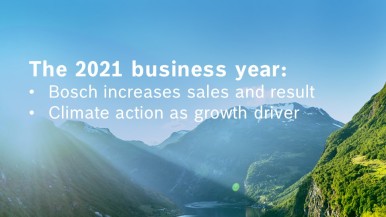
The 2021 business year: Bosch increases sales and result - company exceeds forecasts

09.02.2022

Press release

Business/economy

The 2021 business year: Bosch increases sales and result - company exceeds forecasts

Stuttgart, Germany – The Bosch Group increased its sales and result significantly in 2021. According to preliminary figures 1 , total sales rose 10 percent to 78.8 billion euros. After adjusting for exchange-rate effects, sales growth at the supplier of technology and services was 11 percent. Earnings before interest and taxes (EBIT) from operations increased by more than half to reach 3.2 billion euros. The EBIT margin from operations is therefore expected to be around 4 percent, compared with 2.8 percent in the previous year. “Our business performed much better in 2021 than expected,” said Dr. Stefan Hartung , chairman of the board of management of Robert Bosch GmbH, at the presentation of the company’s preliminary business figures. “We were able to exceed our forecasts despite many challenges, such as cost burdens due to supply bottlenecks and price increases for raw materials.” Business success was also significantly shaped by “solidarity in times of social distancing,” as he put it. “I would like to thank our associates for their commitment, and our customers, suppliers, and business partners for their trust,” Hartung said, adding that, together with the global Bosch team, he wanted to continue developing technology that is “Invented for life” as a response to current challenges. “Bosch is a technological pioneer in many areas, and we want to keep it that way.” To this end, the company is continuing to invest large sums in strategically important fields, including a total of around 1 billion euros in microelectronics and electromobility this year alone. At the same time, Bosch is increasingly focusing on partnerships, such as the recently announced alliance with Volkswagen in the field of automated driving. The Bosch chairman also expects the efforts of many countries to move toward a climate-neutral economy to significantly stimulate growth in the future: “Climate action is driving our business forward – from mobility solutions and industrial automation to building technology and home appliances,” Hartung said. “And thanks to connectivity and artificial intelligence, energy efficiency will continue to improve.” In this vein, Bosch was able to increase its sales of connected power tools, home appliances, and heating systems by 50 percent in 2021 – from 4 million units in 2020 to more than 6 million. 1 Based on internal reporting.Bosch is stepping up its climate action – growth through electrification Bosch is committed to the goals of the EU’s Green Deal. Its business sectors are already implementing a broad range of measures to combat global warming: With its 400 locations worldwide, Bosch has been climate neutral since the first quarter of 2020. Between now and 2030, the company plans to cut carbon emissions along its supply chain – from purchasing to product use – by 15 percent. According to the Bosch chairman, electrification is already giving rise to more and more business. “We are generating billions in sales with electromobility. We’re also growing at double-digit rates with heat pumps for the home, and electrical drives are making inroads in industrial technology,” Hartung said. He believes this puts the company in a strong position: “Bosch is translating climate action into growth.” The company is demonstrating how the transformation to climate neutrality can succeed both ecologically and economically, he said. Sustainable mobility – growth from automotive and industrial technology Bosch is also tapping further growth potential in electromobility. Since the end of 2021, the company has been manufacturing power semiconductors made of silicon carbide (SiC) , which can extend the range of electric vehicles by up to 6 percent. According to the market research company Yole, the SiC market as a whole will grow on average by 30 percent a year to over 2.5 billion dollars over the next three years. Dr. Robert Habeck, the German Federal Minister of Economic Affairs and Climate Action, recently visited Bosch’s Bamberg site to find out more about the mass production of the stationary fuel cell (solid-oxide fuel cell, SOFC). With its SOFC technology, Bosch is playing a role in the transition to renewable energy while opening up new business opportunities. By 2024, the company plans to invest more than 400 million euros in SOFC technology and a further 600 million euros in mobile fuel cells. Bosch has also entered the factory equipment business for battery production. This business has potential: according to the company, the global battery market is growing by up to 25 percent annually. Together with Volkswagen, Bosch is looking into jointly making battery cell production processes ready for volume production. Hartung said: “Our common goal is for a European supplier to be the cost and technology leader in the volume production of battery technology.” Experts see the joint plans as an important step on the road to climate-neutral mobility and the mass production of sustainable batteries. Software-dominated mobility – double-digit growth in a market worth billions Bosch also intends to achieve growth and expand its position in software development for vehicles. The Mobility Solutions business sector already equips vehicles worldwide with more than 200 million control units running its proprietary software each year. The company expects the market for automotive software to reach a volume of some 200 billion euros by 2030. “Bosch will see double-digit growth in this market,” said Dr. Markus Heyn , the new chairman of the Mobility Solutions business sector and member of the board of management of Robert Bosch GmbH. “Here we will benefit in no small part from the evolution of the car into an internet node.” According to Heyn, Bosch has already set the strategic course for this. The company’s portfolio of application-independent vehicle software will be brought together in its ETAS subsidiary in mid-2022. ETAS will offer basic vehicle software, middleware, cloud services, and development tools for universal application. In addition, Bosch’s new Cross-Domain Computing Solutions division will create application-specific vehicle software with special hardware for functions such as driver assistance and automated driving. In this field, Bosch entered into a wide-ranging alliance with Cariad, Volkswagen’s software subsidiary, at the end of January 2022. “Our goal is to accelerate the process of making partially and highly automated driving in everyday vehicles a reality,” Heyn said. “We want to set standards for the market that will benefit other automakers.” Transforming the industrial workplace – a billion euros earmarked for training The path toward a climate-neutral economy is also one that Bosch wants to help forge as an employer. “With many industries undergoing a transformation, Bosch sees an opportunity to rethink employment,” said Filiz Albrecht , member of the board of management and director of industrial relations at Robert Bosch GmbH. To support people as they move from one kind of work to another, it is increasingly important for employers to “make prospects for new employment visible outside their own company as well.” That’s why in Germany, Bosch is contributing its broad experience to Allianz der Chancen , a cross-industry initiative concerned with the transformation of the working world. “We believe we can make this change socially acceptable,” Albrecht said. To that end, the company is also pursuing new approaches to associate placement and qualification. Furthermore, Bosch is continually investing in upskilling its workforce – more than a billion euros over the past five years. Another way the company is driving change in the world of work is with hybrid collaboration models. “With our ‘Smart Work’ initiative, we are systematically shaping the interplay between working remotely and working on site. Together with their supervisors, teams determine the flexible arrangement of when and where they work for themselves,” Albrecht said. Determining their time and place of work is especially important for software developers, and, as Albrecht says, the need for these professionals is great: “In the Cross-Domain Computing Solutions division in Germany alone, we currently have more than 1,000 vacancies for software experts.” Business development in 2021 – all business sectors increased sales Not only did the Bosch Group’s total sales grow year on year, but they are also higher than in 2019, the year before the crisis. “The company’s broad diversification across different industries and regions paid off once again,” said Dr. Markus Forschner , member of the board of management and chief financial officer of Robert Bosch GmbH. “All business sectors increased their sales despite global supply bottlenecks.” The Mobility Solutions business sector, which is the largest and generates the highest sales, recorded significant growth, even though the business environment in the fourth quarter put a brake on developments. Sales rose 7.5 percent to 45.4 billion euros despite the chip shortage, which had a particularly major impact on the automotive industry. Adjusted for exchange-rate effects, this is an increase of 7.9 percent. The Industrial Technology business sector benefited particularly from the recovery in the mechanical engineering market and achieved sales of 6.1 billion euros. This is an increase of 20 percent, both in nominal terms and after adjusting for exchange-rate effects. As the CFO pointed out, this meant that sales returned to their pre-crisis level. In the Consumer Goods business sector, products for the home and garden were once again in strong demand. At 21 billion euros, sales were significantly above the previous year’s level. This is a rise of 13 percent; adjusted for exchange-rate effects, it is 15 percent. Sales in the Energy and Building Technology business sector rose 11 percent to 5.9 billion euros – growth of 12 percent after adjusting for exchange-rate effects. To quote Forschner, “The business benefited from strong demand for climate-friendly heating technology, with the business sector actually exceeding its pre-crisis level.” Business development in 2021 – sales growth in all regions “Regionally as well, Bosch sales grew across the board,” Forschner said. In Europe , sales grew by 9.3 percent to 41.5 billion euros. After adjusting for exchange-rate effects, this is an increase of 10 percent. In North America , sales came to 11.5 billion euros. The increase in sales of 6.5 percent becomes 10 percent after adjusting for exchange-rate effects. In South America , sales rose to 1.4 billion euros – an increase of 32 percent, or 41 percent after adjusting for exchange-rate effects. “This is a very positive development, especially since the region was hit particularly hard by the coronavirus pandemic the previous year,” Forschner explained. In Asia Pacific , sales grew by 12 percent to 24.4 billion euros – 11 percent after adjusting for exchange-rate effects. Headcount development in 2021 – slight increase worldwide As of December 31, 2021, the Bosch Group employs some 401,300 associates worldwide. Most of this increase of some 6,700 related to Asia Pacific and Europe; the number of associates in Germany remained stable at around 131,400. In research and development, the number of associates rose by just under 4 percent to 76,300. The number of software developers worldwide was more than 38,000 – an increase of some 4,000 over the previous year. Outlook for 2022 – global economy beset by uncertainty Bosch expects the global economy to grow between 4 and 4.5 percent in 2022, as against some 5.5 percent in 2021. Despite impressive progress made with vaccinations in many countries, the company expects Covid-19 to continue to impose heavy burdens on society and the economy in 2022. In addition, ongoing supply bottlenecks and rising prices for raw materials, primary products, and transportation will have a major impact on the global economy and affect the business of many sectors, especially the automotive industry. The marked rise in inflation in many sectors and regions is also clouding the outlook. Provided the business environment is not disrupted further, the Bosch Group expects to grow its sales in 2022. It also expects to achieve an EBIT margin from operations that is at least on a par with the previous year. Despite these considerable challenges, Forschner remains confident: “Bosch has a sound financial basis for investing in strategically important fields and continuing on its current course.” It remains Bosch’s objective to grow more strongly than the markets in its most important sectors and regions.

Start of the 2021/2022 training year: Bosch education campaign for Industry 4.0

01.09.2021

Press release

Business/economy

Start of the 2021/2022 training year: Bosch education campaign for Industry 4.0

Stuttgart, Germany – Bosch is continuing its Industry 4.0 education campaign. “Because Industry 4.0 strengthens the competitiveness of manufacturing sites, it helps safeguard jobs,” says Rolf Najork, the member of the Bosch board of management responsible for industrial technology. At the start of the 2021/2022 training year, Bosch will be inaugurating a new Industry 4.0 training center in Stuttgart-Feuerbach and one at the Bosch Rexroth Customer and Innovation Center in Ulm. New certificate courses initiated by Bosch, such as Industrial Manager of Digital Transformation, will also start in September. After the pilot phase, curricula that Bosch helped develop will be exported internationally to train people as Industry 4.0 specialists and more. In total, Bosch offers more than 100 external training courses for Industry 4.0, which are open to associates and interested parties from other companies. “Our some 240 plants worldwide keep us at the cutting edge. We draw on our experience and develop concepts to make workers fit for Industry 4.0,” says Filiz Albrecht, Bosch board of management member and director of industrial relations at Robert Bosch GmbH. Over the past five years, Bosch has invested more than one billion euros in qualifying and further training its associates. The company is now introducing newly designed Industry 4.0 roles across its plants.Skilled workers are the key to Industry 4.0 Connected industry is becoming a reality. Almost two-thirds of all German companies have now integrated Industry 4.0 applications into their manufacturing operations – three years ago, it was just half (source: Bitkom, 2021). Yet obstacles remain: according to the industry association Bitkom, 55 percent of companies lack Industry 4.0 specialists, and 52 percent feel overwhelmed by the complexity of the subject. Bosch is working to counteract this. “Bosch is a pioneer in Industry 4.0. By sharing our knowledge and experience, we help companies successfully implement this modern form of production,” Najork says. Through academies from Bosch Rexroth and Bosch Connected Industry, the company offers an extensive apprenticeship and professional development program for Industry 4.0. Parts of this program are also offered by Bosch partners. For example, the course leading to qualification as an Industry 4.0 specialist, which Bosch helped design, can be completed at chambers of industry and commerce throughout Germany. And thanks to German chambers of commerce outside Germany, this “homegrown” Industry 4.0 curriculum is now becoming the international standard as well: from Slovenia and the Czech Republic to Malaysia, from Singapore to Colombia and Peru, companies are training their workers according to the German model. “Skilled workers are the key to Industry 4.0, and vital for competitiveness. Any company wishing to become and stay successful has to train its people,” Najork says. In addition to training formats, Bosch is developing full-scale training equipment that covers robot programming, augmented reality, app technology, RFID, and manufacturing execution systems. These “Industry 4.0 mini-factories” will be used at vocational schools and universities as well as in company training centers. In addition, Bosch is opening its own factory gates and offering Industry 4.0 tours at several locations. Bosch is developing new role profiles for Industry 4.0 Bosch started digitalizing its own plants in 2012. Some 85 percent of all parts production and assembly lines in Bosch plants worldwide feature connectivity, so they can automatically capture digital machine-based performance data such as cycle times, malfunctions, or reject parts. “Nearly every one of our plants has connected applications in use, and we continue to systematically train our associates for Industry 4.0,” Albrecht says. Bosch offers around 360 different courses on digitalization and on Industry 4.0 in particular – from apps, videos, and online seminars to traditional on-site training. Role profiles specially developed for Industry 4.0 are currently being introduced in plants worldwide. In the future, each Bosch plant will have a permanent Industry 4.0 team consisting of a coordinator plus IT specialists for infrastructure, hardware, and processes. The teams will be rounded off by data analysts and data scientists who process production results to make them understandable and also identify problems early on with the help of machine learning. “We offer the appropriate courses for each new role. After all, you have to understand the connected world before you can shape it,” Albrecht says.

Bosch readies workers for Industry 4.0

31.08.2021

Press release

Business/economy

Bosch readies workers for Industry 4.0

Stuttgart, Germany – Bosch is one of the pioneers of Industry 4.0, and it is driving forward the occupational training and professional development of its associates. Such training is needed: Industry 4.0 links industrial production with modern information and communication technology, changing both working methods and working conditions. This new world calls for new qualifications and skills, including expertise in areas such as automation, sensor technology, and connected manufacturing. To best prepare and train workers for the digital transformation in manufacturing, Bosch has launched numerous initiatives and programs.Digital transformation manager: shaping Industry 4.0 at the company At the start of the 2021/2022 training year, the Würzburg Chamber of Industry and Commerce (IHK) and Bosch Rexroth will be offering a new Industry 4.0 course: participants will learn how to promote digitalization and implement it in logistics, production, and maintenance. They will be able to recognize the Industry 4.0 potential in their own company and develop solutions. The course is divided into four modules centered on smart factories, connected business models, and modern work organization. It is aimed at project managers, product managers, and administrators. Master craftsman in connected industry: course for technical specialists Designed by the IHK together with partners from industry including Bosch Rexroth, the course is aimed at specialists with many years of experience, technical specialists, and future managers. Participants learn how to plan and implement connected and digital production processes. In addition to technical expertise, the course teaches the social skills needed for instructing and leading workers. Various chambers of industry and commerce have been offering this course since 2020. It offers a total of around 1,200 hours of instruction. Industry 4.0 specialist: vocational training program especially for skilled workers Bosch has joined forces with the Stuttgart Region Chamber of Industry and Commerce and other science and industry partners to develop and pilot a certification course known as Fachkraft für Industrie 4.0 (IHK) , or Industry 4.0 specialist. The first nationwide IHK training course to cater to skilled workers, it brings technicians up to speed with the requirements of connected manufacturing. The course consists of five modules totaling 104 hours. Theory and practice are given equal weight. Since 2019, various chambers of industry and commerce have been offering this course throughout Germany. Bosch apprentices as Industry 4.0 ambassadors As part of the Knowledge Factory – Companies for Germany initiative, more than 500 Bosch apprentices are involved in over 300 educational partnerships. Together with their trainers, the apprentices work on projects to develop syllabuses that will give students an understanding of the world of digitalization and connectivity. The Homburg site, for example, deploys young apprentices as Industry 4.0 ambassadors at eight partner schools, where they work with their trainers to impart basic digital knowledge. This gives students a practical insight into the world of connected manufacturing and its various job profiles. Bosch plants are training associates for Industry 4.0 Bosch’s manufacturing sites are educating and training associates to prepare them for the challenges of connected manufacturing. The Industry 4.0 lead plant in Blaichach in southern Germany offers various career development options. Training videos and full-day seminars address the use of new systems and teach teamwork and leadership methods. The plant also offers new job profiles, such as a career as a data scientist. They take care of processing and analyzing data, and develop algorithms for machine learning. Bosch Rexroth Academy offers practical knowledge As a leading specialist in drive and control technologies, Bosch Rexroth applies Industry 4.0 in its own plants – and the Bosch Rexroth Drive & Control Academy passes this knowledge on to technicians, engineers, teachers, and trainers. To this end, the Academy offers a wide range of basic and product training courses. Participants learn important skills: How can manufacturing gradually be brought into the Industry 4.0 era? What are the benefits of different kinds of data, and how can they be recorded, collected, and evaluated? How can Industry 4.0 optimize processes and increase productivity? With seminars and training courses, the Academy provides its students with future-oriented apprenticeships and professional development programs, and also reskills technical specialists. In September 2021, the Academy will open another location in Bosch Rexroth’s new customer and innovation center in Ulm. Best practice for companies: two-year Industry 4.0 learning journey The third Industry 4.0 learning journey under the auspices of Bosch and Fraunhofer IPA will be launched in September 2021. In 12 two-day events, Industry 4.0 experts will provide participants from interested companies with detailed insights into current projects. The learning journey is focused on technical solutions and their implementation, professional development for workers, and concrete benefits for customers. This is accompanied by workshops in which participants design possible applications in their own companies. It is possible to take part in events either live on-site in the factories or digitally via the streaming program, which also includes all presentations. Bosch Innovation Center for Industry 4.0 in China As a global company, Bosch is actively engaged in education and training worldwide. Bosch Rexroth opened its first Innovation Center for Industry 4.0 in China in 2017. It is located in Chengdu, the capital of Sichuan province in the southwest of the country. On 3,500 square meters of floor space, up to 200 interested parties can improve their knowledge. The Bosch Rexroth Innovation Center offers courses in manufacturing and logistics as well as Industry 4.0. Participants can choose from 20 different courses, including production and quality management, materials flow planning, and supplier value streams. The Innovation Center has a strong practical orientation and offers apprentices the opportunity to work at connected production lines. Training of Industry 4.0 specialists in Singapore Bosch maintains a partnership with the Institute of Technical Education in Singapore, which is based on a transnational exchange program for students in the fields of mechanical engineering and mechatronics. In addition, Bosch Rexroth has joined forces with the government of Singapore and other partners to open the Bosch Rexroth Regional Training Center in Singapore’s Jurong Innovation District. The site covers 350 square meters and offers a standardized Industry 4.0 program, which includes the course leading to qualification as an Industry 4.0 specialist. Bosch Industry 4.0 experts provide advice and support Bosch provides companies with support in bringing digitalization and connectivity to their manufacturing and logistics activities: from strategic alignment to planning and implementing the right solutions. Bosch Industry Consulting experts are on hand to provide advice and can draw on comprehensive know-how in lean management. Customers can therefore benefit from the experience gathered in some 240 Bosch plants and over 700 logistics centers worldwide.

Covid-19 vaccination campaign: Bosch plans extensive vaccination program for ass ...

04.05.2021

Press release

Working at Bosch

Covid-19 vaccination campaign: Bosch plans extensive vaccination program for ass ...

Renningen / Stuttgart – Bosch, the supplier of technology and services, plans to open vaccination centers at a number of its locations in Germany. It aims to offer a Covid-19 vaccination to its 130,000 associates in Germany, assuming corresponding vaccine availability. “We want to contribute to the vaccination drive in Germany. The infrastructure is in place and our company doctors are ready and waiting. They will start the vaccinations as soon as we get the green light,” says Filiz Albrecht, member of the Bosch board of management and director of industrial relations, on the plans of the company. “We care deeply about the health of our associates and of the general public, as we are demonstrating with this comprehensive vaccination commitment.” On the Renningen research campus site alone, Bosch plans to offer up to 1,400 vaccinations a day in a larger center for employees in the greater Stuttgart area.Associates will also be able to get vaccinated by local vaccination centers and company medical staff at over 50 other locations. A concept for mobile vaccination teams has been developed to support smaller locations. In addition, the company plans to extend the offer to relatives if there is sufficient availability of the vaccine and if the authorities give the go-ahead for this. In total, Bosch can vaccinate up to 6,000 people a day in Germany. Vaccinations will be voluntary, subject to medical advice, and in line with prioritization rules. Final preparations are underway, including training for the medical team and discussions with authorities on vaccine procurement. For its vaccination campaign, Bosch is drawing on the competence of its company doctors as well as other internal expertise. The Bosch Service Solutions division is running the software-based vaccination registration system. The vaccination cabins at the Renningen vaccination center were built in a short space of time using aluminum sections from industrial technology company Bosch Rexroth and can be customized and expanded according to requirements. High levels of qualification and experience among Bosch company doctors The Bosch medical team comprises some 200 associates, including 50 company doctors. “Bosch company doctors are vastly experienced at administering vaccinations,” says Falko Papenfuß, head of the Bosch medical service. “For many years they have offered general vaccination advice, provided travel-related medical care, and been responsible for associates’ seasonal flu vaccinations.” In 2020, 18,000 associates in Germany received a flu vaccination. People outside of Bosch also benefit from the company doctors’ competence: Bosch medical experts have been assisting the nationwide vaccination campaign in Germany over the past few months, including at the vaccination center at the Robert Bosch Hospital in Stuttgart. Protective measures remain in place, comprehensive test offer The protective measures introduced at the beginning of the pandemic continue to apply at all locations and are being continuously updated based on the latest guidelines and medical findings. Bosch has been providing associates unable to work from home with regular Covid-19 antigen self-tests for a number of weeks now. Associates at German locations can take multiple self-tests per week, or even on a daily basis, depending on the local situation. Bosch is also deploying its own rapid PCR test using the Vivalytic analysis device, which was developed in-house, at more than 50 locations in Europe as part of its testing concept. Associates also continue to receive Bosch-produced face masks. Worldwide commitment to vaccination campaign Bosch also plans to offer vaccinations to its associates internationally, where possible. Associates at a number of international locations, including in China, France, India, Romania, Russia, Serbia, and the U.S., have already been able to receive vaccinations. As is standard practice in these countries, Bosch has been responsible for organizing vaccinations for its associates – mostly through external bodies or medical services. In some cases, Bosch has also offered organized trips to public vaccination centers for its associates in collaboration with local authorities. The company has opened a larger vaccination center together with the local government on the site of its plant in Cluj, Romania – another is operated by the Indian authorities at the plant in Adugodi (Bengaluru). Bosch employs more than 3,500 associates there.

Bosch believes AIoT, electrification, and green hydrogen are the way forward

22.04.2021

Press release

Business/economy

Bosch believes AIoT, electrification, and green hydrogen are the way forward

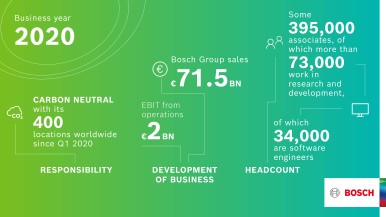
Renningen and Stuttgart, Germany – Bosch, the supplier of technology and services, is combining the internet of things (IoT) with artificial intelligence (AI) and believes electromobility will allow it to develop new business opportunities on the back of the profound technological and ecological changes currently occurring. “Bosch came through the first year of the coronavirus pandemic well,” said Dr. Volkmar Denner , the chairman of the board of management of Robert Bosch GmbH, at the press conference to present the company’s 2020 annual report . “We are one of the winners in the transition to electromobility, and we are significantly expanding our software business by tying in artificial intelligence.”In powertrain technology, electromobility is establishing itself as Bosch’s core business. Denner reported that the company is making heavy upfront investments in this area – a further 700 million euros this year alone. Up to now, its upfront investments in electromobility total five billion euros. Currently, Bosch sales revenue from electrical powertrain components is growing twice as fast as the market, at almost 40 percent. The aim is to increase annual sales fivefold to a total of some five billion euros by 2025 and to break even one year earlier. “Electromobility has long since ceased to be a bet on the future. Our upfront investments are now beginning to pay off,” the Bosch CEO said at an online press conference. Overall, Bosch had acquired orders worth over 20 billion euros by the end of 2020. In the first three months of this year, Bosch Group sales climbed 17.0 percent year on year. “With a good first quarter, Bosch has made a successful start to 2021,” said Prof. Stefan Asenkerschbaumer , the CFO and deputy chairman of the Bosch board of management. He expressed confidence for 2021, but expects it to be another challenging year. For the current reporting period, sales are expected to increase roughly 6 percent year on year, while the margin from operations is set to improve slightly to around 3 percent – or around 4 percent without restructuring costs. However, this depends on the effects of the semiconductor bottlenecks, which are difficult to assess. “The year 2021 will be an important milestone on our path to regaining our target margin of around 7 percent in the next two to three years,” Asenkerschbaumer said. The encouraging 2020 business year – despite the pandemic – with an operating result (EBIT from operations, adjusted for the effects of purchase-price allocations for Automotive Steering and BSH Hausgeräte) of 2.0 billion euros provides Bosch with a sound footing on which to continue to invest in areas of future importance. With sales amounting to 71.5 billion euros, research and development spending remained essentially unchanged at 5.9 billion euros, and EBIT margin from operations reached 2.8 percent. Adjusted for restructuring expenses, which additionally burdened result in 2020, the figure was 4.7 percent. Connectivity megatrend: customers becoming integral to development Bosch aims to leverage the competitive advantage it derives from its wealth of experience in combining connectivity (the internet of things, IoT) and artificial intelligence (AI) to generate future business and become a leading AIoT company . Bosch foresees that AI-enabled products will generate sales worth billions of euros over the next few years. Sales of connectivity-enabled devices for the home are expected to double: from four million last year to around eight million units in 2021. In addition, Bosch wants to use AI to evaluate data relating to how its customers use its products, and in this way to provide software updates that create new functions and services for those customers. “Connecting things leads to knowledge about how things are used,” Denner said. “This lets us continuously improve our products, keep them up to date, and provide our customers with more benefits.” In the field of video security, for example, video analysis based on neural networks opens up new possibilities. To this end, Bosch is integrating detectors both into new cameras and into an AI box that can be connected to installed devices. The first application is a traffic detector that will initially be able to detect and locate vehicles precisely in busy traffic situations, even under difficult lighting conditions. The more data that flows into the customer application, the more AI will be able to do, including accurate accident detection, the company says. Electrification megatrend: new opportunities in several business areas Global efforts to combat climate change are boosting electrification and green hydrogen. Denner believes electrification opens up new opportunities in several business areas: “Electrification requires solutions not only for electric driving in cars, but also for electric heating in buildings.” In electromobility , the key drivers of change are falling battery costs and emissions standards designed to meet climate action targets. In building technology, especially in heating and air-conditioning, the use of heat pumps and renewables is playing a growing role. In heating systems , for instance, Bosch is growing much faster than the market with solutions based on electricity. Sales of heat pumps grew by more than 20 percent in 2020; Denner expects them to triple by 2025. The company also anticipates that the refurbishment of residential buildings called for under the European Green Deal will provide a strong stimulus to growth. With this in mind, Bosch wants to leverage its “investment clout, large-scale production capability, and commercialization expertise.” In the case of the company’s particularly efficient and quiet air-to-water heat pumps alone, unit sales almost doubled in Germany in 2020. Hydrogen megatrend: fuel-cell market worth billions Bosch is also focusing on a growth market for the hydrogen megatrend: the company believes the market for green hydrogen in the EU will be worth almost 40 billion euros by 2030 – with annual growth rates of 65 percent. Fuel cells convert hydrogen into electricity, and Bosch is developing both stationary and mobile fuel-cell solutions. From 2021 to 2024, Bosch plans to invest one billion euros in fuel-cell technology . “Bosch is already H₂-ready,” Denner said. The plan is to put 100 stationary fuel-cell plants into operation this year. They will supply electricity to users such as data centers, industrial manufacturers, and residential areas. One stationary solid-oxide fuel cell, located in the center of Bamberg, Germany, was brought into operation at the end of March 2021 together with Stadtwerke Bamberg, the city’s public utilities. Bosch estimates that the market for mobile fuel-cell components will be worth around 18 billion euros by the end of the decade. Denner believes Bosch is in a good position here: “We have what it takes to be a leader in this market as well.” Bosch recently entered into a joint venture with China’s Qingling Motor Group to produce fuel-cell powertrains. A test fleet of 70 trucks is set to be on the roads before the end of this year. Denner: EU plans may threaten carbon neutrality Denner does not believe that the EU’s initial plans for the Euro 7 emissions standard make sense; however, he expressed his satisfaction that the debate was now showing signs of movement and becoming more objective. He explained why: “Climate action is not about the end of the internal-combustion engine. It’s about the end of fossil fuels. And while electromobility and green charging power make road transport carbon neutral, so do renewable fuels.” The Bosch CEO reminded his audience that climate-neutral mobility is almost as ambitious a goal as flying to the moon was in the 1960s. But instead of just setting the big goal of “first man on the moon” and leaving it up to engineers to decide how to achieve it, as U.S. President Kennedy did at the time, the European Commission is doing things the other way around. “This is a surefire way to cut off alternative paths to climate action,” Denner said. “If society truly wants climate action, it is essential that we do not play technological approaches off against each other. Instead, we must combine them.” CO₂ reduction at Bosch: along the entire value chain Bosch is pressing ahead with its own climate action targets as planned: Now that the climate-neutral status of the Bosch Group, with its more than 400 locations worldwide, has been certified, Bosch is giving concrete shape to its plans for what is known as Scope 3. By 2030, it aims to reduce carbon emissions by 15 percent from their 2018 level along its entire value chain, from suppliers to customers – a reduction of 67 million metric tons of carbon dioxide emissions. “Our efforts are sure to drive our product portfolio in the direction of energy efficiency or even technology change. In the future, a supplier’s or logistics provider’s carbon footprint will be one of the criteria for awarding new procurement contracts,” Denner said. “In terms of mitigating global warming, this will pay off.” Outlook for 2021: despite confidence, the year remains challenging Bosch expects the global economy to grow by just under 4 percent this year, after a contraction of around 3.8 percent last year. “Even though we’ve made a confident start to 2021, the pandemic continues to pose significant risks,” Asenkerschbaumer said. The CFO added that Bosch is particularly aware of market bottlenecks in the automotive sector, especially for semiconductors, which are in great demand. The company is doing everything in its power to support its customers in this tense situation. However, an improvement in the short term is not to be expected, and the situation may also impact business developments in the current year. In the long run, Asenkerschbaumer believes it is necessary to make all supply chains in the automotive industry less prone to disruption. Moreover, aligning its mobility business with areas of future importance such as electromobility, automated driving, and future electronics architectures calls for enormous upfront investments. “In this profound transformation, 2021 will be both a very important and a challenging year for us.” Business year 2020: coronavirus pandemic overcome In 2020, Bosch Group sales amounted to 71.5 billion euros. As a result of the pandemic, sales were 6.4 percent below their previous-year level (4.3 percent after adjusting for exchange-rate effects). The company generated earnings from operations before interest and taxes (EBIT from operations, adjusted for the effects of purchase-price allocations for Automotive Steering and BSH Hausgeräte) of 2.0 billion euros. The EBIT margin from operations came to 2.8 percent. “Improved sales in the second half of the year, as well as significant cost savings, helped cushion the impact of the pandemic,” Asenkerschbaumer said. The equity ratio remained at a high level of 44 percent, while free cash flow reached a record level of 5.1 billion euros. The CFO sees the company in a satisfactory liquidity situation: “Bosch continues to enjoy a healthy financial structure, and this will allow it to focus on areas of future importance.” Business year 2020: development by business sector The Bosch Group’s broad diversification was vindicated once again in 2020, balancing out different business developments. In the Mobility Solutions business sector, sales developed better than the market. At 42.1 billion euros, sales were down 10 percent year on year. However, worldwide automotive production fell 16 percent over the same period. After adjusting for exchange-rate effects, sales fell 8.2 percent. The EBIT margin from operations was minus 1.3 percent, with the refocusing of the business also having an impact. In the Industrial Technology business sector, sales reached 5.1 billion euros. With the market already in decline before the coronavirus pandemic, sales tumbled by 17 percent¹, or by 15 percent after adjusting for exchange-rate effects. At 4.7 percent, the EBIT margin was lower than in the previous year. In the Consumer Goods business sector, demand for household appliances and power tools increased significantly during the pandemic. Sales grew by 5.1 percent to 18.7 billion euros. After adjusting for exchange-rate effects, sales growth was 8.4 percent. The margin from operations was an outstanding 11.5 percent. Sales in the Energy and Building Technology business sector fell by 2.7 percent, or by 0.8 percent after adjusting for exchange-rate effects. The EBIT margin was 4.6 percent, from sales of 5.5 billion euros. Business year 2020: development by region¹ In Europe , sales for the year were 38.0 billion euros. This was 5.1 percent down on the previous year, or an exchange-rate adjusted 3.7 percent. In North America , sales totaled 10.7 billion euros, representing a 15.5 percent fall. After adjusting for exchange-rate effects, the fall was 12.8 percent. In South America , exchange-rate effects had a particularly pronounced impact on sales. At 1.1 billion euros, overall sales were 22.3 percent down on the previous year; however, the fall was just 0.2 percent after adjusting for exchange-rate effects. In Asia Pacific including other regions, the early and strong market recovery in China cushioned the effects of the coronavirus pandemic. At 21.7 billion euros, overall sales fell by just a slight 2.6 percent year on year, or by just 0.7 percent after adjusting for exchange-rate effects. Associates: change also offers opportunities Denner admitted that Bosch’s transformation will cost jobs on the one hand, but added that it will also open up new prospects for associates on the other. At its core plants, Bosch is taking skills from the development and production of gasoline and diesel systems and applying them to new technologies such as fuel cells. “We have already filled more than half our electromobility-related jobs with associates from the combustion-engine business,” the Bosch CEO said. In addition, a company-wide placement platform has been created in order to quickly get specialists into positions in areas of future importance. In its digital qualification programs as well, Bosch is making progress: since the beginning of 2020, the company’s in-house learning portal has been accessed more than 400,000 times. In 2020, more than a third of the training catalog was available online; by 2023, this figure is expected to rise to half. As of December 31, 2020, the Bosch Group employed some 395,000 associates worldwide. That is around 3,100 fewer people than in the previous year – a drop of around 1 percent. Headcount decreased primarily in Asia Pacific. In Germany, the number of associates remained largely constant at 131,800. Worldwide, the number of researchers and engineers increased by around 600 to around 73,200. The number of software developers also grew by more than 10 percent to around 34,000. ¹ Compared with a previous-year figure that has been adjusted for the effect of the divestment of the packaging machinery business.

Bosch stays on course through the coronavirus crisis - achieving positive result ...

03.02.2021

Press release

Business/economy

Bosch stays on course through the coronavirus crisis - achieving positive result ...

Embargoed until February 4, 2021 12:00 CET Dr. Volkmar Denner, Chairman of the board of management, Robert Bosch GmbH, and Prof. Stefan Asenkerschbaumer, deputy chairman of the board of management, Robert Bosch GmbH, at the new year’s media briefing on February 3, 2021 Check against delivery.Ladies and gentlemen, The coronavirus pandemic still requires us to stay distanced. Despite this, or precisely because of this, we want to foster close dialogue with you. It therefore gives me particularly great pleasure to welcome you to our new year’s media briefing. At least there are some reasons to be hopeful – foremost among them the start of vaccinations at the turn of the year. Our outlook for the new year is thus one of cautious optimism. Which topics will we be touching on this evening? We’ll start by reviewing the past year: how did Bosch’s business develop in 2020? But beyond that, what prospects and business opportunities do we see in climate action and mobility, the internet of things and artificial intelligence? The year 2020 was very much defined by coronavirus – socially, politically, and economically. It was a year that demanded a great deal from all of us: our customers, our suppliers, and the Bosch team. It was a year in which our associates demonstrated what “We are Bosch” means, even in the face of adversity: initiative, solidarity, and staying power. They achieved extraordinary things, whether in the smooth, rapid ramp-up of more than 100 affected plants following shutdowns, or in developing a rapid coronavirus test in just six weeks – a test that also reliably detects mutant coronaviruses. And at the same time, they set a milestone in the fight to mitigate global warming: according to in-house calculations, Bosch and all its 400 locations worldwide have been climate-neutral since spring 2020 – earlier, with fewer offsets, and more cost effectively than expected. I’m particularly proud of that. An independent audit is currently being carried out. So before I take a look at the preliminary business figures, I would first like to thank our associates around the globe on behalf of the entire board of management. Without their strong commitment and solidarity, Bosch would not have been able to manage the coronavirus crisis as well as it has. In fact, our business developed better than expected in 2020. Despite the effects of the pandemic, we were able to achieve a very positive result. Once again, our broad global footprint and our diversification proved their worth. The situation remains challenging, and unfortunately we cannot drop our guard – and this not only because of the ongoing coronavirus pandemic. We must also still contend with pressure resulting from the decline in automotive production and structural change in the industry. Stefan Asenkerschbaumer will now present the preliminary business figures for 2020. He will follow this with an initial appraisal of the current year. Business year 2020: development better than expected Thank you, Volkmar! Ladies and gentlemen, I would also like to welcome you, whether at home or in your newsrooms. In economic terms, 2020 was dominated by the coronavirus pandemic. The suspension of public life led to an economic slump in almost every country in the world, especially in the second quarter. Entire industries were forced to shut down. This also posed major challenges for the automotive industry with its closely interwoven global supply chains. At Bosch, this caused business development to plummet in the spring: our sales in April and May fell by an average of around 40 percent compared with the same months of the previous year. When restrictions eased in the second half of the year, economic activity picked up again. This also enabled Bosch to make up a great deal of lost ground. We are very satisfied with the way business developed overall in 2020 despite the crisis. We achieved a very positive result. Overall, Bosch Group sales also developed better than we were expecting in the middle of the year. Before I come to our key figures, I would like to touch on some of our crisis management measures. We acted quickly to align our costs with the decline in sales. But we also ensured that we continued to push ahead with promising new areas such as electromobility and AIoT. Moreover, together with our employee representatives we were able to quickly find solutions to safeguard jobs through commensurate savings in personnel costs – taking advantage of wage subsidy programs, reducing working hours, and giving managers unpaid leave. Our associates supported the necessary cost-cutting measures across all levels. I would like to take this opportunity to add my sincere thanks for this. We were just as thorough when it came to capital expenditure: by reducing capital expenditure we were able to save more than 1.1 billion euros of cash compared with the previous year. Our capex ratio amounted to some 5 percent. This also enabled us to increase our liquidity. But what does this mean in concrete terms for our preliminary business figures? As in previous years, the key figures we disclose are taken from our internal reporting system, which may differ somewhat from the external figures in the annual report: The sales of the Bosch Group amounted to 71.6 billion euros: a year-on-year drop of 4.4 percent after adjusting for exchange-rate effects. Our EBIT reached approximately 1.9 billion euros. This puts the estimated EBIT margin at around 2.5 percent of sales. This result includes restructuring expenditure to the tune of some 1.4 billion euros – which will strengthen our profitability in the long term. After adjusting for this expenditure, we achieved an estimated EBIT of approx. 3.3 billion euros – a margin of roughly 4.5 percent. The cost adjustments and cutbacks in capital expenditure have also created positive free cash flow of some 5 billion euros. This is the highest figure in our company’s history – despite the fact that in the first half of the year we were still forecasting a year-on-year decline. Business year 2020: developments by business sector Ladies and gentlemen, sales fell in three of our four business sectors, albeit to varying degrees. Only our consumer goods business saw sales growth. Industry shutdowns hit Mobility Solutions, our biggest business sector, particularly hard. At 42.3 billion euros, sales were down 9.5 percent on the previous year. After adjusting for exchange-rate effects, the decrease was 8.1 percent. Overall, however, our business grew faster than the market, where automotive production contracted by 15 percent. The Consumer Goods business sector served to stabilize our business. We benefited here from an extraordinary boom in household appliances and power tools as the coronavirus pandemic caused consumers to focus their energies on their home environment. Despite the collapse in the spring, sales rose a nominal 5.2 percent to 18.6 billion euros. After adjusting for exchange-rate effects, this figure rises to 8.2 percent. The Industrial Technology business sector was again unable to escape the continuing market weakness in 2020. In addition, the coronavirus crisis is having a major impact on business. At 5.1 billion euros, overall sales were 16.0 percent down on the previous year, or 15.0 percent after adjusting for exchange-rate effects. Encouragingly, order intake has also been picking up in this sector since the fall. The Energy and Building Technology business sector benefited from subsidy programs for climate-friendly heating systems and stability in the integrator business in building technology. The product business here was less favorable. For example, the cancellation of many events led to considerable losses in conference and public-address technology. Overall, however, the decline in sales was limited, with revenues falling by 3.4 percent to 5.4 billion euros. Adjusted for exchange-rate effects, this is a decrease of just 2.0 percent. Business year 2020: developments in the regions Ladies and gentlemen, next I will take a brief look at the development of sales in the individual regions. Here, too, the slump in sales in the spring left its mark, albeit to varying degrees. Sales revenue in Europe totaled 38.0 billion euros. This represents a decrease of 5.7 percent, or 4.6 percent after adjusting for exchange-rate effects. Sales in North America declined by 14.0 percent to 10.8 billion euros, an exchange rate-adjusted drop of 12.0 percent. In South America, exchange rate-adjusted revenues fell by 2.5 percent to 1.1 billion euros. In nominal terms, sales fell by 21.0 percent. In Asia-Pacific, revenues totaled 21.7 billion euros, which was fortunately only a slight decrease of 1.4 percent. After adjusting for exchange-rate effects, sales in fact grew by 0.5 percent. The early market recovery and the positive sales trend in China helped. Our sales in China exceeded sales in Germany for the first time in the company’s history. Business year 2020: headcount development Ladies and gentlemen, let us now take a look at headcount development. As of December 31, 2020, the Bosch Group employed some 394,500 associates worldwide. Of these, 129,900 were employed in Germany. Our worldwide headcount was down just 1.1 percent year on year. This shows that we have so far been able to keep employment levels virtually stable, despite the crisis – in our research and development units headcount even slightly increased, which we did to ensure we can continue to drive forward key strategic investments. Outlook for 2021: subdued development of the global economy It is not only the coronavirus pandemic that makes us view the new business year with caution. We must be prepared for a slower pace of recovery in the global economy than in recent months. After contracting by around 4.5 percent last year, we estimate growth of just under 4 percent this year. Yet it is not only the persisting consequences of the pandemic that are holding growth back. Political developments such as Brexit and continuing strategic competition between the U.S. and China with its potential for trade restrictions are also negatively impacting global economic development. It is a similar picture in the automotive industry. Roughly 85 million vehicles will roll off the assembly lines worldwide this year. In 2020, automotive production collapsed to approx. 78 million units, down from a good 92 million in 2019. To remind you: the historic high in this segment – 98 million units – was reached in 2017. This points to overcapacity in the market – of as much as 20 percent. At present, the bottleneck on the global semiconductor market is making business in the automotive industry more difficult – and it has not left Bosch unscathed either. Ladies and gentlemen, given the continued volatility of our business environment, we do not wish to give you sales and earnings forecasts for the current year at this time. It remains our goal to grow more strongly than the markets in the sectors and regions that are important for us. Irrespective of the pandemic’s further development, we must continue with the necessary structural adjustments that have already been initiated. To achieve this, we will continue to strive for solutions that are as socially acceptable as possible – we see this as our Bosch way. Our aim is twofold: to lead Bosch out of the coronavirus crisis stronger than before, and to help successfully shape the structural change in the automotive industry. At the same time, we will be working without let-up on our competitiveness and profitability. Our target for EBIT margin – as you know – is around 7 percent. We need a sound financial basis to be able to expand promising new areas. But what are the future growth areas for Bosch, and what are our challenges? Volkmar Denner will now tell you. Strategy I: Sustainable growth – with climate neutrality and electromobility Thank you, Stefan. Ladies and gentlemen, I would like to begin my strategy overview with the Bosch compass that guides us, especially in times of crisis. I am referring to our “Invented for life” ethos. It is an ethos that is manifested in products and services that save lives, improve quality of life, and keep our impact on the environment and resources to a minimum. Invented for life – this spurs on our engineers above all to regularly produce pioneering achievements. Our AVP automated valet parking, for example, is the first solution for driverless driving to be officially approved by the authorities. And in the next few months, we will put the world’s first radar-based assistance systems for motorcycles into mass production, for BMW as well as for Ducati and KTM – we describe these as virtual shields for riders. Invented for life – this idea guides our very strategy. We focus it clearly and systematically on areas of future importance – areas we can help shape, areas in which we want to and can grow. One of them is AIoT, the interplay of the internet of things and artificial intelligence; another is sustainability with a focus on climate action. We made Bosch climate neutral – a first for a global industrial company – but our climate action doesn’t stop there. Through our new company Bosch Climate Solutions, we want to pass on our experience to other companies. It has attracted a lot of interest, and gained its first few customers – including companies as diverse as Freudenberg and Hansgrohe, Köhler Papier and Prettl. With this CO2 advisory service, Bosch is making it easier for more companies to quickly become climate neutral. And we are turning climate action into a new business model with which we can grow. In addition, we want to further drastically reduce the carbon footprint along our supply chain; in other words, we are tackling what are known as Scope 3 emissions. To this end, we were the world’s first automotive supplier to agree a binding target with the Science-Based Targets initiative: to cut CO2 emissions 15 percent by 2030. This calls for new and improved technical solutions for our products, and not least for the future of driving. Bosch climate action must also take place on the road. But what does sustainable mobility mean? Fundamentally, this concerns the powertrain of the future. For Bosch, this future is open; in any case, we have always thought in terms of alternatives. We will invest some 700 million euros this year on the road to electromobility, after 500 million euros last year. In total, we have already made upfront investments of a good 5 billion euros. Again, the effort is paying off: since 2018, Bosch has acquired 90 powertrain electrification projects, including 30 last year alone worth 7.5 billion euros. We are currently growing twice as fast as the market. More than 2.5 million vehicles around the world currently feature Bosch electric powertrain components. For Bosch, our business with electromobility is already worth several billion euros. Electromobility is thus becoming one of Bosch’s core businesses. Nonetheless, in times of structural change, we would be well advised to continue thinking in terms of alternatives. Even when it comes to electric driving, we are not just relying on batteries; we are also readying fuel-cell drives for large-scale production. Electric cars are carbon neutral when they run on renewable electricity, and the same goes for diesel and gasoline cars – provided they run on synthetic fuels. The upcoming Euro7 regulation should not squander this opportunity to mitigate global warming. Even now, modern diesel and gasoline engines no longer have a significant impact on urban air quality. But our current understanding of the European Commission’s proposals suggests that they would be obligated to comply with the Euro7 limits in every driving scenario, no matter how unrealistic – which will not be possible without making vehicles considerably more expensive. Fundamentally, we find ourselves in a challenging transition phase. This should be clear to everyone involved – including the politicians responsible for passing regulations. Electromobility is coming and nobody disputes this – Bosch has been actively driving forward this shift for years. But the upfront investments to finance it have to come from our existing powertrain business. And to keep as many associates as possible on board during this transformation, it is crucial that the transition be smooth. We can make all powertrain alternatives – whether diesel, gasoline, or electric – carbon neutral. Just because something is socially and economically right, it doesn’t have to be ecologically wrong. We must maintain a balance between economic, ecological, and social considerations. Helping the automotive industry transition to climate-friendly, green mobility, while safeguarding jobs at the same time, should be the goal. At present, however, I can see a one-sided emphasis on the ecological perspective, with the implicit assumption that business will be able to take this in its stride. This urgently needs rethinking. Strategy II: AIoT as a growth opportunity — making connected products intelligent The automotive powertrain example clearly shows the mix of opportunities and challenges that the topic of sustainability creates for a technology company like Bosch. New growth can emerge from this. This brings me to another area of future importance to our company. If any company can connect its product portfolio with the internet of things (IoT) and artificial intelligence (AI), then it is Bosch. We call this combination “AIoT.” We want to become the leading supplier in this area – and we have more at our disposal than most of our competitors: both broad domain knowledge and extensive expertise in electronics and software. With AIoT, we create benefit for our customers – such as lower energy costs and increased comfort and safety. Meanwhile, for us, AIoT opens up the possibility of a closed value-creation cycle. To date, Bosch has understood value creation to mean primarily the manufacture and supply of products. Only connectivity generates information about how our products are used – field data that we can analyze with the help of AI to improve product use via software updates or as the basis for new functions and services. The technical prerequisites are in place: an IoT suite to connect devices, sensors, and gateways; cloud infrastructure to process data; and an AI platform to rapidly scale up artificial intelligence applications. Now it’s a matter of turning technical expertise into business. Bosch is on track to becoming a leading AIoT company. We have already sold some ten million connectivity-enabled power tools, home appliances, and heating systems, and the number of active users is growing. Altogether, more than 90 percent of all Bosch electronic products already feature connectivity. Moreover, from 2025 at the latest, every Bosch product will either contain AI or have been developed or manufactured with its help. Work done at the Bosch Center for Artificial Intelligence (BCAI) is now bearing fruit. Just three years after it was set up, our initial investment had paid off. Its projects have now achieved a contribution to result of some 300 million euros. Artificial intelligence is particularly profitable in manufacturing. At Bosch, it is already being used in 600 production lines. For instance in our highly complex wafer fabs, AI is used in detailed production scheduling, saving time and costs as it guides the wafers through almost 1,000 processing steps. This alone means a 5 percent faster wafer throughput, with an investment payback time of just three months. It is above all in Mobility Solutions, our biggest business sector, that we can see the extent to which our path toward AIoT strengthens our expertise in electronics and software. Since the beginning of the year, around 17,000 associates worldwide have been working together in our new Cross-Domain Computing Solutions division. This unit brings together hardware and software development for new automotive electronics architectures. With these architectures, we are addressing a future market that is emerging as a result of automated driving. Automation calls for more intelligence in the car. And more than ever, cross-domain vehicle computers will combine the functions of separate control units for brakes, powertrains, and steering. The market for software-intensive electronic systems in vehicles is already worth around 20 billion euros. We are expecting to see annual growth of up to 15 percent until 2030. In the second half of 2020, Bosch won orders worth around 2.5 billion euros for its vehicle computers. Further deals worth billions are expected to follow this year. We are developing AIoT applications across all our business sectors. However, the range of solutions is wide, as we can see from three very different examples: First, intelligent fire protection. Equipped with AI, our Aviotec video-based fire detection system also works in environments where there is no visible light thanks to new video-analysis algorithms we have developed. This means Aviotec can reliably detect smoke and flames even with infrared as the only light source. The second example is fitness tracking. On this subject, we unveiled an AI-enabled sensor at CES in Las Vegas – the first of its kind in the world. The sensor can recognize any new fitness activity that is based on repetitive movement. Its secret is “edge AI.” In other words, the intelligence is in the sensor itself. This minimizes latency and power consumption while also keeping data protected. The global fitness tracking market is currently growing at 15 percent annually (source: Fortune Business Insights). And lastly, artificial intelligence in manufacturing. Our special-purpose machinery unit has developed an application platform for machine-based visual inspection of workpieces. We call it “Machine Vision AI” – and it helps detect even the tiniest scratches on surfaces or defects in weld seams. With applications like these, our prospects for growth are good. This is because industrial solutions account for a large share of the global IoT market, which is expected to grow by 11 percent annually until 2024 (source: IDC). The coronavirus isn’t everything – Bosch remains on course to achieve its goals The versatility of our AIoT solutions perfectly illustrates Bosch’s broad diversification. And on a personal note, I might add that although we must continue to navigate prudently through the coronavirus crisis, we are not losing sight of the strategic goals we have set ourselves. Yes, 2020 was an extraordinary year, and yes, 2021 will hardly be less challenging, but still we remain on course – to enable sustainable mobility for people and goods and to become a leading AIoT company. The crisis is not over yet. To remain viable in the future, we will continue our work on costs. But the medium-term targets we have set hold out the promise of sound growth. I’m sure we’ll now have a lot to talk about. But for now, let me thank you for giving me your time.


Coronavirus: Bosch puts fully automated mask-production lines into operation

15.05.2020

Press release

Business/economy

Coronavirus: Bosch puts fully automated mask-production lines into operation

Stuttgart, Germany – In the fight against coronavirus, Bosch has now turned its hand to the fully automated production of face masks. Dr. Volkmar Denner, chairman of the board of management of Robert Bosch GmbH, today launched the first special production line for face masks at the Bosch plant in Stuttgart-Feuerbach. “Containing coronavirus is a challenge for society as a whole. By equipping our associates with masks we make ourselves, we are helping to relieve the burden on the market. Moreover, we are doing the groundwork that will enable us to safely resume operations and protect our associates,” Denner says. Following a coordinated ramp-up that will run until the end of June, the company will make over half a million masks a day on five production lines at four locations worldwide. The lines were designed by Bosch’s special-purpose machinery unit. Bosch is making the design plans available to interested companies free of charge. Bosch has already received inquiries from over 30 companies regarding the designs of the special production line.Bosch designs a production line for face masks In combination with other hygiene measures, face masks are an effective means of reducing the risk of new Covid-19 infections. Developed by Bosch’s special-purpose machinery unit in just a few weeks, identical, fully automated production lines for face masks are now being set up at several company locations. In addition to the lead plant for Industry 4.0 in Stuttgart-Feuerbach, where two lines are planned, mask production will be ramped up at the Bosch locations in Naganathapura, India, and Juárez, Mexico, in successive weeks. A facility at the Rexroth plant in Erbach, Germany, will round off the manufacturing network. Overall, by the end of June, the production volume of the five lines is set to exceed ten million masks a month. In-house production to relieve supply bottlenecks The face covering is primarily intended to impede the spread of pathogens from the wearer’s nose and throat. At the same time, the mask acts as a barrier to bodily fluids produced by people in the immediate vicinity. Bosch is manufacturing surgical mask types I and II, which comply with the European DIN EN 14683 standard, and will use them mainly to protect its roughly 400,000 associates worldwide. Bosch wants to make any excess capacity available to third parties, provided there is demand and the masks satisfy country-specific standards. Furthermore, Bosch is making the designs, technical drawings, and assembly instructions of the lines available to other companies free of charge, as well as information about how the masks are packaged and distributed. “Our special production lines give us greater independence, since masks can be made directly on site, right where they are needed,” Denner says. Bosch’s special-purpose machinery unit offers interested companies expert advice and supplies complete systems on request. “Bosch is responding to coronavirus by developing technology. We are contributing our innovative strength and extensive manufacturing expertise,” says Rolf Najork, the Bosch management board member responsible for industrial technology. Bosch’s special-purpose machinery unit provides tailored solutions Part of the Industrial Technology business sector, Robert Bosch Manufacturing Solutions GmbH has been developing flexible and scalable plans for assembly systems, testing and process technology, and related services for 25 years now. Within the Bosch Group, the subsidiary plays a significant role. In the field of electromobility, for example, it is responsible for the final inspection of e-bike motors. With some 2,000 associates at nine locations worldwide, the services provided by the special-purpose machinery unit are tailored to the needs of both Bosch plants and external customers.

In the coronavirus crisis, Bosch is committed to both technological innovations  ...

29.04.2020

Press release

Business/economy

In the coronavirus crisis, Bosch is committed to both technological innovations ...

Stuttgart, Germany – After shutting down production at nearly 100 Bosch locations worldwide this month, the company is systematically preparing for a gradual ramp-up of manufacturing. “We want to ensure reliable supplies to meet our customers’ demand as it gradually returns, with a view to helping the world economy recover as quickly as possible,” said Dr. Volkmar Denner, chairman of the board of management of Robert Bosch GmbH, at the company’s annual press conference. “Our goal is to synchronize the ramp-up of production and secure supply chains, especially in automotive production. We have already achieved this in China, where our 40 or so local plants are producing again and the supply chains are stable. We are working hard to do the same in our other regions.” To make a success of ramping up production, Denner said that the company is putting numerous measures in place to ensure that associates are adequately protected against coronavirus infection. Bosch is also committed to taking a coordinated, joint approach with customers, suppliers, authorities, and employee representatives.Helping contain the coronavirus pandemic “Wherever possible, we want to contribute our expertise to efforts to contain the pandemic, for instance through our newly developed rapid Covid-19 test and our Vivalytic analysis device,” Bosch CEO Denner said. “Demand is huge. We’re doing everything we can to significantly increase production, and will increase capacity five-fold over our original plans by the end of the year,” he continued. Bosch intends to produce more than a million rapid tests in 2020, and to increase this to three million next year.In addition to existing laboratory tests, the Vivalytic analysis device is to be used initially in hospitals and doctors’ offices, where it will be used primarily to protect medical staff, for whom the rapid availability of test results in less than two-and-a-half hours is crucial. The rapid test is already being delivered to European customers with a “research use only” label, and can be used following validation. Bosch expects to have a CE mark for the product by the end of May. An even faster test, which can reliably detect Covid-19 cases in less than 45 minutes, is in the final stages of development. “All our work in this field is guided by our ‘Invented for life’ ethos,” Denner said. Bosch has already started production of face masks. Even now, thirteen Bosch plants in nine countries – from Bari in Italy, to Bursa in Turkey, to Anderson in the United States – have taken the initiative and are making such masks for local requirements. In addition, the company is currently setting up two fully automatic production lines at its Stuttgart-Feuerbach location with further lines to follow at its German Erbach location as well as in India and Mexico. “It took our special-purpose machinery unit just a few weeks to design the necessary machinery,” Denner said. Bosch has also made the designs available to other companies free of charge. This means the company will be able to manufacture more than 500,000 masks per day. The masks are intended to protect Bosch associates at plants worldwide. Furthermore, the aim is to make them available to third parties as well. This will depend on gaining the appropriate country-specific approvals. In addition, Bosch is producing 5,000 liters of disinfectant each week in Germany and the U.S. for its associates in American and European plants. “Our people are doing great work here,” Denner said.Global economic development in 2020: recession negatively affecting outlook In view of the coronavirus pandemic, Bosch anticipates considerable challenges for the global economy in the current business year: “We are bracing ourselves for a global recession that will also have a considerable impact on our own performance in 2020,” said Prof. Stefan Asenkerschbaumer, CFO and deputy chairman of the Bosch board of management. Based on the effects known to date, Bosch currently expects automotive production to fall by at least 20 percent in 2020. In the first quarter of this year, Bosch Group sales fell by 7.3 percent, meaning they are already considerably lower year on year. Sales dropped by 17 percent in March 2020 alone. Given the many imponderables, the company felt unable to make a forecast for the year as a whole. “A supreme effort must be made to achieve at least a balanced result,” the CFO said. “In this severe crisis, it is again an advantage for us that we are so diversified, with different business sectors.” Currently, the focus is on extensive measures to reduce costs and secure liquidity. This includes reductions in working hours and cutbacks in production already in place at many locations worldwide, salary reductions for specialists and managers including executive management, and extended time frames for investments. In addition, Bosch had already launched a comprehensive program to improve its competitiveness at the beginning of 2020. “In the medium term, our objective is to return to a roughly 7 percent margin from operations, but without neglecting the essential tasks to secure our future,” Asenkerschbaumer said. “We are devoting all our energy to this and to overcoming the coronavirus pandemic. In this way, we will create the financial foundations we need to seize the huge opportunities that lie ahead for the Bosch Group.”Climate action: Bosch is systematically pursuing ambitious goals Despite the challenges of the current situation, Bosch is maintaining its long-term strategic course: the supplier of technology and services is continuing with its systematic pursuit of ambitious climate goals and is developing the activities required to support an expansion of sustainable mobility. “Although other issues are currently in the spotlight, we must not lose sight of the future of our planet,” Denner said. About a year ago, Bosch announced that it would be the first globally operating industrial enterprise to become climate neutral by the end of 2020, and this at all its 400 locations worldwide. “We will achieve this goal,” Denner said. “At the end of 2019, we achieved carbon neutrality for all our locations in Germany; as of today, we are 70 percent of the way to achieving this worldwide.” To make carbon neutrality a reality, Bosch is investing in energy efficiency, increasing the proportion of renewables in its energy supply, buying in more green power, and offsetting unavoidable carbon emissions. “The share of carbon offsets will be significantly lower than planned in 2020, at just 25 percent instead of nearly 50 percent. In other words, we are making faster progress than we expected in improving the quality of the measures we take,“ Denner said.Carbon-neutral economy: new advisory company established When it comes to climate action, Bosch is taking two new approaches to ensure its own efforts have a multiplier effect in the economy. One goal is to make upstream and downstream activities along the value chain as climate neutral as possible, from “purchased goods” to “use of products sold.” By 2030, the associated emissions (Scope 3) are expected to fall by 15 percent, or more than 50 million metric tons per year. To this end, Bosch has agreed on a target with the Science-Based Targets initiative , making Bosch the first automotive supplier to commit to a measurable target. Moreover, the company plans to pool the knowledge of nearly 1,000 Bosch experts worldwide and experience from more than 1,000 energy-efficiency projects of its own in a new advisory company, called Bosch Climate Solutions. Explaining this step, Denner said: “We want to make our experience available to other companies, to help them progress to carbon neutrality,”Growth market for Europe: venturing into the hydrogen economy “Climate action remains crucial for humanity’s survival. It costs money, but doing nothing will cost even more,” Denner said. “Politics must not stand in the way of companies expanding their ingenuity and using technology to benefit the environment – without harming prosperity.” According to Denner, what is important is a broad technology offensive that not only sets out a battery-electric path to sustainable mobility, but also takes into consideration efficient combustion engines and especially renewable synthetic fuels and fuel cells. The Bosch CEO called for a bold move into the hydrogen economy and the production of renewable synthetic fuels once the coronavirus crisis has passed. In his view, this is the only way Europe can become climate-neutral by 2050. “Today’s hydrogen applications need to make it out of field testing and into the real economy,” Denner said. He appealed to policymakers to support the necessary technologies: “This will enable us to achieve even ambitious climate targets.”Ready for hydrogen: mobile and stationary fuel cells Climate action is accelerating structural change in many sectors. “Hydrogen is becoming increasingly important, both in the automotive industry and in building technology. Bosch is very well prepared for this,” Denner said. Bosch and its partner Powercell are already working to commercialize mobile fuel-cell stacks for use in vehicles. Their market launch is planned for 2022. This is how Bosch intends to position itself successfully in another growth market: As early as 2030, one in eight newly registered heavy trucks could be powered by a fuel cell. Bosch is working with its partner Ceres Power on stationary fuel cells . These can supply buildings such as computing centers with electricity. Bosch anticipates that the market for fuel-cell power stations will be worth more than 20 billion euros by 2030.Powertrain and heating technology: electrification of the product portfolio “As climate action is stepped up, electrical solutions will be limited in the near term to complementing the combustion solutions that have dominated up to now,” Denner said. That is why Bosch is pursuing technology-neutral powertrain development. According to Bosch market research, two out of every three newly registered vehicles in 2030 will still run on diesel or gasoline, with or without a hybrid option. That is why the company is also continuing to invest in highly efficient combustion engines . Thanks to Bosch’s new exhaust technology, diesel engines’ NOx emissions have been almost completely eliminated, as independent tests have already shown. Bosch is also systematically refining the gasoline engine: modifications to engines and efficient exhaust-gas treatment can now bring particulate emissions down to a level roughly 70 percent lower than the Euro 6d temp standard. In addition, Bosch is committed to renewable fuels , since legacy vehicles will also have to play their part in cutting CO 2 emissions. Renewable synthetic fuels can make the combustion process carbon-neutral. This is why, according to Denner, it would make more sense to offset such renewable synthetic fuels against fleet consumption, instead of tightening the CO 2 rules for the automotive industry in a time of crisis. In addition, Bosch wants to become a market leader in electromobility. To this end, the company will be investing roughly 100 million euros in the production of electrical powertrain systems at its plants in Eisenach and Hildesheim. Electrification is also making inroads in heating technology, for example in heating system modernization. “We predict a decade of electrification in the boiler room,” Denner said. With this in mind, Bosch is investing an additional 100 million euros in its heat-pump business and intends to expand its development work and double its market share.Business year 2019: steadfast in a weak market environment “Against the backdrop of a further weakening of the global economy and a 5.5 percent decline in automotive production, the Bosch Group held up well in 2019,” Asenkerschbaumer said. Thanks to a variety of successful products, sales totaled 77.7 billion euros, only 0.9 percent below the previous year’s level; adjusted for exchange-rate effects, they fell by 2.1 percent. The Bosch Group generated earnings from operations before interest and taxes (EBIT from operations) of 3.3 billion euros. This means it achieved an EBIT margin from operations of 4.2 percent. Excluding extraordinary positive effects arising especially from the divestment of the packaging machinery business, the margin was 3.5 percent. “In addition to heavy upfront investments, the factors weighing on result were in particular the weak state of markets such as China and India, the further reduction in demand for diesel cars, and high restructuring costs, particularly in the mobility segment,” CFO Asenkerschbaumer said. With an equity ratio of 46 percent and cash flow of 9 percent of sales in 2019, Bosch’s financial situation is sound. Expenditure on research and development rose to 6.1 billion euros, or 7.8 percent of sales. At roughly 5 billion euros, capital expenditure was up slightly year on year.Business year 2019: development by business sector Despite the decline in global automotive production, the Mobility Solutions business sector generated sales of 46.8 billion euros. Revenues were 1.6 percent lower year on year, or 3.1 percent after adjusting for exchange-rate effects. This means that the Bosch sector with the highest sales outperformed global production volumes. The EBIT margin from operations stood at 1.9 percent of sales. Business in the Consumer Goods business sector picked up during the year. Sales totaled 17.8 billion euros, which equates to a drop of 0.3 percent, or 0.8 percent after adjusting for exchange-rate effects. At 7.3 percent of sales, the EBIT margin from operations is lower year on year. The Industrial Technology business sector felt the effects of the declining machinery market, but still increased its sales by 0.7 percent to 7.5 billion euros; after adjusting for exchange-rate effects, this was a slight drop of 0.4 percent. Excluding the non-recurring extraordinary effect from the sale of the Packaging Technology division, the EBIT margin from operations was 7 percent of sales. Revenues in the Energy and Building Technology business sector rose 1.5 percent to 5.6 billion euros, or by 0.8 percent after adjusting for exchange-rate effects. This equates to an EBIT margin from operations of 5.1 percent of sales. Business year 2019: development by region Bosch’s business performance varied from region to region in 2019. In Europe , sales were 40.8 billion euros, 1.4 percent down on the previous year, or an exchange rate-adjusted 1.2 percent. In North America , revenues increased by 5.9 percent (only 0.6 percent after adjusting for exchange-rate effects) to 13 billion euros. In South America , sales increased by 0.1 percent to 1.4 billion euros, but by 6 percent after adjusting for exchange-rate effects. Business in Asia Pacific (including Africa) reflected the collapse of automotive production in India and China: sales declined by 3.7 percent to 22.5 billion euros, an exchange rate-adjusted drop of 5.4 percent. Headcount: one in five associates works in research and development As of December 31, 2019, the Bosch Group employed 398,150 associates worldwide at just over 440 subsidiaries and regional companies in 60 countries. The main reason for the 2.9 percent year-on-year reduction in headcount is the sale of the Packaging Technology division. In total, some 72,600 specialists work in research and development at Bosch, almost 4,000 more than in the previous year. In 2019, the number of software developers in the company increased by more than 10 percent to roughly 30,000. Key figures can be found here and in the 2019 annual report here .