Search & find:
Media, press releases, events for your editorial coverage

Bosch commissions its first in-house electrolyzer with Hybrion electrolysis stacks

05.11.2025

Press release

Powertrain systems

Bosch commissions its first in-house electrolyzer with Hybrion electrolysis stacks

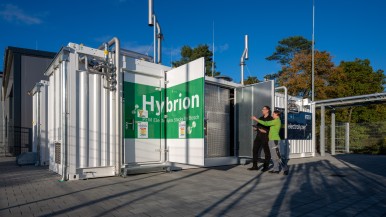
Stuttgart and Bamberg, Germany – Hydrogen is on the advance at Bosch: after officially launching Hybrion PEM electrolysis stacks (PEM = proton exchange membrane) in March, Bosch has now put two of them into operation in an electrolyzer at its Bamberg site. This 2.5 megawatts system converts water into hydrogen and oxygen using renewable electricity – and meets the EU’s requirements for renewable hydrogen. At the same time, the commissioning of the electrolyzer in Bamberg marks the start of a new chapter: it is part of an entire hydrogen landscape built to demonstrate various ways of producing, storing, and using hydrogen. “Hydrogen plays a central role in a climate-neutral world, which is something we’re committed to achieving as a society in Germany and Europe, and it’s an ideal energy source. It can be produced, stored, and transported almost anywhere, and in a climate-neutral way”, says Dr. Markus Heyn, member of the Bosch board of management and chairman of the Mobility business sector. For Bosch, hydrogen continues to be a strategically important business. The official start of operations for our electrolyzer and the opening of the hydrogen landscape here in Bamberg mark an important milestone for us....says Dr. Markus Heyn, member of the Bosch board of management and chairman of the Mobility business sector. At the heart of the electrolyzer, which was built by FEST, a company based in Goslar, Germany, are two Bosch Hybrion electrolysis stacks manufactured in Bamberg. Each of these stacks with a rated power of 1.25 megawatts produces around 23 kilograms of hydrogen per hour from water and electricity. At full load, the electrolyzer can produce more than 1 metric ton of hydrogen daily. That’s enough fuel for an electric 40-ton truck fitted with a Bosch fuel-cell power module (FCPM) to travel up to 14,000 kilometers. The Bamberg hydrogen landscape features just such an FCPM, equipped with a Bosch fuel-cell stack, in continuous operation inside a “lifetime container” with a view to testing the module’s durability. The hydrogen to power the FCPM flows into the container from the electrolyzer via a pipeline network. Here, the hydrogen-producing process that previously ran in the PEM electrolysis stacks is now reversed: hydrogen and oxygen are fed into the FCPM’s fuel-cell stacks, where they react to produce water and electrical energy. The electricity generated by the FCPM flows back into the electrolyzer, where it is used both to test the electrolyzer and to produce hydrogen locally. These around-the-clock tests inside the lifetime container simulate a wide range of usage scenarios to ensure the durability and reliability of the FCPMs. Large-scale production of the FCPM started in Bosch’s Stuttgart-Feuerbach plant in mid-2023. It was recently nominated for the prestigious German President’s Future Prize. “Bosch can do hydrogen, and at scale,” says Thomas Pauer, the president of the Power Solutions division. "We got involved in the area at an early stage, made upfront investments, and are now offering market-ready technical solutions. That includes our fuel-cell power module. The fact that it was nominated for the German Future Prize proves that this Bosch technology is at the cutting edge. And that applies both to the fuel cells and to the electrolysis.” Bamberg also has a second test station for the Hybrion PEM electrolysis stacks manufactured at the plant there. Before delivering stacks to customers, this is where Bosch ensures that they reliably achieve their performance and efficiency under real operating conditions. For example, various load profiles are simulated to test the reaction of each stack to electrical fluctuations. In addition, every Hybrion stack is activated before delivery so that it is immediately ready for use at the customer’s premises. Another feature of the hydrogen landscape is the 21-meter-high hydrogen tank, in which hydrogen from electrolysis can be stored at up to 50 bar. Bosch has already reached its first milestones in electrolysis technology in 2025. Following the market launch in the spring, deliveries have begun to various customers and partners, including companies such as IMI, Kyros Hydrogen Solutions, Neumann & Esser, Pietro Fiorentini, and the latter’s subsidiary Hyter.

Bosch puts its first hydrogen truck into service in plant traffic

08.10.2025

Press release

Powertrain systems

Bosch puts its first hydrogen truck into service in plant traffic

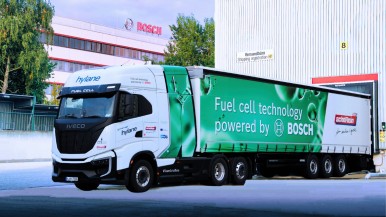
Nuremberg, Germany – Bosch has taken a further step on the road to climate-friendly logistics – with one of the technology company’s own products. Its Nuremberg plant recently started using a fuel-cell electric truck in plant traffic. The truck is equipped with the Bosch fuel-cell power module (FCPM), which was recently nominated for the prestigious German President’s Future Prize. “When we decided to make our plant traffic more climate-friendly, it was clear that we wanted a truck featuring Bosch’s FCPM,” explains Alexander Weichsel, the commercial plant manager in Nuremberg. “This deployment is an important building block that helps us reduce our emissions in logistics. The fact that several thousand trucks with Bosch fuel-cell systems are already on the road worldwide shows that the concept is proving its worth.” By converting hydrogen and oxygen into water and electricity, the 40-ton truck can be operated completely electrically. Using renewable hydrogen even makes the truck’s powertrain climate neutral. By switching to the new vehicle, Bosch also wants to set an example in Nuremberg and play an active role in developing a hydrogen value chain in line with the state of Bavaria’s Hydrogen Strategy 2.0.Real operation provides valuable data for further development The Iveco truck in question has a range of up to 800 kilometers. It is operated by the freight forwarder Schäflein on behalf of the Bosch plant. Schäflein in turn rents the vehicle from the rental provider Hylane, which specializes in emissions-free trucks. The vehicle, which primarily transports products from the plant’s own manufacturing operations, is expected to cover 12,000 kilometers per year. As a result, the Nuremberg plant will reduce Bosch’s CO 2 emissions – because the vehicle runs on hydrogen instead of diesel. Alongside this reduction of emissions in logistics, however, the primary reason for putting the truck into service is initially to gather experience and as much data as possible. This will flow into the further development of future powertrain systems such as the Compact 190 and Compact 300 models. Plant manager Weichsel is optimistic about the future: “The fact we’ve had no problems operating this truck shows that the fuel cell is ready for volume production.” At the same time, he says: “The key to a successful hydrogen economy is above all to ensure an abundance of affordable hydrogen and put in place an adequate H 2 infrastructure, including in Nuremberg. We’re actively working with industrial partners in the Nuremberg metropolitan region to implement Bavaria’s hydrogen strategy.” With the Iveco FCPM truck, Bosch has now put its own system into real operation in Europe for the first time. The truck’s five hydrogen tanks hold up to 70 kilograms at a pressure of 700 bar. Its fuel-cell system delivers a total output of over 200 kilowatts. Its e-axle is powered by the fuel-cell system, while two battery packs installed centrally in the truck serve as energy storage. The truck has a system output of 400 kilowatts and a gross weight rating of up to 44 metric tons. In addition to its robustness and long range – which, unlike battery-electric vehicles, is not affected by the outside temperature – the truck offers impressively short refueling times, which are similar to those of a diesel truck. Large-scale production of the FCPM started in Stuttgart-Feuerbach in mid-2023. The Bosch plant in Bamberg supplies the fuel-cell stack, while the Homburg plant supplies other components such as the electric air compressor and the recirculation blower. Bosch has been strongly committed to building an H2 economy for a long time, and is developing technical solutions for the production, infrastructure, and use of hydrogen. This spring, the company heralded its market entry with technology for electrolyzers and presented its Hybrion PEM electrolysis stacks. When it comes to hydrogen applications, Bosch is active not only in the field of mobile fuel cells but also in hydrogen engines.

Bosch makes two-wheelers and powersports vehicle fit for the future

05.11.2019

Press release

Connected mobility

Bosch makes two-wheelers and powersports vehicle fit for the future

Milan – Motorcycling is passion, dynamics, and speed. It also provides a unique riding pleasure and a sense of freedom. To make two-wheelers and powersports vehicles fit for the future without compromising the thrill of the ride, Bosch offers a bunch of innovative solutions making it as exciting, safe, and emissions-free as possible. You will find Bosch in Hall 13, Booth G55.Connectivity: the next step in the evolution of riding safety Bosch gets two-wheelers and powersports vehicles connected, internally as well as with the outside world. Smart, connected on-board systems assist the rider and enhance safety. Thanks to connected solutions from Bosch, riders no longer have to put up with a lack of access to digital information and entertainment while on the road on their motorcycles and powersports vehicles. Integrated connectivity cluster (6.5” frameless): For the first time globally at EICMA 2019, Bosch presents the next generation of integrated connectivity cluster (6.5” frameless). The highlight is the size optimization of the device, obtained by the integration of telltales into the TFT screen. It provides a better display to frame ratio, the TFT area is larger compared to outline dimensions. This new seamless design results in a smaller packaging which leads to an increased flexibility in mounting on various types of motorcycle models. Bosch’s integrated connectivity cluster combines traditional instrumentation with a wide range of infotainment features in a single device. The optical bonding and anti-reflection coating enables easy readability of the crystal-clear display in all weather conditions. Even in the rain, direct sunlight or in the dark, the colors are distinct and the contrast is high. Simply connected with mySPIN: mySPIN enables riders to bring the smartphone content to their motorcycle, scooter or powersports vehicle via the cluster display. This solution provides an open platform featuring an extensive range of options to all vehicle manufacturers. The system is easy to use. As soon as the smartphone is connected to the vehicle via WLAN, Bluetooth or USB, a wide variety of apps immediately becomes available to the rider on the display. Safety: on the way to accident-free motorcycling As the world’s leading supplier of motorcycle safety technology, Bosch has already made riding on two wheels considerably safer with safety systems such as ABS and MSC motorcycle stability control. Now the company is going one step further with advanced rider assistance sytems. According to Bosch accident research estimates, radar-based assistance systems could prevent one in seven motorcycle accidents. These electronic assistants are always vigilant and, in emergencies, they respond faster than people can. Motorcycle stability control (MSC): Bosch developed the first all-in-one safety system for two-wheelers in the world: motorcycle stability control (MSC) has enhanced safety of motorcycle riders since 2013. MSC assists riders during critical low siding situations as well as it immediately counters while braking in bends. This can improve both riding stability and braking performance. For the first time, the Bosch MSC system is installed on an electric motorcycle the Zero SR/F. It shows that increasing demand of safety systems for various type of vehicle including electric motorcycles, and Bosch MSC contributes to increase riding safety for every rider. Semi-active damping control systems for powersports vehicles: The semi-active damping control system for powersports vehicles enhances the safety, comfort, and dynamics of the drive. Vehicles featuring this semi-active damping control system are equipped with multiple sensors that are used to continuously monitor road conditions, with changes being made almost instantaneously. The sensors also enable the system to increase stability, especially during off-road riding. At the push of a button, the system allows riders to choose and adjust the suspension settings to match their preferences. The semi-active damping control system adjusts actuators in the dampers to reduce vibration and improve not only vehicle stability, but also riding comfort. Advanced rider assistance systems: The advanced rider assistance systems improve safety and comfort for motorcyclists, comprising adaptive cruise control (ACC), forward collision warning, and blind spot detection. The technology underpinning these systems is a combination of radar sensor, brake system, engine management, and HMI (human machine interface). The radar functions as a sensory organ providing accurate picture of vehicle’s surroundings, improving riding safety and comfort without reducing the enjoyment of riding. The motorcycle manufacturers Ducati and KTM will include the new rider assistance systems in the model production as soon as 2020, which is the beginning of Bosch advanced rider assistance systems production. The systems will also be included in the production models of Kawasaki, starting the series production in 2021. Powertrain: latest technologies for fewer emissions As urban mobility today faces great challenges, Bosch develops highly efficient powertrain solutions to help vehicle manufacturer bring down emission levels, and contribute to better air quality. Light electric vehicles with Bosch technology are already making inroads today; in addition to their quiet operation and lower consumption of resources, their advanced technology, user-friendly operation and great dynamics make for maximum riding fun. System solutions for light electric mobility: At the EICMA 2019, Bosch presents two innovative system approaches for light electric vehicles: the lean drive system and the comprehensive integrated system. The drive system compromises of an electric drive unit and the control unit. The components are harmonized to enable a smooth and efficient riding experience capable of easy integration in vehicles with varying energy management solutions. In comparison to that, the integrated system is comprehensive solution that can be adapted based on the needs of our customers. The system comprises of a drive unit, control unit, battery solution and enables the customers to add different connectivity functionalities. This system can be applied flexibly in different classes of light electric vehicles by multiplying components to ensure the perfect fit to all manufacturer’s needs with reduced effort. With the two system approaches, Bosch can ensure high performance, high reliability as well as a unique riding experience to meet the demands of the industry which includes use cases like cargo application and last mile deliveries. The integrated system will be featured at the EICMA 2019 in a Nuuk Urban. Engine management systems: The Bosch engine management systems can help two-wheeler manufacturer to fulfill future emission regulations such as Euro 5 and BS 6 (Bharat stage 6) including OBD l/ll. In combination with sensor technology, the engine management systems have achieved considerable increases in efficiency compared to conventional carburetor.

More technology for better air: Bosch is helping cities worldwide in the battle  ...

25.07.2019

Press release

Powertrain systems

More technology for better air: Bosch is helping cities worldwide in the battle ...

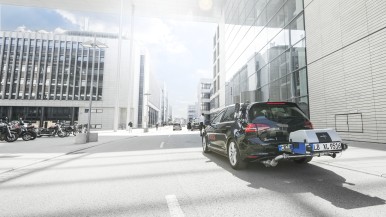
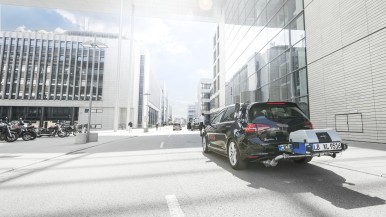
Stuttgart, Germany – Around the world, people are flocking from rural areas to cities. By 2050, there will be more than six billion people living in megacities, twice as many as now. Over the same period, the volume of urban traffic is set to increase threefold, not least because the continuing boom in online commerce will feed further growth in delivery traffic. A denser population and more traffic mean deteriorating air quality. Across the globe, from Paris to Shanghai, major cities therefore face a major challenge: providing mobility for people and goods while also improving the quality of the air we breathe. This is no easy task: according to the World Health Organization (WHO), around 90 percent of the world’s population now live in areas where air quality is poor. The Organization for Economic Cooperation and Development (OECD) estimates that the economic impact of air pollution is around 5 trillion dollars worldwide. Rising healthcare costs account for the lion’s share of this sum. “Clean air concerns us all,” says Dr. Volkmar Denner, the chairman of the board of management of Robert Bosch GmbH. “At Bosch, we recognize not only our global responsibility for climate action but also our local responsibility for combating air pollution. And to meet that, we need more technology, not less. With technology that is ‘Invented for life,’ we can help cities and make the world a better place.” Bosch is therefore working both beneath and beyond the engine hood in order to make mobility as emissions-free as possible. Moreover, as an employer, the company is also taking on responsibility for improving air quality around the globe. At Bosch, we recognize not only our global responsibility for climate action but also our local responsibility for combating air pollution. And to meet that, we need more technology, not less. With technology that is ‘Invented for life,’ we can help cities and make the world a better place....Dr. Volkmar Denner, the chairman of the board of management of Robert Bosch GmbH Understanding the factors behind air quality: different cities, different challenges Technological advances and policy changes have significantly improved air quality, especially in Europe and the United States. Poor air quality is not caused by vehicle emissions alone. Industry, agriculture, and the energy sector also contribute to air pollution in varying degrees around the world. Air composition varies sharply from one location to another – as do levels of airborne pollutants such as particulate matter, ozone, sulfur dioxide, and nitrogen oxides. Other factors impacting air quality include chemical processes in the atmosphere triggered by temperature gradients, wind conditions, and solar radiation. For example, sunlight increases ozone concentration, and ozone can react with nitrogen monoxide to form nitrogen dioxide (NO 2 ). To gain a better understanding of these processes and to collect more data on air pollutants at various locations in urban areas, Bosch has developed a system for measuring pollution. Installed in a compact housing, this technology is currently being trialed in the Stuttgart metropolitan area, Paris, and Marseille. Its purpose is to deliver reliable data on air quality, which can then be used, for example, to map air quality in real time across a city as a basis for more efficient traffic management. Beneath the engine hood: focusing on nitrogen oxide and particulate emissions Bosch is using its know-how and considerable financial resources to make cars fit for the future. This involves a two-pronged strategy: advancing the development of electromobility and achieving further refinements to the internal-combustion engine. The aim is to design an internal-combustion engine that no longer makes any appreciable contribution to air pollution in our cities. With the development of new technology for diesel-powered vehicles, Bosch has taken a major step in this direction. This technology, which is now being successively rolled out in production vehicles, will reduce the emission of nitrogen oxides to well below the level of future limits. In other words, nitrogen-oxide emissions from new diesel cars will no longer be relevant. Thanks to the introduction of the particulate filter, this has also been true of particulate emissions from diesel vehicles for quite some time now. Bosch is also pursuing this aim for gasoline engines, and making good progress: modifications to engines and efficient exhaust-gas treatment can bring particulate emissions down to a level roughly 70 percent lower than the Euro 6d temp standard. In Europe, Bosch no longer carries out any development work for gasoline engines that are not fitted with a particulate filter. At the same time, the company is also seeking to minimize the particulate emissions produced by braking systems. Developments here include the iDisc, which generates as little as ten percent of the brake dust produced by a conventional brake disc, and the regenerative braking system, which can cut brake dust by over 95 percent in electric vehicles. Beyond the engine hood: understanding, planning, and managing city traffic Bosch’s activities to improve air quality go beyond the engine hood as well. “We’re focusing on the big picture here,” Denner says, “and looking at long-term mobility trends, particularly in urban areas.” Bosch is now in talks with over 100 municipalities and regions across Europe. The aim is to improve air quality. On the basis of the acceleration and braking patterns of single vehicles, Bosch can reliably extrapolate to the behavior of the total fleet of vehicles on the road and thus to the total current emissions. Bosch is therefore now collecting anonymous data in Stuttgart and neighboring municipalities in order to determine how traffic must change to reduce emissions. It is on this basis that Bosch is advising cities on traffic planning and traffic management. In Stuttgart, for example, at Germany’s busiest traffic junction, Bosch has shown that by maintaining a steady flow of traffic, it is possible to reduce current vehicle emissions by as much as 20 percent. This is just one of many lines of attack currently being pursued by Bosch. Another is the launch of the e-scooter sharing service COUP. This Bosch subsidiary operates a combined fleet of 5,000 electric scooters, providing locally emissions-free mobility for people in Berlin, Paris, and Madrid. Bosch is also employing pure software solutions to improve air quality. The Triffix app, supplied by the Bosch startup of the same name, provides real-time customized routing information from A to B, including alternative routes, direct from the city’s traffic control center. In so doing, it helps prevent urban traffic from grinding to a halt. Responsibility as an employer: mobility management for associates Yet the very best way to stop traffic from coming to standstill is to prevent congestion altogether. This is the basic principle behind the mobility management system that Bosch operates for its associates. In the Stuttgart metropolitan area alone, some 50,000 Bosch associates, though only one-eighth of the company’s global headcount, cover a combined total of over 1.5 million kilometers a day. The solution is to use shuttle buses, which eliminates many of these individual journeys. Bosch runs shuttles not only in Stuttgart but also in Istanbul (Turkey), Curitiba and Campinas (Brazil), and Changsha, Beijing, Shanghai, and Suzhou (China). In Shanghai, for example, ten long-haul and seven short-haul buses transport more than 1,000 passengers a day. Alternatively, by using the ride-share platform SPLT, which Bosch acquired in 2018, associates can create their own carpool and commute to work together. This platform was recently introduced in Mexico and is now being used in the Stuttgart metropolitan area. In addition, Bosch associates are also being offered the option of telecommuting from home or from a more convenient company location. As Bosch’s broad-based approach shows, it will take a whole range of measures to improve air quality. Only by adopting such strategies will cities around the world be able to breathe easily again and continue to provide their swelling populations with a high quality of life.

Diesel at Bosch: your questions answered

30.07.2018

Press release

Powertrain systems

Diesel at Bosch: your questions answered

What is the benefit of the new Bosch diesel technology? Through continuing research and improvements in diesel technology and applications, Bosch engineers have been able to achieve even lower emissions of nitrogen oxides (NOx) across a wide range of environmental and driving conditions. In EU6-RDE on-road testing, vehicles equipped with the new Bosch diesel technology achieved average NOx emissions as low as 13 mg per kilometer. Although Bosch’s engineers achieved these results by substantially modifying existing technologies, the technologies are now available and can be applied in new vehicles without incurring high additional costs. Is there any comparison for the number 13 mg/km? Since 2017, the European EU6 RDE standard has required that new passenger car models be tested according to a mix of urban, extra-urban, and freeway cycles and emit an average of no more than 168 milligrams of NOx per kilometer. As of 2020, this limit will be cut to 120 milligrams. As of today, the demonstration vehicles equipped with Bosch’s new diesel technology have demonstrated that they can achieve average NOx emissions of as low as 13 mg/km over the course of a drive that fits the EU6-RDE testing requirements. What is meant by “a wide range of environmental conditions”? This includes extremes of driving styles (highly dynamic as well as very slow), both high and low ambient temperatures, in freeway as well as congested city driving, etc. What distinguishes the new diesel technology? The technological solution developed by Bosch involves a highly responsive airflow management system for the engine, including the use of a further optimized turbocharger and a combination of high- and low-pressure exhaust-gas recirculation, as well as an active SCR on DPF catalyst and passive downstream SCR catalyst. In addition, Bosch has also developed a sophisticated thermal management system for the diesel engine to help keep exhaust gases and equipment in a temperature range that helps optimize emissions reduction over a wide range of driving and environmental conditions. When will the technology be ready for production? Bosch has achieved these results in demonstration vehicles by substantially modifying engine and emissions configurations and the application of technologies and components that have now become available in the market. Bosch’s customers can begin to work with the system knowledge Bosch has developed and incorporate into production projects for future model years. Why is urban driving more demanding than extra-urban or freeway driving? To ensure optimum NOx conversion, the exhaust gases and control systems must be hotter than 200 degrees Celsius. This temperature can be a challenge to maintain in urban driving, when exhaust gases can cool due to gridlock or stop-and-go traffic. Bosch’s new thermal management system addresses this issue by actively regulating the exhaust gas temperature in a wide range of operating conditions. Does the temperature regulation require an auxiliary 48-volt heater installed in the exhaust-gas system or additional components of a similar kind? Bosch’s new diesel system is based on components already available in the market and does not require an additional 48-volt on-board electrical system. Will the new Bosch technology make the diesel engine significantly more expensive? Bosch does not believe that the technology will add significantly to the costs of producing diesel vehicles. Will the diesel engine lose its comparative advantage in fuel economy and climate-friendliness as a result of the new technology? No, our engineers were able to achieve their further reductions of NOx emissions while retaining the diesel’s comparative advantage in terms of CO₂ emissions. When will the diesel technology be available for customers to buy? Bosch is not in a position to say when vehicles will be available. This will depend on decisions by the OEMs. You call it a breakthrough, but then say the parts are close to going into production. Isn´t that a contradiction? Bosch has taken advantage of the fruits of ongoing research and development as well as new components now reaching the market, such that its customers can begin applying what Bosch has learned in projects for future model year production vehicles. The progress made is largely due to complex modifications of the entire system. If Bosch is mainly making use of existing hardware, why are we only seeing this technology now, instead of some years ago? Some of the hardware available now was not available years ago, and the engine management and temperature management Bosch has developed required years of systems engineering and learning that was not available years ago. In addition, Bosch engineers developed enhanced testing and measurement strategies that enabled them to measure vehicles’ emissions under more dynamic conditions and with greater precision. As the test and measurement systems improved, Bosch engineers could target their optimization efforts more precisely, which accelerated the pace of technological development. What does this technology mean for urban air quality? To find this out, Bosch asked an independent engineering firm to carry out an analysis. It looked at the air quality in the vicinity of the Neckartor monitoring station in Stuttgart, which is notorious for high NOx values. The results of the data analysis are clear: If all diesel vehicles were equipped with the latest Bosch exhaust technology, their share of local pollution would be negligible, and they would help maintain ambient air quality well within the limits set by the EU, even at Neckartor. Can the new Bosch diesel technology be retrofitted? Given the nature of the systems modifications Bosch made in its demonstration vehicles, it would not be reasonably feasible or practical to retrofit existing vehicles. Hasn’t the technology come too late to prevent driving bans? Policy makers have a variety of measures other than driving bans to help maintain ambient air quality within EU limits. Normal fleet renewal alone will help reduce the contribution of diesel passenger cars to ambient NOx levels, and if in the future all diesel vehicles employed the further advances Bosch has developed, diesel passenger cars will add only negligible amounts of NOx such that diesel driving bans will not be needed to meet ambient limits. Is this complex technology also affordable in compact vehicles? In principle, Bosch sees the technical feasibility to adapt the technology to various engine types. How will AdBlue consumption be affected? In the trial vehicle, AdBlue consumption is roughly 1.5 liters per 1,000 kilometers, even with sporty driving. How much engineering effort went into the new diesel technology? Development of the new diesel technology required an enormous amount of effort over the course of several years.

Bosch blazing new trails in mobility and environmental protection

25.04.2018

Press release

Business/economy

Bosch blazing new trails in mobility and environmental protection

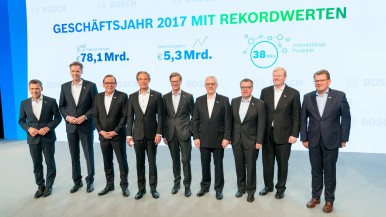
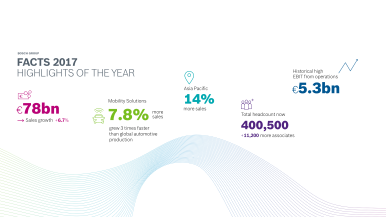
Stuttgart and Renningen, Germany – Bosch is aiming for further growth in 2018, despite the difficult economic climate. After achieving record results in 2017, and in light of economic and geopolitical risks, the Bosch Group expects its sales revenue to grow by 2 to 3 percent in 2018. In the first three months, the sales revenue generated by the company matched the high level of the same period of the previous year, and even increased by around 5 percent when adjusted for exchange-rate effects 1 . “Our company is unequaled when it comes to combining comprehensive connectivity expertise with broad industry and product know-how. This is the Bosch Group’s unique selling proposition,” said the Bosch CEO Dr. Volkmar Denner, speaking at the annual press conference in Renningen. Denner sees improving the quality of life and contributing to eco- and climate-friendliness at the top of Bosch’s agenda: “Our ‘Invented for life’ ethos is our motivation for developing the best possible technologies for environmental protection. We want to help keep people mobile, while improving air quality.” To make practically zero-emissions traffic reality, the company is making heavy investments – both in making electromobility a market success and in enhancing the combustion engine.Innovative diesel technology: unprecedented NOx emissions Bosch has now achieved a breakthrough in diesel technology: with their new diesel technology, Bosch engineers have succeeded in getting NOx emissions down to one-tenth of the legally permitted limit. On average, test vehicles equipped with the enhanced technology already emit no more than 13 milligrams of NOx per kilometer, or far less than the 120 milligrams that will be permitted after 2020. “There’s a future for diesel. It will remain integral to tomorrow’s mobility solutions,” the Bosch CEO said. More detailed information on these technological advances can be found here . 2017 in review: record sales revenue and earnings The year 2017 was an extremely good one for Bosch. The company generated sales revenue of 78.1 billion euros. This represents an increase of 6.8 percent, or 8.4 percent after adjusting for exchange-rate effects, which totaled some 1.2 billion euros. All business sectors contributed to these positive results. EBIT (earnings before financial result and tax) from operations reached 5.3 billion euros in 2017, thus improving by nearly 17 percent compared with 2016. “Both sales revenue and earnings are the highest ever in our company’s history. What’s more, EBIT from operations increased at a higher rate than sales revenue,” said Prof. Stefan Asenkerschbaumer, Bosch CFO and deputy chairman of the management board. The EBIT margin from operations came to 6.8 percent, or 0.6 percentage points higher than in the previous year. Research and development expenditure also remained on a high level. Last year, it came to some 7.3 billion euros. This is equivalent to more than 9 percent of sales. The ultimate IoT-related discipline: cross-domain ecosystems No other company offers as many real-world connectivity solutions as Bosch: aside from smart mobility, they include domains such as connected manufacturing (Industry 4.0), the smart city, and not least the smart home. So far, Bosch has put 170 in-house IoT projects into practice, focusing on fundamental challenges such as population growth, urbanization, and climate change. In 2017, the company sold some 38 million web-enabled products, roughly 40 percent more than in 2016. Today, Bosch employs more than 25,000 software engineers, no less than 4,000 of whom are engaged in developing solutions for the internet of things. The company increasingly sees future business prospects arising from the digitalization of entire ecosystems. Home Connect – the biggest IoT ecosystem for household appliances – has already been adopted by 28 industry partners. The Home Connect app can be used to operate everything from coffee makers to washing machines. Bosch has identified significant potential in cross-domain ecosystems that link different industries, such as “Logistics 4.0.” Such ecosystems bring together solutions for manufacturing processes, building services, security, and mobility – all areas in which Bosch plays an active role. As Volkmar Denner emphasized: “Cross-domain ecosystems are the ultimate IoT-related discipline. No other company is better qualified to realize them than Bosch. The competitive advantage offered by our diversification has never been greater.” Electromobility: striving for market leadership Bosch is working tirelessly to achieve a breakthrough for electromobility. In 2017, the company won 20 contracts to produce electrical powertrain systems, valued at a total of 4 billion euros. Bosch expects the mass market for electric vehicles to take off from 2020, and aims to be a leading player in that market. This is already the case in China, where Bosch is working with the U.S. startup Nikola Motor Company and the Chinese company Weichai Power, the world’s biggest manufacturer of commercial-vehicle engines, to promote the use of fuel cells in production vehicles. In addition to its components business, Bosch also sees a promising future in web-based services, such as the recently premiered system!e , to improve the viability of electric driving. Automated driving: from component sales to systems solutions Bosch is also making significant progress in the transition to automated driving. As early as 2019, the company expects to generate sales of two billion euros with driver assistance systems. Bosch is growing faster than the market, which is forecast to grow 20 percent this year. Sales of Bosch radar and video sensors, for example, are expected to increase by 40 percent. “More automation means greater technical complexity. In the future, our customers will need all-in-one solutions, not just discrete components. This is another area in which our systems expertise is an advantage,” Denner said. Some 4,000 engineers are working for Bosch on automated-driving solutions, 1,000 more than a year ago. Connected driving: entering the ridesharing business Connected mobility is another market in which Bosch expects to generate significant business. The value of this market is forecast to reach 140 billion euros worldwide by 2022. By 2025, there will be more than 450 million connected vehicles on the world’s roads. Bosch has entered the ridesharing business through its acquisition of the U.S. start-up Splitting Fares (SPLT) . Bosch has brought SPLT and more than 20 other mobile service providers together in its new Connected Mobility Solutions division. They include the COUP e-scooter sharing service, which is soon to expand its business to Madrid, Spain. Results by business sector for 2017 All business sectors reported improved sales revenue in 2017: Mobility Solutions increased its sales revenue by 7.8 percent (9.4 percent after adjusting for exchange-rate effects) to 47.4 billion euros. This is three times the growth rate for the automotive industry worldwide. This sales revenue includes, for the last time, the contribution by the Bosch Starter Motors and Generators division, which was sold at the end of 2017. The margin from operations was 7.3 percent, or one percentage point higher than in the previous year. In the Consumer Goods business sector, sales revenue amounted to 18.4 billion euros. This represents an increase of 4.5 percent, or 6.7 percent taking exchange-rate effects into account. The margin from operations was 8.1 percent. The Industrial Technology business sector increased its sales revenue by 7.8 percent to 6.8 billion euros, or by 9.2 percent after adjusting for exchange-rate effects. The margin from operations was 3.3 percent, up 2.1 percentage points on the previous year. The Energy and Building Technology business sector achieved sales of 5.4 billion euros, which equates to an increase of 4.1 percent, or 5.8 percent after adjusting for exchange-rate effects. The margin from operations was 4.4 percent. Results by region for 2017 The Bosch Group generated sales revenue of 40.8 billion euros in Europe in 2017. This represents an increase of 5.6 percent, or 6.6 percent taking exchange-rate effects into account. The company benefited from the recovery of important western European markets and the good economic developments in Germany. Sales revenue from eastern European countries such as Russia, Romania, and Turkey also increased significantly. Strong growth was also reported in Asia Pacific , including Africa . Sales revenue increased by 13.5 percent (16.5 percent after adjusting for exchange-rate effects) to 23.6 billion euros. After adjusting for exchange-rate effects, the group’s sales revenue in North America remained on the previous year’s level. Due to lower output in the automotive sector and negative exchange-rate effects, sales revenue dropped by a nominal 2 percent to 12.1 billion euros. In South America , by contrast, sales revenue increased substantially, rising 16.4 percent (13.2 percent after adjusting for exchange-rate effects) to 1.6 billion euros. Headcount: continuing demand for IT and software experts At the reporting date of December 31, 2017, the Bosch Group had around 402,000 associates worldwide. This represents a year-on-year increase of 12,900. Recruitment was particularly strong in Asia Pacific and in central and eastern Europe. In Germany, the workforce expanded by around 3,700 to a total of 137,700 associates. Bosch is looking to recruit more trained specialists and executives in 2018, with a special focus on IT and software engineers. An overview of key figures can be found here .

Growth, earnings, environmental protection: in its quest to make mobility as emi ...

25.04.2018

Press release

Business/economy

Growth, earnings, environmental protection: in its quest to make mobility as emi ...

Presentation by Dr. Volkmar Denner, chairman of the board of management of Robert Bosch GmbH and Prof. Stefan Asenkerschbaumer, deputy chairman of the board of management, at the annual press conference on April 25, 2018 Ladies and gentlemen, we deliberately chose not to begin this annual press conference with the traditional presentation of our financial position. On behalf of the board of management, I would like to thank you for joining us today. Instead, we’ve started with our research, which nicely illustrates what forms the bedrock of our business. I’m talking about technology – the breadth and depth of our expertise that makes our commercial success possible. Thank you, Mr. Jadidi, for providing a brief insight into our work on artificial intelligence. Even this glimpse should have convinced you that the gulf between our present and future business areas is not as wide as you might have thought. In fact, the opposite is true: at Bosch, advances in artificial intelligence mean advances for the combustion engine, too. And a major theme of this press conference will be precisely how we can decisively improve air quality with both state-of-the-art combustion engines and electrical powertrains. For us, clean air in our cities, protecting the environment, and combating climate change are not distant, abstract goals, but something our engineers work hard on every single day. A company such as Bosch, with its exceptional technological prowess, must do everything in its power to ensure the world and our cities remain good places to live.The issues of climate change and urban air pollution are highly complex. In addition to technological solutions, they always require political decisions as well. To name just one example, industry shouldn’t wait for the long drawn-out implementation of the Paris climate agreement – it should anticipate it. That is precisely what I consider to be the deepest core of Bosch’s strategic imperative, “Invented for life” – applying the best technology possible to protect our natural environment, even above and beyond political directives. For road traffic, this means we want to make it accident-free and stress-free, but especially as emissions-free as possible – regardless of whether the vehicle consumes fuel or electricity. That’s why we are investing billions of euros in electromobility. Today we say there’s no car on the planet without a bit of Bosch; tomorrow we will say no electric car without a bit of Bosch. At the same time, we are working on the future of diesel. Our engineers have developed solutions over the past few months that significantly reduce the emissions of diesel engines. This breakthrough offers the opportunity to shift the heated debate over diesel into new territory and, hopefully, bring it to a close. With this new exhaust technology, blanket driving bans in the centers of the world’s major cities will no longer be an issue. Why? Because we now have the technology to resolve the problem of nitrogen oxides in road traffic. Diesel can now resume its success story. It was diesel’s critics that particularly spurred our engineers on. Their results are plainly visible, or better yet: measurable. Bosch technology allows today’s real diesel emissions to fall far below the legal limits due to take effect in 2020. This is the technology that Bosch stands for: “Invented for life,” not for the lab. But our technological breakthrough is only one part of the story; Bosch wants to go further. What we want is more transparency and realism, whenever measurements relating to road traffic are made. In other words, we’re not just aiming to measure and reduce real driving emissions (RDE), as that would leave out consumption and CO 2 . Instead, we have to take real driving consumption (RDC) into account. From RDE to RDC – this summarizes our objective. Creating more clarity for climate action calls for consumption and CO 2 to be measured under realistic conditions. Low fuel consumption in a test bay does little to help the climate – we must make room for reality here, too. Transparency with regard to CO 2 also means including all carbon-dioxide emissions attributable to road traffic: from fuel production and electricity generation to actual consumption on the road. Taking such a comprehensive view may result in the realization that it’s better to drive the right diesel vehicle than the wrong electric car. The main point here is not an either-or proposition between combustion engines and electromobility – instead, our aim is transparent eco- and climate-friendliness in all drive systems. Of course, this is also an important issue for Bosch from a commercial point of view. Automotive drive systems, whether conventional or alternative, are our core business – we’re talking about tens of thousands of jobs. There is no other domain in which our company’s environmental, commercial, and social responsibilities intersect to the same extent. That is why we’ve chosen it as the focus of this annual press conference. The presentations today will also serve to explain our business situation. In this regard, there are three key points: First, we can look back on a successful financial year in 2017. Sales increased more than expected, and margin saw encouraging growth, too. This is due to all Bosch associates, and I wish to thank them for that. Second, our forecasts for the business year 2018 are more cautious. We see several risks, but still aim to further increase sales and especially margin as well. Third, we are not only securing our existing business areas this year, but planning to open up new ones: electromobility and connectivity. I will go into this point in more detail when I talk about strategy. Now, however, I will hand over to Mr. Asenkerschbaumer, who will provide a review of last year and a forecast for this one ... The financial figures: a successful 2017 Ladies and gentlemen, 2017 was a successful year for the Bosch Group. Across the board, I can present you with good figures. This success was partly due to the generally robust economic fundamentals: the global economy did better than we had originally anticipated at last year’s annual press conference – and it outperformed the previous year as well. Global GDP climbed 3.2 percent, compared with 2.7 percent in 2016. Automobile production worldwide likewise exceeded our expectations in 2017, with growth of 2.4 percent. Yet, the momentum was clearly down compared with 2016, when the economy grew roughly 4.5 percent. What was pleasing was the substantial recovery of the mechanical engineering sector. Positive stimuli came from all regions, but most notably from China. Other segments of importance for us, private consumption and global construction activity, also developed favorably overall worldwide. At 78.1 billion euros, the Bosch Group's sales revenue is slightly higher than the preliminary figure published in January. Compared with the previous year, sales revenue increased substantially by 6.8 percent. Yet at roughly 140 million euros, there were no appreciable consolidation effects in 2017. The sale of the Starter Motors and Generators division completed at the end of the year will not impact sales revenue until 2018. That said, reported sales revenue was again burdened by substantial exchange-rate effects of 1.2 billion euros. Adjusted for these effects, our sales revenue grew by an even greater margin of 8.4 percent. All business sectors, and especially Mobility Solutions, grew their sales revenue significantly in 2017. Here, sales revenue increased 7.8 percent, and indeed by as much as 9.4 percent, if we adjust for currency effects. We did well across our entire product range – in powertrain technology with state-of-the-art systems for gasoline direct injection, but also with advanced diesel technology in the commercial vehicles segment as well as with exhaust-gas treatment systems. That allowed us to compensate for lost ground in the European passenger-car segment. In 2017, we again benefited from continued growth in demand for driver assistance systems, advanced display and infotainment systems, and new generations of thermal management systems. Our e-bike business was very successful, as were our other activities in the two-wheeler market. In the Industrial Technology business sector, specifically in the Drive and Control Technology division, we benefited from the recovery of the mechanical engineering market, exciting innovations, and the realignment undertaken in recent years. Sales revenue rose 7.8 percent to 6.8 billion euros, or by as much as 9.2 percent after adjusting for exchange-rate effects. The division is driving forward the expansion of its activities in Industry 4.0, both as a leading user in our own plants and as a leading provider to our customers. Yet the focus here is not merely on new plant, but also on equipping and modernizing existing plant, where data analytics and connectivity can deliver substantial gains in productivity. In contrast, we are not satisfied with the downward sales trend in the Packaging Technology division. However, both the Consumer Goods and Energy and Building Technology business sectors posted an encouraging increase in their sales revenue. In 2017, Consumer Goods generated sales revenue of 18.4 billion euros, thus climbing 4.5 percent in nominal terms or 6.7 percent after adjusting for exchange-rate effects. Both its divisions – BSH Hausgeräte and Power Tools – contributed to this development. The focus at BSH Hausgeräte was on connectivity and the expansion of its international business, particularly in high-growth markets such as China and India. Power Tools is proving successful with innovations that are very closely tailored to the needs of users and is now in the process of expanding its international business in emerging markets as well. Sales revenue in the Energy and Building Technology business sector rose 4.1 percent to 5.4 billion euros, or by 5.8 percent if we adjust for currency effects. Because of its strong market position in the United Kingdom, the Thermotechnology division in particular was hit hard by the weakness of sterling. An important driver here is increasing connectivity, with the result that the Thermotechnology and Building Technologies – formerly Security Systems – divisions are increasingly collaborating in joint projects. In this context, the Security Systems division was renamed Building Technologies to reflect its significantly broader portfolio, which now extends far beyond security technology. For instance, we are considerably expanding the installation business in the building and energy sector. The Bosch Global Service Solutions division was again able to produce double-digit growth. Business performance varied widely from region to region. Sales in Asia Pacific again saw double-digit growth of 13.5 percent, or as much as 16.5 percent after adjusting for exchange-rate effects. Developments in Europe were also pleasing, with growth of 5.6 percent, or 6.6 percent if we adjust for currency effects. In South America, we were able to recover from the past years of economic downturn and generate growth again, up a nominal 16.4 percent, or 13.2 percent after exchange-rate effects. In North America, by contrast, we had to shoulder a nominal 2 percent contraction in sales revenue owing to the challenging economic fundamentals in the automotive sector there. After adjusting for currency effects, sales revenue stagnated. Aside from sales revenue, we also managed to substantially boost earnings overall and in particular our EBIT margin in 2017. When looking at the figures for 2016, it should be noted that our presentation of 2016 earnings partly reflects a change of methodology as regards the net interest expense on pension provisions. As is common practice at most companies, we now present the net interest expense under the financial result; the figures for the previous year have been restated accordingly. EBIT thus more closely reflects the development of operations. On a like-for-like basis as well, our 2017 EBIT of 5.3 billion euros and our operating margin of 6.8 percent were significantly up on the previous year. The difference between this figure and the disclosed 2017 EBIT of 4.9 billion euros essentially stems from depreciation and amortization in connection with the full acquisition of the former joint ventures BSH Hausgeräte and Automotive Steering in 2015. A look at the development of earnings broken down by business sector also reveals a pleasing picture. Here too, we have restated the figures for 2016 to ensure comparability as regards methodology. Mobility Solutions achieved an operating result of 3.4 billion euros, compared with 2.8 billion euros in the previous year. In the Industrial Technology business sector, the good development of business coupled with the positive impact of realignment measures led to an increase in the operating result to roughly 220 million euros compared with roughly 75 million euros in 2016. We were very successful in the Consumer Goods business sector, which again returned an operating result of 1.5 billion euros, and once again an operating margin in excess of 8 percent. Despite significant exchange-rate burdens, the Energy and Building Technology business sector managed to match the previous year’s earnings level. We achieved this good result despite the substantial upfront investment in the transformation that lies ahead. Research and development cost reached approximately 7.3 billion euros, compared with 6.9 billion euros in the previous year. Owing to the good development of sales revenue, research and development cost as a percentage of sales decreased slightly to 9.3 percent, compared with 9.5 percent in the previous year. We are making heavy upfront investments in driver assistance systems – more specifically in autonomous driving functionalities, display and infotainment systems, and sensor technology. At the same time, we are still focusing on developing state-of-the-art powertrain technology, both for even more efficient combustion engines and for e-mobility. Aside from our expenditure on R&D, we have also increased slightly our expenditure on property, plant, and equipment. After rounding, however, expenditure here was still on the previous year's level of 4.3 billion euros. These heavy upfront investments related to efforts to strengthen technological expertise and competitiveness, to new product launches, and to the expansion of our manufacturing capacity. Again, Mobility Solutions should be especially mentioned in this context. Roughly three-quarters of total capital expenditure, or 3.3 billion euros, was injected into this business sector. We also greatly increased capital expenditure in Consumer Goods to 800 million euros from 720 million euros in the previous year, partly in connection with the expansion of manufacturing capacity outside Germany. Just one last remark while we're on the subject: The substantial changes in R&D cost and capital expenditure from 2014 to 2015 are attributable to the first-time consolidation at the time of the former joint ventures BSH Hausgeräte and Automotive Steering. I want to only briefly touch on the statement of financial position. It continues to be extremely robust, and there were no major changes to its structure compared with the previous year, with one exception: owing to the good development of earnings, we were able to raise the equity ratio to roughly 46 percent, and that from the previous year's already very high level of roughly 44 percent. Even after the repayment of bonds and liabilities totaling roughly 1.5 billion euros, we still have a high liquidity as reported in the statement of financial position of 16.5 billion euros, compared with 16.7 billion euros in the previous year. So what is the outlook going forward? In the initial months of 2018, the economy was certainly robust, although we see substantial risks. A year ago, I had already expressed my concerns about a growing trend toward protectionism. These concerns have since proved justified. Still, we expect that global trade will continue to grow, although possibly at a slower pace. At the end of the day, countries face high stakes, given the complexity of today's integrated and multi-layered international supply chains within and between companies. So we also see good chances that the trade conflict triggered by the United States can be resolved at the negotiating table, at least as concerns U.S.-European trade. An escalation between the United States and China, with repercussions for global trade as a whole, poses the biggest risk factor. That could significantly slow down global growth, at least temporarily. Even though we currently believe that there is only a limited probability of the trade conflict escalating, we remain very cautious. Although the world economy's condition is still robust, our budget factors in global economic growth of only 2.6 percent for 2018. Despite the economic risks, we want to increase our sales revenue for 2018 – on a like-for-like basis, and thus adjusted for the baseline effect of the divestment of Starter Motors and Generators – by between 2 and 3 percent. In the first three months of the current year, our sales revenue has matched the high level of the same quarter of the previous year. Adjusted for exchange-rate effects, it is roughly 5 percent higher. It is especially important for us to ratchet up our profitability further. This is a tall order, also in light of the still very heavy upfront investments to be made in areas of future importance and of the major transformation efforts ahead. Nonetheless, we are aiming for a further year-on-year improvement in our operating margin again in 2018. And with that, I would like to hand back to Mr. Denner. How will we drive tomorrow? Strategy for the transformation in mobility ...Thank you, Mr. Asenkerschbaumer. Taking a more strategic view, one question in particular occurs to me: how will we drive tomorrow? This touches on exactly where change is coming particularly quickly: nowhere as fast as in our largest business sector, Mobility Solutions. The transformation is happening in many areas – for example, in the public debate about environmental protection on the road, but also in the everyday experience of stop-and-go traffic. Both change the importance accorded to the car, and people’s willingness to switch to other modes of transportation is rising. So, how will we drive tomorrow? As emissions-free, accident-free, and stress-free as possible, is the answer I gave earlier. This is the vision we are pursuing with our three development paths, which we staked out earlier than others: vehicle electrification, automation, and connectivity. And we especially consider connected mobility to be flexible mobility, allowing users to switch between car, bike, and rail. Our strategy is to pursue a variety of technologies. This variety can be seen especially in our new Powertrain Solutions division. We established this division to develop the best drive systems of the future. This means, for one thing, that we are committed to electromobility – fully and in all its facets: hybrids, battery-driven powertrains, and fuel cells. Our electrical powertrain components already feature in more than 800,000 vehicles around the world. No other company is working as broadly on electromobility as Bosch – from bicycles to trucks. And of course we offer connected recharging services to make electric driving suitable for everyday use. At the same time, we are continuing to refine combustion-engine technology. Until electromobility is ready for the mass market, we need a highly efficient combustion engine that produces the lowest emissions possible. We are currently partnering with automotive manufacturers on some 1,000 RDE projects, with an eye to ensuring new vehicles comply with the Euro 6 emissions standard on the road, too. But we and our customers want more: not only to fall well within the limits, but to push the boundaries of what is technically feasible. It is exactly here that our engineers have made an innovative leap. What will happen to diesel? New answers to an ecological question In essence, we are talking about nothing less than a new technological answer to a commercial and ecological question: what will happen to diesel? Following our breakthrough, we are convinced that in the future, no one will be able to impose a blanket ban on diesel in cities – it will keep its place in urban traffic, too, whether for tradespeople or commuters. But to start at the beginning, what is the key problem of emissions in road traffic that still needs to be solved? Many assume it is particulates, but that’s not the case. Since the introduction of particulate filters, diesel engines have ceased to be a source of particulate pollution in cities, and spark-ignition engines need to follow suit as quickly as possible. Indeed, since mid-2017, Bosch has no longer accepted any orders for gasoline systems without filters. The main problem posed by diesel engines is nitrogen-oxide emissions. The challenge is to bring them below the limits not only on the test stand, but on the road as well. It is precisely this hurdle that our engineers have now overcome, exceeding expectations with pioneering solutions that will allow automakers to come in well below the legal limits. The new kind of tests – moving away from the test stand and toward the road – have especially driven our progress. In fact, since portable emission measurement system (PEMS) technology became available for passenger cars, our engineers have gained a deep understanding of the technical processes involved in RDE tests. We have spent decades refining the diesel engine into a high-tech system, and now we are building on that. Now the tests work on the road as well and are serving as a catalyst for development. As a result, we are achieving record outcomes that would have been thought impossible just a few months ago. First, I will give you our average emissions reading from the legally required RDE trip, covering a mix of freeways and urban and extra-urban roads: the average reading is just 13 milligrams of nitrogen oxide per kilometer – that’s roughly a tenth of the European legal limit set to go into force in 2020. By comparison, the Euro 6 standard allowed 80 milligrams of nitrogen-oxide emissions per kilometer in the test bay, and is currently 168 milligrams on the road, set to decrease to 120 milligrams as of 2020. Using our new exhaust technology, automakers will be able to come in well below these limits. That takes care of RDE. However, our engineers have taken a close look at a place where emissions are particularly difficult to reduce: in the city. Specifically, they staked out the toughest route through Stuttgart, one much more challenging than the usual test trip. “More challenging” means plenty of gradients and heavy traffic. Here I would like to illustrate our progress with a time series of the average nitrogen-oxide readings: 90 mg/km in 2016, 80 mg/km in 2017, and just 40 mg/km in 2018. In other words, We have the technology that enables the automotive industry to also meet the limits due to take effect in 2020, no ifs, ands, or buts – even in stop-and-go traffic, even on the gradients of the Stuttgart route, and all that even in cold weather. Sporty driving? Cold weather? Preventing nitrogen oxide spikes This means diesel emissions stay low, independent of driving style and temperature. Sporty driving? Cold weather? Our readings indicate that neither is an issue anymore. Regarding driver influence, our answer is a responsive air flow management system for engines. The more dynamic the driving style, the more dynamic our exhaust gas recirculation system becomes. And our preferred approach for handling the effect of temperature is sophisticated thermal management. It is precisely in this area that our engineers finally achieved a breakthrough: by actively managing the exhaust temperature, we can ensure the exhaust system operates in a stable temperature range that allows it to reduce nitrogen oxides especially efficiently. So even when outside temperatures are rock-bottom, emissions will stay low. When used properly, our technology is so robust that diesel engines will be driving on the road in true eco-friendly fashion. But there are two key points to consider: When will this new exhaust technology be available? And how expensive will it be? First, our new solutions are available to automakers effective immediately and can be incorporated into production projects. Second, diesel engines will not become much more expensive. Everything we have fitted to our test vehicles to reduce emissions is close to entering production – no additional hardware components needed. We are pushing the boundaries of what is technically feasible, but by refining existing technology. For customers, this means diesel will become a low-emissions technology, which was unthinkable until just recently, but will still be affordable. Air quality in cities? Traffic is playing an ever smaller role I would like to stay with the ecological viewpoint for a moment. After all, people are less concerned with what comes out of the tailpipe than with what they themselves breathe in. So what concrete effect does our progress with exhaust technology have on urban air quality? We commissioned an independent engineering firm to conduct a precise analysis, and deliberately asked them to analyze data from Neckartor in Stuttgart – one of the most heavily trafficked monitoring points in the whole of Germany. Even at this location, our new diesel technology produces extremely low nitrogen-oxide emissions. And this of course leads to cleaner air. The results of the data analysis are clear: If all diesel vehicles were equipped with our latest exhaust technology, their share of local pollution would be negligible, and they would remain well within the legal limits, even at Neckartor. This brings us closer to a major goal, which seemed out of reach until only recently: a combustion engine that has virtually no impact on the ambient air. To improve air quality still further in the future, we are not going to let legal limits determine our targets. Instead, we will look to what is technically feasible. To that end, we will continue to systematically develop this new diesel technology – with no small help from artificial intelligence, as Mr. Jadidi demonstrated earlier on. Ladies and gentlemen, this is no ordinary annual press conference. For this reason, I’d now like to hand over to an engineer who, together with his team, was directly involved in the breakthrough in exhaust-gas treatment. Mr. Bareiss is a section head in our diesel systems engineering unit … … Many thanks, Mr. Bareiss The bottom line is that not only are we approaching a truly thrilling electrified future, but we are hard at work on revolutionizing a technology that is over 100 years old. Combustion engines – whether powered by diesel or gasoline – will soon emit so little in the way of particulates and nitrogen oxides that they will have no significant impact on the air. For anyone with a pragmatic, non-ideological interest in improving the air in our cities, diesel engines and their further technological development will obviously be part of the solution. After this ecological rehabilitation, diesel can take off again. It is not combustion engines that are being made obsolete, but rather the debate about their imminent demise. Clarity for climate action: a call for realistic CO 2 values This is all the more reason for us to keep an eye on the issue of climate action. The future of humanity is at stake – this is a point on which there was practically global consensus even before the Paris agreement. That is why it is so important to be more up-front about carbon-dioxide emissions from road traffic, too. At Bosch, we have seen how focusing on real driving emissions has stimulated technological progress. A similar innovation effect may arise from measuring real driving consumption. Measuring fuel consumption and in turn CO 2 emissions on the road under real conditions – this will ensure transparency regarding climate-friendliness. We will see even more clearly than before where we need to take action in order to improve the carbon footprint of road traffic. Before going further, we should note that advances in the battle against nitrogen-oxide emissions are by no means won at the cost of efficiency, meaning there is no appreciable increase in consumption and CO 2 . Diesel thus retains its ecological advantage. On the road, a diesel engine emits 15 percent less carbon dioxide on average than a comparable gasoline engine. And in the steps we have taken to curb nitrogen-oxide emissions, we have done everything to maintain this advantage: in diesel engines, fuel consumption and CO 2 emissions increase by no more than 1 or 2 percent. This means diesel engines are still highly efficient. And that’s good news, because they will remain a necessary part of climate action on the road at least until electromobility becomes ready for the mass market. But to repeat what I said earlier, we at Bosch see a clear advantage in aligning our efficiency and climate action targets more closely to reality. That is because, as every driver knows from their own experience, the previous European driving cycle NEDC left an appreciable gap between certified and actual consumption. The move to the globally harmonized WLTP test cycle will already narrow that gap. But Bosch argues for going a step further: Make consumption under real on-road driving conditions, or real driving consumption, a yardstick for vehicle CO 2 emissions. This has the added benefit of creating more transparency for customers. The more realistically we can measure CO 2 emissions, the more effective we can be in the fight against climate change. Anyone in favor of climate action cannot ignore road traffic’s overall carbon footprint. In this respect, Bosch argues for taking a comprehensive view – “well to wheel,” right from the source in other words, instead of merely “tank to wheel.” When it comes to global climate, it is not just a vehicle’s direct emissions that count, but also the emissions from fuel production and electricity generation. We would like to see this overall footprint included in the next round of CO 2 legislation. Drivers of electric vehicles will no longer be able to believe that they are carbon-neutral – in other words, with zero CO 2 emissions. If Europe’s current energy mix were to be included in the calculation, a compact electric car would have a carbon footprint of 40 grams per kilometer – and if this is based on Germany’s energy mix, it would be as much as 80 grams. When it comes to their climate-friendliness, combustion engines and electrical powertrains are not that far apart now, nor will they be in the near future, as a recent study by the German automobile club ADAC has shown. In developing both powertrain types, we have to exhaust their improvement potential as quickly as possible – applying the right levers particularly with infrastructure and the policy framework. This is a task for all of society, and has two objectives: ensuring that combustion engines increase their use of lower-CO 2 fuels, and that electrical powertrains use more renewable energy. We believe this to be a more nuanced approach to climate-friendliness on the road. The ethics of the best technology possible: new development principles Now, you may be asking yourselves: Why does Bosch want to do more to protect the environment and combat climate change than currently required by law? I could provide an easy answer to this question and speak glibly about our ambitious engineers who want to turn technological possibilities into reality. But there is more to it than that: our company mindset is changing, and our new product development code embodies this change. This code contains three crystal-clear principles: One, in our product development, we prohibit the installation of functions that automatically recognize test cycles. Two, our products are not allowed to be optimized for test situations. And third: normal, everyday use of our products should safeguard human life as well as conserve resources and protect the environment to the greatest possible extent. We represent these views externally as well, and in unclear cases, Bosch values take priority over customer wishes. Internally, we view the principles as a way to guide and motivate our engineers. By the end of 2018, we plan to have trained 70,000 associates on these principles – it’s the largest training initiative in Bosch’s history. Tomorrow’s mobility: progress on all development paths We are no less serious about our efforts regarding the future of mobility. For us, that clearly means driving forward electromobility as well as refining the combustion engine. Bosch is bringing new energies to the powertrain in both areas. We won some 20 major orders for drive systems in electric cars in 2017 alone, worth a total of almost four billion euros. That includes major orders for our electric axle. We want to become the market leader in the emerging mass market for systems and services in electromobility – a position we already hold in China, currently the biggest and fastest growing electromobility market. Our progress on the two other development paths toward the future of mobility is just as rapid. As the industry moves toward automated driving, we’re seeing the continued strong growth of driver assistance systems. Market volume is poised to grow by 20 percent in 2018, and Bosch’s sales by even more – that figure should exceed two billion euros in 2019. We project particularly strong growth in sales of our sensors – radar and video are to increase by 40 percent this year. Safety is the main factor advancing further vehicle automation. On this path, technical complexity will increase – yet another reason we are predicting a shift from the pure component business to the higher-quality systems business. Bosch already has a good 4,000 associates teaching vehicles how to drive, 1,000 more than a year ago. Beyond the car, Bosch is working on other aspects of flexible mobility of the future. Our goal is to connect four-wheeled travel with two-wheelers and rail as seamlessly as possible. To that end, we are pursuing a wide range of projects: Coup, our e-scooter sharing service in Berlin and Paris, is heading for Madrid this summer, and our fleet will more than double to 3,500. And this year we are implementing driverless parking in connected parking garages not only with Daimler, but also with e.GO. Now we have consolidated our connected driving activities in a new division, Connected Mobility Solutions, with some 600 associates in Germany and China. This division has also just entered the ridesharing business and expects significant double-digit growth rates over the next few years. Diversification pays off: the ultimate IoT-related discipline This example alone shows how connectivity is becoming a more integral, normal part of our business. The same is happening with connected manufacturing, known in Germany as Industry 4.0, as it moves beyond the project stage. Here, too, we have established a strong and effective business unit: Bosch Connected Industry, with 500 associates in Germany, Hungary, and China. We are translating connectivity into business beyond mobility as well. I presented our progress in this area a few weeks ago at Bosch ConnectedWorld in Berlin, so here I just wish to mention the three main steps we are taking as we tap the commercial potential of the internet of things – our IoT journey, if you will: Making our products web-enabled, building up our software expertise – this is only the first step. We sold 38 million web-enabled products in 2017, 11 million more than the previous year. At the moment we employ some 25,000 software engineers, about 4,000 of whom work solely on the internet of things. Bosch has thus long been a software company. But since we have also remained an industrial enterprise, we connect not only digital worlds, but real ones as well. The second step is the digitalization of ecosystems in existing industries. Our subsidiary BSH serves as a prime example: its Home Connect is the largest ecosystem in the home-appliance industry – with 28 partners from Bosch Smart Home to Amazon’s Alexa. Dishwashers that notify you when you’re low on detergent, a recipe app that encourages you to cook along to videos and photos – this makes housework feel less like work. Linking various industries and domains to digital ecosystems – this is the third step, and the “grandaddy” of all IoT disciplines. For example, Bosch views Logistics 4.0 as the logical extension of Industry 4.0 – the objective is to connect the entire value stream, from supplier to factory to customer. And it is precisely here where our diversification reveals a new strategic advantage: systems for mobility, for industry, for buildings, security, and energy – we supply them and we connect them. This is also the only way to realize smart city solutions. Diversification has never been as great a strategic advantage as in the present age of connectivity. How Bosch sees itself: technology- and values-based in equal measure This point about the productivity of our broad portfolio brings me to the end of my presentation. Bosch has taken on no small strategic task: We are using connectivity to create new advantages from our diverse business activities. We are tapping new areas of business in mobility, and securing existing ones. We see ourselves as a technology- and values-based company. Specifically, we want to help enable both individual mobility and environmental protection. It is not enough that we are achieving a breakthrough in the battle against nitrogen-oxide emissions in real driving conditions; we also want to achieve more transparency in climate-friendliness on the road. A company such as Bosch is not focused solely on laws, but on values – in other words, we want to do more than we are required to. And it is with our technology that we can position ourselves at the forefront of the environmental movement.


A successful business year in 2017

30.01.2018

Press release

Business/economy

A successful business year in 2017

Presentation by Dr. Volkmar Denner, chairman of the board of management of Robert Bosch GmbH and Prof. Stefan Asenkerschbaumer, deputy chairman of the board of management of Robert Bosch GmbH, at the press briefing on January 29, 2018 Check against delivery.Ladies and gentlemen, Welcome to the 2018 press briefing on our preliminary figures. Thank you for being our guests this evening. We are also pleased to be welcoming international media to this event for the first time. Before we begin with the traditional presentation of our preliminary figures, I would like to say a few words about today’s event. We are here in the new offices of Bosch’s start-up platform, soon to be home to some 200 associates. Of those 200, 150 will work in innovation teams and 50 in start-ups currently supported by the platform; you had the chance to learn about one of these in more detail earlier. Werkzentrum Weststadt, the complex you are in this evening, offers our young entrepreneurs a professional home. Here they can create business models for the connected world, enjoy a creative freedom that allows ideas to grow, and flourish as entrepreneurs. From associate to CEO – here, short career paths are possible and desired. What role will new forms of leadership and collaboration play at Bosch in the future? And not just here in Ludwigsburg, but throughout the entire company? I will go into this in more detail later. After all, the ubiquitous topic of connectivity is not only a question of technology, but also one of corporate culture. First on the agenda this evening is a review of the 2017 business year, and an initial outlook for 2018. What progress is Bosch making with digital transformation? What kind of business success are we achieving with connectivity? This evening, we will show that, for Bosch, connectivity and digitalization are not mere hype or some topic of the far-off future. The company’s transformation has become part of day-to-day operations and is firmly anchored there. Bosch aims to be a leading IoT company. This has long been the case for our mobility solutions business, so we are taking that as our model – with foresight and especially with firm commitment. The transformation provides us with a further opportunity to show that excellence is not only something that exists on paper at Bosch, but in practice as well – in both a technological and a commercial sense. The digital transformation means a major break with the past, but it also offers a promising future. Connectivity delivers technical solutions for many fundamental challenges: population growth, urbanization, aging, and climate change. Our planet can only provide a livable home to billions of people if we find innovative solutions to the most pressing issues of our times. Such solutions need to be smart, connected, and digital – precisely what we are working on. Before we go into the details of the preliminary 2017 figures, I wish to say one thing in our characteristically understated way: we didn’t do too badly. In 2017, we exceeded our growth forecast, and further improved our result. Bosch remains on a growth course. Mr. Asenkerschbaumer will now present the details.Business year 2017: expectations exceeded, targets met Thank you, Mr. Denner. Good evening, ladies and gentlemen. I will start off with the highlights of the preliminary figures for 2017: 78 billion euros – sales in 2017 6.7 percent – sales growth in 2017 5.3 billion euros – EBIT from operations in 2017 6.8 percent – EBIT margin from operations in 2017 In business terms, 2017 can be summarized as follows: expectations exceeded, targets met. According to preliminary figures, Bosch Group sales rose from 73.1 billion euros to around 78 billion euros – a new record for our company. Sales growth amounted to 6.7 percent, or 8.3 percent after adjusting for exchange-rate effects. As in 2016, last year’s sales results were negatively impacted by exchange-rate effects to the tune of some 1.2 billion euros.Development of individual business sectors Now I’d like to review how our various business sectors developed. Encouragingly, all business sectors saw considerable growth in 2017. Sales in Mobility Solutions rose by 7.8 percent to 47.4 billion euros. Adjusted for exchange-rate effects, that figure is 9.2 percent. This means the business sector outpaced global automotive production by a factor of three. Many factors drove this highly positive development, including strong demand for diesel injection systems, especially from the commercial-vehicle segment, for gasoline injection systems, and for driver assistance and infotainment systems. Sales generated by the former Starter Motors and Generators division, now SEG Automotive, were included for the last time. We closed on the sale of the business to a Chinese purchaser consortium at the end of 2017. In the Consumer Goods business sector, BSH Hausgeräte and Power Tools generated sales of 18.5 billion euros. This equates to an increase of 4.5 percent, or 6.7 percent when adjusted for exchange-rate effects. Both divisions’ connected product innovations for the home and garden are enjoying ever more popularity. We were particularly pleased with the development of the Industrial Technology business sector. After two years of declining sales, the sector saw powerful growth of 7.7 percent, or 8.5 percent when adjusted for exchange-rate effects. Sales increased to 6.7 billion euros, thanks to the Drive and Control Technology division. Following a reorganization, the division has regained its former strength, and thus demonstrates how restructuring can encourage growth. The Energy and Building Technology business sector achieved sales of 5.4 billion euros, an increase of 3.1 percent, or 4.8 percent after adjusting for exchange-rate effects. Consumers in 2017 wanted connected solutions for heating and air conditioning, plus smart technology for building automation and security. Our services business continues to exhibit strong growth.Business developments by region Now to the development of sales in the individual regions. Overall, all regions except North America saw growth in 2017. In Europe , Bosch’s business developed well, with sales rising 5.5 percent (6.3 percent after adjusting for exchange-rate effects) to 40.7 billion euros. One of the reasons was continuing growth in western and central Europe. Bosch’s growth in North America was at the same level as the previous year after adjusting for exchange-rate effects. Sales reached 12.1 billion euros, a nominal decline of 2.3 percent. Growth in the automotive industry in particular failed to meet expectations. In South America , the recovery continues with double-digit sales growth of 15 percent. Sales now stand at 1.6 billion euros. After adjusting for exchange-rate effects, this is an increase of 12 percent. Relevant markets for Bosch, such as agriculture, automotive, and pharmaceuticals, continue to recover and are performing well. In Asia Pacific , the Bosch Group generated sales of 23.6 billion euros. Compared to last year, this is a significant increase of 14 percent, or 17 percent after adjusting for exchange-rate effects. The primary driver of this growth was positive business development in China and India.Development of result in 2017 Ladies and gentlemen, the improvement in our EBIT from operations (earnings from operations before interest and taxes) was even better than our positive sales development might suggest. According to preliminary figures, in 2017 the Bosch Group recorded EBIT from operations of 5.3 billion euros – another record high. This equates to an EBIT margin from operations of 6.8 percent. With this, we have surpassed last year’s EBIT from operations of 4.3 billion euros and EBIT margin of 5.8 percent. The increase in EBIT margin from operations by a full percentage point is primarily due to the positive business performance, as well as in small part to a change in how interest expenses for pension provisions are disclosed. Calculated on a like-for-like basis, the EBIT margin has increased by roughly 0.6 percentage points.Headcount development in 2017 As of December 31, 2017, Bosch Group headcount had increased by some 11,200 to approximately 400,500 associates worldwide. New associates were taken on primarily in Asia Pacific and in central and eastern Europe. In Germany, headcount grew by 3,800 associates. How can we summarize business developments in the Bosch Group last year? Sales growth – both nominal and adjusted for exchange-rate effects – exceeded our expectations. Bosch remains on a growth course. Development varied by region and by business sector. However, all business sectors saw considerable growth and contributed to the group’s overall growth. However dynamic the transformation in technology and markets, Bosch is steadfast in its investment in the future. Research and development spending totaled 7.5 billion euros last year. Business developments in 2017 would indicate that the Bosch Group’s innovative strength is still formidable. We are driving our core business forward with great success, even as we shift the company’s focus to connectivity and the internet of things.Business year 2018: a volatile geopolitical situation Before I speak about our business targets for the new year, let me first take a look at the general situation in 2018. Despite the positive development of the global economy over the past few months, our outlook for 2018 is cautious. Why is that? In contrast to 2017, we are expecting to see slower global growth. True, we expect the global economy to grow by at least a healthy 2.5 percent; however, we see several geopolitical risk factors, such as the Brexit negotiations, the situation in Turkey, and tensions in the Arab world. Other factors clouding the outlook are U.S. foreign policy, which is difficult to predict, and tensions with North Korea. In Europe, we expect the recovery following the years of crisis to continue, and with it, decent business developments in 2018. In view of the rapid growth seen at the end of 2017 and the cuts in the tax rate, our expectations for economic developments in North America are more positive that they were just a few months ago. That said, we anticipate a downturn in the economic cycle as the year proceeds. Despite structural weaknesses, South America will continue its recovery from the crisis and will post positive growth. In Asia Pacific, the slowdown in China’s growth will leave its mark. We assume the Chinese government will actively support measures to correct overcapacity and excessive levels of debt, which will slow economic growth temporarily. In terms of industrial sectors, the picture is a varied one: Growth in global vehicle production in 2018 will remain below 2017 levels. We are expecting weaker growth in automotive production in our core markets, such as China and Europe. For the mechanical engineering industry, we expect moderate, albeit initially strong, upward momentum. Due largely to continued low interest rates and low inflation, we expect a more positive picture in private demand, in keeping with the broader upward economic trend. We expect to see a slight uptick in developed countries in particular. Against this geopolitical backdrop, what are the Bosch Group’s business targets for 2018? We plan to further increase sales and earnings. In 2018, we must continue to systematically boost the competitiveness of all our business sectors. We will continue to invest large amounts in the future of the company, especially in mobility. Mr. Denner will now provide more specifics on our plans: how we will pool our expertise, leverage strategic progress, and take deliberate steps to translate the transformation into a commercial advantage.Digital transformation: day-to-day business at Bosch Thank you, Mr. Asenkerschbaumer. Ladies and gentlemen, I want to start the second half of our presentation by asking a question. Has the digital transformation already taken place, or is it still underway? I believe we need to be fully aware that we are just at the beginning. Industries and markets have yet to see the full disruptive impact of connectivity, which will lead to major upheaval. Bosch recognized this trend early on. As early as 2008, so ten years ago, we made our first acquisition for today’s internet of things in the form of Bosch Software Innovations. And back in 2011, we underlined the importance of seeing the car as part of the internet. It is perhaps because Bosch was a pioneer in this area that the company is already in the thick of the digital transformation today. In fact, it has become part of our day-to-day business. However, we must realize one thing: although Bosch had an excellent head start, there is still a long way to go. The digital transformation is becoming a constant in an environment driven by technology and market changes. Despite this, our IoT strategy is starting to bear fruit. Let me give you a few facts to illustrate this: Bosch Software Innovations has already designed, developed, and carried out 250 international IoT projects. We are currently working on 170 IoT projects of our own in areas as varied as connected mobility, connected buildings, connected industry, and connected agriculture. We sold 38 million web-enabled products in 2017. Today, the Bosch IoT Suite connects 6.2 million sensors, devices, and machines with users and company applications. We recognized the potential of connectivity early on, and have been systematically preparing ourselves for it for nearly ten years. For example, we have steadily expanded our software and IT expertise. With over 25,000 software experts, today we are a software company, too. But how do we differ from internet companies in the U.S. and Asia? Where Silicon Valley connects the digital world, Bosch connects the real world. Above all, our approach in the internet of things is aimed at achieving concrete improvements in people’s real, everyday lives.Broad range of IoT solutions for fundamental challenges Let’s take a look at some of the highlights in the range of Bosch IoT projects: Connected mobility : In major U.S. metropolitan areas and a number of cities in Europe, the community-based parking solution Bosch devised is helping to reduce the number of miles driven in the search for parking. Connected cities : Some 7,700 kilometers from here is the northern Chinese city of Tianjin, which Bosch plans to turn into a smart city. The Smart Tianjin initiative aims to enhance efficiency and quality of life in the port city, which is home to 15 million people. This smart city project is one of 14 beacon projects worldwide that Bosch is currently spearheading. For smart cities, we offer solutions for energy, buildings, mobility, security, safety, and e-governance. Connected homes : For the smart kitchen, for example, we offer not just connected household appliances, but also digital services. Our Home Connect ecosystem incorporates a cooking app created by the Kitchen Stories start-up; the app has already been downloaded more than 15 million times. Available in 12 languages, the app contains over 1,000 recipes and uses videos and photos to demonstrate how to prepare them. Connected agriculture : Located 9,500 kilometers from here, Fazenda Santa Fé is one of Brazil’s largest cattle ranches. With the help of Bosch sensors, software, and services, ranchers can monitor things like the weight gain of their livestock. Brazil alone has 100 million head of cattle, Argentina has 50 million, and the U.S. has another 100 million. Our customers are already using sensor-based solutions in the cultivation of produce such as tomatoes, strawberries, and asparagus. Bosch technology is even being used in oyster farming – a major industry in Tasmania. Meanwhile, our cloud-based milk monitoring system helps dairies and dairy farmers ensure that their milk doesn’t spoil. One of the biggest problems in agriculture is plant disease. In Japan, we are employing artificial intelligence (AI) and analyzing sensor data in the Bosch IoT Cloud to predict the risk of disease when growing tomatoes. We made further strides in broadening our AI expertise in 2017. In addition to the 300 million euros we’re investing in expanding the Bosch Center for Artificial Intelligence’s locations in Germany, India, and U.S., we’re investing further funds in research into concrete applications in partnerships as well. Bosch is working with the University of Amsterdam, a leader in the field of AI, on the Delta Lab research initiative. In total, 10 million euros are flowing into this partnership and into Cyber Valley, which we operate together with the University of Tübingen and other partners.Fewer accidents: automated driving is here We envision mobility that is without emissions, without stress, and without accidents. Simply making better cars will no longer be enough; we need new conceptions of mobility. To that end, we will automate, electrify, and connect road vehicles. Last spring, we premiered our onboard AI computer, which will guide cars through new and complex traffic situations in the future. The computer is capable of up to 30 trillion floating-point operations per second – three times as many as a human brain. Serving as the brain of self-driving cars, the onboard computer will go into production at the beginning of the next decade. At the same time, we are working with Daimler to enable fully automated and driverless driving in urban environments – driverless driving meaning vehicles such as robocabs and the driverless delivery of shared vehicles. The first test vehicles will be on the roads as early as sometime in the next few months. We also worked with Daimler last summer on realizing driverless parking in the Mercedes-Benz Museum parking garage. The world’s first infrastructure-based solution for automated valet parking will go live this year. In addition, we have set up a strategic partnership with Baidu in China to collaborate on applying connectivity to transport. These projects exemplify how Bosch is driving forward the automation of transport by collaborating with partners who could not be more different – computer companies, automakers, and IT and internet companies.Less stress: two-wheeler connectivity In response to the increasing number of mobility and IoT applications for semiconductors, we are building a new wafer fab in Dresden. Starting in 2021, as many as 700 associates will be producing 300-mm wafers in a facility worth over a billion euros. Semiconductors are the core components of all electronic systems, including connected e-bikes. Bosch has electrified the bicycle industry and helped e-bikes achieve a breakthrough. Before that, the sector was largely analog; we now aim to digitalize it further. As a counterpart to our Nyon e-bike computer, we bought the connected biking start-up COBI.Bike in 2017. Its products and technology platform allow cyclists to use their smartphones as navigation, infotainment, and display devices. You can already test Bosch’s newly developed ABS for bicycles yourself. It will make cycling much safer. Since we launched our COUP e-scooter service in Berlin in 2016, our customers there have been able to use an app to locate and reserve an e-scooter at any time, and then immediately drive it off. Since last summer, users in Paris have been able to head to the Arc de Triomphe on one of COUP’s 600 e-scooters in the French capital. Starting this summer, people in Madrid will be able to rent our e-scooters, too. All in all, there are approximately 3,500 COUP scooters on the road, producing zero emissions locally. Within a matter of months, COUP has evolved to become one of the leading e-scooter sharing services.A realistic goal: a low-emissions, carbon-neutral combustion engine This addresses one of the most urgent traffic problems facing cities today: how can goods be transported and people move from A to B without jeopardizing air quality? We are working on answers to this question. Considering environmental requirements and technical potential, we believe a mix of combustion engines and electric vehicles will be on the road for a long time yet. As regards diesel, our test vehicles already meet 2020 limits. In addition to that, we are currently working on systems that are comfortably beneath these limits. With gasoline engines, too, we want to do our part to protect the environment; hence our focus on particulate emissions. For this reason, as of the middle of last year, in Europe we no longer accept orders in which the engine design does not include a particulate filter. We see an alternative path for Bosch in the future: we no longer want to make do with the limits set by lawmakers. We have formulated a clear objective for our engineers: a combustion engine should fundamentally “breathe out” only what it “breathes in.” With the exception of CO 2 , emissions should not differ significantly from the ambient air. When powered with synfuels, such engines can even be carbon-neutral.Lower emissions: market and technological successes in electromobility At the same time, we are going full throttle with electromobility. We acquired numerous orders last year, some worth billions of euros. Our customers range from traditional automakers to new players, most of them in Europe and Asia. Our customers benefit from production-tested parts and from our expertise in systems integration. A new 48-volt battery for hybrid vehicles will go into production at the end of this year. Market forecasts estimate that some 15 million new vehicles will be partly electrified with 48-volt systems by 2025. Combining motor, control unit, charger, display, and app, the 48-volt system is a comprehensive drive system for small and light vehicles – a segment that is seeing strong growth, particularly in Asia. By 2020, some 100 million light electric vehicles will roll off production lines worldwide, many destined for the urban environment. Thanks to our complete, standardized system, established manufacturers and start-ups alike can eliminate long and expensive development processes, as electromobility becomes more affordable for a broader market. The same goes for our electric axle, or e-axle. This all-in-one solution integrates an electric motor, power electronics, and transmission in a single system. The e-axle offers tremendous business potential. Starting in 2019, it will be available for installation in hybrids and electric cars, compact cars, SUVs, and even light trucks. We are creating the world’s first e-axle for heavy trucks in collaboration with the U.S. start-up Nikola Motor Company. Powertrain-wise, the company is also very advanced: as of 2021, the Nikola One und Nikola Two trucks will be powered by hydrogen. Fuel cells in a heavy truck – another world first. The Chinese government has also recognized the potential of fuel cells, particularly for commercial vehicles, and has formulated an ambitious strategy for them as part of its current Five-Year Plan. By 2025, it intends to have the necessary infrastructure in place to allow hydrogen vehicles to be launched on the market. To this end, Bosch is partnering with Weichai, the country’s biggest truck engine manufacturer, to launch fuel-cell powertrains for commercial vehicles in what is currently the world’s largest electromobility market. We aim to mirror the momentum in the powertrain sector in our organizational structure. Our new division, Powertrain Solutions, began operations at the start of this year. It pools all our powertrain expertise – diesel, gasoline, and electromobility – in one organization. At more than 60 locations in 25 countries, some 88,000 associates are working together on the powertrain of the future. As you can see, whether hydrocarbon fuel or electricity, Bosch is driving the powertrain. In the electromobility business, no automotive supplier is as broadly diversified as Bosch – from bicycles to trucks, we electrify it all. As you know, we’re currently examining the possibility of manufacturing our own battery cells. By 2030, some 1,000 gigawatt hours of battery capacity will be required worldwide. In order to secure a market share of 20 percent and, with it, a leading position, an investment of some 20 billion euros would be necessary for a manufacturing capacity of 200 gigawatt hours. From an entrepreneurial perspective, such a decision needs to be weighed up carefully. Such a move offers opportunities, as well as many risks. After all, it’s not just a question of technology; entering into cell production is above all a commercial undertaking that has to make economic sense. Many unknowns as well as technological and especially market developments can only be predicted with difficulty or a high degree of uncertainty, due to the long planning period. Today’s cell market is primarily divided between five Asian manufacturers. And with future cell technologies as well, it will be the scene of a fierce price war. Established market players have a strong competitive advantage. Since materials costs – including raw materials – are responsible for three-quarters of the value created, there only remains a narrow scope for creating and exploiting competitive advantages. On the subject of cell production, there is another factor that will affect our decision. We have to ask ourselves how important it will be for commercial success in the electromobility arena. As I’ve already pointed out, Bosch is already very well positioned in the electromobility business as it is. We expect to be able to let you know our decision within the next few weeks.The city: a smart living space for six billion people Ladies and gentlemen, in about 30 years, two-thirds of the global population – six billion people – will be living in cities. Some conurbations in Africa and Asia will surpass 50 million residents. By 2050, urban traffic will nearly quadruple in volume. Cities today already cause 80 percent of all greenhouse-gas emissions and consume 75 percent of the world’s energy. Going forward, the quality of life in cities will depend to a large extent on intelligent and connected solutions. Between now and 2020, the smart-city market will grow 19 percent each year to reach 700 billion euros. And by 2025, 80 conurbations around the world will be smart cities. In this sector, we can draw on our broad portfolio and cross-domain expertise. One key factor for the quality of life in a city is its air quality. That is why Bosch collaborated with Intel to develop Climo, a mobile air lab. No larger than a shoebox, Climo measures 12 air-quality parameters. It can provide information about the concentration of carbon dioxide and even pollen in real time. The data can be used as a basis for managing traffic flows, for instance, or to help residents decide if the air quality is good enough for sports or other activities. The smart lab was recently honored with a CES Innovation Award.

Bosch significantly increases sales and earnings

30.01.2018

Press release

Business/economy

Bosch significantly increases sales and earnings

Stuttgart and Ludwigsburg, Germany – In 2017, Bosch achieved a strong 6.7 percent increase in sales. According to preliminary figures, the supplier of technology and services generated sales of 78 billion euros last year. Adjusted for exchange-rate effects, that represents an increase of 8.3 percent. Sales results were negatively impacted by exchange-rate effects to the tune of some 1.2 billion euros. “We exceeded our growth forecasts and further improved our profitability. In 2017, our sales were higher than ever,” said Dr. Volkmar Denner, chairman of the board of management of Robert Bosch GmbH, speaking at the press briefing on preliminary figures in Ludwigsburg, Germany. As a result of its innovative strength and a strategy focused on connectivity, the company remains on a growth trajectory. As Denner explained: “We recognized the potential of connectivity early on and are now converting it into business success.” Earnings from operations before interest and taxes (EBIT) rose to some 5.3 billion euros in 2017. This equates to an EBIT margin from operations of 6.8 percent. As Professor Stefan Asenkerschbaumer, the CFO and deputy chairman of the board of management, explained, “Bosch’s success in its core business finances its efforts to become a leading supplier of IoT technology and mobility solutions.” Looking at the year ahead, the company sees numerous opportunities to bring connectivity to further areas, such as factories, buildings, and cities, as well as to transform mobility. Denner also stressed the importance of transforming corporate culture for the digital transformation.New: an Industry 4.0 operating unit Denner said that connectivity and digitalization have become part of day-to-day business at Bosch, where they are firmly anchored. “The transformation provides us with a further opportunity to show that excellence is not only something that exists on paper at Bosch, but in practice as well – in both a technological and a commercial sense.” Bosch sees tremendous sales potential in connected industry, or Industry 4.0. A new operating unit, Bosch Connected Industry, began operations with 500 associates at the start of January 2018. It is here that Bosch will pool all its Industry 4.0 activities and expertise, especially concerning software and services. Going forward, Bosch will also contribute its expertise in Industry 4.0 implementation to an advisory service for third parties. Between now and 2020, the company aims to exploit Industry 4.0 to increase sales by more than a billion euros. Having acquired a stake in the map provider HERE , Bosch will be able to unlock further potential for projects in the Industry 4.0 domain.Connectivity addresses fundamental challenges Denner emphasized the importance of connectivity over the internet of things: “Our planet can only provide a livable home to billions of people if we find innovative solutions to pressing issues.” Bosch currently has some 170 IoT projects that address fundamental challenges such as population growth, urbanization, air pollution, and climate change. “We use the internet of things to connect the real world in a bid to improve quality of life,” Denner said. In 2017, for example, the company introduced new solutions for smart farming , or connected agriculture, which it is hoped will help feed eight billion people by 2025. Here, sensor-based solutions and artificial intelligence are being deployed in the cultivation of asparagus , strawberries , and tomatoes . Bosch technology is also helping achieve greater efficiency and sustainability in oyster farming and cattle ranching . The digital agriculture market is expected to grow more than 70 percent by 2020.Smart homes and smart cities: living space for billions of people In response to the increasing number of mobility and IoT applications for semiconductors, Bosch is building a wafer fab in Dresden and intends to invest more than a billion euros in the new facility by 2021. Among the areas of application for these chips are smart homes. For the smart kitchen, Bosch will offer not just connected household appliances, but an increasing number of digital services as well. Its Home Connect ecosystem incorporates an app provided in twelve languages by the Kitchen Stories start-up. The app, which has already been downloaded more than 15 million times, contains over 1,000 recipes and uses videos or photos to demonstrate how to prepare them. At CES in Las Vegas at the start of the year, Bosch introduced its comprehensive portfolio for connecting entire cities. Among its offerings is the “ Climo ” mobile air lab, which provides data on city air quality in real time. By 2025, 80 of the world’s metropolises will be smart cities, and even now, Bosch is pursuing 14 beacon projects in this field. The smart-city market will grow to 700 billion euros by 2020.Urban mobility: emissions-free, stress-free, and accident-free Urbanization goes hand in hand with a multitude of problems. Urban traffic will triple by 2050. “We want to achieve urban mobility that is emissions-free, stress-free, and accident-free. To that end, we will automate, electrify, and connect road traffic,” Denner said. Starting this summer, the COUP sharing platform is bringing its e-scooters to the streets of Madrid. Automation, too, will help relieve the burden of urban traffic – by the start of the coming decade, Bosch and Daimler will make fully automated and driverless vehicles a reality on city streets. The first test vehicles will be on the road as early as 2018. Bosch and Daimler also moved one step closer to automated driving in 2017: in the Mercedes-Benz Museum parking garage in Stuttgart, the companies launched the world’s first solution for a fully automated valet parking service.Powertrain of the future: alliances drive fuel cells forward Regarding electrification, Bosch made key strides in 2017. For hybrid vehicles, it started production of a newly developed 48-volt battery which is easy to integrate into new vehicle models. Established manufacturers and start-ups alike can thus dispense with long and expensive development processes. As of 2019, Bosch’s new electric axle drive , or e-axle, will increase electric cars’ range. “Bosch is picking up the pace in electromobility. We acquired numerous orders in 2017, some worth billions of euros,” Denner said. Bosch is working with Nikola Motor Company, a U.S. start-up, on developing a hydrogen-powered e-axle for heavy trucks . “By 2030 at the latest, fuel cells will play a key role in the powertrain mix. We are stepping up our development activities and gradually expanding our product portfolio,” Denner said. In China, the largest market for electromobility, Bosch is collaborating with the truck engine manufacturer Weichai on a pilot project to develop fuel cells for trucks. As Denner explained: “From bicycles to trucks – in the electromobility business, no automotive supplier is as broadly diversified as Bosch.”A technologically viable vision: the carbon-neutral combustion engine Denner stressed the importance and potential of the combustion engine: “It is unlikely that we will meet our CO₂ targets in Europe without diesel.” Referring to the ongoing discussion about driving bans on diesel vehicles, Denner pointed out that efficient and resource-conserving diesel technology already exists. And not only that: “Our test vehicles meet 2020 limits even today. We are already developing and testing systems that are actually well below these limits,” said Denner, whose responsibilities include research and advance engineering. Bosch engineers have an ambitious goal: to design a combustion engine that “breathes out” only what it “breathes in.” With the exception of CO₂, its emissions should be indistinguishable from the ambient air. When powered with synfuels , such engines would even be carbon-neutral.Innovation culture: driving forward connectivity “There can be no digital transformation without cultural change,” Denner said. “We are rethinking leadership and collaboration, which in turn is strengthening our culture of innovation.” In many areas, Bosch is breaking down hierarchies and erasing the boundaries between departments and functions. The company has already phased out more than two-thirds of the red tape that is typical for large enterprises, and done away with individual bonuses. Denner believes the culture of innovation at Bosch offers a clear competitive advantage: “We are fortunate in having a workforce that is accustomed to continuously striving for improvement.”Business developments in 2017 by business sector All business sectors played a role in the positive development of the company’s business in 2017. According to preliminary figures, sales in Mobility Solutions rose by 7.8 percent – three times faster than global automotive production – to 47.4 billion euros. Adjusted for exchange-rate effects, growth was 9.2 percent. This success was driven primarily by strong demand for diesel injection systems, especially from the commercial-vehicle sector, for gasoline injection systems, as well as for driver assistance and infotainment systems. In the Consumer Goods business sector, BSH Hausgeräte and Power Tools increased sales by 4.5 percent to 18.5 billion euros. After adjusting for exchange-rate effects, sales grew 6.7 percent. BSH Hausgeräte in particular performed well in 2017, its 50th anniversary year. The Industrial Technology business sector saw powerful growth of 7.7 percent, with sales rising to 6.7 billion euros. This is equivalent to an increase of 8.5 percent after adjusting for exchange-rate effects, an increase that was due mainly to the Drive and Control Technology division. The Energy and Building Technology business sector achieved sales of 5.4 billion euros, which equates to an increase of 3.1 percent, or 4.8 percent after adjusting for exchange-rate effects. The Thermotechnology and Security Systems divisions won over consumers with connected solutions for heating and air conditioning, plus smart technology for building automation and security. Business developments in 2017 by region In Europe , Bosch’s business developed very well, with sales rising 5.5 percent (6.3 percent after adjusting for exchange-rate effects) to 40.7 billion euros. One of the reasons for this was continuing growth in western and central Europe. In North America , the technology and services company’s exchange rate-adjusted growth there was on a par with the previous year. Sales totaled 12.1 billion euros, a nominal decline of 2.3 percent. The recovery in South America continued, with growth of 15 percent to 1.6 billion euros. Adjusted for exchange-rate effects, that represents an increase of 12 percent. Bosch saw strong growth in Asia Pacific and Africa , with sales rising to 23.6 billion euros. This is a year-on-year increase of 14 percent, or 17 percent after adjusting for exchange-rate effects. Headcount increase: more than 400,000 associates In 2017, the Bosch Group’s workforce grew by some 11,200 around the world. As of December 31, 2017, the Bosch Group employed 400,500 people. Bosch hired several thousand software and IT specialists around the globe. The company expanded its workforce primarily in Asia Pacific and central and eastern Europe. In Germany, headcount grew by 3,800 associates. Outlook for 2018: improved sales and result despite a weak economic environment Bosch expects moderate global economic growth of some 2.5 percent in 2018. Overall, the supplier of technology and services sees a series of economic risks due to geopolitical developments such as the Brexit negotiations, unpredictable U.S. foreign policy, and the tensions with North Korea. Bosch assumes economic momentum will slow down, particularly in China. Despite this difficult environment, Bosch plans to further increase its sales and result in 2018 and to continue advancing its transformation into a leading IoT company and provider of mobility solutions.