Search & find:
Media, press releases, events for your editorial coverage

Bosch is reorganizing its corporate structure

22.10.2026

Press release

Business/economy

Bosch is reorganizing its corporate structure

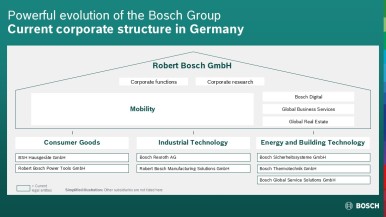
Stuttgart – Bosch is accelerating the company’s evolution and plans to reorganize its corporate structures: the activities of the Mobility business sector and the central service units – Bosch Digital, Global Business Services, and Global Real Estate – in Germany are to be transferred from Robert Bosch GmbH to separate legal entities. As a result, the four legal entities will be managed as wholly owned subsidiaries (limited liability companies under German law – GmbH) within the Bosch Group in future. With this move, Bosch is streamlining its organizational set-up and adopting a consistent corporate structure: the various business fields within the Industrial Technology, Consumer Goods, and Energy and Building Technology business sectors already operate as separate subsidiaries today. Now, the Mobility business sector and the service units will mirror this same model in Germany. With the planned reorganization of our corporate structure, we are creating the conditions that will allow each operating unit to unfold its full potential – with greater entrepreneurial freedom, short decision-making paths, and closer customer focus,...says Dr. Christian Fischer, chairman of the board of management of Robert Bosch GmbH. The goal of the reorganization is to further enhance Bosch’s innovative capacity and competitiveness through greater customer focus, strengthened entrepreneurship, increased flexibility, and short decision-making paths in day-to-day operations. “We are operating in an increasingly challenging environment across our markets. New competitors, particularly from Asia, are intensifying the competitive pressure. For us at Bosch the implication is that we need to bring innovations to market even faster, substantially simplify structures and processes, and accelerate our overall pace to keep up,” says Dr. Christian Fischer, chairman of the board of management of Robert Bosch GmbH. “The goal is to sustainably increase the profitability of the Bosch Group as a whole so that we can continue to fund technological breakthroughs from our internal resources. With the planned reorganization of our corporate structure, we are creating the conditions that will allow each operating unit to unfold its full potential – with greater entrepreneurial freedom, short decision-making paths, and closer customer focus. It will also mean that our internal service units can contribute more significantly to the performance of our operating units, offering competitive and first-class services. One thing is clear: all legal entities will remain an integral part of the Bosch Group, irrespective of their new legal form.”As part of the reorganization, approximately 62,500 associates in Germany – most of whom from the Mobility business sector – are set to transfer to the new subsidiaries. Their employment contracts are likewise be transferred to the new subsidiaries. In future, Robert Bosch GmbH will primarily comprise corporate headquarters as well as the central research and advance engineering team. At present, this concerns more than 3,000 associates in total.New synergy between corporate headquarters and operating unitsThe planned standardization of structures marks an important milestone in ensuring the consistent evolution of Bosch. To support this initiative, the company is realigning its interplay between corporate headquarters and operating units. The subsidiaries will be given greater operational autonomy so they can respond with greater precision and speed to rapidly changing markets and customer needs. Going forward, corporate headquarters will take on a more strategic holding role, supporting all operating units in unlocking their full potential. The complete evolution is to be implemented in stages by the end of 2027 while the new legal entities are scheduled to begin operations on August 1, 2027.Mobility business sector as a separate legal entityAs a separate subsidiary within the Bosch Group, the Mobility business sector will integrate its operations even more closely and manage them across its operating units. This will enable Bosch Mobility to offer its customers worldwide even more precisely tailored, integrated solutions from a single source, accelerate decision-making, streamline processes, and invest financial resources more strategically in innovation and growth fields. At the same time, the new structure will create new opportunities for strategic partnerships and the development of new business models. With this new structure, Bosch is consistently driving the evolution of its Mobility business sector and thereby also enhancing its competitiveness: “We’re starting from a position of strength. But to defend our lead in the long term, we must consistently realign with new customer requirements, markets, and the competition,” says Dr. Markus Heyn, deputy chairman of the board of management of Robert Bosch GmbH and chairman of the Mobility business sector. “Going forward, we’ll be able to take an even more customer-centric approach, act more powerfully as one team, and shape change faster in one of the world’s most demanding industries. Our ambition is to continue setting the pace for the automotive industry. That requires speed, clarity, and business resolve – and we have all three.” As a separate subsidiary, Mobility will remain the largest business sector within the Bosch Group. In 2025, its sales revenue amounted to 55.8 billion euros, or roughly 60 percent of total group sales revenue.

Bosch Ventures invests in Sonexos

21.10.2026

Press release

Venture Capital

Bosch Ventures invests in Sonexos

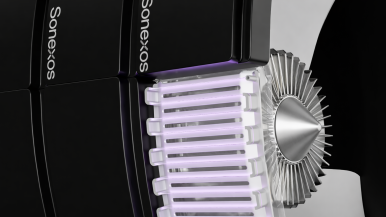
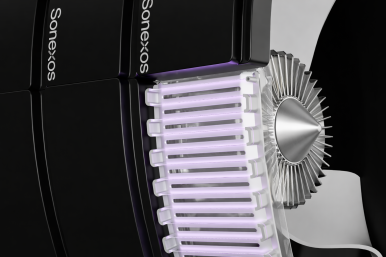
Stuttgart, Germany / Lausanne, Switzerland – Bosch Ventures is investing in Swiss deep-tech company Sonexos as part of its CHF 5 million Pre-Series A financing round. The round will support the industrialization and market introduction of Sonexos’ novel plasma-based technology for active noise control.Sonexos is developing a new way to tackle one of acoustics’ persistent engineering challenges: low-frequency noise from fans, compressors and motors. Conventional solutions typically require significant space and material and can restrict airflow. Sonexos instead uses an electronically controlled layer of plasma to absorb sound, creating a thin, lightweight solution with no moving parts.Deep tech with industrial relevance and societal impactFor Bosch Ventures, Sonexos brings together differentiated deep technology, industrial relevance and the potential to improve everyday life, a strong expression of Bosch’s “Invented for life” principle.“Technology is most valuable when it moves out of the laboratory and solves problems people experience every day. Sonexos is a strong example of that principle: outstanding deep tech addressing a very tangible challenge, with applications ranging from the appliances in our homes to the infrastructure powering the digital economy,” says Dr. Ingo Ramesohl, Managing Director of Bosch Ventures. “What convinced us in particular is the credible pathway toward industrial scale.” Swiss Technology for global MarketsSonexos’ technology originated in research at EPFL and combines plasma physics, high-voltage electronics and adaptive control software. Its Plasmacoustic Metalayer™ absorbs acoustic energy directly at a surface instead of relying on conventional bulky passive absorbers or loudspeakers that cancel sound at a particular listening position.Sonexos’ initial target markets include domestic appliances, Heating, Ventilation, and Air Conditioning (HVAC) and industrial systems. The company is also expanding into datacenter and energy-storage cooling, where increasingly powerful computing infrastructure is driving demand for both greater cooling capacity and effective noise management. The potential impact extends beyond acoustic performance. More compact noise-control systems can give engineers greater freedom when designing products in which space, weight and airflow are critical constraints. In applications such as data-center cooling, reducing fan noise without obstructing airflow could also help reconcile growing infrastructure needs with the interests of surrounding communities.From breakthrough technology to series production “This investment marks an important step from breakthrough technology toward industrial-scale production,” says Mark Donaldson, Founder and CEO of Sonexos. “Together with our customers and partners, we are now turning plasmacoustics into a technology that can be deployed at scale.”The investment comes at a decisive stage in Sonexos’ development. The company is already conducting paid prototype-integration programs with global manufacturers of domestic appliances and HVAC equipment. The new financing will be used primarily for industrialization, customer programs and the further development of Sonexos’ intellectual-property portfolio.The seed investment in Swiss-based Sonexos underscores Bosch Ventures’ international commitment to advancing deep-tech innovation. Complementing this international investment approach, Bosch Ventures announced its earlier this month, dedicated to investing in German deep-tech startups.

Deutsche Aircraft opts for an integrated security solution from Bosch Building T ...

13.10.2026

Press release

Building Technologies

Deutsche Aircraft opts for an integrated security solution from Bosch Building T ...

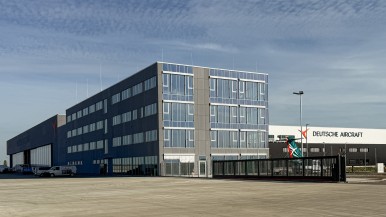
Munich – German aircraft manufacturer Deutsche Aircraft is constructing a new production site for regional aircraft at Leipzig/Halle Airport and has selected Bosch Building Technologies to supply its building security and life safety systems. The product-agnostic systems integrator has planned and implemented a comprehensive, integrated security solution for the new complex, which comprises a final assembly line, a commissioning hangar, a logistics center, and an administrative building. The new final assembly line marks an important milestone on the journey to series production, bringing regional aircraft production back to Germany after a gap of approximately 20 years. The Leipzig facility will serve as the future home of D328eco final assembly, reinforcing Germany's position as a center for advanced regional aircraft manufacturing.The new site follows the principles of an intelligent, networked factory and creates the conditions required for efficient and future-proof production of the D328eco, the next-generation regional turboprop from Deutsche Aircraft. The fire alarm, intrusion alarm, access control, video surveillance, and voice alarm systems installed by Bosch Building Technologies are intelligently networked. At the heart of the solution lies the Building Integration System 360 (BIS 360): a higher-level management system that centralizes all security-related data and ensures that the responsible personnel are able to quickly assess and react to situations. The integrated approach supports operational excellence, process continuity, and scalable production as Deutsche Aircraft progresses toward industrialization of the D328eco program. “Each area of our new site has different requirements for security, safety, access control, threat management, and organizational security. In light of this, we are truly delighted to have Bosch Building Technologies by our side as a partner, given its extensive experience of complex and highly regulated industrial environments. The company’s holistic approach supports the operational requirements of a state-of-the-art aircraft production site and impressed us right from the start,” explains Sebastian Böhnl, Vice President Operations & Production at Deutsche Aircraft.An impressive holistic concept for technical building securityBosch Building Technologies planned and implemented the solution in strict accordance with its customer’s specific operational and security-related requirements. In the administrative building, it is primarily a question of protecting employees, visitors, and sensitive business information. Meanwhile, the production and logistics areas are characterized by complex processes, goods flows, and safety-critical operations, all of which have to be reliably protected. In addition, the aviation environment in the hangar places particularly stringent requirements on access control, surveillance, and emergency management. For Deutsche Aircraft, having an integrated concept is crucial to creating the optimal production environment for the D328eco. The networked systems support operational continuity, protection of the infrastructure, and effective site management across all areas of the facility. In this way, they help enable smooth production processes and long-term scalability. “The integrated solution from Bosch Building Technologies offers more than just security. It helps make our operations more efficient and transparent while also future-proofing them. Integrating systems across the entire site enables us to simplify management processes and lay the foundation for producing the D328eco in Leipzig,” explains Böhnl. “We are delighted to be contributing to this project as the partner responsible for technical building security. When faced with a situation that involves both complex production processes and maximum security requirements, you need solutions that work reliably,” emphasizes Dr. Marcus Nadenau, Senior Vice President of the Building Solutions business unit at Bosch Building Technologies. As a specialist in industrial building solutions, Bosch is fully familiar with the particular requirements of state-of-the-art production and development sites. These range from ensuring a high level of process availability through to protecting sensitive infrastructure. In addition to this, Bosch has many years of experience in the airport and aviation sectors. Integrated portfolio for complex requirements in an airport settingTo protect employees and buildings, Bosch Building Technologies has installed state-of-the-art fire alarm systems that detect potential hazards early on and quickly raise the alarm. Early detection is crucial for keeping people safe from fires in large production, storage, and hangar areas and preventing disruption to operations. The system also incorporates intrusion alarm technology and a comprehensive video surveillance solution. This ensures sensitive areas are protected and also provides a high level of transparency in day-to-day operations. Moreover, Bosch Building Technologies has implemented an intelligent access control system so that only authorized individuals can gain entry to specific areas. This enables precise and flexible control of different security zones within the complex. Particularly sensitive access points are further protected by special controlled entry systems to prevent tailgating. In the event of incidents or emergencies, the installed technology also supports safe evacuation processes along escape and emergency routes, so that employees and visitors are able to exit buildings quickly in critical situations. In addition, intercom systems have been installed to enable direct and efficient communication between security-relevant areas such as entrances, the security control center, and sensitive operational zones. A system of master key depots rounds off the overall security concept. This solution ensures that critical keys are readily accessible in an emergency – an important factor for the fire department and other emergency personnel.About Deutsche Aircraft Deutsche Aircraft is investing more than 100 million euros in the construction of the final assembly line at Leipzig/Halle Airport, underscoring its long-term commitment to the region and the German aviation industry. The company is aiming to produce up to 48 aircraft per year at the new production site.The high level of automation and digitalization makes the final assembly line one of the world’s most advanced production facilities for regional aircraft. The D328eco that is to be manufactured there is a modernized version of the internationally renowned and tried-and-tested Dornier 328 regional aircraft. A 40-seat next-generation turboprop, the D328eco is one of the most modern and efficient aircraft in its class. In addition to having significantly lower operating and maintenance costs, its fuel consumption is almost 15 percent lower than that of its predecessors. With the new production facility, Deutsche Aircraft reaffirms its clear commitment to establishing a modern, resilient and future-proof aerospace manufacturing ecosystem in Leipzig. Combining advanced production capabilities with integrated digital infrastructure creates the foundation for the long-term, scalable production of the D328eco while supporting the company's broader vision for sustainable regional aviation.