Search & find:
Media, press releases, events for your editorial coverage

Bosch sensor platform turns robots into real movement talents

05.01.2026

Press release

Internet of Things

Bosch sensor platform turns robots into real movement talents

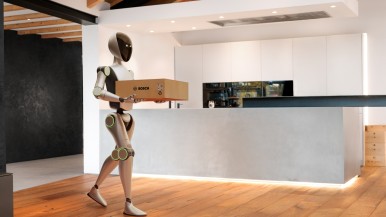
Las Vegas, NV – At the pulsating heart of the robotics revolution and the rapidly expanding world of Extended Reality (XR) lies a silent, yet indispensable technology: MEMS (Micro-Electro-Mechanical Systems) sensors. Much like the complex senses that guide living organisms, these tiny, sophisticated devices serve as the foundational pillar, endowing machines with the crucial ability to perceive and understand their own motion and orientation. This spatial awareness transforms complex algorithms into fluid movements and immersive digital experiences.Three new high-end sensors for the growth market At CES® 2026, Bosch Sensortec introduces the BMI5 platform, a new generation of inertial (acceleration and gyroscope) sensors designed to provide high-precision performance with ultra-low noise to capture every nuance of motion across multiple device classes. Built on a shared hardware foundation and adapted through intelligent software, the platform launches with three variants – BMI560, BMI563 and BMI570. The BMI5 family products are addressing the premium segments of consumer electronics device manufacturers, building the base for the growing MEMS sensor market. According to market research and strategy consulting company Yole Group, this market with Bosch as the market leader, is expected to grow to more than 19.2 billion USD by 2030, with an average compound annual growth rate (CAGR 2024-2030) of 4 percent.* To meet the high-volume serial production demands, the cleanroom area in its own Bosch wafer fab in Reutlingen, Germany was expanded from approximately 35,000 square meters to over 44,000 square meters by the end of 2025. Specific solutions for diverse applications The BMI560 sensor makes virtual and augmented reality experiences feel incredibly real. It precisely tracks head movements with almost no delay, allowing users to interact naturally in 3D environments. Advanced image stabilization helps smartphones and action cameras capture clear, shake-free photos and videos, even on the go. The BMI563 is handling vibrations and extreme movements, making it ideal for robots that need to navigate precisely or for controllers in virtual reality that track every subtle hand gesture. It helps these devices understand their surroundings and movements with exceptional accuracy. For example, Bosch's new MEMS sensor helps a humanoid robot find the right way, even if the camera lens is covered by an object. The BMI570 enhances smartwatches and wireless earbuds. Compared to its predecessor, the new platform delivers a doubled measurement range. This enables the detection of an even wider array of movements and gestures, particularly those in dynamic forms. For hearables it provides accurate head-orientation data for immersive 3D audio experiences. This means music or calls can sound like they're coming from a specific direction, reacting to how the user is moving. Technical AI excellence paired with responsible innovation An Edge-AI classification engine helps the device stay “always on” by recognizing movement patterns directly inside the sensor. This uses less power, makes reactions faster, and adds smart benefits — like automatic activity detection on a smartwatch without the user needing to interact. Across all variants, the BMI5 platform meets Bosch Sensortec’s highest ecological standards to date, combining technical performance with responsible innovation. This unified architecture enables device makers to streamline cutting-edge and at the same time a sustainable development across product lines. With the BMI5 platform, we are strengthening the foundation for the next generation of motion-aware devices...said Stefan Finkbeiner, CEO of Bosch Sensortec. “Our customers benefit from a consistent level of precision, robustness and exceptional performance across all variants - enabling responsive XR systems, reliable robotics and intuitive wearables. The platform combines technical excellence with responsible innovation, reflecting our core Bosch values of quality and sustainability supporting a wide range of applications with a single, scalable architecture. And this was just the beginning. The BMI5 family continues to grow, with more variants already in the pipeline.” *Source: Status of the MEMS Industry 2025 report, Yole Group. Availability: Samples are now available for direct customers, and the complete product line-up will go into high-volume series production from Q3 2026 onwards.

AI-enabled sensors deliver life-changing use cases

06.01.2025

Press release

Artificial Intelligence

AI-enabled sensors deliver life-changing use cases

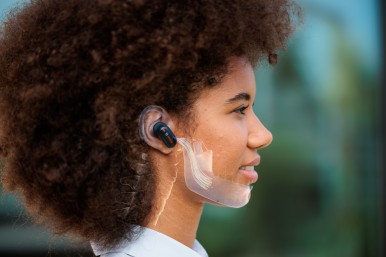
Las Vegas, NV - Sensor technology is transforming our lives: tracking our fitness, making our gadgets easy to use, and monitoring air quality, to mention just a few examples. To provide all these sophisticated functions to consumers, Bosch Sensortec’s sensors are evolving to be smarter – by integrating MEMS technology with embedded microcontrollers, software, and AI runs inside the sensor itself. Bosch’s innovative cutting-edge sensor solutions are making an impact in diverse areas such as consumer health, smart homes and smart cities. AI and intelligent software are the key enabling technologies that make this possible. ...Stefan Finkbeiner, CEO at Bosch Sensortec At CES®, Bosch Sensortec is showcasing its latest AI-enabled sensors, and highlighting how software adds value not only to the sensor but to the entire system. Stefan Finkbeiner, CEO at Bosch Sensortec, said: “Bosch’s innovative cutting-edge sensor solutions are making an impact in diverse areas such as consumer health, smart homes and smart cities. AI and intelligent software are the key enabling technologies that make this possible.” Vision 2030: Bosch aims for more than 10 billion intelligent sensors According to market research and strategy consulting company Yole Group, Bosch is the market leader for MEMS for the fourth year in a row. In 2024 alone, Bosch Sensortec surpassed the milestone of delivering over 1 billion MEMS sensors featuring integrated microcontrollers and software. From 2027 onwards, 90 % of the products will include these integrated features. By 2030, the company aims to achieve a remarkable total of more than 10 billion MEMS sensors sold with this advanced integration. AI on the edge With AI running on the edge (meaning directly in the sensor), there’s no need for constant cloud connectivity. This ensures data remains private, dramatically reduces latency, and cuts power consumption, all while delivering accurate real-time feedback to users. State-of-the-art software solutions add value not only to the sensor but to the entire system, enabling new applications and forming the basis for AI inside the sensor itself. Always-on and ready to go Always-on technology is essential in consumer electronics, enabling continuous access to features without the need to activate the device and wake up the main processor. This significantly extends battery life, and creates a more intuitive and effortless experience for users, especially in smartphones and hearables. This is achieved with intelligent sensors combined with smart software, enabling quick access to voice assistants, health monitoring, and more, empowered by MEMS sensors with integrated microcontrollers. Examples of always-on use cases include voice activity detection and keyword triggering to activate voice assistants in hearables, fall detection in smartwatches for faster emergency assistance, and automatic orientation sensing in smartphones to adjust modes and enter sleep mode when inactive. Smart Connected Sensors (SCS): the personal AI feedback coach Can you imagine having unlimited access to a professional fitness trainer, with feedback at any time? This is the future of exercising – made possible by the Smart Connected Sensors platform from Bosch Sensortec. The platform gives users qualitative feedback on the movement execution, as well as measuring movements and repetitions. Specifically designed for full-body motion tracking, the SCS platform provides a fully integrated hardware and software solution (based on the BHI380, a programmable IMU-based sensor system with AI) that dramatically cuts development costs and time to market. A sound move for software-enabled voice control Wireless headsets have transformed how we listen to music, podcasts and audiobooks, providing free, unhindered movement – as well as new features enabled by sensors, such as activity recognition and indoor navigation. But shifting to voice control can cause problems, when the system is triggered unintentionally because it reacts to ambient noise. To fix this issue, Bosch Sensortec has come up with a software-based innovation: a new type of acceleration sensor, the BMA550, detects sound through bone vibrations. Intelligent algorithms then ensure voice control activates only when the wearer of the headset is actually speaking. Intelligent algorithms then ensure voice control activates only when the wearer of the headset is actually speaking. Take a breath: air quality sensing Poor indoor air quality is a problem: the concentration of PM2.5 particulates from domestic cooking can reach levels 100 times higher than acceptable limits. Localized, actionable data from Bosch's particulate matter sensor for PM2.5 and PM1 enables effective responses to poor air quality. A software update coming soon will activate PM10 measurement in addition. Almost the entire global population (99 %) breathes air that exceeds WHO air quality limits, and threatens their health. Bosch’s BMV080 sensor uses software and intelligent algorithms, in a tiny, fanless design which is more than 450 times smaller than any comparable device on the market. Open platform and strong collaboration Bosch can’t do all this alone and offers a framework that supports customers in creating movement classification algorithms specific for their own application. These models can then run on a smart motion sensor, such as the BHI360. For example, Bosch Sensortec and Doublepoint have partnered to develop a powerful microgesture control solution for smartwatches, using the BHI360. This enables always-available, reliable control, such as allowing users to adjust light brightness with an intuitive pinch gesture. This collaboration exemplifies Bosch Sensortec's commitment to innovation in the IoT and wearable markets, empowering manufacturers to bring advanced, user-friendly products to market more quickly. ... Lucas Ginzinger, Vice President Marketing and Business Strategy at Bosch Sensortec Doublepoint's advanced algorithms are seamlessly integrated into Bosch’s compact, low-power IMUs via a new software tool. Compared to camera-based solutions, this IMU-based approach enables obstruction-free gesture detection, offering greater reliability and efficiency. “This collaboration exemplifies Bosch Sensortec's commitment to innovation in the IoT and wearable markets, empowering manufacturers to bring advanced, user-friendly products to market more quickly,” said Lucas Ginzinger, Vice President Marketing and Business Strategy at Bosch Sensortec. Website: https://www.bosch-sensortec.com/


Bosch unveils cutting edge Smart Connected Sensors platform for full-body motion ...

08.01.2024

Press release

Internet of Things

Bosch unveils cutting edge Smart Connected Sensors platform for full-body motion ...

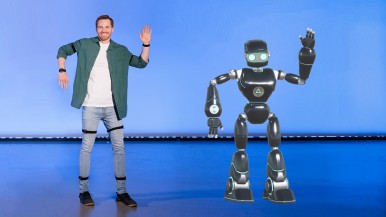
Las Vegas, Nevada / Reutlingen, Germany – Unlimited access to a personal feedback coach? That's the dream of many fitness and gaming enthusiasts. With the brand new Smart Connected Sensors platform, Bosch Sensortec ensures that movements and repetitions are not only measured, but that users get qualitative feedback on the movement execution. Specifically designed for full-body motion tracking, this new platform provides a fully integrated hardware and software solution that dramatically cuts development costs and time to market.Business customers wanting to integrate sensors in their designs are often faced with time-consuming and complicated tasks, combining and tweaking multiple devices to create the necessary hardware and software system. There is no sensor solution available on the market right now that provides wireless and ready-to-use full-body movement feedback. To meet this need and save developers precious time and effort, Bosch Sensortec provides business customers with the full package: BHI380, a programmable IMU-based sensor system using AI functionality. A wearable reference design (certified CE, FCC, ISED, MSIT, SRRC, MIC, NCC, UKCA) that can be straightforwardly attached to any part of the body without having to handle cable clutter, an external camera or dedicated bodysuits. Software features including gesture and activity recognition, body movement detection, relative body angle information, as well as a feedback coach. Multiple applications in rehabilitation, fitness and gaming The possibilities are almost endless. Key use cases will include rehabilitation, fitness, and gaming according to the motto “Move. Prove. Improve.” The Smart Connected Sensors platform provides complex feedback that enables users to properly perform rehabilitation exercises at home, thereby supporting their faster recovery. For highly responsive gaming applications, motion sensors will provide intuitive, accurate control by tracking even the tiniest movements. In the area of sports and fitness, the motion sensors can be used for complete body movement detection, for example to give detailed feedback on how well high-intensity exercises are performed. The sensors communicate wirelessly via Bluetooth Low Energy and thus do not restrict users' movement. Thanks to the platform principle, the system can be connected to numerous applications, such as wearables, hearables and AR/VR headsets. Engineers will find the Smart Connected Sensors platform easy to use and simple to scale, easily incorporating additional sensors and capabilities into their existing designs. Importantly, the platform enables up to eight nodes with various Bosch Sensortec sensors to be neatly connected to a central node, including Inertial Measurement Units (IMUs), magnetometers and pressure sensors. “For applications using Smart Connected Sensors, our new platform significantly reduces the amount of effort required from designers, enabling them to cut time to market and focus more on their specific expertise,” said Stefan Finkbeiner, General Manager and CEO at Bosch Sensortec. For applications using Smart Connected Sensors, our new platform significantly reduces the amount of effort required from designers, enabling them to cut time to market and focus more on their specific expertise...said Stefan Finkbeiner, General Manager and CEO at Bosch Sensortec. The sensor platform provides qualitative feedback based on integrated AI features and comes with a pattern creation software tool that helps customers customize their system design. By using this tool, the customer retains control over their data, as there is no need for regular data exchange with Bosch Sensortec. Availability: Smart Connected Sensors is available on direct request.

A new dimension of acceleration: Bosch launches world’s smallest MEMS accelerome ...

08.01.2024

Press release

Internet of Things

A new dimension of acceleration: Bosch launches world’s smallest MEMS accelerome ...

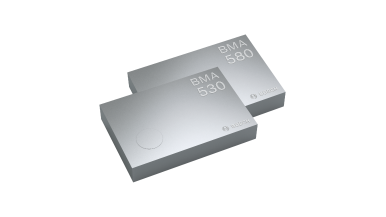
Las Vegas, Nevada / Reutlingen, Germany – Space is at a premium in hearables, smartwatches and other portable consumer products, and all components must be as small as possible. At the same time, OEMs are demanding plug-and-play step-counters and other sensors with built-in features that enable easy implementation without detailed application knowledge. To meet these challenges, Bosch Sensortec has announced the BMA530 and BMA580, the world's smallest MEMS accelerometers. Both devices include built-in features making them easy to design with. BMA530 tracks activities with its step counter and is especially suitable for wearables, and BMA580 targets hearables with voice activity detection.Compared to Bosch's current generation accelerometer (BMA253), the BMA530 and BMA580 have a 76 percent smaller footprint and have been reduced in height from 0.95 mm to 0.55 mm. This size reduction is achieved with an innovative Wafer Level Chip Scale Package (WLCSP). The small size of the accelerometers makes them easy to place on a PCB, and their integrated features make them easy for design engineers to integrate into their portable products. "The demand for tiny sensors with ever-increasing performance is growing as the industry moves towards more stylish and minimalist designs that require smaller sensors," said Stefan Finkbeiner, General Manager and CEO of Bosch Sensortec. "The new BMA530 and BMA580 provide an ultra-compact, fully-featured solution to meet this demand." The demand for tiny sensors with ever-increasing performance is growing as the industry moves towards more stylish and minimalist designs that require smaller sensors. The new BMA530 and BMA580 provide an ultra-compact, fully-featured solution to meet this demand. ...said Stefan Finkbeiner, General Manager and CEO of Bosch Sensortec. Bone conduction for reduced power consumption The BMA580 provides innovative voice activity detection and an advanced feature set for hearable devices. Typically, microphones in hearables consume a lot of power because they need to be always-on to listen for voice activity. Instead, the BMA580 uses bone conduction to detect the vibration of the user’s voice and then wakes the microphone from sleep – for an overall power saving. No other sensor on the market combines bone conduction with this miniature sensor size. The BMA580 enables user interaction with a hearable in response to the user tapping the device, for example to answer or end a call. The sensor’s software includes an algorithm that can distinguish between single, double and triple taps. In addition to wearables, the new BMA530 acceleration sensor is ideal for gesture recognition in toys, fall detection in laptops and other devices, and power management functions such as putting a smartphone to sleep when it is not moved. The new accelerometers offer multiple power modes and automatically switch from low-power to high-power modes to extend battery life. They offer a flexible set of connectivity options, including an I3C® interface. Availability: The new acceleration sensors from Bosch Sensortec can be ordered at our distribution partners from Q1 2024 onwards.