Search & find:
Media, press releases, events for your editorial coverage

The Bosch company retirement scheme in Germany

18.12.2024

Factsheet

Working at Bosch

The Bosch company retirement scheme in Germany

1929: With Bosch-Hilfe e.V., Robert Bosch establishes for all associates support for retirement and for the surviving dependants. 1999: Bosch merges more than 70 company pension plans into the Kapital Vorsorge Plan 2002: Bosch is the first German industrial company to set up its own pension fund and initially uses it to convert associates' salaries 2006: Bosch and the workers‘ council agree to transfer the Kapital Vorsorge Plans into the Bosch Vorsorge Plan with the Bosch Pensionsfonds as the central financing instrument 2016: Bosch introduces the Fondsrente, with which associates continue to participate in the performance of the Bosch Pensionsfonds during the retirement payout phase Bosch Vorsorge Plan With the Bosch Vorsorge Plan, Bosch offers its associates an attractive retirement benefit based on one of the most modern retirement schemes in Germany. In addition, associates and their families are already covered during their working life in the event of disability or death. Bosch builds up assets with company contributions for the associates and bears the costs for this. Associates can further increase this pension assets through their own contributions. All contributions are based on the investment result of the Bosch Pensionsfonds. The contributions themselves are guaranteed by the company as a minimum benefit. In retirement, the credit is available as an additional income with flexible payout options. 11.4 billion euros of assets in the Bosch Vorsorge Plan 138,000 active associates with retirement assets in the Bosch Vorsorge Plan 39,000 former associates with vested entitlements (including commitments before introducing Bosch Vorsorge Plan) 65,000 beneficiaries, including 15,000 surviving dependents (including commitments before introducing Bosch Vorsorge Plan) 3,300 recipients of disability payments Average annual return since foundation: around 6% in the investment segment up to age 55 just under 4% in the investment segment over age 55 Status: 31.12.2024

How Bosch uses AI in manufacturing

05.12.2023

Factsheet

Industry 4.0

How Bosch uses AI in manufacturing

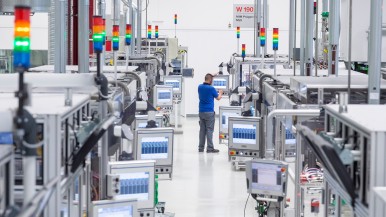
Bosch plant in Ansbach This plant manufactures printed circuit boards for use in control units for ABS and ESP as well as for electronic steering systems. In the assembly of these boards, particular attention has to be paid to the solder joints: there are between 5,000 and 8,000 of them on each board. The Ansbach plant uses an AI-based measuring process to check whether all circuit-board elements are soldered correctly. If this is not the case, an image of the faulty solder joint is presented to experienced visual inspectors for evaluation. All in all, the inspectors now receive only a fraction of the images they previously had to review. The AI significantly reduces the visual inspectors’ workload, improves the quality of the results, and increases productivity. Bosch plant in Blaichach The plant in Bavaria also uses AI for quality control. At the Immenstadt site, the screen at the test bench for ABS systems lights up red to show the assembly workers if the component being tested is defective. This information is provided by a self-learning system that uses the data it has collected to recognize error patterns and, in this way, to distinguish relevant error messages from non-relevant ones. Weekly retraining of the algorithms continuously improves the high success rate. Bosch plant in Changsha At this plant in China, Bosch has introduced an AI-based energy management system that it developed in-house. The system relies on AI algorithms to predict energy consumption on production lines, enable continuous production scheduling, and incorporate business and environmental factors. These factors include forecasts of customer demand, production plans, weather, temperature, and humidity. This saves energy and reduces emissions. With the help of the AI solution, the Changsha plant was able to cut its annual electricity consumption by 18 percent and carbon dioxide emissions by 14 percent. For its achievements, the plant was singled out as an Industry 4.0 lighthouse by the World Economic Forum in 2022. Bosch plant in Charleston At this U.S. location, Bosch manufactures mobility solutions such as ESP, electric motors, and fuel-injection valves. The plant uses a root-cause analysis to investigate causal relationships that can lead to rejects at the end of the production process. AI software lends support to this analysis by sifting through the billions of data points that a manufacturing execution system (MES) collects and records during production. From this data, the AI derives possible correlations between the measured values and quality deviations in the production line and sets them out clearly on a dashboard, where associates see a ranked list of possible causes sorted by descending probability. Bosch plant in Dresden In this wafer fab, which went into operation in 2021, the company employs an AI system developed by its own researchers to detect anomalies and faults in the manufacturing process at an early stage. Predictive maintenance means that work on machines and systems is carried out as necessary. Artificial intelligence guarantees high process stability in the wafer fab and increases quality continuously. This saves customers time-consuming tests and curtails month-long trials. As a result, Bosch not only manufactures faster, but can also be relied on to deliver on time. Bosch plant in Mexicali At this plant in Mexico, AI uses noise analysis to check the quality and functionality of the multifunctional tools manufactured on-site. Once production is complete, a microphone “listens” to the tools for three seconds before the AI software delivers its verdict: OK or not OK – and the results are much more reliable than is possible for human inspectors. Around 300,000 tools were tested during development of the AI solution. The plant aims to use this process to inspect over one million products per year. Bosch in Reutlingen Artificial intelligence is also used in production scheduling at highly automated wafer fabs such as the Bosch plant in Reutlingen, Germany, where it saves time and costs as it guides the wafers through up to 1,000 processing steps. The AI has an overview of all the materials available for a manufacturing step and sorts them on the assembly line so as to achieve optimum throughput. In many instances, production sequencing is determined completely by AI, thus ensuring optimum utilization of capacity.

Making a virtue out of necessity

02.11.2023

Factsheet

Making a virtue out of necessity

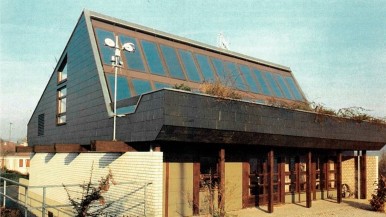
What refrigerators have to do with heat-pump development In 1852, William Thomson published a paper on refrigerators that worked on the principle of compression. In reverse, he suggested, they would also be excellent for heating. In his research on “heating machines,” Thomson showed that they would require much less primary energy than conventional direct heating. Peter Ritter von Rittinger is regarded as the inventor of the first heat pump: a system for evaporating brine that he presented in 1853. The process yielded an energy saving of 80 percent compared to the conventional evaporation process using wood. In other words, the contemporary scarcity of wood was the trigger for the development of this pioneering patent. However, heat pumps did not gain acceptance until the 20th century, with fuel shortages in various decades playing a major role. Particularly in the United States, which was largely spared the effects of the first world war, air conditioners were already being built with a heating function as standard in the 1920s. In Zurich, Switzerland, the city hall was equipped with a substantial heat-pump system for heating in 1938. The first ground-coupled model then appeared in the U.S. in 1945. 1975: Bosch presents first-generation heat pump and starts production Under the Junkers brand, the first Bosch heat pump was installed as a prototype in a residential building in Wernau am Neckar, Germany, in January 1975. It used well water as its heat source. Heat pumps went into production in the same year. The smaller, improved second-generation heat pump went into production in 1982. The oil crisis in the 1970s drives development forward The “Tritherm” house was a single-family home built as a pioneering prototype in 1976 on the factory premises of Junkers, then a division of Bosch, in Wernau. As its name suggests, the house made use of three heat sources. Starting in 1977, research was conducted here on ways of saving energy and resources. The oil crisis drove home the finite nature of fossil fuels such as coal, oil, and gas. This realization prompted researchers in many fields – not just in heating technology – to search for alternative sources of energy that would help conserve resources. The building’s 174 square meters of living space, complete with basement and 1,400 cubic meters of enclosed space, featured groundbreaking technology: heating and hot water were provided by a heat pump with an air-to-air heat exchanger, which extracted heat from the outside air, together with 25 solar collectors covering an area of some 40 square meters. Solely as a reserve for peak loads on the coldest winter days, there was also a conventional central heating system using liquefied petroleum gas. The results were impressive even then: these systems lowered the fuel consumption to less than 10 percent of its previous level. 1980: Bosch presents a hot water heat pump At the Intherm trade fair in Stuttgart, the Junkers brand showcased a new hot water heat pump that could heat tap water to around 50 degrees Celsius. The pump’s performance and capacity were designed for a six-person household. 2004: Bosch acquires the Swedish heat-pump manufacturer IVT In 2004, Bosch acquired “Industriell Värme Teknik” in Tranås, Sweden, a company set up in 1968. Its core competence was brine-to-water heat pumps, which extract energy from a great depth via a borehole in the ground. This extremely efficient technology, which is still the standard in Sweden today, gained acceptance thanks to a number of major projects in the 1990s – among them the installation of brine-to-water heat pumps at Drottningholm Palace, the summer residence of the Swedish royal family. 2007: Bosch acquires U.S. heat-pump manufacturer FHP With the acquisition of FHP Manufacturing Company, Fort Lauderdale, Bosch entered the attractive U.S. market for geothermal electric heat pumps, and continued its growth course in the promising renewables segment. 2011: Energy Plus house with heat pump At the end of 2011, Bosch’s Buderus brand and SchwörerHaus completed a single-family house in Wetzlar that provides more primary energy over the year than its occupants require. This house showed that it was possible to use the available technology to build a house that produces an energy surplus. The first step is to keep energy consumption low by optimizing the building envelope and harnessing residual energy flows. Next, the remaining energy demand must be met as efficiently as possible and the building itself must generate as much electricity as possible. To meet these requirements, the “Energy Plus” house is equipped with a Buderus-brand electric heat pump, with roof-mounted photovoltaic modules, with solar-active low-temperature collectors on the facade, and with a controlled domestic ventilation system featuring heat recovery. Bosch low-consumption home appliances round off the range of domestic equipment. Calculated over the year, this results in a positive energy balance: the expected annual energy demand for home appliances, domestic hot water, ventilation, and heating is 7,550 kWh, while the expected annual electricity generation amounts to 9,100 kWh. Since 2015: Emissions reductions focus on the building sector Ever since the 2015 Paris Agreement, the importance of the building sector in achieving climate goals has come into sharper focus. The EU’s stock of existing buildings accounts for some 36 percent of its greenhouse gas emissions 1) . Achieving climate targets calls for a climate-neutral building stock. The preferred technologies are heat pumps for newly built and refurbished existing buildings, and heat-pump hybrids for unrefurbished buildings. Demand for heat pumps as an environmentally friendly heating solution grew steadily since the late 2010s. 2023: Bosch presents first propane-operated air-to-water heat pump The latest generation of Bosch heat pumps run on the natural refrigerant propane. Not only does this naturally occurring gas have a low global warming potential, but its ideal thermodynamic properties enable the heat pump to achieve particularly high energy efficiency and higher flow temperatures. Using propane as a refrigerant in heat pumps ensures a futureproof and sustainable supply of heat. The latest-generation heat pumps can also be installed together with a conventional heat generator in a combination known as a heat-pump hybrid. This is a fast and cost-effective way of switching unrefurbished existing buildings to alternative heating. In both day and night modes, the latest-generation heat pumps are characterized by low noise levels. This makes them suitable for use in densely built-up terraced housing estates. 1) https://commission.europa.eu/news/focus-energy-efficiency-buildings-2020-02-17_en Press kit Bosch Heat pumps

Brine, air, water: Heat pump technology explained

30.10.2023

Factsheet

Brine, air, water: Heat pump technology explained

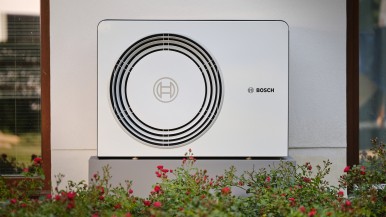
Heat pump types All heat pumps work in a similar way, using electricity to harness free ambient energy. Bosch offers a wide range of heat pumps that are particularly efficient depending on the application. These include a) air- to-water heat pumps, b) split air conditioners (air-to-air heat pumps), c) brine-to-water heat pumps and d) water-to-water heat pumps. Use as hybrid systems Many Bosch heat pumps can be combined with another heat generator such as a gas condensing boiler if required. These hybrid heat pumps are particularly suitable for existing buildings and are particularly efficient thanks to intelligent control that ensures the most appropriate heat generator is used at all times. Absorption, compression, release, decompression The operating principle of heat pumps* Energy absorption The ambient air contained in the energy sources air, water, and earth is used to heat a refrigerant. The refrigerant absorbs the ambient air and gradually evaporates. Compression The heated refrigerant is compressed by an electrically powered compressor, which heats up further, increasing the pressure. Release When the desired temperature is reached, a heat exchanger transfers it to the heating water. Decompression After the heat is released, the refrigerant is still under high pressure. The refrigerant is passed through an expansion valve and the process is repeated. * The operating principle applies to all heat pumps except air-to-air heat pumps (air conditioners). The latter distribute the heat to the rooms via the air rather than via a hot water circuit. Air-to-water heat pumps Using ambient air with little effort Air-to-water heat pumps from Bosch extract heat from the ambient air. They are suitable for both new and existing buildings and reliably meet the heating and/or hot water requirements of single or multi-family houses. The refrigerator principle An air-to-water heat pump works according on the same principle as a refrigerator – only in reverse. In the air-to-water heat pump, the outside air is drawn in by an integrated fan and meets a refrigerant that evaporates. The air-to-water heat pump uses one kilowatt hour of electricity to produce many times that amount of thermal energy. In this way, new and renovated buildings can be fully heated all year round and hot water can be reliably provided without the need for an additional heating system. Split and monobloc heat pumps In monobloc heat pumps the technical components for heat generation are located within one unit. In split heat pumps the process takes place in two separate units. Both systems work on the same principle, only the construction is different. Air-to-water heat pumps can not only provide heat, but also provide efficient cooling in summer. Split air conditioners (air-to-air heat pumps) Using the ambient air as an energy source A split air conditioner uses energy from the ambient air, i.e. that it cools and heats a building without radiators. Operating principle of split air conditioners Split air conditioners extract energy from the environment and transport it to the place where it is needed, e.g. the living room. The term air source heat pump covers both split air conditioners (air-to-air heat pumps) and air-to-water heat pumps. Both extract heat from the surrounding air. Especially efficient when combined with heat recovery ventilation Unlike air-to-water heat pumps, air-to-air heat pumps do not transfer the heat to the rooms via a hot water circuit, but via the air. Heating systems with air-to-air heat pumps are therefore also called ventilation heating systems; they do not require radiators or heating surfaces. Air-to-air heat pumps can be part of a heat recovery ventilation system. In this case, the hot exhaust air is used as an energy source. In reverse mode, some air-to-air heat pumps can also cool. Brine-to-water heat pumps Extracting heat from the ground These heat pumps are called brine-to-water heat pumps because a heat transfer fluid (brine) taps the earth as an energy source. As the heat is extracted from inside the earth, these systems are also known as geothermal heat pumps or geothermal heating systems. The visual advantage is that there is no need for external heat generating equipment. Heat from a probe borehole a or a surface collector In brine-to-water heat pumps, the brine circuit extracts the heat from the ground. This requires probe boreholes or surface collectors in which the brine circulates. The water/salt mixture is a good heat transfer medium and is environmentally harmless. At the heat pump's evaporator, the energy from the brine is transferred to the refrigerant circuit. A compressor compresses the refrigerant, causing its temperature to rise. Efficient and economical cooling possible in summer A major advantage of brine-to-water heat pumps is that they can be used for cooling in the summer. In ‘reverse mode’ the system dissipates heat into the cool ground. The temperature gradient eliminates the need for compression. The result is efficient and economical air conditioning that regenerates the ground through heat dissipation. Water-to-water heat pumps Efficient thermal energy from the groundwater A water-to-water heat pump – or groundwater heat pump – extracts thermal energy from groundwater by means of two wells. The thermal energy can then be used for heating or hot water generation. Water-to-water heat pumps are very efficient. Using the underground groundwater reservoir High heat output thanks to constant groundwater temperature While air source heat pumps draw in the ambient air via fans, and geothermal heat pumps use the earth’s heat via probes or surface collectors, water-to-water heat pumps make use of the underground groundwater reservoir. The temperature of the groundwater is largely constant throughout the year, so the heat pump provides high heating output in both summer and winter. Water-to-water heat pumps can achieve efficiencies of around 500%, which corresponds to a seasonal coefficient of performance (SCOP) of 5. Using two wells In a water-to-water heat pump, the suction well sucks in the groundwater to extract heat, while the injection well returns the used cold water to the ground. Press kit Bosch Heat pumps

300 milimeters wafer fab in Dresden

21.08.2023

Factsheet

Connected mobility

300 milimeters wafer fab in Dresden

Total investment approx. 1 billion euros Site approx. 100,000 m2 Total floor space approx. 72,000 m2 of production area and office space Clean-room area Currently approx. 10,000 m², addition of some 3,000 m² Associates roughly 480 in August 2023 Qualified professionals needed Experts from the semiconductor industry, such as process, production or maintenance engineers, mathematicians, software engineers as well as professionals and graduates with degrees in physics, chemistry, or microsystems technology Manufactoring technology Highly automated wafer production (300mm silicon substrate wafers with structures up to 65nm in width) Manufactured products Application-specific integrated circuits (ASICs) and power semiconductors MEMS manufactoring on 300mm wafers (SOP in 2026) Fields of application for semiconductors Mainly automotive electronics and industrial applications Connected manufactoring At the wafer fab in Dresden, production data is generated at a rate of 250 MB/second, which corresponds to the data volume of 400 HD videos running simultaneously. Funding Construction of the new wafer fab in Dresden received funding as part of IPCEI 1 Microeletronics (Important Project of Common European Interest) from the German federal government – more specifically, the Federal Ministgry for Economic Affairs and Climate Action (BMWK). Over the next years, Bosch plans to invest some three billion euros in Dresden and Reutlingen, both as part of its own investment plan and under the auspices of the European IPCEI ME (“Important Project of Common European Interest on Microelectronics”) funding program.

1,200 meters of welds make each fuel-cell stack hydrogen-tight

10.07.2023

Factsheet

Bosch Group

1,200 meters of welds make each fuel-cell stack hydrogen-tight

The Stuttgart-Feuerbach manufacturing site Feuerbach has a firm place in the past and future of mobility. The Stuttgart-Feuerbach site is the largest and oldest Bosch location worldwide. It was set up by Robert Bosch himself in 1909. The Feuerbach plant has been moving people and goods for more than 100 years: roughly 2,800 associates work in the Feuerbach plant, and the location as a whole employs roughly 15,000. Hardly any other location illustrates the transformation in mobility as well as Feuerbach. The manufacture of magneto parts began there in 1910, and 1927 saw the start of production of diesel injection pumps for trucks. Since then, it has witnessed the start of production of many products, mainly for combustion engines. And now, from July 2023, it will see the volume production of the fuel-cell power module (FCPM) on an area currently almost as large as half a soccer field. This volume production of the FCPM is also a joint project involving a number of German locations with a long mobility history: Bamberg is supplying the Feuerbach manufacturing operation with the fuel-cell stack. And important system components such as the electric air compressor and the recirculation blower come from Homburg. The assembly and testing of the complete system is then done in Feuerbach. The Feuerbach plant is part of an international manufacturing network. Only as a result of the exchange of knowledge and manufacturing expertise was it possible for production of the fuel-cell power module to start not only in Feuerbach, but also in Chongqing, China, where the requisite components come from the Bosch plant in Wuxi. Similarly, it is planned to manufacture stacks in Anderson, NC. The fuel-cell power module The fuel-cell power module is the most complex system Bosch has ever developed. A fuel-cell power module made in Feuerbach comprises several hundred individual parts, weighs more than 500 kilograms, and has a surface area of roughly 1.5 square meters. The module is designed to fit into the space previously occupied by the truck’s combustion engine. This is an advantage for truck makers, and also saves them money, since they can build on the same vehicle platform. The fuel cells are the heart of the power module. At first glance, they are not very spectacular. They are only roughly the size of an envelope, and weigh less than 100 grams. To make them capable of propelling a heavy truck, several hundred fuel cells are combined. This combination, known as a stack, provides a total electrical output of more than 100 kilowatts. A fuel-cell power module comprises two such stacks, and thus delivers a total output of more than 200 kilowatts – more than enough to drive a 40-ton truck. In the case of the new fuel cell drive system, we can draw on the knowledge gained from decades of research and development work on powertrain components, and also profitably use our manufacturing expertise for the mobility of tomorrow. Over the long term, we want more than half of the fuel cell powertrain by value to be created internally and Bosch's special machine engineering covers more than 50 percent of the production equipment. It was also possible to transfer knowledge relating to coating technology and leak testing. In addition, Bosch researchers have developed solutions that will help prolong the service life of PEM fuel cells to as much as 30,000 operating hours in the future. When manufacturing mobile fuel-cell systems, high-speed laser welding is used. We use it to make 1,200 meters of welds in each stack hydrogen-tight. Apart from the stack, a mobile fuel-cell system contains many other components, including a hydrogen metering valve and an electric air compressor. Together, they ensure that the fuel cells are supplied with hydrogen and oxygen, so that an electrochemical exchange of the reactant gases hydrogen and oxygen can produce electricity. On the one hand, this electricity is stored in a battery. On the other, it directly drives the vehicle’s electric motor. Unlike in purely battery-electric heavy trucks, where the batteries can weigh up to nine tons, the batteries in a fuel-cell truck weigh only roughly 500 kilograms. Fuel-cell manufacturing and testing technology Following individual manufacturing steps, and before the process is complete, the fuel-cell system is continuously tested for impermeability. The helium used in the leak test is captured, filtered, and reused for subsequent leak tests. In this way, up to 40 percent of the helium used can be reused. In addition, the nitrogen that is also used in leak testing is extracted from the ambient air using a nitrogen generator. In this way, packaging and transportation are avoided, and there is no need to compress the gas, which saves energy. Each fuel-cell power module is thoroughly tested before delivery. The end-of-line (EOL) test records 450 variables. The various driving modes (acceleration, braking) in the truck are tested with hydrogen and oxygen at a test bench under real conditions. The manufacturing and testing technology used here comes from Bosch Manufacturing Solutions, the company’s special-purpose machinery unit. The testing process is efficient in design, and is being further refined. The electricity produced during the process is fed into the Feuerbach location’s power supply. The fuel cell-electric truck If the fuel tanks are big enough, a truck can drive the roughly 800 kilometers from Hamburg to Munich without refueling. Refueling takes roughly as long as it takes to drink a cup of coffee: in between 10 and 20 minutes, the truck is full. One kilogram of hydrogen contains as much energy as 3.3 liters of diesel. To be able to refuel vehicles with hydrogen quickly and simply, the gas has to be compressed to as much as 900 bar. For the energy-efficient operation of hydrogen compressors in filling stations, Bosch Rexroth has developed a low-maintenance, scalable systems solution. Mobile fuel cells run on gaseous hydrogen. Inside the cells, this hydrogen reacts with oxygen from the ambient air. The result is electricity to drive the electric motor and “exhaust” in the form of pure steam. At the end of 2022, some 500 vehicles featuring Bosch fuel-cell systems were already on the roads. With the planned start of production in the U.S. and China, their number will grow further. Bosch is confident that, by 2030, one in five new trucks weighing six tons or more will feature a fuel-cell powertrain – provided international efforts to mitigate global warming continue to gain pace.


Transformation needs diversity

21.11.2022

Factsheet

Bosch Group

Transformation needs diversity

To remain competitive in times of change, companies have to develop new forms and curricula for their associates’ occupational training and further professional development. Bosch started preparing itself for the transformation in the automotive industry early on, and is well positioned with a leading position in electromobility, comprehensive training programs, and the development of new business areas and markets. In 2018, the company laid the foundation for a comprehensive training initiative (Mission to Move) to qualify associates for new tasks in growth areas such as electromobility, software, data analysis, and artificial intelligence. Mission to Move: On-demand training and training specifically for new posts Transfer qualification at Bosch So far, more than 1,000 associates have received training to qualify them for specific new tasks or positions. Most of them are engineers, but other highly qualified people have also taken part starting in 2020. Worldwide approach The digital transformation is creating a powerful incentive to quickly build up new knowledge and new capabilities. That is why the programs are constantly being adjusted to meet regional needs as well. To date, Bosch associates at more than 40 locations in some 20 countries have participated in Mission to Move. Roughly one-quarter of the participants come from locations outside Germany. Contents The program portfolio now covers three areas with ten learning programs in different formats: Electrification for engineers and skilled workers Software qualification Big data with data science, data analytics, and data engineering In-house and external partners In these endeavors, Bosch works with in-house partners such as the Bosch Learning Company and the company’s apprenticeship unit, as well as with the Chamber of Commerce and Industry and the universities of Stuttgart, Aalen, and Ingolstadt. The length of these courses varies depending on the program. Individual programs Electrification This program is designed for associates switching to the electromobility field. In a seven-week program, associates spend three days a week familiarizing themselves with subjects such as e-mobility concepts, battery technologies, power electronics, and software. Participants can learn more about these subjects in practical training modules lasting several days. The basic theory is taught by the apprenticeship unit, which has now evolved into a technical training campus for subject matter relating to electrification. The program aims to qualify associates for jobs such as a design engineer for 48-volt batteries and project manager for power electronics. Software These two programs offer software training for associates from hardware-related units. The “intense” program lasts between 10 and 12 weeks, and comprises four 60-minute modules. The “long-term” program, by contrast, spans an 11-month period and comprises eight modules. Here as well, the program covers both theory and practice. In small groups, participants visit partner universities to learn basic theory. This will then qualify them for jobs in areas such as software and systems engineering as well as software function development. Bosch is continuously evaluating its requirements for the necessary skills, so that it can take further steps to qualify people for new jobs. Big data In these programs, associates with in-depth specialist knowledge in the mobility field learn and familiarize themselves with additional skills relating to the storage, processing, and analysis of big data, and how this improves the quality and efficiency of products and processes and provides the basis for developing new data-based business models. Qualification as an industrial electrician Mechanics are trained to become industrial electricians certified by the chamber of commerce. The engineers and other skilled workers taking part are closely supervised to ensure that the programs are a success. Mentors, the sense of community in the small study groups, the alumni network, and concurrent familiarization with the new jobs that await the participants provide additional support and motivation. Roughly 95 percent of participants complete the course.

Reutlingen wafer fab

28.10.2021

Factsheet

Connected mobility

Reutlingen wafer fab

Areas of operation Manufacturing for semiconductors (Frontend) Test center for semiconductors (Backend) Associates about 4,000 Cleanroom surface area 35,000 m², till end of 2025: 44,000 m² Production facilities 150-millimeter technology since 1995 200-millimeter technology since 2010 Pre- and final measurement for 150- and 200-millimeter wafers Manufactured products Application-specific integrated circuits (ASICs), low-voltage/high-voltage power semiconductors, microelectromechanical systems (MEMS) Manufacturing technology 150- and 200-millimeter silicon substrates with structural widths (nodes) of up to 180 nanometer 150-millimeter silicon carbide substrates with structural widths (nodes) of up to 400 nanometer Fields of application for semiconductors Power units for electromobility, e-bikes, power tools and further Bosch products Automotive electronics: airbag and driver assistance systems, Electronic Stability Control ESC, electronic control units for electric motors and IC engines as well as for transmissions, parking assistants and night vision enhancement systems Consumer electronics: games consoles, hearables, laptops, smartphones, wearables Investments and extension course of action Rising demand Consistent development of the manufacturing capacity to meet the growing demand of semiconductors chips (ASICs, MEMS and power semiconductors). From 2021 to 2023 With 150 million euros in two steps from 2021 to 2023 will gain about 4,000m² of new cleanroom surface area that will be realized in existing buildings. In addition, 150 new jobs in the fields of semiconductor development will be raised. Till end of 2025 State-of-the-art manufacturing: more than 250 million euros will be invested for a new element, the total amount of the cleanroom surface area will raise up to 44,000 m².

Semiconductor production at Bosch

28.05.2021

Factsheet

Connected mobility

Semiconductor production at Bosch

Current portfolio Bosch manufactures and sells electronic components for vehicles and for consumer electronics. These include application-specific integrated circuits (ASICs) , power semiconductors and microelectro-mechanical systems (MEMS) such as acceleration, pressure, yaw-rate, magnetic field, mass-flow and environ-mental sensors. Manufacturing sites Reutlingen (150-mm and 200-mm technology) Dresden (300-mm technology) Patents Bosch holds more than 1,000 patents and patent applications for MEMS technology as well as more than 500 in the field of semiconductor technology. Market The requirements after semiconductor chips (ASICs, power semiconductors and MEMS) will further increase. The reason is about a rise of the proportion of semiconductors in electronic devices and car applications, e.g. connected and automated driving or the electro mobility. Microelectronics can be seen as technological key sector. Expertise in innovation and technology Invented for life For more than 60 years Bosch has been developing and manufacturing microelectronic components and systems. In 1958 the first semiconductor product a “Variode” was produced in Stuttgart-Feuerbach. Semi-conductors (integrated circuits) have been manufactured at the wafer fab in Reutlingen since 1970. Know-How in semiconductor’s business Microelectronics: Bosch is making key business Technologies accessible and is inventing innovative production measures. The company developed the microfabrication technique called “Bosch Prozess” in 1994 where new semiconductors can be manufactured. Sensor technology Since 1995 Bosch has been producing more than 15 billion MEMS and is now the world market leader in this field. “Deutscher Zukunftspreis 2008“ Award winning invention of a new procedure for the surface micromechanics. First AIot-plant in Dresden In 2021 Bosch opened one of the most modern wafer fab in the world: a highly automated and intelligent plant, with fully connected machines and embedded processes combined with artificial intelligence methods. New innovation in series At the end of 2021: start of production of Silicon carbide (SiC) semiconductors which are used in the power electronics of electric cars reaching more range and faster charging stops. Vertical synergies Bosch is one of the leading suppliers in the automotive industry with an own sector for semiconductors. Investments Capital expenditure In its wafer fabs in Reutlingen and Dresden alone, Bosch has invested more than 2.5 billion euros since 200-millimeter technology was introduced in 2010. On top of this, billions of euros have been invested in developing microelectronics. 2021 The wafer fab Dresden is the biggest single Investment of the company’s history with about one billion euros of investment. Till 2023 in Reutlingen: more than 150 million euros will be invested for new cleanroom surface areas in existing buildings and 150 new jobs in the fields of semiconductor development will be raised. 2022 More cleanroom surface areas for meeting the demand of chips: more than 400 million euros for the expansion in Dresden, Reutlingen, Penang. 2023 Expansion of the existing cleanroom surface area in Dresden for more than 250 million euros. Till end of 2025 State-of-the-art manufacturing: more than 250 million euros will be invested for a new element, the total amount of the cleanroom surface area will raise up to 44,000 m².

Semiconductor terminology

25.05.2021

Factsheet

Connected mobility

Semiconductor terminology

Semiconductors – one way, then another Semiconductors are chemical substances that have the properties both of electrical conductors and of non-conductors – hence semiconductors. As microchips, they are built into practically every kind of electrical system. They are a key technology of the connected world. Silicon – the raw material of the connected world Silicon (Si) is the stuff of high-tech dreams. In the natural world, it is as common as sand on the beach – in fact, sand is mainly made up of silicon dioxide. To get the ultra-pure monocrystalline silicon needed for chip production, oxygen is extracted from the sand in a complex process. One metric ton of sand is enough to make roughly 3,000 wafers measuring 300 millimeters in diameter. Wafers – the semiconductor world in disc form In the world of semiconductors, the term “wafer” means a circular disc made of a material such as silicon. In what is known as a drawing process, a round monocrystal – the ingot – is created from extremely hot liquid silicon. The ingot may be 300 millimeters in diameter and more than one meter long. This cylinder is then sawed into discs – the raw wafers. These discs are thinner than a millimeter. In a manufacturing process lasting up to several month, these discs are turned into semiconductor chips. Semiconductor chips – and what they have to do with skyscrapers A microchip comprises many superimposed layers, like the stories of a skyscraper. Roughly 30 layers are stacked on top of each other in a microchip. Each of these has a particular function, such as conducting electricity or forming resistors. To create these layers, the wafer has to go through hundreds of process steps. In these steps, additional thin layers are deposited onto the wafer and structured. First, individual layers are deposited on the raw wafer, coated with photoresist, then exposed through a photomask. Only the exposed photoresist hardens, while the coating that has remained soft is removed by an etching solution. The surfaces that have been stripped in this way are now subject to physical processes, as a result of which the material there takes on the required electrical properties. Following that, any remaining photoresist is removed by cleaning. A new layer is now deposited on the wafer layer that has been treated in this way, and the process starts over – with a photomask for the next layer and the associated process. The more layers that are created, the more complex and powerful the chip will be. In this way, active and passive components are created on the wafer. Metal conductor tracks connect them with a circuit. It may take several months for a wafer to pass through all these process stages. All the circuits that have been created in this way are then checked for functionality while still on the wafer. The wafer is then sent to manufacturing partners, who break it up into individual chips and package them in their typical plastic housing. Following a further function test, the microchips are ready to be used in many electronic parts, components, and systems. MEMS – seeing, feeling, smelling Rectangular or square, smaller than a pinhead, and between one and four millimeters tall – the tiny MEMS sensors are hugely versatile all-around talents in the connected world. MEMS stands for microelectromechanical systems. They act effectively as sensory organs in a wide range of different applications in vehicles and supply the control units with important information, such as whether the car is spinning on a slippery road surface. Nowadays it is also impossible to imagine consumer and entertainment electronics without MEMS sensors. For example, they transform a simple cellphone into a smartphone that takes sharp photos with no shaking or jittering. MEMS sensors consist primarily of a MEMS element and an ASIC on a tiny circuit board. The whole object is covered by a protective casing. ASICs – chips with built-in “intelligence” If MEMS sensors are the sensory organs of the connected world, then application specific integrated circuits (ASICs) are the brains. They process the information from the MEMS sensors and trigger further actions. For example, they deploy a vehicle’s airbags at exactly the right time. Although the silicon chips measure just a few square millimeters, they contain complex circuits, sometimes featuring several millions of individual electronic functions. Power semiconductors – brimming with strength These special semiconductor components look after the controlling and switching of high electrical currents and voltages. To manage this, they are equipped with special switching and conducting properties, as the high currents and voltages would destroy ordinary semiconductor components. In electric and hybrid vehicles, for example, they control the energy flow in the power electronics between the battery and the e-motor and ensure that the electricity is used as efficiently as possible. Cleanrooms – not just clean, but squeaky clean Semiconductors are made up of extremely fine structures roughly 50 times thinner than a human hair. In the manufacturing rooms for semiconductor production, therefore, it must be ensured that there is absolutely no dust or other contaminating particles present in the ambient air. Even the tiniest of particles can destroy semiconductor components. Therefore, the air is kept clean using special extraction and filtering technology. There are various cleanroom classes. Sensitive chip manufacturing requires the purest: class 1. For work clothing, this means: coverall, gloves, hood, and face mask. And make-up, lipstick, and eyeliner are a no-go. Yellow light – without the sun The cleanroom is illuminated with a special yellow light that contains no ultraviolet radiation. This prevents the photoresist-coated wafers from being inadvertently exposed.