23.09.2026
Press release
Bosch Group
Half-year figures 2026: Bosch reaffirms outlook
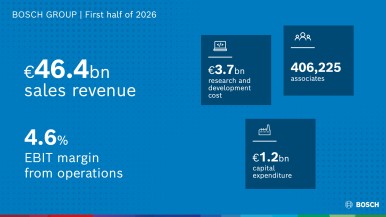
Stuttgart, Germany – The Bosch Group posted solid results in the first half of 2026 amid a business environment that remains challenging. The supplier of technology and services increased its sales revenue by 3.6 percent to 46.4 billion euros (H1 2025: 44.8 billion euros). The HVAC business recently acquired from Johnson Controls and Hitachi contributed some 2 billion euros in sales growth. EBIT (earnings before interest and taxes) from operations stood at 2.2 billion euros (H1 2025: 2.3 billion euros). The EBIT margin from operations was 4.6 percent of sales revenue, compared with 5.1 percent in the previous year. Result was primarily impacted by special effects in the Mobility business. Despite numerous economic and geopolitical uncertainties, Bosch is reaffirming its forecast of sales and result for the full year. “With solid sales growth in the first half of the year, we see ourselves on the home stretch for 2026, but we still need a strong finish,” said Markus Forschner , the chief financial officer and deputy chairman of the board of management of Robert Bosch GmbH, while presenting half-year figures for the first time. “That is why we are steadfastly pursuing the structural adjustments and cost-cutting measures we have initiated, so that we can continue to make major upfront investments in emerging technologies and capitalize on growth opportunities.”Outlook for H2 2026: competitiveness and a robust presence The global economy is proving remarkably resilient overall in 2026. At the same time, Bosch expects the economic outlook to remain marked by uncertainties that will continue to delay investment decisions in many markets and lead to intense competitive pressure. In the key automotive sector, Bosch expects global production figures for passenger cars and light commercial vehicles to decline again in 2026, while production of heavy-duty commercial vehicles is expected to grow slightly. “Bosch is rigorously pursuing its growth strategy despite global uncertainties and is capitalizing on opportunities in new technologies, business areas, and emerging markets,” Forschner explained. “That is why our focus for the second half of the year will continue to be on increasing competitiveness and ensuring the company maintains its robust presence. Our goal is to further reduce costs and complexity.” Despite the challenging environment, the company reaffirms its forecasts: for fiscal year 2026, Bosch still expects sales growth in the range of 2–5 percent. The EBIT margin from operations is expected to reach 4–6 percent. Review of H1 2026: development by business sector Sales development in the business sectors paints a mixed picture, although all sectors made a positive contribution to result. The Mobility business sector generated sales revenue of 27.8 billion euros, which was 0.5 percent lower year on year. Adjusted for exchange-rate effects, this represents an increase of 2.3 percent. Stagnant automotive production weighed on earnings, as did one-time special effects. The latter were primarily due to impairment losses on production facilities totaling 270 million euros; the worldwide ramp-up of electromobility is lagging behind previous expectations. The EBIT margin from operations was 4.7 percent (H1 2025: 5.8 percent). Sales revenue in the Industrial Technology business sector grew by 6.8 percent (9.2 percent after adjusting for exchange-rate effects) to 3.4 billion euros, reflecting the improved order situation. The EBIT margin came to 2.5 percent (H1 2025: 4.5 percent). The increasing intensity of competition from Chinese suppliers made itself felt in the Consumer Goods business sector, with sales revenue falling by 2.9 percent year on year to 9.6 billion euros. Adjusted for exchange-rate effects, sales remained unchanged. The EBIT margin from operations was 4.4 percent (H1 2025: 5.1 percent). The Energy and Building Technology business sector recorded a 45.9 percent jump in sales revenue to 5.4 billion euros as a result of the acquisition in the Home Comfort division. Of that amount, roughly 2 billion euros are attributable to the acquisition. The sale of significant portions of the Building Technologies product business resulted in a decline in revenue of some 450 million euros. Adjusted for exchange-rate effects, sales growth was 52.0 percent. The EBIT margin from operations was 7.3 percent (H1 2025: 0.8 percent). Review of H1 2026: development by region Global growth slowed in the first half of 2026 amid considerable geopolitical tensions. In particular, the war in the Middle East and the ongoing war in Ukraine weighed on the global market environment. In all regions, exchange-rate effects dampened sales development. In Europe, sales increased by 1.4 percent to 22.4 billion euros. Adjusted for exchange-rate effects, they grew by 2.2 percent. In the Americas, sales reached 9.4 billion euros, representing growth of 5.7 percent, or 12.2 percent after adjusting for exchange-rate effects. In Asia Pacific , sales revenue grew by 5.9 percent to 14.6 billion euros; after adjusting for exchange-rate effects, the increase was 10.4 percent. The acquisition in Bosch Home Comfort was a key factor in the positive performance in the Americas and Asia Pacific. Review of H1 2026: development of headcount At the end of the first half of 2026, the Bosch Group employed 406,225 people, which is 6,549 fewer associates than it had on December 31, 2025 (412,774). The decline in headcount affected all business sectors, but had a disproportionately large impact on Mobility. From a regional perspective, the steepest fall in headcount was in Europe. In Germany, Bosch employed 118,932 people as of mid-year (December 31, 2025: 122,968) – a decrease of 4,036 associates. Review of H1 2026: high financial strength, liquidity, and R&D ratio The Bosch Group continues to be financially strong, even though liquidity as per the consolidated statement of cash flows was lower year on year at 9.0 billion euros (H1 2025: 11.2 billion euros). The equity ratio remained at a high level of 41.3 percent (December 31, 2025: 41.5 percent¹). Reflecting the improved capital efficiency, the investment ratio stood at 2.5 percent (H1 2025: 3.8 percent), while capital expenditure totaled 1.2 billion euros (H1 2025: 1.7 billion euros). The R&D ratio stood at 8.0 percent (H1 2025: 8.7 percent). As of June 30, 2026, free cash flow (FCF) stood at -969 million euros, an improvement over the same period last year (-2.7 billion euros); this pattern of interim FCF development is typical of many companies. Key factors in this regard were the seasonal nature of capex in tangibles and the resulting increase in liabilities at year-end, which led to disproportionately high disbursements in the first quarter. By the end of the year, Bosch expects positive FCF of at least 1 percent of sales revenue. 1 Previous year’s figure adjusted following the final consolidation of the acquisition in Home Comfort.