Search & find:
Media, press releases, events for your editorial coverage

Hannover Messe 2025: Bosch embraces hydrogen production

26.03.2025

Press release

Industry 4.0

Hannover Messe 2025: Bosch embraces hydrogen production

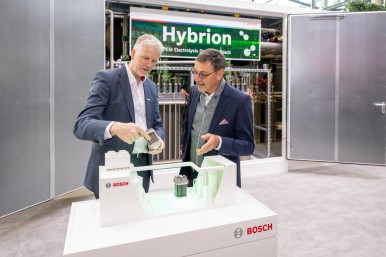
Stuttgart and Hannover, Germany – Whether in the chemicals, transportation, steel, or energy industries, there is enormous potential for decarbonization if hydrogen is used as an energy source – especially if it is produced using renewables. With an expected global capacity of 100–170 gigawatts by 2030, electrolysis is a strategic growth field for Bosch, despite the slowdown in the ramp-up of the hydrogen economy. To mark its entry into this market, the company is showcasing technology for electrolyzers at Hannover Messe. Bosch is premiering two Hybrion PEM (proton exchange membrane) electrolysis stacks as a modular container solution integrated into an electrolysis system. Such stacks are at the heart of the electrolyzer. The complete system, with an output of 2.5 megawatts, is supplied by FEST, based in Goslar, Germany. “To counter climate change, we need alternatives to fossil fuels. Green hydrogen, produced with renewable energy, will play a vital role in massively reducing carbon emissions in the industrial, transport, and energy sectors. Producing this hydrogen requires electrolysis systems – and Bosch’s Hybrion stack is the key component for them,” says Dr. Stefan Hartung, chairman of the board of management of Robert Bosch GmbH. To counter climate change, we need alternatives to fossil fuels. Green hydrogen, produced with renewable energy, will play a vital role in massively reducing carbon emissions in the industrial, transport, and energy sectors. Producing this hydrogen requires electrolysis systems – and Bosch’s Hybrion stack is the key component for them....Dr. Stefan Hartung, chairman of the board of management of Robert Bosch GmbH Bosch aims to apply its fuel-cell expertise to hydrogen production. The company wants to use its experience in volume production to achieve economies of scale and reduce costs in the future. In 2025, it is planning to work on several projects in Europe with various partners. Even before the official sales launch in April, Bosch has already acquired orders amounting to some 100 megawatts – for example, Neuman & Esser will be integrating 16 Bosch Hybrion stacks into an electrolyzer with a capacity of 20 megawatts. Bosch is also working with companies including AKA Energy Systems, Andritz, Pietro Fiorentini, Hyter, H2B2, iGas, IMI, Nikkiso, and Técnicas Reunidas. “Hydrogen is a strategic growth field for Bosch – we expect sales revenue to run into the billions by 2030,” says Dr. Markus Heyn, member of the board of management and chairman of Bosch Mobility. Hydrogen is a strategic growth field for Bosch – we expect sales revenue to run into the billions by 2030....Dr. Markus Heyn, member of the board of management and chairman of Bosch Mobility Stack production and hydrogen cycle in Bamberg The Hybrion stacks will initially be manufactured at the Bosch location in Bamberg, Germany. For each unit, over one hundred electrolysis cells are arranged in layers. For this, Bosch has developed a special clamping tool that greatly simplifies and accelerates the manufacturing process. Each stack can produce up to 23 kilograms of hydrogen per hour when supplied with a maximum power input of 1.25 megawatts. This is enough for a 40-ton truck with a fuel-cell powertrain to travel around 250 to 300 kilometers. In the individual electrolysis cells, a proton exchange membrane – made using a special polymer – separates the anode and cathode from each other. To produce hydrogen, ultrapure water is first fed into the anode side of the PEM electrolyzer. As a result of electrical voltage at the two electrodes, the water at the anode reacts to form oxygen and free electrons and protons. The protons cross the membrane and combine with the electrons to form hydrogen gas at the cathode. Bosch’s Hybrion PEM electrolysis stacks are suitable for hydrogen production in modular plants starting from 1 megawatt, but also for large, gigawatt-scale industrial plants. A FEST electrolyzer with integrated Bosch PEM electrolysis stacks is set to go into operation at the Bamberg plant as part of a hydrogen cycle in 2025. Bosch intends to use the hydrogen produced there for the endurance testing of mobile fuel-cell stacks, which are also manufactured in Bamberg. The power generated during that testing will in turn flow into the electrolyzer, thus closing the cycle. The hydrogen itself is initially intended for the company’s own use. Bosch offers a broad portfolio of products and solutions for hydrogen Bosch has an exhaustive hydrogen portfolio. “In developing hydrogen technologies, Bosch also relies on its proven expertise in industrial technology. We offer solutions from industry for industry,” says Dr. Tanja Rueckert, member of the Bosch board of management. Bosch Manufacturing Solutions, for example, offers water treatment systems that can be used to produce the ultrapure water required for electrolysis. These systems use thermal and electrochemical processes to remove impurities such as salts or metals from the water. Bosch is also actively using hydrogen in mobile fuel cells and hydrogen engines. Together with FirstElement Fuel, the U.S. market leader for the commercial operation of liquid hydrogen filling stations, Bosch Rexroth has achieved an important technology milestone for refueling infrastructure. CryoPump stations cut operating costs by up to 70 percent, bringing them down to an economical level, while shortening refueling processes for heavy trucks to around ten minutes.

Hannover Messe 2025: Bosch offers intelligent and efficient solutions for industry

19.03.2025

Press release

Business/economy

Hannover Messe 2025: Bosch offers intelligent and efficient solutions for industry

Stuttgart and Hannover, Germany – At Hannover Messe, Bosch presents solutions for industry – from hydraulics and electrolysis to software . In each case, the focus is always on improving the efficiency and productivity of manufacturing and enabling sustainable production. There is a significant role for hydrogen in making production sustainable – and in Hall 13, Booth C33, Bosch will be showcasing technologies for producing and using this resource. Bosch Rexroth will also be presenting its broad portfolio of industrial technology in Hall 6, Booth D26. In addition, Bosch experts will be sharing their thoughts with industry through presentations and panel discussions .Bosch technical highlights make industry fit for the future Hydraulic Hub: With its comprehensive range of digital services, the Hydraulic Hub simplifies and accelerates the servicing and maintenance of industrial hydraulic products, thereby increasing machine availability. Users of this digital service platform can access Bosch Rexroth’s hydraulics and service expertise 24/7 via its intuitive interface. The Hydraulic Hub also offers support with documentation and with proactive maintenance of hydraulic systems. AI-based tools provide answers to specific questions, such as what to do in the event of an oil leak, and help identify and rectify faults. Bosch Rexroth is working with Amazon Web Services, among others, to apply AI technologies. Electrolysis stack: Hydrogen production by way of electrolysis using renewable electricity has a central role to play on the path to a climate-neutral economy. In 2025, Bosch will launch its first electrolysis stack, the heart of every electrolyzer. The Bosch stack comprises more than 100 electrolysis cells that employ electricity to split water into oxygen and hydrogen. It is designed for an output of 1.25 megawatts, which corresponds to a hydrogen production rate of 23 kilograms per hour. On the hydrogen side, the resulting pressure is more than 30 bar. The stack is suitable for use in modular systems from 1 megawatt upward as well as in large gigawatt-class industrial systems. Water treatment system: The Pure Water System offered by Bosch Manufacturing Solutions (BMG) is a container system for the production of ultrapure water for electrolysis. Impurities in the water can render electrolyzers inoperative in a very short time. BMG’s water treatment system uses thermal and electrochemical processes to remove impurities such as salts or metals, thereby producing ultrapure water. The first step uses an energy-efficient and water-saving distillation technology called mechanical vapor compression. This is followed by electrodeionization (EDI), in which an electric field removes the remaining ions from the distillate. The Pure Water System requires no filter media or chemicals at all to treat salty water. The system’s product water meets the strict purity requirements of all electrolyzer technologies. Electrolyzer stack testing system: Bosch Manufacturing Solutions (BMG) offers an innovative system for the safe and efficient end-of-line testing of PEM electrolysis stacks up to a size of 1 megawatt. Automated contacting of the electrolyzers at the anode, cathode, and power supply increases precision and reduces the time required for testing. The software’s test procedures can be flexibly adapted to the specific requirements of different tests. Moreover, its customizable data evaluations enable a detailed analysis of the test results, which supports quality assurance in stack production. BMG also offers a modular, customizable electrolysis system for efficient hydrogen production, as well as a broad portfolio of assembly and testing systems for the development, manufacture, and quality assurance of fuel cells and fuel-cell power modules (FCPM). CryoPump station: Bosch Rexroth has worked together with FirstElement Fuel, the U.S. market leader for the commercial operation of liquid hydrogen filling stations, to develop an important technology milestone for refueling infrastructure. CryoPump stations cut operating costs by up to 70 percent, bringing them down to an economical level, while shortening refueling processes for heavy trucks to around ten minutes. Compared to conventional crankshaft-based pumps, the technology increases efficiency to over 95 percent and extends maintenance intervals to over 4,000 hours. With a footprint of less than 11 m² and a noise level of less than 65 dB(A), the stations are ideal for use in existing filling stations, even in residential areas. Battery production solutions: Battery production is considered a key technology for the energy transition. The only way manufacturers can hope to meet heavy future demand is by rapidly scaling up their battery production capacity. At Hannover Messe, Bosch Rexroth will be demonstrating how to realize complex value streams and extremely dynamic material movements using real material flow solutions along the entire value stream: from the virtual warehouse and cell preparation through module and pack assembly to transport and end-of-line testing. Compact gas compressor: Efficient and cost-effective hydrogen compression and storage is a key issue in the energy transition. Based on a proven automotive application, Bosch has developed a gas compressor that can compress over 11 standard cubic meters of hydrogen per hour to as much as 350 bar. This corresponds to more than one kilogram of hydrogen. The compressor’s compact dimensions and extremely low weight of less than ten kilograms make installation and maintenance considerably easier. In addition to hydrogen, the compressor is also suitable for other gases such as nitrogen, helium, and carbon dioxide, which greatly expands its range of application. HeyBosch: Bosch and Microsoft have expanded their partnership to introduce HeyBosch, an advanced AI platform based on Microsoft Azure. HeyBosch improves data management for industrial companies by providing insights into data and knowledge, making complex engineering data easy to understand, and using generative AI to enable user training. The platform integrates conversational AI, VR/AR functions, and business intelligence tools to offer a consistent and user-friendly experience.

Hannover Messe 2024: Bosch presents sustainable solutions for factory automation ...

22.04.2024

Press release

Business/economy

Hannover Messe 2024: Bosch presents sustainable solutions for factory automation ...

Stuttgart and Hannover, Germany – Industrial manufacturing is the engine of every economy. It creates jobs, secures prosperity, and ensures growth through trade. When industrial manufacturers come together again for this year’s Hannover Messe, there will be one major challenge that all of them continue to face: to respond to climate change, factories must become sustainable and conserve resources. Bosch is one of the leading factory outfitters; its broad portfolio of solutions for factory automation, the hydrogen economy, digitalization, and artificial intelligence (AI) helps industrial companies achieve a green transformation.Bosch industrial technology is in demand: in 2023, the supplier of technology and services was able to hold its own in a volatile market environment characterized by geopolitical tensions, the economic downturn, and interest-rate effects. Its sales of industrial technology rose to 7.4 billion euros. This equates to an increase of 6.8 percent, or 10.2 percent after adjusting for exchange-rate effects. The main drivers of this growth were Bosch’s acquisitions of HydraForce and Elmo Motion Control. “We are pursuing a long-term growth strategy with industrial technology,” says Tanja Rueckert, the member of the board of management of Robert Bosch GmbH responsible for the Industrial Technology business sector as well as the area of digital business and services. “We want to strengthen our market position, expand regional supply chains, and increase our industrial technology sales to 10 billion euros by 2028.” We want to strengthen our market position, expand regional supply chains, and increase our industrial technology sales to 10 billion euros by 2028....Tanja Rueckert, the member of the board of management of Robert Bosch GmbH At Hannover Messe 2024, Bosch will be presenting technologies and solutions in the fields of automation, digitalization, and hydrogen. “As an early adopter of artificial intelligence and digitalization applications, industrial technology is like almost no other sector,” Rueckert says. “Software and connectivity help increase efficiency, quality, and sustainability in production. The only way we can secure our standard of living and prosperity is with a strong industrial sector.” Generative AI: improve processes, increase quality In manufacturing, Bosch wants to use generative AI to further improve production management, monitoring, and control. In two Bosch plants in Germany, the company has launched initial projects through which generative AI creates synthetic images in order to develop and scale AI solutions for optical inspection and to optimize existing AI models. Bosch expects that this will reduce the time needed for planning, launching, and ramping up AI applications from the current six-to-twelve months to just a few weeks. Developed by Bosch researchers, this service for generating synthetic data is to be offered to all Bosch locations following successful piloting. ctrlX AUTOMATION: automation toolkit The ctrlX AUTOMATION system for factory automation developed by Bosch Rexroth comprises hardware, software, and apps. It is an open platform that provides all the building blocks for complete automation solutions, and reduces component and engineering costs by 30 to 50 percent. The platform’s community of partners, known collectively as ctrlX World, is continuously expanding the range of solutions with hardware, and above all with apps. So far, 100 partners have contributed their strengths and solutions. Since its launch five years ago, the number of customers has risen to around 1,500. Sales in this area increased 30 percent in 2023. Battery production: components for automated equipment Whether in electromobility, consumer electronics, or building technology, the demand for energy storage is greater than ever. Bosch Rexroth offers a comprehensive portfolio for battery production that includes individual components, systems solutions, and subsystems featuring linear, joining, and transfer technology in addition to the fully open ctrlX AUTOMATION system. Speed and precision are also important in battery production. Bosch Rexroth has developed linear robots that can be used quickly for typical applications such as handling cells and packs as well as joining and dispensing. These robots optimize processes in module and pack assembly and disassembly. Battery recycling: automation solution for deep discharge of batteries There are more and more electric cars driving quietly and with low emissions on the roads. Their batteries contain rare and valuable raw materials such as lithium and nickel, the recovery of which makes economic and ecological sense. Bosch Rexroth’s toolkit solution for diagnosing, discharging, and dismantling used vehicle batteries enables the automation of these process steps, which are upstream of the actual process of recovering the raw materials. This makes it possible to recycle batteries on an industrial scale and offers the possibility of flexible scaling. Stack and smart electrolysis module: technology for H2 electrolyzers Bosch not only plans to use hydrogen, but also to provide smart technology for its production. For this purpose, the company has developed an electrolysis stack, the central element of an electrolyzer. The stack comprises more than 100 electrolysis cells that use electricity to split water into oxygen and hydrogen. It is designed for an output of 1.25 megawatts. That is equivalent to the production of 23 kilograms of hydrogen per hour. The Bosch electrolysis stack is suitable for use in smaller-scale plants producing 1 megawatt and more, all the way up to large, gigawatt-scale plants. It is expected to be market-ready from 2025. In addition, Bosch is planning to combine its electrolyzer stack with a control unit, power electronics, and various sensors to create a smart electrolysis module. Manufacturing and testing technology: how fuel cells are made Bosch Manufacturing Solutions (BMG), the company’s special-purpose machinery unit, supplies advanced manufacturing equipment and testing technology for fuel-cell manufacturing – from individual components to complete systems. In total, more than 50 percent of the required manufacturing equipment comes from Bosch itself. When testing stacks and systems, natural conditions are simulated for the end-of-line functional test, where the PEM fuel cells are put through their paces. Here, gas composition, temperature, pressure, and humidity are the same as in the actual vehicle. The test benches work efficiently: 50 percent of the hydrogen used is recovered for new testing processes. A test bench for proton exchange membrane (PEM) electrolysis stacks will be presented for the first time at Hannover Messe. This type of test bench can be upgraded for development as well as for end-of-line functional testing, and is available in size classes between 50 kW and 3 MW. eSEA underwater actuator: electrification of offshore facilities In the future, hydrogen will often be produced in remote areas – in the desert or at sea – and thus far away from where it will later be used. To make it economical to operate the offshore facilities required for green hydrogen and the capture and storage of CO2, their plant technology needs to be significantly cheaper to purchase and operate than it has been to date. Bosch Rexroth has developed an electrical solution for controlling valves in underwater process plants at depths of up to 4,000 meters. Since this solution no longer feature valves operated via hydraulically driven actuators, it eliminates the need for miles of hydraulic lines to connect to hydraulic power units above water. Hydrogen filling stations: drive solutions for compressing hydrogen Hydrogen filling stations play a major role in decarbonizing the mobility sector. Within the next six years, several thousand hydrogen filling stations are set to go into operation worldwide. Together with partners, Bosch Rexroth has developed scalable solutions for servo-hydraulic compressor drives in the power range between 10 and 280 kW for the compression of hydrogen. To be able to refuel vehicles with hydrogen fuel quickly and simply, the gas has to be compressed to as much as 900 bar. A new electrohydraulically driven cryogenic pump has been developed in partnership with FirstElement Fuel, a leading company in the U.S. for the commercial operation of hydrogen filling stations. This cryogenic pump compresses liquid hydrogen directly to 875 bar. The aim is to refuel heavy trucks with 100 kg of hydrogen in under ten minutes. Direct refueling eliminates the need for intermediate storage tanks at filling stations. The first filling stations are set to be equipped starting in 2025. Moreover, Bosch Rexroth has worked with Maximator Hydrogen to develop scalable, low-maintenance drive units, with ratings currently up to 250 kW, that offer filling station operators an affordable way into hydrogen technology. The new container-based compressors can potentially reduce total cost of ownership by half compared with the commercially available alternatives. The Swiss Coop Group already uses hydrogen trucks for its goods transportation. They refuel at five filling stations equipped with Maximator and Bosch Rexroth technology. Bosch at Hannover Messe Bosch Rexroth – Hall 6, Booth D26 Bosch Connected Industries – Hall 9, Booth F27 Bosch Manufacturing Solutions – Hall 13, Booth C33 Selected panels with Bosch experts • Research Summit – Panel discussion with Dr. Tanja Rueckert, member of the board of management and chief digital officer, Robert Bosch GmbH, Monday, April 22, 2024, 2:30–3:15 p.m., Convention Center (CC), Room 1 • Panel discussion “The future of SMEs: Organizing sustainability & establishing digital business models” with Lisa Reehten, managing director, Bosch Climate Solutions, Tuesday, April 23, 2024, 5:15–5:35 p.m., Hall 8, Booth D17 • Panel discussion “AI meets automation” with Hans Michael Krause, director ctrlX World, Bosch Rexroth AG, Tuesday, April 23, 2024, 1:30–2:00 p.m. in Hall 3, Booth A76 • Lecture “Digital twins: What nobody is talking about” with Dr. Birgit Boss, Bosch Connected Industry, Thursday, April 25, 2024, 3:00–3:25 p.m., Industry 4.0 Conference Stage, Hall 8, Booth D17 • Panel discussion “The role of 6G in shaping the next industrial era” with Andreas Müller, Wednesday, April 24, 2024, 2:45–3:30 p.m., Hall 14, Booth H06


Bosch to use generative AI in manufacturing

07.12.2023

Press release

Industry 4.0

Bosch to use generative AI in manufacturing

Stuttgart, Germany – Bosch is piloting generative AI and foundation models in manufacturing. In initial projects in two Bosch plants in Germany, generative AI creates synthetic images in order to develop and scale AI solutions for optical inspection and optimize existing AI models. Bosch expects that this will reduce the time needed for planning, launching, and ramping up AI applications from the current six to twelve months to just a few weeks. Following successful piloting, this service for generating synthetic data is to be offered to all Bosch locations. Nearly half of all Bosch plants are already using AI in their manufacturing operations. With the help of generative AI, we’re not only improving existing AI solutions, but we’re also laying the foundations for the optimum take-up of this future technology in our global manufacturing network...says Stefan Hartung, chairman of the board of management of Robert Bosch GmbH. There are sound economic reasons for this move: depending on the size of the plant and type of production, artificial intelligence can be used to achieve productivity gains and six- to seven-figure cost savings – per year and plant. “AI has excellent potential for innovation and can make human work even more productive. As a manufacturing company, established factory outfitter, and Industry 4.0 trendsetter, Bosch aims to play a leading role in the development and application of industrial AI,” Hartung says.AI in practice: Bosch projects deliver substantial benefit Bosch pilot plants are already using AI in production scheduling, monitoring, and control. At the plant in Hildesheim, for example, AI-based data analysis has helped reduce cycle times during the production ramp-up of new lines by 15 percent. At the plant in Stuttgart-Feuerbach, new algorithms cut component-testing processes from three and a half to three minutes. “With generative AI, we’re now taking the next step in the evolution of artificial intelligence and advancing modern manufacturing to a new level,” says Tanja Rueckert, member of the Bosch board of management and chief digital officer. In this process, Bosch can build on its own expertise: the software models for generative AI were developed by Bosch research and are now being implemented in the field by Bosch factories. One plant uses an AI method of synthetically generated images to reliably inspect welds of copper wires in electric motor production, while another focuses on the quality assurance of high-pressure pumps. AI boost: generative AI pushes the boundaries of feasibility For years, the Feuerbach plant inspected fuel-injection components manually. The nature and complexity of the products, as well as differences in the structure of the production lines, meant that neither rule-based nor AI-assisted optical inspection was possible. The new approach is a scalable generative AI that recognizes variants of a product and error patterns and takes into account different arrangements and sequences in the production process. This is based on a foundation model developed by Bosch research and fed by large data sets from the Bosch manufacturing network. Synthetically generated data is used to refine the model and customize it for on-site applications. This is expected to make the AI capable of inspecting components independently, only submitting cases to visual inspectors where it is unsure. At the Hildesheim plant, synthetically generated images have already been successfully used for training purposes in the first standard systems in electric motor production. The human eye cannot distinguish the artificially generated images from real ones. The plant expects that project duration will be six months shorter with the new approach than with conventional methods, leading to annual productivity increases in the six figure euro range. Bosch plans to expand the AI approach to other locations. “In our work to develop AI solutions, we’re unlocking the potential offered by the Bosch manufacturing network and its roughly 230 plants. And we are using new technologies. Generative AI helps to harmonize individualization and scaling – the technology gives us the best of both worlds,” Rueckert says. AI status: widely used in Bosch plants Many Bosch plants have one thing in common: not only are they AI pioneers, but they also focus consistently on Industry 4.0. “Bosch has been digitalizing and connecting its own plants and those of its customers for more than ten years. Now we’re combining Industry 4.0 with artificial intelligence: connected manufacturing provides data and AI evaluates it,” Rueckert says. Errors are detected at an early stage, machine downtimes are kept to a minimum, scrap is reduced, and energy is applied in a focused way. “The use of AI will make factories more efficient, more productive, and more eco-friendly,” she adds. For example, Bosch research has developed an AI-based system that identifies anomalies and malfunctions in the manufacturing process and improves product quality. This software is now in use in around 50 Bosch plants, with over 2,000 production lines connected. Many Bosch plants also use artificial intelligence in the optical inspection of components. For example, over 20 plants use Machine Vision AI, a solution designed by Bosch’s special-purpose machinery unit that helps detect hard-to-identify features, such as scratches and chipping on surfaces and defects in weld seams. AI pioneers: World Economic Forum commends Bosch plants The Bosch plant in Bursa, Turkey, illustrates what AI can achieve in manufacturing. Starting from an already high level of technical expertise, the plant has used AI to further improve manufacturing quality: it has reduced water consumption by 30 percent, energy consumption by 6 percent, and scrap by 9 percent, while also increasing plant efficiency by almost 10 percent. This year, these achievements prompted the World Economic Forum (WEF) to single out the plant in Bursa as an Industry 4.0 lighthouse. This is the fourth time a Bosch plant has received such recognition from the World Economic Forum, and the second time specifically for developments in the field of artificial intelligence. All this shows that “AI’s importance is historic. It will fundamentally change industrial production – for the better,” Rueckert says.

How Bosch uses AI in manufacturing

05.12.2023

Factsheet

Industry 4.0

How Bosch uses AI in manufacturing

Bosch plant in Ansbach This plant manufactures printed circuit boards for use in control units for ABS and ESP as well as for electronic steering systems. In the assembly of these boards, particular attention has to be paid to the solder joints: there are between 5,000 and 8,000 of them on each board. The Ansbach plant uses an AI-based measuring process to check whether all circuit-board elements are soldered correctly. If this is not the case, an image of the faulty solder joint is presented to experienced visual inspectors for evaluation. All in all, the inspectors now receive only a fraction of the images they previously had to review. The AI significantly reduces the visual inspectors’ workload, improves the quality of the results, and increases productivity. Bosch plant in Blaichach The plant in Bavaria also uses AI for quality control. At the Immenstadt site, the screen at the test bench for ABS systems lights up red to show the assembly workers if the component being tested is defective. This information is provided by a self-learning system that uses the data it has collected to recognize error patterns and, in this way, to distinguish relevant error messages from non-relevant ones. Weekly retraining of the algorithms continuously improves the high success rate. Bosch plant in Changsha At this plant in China, Bosch has introduced an AI-based energy management system that it developed in-house. The system relies on AI algorithms to predict energy consumption on production lines, enable continuous production scheduling, and incorporate business and environmental factors. These factors include forecasts of customer demand, production plans, weather, temperature, and humidity. This saves energy and reduces emissions. With the help of the AI solution, the Changsha plant was able to cut its annual electricity consumption by 18 percent and carbon dioxide emissions by 14 percent. For its achievements, the plant was singled out as an Industry 4.0 lighthouse by the World Economic Forum in 2022. Bosch plant in Charleston At this U.S. location, Bosch manufactures mobility solutions such as ESP, electric motors, and fuel-injection valves. The plant uses a root-cause analysis to investigate causal relationships that can lead to rejects at the end of the production process. AI software lends support to this analysis by sifting through the billions of data points that a manufacturing execution system (MES) collects and records during production. From this data, the AI derives possible correlations between the measured values and quality deviations in the production line and sets them out clearly on a dashboard, where associates see a ranked list of possible causes sorted by descending probability. Bosch plant in Dresden In this wafer fab, which went into operation in 2021, the company employs an AI system developed by its own researchers to detect anomalies and faults in the manufacturing process at an early stage. Predictive maintenance means that work on machines and systems is carried out as necessary. Artificial intelligence guarantees high process stability in the wafer fab and increases quality continuously. This saves customers time-consuming tests and curtails month-long trials. As a result, Bosch not only manufactures faster, but can also be relied on to deliver on time. Bosch plant in Mexicali At this plant in Mexico, AI uses noise analysis to check the quality and functionality of the multifunctional tools manufactured on-site. Once production is complete, a microphone “listens” to the tools for three seconds before the AI software delivers its verdict: OK or not OK – and the results are much more reliable than is possible for human inspectors. Around 300,000 tools were tested during development of the AI solution. The plant aims to use this process to inspect over one million products per year. Bosch in Reutlingen Artificial intelligence is also used in production scheduling at highly automated wafer fabs such as the Bosch plant in Reutlingen, Germany, where it saves time and costs as it guides the wafers through up to 1,000 processing steps. The AI has an overview of all the materials available for a manufacturing step and sorts them on the assembly line so as to achieve optimum throughput. In many instances, production sequencing is determined completely by AI, thus ensuring optimum utilization of capacity.