Search & find:
Media, press releases, events for your editorial coverage

The Bosch company retirement scheme in Germany

18.12.2024

Factsheet

Working at Bosch

The Bosch company retirement scheme in Germany

1929: With Bosch-Hilfe e.V., Robert Bosch establishes for all associates support for retirement and for the surviving dependants. 1999: Bosch merges more than 70 company pension plans into the Kapital Vorsorge Plan 2002: Bosch is the first German industrial company to set up its own pension fund and initially uses it to convert associates' salaries 2006: Bosch and the workers‘ council agree to transfer the Kapital Vorsorge Plans into the Bosch Vorsorge Plan with the Bosch Pensionsfonds as the central financing instrument 2016: Bosch introduces the Fondsrente, with which associates continue to participate in the performance of the Bosch Pensionsfonds during the retirement payout phase Bosch Vorsorge Plan With the Bosch Vorsorge Plan, Bosch offers its associates an attractive retirement benefit based on one of the most modern retirement schemes in Germany. In addition, associates and their families are already covered during their working life in the event of disability or death. Bosch builds up assets with company contributions for the associates and bears the costs for this. Associates can further increase this pension assets through their own contributions. All contributions are based on the investment result of the Bosch Pensionsfonds. The contributions themselves are guaranteed by the company as a minimum benefit. In retirement, the credit is available as an additional income with flexible payout options. 11.4 billion euros of assets in the Bosch Vorsorge Plan 138,000 active associates with retirement assets in the Bosch Vorsorge Plan 39,000 former associates with vested entitlements (including commitments before introducing Bosch Vorsorge Plan) 65,000 beneficiaries, including 15,000 surviving dependents (including commitments before introducing Bosch Vorsorge Plan) 3,300 recipients of disability payments Average annual return since foundation: around 6% in the investment segment up to age 55 just under 4% in the investment segment over age 55 Status: 31.12.2024

How Bosch uses AI in manufacturing

05.12.2023

Factsheet

Industry 4.0

How Bosch uses AI in manufacturing

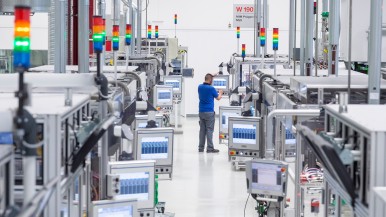
Bosch plant in Ansbach This plant manufactures printed circuit boards for use in control units for ABS and ESP as well as for electronic steering systems. In the assembly of these boards, particular attention has to be paid to the solder joints: there are between 5,000 and 8,000 of them on each board. The Ansbach plant uses an AI-based measuring process to check whether all circuit-board elements are soldered correctly. If this is not the case, an image of the faulty solder joint is presented to experienced visual inspectors for evaluation. All in all, the inspectors now receive only a fraction of the images they previously had to review. The AI significantly reduces the visual inspectors’ workload, improves the quality of the results, and increases productivity. Bosch plant in Blaichach The plant in Bavaria also uses AI for quality control. At the Immenstadt site, the screen at the test bench for ABS systems lights up red to show the assembly workers if the component being tested is defective. This information is provided by a self-learning system that uses the data it has collected to recognize error patterns and, in this way, to distinguish relevant error messages from non-relevant ones. Weekly retraining of the algorithms continuously improves the high success rate. Bosch plant in Changsha At this plant in China, Bosch has introduced an AI-based energy management system that it developed in-house. The system relies on AI algorithms to predict energy consumption on production lines, enable continuous production scheduling, and incorporate business and environmental factors. These factors include forecasts of customer demand, production plans, weather, temperature, and humidity. This saves energy and reduces emissions. With the help of the AI solution, the Changsha plant was able to cut its annual electricity consumption by 18 percent and carbon dioxide emissions by 14 percent. For its achievements, the plant was singled out as an Industry 4.0 lighthouse by the World Economic Forum in 2022. Bosch plant in Charleston At this U.S. location, Bosch manufactures mobility solutions such as ESP, electric motors, and fuel-injection valves. The plant uses a root-cause analysis to investigate causal relationships that can lead to rejects at the end of the production process. AI software lends support to this analysis by sifting through the billions of data points that a manufacturing execution system (MES) collects and records during production. From this data, the AI derives possible correlations between the measured values and quality deviations in the production line and sets them out clearly on a dashboard, where associates see a ranked list of possible causes sorted by descending probability. Bosch plant in Dresden In this wafer fab, which went into operation in 2021, the company employs an AI system developed by its own researchers to detect anomalies and faults in the manufacturing process at an early stage. Predictive maintenance means that work on machines and systems is carried out as necessary. Artificial intelligence guarantees high process stability in the wafer fab and increases quality continuously. This saves customers time-consuming tests and curtails month-long trials. As a result, Bosch not only manufactures faster, but can also be relied on to deliver on time. Bosch plant in Mexicali At this plant in Mexico, AI uses noise analysis to check the quality and functionality of the multifunctional tools manufactured on-site. Once production is complete, a microphone “listens” to the tools for three seconds before the AI software delivers its verdict: OK or not OK – and the results are much more reliable than is possible for human inspectors. Around 300,000 tools were tested during development of the AI solution. The plant aims to use this process to inspect over one million products per year. Bosch in Reutlingen Artificial intelligence is also used in production scheduling at highly automated wafer fabs such as the Bosch plant in Reutlingen, Germany, where it saves time and costs as it guides the wafers through up to 1,000 processing steps. The AI has an overview of all the materials available for a manufacturing step and sorts them on the assembly line so as to achieve optimum throughput. In many instances, production sequencing is determined completely by AI, thus ensuring optimum utilization of capacity.

1,200 meters of welds make each fuel-cell stack hydrogen-tight

10.07.2023

Factsheet

Bosch Group

1,200 meters of welds make each fuel-cell stack hydrogen-tight

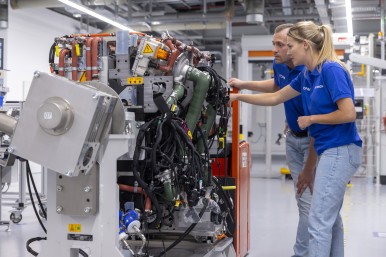
The Stuttgart-Feuerbach manufacturing site Feuerbach has a firm place in the past and future of mobility. The Stuttgart-Feuerbach site is the largest and oldest Bosch location worldwide. It was set up by Robert Bosch himself in 1909. The Feuerbach plant has been moving people and goods for more than 100 years: roughly 2,800 associates work in the Feuerbach plant, and the location as a whole employs roughly 15,000. Hardly any other location illustrates the transformation in mobility as well as Feuerbach. The manufacture of magneto parts began there in 1910, and 1927 saw the start of production of diesel injection pumps for trucks. Since then, it has witnessed the start of production of many products, mainly for combustion engines. And now, from July 2023, it will see the volume production of the fuel-cell power module (FCPM) on an area currently almost as large as half a soccer field. This volume production of the FCPM is also a joint project involving a number of German locations with a long mobility history: Bamberg is supplying the Feuerbach manufacturing operation with the fuel-cell stack. And important system components such as the electric air compressor and the recirculation blower come from Homburg. The assembly and testing of the complete system is then done in Feuerbach. The Feuerbach plant is part of an international manufacturing network. Only as a result of the exchange of knowledge and manufacturing expertise was it possible for production of the fuel-cell power module to start not only in Feuerbach, but also in Chongqing, China, where the requisite components come from the Bosch plant in Wuxi. Similarly, it is planned to manufacture stacks in Anderson, NC. The fuel-cell power module The fuel-cell power module is the most complex system Bosch has ever developed. A fuel-cell power module made in Feuerbach comprises several hundred individual parts, weighs more than 500 kilograms, and has a surface area of roughly 1.5 square meters. The module is designed to fit into the space previously occupied by the truck’s combustion engine. This is an advantage for truck makers, and also saves them money, since they can build on the same vehicle platform. The fuel cells are the heart of the power module. At first glance, they are not very spectacular. They are only roughly the size of an envelope, and weigh less than 100 grams. To make them capable of propelling a heavy truck, several hundred fuel cells are combined. This combination, known as a stack, provides a total electrical output of more than 100 kilowatts. A fuel-cell power module comprises two such stacks, and thus delivers a total output of more than 200 kilowatts – more than enough to drive a 40-ton truck. In the case of the new fuel cell drive system, we can draw on the knowledge gained from decades of research and development work on powertrain components, and also profitably use our manufacturing expertise for the mobility of tomorrow. Over the long term, we want more than half of the fuel cell powertrain by value to be created internally and Bosch's special machine engineering covers more than 50 percent of the production equipment. It was also possible to transfer knowledge relating to coating technology and leak testing. In addition, Bosch researchers have developed solutions that will help prolong the service life of PEM fuel cells to as much as 30,000 operating hours in the future. When manufacturing mobile fuel-cell systems, high-speed laser welding is used. We use it to make 1,200 meters of welds in each stack hydrogen-tight. Apart from the stack, a mobile fuel-cell system contains many other components, including a hydrogen metering valve and an electric air compressor. Together, they ensure that the fuel cells are supplied with hydrogen and oxygen, so that an electrochemical exchange of the reactant gases hydrogen and oxygen can produce electricity. On the one hand, this electricity is stored in a battery. On the other, it directly drives the vehicle’s electric motor. Unlike in purely battery-electric heavy trucks, where the batteries can weigh up to nine tons, the batteries in a fuel-cell truck weigh only roughly 500 kilograms. Fuel-cell manufacturing and testing technology Following individual manufacturing steps, and before the process is complete, the fuel-cell system is continuously tested for impermeability. The helium used in the leak test is captured, filtered, and reused for subsequent leak tests. In this way, up to 40 percent of the helium used can be reused. In addition, the nitrogen that is also used in leak testing is extracted from the ambient air using a nitrogen generator. In this way, packaging and transportation are avoided, and there is no need to compress the gas, which saves energy. Each fuel-cell power module is thoroughly tested before delivery. The end-of-line (EOL) test records 450 variables. The various driving modes (acceleration, braking) in the truck are tested with hydrogen and oxygen at a test bench under real conditions. The manufacturing and testing technology used here comes from Bosch Manufacturing Solutions, the company’s special-purpose machinery unit. The testing process is efficient in design, and is being further refined. The electricity produced during the process is fed into the Feuerbach location’s power supply. The fuel cell-electric truck If the fuel tanks are big enough, a truck can drive the roughly 800 kilometers from Hamburg to Munich without refueling. Refueling takes roughly as long as it takes to drink a cup of coffee: in between 10 and 20 minutes, the truck is full. One kilogram of hydrogen contains as much energy as 3.3 liters of diesel. To be able to refuel vehicles with hydrogen quickly and simply, the gas has to be compressed to as much as 900 bar. For the energy-efficient operation of hydrogen compressors in filling stations, Bosch Rexroth has developed a low-maintenance, scalable systems solution. Mobile fuel cells run on gaseous hydrogen. Inside the cells, this hydrogen reacts with oxygen from the ambient air. The result is electricity to drive the electric motor and “exhaust” in the form of pure steam. At the end of 2022, some 500 vehicles featuring Bosch fuel-cell systems were already on the roads. With the planned start of production in the U.S. and China, their number will grow further. Bosch is confident that, by 2030, one in five new trucks weighing six tons or more will feature a fuel-cell powertrain – provided international efforts to mitigate global warming continue to gain pace.

Transformation needs diversity

21.11.2022

Factsheet

Bosch Group

Transformation needs diversity

To remain competitive in times of change, companies have to develop new forms and curricula for their associates’ occupational training and further professional development. Bosch started preparing itself for the transformation in the automotive industry early on, and is well positioned with a leading position in electromobility, comprehensive training programs, and the development of new business areas and markets. In 2018, the company laid the foundation for a comprehensive training initiative (Mission to Move) to qualify associates for new tasks in growth areas such as electromobility, software, data analysis, and artificial intelligence. Mission to Move: On-demand training and training specifically for new posts Transfer qualification at Bosch So far, more than 1,000 associates have received training to qualify them for specific new tasks or positions. Most of them are engineers, but other highly qualified people have also taken part starting in 2020. Worldwide approach The digital transformation is creating a powerful incentive to quickly build up new knowledge and new capabilities. That is why the programs are constantly being adjusted to meet regional needs as well. To date, Bosch associates at more than 40 locations in some 20 countries have participated in Mission to Move. Roughly one-quarter of the participants come from locations outside Germany. Contents The program portfolio now covers three areas with ten learning programs in different formats: Electrification for engineers and skilled workers Software qualification Big data with data science, data analytics, and data engineering In-house and external partners In these endeavors, Bosch works with in-house partners such as the Bosch Learning Company and the company’s apprenticeship unit, as well as with the Chamber of Commerce and Industry and the universities of Stuttgart, Aalen, and Ingolstadt. The length of these courses varies depending on the program. Individual programs Electrification This program is designed for associates switching to the electromobility field. In a seven-week program, associates spend three days a week familiarizing themselves with subjects such as e-mobility concepts, battery technologies, power electronics, and software. Participants can learn more about these subjects in practical training modules lasting several days. The basic theory is taught by the apprenticeship unit, which has now evolved into a technical training campus for subject matter relating to electrification. The program aims to qualify associates for jobs such as a design engineer for 48-volt batteries and project manager for power electronics. Software These two programs offer software training for associates from hardware-related units. The “intense” program lasts between 10 and 12 weeks, and comprises four 60-minute modules. The “long-term” program, by contrast, spans an 11-month period and comprises eight modules. Here as well, the program covers both theory and practice. In small groups, participants visit partner universities to learn basic theory. This will then qualify them for jobs in areas such as software and systems engineering as well as software function development. Bosch is continuously evaluating its requirements for the necessary skills, so that it can take further steps to qualify people for new jobs. Big data In these programs, associates with in-depth specialist knowledge in the mobility field learn and familiarize themselves with additional skills relating to the storage, processing, and analysis of big data, and how this improves the quality and efficiency of products and processes and provides the basis for developing new data-based business models. Qualification as an industrial electrician Mechanics are trained to become industrial electricians certified by the chamber of commerce. The engineers and other skilled workers taking part are closely supervised to ensure that the programs are a success. Mentors, the sense of community in the small study groups, the alumni network, and concurrent familiarization with the new jobs that await the participants provide additional support and motivation. Roughly 95 percent of participants complete the course.

Facts, figures, and amazing truths about semiconductors

25.05.2021

Factsheet

Connected mobility

Facts, figures, and amazing truths about semiconductors

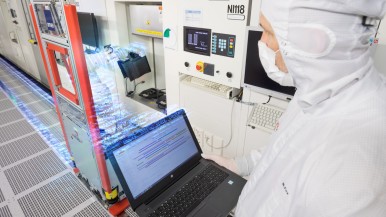
The market In 2020, some 440 billion dollars’ (385 billion euros) worth of semiconductors were sold worldwide, an increase of around 7 percent over 2019 (source: World Semiconductor Trade Statistics [WSTS]). WSTS estimates that the market will grow roughly 11 percent in 2021, to 488 billion dollars (427 billion euros). In 2020, the European semiconductor market was worth 38 billion dollars (33 billion euros), with 12.3 billion dollars (10.8 billion euros) of this amount accounted for by Germany (source: ZVEI). ZVEI expects sales across Europe to grow 5 percent in 2021, to roughly 40 billion dollars (35 billion euros). In 2020, semiconductors for automotive applications accounted for 10.6 percent of the global semiconductor market. In the EMEA semiconductor market, these chips have a market share of 35 percent (source: ZVEI, WSTS). Since 2009, micro- and nanoelectronics has been one of Europe’s six key enabling technologies (KETs). The European Commission regards these technologies as decisive for Europe’s future competitiveness. Bosch is one of the leading manufacturers of semiconductors for automotive applications. It is also one of the leading companies for the manufacture of MEMS sensors for automotive applications and consumer electronics. Production Semiconductor chips are manufactured on circular discs of e.g. silicon or silicon carbide, known as wafers. Depending on the size of the chip, an eight-inch (200-millimeter) wafer will yield anything between a few hundred and a few thousand chips. Although the silicon chips measure just a few square millimeters, they contain complex circuits, sometimes featuring several millions of individual electronic functions. While three-inch (76-millimeter) wafers were standard in the 1970s, most of the wafers produced today are either 8 inches (200 millimeters) or 12 inches (300 millimeters) in diameter. Bigger wafers mean that more chips can be produced in one manufacturing cycle. Semiconductor production is carried out under cleanroom class 1 conditions. Every cubic foot (approx. 28 liters) of normal ambient air contains 100,000 particles. When manufacturing semiconductors, by contrast, there must be no more than one particle weighing half a microgram in every cubic foot of air. That is roughly the equivalent of having a single cherry pit in all of Lake Constance. The process of turning raw wafers into semiconductor chips is a complex one, and can last up several month. In 1994, Bosch developed the “Bosch process” for manufacturing MEMS sensors. For this work, the developers Jiri Marek, Michael Offenberg, and Frank Melzer received the German Future Prize in 2008. Bosch holds more than 1,500 patents and patent applications in the field of semiconductors, 1,000 of which are for MEMS technology. The development of semiconductor technology at Bosch Bosch has been manufacturing a wide range of semiconductor chips for more than 60 years. These include application-specific integrated circuits (ASICs), power semiconductors, and microelectromechanical systems (MEMS). In the mid-1950s, Bosch research began to explore the development of particularly robust semiconductor components that are suitable for use on the road. In the 1960s, Bosch developed the first power semiconductor for cars. Back then, special generator diodes made generators more reliable and longer-lasting. At the end of the 1960s, Bosch built its first semiconductor factory in Reutlingen due to the growing demand for the components from within the Bosch Group. Production of integrated circuits started 1970. In 1970, Bosch launched the world’s first mass-produced ASICs for cars. Specifically, they were power transistors for voltage regulators and integrated circuits. When Bosch began producing its Motronic – a digital engine control system (ignition and injection in one control unit) – in 1979, it had an eight-bit microprocessor on board. Together with the erasable memory used, this was effectively the world’s first use of a computer in a car in a driving-relevant role. Bosch has been producing MEMS sensors for more than 25 years; the first model was a pressure sensor for the Bosch Motronic. In 2010, Bosch took its 200-millimeter semiconductor factory in Reutlingen into operation. With a total outlay of 600 million euros, this was the biggest single investment ever made in the company’s history. In June 2018, Bosch laid the foundation stone for the construction of one of the world’s most advanced semiconductor factories: starting in 2021, it will produce semiconductor chips based on 300-millimeter technology. Bosch is investing roughly a billion euros in this high-tech plant. Use in vehicles Worldwide, the average value of the microelectronics per vehicle will have grown from 138 dollars (120 euros) in 1998, to 559 dollars (489 euros) in 2018, to 685 dollars (600 euros) by 2023 (source: ZVEI). According to the experts, most of this growth will be due to driver assistance systems, infotainment, and powertrain electrification. Semiconductors account for some 80 percent of innovations in new vehicles (source: ZVEI). They can be found, for example, in the powertrain, in the cockpit, and in the infotainment and driver assistance and safety systems. While every car rolling off the production lines worldwide in 2016 had on average nine Bosch chips on board, this figure had risen to 17 chips by 2019. Use in consumer and entertainment electronics For 15 years, Bosch MEMS sensors have also been used in consumer electronics. 2006 saw the market launch of the first MEMS sensor for this sector. It enhanced the fun of games consoles. In 2020, just under 1.3 billion smartphones were sold (source: International Data Corporation [IDC]). In addition, wearables – the collective term for electronics that can be worn on the body, such as smart watches, fitness armbands, and data goggles – are growing in popularity. In 2020, sales of wearables were around 445 million units (source: IDC). All these devices contain sensors that evaluate a very wide range of information. On average, five MEMS sensors are built into every smartphone. They enable the mini-computers to recognize when the screen has been turned, and they stabilize photos and facilitate navigation. Amazing but true When Bosch began the production of micromechanical sensors in 1995, the edge length of an acceleration sensor was 133 millimeters. The edge length of the smallest MEMS sensor currently in Bosch’s portfolio is 1.56 millimeters. That is smaller than a pinhead and represents a miniaturization of the sensor size by factor 85 within about 25 years – while simultaneously featuring more functions. More than 80 of these microchips would fit on a thumbnail. To date, Bosch has manufactured well in excess of 15 billion MEMS sensors in Reutlingen, with several million more added to the tally every day. On average, Bosch semiconductors are two millimeters thick. If the 15 billion MEMS sensors already manufactured by Bosch were laid end to end, the row of chips would be about 30,000 kilometers long. That is roughly the distance from the North to the South Pole and back to the equator. In consumer electronics, MEMS sensors are less than one millimeter in height. Some components inside the sensors measure a mere four micrometers – 17 times thinner than a human hair.

Bosch combines Industry 4.0 with AI

03.03.2021

Factsheet

Industry 4.0

Bosch combines Industry 4.0 with AI

Stuttgart, Germany – Bosch is developing the factory of the future. In this endeavor, the company sees Industry 4.0 as the way forward. Once Bosch has tested and validated products in-house, it markets them to other companies. Its portfolio ranges from software packages for manufacturing and logistics, to robots that make and deliver parts, to workplace assistance systems. The company expects that the use of artificial intelligence will take its endeavors to the next level. It can help reduce reject rates in factories, for example, and improve the utilization of machines and systems.AI in action: Examples from Bosch manufacturing operations Industry 4.0 combined with artificial intelligence helps in finding solutions for complex tasks. Connected manufacturing provides data and AI evaluates it. One use case for artificial intelligence is in production scheduling in highly automated wafer fabs such as the Bosch plant in Reutlingen, Germany, where it saves time and costs as it guides the wafers through up to 1,000 processing steps. This means a five percent faster wafer throughput, with an investment payback time of just three months. Bosch also uses artificial intelligence in its quality control. At its Immenstadt location, the screen at the test bench for ABS systems lights up red to show the assembly workers if the component being tested is defective. This information is provided by a self-learning system that uses the data it has collected to recognize error patterns and, in this way, to distinguish relevant error messages from non-relevant ones. Weekly retraining of the algorithms constantly improves the high success rate. Quality improvement is also the focus at the Bosch Rexroth plant in Homburg, where machine tools process hydraulic valve housings for mobile applications such as tractors. Machine learning methods are applied to make near real-time statements about the quality of workpieces on the basis of the data collected by machine tools. If necessary, the production processes are immediately adjusted, thus reducing the number of reject parts. Having reached development maturity, the AI application eliminates the need for labor-intensive downstream lab tests. Bosch develops AI solutions for its own plants and for customers Bosch’s special-purpose machinery unit has designed Machine Vision AI, an application platform for machine-based visual inspection of workpieces. It helps detect hard-to-identify features such as scratches and chipping on surfaces and defects in weld seams. The salient features of this solution are its ease of use and high reproducibility. A gradual rollout of the technology is currently underway in Bosch plants. The Bosch Rexroth APAS inspector , a production assistant for automatic visual inspection, is already established in factories and available on the market. Its learning image processing software means the system can be “retrained” at any time without requiring extensive programming knowledge on the part of the operators. AI also helps make manufacturing more resource friendly. More than 100 Bosch plants and locations utilize the Energy Platform from the company’s Industry 4.0 portfolio. Also available to external customers, the platform uses intelligent algorithms to quickly detect machines’ energy consumption and cushion any peak loads. This further reduces carbon dioxide emissions in factories; for example, Bosch’s lead plant for Industry 4.0 in Homburg, Germany, cut its emissions by some ten percent within two years. Bosch is now adding what it calls a Balancing Energy Network to its Energy Platform. This software solution uses AI to control and optimize energy flows in manufacturing operations. In addition to boosting energy efficiency, it allows power from renewable energy sources to be put to the best use, enabling flexible operating schedules to be drawn up. Originally developed for manufacturing facilities, the software has the potential to help all types of larger building complexes reduce their environmental footprint, including hospitals, shopping malls, and sports arenas. Bosch is a pioneer and leader in Industry 4.0 Bosch has been adding connectivity to manufacturing and logistics since 2012, with almost all its plants now using Industry 4.0 solutions. Projects in this area deliver measurable benefit. Industry 4.0 solutions make it possible to increase productivity at individual locations by up to 25 percent. One example is the Nexeed software developed by Bosch Connected Industry, which enables real-time management, monitoring, and control of production activities. Validated and used in Bosch factories, Nexeed has already won over more than 100 customers from a wide range of sectors, including BMW and the sensor manufacturer Sick. While Bosch Connected Industry focuses on Industry 4.0 software for production, the Bosch.IO unit offers cloud-based IoT solutions aimed primarily at logistics and AI-based energy management. Bosch Rexroth develops smart hardware, intelligent robotics solutions such as APAS or ActiveShuttle, and pioneering automation technology for the factory of the future. It has now launched an open, 5G-capable automation control platform: ctrlX Automation. Bosch Manufacturing Solutions rounds off the Industry 4.0 portfolio. The special-purpose machinery unit provides customized systems for production, from assembly to process and testing technology.

The Bosch plant in Feuerbach – where tradition meets high-tech

05.10.2020

Factsheet

Business/economy

The Bosch plant in Feuerbach – where tradition meets high-tech

Feuerbach, in Germany, is home to Bosch’s biggest, as well as oldest, location worldwide. It was established by Robert Bosch himself in 1909, and is home to a Bosch plant that has been in existence for more than a century. In other words, it has a rich history. At the same time, it also has a very bright future – not least because the plant has kept pace with progress and is now profiting from the benefits of Industry 4.0 in the areas of manufacturing, maintenance, transport, and monitoring. For example, with a network of over 550 items of connected machinery throughout the plant, the condition of individual production systems can be monitored via a graphic display showing their current operating status. Equipped with this knowledge, plant engineers can intervene at a first sign of a problem, thereby reducing machinery downtime and increasing output. At the same time, the plant also benefits in the field of logistics, where seamless connectivity has substantially enhanced processes and brought greater transparency. For example, a smart supermarket system with put-to-light technology automates the management of inventory and simplifies sorting in a materials store that is located close to the production line. All parts removed are recorded by the inventory management system, and replacement orders automatically dispatched. The resulting transportation is undertaken by digitalized milk runs or fully autonomous ActiveShuttles. Alongside the extensive deployment of software-based solutions, the Feuerbach plant is also driving forward the development of human-machine interaction. This includes the use of APAS, an automatic production assistant that works hand in hand with human operatives without the need for a protective fence. In other words, Industry 4.0 is changing the face of manufacturing and, with it, the nature of manufacturing jobs. Feuerbach has been quick to respond to this trend. In spring 2018, skilled workers from the plant commenced training for the new, nationwide qualification for Industry 4.0 specialists established by the Chamber of Commerce and Industry (IHK). In addition, in its role at Industry 4.0 lead plant, Feuerbach is doing pioneering work on 5G for the entire Bosch manufacturing network with its approximately 250 plants. For this purpose, Bosch has applied for and received a 5G license to build a private campus network. The set up of the network is planned in 2020. General information Plant name Feuerbach Plant Established 1909 Surface area approx. 109,100 m² Workforce approx. 3,000 Products High-pressure pumps and components for exhaust-gas treatment Core competencies Lead plant functions, digitalization/Industry 4.0, carbon coating, contact measurement, Bainitic hardening Division Powertrain Solutions Facts and figures: Industry 4.0 in Feuerbach Over 550 items of connected machinery 10 percent reduction in cycle times Over 50 percent reduction in administrative overheads for production management due to introduction of the Active Cockpit interactive communication platform Over 50 percent reduction in energy requirements (as per January 2019 compared to 2007), also as a result of smart connectivity for diverse data sources

How Bosch factories are driving climate action

09.07.2020

Factsheet

Business/economy

How Bosch factories are driving climate action

Stuttgart, Germany – Green, smart, successful. The future of manufacturing lies in combination: in making obvious connections and harmonizing ecological and economic concerns. This presents companies with immense challenges. With the manufacturing industry accounting for around one-fifth of CO 2 emissions in Germany, for example, attention is turning above all to production processes and the indirect emissions resulting from the external procurement of electricity and heat. In 2019, Bosch emitted around 1.94 million metric tons of CO 2 worldwide (Scope 1+2) – around 90 percent of which arose in production. Examples from Bosch plants in Germany, France, India, Mexico, and Sweden show what measures the company is taking to achieve climate-neutral manufacturing.Salzgitter and Wernau, Germany – hydrogen as an important building block for the move to alternative energy In Salzgitter, Bosch is working with the Fraunhofer Institute and other local companies to establish a center for hydrogen, known as the Hydrogen Campus, which is funded by the city and the state of Lower Saxony. A pilot project is investigating the potential of hydrogen to reduce factories’ carbon footprint. Hydrogen is regarded as an important building block for the move to alternative energy. Using green electricity, an electrolyzer produces hydrogen and oxygen from water. Hydrogen can replace fuels such as oil or natural gas in the steel and chemicals industries. Used in fuel cells, it can power trains or cars. The Bosch plant in Salzgitter is being used to trial the use of hydrogen an an energy source for factories. The project partners will start building the Hydrogen Campus this year; the ramp-up phase will begin in 2021 with the aim of building a 50 MW electrolysis plant. This will produce around 7,500 metric tons of hydrogen a day, thereby saving up to 41,000 metric tons of CO 2 emissions. At the Bosch training center in Wernau, a pilot SOFC plant is being taken into operation. SOFC stands for solid-oxide fuel cell. The plant is made up of three fuel-cell systems for stationary applications. These will offer a low-carbon supplement to the Wernau plant’s existing power supply, as well as help accelerate the development of such distributed energy systems. When compared with the German electricity mix, an SOFC fuel-cell system saves as much as 40 percent of CO 2 emissions, even when running on natural gas. If the fuel-cell runs on hydrogen or green gas, no further direct emissions of CO 2 are caused. An SOFC unit with an output of 10 kilowatts can cover the annual electricity needs of more than 20 four-person households. In the case of the Wernau plant, this means that the three fuel-cell systems can almost completely cover the energy needs of one of the plant buildings.Homburg, Germany – crunching data to conserve energy and increase efficiency The Bosch plant in Homburg is edging ever closer to the vision of an energy-efficient, self-learning plant. In the past two years, this location has cut its carbon dioxide emissions by around 4,500 metric tons, and by more than 25,000 metric tons since 2007, by employing digitally connected sensors, self-programmed algorithms, and efficiency conversions on machinery. To achieve this, it followed a “maximum transparency meets technological innovation” approach. The energy management platform developed by Bosch uses data that has been collected from the machinery at some 12,000 measuring points. Associates can track, control, and optimize each individual machine’s power consumption. Technical solutions include ventilation of manufacturing shops on an as-required basis, waste heat recovery from various machining processes, and smart consumption management for machinery. In addition, the location is championing the efficiency technology of the future: last year, the prototype of a stationary fuel cell developed by Bosch was put into operation in Homburg. The fuel cell is integrated into the location’s energy supply network and covers peak electricity demand.Reutlingen, Germany – putting waste heat to intelligent use As the Reutlingen plant conducts its manufacturing operations in fully air-conditioned clean rooms, it requires year-round heating. Until now, this demand has been covered by boilers, with the heat in the summer months remaining largely unused. Now, there is a solution: heat exchangers have been added to the heating network at specific points to systematically lower the temperature curve of the heating circuit and thus allow the available waste heat to be used for heating throughout the entire location. In addition, this saves the energy that was previously used to dissipate excess heat. The boilers now run on an as-required basis and can be switched off for practically the entire summer. This reduces the time that heating systems are in operation from 7,500 hours to 4,000 hours per year. It also reduces annual energy consumption by 3,000 megawatt hours and carbon emissions by 700 metric tons.Feuerbach, Germany – people and machines work together to deliver energy efficiency The Bosch plant in Feuerbach has been in existence for more than a century and lies at the heart of the oldest and biggest Robert Bosch GmbH location. Established in 1909, the Feuerbach plant has steadily and systematically modernized its facilities and consistently improved its energy efficiency. With training sessions in its “Energieerlebniswelt” (energy experience world), a local team focuses on energy monitoring and increasing awareness among the workforce. The plant has pursued heat-recovery, room-automation, machine power shut-off management, and shop-renovation projects with great success. Its energy requirements are down more than 50 percent compared with 2007; its carbon emissions are down 47 percent.Nashik, India – reducing carbon footprint with power generated on site In India, Bosch is pursuing carbon neutrality by tapping natural sources of energy. Spurred on by the idea of supplying the location with fully renewable power during daytime hours, the team at the Nashik location began installing its first photovoltaic systems in 2015. It now has 50,000 solar panels in place on roofs, parking lots, and the grounds to generate around 20 percent of the power required by the plant each year. The facility has reduced its carbon emissions by some 25,000 metric tons and saved over 33,000 megawatt hours since 2015. This is equivalent to the power consumed by some 24,500 Indian households. Bosch experts have also developed an eco-friendly solution for cleaning the modules: the water is recycled several times.Rodez, France – sustainable heating system Reduce the site’s carbon footprint – that was what the team in Rodez in France set out to do when it started making plans in 2009. The location now has a biomass heating plant, up and running since 2013. It burns wood chips obtained from local forestry resources. Rodez uses its power to heat water and generate process heat. On average, the wood chip-fired plant covers 90 percent of the location’s heating requirements. It consumes some 6,600 metric tons of wood chips a year. Burning this biomass releases no more carbon than the trees had taken from the atmosphere. The factory has reduced its yearly emissions by around 600 metric tons.Bosch in Mexico – renewables cover four-fifths of demand Mexico has revamped its energy policy. A government energy reform program aims to source 35 percent of the country’s electricity from non-fossil fuels by 2024. With many hours of sunshine annually and high-wind regions, Mexico’s geography and climate are certainly conducive to that goal, providing a solid foundation for change alongside committed support from government and business. Bosch is part of this movement, and has already set a high standard: Power sourced exclusively from the Dominica wind farm in the state of San Luis Potosí covers up to 80 percent of the energy requirements of several Bosch locations in Mexico. Between 2015 and 2019, Bosch Mexico reduced its carbon emissions by 250,000 metric tons.Mellansel, Sweden – energy-efficient painting technology One of the most flexible and eco-friendly paint shops in European mechanical engineering is located in Mellansel, Sweden: the Bosch Rexroth plant there paints equipment such as heavy-duty hydraulic motors for recycling plants and raw materials handling equipment. It is also where engines that will subsequently come into contact with salt water are coated with several layers of corrosion-proofing. In this process, the temperature and the ratio of water to color pigments are closely monitored so that excess heat can be recovered. As a result, energy consumption is 75 percent lower than before.