Search & find:
Media, press releases, events for your editorial coverage

Bosch Rexroth achieves stable sales at previous year's record level in 2019

16.04.2020

Press release

Business/economy

Bosch Rexroth achieves stable sales at previous year's record level in 2019

Lohr am Main, Germany – Bosch Rexroth held up well in 2019 in a difficult environment and despite a sharp drop in incoming orders. At 6.2 billion euros, sales remained stable at the previous year’s record level. The company benefited from a solid core business in hydraulics and the further expansion of its product range in factory automation as an important door opener for new markets. “We draw a positive conclusion for 2019," says Rolf Najork, member of the Board of Management of Robert Bosch GmbH, responsible for the Industrial Technology division and Chairman of the board of Bosch Rexroth AG. "In view of the volatile markets and the noticeable economic slowdown, this very good result was anything but certain. It shows that our broad positioning with different divisions is a great advantage and that we have set the right course with our structural adjustments.” In 2019, Bosch Rexroth was able to match the success of the previous year in all regions. The core markets of Germany and Europe remained the strongest. Sales in Germany dropped by 4.1 percent to 1.4 billion euros. In the remaining European markets (excluding Germany), sales declined by 0.3 percent to 2.1 billion euros compared to the previous year. In the growth markets in the Asia-Pacific / Africa region, Bosch Rexroth achieved sales of 1.6 billion euros, which equals a slight increase of 0.6 percent. The region North and South America recorded a 5.3 percent rise to 1.1 billion euros. At the end of the fiscal year (December 31, 2019), the company employed around 31,000 people worldwide.Economic environment and COVID-19 pandemic cloud prospects for 2020 Bosch Rexroth expects business to decline in all regions and sectors in the current fiscal year 2020 due to the general economic weakness and the structural change in customer sectors closely linked to the automotive industry. Order intake declined by 20.3 percent in the course of 2019. Additionally, the global COVID-19 pandemic is currently clouding business expectations for 2020. Hence, the systematic implementation of measures to improve competitiveness in all areas is particularly important for Bosch Rexroth. "We are very much concerned with the current developments regarding COVID-19. We have taken extensive measures during the past weeks to protect our employees, customers and partners while ensuring the best possible supply," says Najork, "Safety is our top priority throughout. We want to be a reliable and responsible partner for our customers, also and especially in such global crises". Focus on innovations and new markets Bosch Rexroth remains one of the most significant innovation drivers and pioneer for new technologies in its markets. For example, the company invested some 348 million euros in research and development in fiscal year 2019 – an increase of 6.2 percent over the previous year. The company continues to focus on developing connected and fully automated solutions in the two major areas of hydraulics and factory automation. All divisions contributed to the success of Bosch Rexroth in 2019. While the core business with industrial and mobile hydraulics proved to be a solid foundation, the factory automation division with its focus on Industry 4.0 and the vision of the fully connected factory of the future, developed into an important door opener for new markets and customers.Machinery Applications and Engineering: connected and intelligent hydraulics Bosch Rexroth is actively driving change in its traditional core business of industrial hydraulics: smart hydraulic components and systems such as the compact hydraulic unit CytroBox can be quickly and easily integrated into connected manufacturing facilities. They are Industry 4.0 ready and offer services for the Internet of Things (IoT), for example for condition monitoring of machines and plants.Mobile Hydraulics: Smart Solutions for the mobile work machine of the future Despite the tense market environment, Bosch Rexroth was able to further expand its market share in mobile hydraulics in 2019. New activities in the fields of automation and driver assistance systems, electrification and IoT are future key topics. With BODAS Connect, Bosch Rexroth offers an open, scalable end-to-end solution to connect mobile work machines with each other. It enables customers to retrieve and analyze data from the mobile application. At the 2019 BAUMA trade fair for construction machinery, the company also presented the first components of a future range of electrification systems for work machines. These solutions support customers in reducing emissions, while further increasing performance. Here, Bosch Rexroth benefits from the long-standing Bosch expertise in electromobility. Factory Automation: new standards for connected manufacturing Connected assembly and intralogistics remain an important strategic focus for Bosch Rexroth’s factory automation division. The spotlight is on the vision of the factory of the future with software-based, automated and connected solutions. The company was able to further strengthen its position as an innovation driver in 2019, amongst others with the open ctrlX AUTOMATION platform. As the first 5G-capable automation platform from Bosch Rexroth, ctrlX AUTOMATION connects a wide range of devices with the new communication standard and ensures consistent connectivity in factories. Existing machines can be upgraded with the new technology via retrofit solutions. The Active Shuttle, which was also introduced in 2019, ensures greater flexibility and higher productivity in the automated factory. The autonomous transport system sets new standards in intralogistics, transports loads of up to 260 kilograms and is loaded and unloaded fully automatically using an integrated lifting platform."GoGreen" project: targets for energy and CO₂ savings exceeded In 2019, Bosch Rexroth was also able to record important achievements in CO2 neutrality: as part of the Bosch Group, the supplier of drive and control technologies has set itself ambitious goals to reduce energy consumption and CO₂ emissions. In the scope of the Bosch Rexroth project “GoGreen”, energy efficiency is being systematically improved in all plants and at customers' sites since 2011 – with an extremely positive outcome: by the end of fiscal 2019, Bosch Rexroth had saved 620 million kilowatt hours of electricity and gas worldwide thanks to "GoGreen," corresponding to more than 265,000 tons of CO₂. This equals the annual energy consumption of a city with some 80,000 inhabitants. Energy consumption at the Bosch Rexroth locations was reduced by 20 to 50 percent. Since the end of 2019, Bosch Rexroth has achieved a CO2-neutral “footprint” in Germany.

Bosch puts 5G machines in pole position

26.11.2019

Press release

Business/economy

Bosch puts 5G machines in pole position

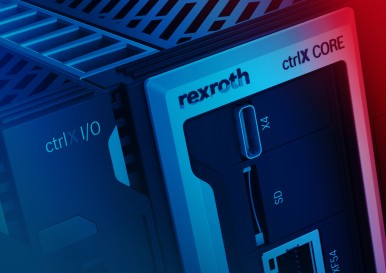
Stuttgart, Germany – 5G is coming. The new communications standard accelerates the internet of things and boosts Industry 4.0. Control systems and sensors of the kind built into facilities, machinery, and logistics chains stand to gain from this fast, reliable real-time wireless data transfer. Preparing machines for state-of-the-art communication involves making them 5G-capable. Now Bosch has the solution: Bosch Rexroth’s new ctrlX AUTOMATION control technology comes with 5G built in and can connect a wide range of industrial devices with the new communications standard. ctrlX AUTOMATION will be showcased at the SPS trade fair in Nuremberg.Bosch opens the door to a new industrial age 5G is set to turbocharge manufacturing. Our new 5G-capable automation platform lays the groundwork and opens the door to a new industrial age,...says Rolf Najork, the member of the Bosch board of management responsible for industrial technology. 5G is the first communications standard designed to enable connectivity for people as well as for the internet of things. The new standard has impressive characteristics: it is up to 20 times faster than 4G, transfers data virtually instantaneously with a latency of one millisecond, and is up to 99.9999 percent reliable – making the receipt of a “digital shipment” as certain as with transmission through a wire. "5G is a revolution and an important building block for the factory of the future", Najork says. Engineers and designers now face the challenges of integrating 5G into their machines and products. Bosch is introducing the solution that meets their needs: the new automation platform’s hardware can be fitted with a 5G module. The operating system and software for ctrlX AUTOMATION are 5G-capable from the outset and support rapid commissioning. Retrofit solutions are also available for adding the new technology to existing machinery. Bosch Rexroth’s new automation platform is scheduled to have its market launch in 2020. 5G will be a competitive factor for connected industry Experts estimate that there will be up to 70 billion connected devices worldwide by 2025. Many of them will be in manufacturing, meaning that 5G will become a competitive factor. The new communications standard will enable applications that require high-power, extremely reliable wireless connections to be integrated securely and efficiently into manufacturing facilities. These include mobile robotics, autonomous transport vehicles, and human-machine interactions. For instance, workers wearing augmented reality glasses can access additional information in their field of vision, optimizing how they monitor and maintain machinery. Combining tasks in the virtual world with those in the real world calls for real-time data flows. And that’s what 5G promises. "This new form of communication eclipses everything we’ve had until now. 5G is the first wireless protocol to truly meet the needs of the manufacturing industry", Najork says. Bosch takes on leadership role in Industry 4.0 and 5G Bosch is developing the factory of the future. In this endeavor, the company is relying on Industry 4.0 . The company first tests and validates products in-house before they are available on the market. Bosch is taking this approach with 5G, too. The company presented its first 5G-capable autonomous transport system, ActiveShuttle , at the Hannover Messe. To support the further development of its factories, Bosch has applied to the German Federal Network Agency for 5G licenses with which to set up local campus networks. Moreover, Bosch has taken on the chair of the global 5G Alliance for Connected Industries and Automation (5G-ACIA) with the aim of shaping the new mobile standard so that it meets the needs of the manufacturing industry from the outset.

Bosch presents tomorrow’s mobility today

12.12.2018

Press release

Mobility

Bosch presents tomorrow’s mobility today

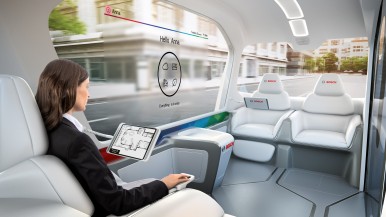
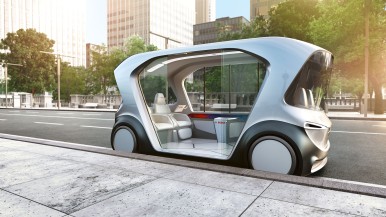
Stuttgart, Germany – A light, airy, minimalistic design, a futuristic outer shell made of display screens and glass, and a spacious interior – that is how architects might describe a novel structure, but in actuality the description also fits a completely new class of vehicle and a new kind of mobility: driverless electric shuttles that glide almost silently through city centers and are seamlessly connected with their environment. These will soon be a common sight on our city streets – whether they are transporting goods or people. Bosch provides components and systems for automating, connecting, and electrifying the shuttles, but shuttle mobility won’t be possible without mobility services. In the future, the company will offer these services too, bundling them into a smart, seamlessly connected ecosystem. That will include booking, sharing, and networking platforms, parking and charging services, and software solutions for managing and maintaining the vehicles, as well as infotainment during the journey. “Bosch is developing a unique package of hardware, software, and mobility services for shuttle mobility of the future,” says Dr. Markus Heyn, member of the board of management of Robert Bosch GmbH. At CES 2019 in Las Vegas, the world’s biggest electronics show, Bosch will be presenting its solutions for this area of transportation with a concept shuttle, and visitors will be able to experience its full range of services. Bosch is developing a unique package of hardware, software, and mobility services for shuttle mobility of the future....Dr. Markus Heyn, member of the board of management of Robert Bosch GmbH Bosch services for users and shuttle operators The emergence of the shuttle segment is a result of rising demand for ridesharing services: in Europe, the U.S., and China alone, about one million such on-demand shuttle buses will be on the roads as early as the year 2020, growing to 2.5 million by 2025 (source: Roland Berger ). Many of these vehicles, available 24/7, will be fully electric, and they will also be completely autonomous by the middle of the next decade at the latest. That’s why Bosch has packed every square centimeter of its concept shuttle with the appropriate technology – from electric powertrains and 360-degree surround sensors to connectivity management and vehicle computers. Yet these components and systems go only part of the way towards shuttle mobility. To make on-demand vehicles suitable for flexible everyday use, they must be connected to mobility services. “In the future, every vehicle on the road will make use of Bosch digital services,” Heyn says. These services allow users to book the vehicles, share rides with other passengers, and pay for the journey. Charging, repairing, and maintaining the vehicles, plus route planning and administrative activities, also call for services that Bosch will offer shuttle fleet operators in a seamlessly connected ecosystem. In the future, every vehicle on the road will make use of Bosch digital services....Dr. Markus Heyn, member of the board of management of Robert Bosch GmbH Booking and sharing Users can easily book a shuttle via smartphone, regardless of whether they’re relaxing on the sofa or sitting at their desk at work. Working behind the scenes, an algorithm identifies the vehicle closest to the requested location and finds other users who wish to travel a similar route. The more passengers a single shuttle can transport, the cheaper the journey for everyone. This approach also reduces the amount of traffic in cities and mitigates the impact on the environment. Bosch is developing the necessary software platforms to make this a reality. When the shuttle pulls up to the requested pick-up point, users again use their smartphones to identify themselves – thanks to Bosch’s Perfectly Keyless digital access service. It recognizes the owner’s smartphone as unmistakably as a digital fingerprint and opens the vehicle only for them. Every passenger always gets the seat that they reserved. Moving forward: electrified and automated Bosch’s electric axle drive makes the shuttles especially efficient yet affordable as they wend their way through the city. And the company’s Convenience Charging service knows just how long the battery charge will last and where to recharge the vehicle. This service means that even today, drivers no longer need to worry about being stranded with a dead battery. It also links vehicle information, such as the current state of battery charge or how much energy the heating and air-conditioning systems are consuming, with environmental data such as congestion and weather forecasts, so as to predict vehicle range with particular accuracy. Furthermore, Convenience Charging finds the ideal charging station and can reserve it in advance. And thanks to a standardized access and payment system, charging is easier than ever. Driverless e-shuttles provide users with transportation that is not only nearly emissions-free, but also very safe. For automation, Bosch develops and makes its own radar, video, and ultrasonic sensors, braking control systems, and power steering, to name a few examples. Smart digital services are indispensable here, too: Bosch predictive road-condition services let automated vehicles know in advance what environmental conditions to expect. They can thus adapt their driving style as needed so as to ensure maximum safety throughout the journey. The Bosch road signature is a map-based localization service with which automated vehicles can accurately determine their position in the lane down to a few centimeters – another crucial prerequisite for the safety of automated shuttles. Comfortable interior Bosch has designed the interior of its concept vehicle to provide space for four passengers, seating them across from one another to maximize legroom and comfort. Infotainment is provided on screens that can be used either by each passenger individually or in groups; for example, a family can watch a movie together as they travel somewhere for the weekend, or colleagues can work on a presentation on their way to the office. Smartphones use the on-board Wi-Fi and can integrate seamlessly with the infotainment system, thanks to Bosch connectivity technology. Its concierge service turns the shuttle into a personal assistant. With all kinds of information at its disposal, the shuttle can provide passengers with recommendations, advance bookings, weather reports, and travel tips at any time. Once the shuttle has arrived at its destination, the passengers can pay for their journey with Bosch’s e-payment service. Maintenance and administrative activities But Bosch services do not end when a rideshare journey is over: the company’s camera-based system for the vehicle interior checks whether anyone has forgotten their phone or handbag. If a passenger does forget something, the shuttle informs them directly via smartphone. The cameras can also detect gum on the seat or an overturned coffee cup – in other words, whether the shuttle needs cleaning – and can make the necessary arrangements immediately. This is so every passenger can start their journey in a clean shuttle. Bosch’s service for over-the-air updates can determine whether the driverless shuttles have the latest software version. The service detects software updates as soon as they are available and executes them in the vehicle securely and reliably. Thanks to sensors installed in the vehicle, predictive diagnostics can monitor the condition of key components and notify the shuttle before a fault actually occurs, so it has enough time to drive itself to a repair shop. This prevents the car from suddenly breaking down, which is a boon to operators. In the future, Bosch will pool updates from the data cloud and predictive diagnostics into a comprehensive connectivity platform . This will give vehicle manufacturers and shuttle service operators a constant overview of the condition of their fleets, so they can ensure that their shuttles are always ready for action. And finally, the Bosch subsidiary ESCRYPT’s security solutions handle vehicle security – whether for keyless access systems, data connectivity with the outside world, or software updates.


Bosch strengthens its operations in Africa with acquisition in industrial technology

01.03.2018

Press release

Business/economy

Bosch strengthens its operations in Africa with acquisition in industrial technology

Stuttgart, Germany, and Johannesburg, South Africa – The Bosch Group is strengthening its business in Africa and further expanding its industrial technology portfolio on the continent. Effective February 28, 2018, Bosch Rexroth AG has acquired all shares in Hytec Holdings (Pty.) Ltd., Johannesburg, South Africa. Hytec specializes in the marketing of hydraulic and automation solutions, and is the leading company in the field in sub-Saharan Africa. In 2017, the company and its roughly 770 associates generated sales of some 86 million euros. Hytec has about 40 branch operations, not only in South Africa, but also in Mozambique, Namibia, Zambia, Botswana, Ghana, and Kenya. In a first phase, Bosch Rexroth acquired a 50 percent stake in its marketing partner Hytec in 2014.“For Bosch, Africa has a lot of potential as a strategic market of the future,” says Uwe Raschke, the Bosch management board member responsible for Europe, the Middle East, and Africa. “In the years ahead, we want to significantly increase our sales in Africa,” Raschke adds. Considerable opportunities are offered by the heavy investments being made in infrastructure projects in areas such as construction and power generation. “Together with Hytec, we can take better advantage of the market opportunities in the African growth industries,” says Rolf Najork, the managing director of Bosch Rexroth. The region is characterized by a lot of end-user business, such as servicing and spare parts for users of machinery. With its new subsidiary, Bosch Rexroth hopes to further expand this business. Hytec has a well-established marketing network in sub-Saharan Africa, and its associates are well familiarized with what local customers want. “We are combining this high level of regional marketing knowledge with Bosch Rexroth’s product expertise and technological prowess. This will be a significant boost to our business on the continent,” Najork says. Hytec will continue to market the products of other manufacturers. Its portfolio includes roughly 30 brands. It will also continue to do business as Hytec, since this is a strong, well-known brand in southern Africa. For Bosch, Africa has a lot of potential as a strategic market of the future....Bosch board member Uwe Raschke Rapid population growth and urbanization are leading to increased demand Africa’s population is growing at a rapid pace, and according to the United Nations is expected to double to 2.5 billion people by 2050. The continent also has the fastest rate of urbanization in the world. Within the next ten years, it is expected that 187 million Africans – equivalent to half the U.S. population – will live in cities. This means growing demand for drive and control solutions for industrial machinery, for mobile machinery such as construction vehicles, and for major construction projects. Even today, Bosch Rexroth and its marketing partner Hytec are successfully collaborating to serve the African market in areas such as power engineering. In one major project, for example, the two companies renewed the entire hydraulic equipment of the Roseires Dam in Sudan. At 1,800 megawatts, the output of this dam on the Blue Nile is comparable with that of a nuclear power station. Bosch has been working with its marketing partner Hytec for more than 50 years. “The complete acquisition of Hytec gives us a welcome opportunity to extend this successful collaboration and to grow further in Africa,” says Tillmann Olsen, general manager of Bosch Rexroth in South Africa. In May 2018, Bosch Rexroth and its new subsidiary Hytec will move into new joint premises in Johannesburg. The premises will include new marketing and administration offices, as well as an assembly line, a service center, and a training center for courses in hydraulics and automation technology. Bosch in Africa In recent years, the Bosch Group has systematically expanded its presence on the African continent. Today, it is represented in ten African countries. The company’s focus is on affordable solutions and services for local requirements. These include training programs for tradespeople in Kenya, for example, or auto mechanics in Nigeria. According to preliminary figures, the company generated sales of some 460 million euros in Africa in 2017. Including the Hytec workforce, Bosch currently employs more than 1,500 associates on the continent. Bosch has been present in Africa since 1906. All four Bosch business sectors – Mobility Solutions, Industrial Technology, Consumer Goods, and Energy and Building Technology – are active there. In South Africa, the company produces automotive components at its production site in Brits. Bosch also actively promotes talented young people in sub-Saharan Africa. In 2008, it was one of the initiators of “Afrika kommt!”, an initiative of German industry for junior managers from sub-Saharan Africa.