Search & find:
Media, press releases, events for your editorial coverage

Bosch and CATL collaborate on battery cells

05.09.2019

Press release

Business/economy

Bosch and CATL collaborate on battery cells

Stuttgart, Germany: Bosch and Contemporary Amperex Technology Co. Limited (CATL) have concluded a long-term strategic cooperation agreement. The partners are going to jointly specify high-performance battery cells. CATL will then design, develop, and manufacture these cells in accordance with Bosch requirements. The cells are to be used in the 48-volt battery developed by Bosch. This battery is the core element of 48-volt hybrid powertrain systems, whose efficiency is making them globally ever more important. In joining this alliance, the supplier of technology and services is also securing its long-term sourcing for battery cells. “We have to understand battery cells, but we do not have to make them ourselves,” says Dr. Stefan Hartung, member of the board of management and chairman of the Mobility Solutions business sector. “With CATL, we have brought an established cell specialist for lithium-ion batteries on board as a partner. In combination with our systems know-how and expertise in battery management, we will extend our strong position in the 48-volt battery market.” CATL, one of the world's leading experts of lithium-ion battery is currently building a battery factory in Erfurt, Germany. For Bosch, this alliance is another step on the path to market leadership in electromobility. Numerous global automakers already use Bosch’s 48-volt battery. This 48-volt hybridization is sure to be the minimum standard in tomorrow’s automotive market....Dr. Stefan Hartung, member of the board of management and chairman of the Mobility Solutions business sector 48-volt system destined to be the minimum standard in tomorrow’s automotive market Bosch’s portfolio for 48-volt systems extends beyond the 48-volt battery to encompass other system components such as DC/DC converters and electrical machines. With this technology, Bosch aims to gear up all classes of vehicles for future emissions requirements and offer affordable hybridization. Its 48-volt electrification augments the combustion engine with an electric motor. This motor is powered by the 48-volt battery, which in turn is charged by recovering energy expended during braking. This can cut fuel consumption by as much as 15 percent. If we want to improve efficiency, we can no longer afford to let brake energy dissipate unused,” Hartung says. “This 48-volt hybridization is sure to be the minimum standard in tomorrow’s automotive market.” The market for 48-volt solutions is growing worldwide. Bosch expects that by 2025, nearly 20 percent of new cars sold annually around the globe will have a 48-volt system and matching battery on board. Demand for 48-volt systems is rising, especially in Europe and China. Cost-effective and easy to integrate – the Bosch 48-volt battery The Bosch plant in Wuxi, China, started making the first generation of the 48-volt battery late last year. The USP of the latest version of this product is that the battery is compact and cooled passively. This means automakers can simply integrate it into their vehicle models, and do not require any additional cooling units. In addition, they can dispense with the long and costly effort of proprietary engineering work. “We are confident that our 48-volt battery will achieve a leading position in the market, and make the 48-volt hybrid affordable for the mass market,” Hartung says. Expertise across the e-mobility ecosystem Bosch is more broadly positioned in e-mobility than any other company. It aims to take the lead in the mass e-mobility market that will emerge in 2020 and beyond. The company is planning to increase its sales in this area more than tenfold by 2025, to five billion euros. Bosch electrical powertrain components already feature in more than a million vehicles around the world. The supplier of technology and services has carried out powertrain projects for 50 electric-vehicle platforms. It is the market leader in China, the world’s biggest and fastest-growing electric-vehicle market. Bosch technology can be found in practically every class of vehicle, from electric baby buggies, bicycles, and scooters to passenger cars and commercial vehicles. The company’s expertise thus extends across the entire e-mobility ecosystem. Bosch is partnering with various automakers to give e-vehicle drivers app-based access to some 40,000 charge spots in eight European countries.

World first: Bosch and Daimler obtain approval for driverless parking without hu ...

23.07.2019

Press release

Connected mobility

World first: Bosch and Daimler obtain approval for driverless parking without hu ...

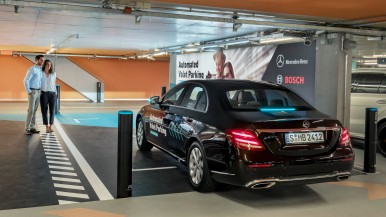
Stuttgart, Germany – Bosch and Daimler have reached a milestone on the way to automated driving: the two companies have now obtained approval from the relevant authorities in Baden-Württemberg for their automated parking system in the Mercedes-Benz Museum parking garage in Stuttgart. The automated valet parking service is accessed via a smartphone app and requires no safety driver. This makes it the world’s first fully automated driverless SAE Level 4 1 parking function to be officially approved for everyday use. This decision by the authorities shows that innovations like automated valet parking are possible in Germany first. ...Dr. Markus Heyn, member of the board of management of Robert Bosch GmbH “This decision by the authorities shows that innovations like automated valet parking are possible in Germany first,” says Dr. Markus Heyn, member of the board of management of Robert Bosch GmbH. “Driverless driving and parking are important building blocks for tomorrow’s mobility. The automated parking system shows just how far we have already progressed along this development path.” “This approval from the Baden-Württemberg authorities sets a precedent for obtaining approval in the future for the parking service in parking garages around the world,” says Dr. Michael Hafner, the head of drive technologies and automated driving at Daimler AG. “As a pioneer in automated driving, our project paves the way for automated valet parking to go into mass production in the future.” Driverless driving and parking are important building blocks for tomorrow’s mobility. The automated parking system shows just how far we have already progressed along this development path....Dr. Markus Heyn, member of the board of management of Robert Bosch GmbH Playing it safe: two partners with a common objective From the very beginning, Bosch and Daimler’s top priority for the driverless parking service was safety. Since there is as yet no official approval process for automated driving functions that do not require a driver, the local authorities – the Stuttgart regional administrative authority and the state of Baden-Württemberg’s transportation ministry – oversaw the project along with experts from the German technical inspection service TÜV Rheinland from the outset. Their aim was to assess the operating safety of the automotive and parking-garage technology. The result is a comprehensive safety concept with appropriate testing and approval criteria that can be applied beyond this pilot project. In the concept, the developers defined how the driverless vehicle detects pedestrians and other cars in its path and reliably comes to a halt when it encounters an obstacle. They also set up secure communications between all system components and took steps to ensure the reliable activation of the parking maneuver. The technology behind driverless parking Drive in to the parking garage, get out, and send the car to a parking space just by tapping on a smartphone screen – automated valet parking has no need for a driver. Once the driver has left the parking garage to go about their business, the car drives itself to an assigned space and parks. Later, the car returns to the drop-off point in exactly the same way. This process relies on the interplay between the intelligent parking garage infrastructure supplied by Bosch and Mercedes-Benz automotive technology. Bosch sensors in the parking garage monitor the driving corridor and its surroundings and provide the information needed to guide the vehicle. The technology in the car converts the commands from the infrastructure into driving maneuvers. This way, cars can even drive themselves up and down ramps to move between stories in the parking garage. If the infrastructure sensors detect an obstacle, the vehicle stops immediately. Project milestones Bosch and Daimler started developing fully automated driverless parking in 2015, and in the summer of 2017, their pilot solution in the Mercedes-Benz Museum parking garage in Stuttgart reached an important milestone: automated valet parking in real conditions, with and without drivers at the wheel, was presented to the public for the first time. This premiere was followed by an intensive testing and start-up phase. Starting in 2018, museum visitors could use the parking service live, accompanied by trained safety personnel, and share their experience. One aspect of the pilot project involved testing lighting concepts on the vehicles. Turquoise lighting indicates that a vehicle is in automated driving mode and informs passers-by and other road users that the vehicle is driving itself. The insights from these tests are reflected in the recently issued SAE standard 3134. Obtaining final approval from the authorities is a further major milestone for Bosch and Daimler: soon, interested parties will be able to experience the innovative valet parking service live in daily operation in the Mercedes-Benz Museum parking garage without additional supervision from a safety driver.

Bosch presents tomorrow’s mobility today

12.12.2018

Press release

Mobility

Bosch presents tomorrow’s mobility today

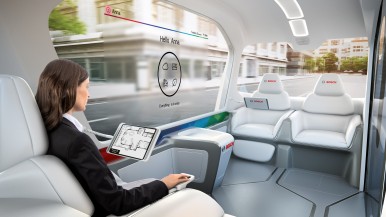
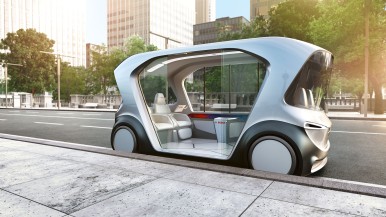
Stuttgart, Germany – A light, airy, minimalistic design, a futuristic outer shell made of display screens and glass, and a spacious interior – that is how architects might describe a novel structure, but in actuality the description also fits a completely new class of vehicle and a new kind of mobility: driverless electric shuttles that glide almost silently through city centers and are seamlessly connected with their environment. These will soon be a common sight on our city streets – whether they are transporting goods or people. Bosch provides components and systems for automating, connecting, and electrifying the shuttles, but shuttle mobility won’t be possible without mobility services. In the future, the company will offer these services too, bundling them into a smart, seamlessly connected ecosystem. That will include booking, sharing, and networking platforms, parking and charging services, and software solutions for managing and maintaining the vehicles, as well as infotainment during the journey. “Bosch is developing a unique package of hardware, software, and mobility services for shuttle mobility of the future,” says Dr. Markus Heyn, member of the board of management of Robert Bosch GmbH. At CES 2019 in Las Vegas, the world’s biggest electronics show, Bosch will be presenting its solutions for this area of transportation with a concept shuttle, and visitors will be able to experience its full range of services. Bosch is developing a unique package of hardware, software, and mobility services for shuttle mobility of the future....Dr. Markus Heyn, member of the board of management of Robert Bosch GmbH Bosch services for users and shuttle operators The emergence of the shuttle segment is a result of rising demand for ridesharing services: in Europe, the U.S., and China alone, about one million such on-demand shuttle buses will be on the roads as early as the year 2020, growing to 2.5 million by 2025 (source: Roland Berger ). Many of these vehicles, available 24/7, will be fully electric, and they will also be completely autonomous by the middle of the next decade at the latest. That’s why Bosch has packed every square centimeter of its concept shuttle with the appropriate technology – from electric powertrains and 360-degree surround sensors to connectivity management and vehicle computers. Yet these components and systems go only part of the way towards shuttle mobility. To make on-demand vehicles suitable for flexible everyday use, they must be connected to mobility services. “In the future, every vehicle on the road will make use of Bosch digital services,” Heyn says. These services allow users to book the vehicles, share rides with other passengers, and pay for the journey. Charging, repairing, and maintaining the vehicles, plus route planning and administrative activities, also call for services that Bosch will offer shuttle fleet operators in a seamlessly connected ecosystem. In the future, every vehicle on the road will make use of Bosch digital services....Dr. Markus Heyn, member of the board of management of Robert Bosch GmbH Booking and sharing Users can easily book a shuttle via smartphone, regardless of whether they’re relaxing on the sofa or sitting at their desk at work. Working behind the scenes, an algorithm identifies the vehicle closest to the requested location and finds other users who wish to travel a similar route. The more passengers a single shuttle can transport, the cheaper the journey for everyone. This approach also reduces the amount of traffic in cities and mitigates the impact on the environment. Bosch is developing the necessary software platforms to make this a reality. When the shuttle pulls up to the requested pick-up point, users again use their smartphones to identify themselves – thanks to Bosch’s Perfectly Keyless digital access service. It recognizes the owner’s smartphone as unmistakably as a digital fingerprint and opens the vehicle only for them. Every passenger always gets the seat that they reserved. Moving forward: electrified and automated Bosch’s electric axle drive makes the shuttles especially efficient yet affordable as they wend their way through the city. And the company’s Convenience Charging service knows just how long the battery charge will last and where to recharge the vehicle. This service means that even today, drivers no longer need to worry about being stranded with a dead battery. It also links vehicle information, such as the current state of battery charge or how much energy the heating and air-conditioning systems are consuming, with environmental data such as congestion and weather forecasts, so as to predict vehicle range with particular accuracy. Furthermore, Convenience Charging finds the ideal charging station and can reserve it in advance. And thanks to a standardized access and payment system, charging is easier than ever. Driverless e-shuttles provide users with transportation that is not only nearly emissions-free, but also very safe. For automation, Bosch develops and makes its own radar, video, and ultrasonic sensors, braking control systems, and power steering, to name a few examples. Smart digital services are indispensable here, too: Bosch predictive road-condition services let automated vehicles know in advance what environmental conditions to expect. They can thus adapt their driving style as needed so as to ensure maximum safety throughout the journey. The Bosch road signature is a map-based localization service with which automated vehicles can accurately determine their position in the lane down to a few centimeters – another crucial prerequisite for the safety of automated shuttles. Comfortable interior Bosch has designed the interior of its concept vehicle to provide space for four passengers, seating them across from one another to maximize legroom and comfort. Infotainment is provided on screens that can be used either by each passenger individually or in groups; for example, a family can watch a movie together as they travel somewhere for the weekend, or colleagues can work on a presentation on their way to the office. Smartphones use the on-board Wi-Fi and can integrate seamlessly with the infotainment system, thanks to Bosch connectivity technology. Its concierge service turns the shuttle into a personal assistant. With all kinds of information at its disposal, the shuttle can provide passengers with recommendations, advance bookings, weather reports, and travel tips at any time. Once the shuttle has arrived at its destination, the passengers can pay for their journey with Bosch’s e-payment service. Maintenance and administrative activities But Bosch services do not end when a rideshare journey is over: the company’s camera-based system for the vehicle interior checks whether anyone has forgotten their phone or handbag. If a passenger does forget something, the shuttle informs them directly via smartphone. The cameras can also detect gum on the seat or an overturned coffee cup – in other words, whether the shuttle needs cleaning – and can make the necessary arrangements immediately. This is so every passenger can start their journey in a clean shuttle. Bosch’s service for over-the-air updates can determine whether the driverless shuttles have the latest software version. The service detects software updates as soon as they are available and executes them in the vehicle securely and reliably. Thanks to sensors installed in the vehicle, predictive diagnostics can monitor the condition of key components and notify the shuttle before a fault actually occurs, so it has enough time to drive itself to a repair shop. This prevents the car from suddenly breaking down, which is a boon to operators. In the future, Bosch will pool updates from the data cloud and predictive diagnostics into a comprehensive connectivity platform . This will give vehicle manufacturers and shuttle service operators a constant overview of the condition of their fleets, so they can ensure that their shuttles are always ready for action. And finally, the Bosch subsidiary ESCRYPT’s security solutions handle vehicle security – whether for keyless access systems, data connectivity with the outside world, or software updates.


Bosch and Veniam ensure seamless vehicle-to- everything connectivity

05.12.2018

Press release

Connected mobility

Bosch and Veniam ensure seamless vehicle-to- everything connectivity

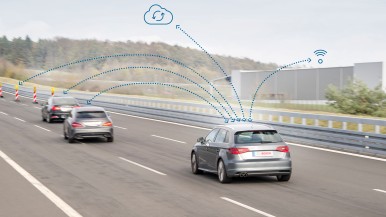
Hildesheim, Germany / Mountain View, USA – What is true for people is also true for cars: communication works best with a common language and a good connection. To enable connected and automated driving in the future, vehicles must be able to easily communicate with one another as well as with their surroundings. There is currently no globally standardized technical basis for this exchange of data, which is known as vehicle-to-everything communication, or V2X. Instead, vehicles will in future communicate using the wide variety of different standards implemented by countries and vehicle manufacturers around the world. “Bosch is taking a multi-standard approach when it comes to V2X. We have developed a universal connectivity unit capable of communicating using all of the transmission standards implemented in connected automobiles,” says Dr. Dirk Hoheisel, Member of the Board of Management at Robert Bosch GmbH. Bosch is taking a multi-standard approach when it comes to V2X. We have developed a universal connectivity unit capable of communicating using all of the transmission standards implemented in connected automobiles....Dr. Dirk Hoheisel, Member of the Board of Management at Robert Bosch GmbH The neat thing here is that Bosch has combined connectivity units and telematics units, which – individually – are only capable of a single transmission technology, to create an all-in-one central control unit for V2X data communication. Cars can then use the Wi-Fi networks available in cities, while elsewhere they can communicate using, for instance, cellular networks. The complex task of managing these diverse communication options is handled by a software solution from the Silicon Valley-based start-up Veniam. It continuously searches for the best transmission technology that suits the particular requirements and switches automatically between the available alternatives. The software therefore maintains continuous and seamless vehicle connectivity, ensuring cars can, for example, reliably alert one another to accidents and passengers can enjoy uninterrupted music streaming. Bosch develops a connectivity unit for all standards It is expected that the number of connected vehicles on the roads in Europe, the United States, and China alone will exceed 470 million by 2025 (source: PwC). Initially, most vehicles will connect directly to the cloud; but, thanks to V2X, increasing numbers of vehicles will in future also be able to communicate directly with one another as well as with traffic signals, road construction sites, pedestrian crossings, and buildings, etc. They will then be able to alert one another to potential hazards like the approaching tail end of a traffic jam, accidents, and icy conditions. Vehicles will also be able to take advantage of the green wave, because they will know when the next set of traffic lights is going to turn green. The vehicles can then adjust their speed accordingly. This ensures the traffic, particularly in cities, flows more smoothly. There is, however, no globally harmonized standard for V2X communication currently on the horizon. While China primarily uses Cellular-V2X technology (C-V2X), which is based on mobile communications, Europe and the United States are planning to additionally introduce transmission standards based on Wi-Fi (DSRC and ITS- G5) alongside C-V2X. A mishmash of standards is therefore emerging internationally, which may lead to vehicle communication issues. However, that will not be the case in the future when cars are equipped with the universal connectivity unit from Bosch. Equipped vehicles will be able to communicate with one another as well as with their surroundings regardless of the vehicle make or the country in which they are used. This will make V2X communication even more secure and reliable. “Thanks to Bosch’s all-in-one principle for connected vehicles, as many drivers as possible around the world can benefit from the added safety, comfort, and convenience provided by V2X,” says Dirk Hoheisel. The unique combination of Veniam’s smart networking software and Bosch’s connectivity unit boosts the vehicle’s data-handling capacities dramatically, paving the way for innovative cloud services and much safer future mobility....João Barros, founder and CEO of Veniam Software ensures the best connection The software from Veniam is the connection enhancer for the connectivity unit from Bosch. As well as keeping an eye on which V2X communication technologies are currently available for use, the software also closely monitors the costs and data transmission latency of each alternative connection option, since not every technology is suitable in every situation. For example, when it comes to alerting a driver to another vehicle that is about to pull out in front of them from a side street, every millisecond counts. This kind of critical information must be communicated in real time using highly reliable technology that is always ready for use – even if that means the resulting data transmission costs are greater. Software updates from the cloud or a navigation system map update, on the other hand, can be put on hold in that sort of situation until a low-cost stationary Wi-Fi network becomes available. Large volumes of data can be transmitted via Wi-Fi in a short space of time, though a downside is that public or home Wi-Fi hotspots are not always available. Veniam’s software is familiar with the pros and cons of each of the communication types and always establishes the optimal connection. “The unique combination of Veniam’s smart networking software and Bosch’s connectivity unit boosts the vehicle’s data-handling capacities dramatically, paving the way for innovative cloud services and much safer future mobility,” says João Barros, founder and CEO of Veniam. On the occasion of the world’s biggest consumer electronics trade show, CES 2019 in Las Vegas, Bosch and Veniam have been selected as CES 2019 Innovation Award Honorees in the “Vehicle Intelligence and Self-Driving Technology” category for their jointly developed solution. Bosch tests V2X in Europe, the United States, and China In the biggest European field trial to date (simTD, Safe Intelligent Mobility – Test Field Germany), V2X communication has proven its suitability for daily use under everyday conditions and in lab simulations. Bosch has played a significant role in this joint project. Since February 2017, Bosch and Vodafone have been performing trials of the V2X communication with the first 5G test modules − the first companies in Europe to do so. The A9 freeway in Bavaria north of Munich is the location for the field tests, which focus on real-time warning systems during lane changing maneuvers on the freeway or in case the vehicle in front brakes suddenly. V2X will also be able to make driver assistance functions even more comfortable, like adaptive cruise control (ACC). In the summer of 2018, Bosch tested secure, direct communication between vehicles and roadside infrastructure, cameras, and sensors in Detroit. The test showcased Wi-Fi- based DSRC technology, where equipped vehicles were provided with in-vehicle notifications about the status of traffic signals ahead and pedestrians crossing the street – functions designed to enhance safety in city traffic. ESCRYPT, a subsidiary in the Bosch Group, provided the cybersecurity technologies behind these V2X demonstrations. In China, Bosch is testing ad hoc communication using Wi-Fi as well as cellular technology. The tests are focusing on alerts that help the driver when overtaking or negotiating complex intersections.

Versatile semiconductors: Bosch launches new automotive system-ICs at electronic ...

05.11.2018

Press release

Connected mobility

Versatile semiconductors: Bosch launches new automotive system-ICs at electronic ...

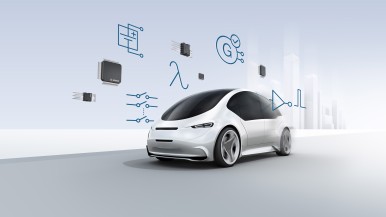
Munich and Reutlingen, Germany – System ICs are application-specific integrated circuits (ASICs) designed to meet special requirements in vehicle systems. They are integrated on a single silicon chip measuring only a few square millimeters, and house complex circuits with up to several million individual electronic functions. At electronica 2018, the world’s leading trade show for electronics, Bosch introduces four new system-ICs. A new chip for electric vehicles will shut off the power in the event of an accident, ensuring safety for driver and passengers and enable rescuers to work without being put in danger.Semiconductors make electric cars safer in an accident Pure electric or hybrid vehicles are equipped with special batteries that provide power to the electric motor at high voltages of 400 to 800 volts. For safety reasons, these high-voltage batteries, power electronics and their electrical wiring are designed to be highly robust. Nevertheless, the question of how secure a high-voltage battery is in the event of an accident is of vital concern to both the vehicle's occupants as well as any rescue workers. To prevent these persons from coming into contact with high voltage, while at the same time eliminating the risk of a vehicle fire, it must be possible to completely isolate the battery from the vehicle’s electrical system. During an accident, so-called "pyro fuses" blow out sections of the electrical wiring to the high-voltage battery by means of a small explosive charge, so that the circuit is interrupted quickly and effectively. Here, Bosch semiconductors play a crucial role: The integrated circuit CG912 can, as a part of the battery management, fire up to four pyro fuses in the battery wiring in the event of an accident,. This mitigates the risk of electrical shock when touching the vehicle’s chassis. In addition, this special IC can also provide power to the battery management. Bosch’s CG912 was originally developed for deploying airbags and has been proven in the field a million times over. New system ICs at electronica 2018 System ICs are truly versatile. They provide stable supply voltages, read sensor data, process information and drive actuators – in real time. The new oxygen sensor evaluation IC CJ138 offers, in comparison to its predecessors, extended options for adapting an engine control unit to a wide range of oxygen sensors, as well as accurate sensor cable diagnostic for short circuit or interruption. The highly integrated transmission IC CG270 precisely controls up to ten hydraulic valves in automatic transmissions and allows the design of more compact control units for modern multi-stage transmissions. CG135 is a transmission IC that monitors the supply voltages in a transmission control unit and prevents the transmission from being damaged in the event of a fault.

Semiconductors – market of the future: Bosch is growing faster than the market

05.11.2018

Press release

Connected mobility

Semiconductors – market of the future: Bosch is growing faster than the market

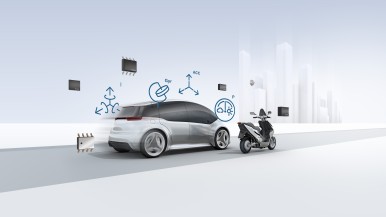
Reutlingen, Germany – Every car nowadays makes use of semiconductors, and that has been true for quite a while. A key technology in today’s modern world, these chips are core components of electrical systems – including those in vehicles. They regulate the powertrain and vehicle handling, tell the navigational system which way the vehicle is going, and signal the airbag to deploy when needed. Having been making semiconductors for more than 45 years, Bosch today is one of the world’s leading manufacturers of chips for mobility applications. “Semiconductors may have been around for a long time, but we have yet to realize their full potential. These components are key to modern-day mobility, and it is impossible to imagine cars today without them,” says Jens Fabrowsky, member of the executive management of Bosch’s Automotive Electronics division. In 2016, every vehicle newly registered worldwide had an average of more than nine Bosch chips on board. “When it comes to semiconductors for cars, we have a singular advantage: Bosch is the only company equally at home in both the automotive and semiconductor industries,” Fabrowsky says. In 2018, every new vehicle featured semiconductors worth 370 dollars (source: ZVEI), and thanks to increasing electrification and automation, demand for chips in vehicles is expected to rise further over the next few years. Semiconductors may have been around for a long time, but we have yet to realize their full potential. These components are key to modern-day mobility, and it is impossible to imagine cars today without them....Jens Fabrowsky, member of the executive management of Bosch’s Automotive Electronics division The ultimate discipline: semiconductors for the auto industry The global semiconductor market is worth billions: the market research company Gartner expects global semiconductor sales to reach 451 billion dollars in 2018. By 2019 alone, the market will have grown at an annual growth rate of more than 5 percent (source: PwC). “The Bosch semiconductor business is growing faster than the market,” Fabrowsky says. In the semiconductor market, the ultimate discipline is making chips for vehicles. Bosch has been making vehicles smart since the 1970s, when it started equipping them with its application-specific integrated circuits (ASICs). In a car, chips are exposed to strong vibrations and extreme temperatures that range from far below zero to far above 100 degrees Celsius. This requires higher standards for the toughness of these special components. Developing semiconductors that can withstand these stresses for a vehicle’s entire lifetime is an intensive process. Here is where Bosch leverages its special dual role: while other companies can process the information collected from semiconductors, Bosch can also apply its deep understanding of the physical principles at work in the chips, and of how to gather the data and ultimately integrate it into the vehicle systems. “Our comprehensive expertise in semiconductors helps us to both develop new automotive functions and steadily improve the chips themselves,” Fabrowsky says. Bosch holds over 1,500 patents and patent applications for engineering and manufacturing its semiconductors. Progress in microelectronics is what made development of assistance systems and automated driving possible in the first place....Jens Fabrowsky, member of the executive management of Bosch’s Automotive Electronics division Electromobility and driver assistance systems boost demand Bosch’s current semiconductor portfolio focuses on microelectromechanical systems (MEMS), ASICs for vehicle ECUs, and power semiconductors. Without the latter, there would be no hybrid or electric vehicles, as they regulate the electric motor and make sure that the battery is being used as efficiently as possible. “Power electronics for hybrid and electric vehicles are a growth driver for Bosch,” Fabrowsky says. Besides electrification, continued strong growth in demand for driver assistance systems is ensuring that more semiconductors with more and more functions are finding their way into cars. Chips with built-in “intelligence,” known as ASICs, are tailored to a particular application; for instance, signaling to airbags in a vehicle when they should deploy. These chips control handling to ensure a consistently safe journey. They also boost the measured signal from radar sensors, so that the proximity warning always functions reliably. “Progress in microelectronics is what made development of assistance systems and automated driving possible in the first place,” Fabrowsky says. Bosch microelectromechanical systems, or MEMS for short, are the sensory organs of modern vehicles. They supply a vehicle’s ECUs with important information regarding its handling, such as if the vehicle is braking or accelerating, or if it is skidding on a smooth road surface. The ESP electronic stability program uses this information to keeps cars, trucks, and even motorcycles safely on track and in their lanes. MEMS sensors tell runners how many calories they are burning As a key technology for the internet of things (IoT), Bosch semiconductors have applications that extend far beyond the world of vehicles. The company’s sensors can be found in more than half the world’s smartphones, and are indispensable for fitness trackers, drones, game consoles, and smart home applications. When it comes to MEMS sensors, Bosch is both a pioneer and the world’s leading manufacturer. More than 20 years ago, the supplier of technology and services itself developed the microfabrication technique, known worldwide as the “Bosch process,” used to make these semiconductors. One billion euros for one of Europe’s most advanced wafer fabs Bosch is underpinning its growth strategy for semiconductors with the single largest investment in the company’s history: it is putting some one billion euros into a new wafer fab in Dresden, which will manufacture 300 mm wafers. Following a rollout phase, pilot manufacturing operations are expected to start at the end of 2021. Compared with conventional 150 and 200 mm wafers, 300 mm wafer technology offers greater economies of scale. Up to 700 associates will be involved in the highly automated chip manufacturing process, working to plan, manage, and monitor production. After Reutlingen, the Dresden plant will be Bosch’s second wafer fab in Germany. With it, the company aims to expand its manufacturing capacity, and thus to further boost its competitive edge in global markets.

In automated vehicles, the seat-of-the-pants feel comes from the Bosch cloud

25.07.2018

Press release

Automated mobility

In automated vehicles, the seat-of-the-pants feel comes from the Bosch cloud

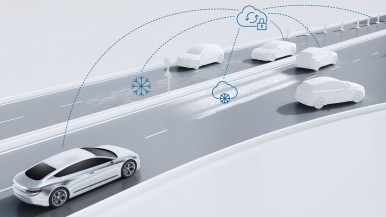
Stuttgart, Germany – Haptic sensation when driving is something that shouldn’t be underestimated. What condition is the road in, how well are the tires gripping? Having or developing a feeling for this can help drivers handle their cars appropriately and safely. Race drivers already have a word for it: seat-of-the-pants feel. They mean the contact between the seat of their pants and their driving seat, which allows them to feel the state of the road surface. Automated vehicles also urgently need information about road conditions. Unfortunately, however, they don’t have any feeling for such conditions – or haven’t up to now. Bosch has developed a system that gives automated vehicles seat-of-the-pants feel. “Wet roads, snow, ice – with our predictive road-condition services, we alert to hazards before critical situations can develop. We are helped here by the weather data provided by our partner Foreca. This means an automated vehicle will know exactly where it can drive autonomously, and how,” says the Bosch management board member Dr. Dirk Hoheisel. With our predictive road-condition services, we alert to hazards before critical situations can develop....Dr Dirk Hoheisel Foreca is one of the world’s leading providers of weather information, with two decades of experience in predicting road weather conditions. “Combining the expertise of Foreca and Bosch will lead to a new era of road-condition forecasting. Unlike weather forecasts in the media, the Bosch road-condition services take multiple possible forecast scenarios into consideration,” says Petri Marjava, Foreca’s sales director. The road-condition services boost driving safety and smoothness. In addition, the availability of automated driving functions is increased. The Bosch services package is to be rolled out worldwide in 2020, initially on the basis of weather data. As more and more connected cars appear on the roads, the service will be augmented by vehicle data. Automated vehicles adjust their speed in good time Up to the highly automated SAE level 4, the decision as to whether a car can assume the task of driving depends on factors such as road type, speed range, and environmental conditions. In future automated vehicles, this decision will also be based on the predictive road-condition services provided by Bosch. Thanks to their help, the automated vehicle will know in good time what environmental conditions to expect. This means it will have plenty of time to adapt its driving style, instead of having to hand over the driving task to the driver at the first sign of impaired road conditions, however minor. If the vehicle’s route takes it through rain, it will adapt its speed well in advance to a level that excludes any risk of aquaplaning and allows it to stop safely at any time. Whatever the SAE automation level, the result is a safe drive that is also smooth and comfortable. Driving automatically, whenever and wherever possible For its predictive road-condition services, Bosch is relying on a multiphase concept. By the time of its planned launch in 2020, it cannot be expected that there will be a sufficiently large proportion of connected vehicles on the roads. Bosch estimates it would take some 20 million connected cars to cover the roughly 80,000 kilometers of freeway in Europe alone. For this reason, road-weather forecasts will initially be the only reliable source of information for drawing sound conclusions about road conditions, especially in rural areas where there is less traffic. Bosch will get the constantly updated global road-weather data it needs for this from Foreca. Bosch’s thorough examination of several leading providers showed that the Finnish weather experts were the most accurate road-weather data provider globally. The more precisely hazardous conditions can be predicted and localized, the easier it will be to keep the availability of automated driving functions to a maximum. Thanks to a worldwide reference measuring fleet and machine learning methods, Bosch and Foreca have jointly been able to optimize the safety and availability of the road-weather models. In this way, the two companies have achieved a safety standard of the kind that will be necessary for life-critical systems such as automated driving. ESP interventions allow friction coefficient to be determined As a sufficient number of connected vehicles take to the roads, Bosch will supplement its predictive road-condition services with vehicle data. These data will include information stored on the CAN bus, the vehicle’s central data network, such as the temperatures measured inside and outside the vehicle, and whether the windshield wipers are in use. Thanks to connectivity, this data will not remain unused in the vehicle, but will find its way into the Bosch cloud via the respective automaker’s back-end server. In addition, Bosch will evaluate the regular interventions by the ESP anti-skid system. Using mathematical methods, engineers can measure the friction coefficient of the road surface at each individual wheel, as well as the status of each wheel. When all these data are combined and intelligently evaluated, the result is a package of smart Bosch services – and the comforting feeling of being in safe hands.

Bosch scores big in Japan with clever technology

07.06.2018

Press release

Business/economy

Bosch scores big in Japan with clever technology

Tokyo – The Bosch Group is scoring big in Japan thanks to its innovative and intelligent solutions for the local market as well as for the global Japanese automotive industry. “Bosch has made impressive progress in Japan. We are working with Japanese automakers to drive forward the automation, electrification, and connectivity of mobility. In addition, we are increasingly focusing on IoT solutions, such as smart agriculture,” says Klaus Meder, the president of Bosch Japan. Last year, the leading supplier of technology and services recorded sales of 2.3 billion euros in Japan, an increase of roughly 10 percent over the previous year. Bosch Japan also made a good start to 2018, mainly due to strong growth for the Mobility Solutions business sector, which generates a significant share of the company’s sales in Japan. In 2017, the company grew twice as fast in this area as the local market. The Industrial Technology business sector also performed well. Bosch has been operating in Japan since 1911 and currently employs some 6,600 people in the country.Business with Japanese automakers sees double-digit growth In 2017, Bosch’s global sales to Japanese automakers rose year-on-year by around 11 percent, which makes it the sixth year in a row these have posted double-digit growth. Looking ahead, Bosch expects this trend to continue over the medium term. Bosch not only supplies Japanese automakers locally, but also works closely with them around the globe. In the ASEAN region, for example, Japanese automakers enjoy a market share of around 90 percent. Accordingly, the region is a focus of investment for the Bosch Group. For instance, at the end of 2017, the company opened its second plant for mobility solutions in Thailand, representing a total investment of 80 million euros. The new smart factory in Hemaraj manufactures components including injection valves, interconnect technology, and knock sensors. The site also houses a research and development center at which around 60 associates work on the further refinement of gasoline injection systems. Bosch is also expanding its manufacturing operations in Vietnam. Since 2008, the company has been producing push belts for continuously variable automatic transmissions in Dong Nai, which is located about 40 km east of Ho Chi Minh City. Bosch is currently investing around 60 million euros to convert this plant into a smart factory and increase its production capacity. By the end of 2018, total investment in the site will have exceed 320 million euros since 2011. Expanding IoT business: smart farming solutions In addition to its mobility solutions business, Bosch is also focusing on developing connected solutions in Japan, for which it is drawing on the country's high degree of innovative strength. Last year, for example, saw the launch of Plantec, a smart system for optimizing tomato cultivation in Japanese greenhouses. The solution is tailored to the local market, as greenhouse cultivation is particularly widespread in the country. Plantec uses sensors to measure humidity, temperature, carbon dioxide levels, and sunlight. These environmental parameters are crucial for plant growth and data on them is collected and sent via a gateway to a cloud server. There, a system analyzes the data and takes into account additional important agricultural parameters as well as the weather forecast. The results of the analysis are displayed in an app. The system can analyze the risk of infection and use artificial intelligence to plan the use of pesticides in advance. It can thus help farmers minimize crop loss. Work on this project is being carried out in conjunction with the Bosch Center for Artificial Intelligence (BCAI). At the end of 2018, the company plans to expand this service to strawberry and cucumber cultivation. Bosch's goal is to supply around 10 percent of Japan's greenhouses by 2020.

Bosch presents solutions to connect mobility in China at Auto Beijing 2018

26.04.2018

Press release

Connected mobility

Bosch presents solutions to connect mobility in China at Auto Beijing 2018

Beijing – Bosch is transforming driving with connected services to make mobility more flexible and less stressful. The leading global supplier of technology and services is highlighting its connected mobility solutions at Auto China 2018. Together with its comprehensive range of solutions for electrification and automation, the company aims to reshape the future of mobility in China. “China's automotive industry is in a phase of fast-paced development. Smart connected mobility and automated driving are on track to becoming part of our daily lives,” said Dr. Rolf Bulander, member of the board of management of Robert Bosch GmbH and chairman of the Mobility Solutions business sector. China's automotive industry is in a phase of fast-paced development. Smart connected mobility and automated driving are on track to becoming part of our daily lives,...said Dr. Rolf Bulander, member of the board of management of Robert Bosch GmbH and chairman of the Mobility Solutions business sector. Sales growth of Bosch Mobility Solutions in China outstrips domestic auto production Sales of Bosch‘s Mobility Solutions in China surged 25 percent year on year to 11 billion Euro (82.9 billion RMB) in 2017 – a growth rate far higher than that of domestic auto production and sales. To achieve this result, Bosch’s focuses on a strong localization strategy in China and provides a comprehensive range of solutions tailor-made for the local market. Rising demands for commercial and new energy vehicles have also been central to fueling this growth. Furthermore, the expansion of Bosch's driver assistance system business has been particularly strong in favor of the rapid introduction of automated driving in local markets. Sustained investment in China and advancements in manufacturing capabilities through R&D efforts have laid a solid basis for Bosch's stable and long-term growth. As testament to this, by the end of 2017, the Mobility Solutions division already had 23 automotive manufacturing locations in China. In May this year, the new plant of the Car Multimedia unit in Wuhu, which will produce infotainment systems, will commence operations. Then the first Bosch iBooster production base in the Asia Pacific will officially start production in Nanjing in November, helping to meet China's growing demand for electrified and automated driving solutions. The second phase of the Automotive Electronics plant in Wujin, Changzhou, will also be completed this year, marking a total investment in the facility of 800 million RMB. Partnerships with local companies are also being strengthened with United Automotive Electronic Systems Co., Ltd., a joint venture between Bosch and Zhong-Lian Automotive Electronics, scheduled to complete construction of new plants in Taicang and Liuzhou in April and June, respectively. The company mainly produces injection system and control units for cars. New division for connected mobility services As the government rolls out its nationwide smart connected driving strategy and given the young average age of car buyers in China, the demand for smart vehicles is rising. The explosion in the number of mobile internet users has also accelerated the pace at which the Chinese market for Internet-connected vehicles has grown. In addressing these trends, at the start of this year, Bosch established a new global Connected Mobility Solutions division to meet the increasingly diversified requirements for connected mobility services. China is a strategic market for growth for the new entity. “Bosch realized early on that internet-connected driving is an important growth area and besides providing a real-time connection between vehicles, users, and the internet, we are also looking at offering digital services that make mobility stress-free and enjoyable,” said Dr. Bulander. Building on Bosch's wealth of experience and proven accomplishments in the fields of vehicle technology and mobility, the new division will expand mobility options that are more suited to China's current driving conditions. This will include smart parking solutions, predictive diagnostics based on deep data mining, as well as advanced fleet management systems. Innovation also in electrification and automation Connected mobility is just one potential field of growth for Bosch in China, however. At China Auto Show, the company is presenting complete powertrain solutions to demonstrate a one-stop solution in the field of electrification. With an energy-saving and efficient intelligent thermal management system, a vehicle's heat flow can be effectively managed, extending the range of an electric vehicle and ensuring comfort of the driver and passengers. Bosch's latest powertrain solution innovatively integrates the motor, power and transmission components into a compact unit that directly drives the car’s axle – the eAxle. Bosch sells this electric axle drive to a wide range of customers – to established automakers and start-ups alike. Here, Bosch customers also benefit from the company’s global research and engineering network. The latter allows the company to carry out projects in China flexibly and close to its customers. Bosch driver assistance systems have already been installed in cars made by 24 Chinese auto brands. These are paving the way for automated driving in China. Bosch’s automated driving team in China continues to work actively with a number of domestic automakers on Level 2 automated technology.