Search & find:
Media, press releases, events for your editorial coverage

Bosch establishes company with the synthetic diamond solutions provider Element Six

07.04.2025

Press release

Business/economy

Bosch establishes company with the synthetic diamond solutions provider Element Six

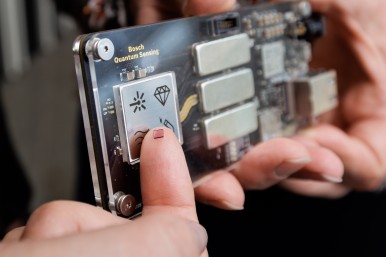
Stuttgart, Germany – They cannot be grasped, either literally or figuratively. Yet their potential is revolutionary, and they are a key technology of the future. We are talking about quanta. For more than ten years, Bosch has been researching in this field, and it is playing a decisive part in commercializing quantum sensors. Since 2023, it has had a development collaboration with Element Six, the world’s leading solutions provider of synthetic diamonds. Bosch is now significantly extending this alliance and establishing a joint venture, to be known as Bosch Quantum Sensing. The joint venture will be based on the in-house start-up of the same name, which Bosch set up in 2022. Domiciled in Ludwigsburg, Germany, Bosch Quantum Sensing currently employs 30 associates. Bosch itself will be the lead partner and be responsible for operations. Element Six will hold a 25 percent stake. It has been agreed that further financial details will not be disclosed. The establishment of the new company is still subject to official approval. Bosch Quantum Sensing sees many areas in which novel quantum sensors can be used, from exploration of natural resources to aircraft navigation and medical technology. By the middle of the next decade, Bosch estimates that the global market potential of medical and mobility applications will be in the mid-single-digit billion euros range per year. Synthetic diamonds are a key component of Bosch quantum sensors. In stepping up its partnership with Element Six, Bosch is making a determined move toward the commercialization of quantum sensors. Quantum sensors are a future technology with huge potential. They will bring about fundamental changes in many sectors of our economy, and improve people’s lives. In setting up this new company, we are underscoring this technology’s strategic significance for Bosch. As innovation leader of commercial quantum sensors, we will work with Element Six to further extend our technological lead,...says Stefan Hartung, chairman of the board of management of Robert Bosch GmbH. Quantum leap toward commercialization The distinctive qualities of these special-purpose synthetic diamonds allow quantum sensors based on them to detect even the tiniest magnetic fields. In this way, they satisfy the most exacting market requirements and make real innovations possible. “We want to work with Element Six to make quantum sensors economical and allow them to be produced on an industrial scale. In this way, we will create the basis for innovative applications that set new standards for precision and efficiency,” says Katrin Kobe, CEO of Bosch Quantum Sensing. “Through the new joint venture between Bosch and Element Six, which aligns with Element Six’ contribution towards De Beers Group’s Origins strategy, we will integrate our synthetic diamond technology with Bosch Quantum Sensing’s capabilities, unlocking new possibilities in critical sectors such as healthcare and navigation. Together, we will harness the respective decades of excellence and innovation to push the limits of what's possible, heralding a new era of synthetic diamond-enabled technologies”, says Siobhán Duffy, the CEO of Element Six. The synthetic diamond solutions provider is in a unique position to supply the highly engineered synthetic diamonds in the quantity and quality required for industrial applications, while Bosch will integrate them into robust and scalable sensor systems. It is a classic win-win situation. Even now, the latest Bosch quantum sensor prototype is the most compact of its kind for the level of sensitivity required – it is the same size as a modern smartphone. In the area of mobility, it could enable a robust navigation in the future, complementary to conventional GPS systems. It could also offer decisive advantages for the exploration of natural resources and, in medical technology, for the measurement of cardiac activity. The advantage of compact sensors is their portability, less expensive production, and better scalability. The long-term goal of Bosch Quantum Sensing is to make quantum sensors so small that they can be integrated onto a chip. Press photos and infocharts are available on the Bosch Media Service at www.bosch-press.com . Contact person for press inquiries: Athanassios Kaliudis Phone: +49 711 811-7497 E-mail: Athanassios.Kaliudis@de.bosch.com

Bosch drives forward the development of 6G

27.02.2023

Press release

Connected mobility

Bosch drives forward the development of 6G

Stuttgart, Germany – Worldwide, research and development work on the future 6G mobile communications standard is picking up pace. Companies and states are investing massively in this technology. Bosch is leading the way and is actively involved in projects, alliances, and initiatives at both the national and international level to lay important foundations for 6G technology. “6G will be much more than just an infrastructure for connectivity; it will greatly increase the efficiency of autonomous driving cars, smart cities, and connected industries. That’s why 6G is a strategically important field of technology,” says Dr. Andreas Müller, who bundles and manages 6G activities at Bosch. The company currently has some 40 associates working on 6G technology. Over the next two years, that number is likely to double,” Müller says. Bosch is currently investing several millions of euros in research and development for 6G. 6G will be much more than just an infrastructure for connectivity; it will greatly increase the efficiency of autonomous driving cars, smart cities, and connected industries. That’s why 6G is a strategically important field of technology...says Dr. Andreas Müller, who bundles and manages 6G activities at Bosch. Bosch and Nokia expand their research alliance to include 6G At the Mobile World Congress 2023 in Barcelona, Bosch and Nokia have now announced that they will expand the alliance they entered into in 2017 to develop industrial IoT solutions in the area of 5G so that it also addresses the new 6G technology. The two companies are conducting joint research on the next generation of networks and investigating how to use future 6G networks for both communications and sensors. Comprehensive Bosch commitment at national and international level Bosch is currently contributing its expertise and experience to five publicly funded projects. In this context, the 6G-ICAS4Mobility , KOMSENS-6G , and 6G-BRAINS projects focus primarily on integrating communication and sensor-based environment recognition. Bosch leads the consortium for the first project . In addition to addressing relevant scenarios for road traffic, insights gained from the project will serve, in particular, as technical foundations for applications in the connected drones domain as well as in Industry 4.0 (e.g. for driverless transport systems). Meanwhile, the 6G-ANNA and 6G-SHINE projects focus on new connectivity structures. These are intended to enhance the efficiency of future E/E architectures in vehicles or robot cells. Bosch is also taking an active and leading role in early discussions and activities relating to future mobile communications standards within various industry alliances. In the 5G Automotive Association (5GAA) , for instance, leading companies from the automotive and telecommunications industries are working together to develop solutions for the mobility of the future. The 5G Alliance for Connected Industries and Automation (5GACIA) brings together industrial companies to focus on connectivity for machinery and equipment. Networks with a sixth sense through integration of sensor technology Among other things, the next generation of mobile communications will integrate new functionalities similar to radar sensors. With 6G, it will be possible to detect the position of objects in the network’s coverage area – without these objects having to be equipped with a radio module. 6G will enable extremely high data rates of up to one terabit per second, with very low latency in the order of some 100 microseconds – which is four times faster than a lightning strike. With the help of digital twins, this will for instance make it possible to monitor and simulate real-world manufacturing processes in a virtual world with no temporal and spatial restrictions. Experts predict that the first 6G standard will be completed by 2028. In recent months, Germany and Europe have launched a large number of 6G projects with the goal of strengthening their technological sovereignty. The German government, through the Federal Ministry of Education and Research (BMBF), is providing some 700 million euros over the next three years to fund 6G activities. In addition, the EU budget has earmarked a further almost 900 million euros until 2027. Japan and the United States have also launched corresponding investment programs totaling around 4.5 billion dollars.

Bosch establishes startup for quantum sensing

17.02.2022

Press release

Research

Bosch establishes startup for quantum sensing

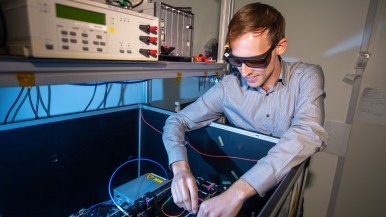
Ludwigsburg, Germany – Robert Bosch GmbH has set up a new business unit to commercialize quantum sensors. With a view to sharing in the strong growth expected for this market, an in-house startup will pool the results of research so far and translate them into products. Jens Fabrowsky, the executive vice-president of Bosch Automotive Electronics responsible for the semiconductor business, says: “Quantum technology is pushing the boundaries of what is possible – in both data processing and sensors. Above all, the aim is to increase the broad practical benefit of quantum effects – for everything from the development of carbon-neutral powertrains to neurological diagnosis. Bosch has been doing extensive research in quantum sensing for many years now, and we see ourselves as global leaders in this area. Now we also want to use this as a basis for future business models.” Quantum technology is pushing the boundaries of what is possible – in both data processing and sensors....Jens Fabrowsky, executive vice-president of Bosch Automotive Electronics Dr. Katrin Kobe to lead new unit The CEO of the newly established startup is Dr. Katrin Kobe. A physics PhD, she brings to Bosch more than 25 years of management experience with a variety of technology companies. During that time, she developed several new business areas. “At Bosch, research is a top priority,” she says. “As a global company with alliances and expertise in quantum technology, Bosch is seizing the opportunity to make headway with this promising new field in an agile startup environment.” There are already 15 associates working at the new startup. The team, which is set to grow to more than 20 in the coming months, is looking to attract engineers and business developers in particular. At Bosch, research is a top priority,” she says. “As a global company with alliances and expertise in quantum technology, Bosch is seizing the opportunity to make headway with this promising new field in an agile startup environment....Dr. Katrin Kobe, CEO of the new start-up Medical applications possible in the foreseeable future Quantum sensors use the individual atoms of a gas or defects in solids as atomic measuring instruments. Because of the special way they are initialized before measurement and their ability to detect individual quantum states after measurement, these sensors achieve unprecedented precision. Thanks to quantum technology, this will soon allow measurements to be carried out that are nearly 1,000 times more precise than those done by today’s MEMS sensors (MEMS stands for micro-electro-mechanical system). Quantum sensors will, for example, be able to help diagnose neurological conditions such as Alzheimer’s and Parkinson’s more accurately and easily. They can also be used to record nerve impulses, and thus to control artificial limbs one day. These sensors can also detect the tiniest changes in an object’s position. Bosch has been researching quantum sensing for seven years now, and has built fully functional and powerful demonstrators of a quantum magnetometer and a quantum gyrometer. Quantum magnetometers can, for example, be used to detect the tiny magnetic fields generated by physiological processes, while quantum gyrometers permit the high-precision detection of rotations for the navigation of autonomous systems. The long-term goal is to achieve further miniaturization and integrate the technology on a chip. Moreover, Bosch has been actively involved in eight publicly funded quantum sensing projects, some of them international, since 2018. With this new business unit, Bosch now wants to open up this field for its own strategic purposes. Strong market growth expected Market experts are predicting strong growth in quantum sensing applications in the years ahead. In 2021, 22 billion dollars was invested worldwide in quantum technology. According to McKinsey & Co., the market for quantum sensors is expected to grow to as much as 7 billion dollars. Bosch’s new business unit will be located on the premises of its grow platform GmbH subsidiary in Ludwigsburg. Organizationally, the startup will be assigned to the Bosch Automotive Electronics division, based in Reutlingen.

Groundbreaking passenger protection: 40 years ago, Bosch launched the electronic ...

04.11.2020

Press release

Automated mobility

Groundbreaking passenger protection: 40 years ago, Bosch launched the electronic ...

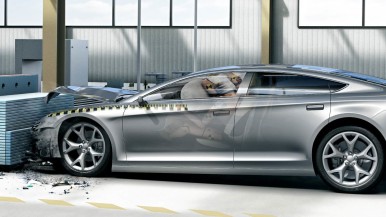
Stuttgart, Germany – A collision, a loud bang, and the worst-case scenario has been avoided – that’s the easiest way to describe the benefits of an airbag. Playing a key role in this protective “detonation” is the airbag control unit. It functions as the control center for the lifesaving inflatable cushion. Forty years ago, Bosch joined forces with the Daimler-Benz AG to start production of the world’s first electronic airbag control unit – giving a decisive boost to passenger protection. “Bosch is a pioneer in automotive electronics and safety,” says Bosch board of management member Harald Kröger. “The electronic airbag control unit shows what we mean by ‘Invented for life.’” Since the start of full-scale production in December 1980, Bosch has manufactured more than 250 million airbag control units, constantly refining the technology all the while. The company’s accident researchers estimate that since the market launch of Bosch’s airbag control units, the front, side, and head airbags they deploy have helped save some 90,000 lives around the world. This makes them a key component of vision zero: no fatalities or serious injuries in road traffic. Bosch is a pioneer in automotive electronics and safety. The electronic airbag control unit shows what we mean by ‘Invented for life.’...Bosch board of management member Harald Kröger The right decision in milliseconds Using internal and external acceleration, yaw-rate, and pressure sensors, a state-of-the-art airbag control unit identifies the type of accident as well as its severity, and deploys the airbag and belt tensioner as needed. In just ten milliseconds – ten times faster than a person can blink – the trigger algorithm interprets the sensor data to determine whether the driver has simply hit the brakes, bumped into a parked car, jumped the curb, or if the vehicle has had a severe collision or is at risk of rolling over. If the situation is dangerous, the system ignites the pyrotechnic gas generator. Within 30 milliseconds, the airbag is fully inflated and can protect the driver and passengers. Today’s vehicles come with as many as nine airbags installed, which can be deployed individually depending on the accident scenario. Following a collision, the system also sends a signal to cut off the fuel supply, or, in electric vehicles, to disconnect the high-voltage battery. In addition, the system forwards information about the accident to other vehicle systems – for example eCall, which automatically calls emergency services after an airbag has been deployed. Since 1977, Bosch engineers have worked with automakers on the first electronic airbag control unit, putting it through more than 6,000 crash tests in 60 vehicle models. Today, more than 1.8 million crash simulations are necessary to prepare an airbag control unit for large-scale production in a vehicle model. The first airbag system, which went into production in December 1980 and then had its market launch in the Mercedes-Benz S-Class, consisted of three components – a voltage converter, an energy reserve, and a control unit – with a total of 170 parts. These controlled only an airbag and belt tensioner for the driver and optionally for the front passenger. Today’s twelfth-generation airbag control units have just half as many parts and can manage up to 48 restraint devices, including various front and side airbags, knee airbags, and belt tensioners.Airbag control units and automated driving In the future, as the number of sensors in vehicles rises, applying the information they gather could ensure that airbags, belt tensioners, and other vehicle functions interact even better. Such an interaction might look something like this: the system swiftly recognizes an impending accident and, for example, automatically puts the occupants into a sitting position that reduces their risk of injury before the actual collision. It can deploy airbags and belt tensioners to provide the best possible crash protection for every person in the vehicle. Increasingly automated driving is one area where these possibilities are relevant, since at higher levels it opens up entirely new interior concepts and more room to move about, even for drivers: they may swivel their seat, turn to face the passengers, or get cozy in their seat. As seating arrangements in the vehicle become more flexible, it is ever more crucial to have very specific control of airbags and belt tensioners. In turn, this increases the complexity of the demands on the airbag control units that Bosch is already working on today. Even after 40 years, this particular bag of tricks is still far from empty.

Virtual companion increases safety for trucks on the road

18.09.2020

Press release

Connected mobility

Virtual companion increases safety for trucks on the road

Stuttgart, Germany – Trucks are the mainstay of logistics. In Germany, three-quarters of all goods are transported by road. Time pressure, long working hours, and monotonous convoys are part and parcel of the truck driver’s everyday routine. If the driver is distracted, overtired, or reacts too slowly, the consequences can be disastrous. Automated driving functions are key to avoiding accidents and dangerous situations. They alert drivers and support them in critical situations, and are increasingly in a position to assume monotonous and fatiguing tasks. At the same time, people remain irreplaceable even at subsequent levels of automation: they must be able to take control if necessary. What is the ideal way to coordinate the interaction between vehicle and driver? This was the focus of the TANGO project over the past three and a half years. TANGO stands for “Technologie für automatisiertes Fahren, die nutzergerecht optimiert wird” in German. Its English equivalent is “Technology for automated driving, optimized to the benefit of the user.”The project focused on partially and conditionally automated driving (SAE Levels 2 and 3). It produced a prototype for an “attention and activity assistant” – a virtual companion that keeps the driver alert, counteracts fatigue, and makes driving as pleasant as possible. In addition to Bosch, which acted as consortium leader, the project’s other participants were Volkswagen, MAN Truck & Bus, University of Stuttgart, Hochschule der Medien, Spiegel Institut, and CanControls. TANGO was funded with a grant of some five million euros from the German Federal Ministry for Economic Affairs and Energy (BMWi).Keeping the assistance level, driving situation, and driver’s condition in view “In the future, manual and automated driving phases will alternate: as in a relay race, responsibility for steering will pass from vehicle to driver and back,” explains Bosch project manager Michael Schulz. “In partially automated driving as per SAE Level 2, the driver must be prepared to intervene at any time; in conditionally automated driving as per SAE Level 3, only when necessary. The objective is to keep the demands placed on the driver at the optimum level so that they are always capable of taking control.” Here is where the attention and activity assistant comes into play. Depending on assistance level, the driver’s condition, and what the actual driving situation will permit, the assistant can provide the driver with various secondary activities: listening to music or audiobooks, reading emails, writing text messages, watching movies, scheduling the day’s appointments, planning the route, and doing fitness exercises. The system has to not only reliably determine the specific driving situation, but also detect and properly interpret the driver’s condition at any given moment – for example, if the driver is tired or distracted. In addition, the research project installed sensors to monitor the interior and combined them with artificial intelligence methods. Cameras detect if the driver’s eyes are closing, if they are blinking frequently, are losing sight of the road, or even if their head is drooping to the side with fatigue. Intelligent algorithms evaluate the images, interpret them, and launch countermeasures. These might be a warning, an offer to perform a secondary activity, or an active intervention such as braking.Development focuses on the needs of the user To get to the root causes of fatigue and distraction and to precisely determine the requirements for the attention and activity assistant, the researchers accompanied truck drivers on their routes, interviewed them about their experiences, assessed online daily logs, and repeatedly compared the intermediate development stages against test subjects so as to make revisions. This process involved driving simulators, drives in test vehicles, and even a little magic: in a right-hand-drive truck, the passenger side of the cab was also equipped with a steering wheel, brakes, accelerator, and all the necessary control and display elements, with the two halves separated by a privacy screen. This approach, dubbed the “Wizard of Oz,” enabled the researchers to simulate the automated function and observe user behavior under realistic conditions. “We deliberately focused our work on the user and user requirements,” Schulz says. The researchers started from the premise that truck drivers are often wary of automated driving because they associate the technology with being stripped of responsibility and worry that their job will be eliminated. As a result, they don’t always use even today’s assistance systems, sometimes deliberately turning them off altogether. The project determined that the strongest argument in favor of more automation was the increase in safety, though comfort as well as more relaxed driving and arrivals play a role as well.Applying the findings for future development – including in cars Against this backdrop, there was particular emphasis on the human-machine interface (HMI). “In the future, a vehicle will have to interact with the driver and serve as a partner,” Schulz says. “Perfect interaction between vehicle and driver requires operation to be simple, intuitive, and inviting.” The prototype contains a control panel consisting of several displays, which combines visual, acoustic, and haptic elements and depicts the attention and activity assistant as an avatar. Findings from the research project will flow into further development in areas such as interior monitoring, automated driving, and entertainment systems. These findings can apply not only to trucks but also to cars, where they also stand to increase safety in road traffic.

How cars and infrastructure work together in urban automated driving

20.07.2020

Press release

Connected mobility

How cars and infrastructure work together in urban automated driving

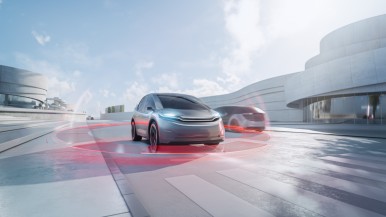
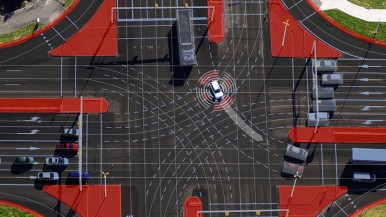
Stuttgart, Germany – Pedestrians obscured from view by vehicles, cyclists passing in front of the car, buses that suddenly approach: negotiating city traffic can quickly become a difficult task. Of all things, it could be streetlights that make urban traffic safer and provide automated vehicles with an overview of the traffic situation. This was the subject of the MEC-View research project. The project required streetlights to be fitted with video and lidar sensors, which then used advanced cellular technology to provide vehicles with critical information in real time, allowing them to detect obstacles – whether other cars, bicycles, or pedestrians – quickly and reliably. After more than three years of development, the project is now ready to present its findings. Partners in the project, which received 5.5 million euros in funding from the German Federal Ministry for Economic Affairs and Energy (BMWi), were Bosch, the consortium leader, together with Mercedes-Benz, Nokia, Osram, TomTom, IT Designers, and the universities of Duisburg-Essen and Ulm. The project’s associated partner was the city of Ulm, which for the past three years has been the testing ground for the sensors on the streetlights and the connectivity technology. The insights gained in the project will now be used to further develop automotive technology, automated driving, and cellular technology. In addition, the infrastructure the project has built up will now be available for further research projects to use.Bird’s-eye beats worm’s eye Reaching up to six meters in height, streetlights tower above road traffic. They have a precise bird’s eye view of developments at busy intersections, say – and it is knowledge like this that automated vehicles will need in the future. While a vehicle’s sensor systems – cameras, radar, and lidar sensors – give it precise 360-degree vision, the view from the ground – from the vehicle alone – is not always sufficient for it to see a pedestrian currently obscured by a truck, a vehicle emerging from a concealed entrance, or a cyclist approaching from behind and changing lanes quickly. “Because the vehicle itself cannot see around corners or through walls, we use the streetlight sensors to extend the vehicle sensors’ field of view,” says Dr. Rüdiger Walter Henn, who heads the MEC-View project at the consortium leader Bosch. The project partners have developed the corresponding hardware and software for this purpose; the system processes the images and signals from the infrastructure sensors, combines them with high-resolution digital maps (HD maps), and transmits them to the vehicle over the air. There, the data merges with the vehicle’s own sensor information to create an accurate picture of the situation, including all relevant road users.Wireless data transmission Advanced cellular technology makes extremely low-latency transmission of sensor information possible. While the MEC-View project used LTE mobile communications technology with an optimized configuration for this purpose, in the new 5G communications standard, real-time data transmission is a basic function. The core task of latency-optimized mobile communications is not only the virtually instantaneous wireless transmission of data, but also the processing of that data as close to the source as possible. This task is performed by special computers, known as mobile edge computing servers (or MEC servers for short), which are integrated directly into the cellular network. They combine the streetlight sensor data with data from a vehicle’s surround sensors and highly accurate digital maps. From this, they generate a model of the surroundings that includes all available information about the current traffic situation, and make this model available to vehicles over the air. In the future, facilities such as the city traffic control centers could be equipped with such servers, so that they can share the data with all vehicles, regardless of manufacturer, and other road users.Seamlessly merging with traffic In Ulm, the project partners have been testing the interaction of automated vehicle prototypes and infrastructure sensors in real traffic conditions since 2018. One intersection in the Lehr district of Ulm is notorious for its lack of good all-round visibility. The streetlights there were equipped with sensors to help automated vehicles negotiate the intersection. Vehicles approaching the difficult intersection from a side road have to merge onto the main road. Thanks to the newly developed technology, the automated prototype now recognizes road users early on and can adapt its driving strategy accordingly. As a result, the vehicle targets gaps in the traffic on the main road and merges seamlessly, without stopping. Such a development will make urban traffic not only safer, but also more fluid. The infrastructure built up during the project will remain in Ulm, where it will be available for use by subsequent research projects.

From windshield wiper to e-bike ABS

19.05.2020

Press release

Automated mobility

From windshield wiper to e-bike ABS

ESP ® – three letters that make all the difference. Since its debut in 1995, the electronic stability program has prevented skidding accidents and saved lives – year in and year out. With innovations such as ESP ® , Bosch has been enhancing road safety for decades. Here, we present a selection:1926: Windshield wiper Goodbye to poor visibility: comprising an electric motor that drove a rubber-coated arm via a worm screw and gear, the Bosch electric windshield wiper finally gave drivers a clear view of the road ahead. It was followed in 1959 by an electric windshield washer system. Activated at the push of a button, an electric pump precisely sprayed water on to the windshield through one or several nozzles that were mounted on the hood. 1927: Power-assisted brake for commercial vehicles In the years after 1900, vehicles became increasingly fast and powerful, but braking force was unable to keep up. This prompted Bosch to develop a pneumatic brake booster for heavy trucks, whose heavy loads meant especially long braking distances. The system used the vacuum that arises in the induction tract of the engine, so that only one-third as much pressure now had to be applied to the brakes. 1928: Bosch brake assistant Bosch also used this innovative brake technology, premiered in 1927, in passenger cars. There were two challenges: to achieve a compact design that would allow it to be installed in the tight space available in the engine compartment, and to make it more affordable. The technology became established as standard equipment. As in the case of the Bosch brake for trucks, drivers now only had to apply one-third of the pedal pressure, and braking distance was also reduced by one-third. 1957: Asymmetric low-beam headlights In 1913, Bosch started production of a new automotive lighting system. The system comprised a generator, headlights, a battery, and a regulator. And while these lighting systems were continuously improved, they still had one disadvantage: they dazzled oncoming vehicles. The more cars there were on the roads, the more inconvenient and dangerous the situation became. In 1957, Bosch premiered asymmetric low-beam headlights. This system causes less dazzle for oncoming traffic and illuminates the driver’s own side of the road better. 1978: ABS antilock braking system Following nine years of development work, 1978 marked the start of the success story of ABS, the electronically controlled antilock braking system for four-wheeler passenger cars. If the wheels lock up, ABS reduces brake pressure then increases it again – up to 40 times a second. This keeps braking distances short, even on slippery surfaces, and the vehicle remains steerable. For motorcycles, the EU mandated the system for all new type approvals from 2016. 1980: Electronic airbag control In 1980, Bosch was the first European company to manufacture electronic triggering units for passive safety systems. This set the standard in road safety. The triggering unit comprised three components made up of some 170 individual parts, and controlled the driver airbag. It was first installed in the Mercedes-Benz S-class. Up to nine airbags are installed in today’s vehicles. They are deployed individually, depending on the accident scenario. 1986: TCS traction control system The TCS traction control system prevents the driven wheels from spinning. The electronic control unit reduces the speed of the spinning wheels until they recover their grip. TCS is an early example of networking diverse automotive electronic systems. When traction control is activated, it intervenes in the engine management or brake control system. Despite actuation of the accelerator, engine power is continuously lowered, or the brake is actuated, until the wheels recover their grip. Traction control can also brake a wheel individually in order to divert engine power to another drive wheel if the latter offers better traction. 1995: MEMS in mass production In the 1980s, Bosch worked on making sensors smaller, more reliable, and more energy efficient, as a way of providing ever more sensor data in cars. Following the start of mass production in 1995, these miniature helpers became ever more prevalent, furnishing control units with data about when the car brakes or accelerates, as well as about the direction the car is traveling. Information such as this is important for safety systems such as ESP ® . 1995: ESP ® electronic stability program Using smart sensors, ESP ® compares 25 times per second whether the car is actually moving in the direction that the driver is steering it in. If it is not, the system intervenes. By reducing engine torque and deliberately braking each wheel individually, the system helps the driver stabilize the vehicle and prevent skidding accidents. Since its market launch in 1995, ESP ® has prevented just under half a million accidents and saved more than 15,000 lives in the EU alone. Bosch celebrates a milestone this year: it has sold 250 million ESP ® systems since production began 25 years ago. 2010: Predictive emergency braking system Ever more sensors in cars, sharing information with each other, make completely new applications possible: the emergency braking system that went into production in 2010 makes use of the information radar and video sensors share with the ESP ® . If there is a threat of collision, it offers drivers multi-stage support. First, it alerts to the need to brake hard. If this alert is not heeded, the system initiates partial braking, and if the driver still does not react, it triggers emergency braking. 2013: MSC motorcycle stability control In 2013, Bosch took its ESP ® success story, which began in 1995, and applied it to two-wheelers. In all riding situations, MSC motorcycle stability control ensures maximum stability: when braking and accelerating, on straight stretches and in bends. Wheel sensors measure wheel speed, and a further sensor measures lean and pitch angles. If the system detects a wheel on the verge of locking up, braking pressure is lowered and built up again within a fraction of a second, ensuring that the correct amount of pressure is constantly applied to prevent each wheel from locking up. This can save motorcyclists’ lives. 2018: eBike ABS Bosch has been manufacturing antilock braking systems for cars since 1978, and for motorcycles since 1995. They were joined in 2018 by an ABS for eBikes, which Bosch developed in collaboration with the brake manufacturer Magura. The world’s first production antilock braking system for pedelecs reduces the risk of becoming unseated in critical situations. In this front-wheel ABS, the hydraulic brakes and electronic brake system are perfectly tuned to each other. Wheel-speed sensors monitor the speed of both wheels. As soon as the front wheel threatens to lock up, the system regulates brake pressure to optimize riding stability. This is a huge added boost to rider safety. In addition, the rear wheel lift control function reduces the risk of a head-over-heels accident. If far too much brake force is applied, the ABS regulates the pressure applied to the front wheel, so that the rear wheel can quickly regain traction.

25 years of Bosch ESP®: no more skidding

19.05.2020

Press release

Automated mobility

25 years of Bosch ESP®: no more skidding

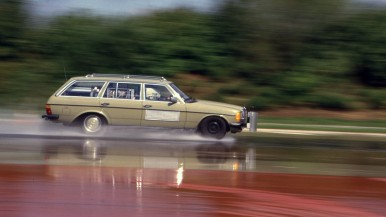
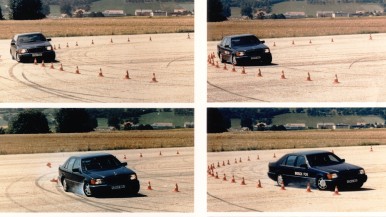
Stuttgart, Germany – A wet road and a sudden evasive maneuver: there was a time when such a situation would frequently have ended in a ditch or against a crash barrier, and not rarely with fatalities or severe injuries. Almost 25 years ago to the day, a remedy was finally provided in the shape of a pioneering invention – the ESP ® electronic stability program that Bosch and Daimler-Benz first launched in S-class vehicles in 1995. Since then, ESP ® has been keeping vehicles safely on track, also in critical situations. Bosch accident researchers estimate that in the EU alone, the anti-skid system has saved some 15,000 lives over the past 25 years, as well as preventing just under half a million accidents involving personal injury. Together with the seatbelt and airbag, ESP ® is one of the most important life-savers in a vehicle. “The development of the electronic stability program was a milestone on the path to our ‘vision zero’ of no more road deaths,” says the Bosch board of management member Harald Kroeger. “ESP ® is an outstanding example of what we mean by ‘Invented for life.” The innovation may be from 1995, but there is nothing dated about it: Bosch has continuously improved its anti-skid system, and produced more than 250 million ESP ® systems to date. Modern cars are inconceivable without this electronic guardian angel. Worldwide, 82 percent of all new vehicles are equipped with ESP ® . In 2016, this figure was 64 percent. The development of the electronic stability program was a milestone on the path to our ‘vision zero’ of no more road deaths....Bosch board of management member Harald Kroeger ESP ® can prevent up to 80 percent of all skidding accidents Especially when roads are wet or icy, when evading unexpected obstacles such as animals on the road, and also when driving into a bend too fast, the electronic stability program intervenes. With ESP ® on board, up to 80 percent of all skidding accidents can be prevented. It combines the functions of the ABS antilock braking system and the TCS traction control system, but can do considerably more. It also detects vehicle skidding movements, and actively counteracts them. The anti-skid system uses information about vehicle dynamics to detect whether the car is heading in the direction the driver is steering. If there is a discrepancy between these two factors, ESP ® intervenes. This may sound simple, but is in fact a complex process. Smart sensors help compare steering angle and vehicle trajectory 25 times a second. If the two diverge, ESP ® reduces engine torque and brakes individual wheels. In this way, the system helps the driver prevent the vehicle from breaking away or skidding – effectively nipping many accidents in the bud. Breakthrough following the elk test The story behind this achievement is a long one. It started in the 1980s with initially independent efforts by Bosch and Daimler-Benz to achieve more vehicle stability. From 1992 until market launch, experts from the two companies worked together in a project unit. The legendary elk test of 1997 helped the system achieve a breakthrough: during tests for a Swedish automotive magazine, a Mercedes Benz A-class tipped over when making an abrupt evasive maneuver. Mercedes-Benz responded by making ESP ® standard equipment. Since that time, more and more vehicles of many different automakers have adopted the anti-skid system. Fewer accidents, fewer injuries, fewer fatalities – legislators have also recognized the benefits of ESP ® and made it a mandatory feature of vehicles in many parts of the world. In the EU, the mandating process was gradual. From November 2011, it was initially mandatory for new passenger-car and commercial-vehicle types, and from November 1, 2014, for all newly registered passenger cars and commercial vehicles. And also in Argentina, Australia, Brazil, Canada, China, Ecuador, Israel, Japan, Malysia, New Zealand, Russia, South Korea, Turkey, and the United States, the anti-skid system is either legally mandated or a self-imposed commitment. Experience from Europe shows that if the proportion of vehicles featuring the system rises, accident numbers fall. ESP® has taken road safety to a new level....Bosch board of management member Harald Kroeger Basis for automated driving “ESP ® has taken road safety to a new level,” Kroeger says. And it has done so across a diverse range of vehicle types. Bosch offers customized ESP ® systems for all powertrain types, from combustion engines to electric motors, and for vehicles of all kinds, from micro cars to commercial vehicles. Even for motorized two-wheelers, the company has developed a kind of ESP ® . The MSC motorcycle stability control that Bosch launched in 2013 ensures the best possible stability in all riding situations, and is a further pioneering road-safety achievement. At the same time, ESP ® is the basic technology for many driver assistance systems, as well as for the automated driving with which Bosch is pursuing its vision zero. “Whether new or tried and tested, Bosch technologies alert and support drivers in critical situations. And increasingly, they are in a position to assume monotonous and fatiguing tasks. This gives us an opportunity to further reduce the number of accidents and road deaths,” Kroeger says. Whether with or without a driver at the wheel, Bosch will be nipping accidents in the bud in the future as well.

Staying on track

19.05.2020

Press release

Automated mobility

Staying on track

Just under half a million accidents involving personal injury avoided and 15,000 lives saved in the EU alone – this is the track record of ESP®, first launched in 1995. The story behind this achievement is one that began more than 25 years ago. The following text present the milestones in the development of the electronic stability program at Bosch:1983: Bosch researchers float some first ideas about how to improve stability when braking hard in bends. They base their ideas on the ABS antilock braking system launched in 1978. An initial proposal is to flexibly adapt each wheel’s slip to improve control over the vehicles when braking in bends. 1984: Effective July 1, a development team is set up. Its task is to use ABS as the basis for developing a brake control system offering improved vehicle control when skidding is imminent in a bend. In such a situation, the vehicle has to remain stable and steerable as far as the laws of physics will allow. 1992: A joint project unit is set up near the Bosch location in Schwieberdingen. It is made up of engineering experts from Bosch and the automaker Daimler-Benz, which is subsequently the first to install the system. An agreement is made to develop a system for production in 36 months. 1995: ESP ® has its press debut in a Mercedes-Benz S-class coupé in May, and its market launch in the coupé and sedan in September (as an extra, standard feature only with the most powerful, 12-cylinder engine). 1997: A Mercedes-Benz A-class vehicle rolls over while performing an extreme swerving maneuver during testing. The model was only recently launched. Following this “elk test” for a Swedish automotive magazine, the automaker decides to make ESP ® a standard feature. Other automakers soon follow suit. 1998: For the first time, the yaw-rate sensor that is at the heart of the ESP ® is produced as a micromechanical sensor. Bosch has been mass-producing these sensors with microscopically small movable structures since 1995. This means ESP ® can be smaller, while at the same time longer-lasting, less sensitive, more reliable, and less expensive. 2003: Bosch celebrates the delivery of its 10 millionth ESP ® system. The technology has now been in the market for ten years. In the years that follow, increasing volumes pave the way for this lifesaver to become established in the compact class. 2011: Traffic experts and policymakers increasingly acknowledge the benefits of ESP ® . The anti-skid system is mandated in various countries, including EU member states. In the EU, the mandating process is gradual. From November 2011, it is initially mandatory for new passenger-car and commercial-vehicle types, and from November 1, 2014, for all newly registered passenger cars and commercial vehicles. 2016: In the Life Achievement category, the European Patents Office confers its European Inventor Award on Anton van Zanten. Born in the Netherlands, van Zanten headed up the 35-strong group of ESP ® developers at Bosch. 2020: ESP ® turns 25. Over the past quarter of a century, Bosch has continuously improved its anti-skid system, producing more than 250 million ESP® systems to date.

A milestone on the road to fully connected traffic

05.05.2020

Press release

Connected mobility

A milestone on the road to fully connected traffic

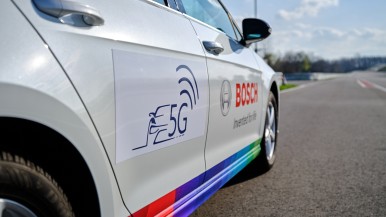
Stuttgart and Hildesheim, Germany – Safer, more convenient, greener: connected vehicles that can communicate with roadside infrastructure in real time reduce emissions and the risk of accidents. This communication requires a stable and reliable data link provided by high-performance 5G, the new fifth-generation wireless technology for cellular networks, or by Wi-Fi-based alternatives (ITS-G5). Sixteen research institutions, medium-sized enterprises, and major players have been working toward this goal over the past three years in the 5G NetMobil research project. They are now presenting their results which will enable major strides for a new era in mobility. “With the 5G NetMobil project, we have achieved decisive milestones on the road to fully connected driving and are demonstrating how modern communication technologies can make our road traffic safer, more efficient, and more economical, all at the same time,” says Thomas Rachel MdB, parliamentary state secretary in the German Ministry of Education and Research. His ministry had funded this research project with 9.5 million euros. The groundwork done in this project in the areas of networks, security, and communication protocols now underpins efforts to standardize specifications, develop new business models, and ramp up the partners’ first production runs. With the 5G NetMobil project, we have achieved decisive milestones on the road to fully connected driving and are demonstrating how modern communication technologies can make our road traffic safer, more efficient, and more economical, all at the same time....Thomas Rachel MdB, parliamentary state secretary in the German Ministry of Education and Research A launch pad for innovative traffic engineering In many traffic situations, it is virtually impossible for drivers to see everything they need to, such as pedestrians crossing convoluted intersections or vehicles suddenly emerging from blind alleys. Radar, ultrasonic, and video sensors are the eyes of modern vehicles. They monitor the traffic situation around the vehicle, but they cannot see around corners or behind obstacles. Direct vehicle-to-vehicle (V2V), vehicle-to-infrastructure (V2I) and vehicle-to-network (V2N) communication enables vehicles to share data in real time with one another and their surroundings – even data on things that cannot be seen. The partners in the 5G NetMobil project are using this communication capability to develop tools such as a crossing assistant to protect pedestrians and cyclists at blind intersections. A camera installed in the roadside infrastructure detects pedestrians and warns vehicles within just a few milliseconds to prevent critical situations, for instance, when a car turns into a side street. Another item on the research agenda is platooning. In the future, commercial vehicles will be able to join up in convoy-like platoons where synchronized acceleration, braking, and steering enables trucks to operate at very close ranks thanks to V2V communication. This automated drafting – that is, tailgating another vehicle to ride in its slipstream – reduces fuel consumption and boosts safety on freeways. Experts from the participating companies and universities have laid out the groundwork for platooning with vehicles less than ten meters apart and for parallel platooning in agriculture. “The work of the research project is relevant to a wide range of applications. This not only benefits project partners from industry and research, but especially road users,” says Dr. Frank Hofmann from Robert Bosch GmbH, who is coordinating the research project on the manufacturing end. The insights gained in this project are now flowing into the global standardization of communications infrastructure. They are cornerstones for partner companies’ further development efforts....Dr. Frank Hofmann, Robert Bosch GmbH Paving the way to standardization and new business models This research project’s brief was to find solutions to key challenges in automotive real-time communication. There’s a good reason for this: direct V2V and V2I communication has to be failsafe, with high data rates and low latency, for fully connected driving to become reality. But what happens if the quality of the data link changes, leaving less bandwidth available for direct V2V communication? The experts developed an agile “quality of service” concept to detect changes in the provided network quality and alerts the connected driving functions accordingly. This way, the distance between vehicles in a platooned convoy can be increased automatically when network quality decreases. Another focal point of this research was to break the main cellular network down into discrete virtual networks (slicing). A separate subnet is now reserved for safety-critical functions such as alerting drivers to pedestrians at an intersection. This safeguard ensures data communication for these functions is always enabled. Another discrete virtual network handles data transmissions to stream videos and update the road map. Its operations can be temporarily suspended when the data rate dips. This research project has also made significant contributions to hybrid communication where the more stable connection – either the cellular network technology or a Wi-Fi-based alternative – is used to prevent the data link from dropping out while the vehicle is on the move. “The insights gained in this project are now flowing into the global standardization of communications infrastructure. They are cornerstones for partner companies’ further development efforts,” Hofmann says. Other questions and answers: Are all partners in the 5G NetMobil project going to use the new 5G mobile communications technology to connect their vehicles? No, the participating partners are pursuing different technological approaches to enable direct communication between vehicles and infrastructure – based on either cellular network technology or WiF-Fi-based alternatives (ITS-G5). This project aimed to build the foundation for standardizing both technologies and enabling manufacturer- and technology-agnostic communication. What use cases were developed in this project? The 5G NetMobil project focused on five applications – high-density platooning of commercial vehicles separated by less than ten meters, parallel platooning of harvesters, a crossing assistant that uses infrastructure-based detection to protect pedestrians and cyclists, and smart traffic control that enables vehicles to ride a wave of green lights and steers them swiftly through city traffic. Another task on its agenda was to draft specifications for the fifth-generation cellular network to meet the requirements of safety-related applications and treat the user to a satisfying user experience.Partners in the 5G NetMobil project: Robert Bosch GmbH (project coordinator) Technische Universität Dresden (project co-coordinator) Acticom GmbH BMW AG CLAAS GmbH Deutsche Telekom AG dresden elektronik ingenieurtechnik GmbH Ericsson GmbH Fraunhofer Heinrich-Hertz-Institut Heusch/Boesefeldt GmbH Hochschule für Technik und Wirtschaft des Saarlandes – htw saar Logic Way GmbH Nokia Technische Universität Kaiserslautern Vodafone GmbH Volkswagen AG

CES 2020: Bosch raises the bar when it comes to artificial intelligence

06.01.2020

Press release

Business/economy

CES 2020: Bosch raises the bar when it comes to artificial intelligence

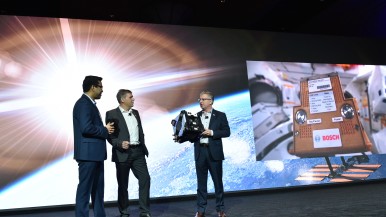
Las Vegas, NV, USA – Whether for automated driving, the smart home, or manufacturing: artificial intelligence (AI) has become an integral part of everyday life. Bosch uses AI and the internet of things (IoT) to make life easier for people and as safe as possible. Here, the slogan “Beneficial AI. Building trust together” sums up the technology and services company’s approach. The focus is on safe and robust AI for the manufacture of smart products, which Bosch will be showcasing at this year’s CES. One of these products is the Virtual Visor: an AI-based digital vehicle sun visor that will be making its debut at the world’s largest trade fair for consumer electronics. The product has also won a CES® Innovation Award, as has Bosch’s 3D display for the car.Other Bosch AI highlights at the show include an application for predictive maintenance of the International Space Station, a system for monitoring vehicle interiors, and a smart platform for medical diagnostics. “The solutions we’re showcasing at CES make it clear that Bosch aims to become an innovation leader in AI as well,” says Bosch management board member Michael Bolle. “As of 2025, every Bosch product will either contain artificial intelligence or will have been developed or manufactured with the help of AI.” The global market volume for AI applications is expected to be around 120 billion dollars over that same period, a twelvefold increase compared to 2018 (source: Tractica ). Bosch wants to tap into that potential: the company already invests 3.7 billion euros each year in software development, currently employs more than 30,000 software engineers, and has 1,000 associates working on AI. In addition, Bosch has established a comprehensive training program. “We plan to make nearly 20,000 associates AI-savvy over the next two years,” Bolle explains. “We must invest not only in artificial intelligence, but in human intelligence as well.” The program includes training formats at three different levels for managers, engineers, and AI developers and includes guidelines for using AI responsibly. To that end, Bosch has drawn up its own set of AI principles that address issues of AI security and ethics. With this in combination with its expertise, the company intends to build trust with customers and partners alike: “Anyone who has internalized technical and ethical principles knows how important data security and sovereignty are,” Bolle says. “In a way, trust is the product quality of the digital world.”Expertise saves lives In the future, Bosch believes one core area of expertise will be the industrial application of artificial intelligence. “We want to harness the power of artificial intelligence not for the purpose of creating models of human behavior, but instead to improve technology to benefit people,” Bolle says. “For this reason, industrial AI has to be safe, robust, and explainable.” According to Bosch, that means people should always remain in control, whether on the street, at home, or in manufacturing. As a pioneer in the development of life-saving driver safety systems such as ABS, ESP, and airbag control units, the company has already proved in the past that people benefit from reliable machines. AI can also make driver assistance systems even more efficient and intelligent: when Bosch’s AI camera for automated driving identifies partially concealed pedestrians, for example, the automatic emergency braking assistant can react even more reliably. Bosch is creating learning technology that is “Invented for life.”Bosch invests 100 million euros in an AI campus Innovations require investment. In addition to spending on software development, Bosch is investing worldwide in people and in competence centers. For example, the company is investing 100 million euros in the construction of a new AI campus in Tübingen, Germany. The move into the new research complex is planned for the end of 2022. It will then offer some 700 AI experts space for creative and productive exchange. These experts come from Bosch, external startups, and public research institutions. The new campus should strengthen exchange among experts in Cyber Valley. “Building trust together” will be a living reality there. Bosch is a founding member of Cyber Valley , which was established in 2016. This joint research venture brings together partners from industry, academia, and government to drive forward AI research and quickly transfer research findings into real-world industrial applications. In addition, the Bosch Center for Artificial Intelligence (BCAI) operates at seven locations worldwide, including two in the U.S.: in Sunnyvale, California and Pittsburgh, Pennsylvania. The BCAI currently has a total of some 250 AI specialists working on more than 150 projects in the domains of mobility, manufacturing, smart homes, and agriculture.World-first Virtual Visor originated in the U.S. Bosch has creative AI minds developing product innovations for mobility, the smart home, and Industry 4.0. Its AI world first for the automotive sector, which is celebrating its world premiere in Las Vegas, originated in the U.S.: the Virtual Visor, which is a transparent digital sun visor. A transparent LCD display connected to the interior monitoring camera detects the position of the driver’s eyes. Using intelligent algorithms, the Virtual Visor analyzes this information and darkens only the portion of the windshield through which the sun would dazzle the driver. The Virtual Visor scored the highest in its category at the CES Best of Innovation Awards. Bosch’s new 3D display won its category as well. Using passive 3D technology, the display generates a realistic three-dimensional effect for images and alerts. This allows visual information to be grasped faster than when displayed on conventional screens, increasing road safety. Additional safety comes from Bosch’s new interior monitoring system for vehicles. It detects when the driver is drowsy or looks at a smartphone based on eyelid movements, direction of gaze, and head position – and alerts the driver to critical situations. It also monitors the vehicle interior to determine how many occupants are present and where and in what position they are sitting. This makes it possible to optimize the operation of safety systems such as the airbags in an emergency. In 2019, Bosch sales of driver assistance systems rose by 12 percent to around 2 billion euros. They are paving the way for automated driving. In the future, when vehicles are in partially automated driving mode for sections of the journey such as on the freeway, the driver monitoring system will become an indispensable partner: In these situations, the camera will ensure that the driver can safely take the wheel again at any time. By 2022, the company will have spent around 4 billion euros on automated driving and will employ more than 5,000 engineers. To round out its sensor portfolio in this domain, Bosch is now working on making lidar sensors production-ready as well. In addition to radar and cameras, lidar is the third essential sensor technology. The Bosch long-range lidar sensor can also detect non-metallic objects at a great distance, such as rocks on the road.Bosch AI used in space and in medicine The company is aiming high with its SoundSee sensor system, which was sent into space at the end of 2019. Riding on NASA’s autonomous flying Astrobee robot, SoundSee will isolate unusual sounds on the ISS, analyze the audio using AI-driven analytics, and indicate when maintenance is necessary. Starting in early 2020, audio data captured by Soundsee will be delivered to a ground control facility configured to meet NASA specifications and built into the Bosch Research Center in Pittsburgh, PA. The system, which is barely bigger than a lunchbox, was developed in the U.S. together with Astrobotic as part of a NASA research collaboration.A completely earthbound but no less innovative product is Vivalution, a smart pathology platform that helps in medical diagnosis. Vivalution magnifies specimens like blood and other bodily fluids, digitizing the microscopic findings, and analyzing them with the help of artificial intelligence-powered algorithms. It is capable of precisely and rapidly identifying cell anomalies and providing physicians with useful support in evaluation and diagnosis.Smartglasses Light Drive make everyday glasses smart Bosch is also showcasing many non-AI innovations at CES. For example, its Light Drive smartglasses module is the world’s first sensor-based solution for making a normal pair of glasses smart. It is more than one-third thinner than other solutions on the market and weighs less than ten grams. The crystal-clear images projected into the wearer’s field of vision, which are clearly discernible even in direct sunlight, range from navigation information and text messages to calendar entries and operating instructions – depending on the information received from a smartphone or smartwatch. At CES, Bosch is using its IoT shuttle technology showpiece to present the solutions that the company offers automakers and mobility service providers for the electrification, automation, connectivity, and personalization of ridesharing vehicles. Its portfolio goes beyond components to include seamlessly connected mobility services that give users flexibility in how they operate, manage, charge, and maintain their fleet vehicles, as well as making each journey safe. At the Bosch booth, visitors can also see improved drive and sensor technologies for the connected and emissions-free mobility of the future.Solutions for the entire house: expanded portfolio for residential IoT Bosch is expanding the scope of its services for the residential internet of things (IoT). The highlight here is the open Home Connect platform, which is being showcased at CES. Starting in mid-2020, the platform’s app will also offer control of lighting and shade, entertainment, and smart gardening equipment from different manufacturers. The number of partner companies, which is currently at 40, is set to more than double, making life at home even more convenient and efficient.Smart technology protects the environment Underlying all these innovative products is Bosch’s entrepreneurial mindset. “We want to harmonize commercial, environmental, and social responsibility,” Bolle says. Climate protection is also a major concern here. According to Bolle, “Bosch not only develops environmentally friendly solutions, but also acts as a role model. By the end of 2020, all our 400 locations worldwide will be climate neutral and from development to manufacturing to administration no longer leave a carbon footprint. We’ve already achieved this for our German locations.” Artificial intelligence plays a role here, too: at individual locations, for example, an in-house energy platform uses intelligent algorithms to identify deviations in energy consumption. This alone has enabled some plants to reduce their CO2 emissions by more than 10 percent over the past two years. Considering that Bosch operates a total of 270 such plants, the savings potential is enormous. As Bolle explains, “That’s how we sum up our message at CES: Bosch has big plans for AI in many respects.”


Political VIPs at Bosch: chancellor Merkel and prime minister Costa open technol ...

30.05.2018

Press release

Business/economy

Political VIPs at Bosch: chancellor Merkel and prime minister Costa open technol ...

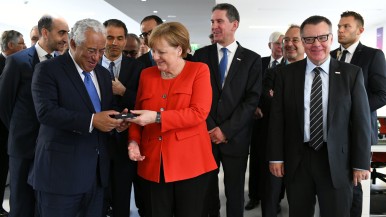
Braga, Portugal – Angela Merkel, the German chancellor, and António Costa, the prime minister of Portugal, today officially opened a new Bosch technology center in Braga together with Bosch board of management member Dr. Dirk Hoheisel . By the end of 2018, over 200 engineers will be working on developing sensors and software functions for automated driving at the location, which is situated about 50 km northeast of the coastal city of Porto. 100 new jobs will be created at the center. Some 100 associates have already transferred to the new 4,500 m2 technology center from the company’s main site, which is located four kilometers away. The German chancellor was in Portugal for talks on the development of German-Portuguese relations. In his speech, Portuguese prime minister Costa welcomed the opening of Bosch’s new technology center in his country, saying, “Portugal stands for innovative strength. Investments like the one Bosch has made here underscore this.” Our associates here will contribute to one of the key projects of future importance – the development of automated driving....Dirk Hoheisel, member of the board of management of Robert Bosch GmbH “Our new technology center in Braga is another indicator of the great potential we see in Portugal. It also reflects our confidence in the expertise of Portuguese engineers,” Hoheisel said, adding: “I am particularly pleased that our associates here will be able to make an even greater contribution to one of the key projects of future importance – the development of automated driving.” In recent years, Bosch has significantly expanded its presence in Portugal: between 2015 and 2017, it spent more than 200 million euros strengthening its activities there in the field of connected and automated mobility. In 2018, investments are expected to match the high levels of previous years. Bosch in Braga: solutions for tomorrow’s mobility The international supplier of technology and services currently employs more than 3,000 associates at its Braga location – around 1,000 more than just five years ago. The majority are involved in the development and manufacture of components for connected mobility, including technology for user-friendly display systems and infotainment. Among these is the eCall automatic emergency notification system for two-wheelers . If the vehicle is involved in an accident, the system automatically places a call for help. Particularly for motorcyclists, who have a much higher risk than car drivers of being involved in an accident, the system can mean the difference between life and death. About ten percent of associates at the Braga location work on developing components for automated mobility. In addition to developing and manufacturing sensors for vehicle safety systems like the ESP electronic stability program, the location also produces sensors that can, for instance, accurately determine the position of self-driving cars. In addition, the Bosch location in Braga has a longstanding research partnership with the local University of Minho, one of the country’s top universities. In a joint project with the university, the new technology center will also conduct research into sensors for automated driving. This partnership is scheduled to commence this year and continue for three years. Bosch Portugal: growing importance in the global engineering and manufacturing network Portugal is a key location within Bosch’s global engineering and manufacturing network. The company has had a presence in Portugal since 1911 and currently employs more than 4,500 associates at four locations. 500 of Bosch’s Portuguese associates work in R&D. In 2017, Bosch generated sales of around 240 million euros in the Portuguese market. Including deliveries to other Bosch companies, the total sales figure was 1.5 billion euros. Opened in 1990, the Braga plant is Bosch’s largest in Portugal. In Aveiro, Bosch’s Thermotechnology division develops and manufactures hot-water heaters, heat pumps, and heating appliances for private households. Ovar, the company’s third location in Portugal, is home to a manufacturing site as well as development activities of Bosch’s Building Technologies division. Video and fire alarm systems are one focus of activity at the site. Bosch’s regional headquarters in Lisbon is home to the company’s administrative as well as sales and marketing activities.