Search & find:
Media, press releases, events for your editorial coverage

Bosch commissions its first in-house electrolyzer with Hybrion electrolysis stacks

05.11.2025

Press release

Powertrain systems

Bosch commissions its first in-house electrolyzer with Hybrion electrolysis stacks

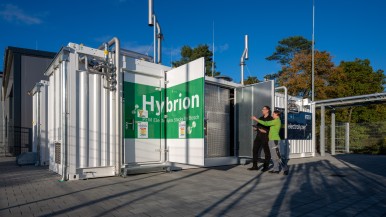
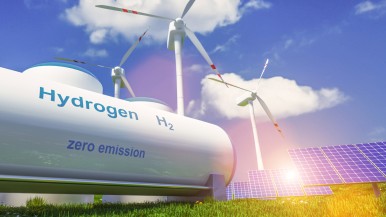
Stuttgart and Bamberg, Germany – Hydrogen is on the advance at Bosch: after officially launching Hybrion PEM electrolysis stacks (PEM = proton exchange membrane) in March, Bosch has now put two of them into operation in an electrolyzer at its Bamberg site. This 2.5 megawatts system converts water into hydrogen and oxygen using renewable electricity – and meets the EU’s requirements for renewable hydrogen. At the same time, the commissioning of the electrolyzer in Bamberg marks the start of a new chapter: it is part of an entire hydrogen landscape built to demonstrate various ways of producing, storing, and using hydrogen. “Hydrogen plays a central role in a climate-neutral world, which is something we’re committed to achieving as a society in Germany and Europe, and it’s an ideal energy source. It can be produced, stored, and transported almost anywhere, and in a climate-neutral way”, says Dr. Markus Heyn, member of the Bosch board of management and chairman of the Mobility business sector. For Bosch, hydrogen continues to be a strategically important business. The official start of operations for our electrolyzer and the opening of the hydrogen landscape here in Bamberg mark an important milestone for us....says Dr. Markus Heyn, member of the Bosch board of management and chairman of the Mobility business sector. At the heart of the electrolyzer, which was built by FEST, a company based in Goslar, Germany, are two Bosch Hybrion electrolysis stacks manufactured in Bamberg. Each of these stacks with a rated power of 1.25 megawatts produces around 23 kilograms of hydrogen per hour from water and electricity. At full load, the electrolyzer can produce more than 1 metric ton of hydrogen daily. That’s enough fuel for an electric 40-ton truck fitted with a Bosch fuel-cell power module (FCPM) to travel up to 14,000 kilometers. The Bamberg hydrogen landscape features just such an FCPM, equipped with a Bosch fuel-cell stack, in continuous operation inside a “lifetime container” with a view to testing the module’s durability. The hydrogen to power the FCPM flows into the container from the electrolyzer via a pipeline network. Here, the hydrogen-producing process that previously ran in the PEM electrolysis stacks is now reversed: hydrogen and oxygen are fed into the FCPM’s fuel-cell stacks, where they react to produce water and electrical energy. The electricity generated by the FCPM flows back into the electrolyzer, where it is used both to test the electrolyzer and to produce hydrogen locally. These around-the-clock tests inside the lifetime container simulate a wide range of usage scenarios to ensure the durability and reliability of the FCPMs. Large-scale production of the FCPM started in Bosch’s Stuttgart-Feuerbach plant in mid-2023. It was recently nominated for the prestigious German President’s Future Prize. “Bosch can do hydrogen, and at scale,” says Thomas Pauer, the president of the Power Solutions division. "We got involved in the area at an early stage, made upfront investments, and are now offering market-ready technical solutions. That includes our fuel-cell power module. The fact that it was nominated for the German Future Prize proves that this Bosch technology is at the cutting edge. And that applies both to the fuel cells and to the electrolysis.” Bamberg also has a second test station for the Hybrion PEM electrolysis stacks manufactured at the plant there. Before delivering stacks to customers, this is where Bosch ensures that they reliably achieve their performance and efficiency under real operating conditions. For example, various load profiles are simulated to test the reaction of each stack to electrical fluctuations. In addition, every Hybrion stack is activated before delivery so that it is immediately ready for use at the customer’s premises. Another feature of the hydrogen landscape is the 21-meter-high hydrogen tank, in which hydrogen from electrolysis can be stored at up to 50 bar. Bosch has already reached its first milestones in electrolysis technology in 2025. Following the market launch in the spring, deliveries have begun to various customers and partners, including companies such as IMI, Kyros Hydrogen Solutions, Neumann & Esser, Pietro Fiorentini, and the latter’s subsidiary Hyter.

Bosch puts its first hydrogen truck into service in plant traffic

08.10.2025

Press release

Powertrain systems

Bosch puts its first hydrogen truck into service in plant traffic

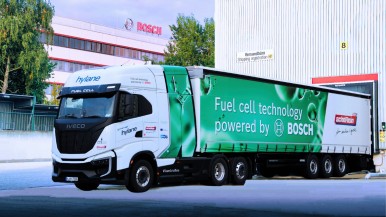
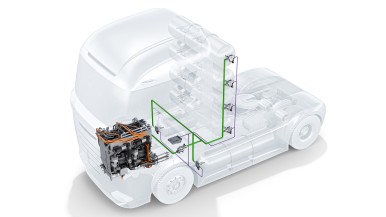
Nuremberg, Germany – Bosch has taken a further step on the road to climate-friendly logistics – with one of the technology company’s own products. Its Nuremberg plant recently started using a fuel-cell electric truck in plant traffic. The truck is equipped with the Bosch fuel-cell power module (FCPM), which was recently nominated for the prestigious German President’s Future Prize. “When we decided to make our plant traffic more climate-friendly, it was clear that we wanted a truck featuring Bosch’s FCPM,” explains Alexander Weichsel, the commercial plant manager in Nuremberg. “This deployment is an important building block that helps us reduce our emissions in logistics. The fact that several thousand trucks with Bosch fuel-cell systems are already on the road worldwide shows that the concept is proving its worth.” By converting hydrogen and oxygen into water and electricity, the 40-ton truck can be operated completely electrically. Using renewable hydrogen even makes the truck’s powertrain climate neutral. By switching to the new vehicle, Bosch also wants to set an example in Nuremberg and play an active role in developing a hydrogen value chain in line with the state of Bavaria’s Hydrogen Strategy 2.0.Real operation provides valuable data for further development The Iveco truck in question has a range of up to 800 kilometers. It is operated by the freight forwarder Schäflein on behalf of the Bosch plant. Schäflein in turn rents the vehicle from the rental provider Hylane, which specializes in emissions-free trucks. The vehicle, which primarily transports products from the plant’s own manufacturing operations, is expected to cover 12,000 kilometers per year. As a result, the Nuremberg plant will reduce Bosch’s CO 2 emissions – because the vehicle runs on hydrogen instead of diesel. Alongside this reduction of emissions in logistics, however, the primary reason for putting the truck into service is initially to gather experience and as much data as possible. This will flow into the further development of future powertrain systems such as the Compact 190 and Compact 300 models. Plant manager Weichsel is optimistic about the future: “The fact we’ve had no problems operating this truck shows that the fuel cell is ready for volume production.” At the same time, he says: “The key to a successful hydrogen economy is above all to ensure an abundance of affordable hydrogen and put in place an adequate H 2 infrastructure, including in Nuremberg. We’re actively working with industrial partners in the Nuremberg metropolitan region to implement Bavaria’s hydrogen strategy.” With the Iveco FCPM truck, Bosch has now put its own system into real operation in Europe for the first time. The truck’s five hydrogen tanks hold up to 70 kilograms at a pressure of 700 bar. Its fuel-cell system delivers a total output of over 200 kilowatts. Its e-axle is powered by the fuel-cell system, while two battery packs installed centrally in the truck serve as energy storage. The truck has a system output of 400 kilowatts and a gross weight rating of up to 44 metric tons. In addition to its robustness and long range – which, unlike battery-electric vehicles, is not affected by the outside temperature – the truck offers impressively short refueling times, which are similar to those of a diesel truck. Large-scale production of the FCPM started in Stuttgart-Feuerbach in mid-2023. The Bosch plant in Bamberg supplies the fuel-cell stack, while the Homburg plant supplies other components such as the electric air compressor and the recirculation blower. Bosch has been strongly committed to building an H2 economy for a long time, and is developing technical solutions for the production, infrastructure, and use of hydrogen. This spring, the company heralded its market entry with technology for electrolyzers and presented its Hybrion PEM electrolysis stacks. When it comes to hydrogen applications, Bosch is active not only in the field of mobile fuel cells but also in hydrogen engines.

Providing seamless proof of sustainability

28.05.2025

Press release

Powertrain systems

Providing seamless proof of sustainability

Stuttgart, Germany – Vehicle fleets are a driver of carbon dioxide emissions, particularly for freight forwarders and transport companies. Opting to use renewable synthetic fuels can greatly reduce their carbon footprint – but documenting this, say for sustainability reports, is a challenge. That’s precisely where Bosch’s Digital Fuel Twin comes in: this software solution, integrated into the vehicle, records the use of climate-friendly fuels and documents the reduced carbon emissions. “Bosch’s Digital Fuel Twin makes it easy for companies to prove that they’re using renewable synthetic fuels,” says Thomas Pauer, the president of Bosch’s Power Solutions division. “It gives them auditable proof of the quantities and the carbon footprint of the fuel used per vehicle, which they can then use in their reporting.” In this way, companies not only comply with ever increasing reporting obligations, but can also document their environmental awareness. The Digital Fuel Twin is currently being used on the Tour d’Europe for the first time, which will also stop off at Bosch in Feuerbach on May 28. This rally to Brussels will see a fleet of cars and trucks with combustion engines refueling exclusively with renewable synthetic fuels at public filling stations as they make their way across Europe. Bosch’s Digital Fuel Twin makes it easy for companies to prove that they’re using renewable synthetic fuels. It gives them auditable proof of the quantities and the carbon footprint of the fuel used per vehicle, which they can then use in their reporting....Thomas Pauer, the president of Bosch’s Power Solutions division A further field of application for the Digital Fuel Twin would open up in the event that it becomes possible to reclassify vehicles with combustion engines as zero-emission vehicles if they use only renewable synthetic fuels. The EU intends to review this option this year. Its current plan starting in 2035 is to fine all manufacturers of combustion vehicles at such a high level as to make it no longer economically viable to sell them. “Renewable synthetic fuels should be a part of the solution. That’s the only way to achieve the climate targets in the transport sector,” Pauer says. “If the EU decides in favor of reclassification, the Digital Fuel Twin can be an important tool in implementing that.” Purely digital records, plausibility checks, and documentation The new Bosch software enables the reliable tracking of all a fuel’s climate-relevant properties: from production through all stages of the supply chain to the filling station and into the vehicle. To begin with, manufacturers of renewable synthetic fuels report to Bosch how much fuel they have sold, to whom, and what the fuel’s carbon footprint is. Transport companies in turn report how much fuel they purchased and when. The Digital Fuel Twin compares this data. If the time and quantity match both in the respective company books and with the recorded pump and sensor data of the transfer interfaces, the fuel properties – the type of fuel, its CO 2 content, and reduction potential – are passed on in the supply chain. Any carbon emitted during further transportation is reassigned to the fuel – meaning the shorter the distances, the better for the climate. Finally, at the filling station, a “digital handshake” – an exchange of data between the filling station, vehicle, and cloud – documents exactly how much and what kind of fuel was purchased. Identification is carried out using, for example, a fleet management system. This database provides users of the Digital Fuel Twin with reliable information about the CO 2 values of the fuel used as well as auditable proof of use. The fuel data is always mapped digitally as a virtual twin in a protected data room in the cloud. Bosch’s software solution can be used in cars, trucks, and buses, but also in construction vehicles and even ships. The Digital Fuel Twin is currently undergoing testing in collaboration with many participants along the entire fuel supply chain. The system’s reliability and safety is being tested together with them and with vehicle manufacturers. To date, the Digital Fuel Twin has been retrofitted into vehicles. In the future, however, the plan is to integrate it into the vehicle’s own electronics as a pure software module, thereby ensuring the tamper-proof use of renewable synthetic fuels at the individual vehicle level. “We expect the Digital Fuel Twin to feature in production vehicles as early as 2026,” Pauer says. Renewable synthetic fuels have been available for many years Renewable synthetic fuels are produced either from plant-based materials or with the help of renewable electricity. In contrast to fuels based on crude oil, they do not release any additional carbon dioxide into the atmosphere. Some of these fuels have been available for years. The most widely used is HVO100 (100 % recycled hydrotreated vegetable oils), which is obtained from waste oils and plant residues. Overall – taking into account the carbon emissions of the fuel itself plus the carbon emitted during its production (“well-to-wheel”) – this diesel fuel offers a CO 2 advantage of up to 90 percent compared to its crude oil counterpart. Sales of this fuel have been freely permitted in Germany since 2024, but it has been available for much longer in countries such as Sweden and the Netherlands. For gasoline engines, there is also the ethanol-based fuel E85. Both fuels, HVO100 and E85, are each already available at more than 5,000 filling stations across Europe.

Bosch at bauma 2025

07.04.2025

Press release

Powertrain systems

Bosch at bauma 2025

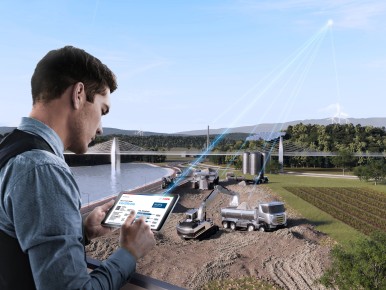
Stuttgart and Munich, Germany – Over one million new construction vehicles will be produced worldwide in 2025 alone. As different as their performance classes and tasks are, they almost all have one thing in common: a diesel engine. Its robustness and strength make it the ideal powertrain for a wide range of applications. At the bauma 2025 trade fair, Bosch will be showing how carbon emissions can be reduced even further in this vehicle segment. “Renewable synthetic fuels make operating both new and existing vehicles much more climate-friendly,” says Jan-Oliver Roehrl, executive vice president of the Bosch Power Solutions division and head of commercial vehicle activities at Bosch. “And in the future, hydrogen engines and electrification also stand to make construction machinery much more sustainable.” Renewable synthetic fuels make operating both new and existing vehicles much more climate-friendly. And in the future, hydrogen engines and electrification also stand to make construction machinery much more sustainable....Jan-Oliver Roehrl, executive vice president of the Bosch Power Solutions division and head of commercial vehicle activities at Bosch Renewable synthetic fuels make combustion engines more climate-friendly Construction vehicles are already subject to comprehensive exhaust-emission regulations, such as Stage V in Europe, Tier 4 in the U.S., and Phase IV in China. To date, however, their climate-relevant emissions have been regulated only to a limited extent, at least by law. One simple option for greatly reducing their carbon emissions that is already available today is to use renewable synthetic fuels such as HVO100. Because these fuels are based on residual and waste materials, they are much more climate-friendly than fossil fuels in terms of overall carbon emissions. They are also “drop-in” fuels, meaning they can be mixed with normal diesel fuel as required. Since Bosch already takes compatibility with these fuels into account when developing its injection technology, they are suitable for use in its products. According to Bosch forecasts, four out of five new construction vehicles worldwide with over 56 kilowatts will still have a diesel engine in 2035. That is why Bosch will continue to develop injection technology and urea dosing technology for exhaust-gas treatment in the future to suit the various segments of the construction machinery market. The Digital Fuel Twin documents the use of renewable synthetic fuels Renewable synthetic fuels can make construction machinery more climate-friendly: the more of it they use, the smaller the carbon footprint of each individual vehicle. Bosch makes this effect visible with a purely digital software solution called the Digital Fuel Twin. This documents the amounts of fuel distributed as well as the fuels’ sustainability, from production and transportation all the way to the filling station. It provides the operators of construction machinery with certificates corresponding to how they have refueled their vehicles; these document the total amounts of fuel used and even the proportionate carbon footprint when using the vehicle. Hydrogen engines build on tried-and-tested foundations When it comes to hydrogen engines, German manufacturers and suppliers can draw on decades of expertise, particularly in the field of engine technology: some 80 to 90 percent of the technology involved can be transferred from conventional combustion engines. If the hydrogen fueling the engines is produced with renewable energy, their use could mark a big step forward for the climate. Often, construction machinery is stationary and operates under heavy loads. “This is precisely where hydrogen engines, with their high efficiency and robustness, can really excel,” Roehrl says. “The first applications of hydrogen engines featuring Bosch injection technology will be launched this year.” Bosch is working on both port- and direct-injection systems and is already involved in more than 100 development projects with customers worldwide. Moreover, the hydrogen engine is also a promising option for large engines, for example as the powertrain for dump trucks in mining. Here, too, robustness and reliability combined with a compact design are essential for economical operation. Electrification solutions for construction machinery In certain construction machinery applications, electrification is another efficient and climate-friendly option for mobile and stationary functions. With its eLION electrification portfolio, Bosch Rexroth already offers a wide range of motors, inverters, gearboxes, software, and accessories, including the appropriate hydraulics. This Bosch subsidiary is currently expanding its range to include components for 96-volt vehicle electrical systems; at the end of 2025, it will introduce a standardized software platform for all voltage classes. Bosch Engineering, meanwhile, is presenting a newly developed high-performance solution for battery voltages of up to 800 volts. This subsidiary’s new electric powertrain system is compact and offers high power density as well as high efficiency. It is also suitable for construction machinery with high power requirements and limited installation space, such as wheel loaders. Bosch, Bosch Rexroth, and Bosch Engineering will be showcasing these solutions at bauma, at booths A3/327 and A4/526.

New area of business: Bosch to develop components for hydrogen electrolysis

04.05.2022

Press release

Powertrain systems

New area of business: Bosch to develop components for hydrogen electrolysis

Stuttgart and Renningen, Germany – When it comes to green hydrogen, Bosch is stepping on the gas: in the interest of effective climate action, the company is planning not only to use this new fuel, but also to be one of the companies producing it. This is why Bosch is branching out into the development of components for electrolyzers, which use electrolysis to split water into hydrogen and oxygen. Ideally, the electricity for this purpose is generated from renewable sources such as wind or photovoltaic power, in which case the result is known as “green hydrogen”. “We cannot afford to delay climate action any longer, so we aim to use Bosch technology to support the rapid expansion of hydrogen production in Europe,” said Dr. Stefan Hartung, chairman of the board of management of Robert Bosch GmbH, at the presentation of the company’s annual figures . “To do this, we will leverage our know-how in fuel-cell technology,” added Dr. Markus Heyn, member of the board of management of Bosch and chairman of the Mobility Solutions business sector. Drawing on this expertise, Bosch will assign the development of electrolyzer components to the Mobility Solutions business sector, investing up to 500 million euros in this venture by the end of the decade. In light of energy diversification, the move away from fossil fuels, and the need to reduce CO2 emissions, demand for green hydrogen is growing rapidly – not only in energy-intensive industries such as steel, chemicals, and heavy-duty freight, but also in private real estate. According to the EU, demand is set to rise to some ten million metric tons a year by 2030. Bosch forecasts that the global market for electrolyzer components will increase to a volume of around 14 billion euros over the same period, with Europe set to see the highest rates of growth. To help business and society reduce dependency on fossil fuels and harness new forms of energy, Bosch intends to invest some three billion euros in climate-neutral technology, such as electrification and hydrogen, over the next three years. “We cannot afford to delay climate action any longer, so we aim to use Bosch technology to support the rapid expansion of hydrogen production in Europe” ...says Dr. Stefan Hartung, chairman of the board of management of Robert Bosch GmbH Bosch is to develop the stack – the core component of an electrolyzer As in the fuel cell, the key component of an electrolyzer is a stack, which comprises several hundred individual cells connected in series. In each of these cells, electricity is used to split water into hydrogen and oxygen. This is the reverse of what takes place in a fuel cell, where electricity is generated by combining hydrogen and oxygen. In both cases, the chemical reaction is facilitated by means of a proton-exchange membrane (PEM). Bosch is collaborating with a number of partners to develop a way of combining the electrolyzer stack with a control unit, power electronics, and various sensors to create a “smart module”. With pilot plants scheduled to commence operation in the coming year, the company plans to supply these smart modules to manufacturers of electrolysis plants and industrial service providers from 2025 onward. Using a simple process, Bosch will incorporate a number of these compact modules. They can then be used both in smaller units with capacity of up to ten megawatts and in gigawatt-rated onshore and offshore plants – whether in new-build projects or in existing plants for conversion to the production of green hydrogen. To maximize the efficiency of hydrogen production and extend the service life of the stack, the smart modules are to be connected to the Bosch cloud. At the same time, the use of a modular design for the electrolyzers is expected to make maintenance more flexible: any scheduled work will require the shutdown of certain sections of the plant only, instead of the entire facility. Bosch is also working on service concepts that will include the recycling of components in order to promote a circular economy. Bosch can use its strengths in mass production and economies of scale Unlike many of the electrolyzer components currently on the market, the Bosch smart modules will be mass produced. As such, the manufacturing operation will generate economies of scale. “Two key factors are involved in ramping up hydrogen production: speed and cost,” Heyn said. “This is where we can play to our strengths, thanks to our expertise in mass production and our automotive know-how.” Bosch is now planning to start volume production as quickly as possible at a number of European locations. These include Bamberg and Feuerbach (Germany), Tilburg (Netherlands), Linz (Austria), and České Budějovice (Czech Republic). Bosch portfolio expansion will safeguard jobs The ongoing transformation of the automotive sector presents a huge challenge for the industry as a whole. As ever, Bosch’s response here is to innovate. In entering a new field of business – one that will add a nonautomotive wing to its mobility solutions business – the company is seizing the opportunity to further safeguard employment. In the coming years, this expansion into electrolyzer components is expected to create work for hundreds of associates. “In fact, we’re doing three things at once,” Heyn said. “We’re making an important contribution ecologically, economically, and socially.” Bosch is working on mobile and stationary fuel cells Bosch firmly believes in hydrogen as a future fuel, and is also working on both stationary and mobile fuel cells . One intended use for the former is as small, on-site power plants for cities, data centers, shopping malls, business parks, and as charge spots for electric vehicles. Bosch plans to use mobile fuel cells to facilitate the climate-neutral shipping of goods and commodities, initially by truck. The company’s portfolio of vehicle-related products in this field ranges from individual sensors to core components such as the electric air compressor , the stack, and complete fuel-cell modules . Production is expected to start this year.

Bosch expands its hydrogen portfolio

17.11.2021

Press release

Powertrain systems

Bosch expands its hydrogen portfolio

Stuttgart, Germany / Brescia, Italy – Bosch has expanded its product portfolio for mobile hydrogen applications: as of now, it also includes components for H2 tank systems such as tank valves or pressure regulators. For this purpose, the supplier of technology and services has entered into an engineering partnership with the Italian specialist OMB Saleri in which the products are jointly further developed. “In the drive to achieve climate neutrality, hydrogen will be an important building block in the future powertrain mix,” says Dr. Uwe Gackstatter, president of the Bosch Powertrain Solutions division. “Together with OMB Saleri, we are making H2 tank components ready for volume production.” Together with OMB Saleri, we are making H2 tank components ready for volume production....Dr. Uwe Gackstatter, president of the Bosch Powertrain Solutions division Targeting the global market for hydrogen refueling solutions Demand for powertrains that run on hydrogen will experience strong growth in the years ahead, especially in commercial vehicles. Bosch expects that by 2030, around one in eight newly registered commercial vehicles worldwide will be powered by a fuel cell. Bosch and OMB Saleri hope that the partnership they have now put in place for components for hydrogen refueling systems will expand their market positions in the H2 sector. Their collaboration includes a licensing and engineering agreement for several products relating to hydrogen storage solutions at pressures of 350 bar and 700 bar. Joint simultaneous engineering teams are now further developing the existing products and optimizing them for volume production. The two companies’ goal is to leverage economies of scale and offer components for hydrogen refueling solutions at competitive prices. Bosch and OMB Saleri pool expertise The partnership brings together the two partners’ know-how. The Italian technology company OMB Saleri, based in Brescia in northern Italy, is considered one of the world’s leading specialists in components for hydrogen storage solutions. As a partner, Bosch will benefit from its engineering expertise, a modern H2 test infrastructure and testing stations, and components that have already proved their worth in initial applications. In return, Bosch will contribute its experience in the commercialization of innovative products as well as a global development and manufacturing network for large volumes. Bosch is working on mobile and stationary fuel cells Bosch believes that hydrogen has a bright future as an energy carrier, and is making considerable upfront investments in this area. From 2021 to 2024, the company plans to invest around 600 million euros in mobile fuel-cell applications and a further 400 million euros in stationary ones for the generation of electricity and heat. The portfolio for vehicles ranges from individual sensors to core components such as the electric air compressor and the stack to the complete fuel-cell module.

Bosch, Shell, and Volkswagen develop renewable gasoline with 20 percent lower CO ...

03.05.2021

Press release

Powertrain systems

Bosch, Shell, and Volkswagen develop renewable gasoline with 20 percent lower CO ...

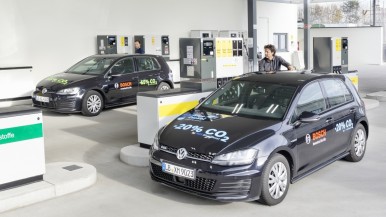
Stuttgart, Germany – The available range of renewable low-carbon fuels is growing. Following on from R33 Blue Diesel, Bosch, Shell, and Volkswagen have now come up with a low-carbon gasoline. Their new fuel, called Blue Gasoline, similarly contains up to 33 percent renewables, ensuring a well-to-wheel reduction in carbon emissions of at least 20 percent per kilometer driven. This means a fleet of 1,000 VW Golf VIII 1.5 TSIs alone could save more than 230 metric tons of CO₂ per year, assuming an annual mileage of 10,000 kilometers each. Shell will offset the remaining carbon emissions from the use of Blue Gasoline through certified offset arrangements. The initial plan is to make the fuel available at regular filling stations over the course of the year, starting in Germany. On the road to climate-friendly mobility, we must ensure we don’t leave any technical opportunities untapped, starting with electromobility and ending with renewable fuels. Every bit of CO₂ we save can help us achieve our climate targets,...says Dr. Uwe Gackstatter, president of the Bosch Powertrain Solutions division. “On the road to climate-friendly mobility, we must ensure we don’t leave any technical opportunities untapped, starting with electromobility and ending with renewable fuels. Every bit of CO₂ we save can help us achieve our climate targets,” says Dr. Uwe Gackstatter, president of the Bosch Powertrain Solutions division. “We’re pleased to present this counterpart to R33 Blue Diesel. Our new fuel now also takes gasoline engines a big step forward in terms of sustainability,” says Felix Balthasar, Manager Speciality Fuels at Shell. Sebastian Willmann, head of Internal Combustion Engine Development at Volkswagen, says: “Blue Gasoline is another building block in the effective reduction of CO₂ emissions from the vehicle fleet. Blue Gasoline’s high storage stability makes the fuel particularly suitable for use in plug-in hybrid vehicles. In the future, the expansion of the charging infrastructure and larger batteries will mean that these vehicles predominantly run on electrical power, and thus that fuel may remain in the fuel tank for longer periods of time.” Highest standards set for fuel quality and sustainability Blue Gasoline fuel complies with the EN 228/E10 standard and even exceeds it in key parameters such as storage stability and boiling behavior. High-quality additives also keep the engine extremely clean and protect it against corrosion. This means not only that the fuel can be distributed via the existing filling station network, but also that it can be used in all new and existing vehicles for which Super 95 E10 gasoline has been approved. The proportion of up to 33 percent renewables is made up of biomass-based naphtha or ethanol certified by the International Sustainability and Carbon Certification (ISCC) system. One source of such naphtha is what is known as tall oil, a by-product in the production of pulp for paper. But naphtha can also be obtained from other residual and waste materials. Bosch company filling stations will now offer only low-carbon fuels In the Blue Gasoline project, the three partners jointly defined the fuel specification to be achieved, taking into account engine requirements and sustainability. They put the product they developed through intensive testing on engine test benches and in trial vehicles – with consistently positive results. Bosch will debut Blue Gasoline at its company filling stations as early as May 2021, starting with its Schwieberdingen site, with a rollout to the company’s filling stations at its Feuerbach and Hildesheim sites scheduled for the course of 2021. The supply of conventional Super 95 E10 gasoline will then be gradually phased out. Since the end of 2018, R33 Blue Diesel has been the only diesel fuel that Bosch company filling stations offer for company cars and internal delivery vehicles. R33 Blue Diesel is also becoming available at more and more regular filling stations in Germany. At present, it is offered at eight filling stations belonging to different brands nationwide, with more set to follow. Renewable fuels are not a substitute for electromobility For Bosch, renewable low-carbon and carbon-neutral fuels will not replace electromobility, but complement it. In principle, the use of these fuels makes sense in all modes of transport, but especially in those for which there is as yet no clear and economical path to electrification. In addition to ships and aircraft, this applies primarily to heavy goods vehicles and existing vehicles, but also to all the vehicles with internal-combustion engines or hybrid powertrains that are on the world’s roads today or will be built in the coming decades. To promote rapid market uptake for these fuels, the focus is on renewable biomass and synthetic fuel components that can be blended into regular fuel in high proportions in line with existing fuel standards. By using Blue Diesel and Blue Gasoline, Bosch is demonstrating that it is not just up to new vehicles to reduce the transport sector’s CO₂ emissions: the existing fleet can also help achieve climate targets.

Bosch and PTV Group: Alliance for better air

23.03.2021

Press release

Powertrain systems

Bosch and PTV Group: Alliance for better air

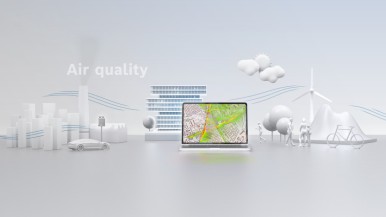
Stuttgart – Bosch and PTV Group, the global market leader for mobility and transportation software, are joining forces to further improve air quality and reduce traffic-related emissions in cities. The new partnership brings together Bosch's know-how in measuring, modeling, and analyzing air quality data with PTV's expertise in traffic planning and simulation. This partnership will provide cities with the right tools to reconcile mobility and better air in the best possible way. While many cities in Europe and around the world are struggling with air pollution, the two companies could help well over 2,000 potential customers in more than 120 countries with their innovative solution. Measures to improve air quality play an important role, especially in cities. Implementation of these measures require precise data and simulations of the type and spread of emissions and immissions. Our collaboration creates the foundation for a long-term improvement in air quality, for example through traffic control....Christian Stach, Executive Vice President, Bosch Powertrain Solutions division Precise data for efficient traffic management The first outcome of the cooperation has already been implemented. Precise emissions data by Bosch is now available in the traffic simulation software PTV Vissim. Bosch generates this data on its cloud-based Air Quality platform, based on detailed traffic data. In PTV Vissim, city and traffic planners can then immediately see how different traffic measures, such as adapted signal control, will affect vehicle emissions and air quality. "Measures to improve air quality play an important role, especially in cities. Implementation of these measures require precise data and simulations of the type and spread of emissions and immissions. Our collaboration creates the foundation for a long-term improvement in air quality, for example through traffic control," says Christian Stach, Executive Vice President, Bosch Powertrain Solutions division. "Better air is a vital factor when it comes to creating livable and sustainable urban areas. At the same time, our cities are growing, with more and more people and goods on the move. Our collaboration combines the data expertise of the leading technology company, Bosch with PTV's analysis and simulation technology. Together, we can empower cities to make sound decisions and effectively improve air quality," says Christian U. Haas, CEO of PTV Group. Potential for further developments Bosch and PTV Group are planning further innovative developments that will be based on a shared-data platform. Immission data generated with artificial intelligence will be integrated from the Bosch Cloud into PTV's various software solutions. In addition, a team of experts from both companies is working on a holistic "city dashboard" that will enable users to analyze and visualize mobility and real-time air quality data. This dashboard will help to address a variety of aspects of the “Smart City” concept, such as optimum location of charging stations, sustainable mobility solutions, the transport of goods on the last mile, etc.

Bosch polls Europeans about the future of the powertrain: respondents in favor o ...

20.10.2020

Press release

Powertrain systems

Bosch polls Europeans about the future of the powertrain: respondents in favor o ...

Stuttgart, Germany – According to a representative survey conducted in June 2020 by the market research institute Innofact on behalf of Bosch, no powertrain types have lost any of their relevance – whether batteries or fuel cells, gasoline or diesel engines. If the 2,500 survey respondents in Germany, France, Italy, and the U.K. had to decide on a new car tomorrow, one in two would opt for a stand-alone combustion engine for their primary car and around one in three for their second car. However, when asked what would be the most prevalently used powertrain in 2030, some 68 percent of those polled see the electrical powertrain in pole position, ahead of hybrids and combustion engines. Survey participants acknowledged the potential of fuel cell-powered cars, with around one in three seeing the fuel cell as the future of mobility. “Electric mobility is on its way – and that’s good news. This year alone, Bosch is investing 500 million euros in this domain. At the same time, we’re also continuously refining the internal combustion engine – because it’s still needed,” says Dr. Stefan Hartung, member of the Robert Bosch GmbH board of management and chairman of the Mobility Solutions business sector. Electric mobility is on its way – and that’s good news. This year alone, Bosch is investing 500 million euros in this domain. At the same time, we’re also continuously refining the internal combustion engine – because it’s still needed....Dr. Stefan Hartung, member of the Robert Bosch GmbH board of management and chairman of the Mobility Solutions business sector Respondents want incentives for all powertrain types A further question reveals respondents’ open-mindedness toward powertrains of all types: when asked whether they favor incentives for vehicles equipped solely with combustion engines, in addition to the many government subsidies for electric cars and plug-in hybrids, 70 percent of the Europeans polled answered in the affirmative. The number of respondents in favor of government incentives to buy new cars with a conventional powertrain is highest in Italy at 83 percent, and lowest in the United Kingdom at 60 percent. In France, 77 percent are in favor; in Germany, 62 percent. “Incentivizing modern combustion engines can accelerate the vehicle fleet’s renewal, which would also help the environment and the climate,” Hartung says. Just under one-third of Europeans would like to see this subsidy run to at least 9,000 euros. This is the same as the maximum rebate currently offered by the German government for the purchase of an electric car. Two findings are notable: for one, 72 percent of city dwellers in the four surveyed European countries believe the combustion engine merits a subsidy. For the other, the majority (80 percent) of 18-to-29 year-olds also endorse incentives for cars with combustion engines. Even cars with conventional engines can run in a climate-neutral way. The key to this is renewable synthetic fuels (RSF), which are made from renewable hydrogen and CO₂ captured from the surrounding air. On average, 57 percent of those taking part in the Bosch survey agreed that RSF should benefit from tax breaks. “There’s just no way around renewable synthetic fuels if we want to achieve our climate targets,” Hartung says. “Only with RSF can the more than one billion vehicles already on the road worldwide help contain global warming.”Can’t live without a car: respondents in Europe are unanimous In Europe, the status of the car and its importance for mobility is unlikely to change any time soon. Around 60 percent of those surveyed in Germany, France, Italy, and the U.K. are unable to imagine living without a car altogether. And a clear majority of the remaining 40 percent are only prepared to leave their car behind some of the time. The car’s approval rating in rural Europe is 77 percent. Incidentally, these findings are roughly similar among 18-to-29 year-olds, around half of whom also come out clearly in favor of a car. While 61 percent of those surveyed in Germany and 47 percent in the U.K. cited greater flexibility as the most important reason for having a car, 41 percent of French respondents indicated they need it mostly for work. In contrast, 55 percent of surveyed Italians prefer the car to other forms of mobility that they feel are less convenient. “For the foreseeable future, the car will remain the number one means of transport – and has excellent prospects of becoming even more climate-friendly,” Hartung says. Bosch’s objective is for people to be able to stay mobile in an affordable and eco-friendly way.The future of the powertrain: Bosch champions electromobility and combustion technology Bosch aims to make transportation as resource-friendly as possible, and is pursuing the vision of CO₂-neutral and virtually emissions-free mobility in several ways. In its approach to future powertrain technology, the supplier of technology and services is keeping an open mind. On the one hand, Bosch aims to become the market leader in electromobility with battery and fuel cell-powered vehicles. Electric vehicles are climate-neutral if the charging power and hydrogen are sourced from renewables. On the other hand, Bosch is continuing to refine combustion engines to contain global warming and protect the environment to the greatest extent possible. If they run on RSF, gasoline and diesel engines can also be climate-neutral on the road. Bosch expects around one-third of all newly registered vehicles worldwide to be purely electric by 2030. Two-thirds of all new vehicles will still be powered by a combustion engine, many of them as hybrids.

City, country, freeway: Bosch paves the way for climate-neutral transportation

08.10.2020

Press release

Powertrain systems

City, country, freeway: Bosch paves the way for climate-neutral transportation

Stuttgart, Germany – Climate action for road transport calls for a broad technology offensive. Commercial vehicles in particular have a wide variety of requirements when it comes to powertrain solutions, as the CO₂ emissions differ greatly depending on driving profile, payload, and driving distance. While light vehicles tend to drive shorter distances, for example on downtown delivery routes, heavy-duty trucks transport goods and merchandise over long distances. To meet EU requirements, CO₂ emissions need to be cut dramatically in both light commercial vehicles and heavy trucks by 2030. Bosch hopes to play a role in realizing climate-neutral transportation for all vehicle classes. To this end, the company is developing a range of efficient powertrains – from combustion engines and battery-electric models to fuel cells.Powertrain solutions for commercial vehicles Silent through the city – the electric powertrain for light commercial vehicles It’s hard to imagine city streets without delivery vehicles, tradespeople, and other small-scale businesses – especially given the steadily rising demand for goods and services. That is why society needs pioneering powertrains that put as little strain as possible on residents and the environment. Bosch’s eCityTruck powertrain solutions allow for low-noise driving with zero local emissions. Together, they form a compact module made up of the e-axle, which combines the electric motor, power electronics, and transmission in a compact unit, and an electric drive module (without the transmission). Both solutions are easy to integrate and can be scaled for light commercial vehicles up to 7.5 tons. Depending on the battery design, they enable ranges of up to 200 kilometers, meaning that most delivery routes of less than 80 kilometers a day are easily covered on a single charge. “With our modular eCityTruck powertrain solutions, we are making the electrified powertrain economical, compact, and efficient,” says Uwe Gackstatter, president of the Bosch Powertrain Solutions division. In doing so, Bosch is getting electric vans ready for the mass market. Battery power for country roads, too – economical electrification for regional delivery trucks from 7.5 to 26 tons Bosch is driving forward the electrification of commercial vehicles outside the city limits as well. For instance, the company offers eRegioTruck powertrain solutions for medium- and heavy-duty trucks as well as for city and long-distance buses, and special use cases. The powertrain concept plays a critical role in making regional traffic within a radius of some 250 kilometers as economical and efficient as possible – not only that, it does it with low noise and zero local emissions. An electric motor, inverter, and vehicle control unit are all part of this systems solution. Depending on the topology, the compact electric motor can come as a separate electrical unit in combination with a transmission, or as an active component integrated into a rigid axle. Going the distance efficiently – Bosch powertrain solutions for long routes and heavy loads Because of the high mileage and the load they transport, the potential for reducing CO₂ in vehicles that drive long-haul routes is particularly great. For each customer’s needs, no matter where in the world, Bosch offers the right powertrain solution – whether it’s powered by diesel, natural gas, battery, or fuel cell. In addition, Bosch is currently examining the technical issues regarding the use of hydrogen in combustion engines and is looking into the marketability of this technology. The engine technologies available today and existing vehicle architectures already form a solid basis for developing this approach. eDistanceTruck powertrain solutions: In the future, how will trucks weighing as much as 40 tons be able to travel more than a thousand kilometers in electric mode? The key lies in Bosch’s eDistanceTruck powertrain solutions. These include the fuel cell as well as hybrid drives. The fuel-cell system in particular scores points with its combination of long range and short refueling times. If the hydrogen used comes from renewable sources, then the fuel cell’s operation is climate-neutral. Bosch offers various solutions for mobile fuel-cell systems that address customer requirements around the world: for the stack as the core of the design, the individual components in the submodules, or the overall system for commercial vehicles. Thanks to their compact design, the solutions are easy to integrate into existing vehicle platforms. Bosch is currently working with the startup Powercell to develop the stack and make it market-ready. The plan is to begin the large-scale manufacture of fuel-cell stacks in 2022 and launch the complete fuel-cell system – the Bosch fuel cell power module – in 2023. In addition, Bosch is currently working with other companies as part of the EU-funded H2Haul project to build a small fleet of fuel-cell trucks and put them on the road. Bosch components for natural gas powertrains: In regions with well-developed infrastructure for natural-gas filling stations, Bosch’s natural-gas drive system offers a viable alternative to conventional fuels for long-haul routes. Compared to liquid fuels, natural gas produces lower CO₂ and particulate emissions and offers cost advantages in many countries, depending on the local fuel prices. Bosch has a comprehensive portfolio of proven natural gas technology for many different vehicle types. Bosch diesel technology: The diesel engine is the dominant powertrain in commercial vehicles and will remain the preferred choice for the foreseeable future. No other combustion engine is used in such a variety of ways. Its advantages include high efficiency and the associated economic benefits, as well as strong engine performance. Bosch’s diesel portfolio features components for fuel injection and fuel supply, engine and air management, and exhaust-gas treatment. The company has also approved these for the use of synthetic fuels. Working together, Bosch and the Chinese engine manufacturer Weichai Power were the first to increase the efficiency of a commercial-vehicle diesel engine up to 50 percent – a real milestone, given that the maximum value for trucks to date was 46 percent. “This demonstrates that Bosch is systematically improving its diesel drive systems for on- and off-highway operation,” Gackstatter says. One feature of the new engine is Bosch’s modular common-rail system for commercial vehicles with up to 2,500 bar injection pressure. The system ensures efficient fuel supply and injection, is scalable, and can be configured for engine sizes with up to eight cylinders. Depending on the segment, it has a service life of up to 1.6 million kilometers, and in off-highway operation, 15,000 hours. In addition, the exhaust-gas treatment by urea injection – called selective catalytic reduction, or SCR – in the Bosch SCR system with double injection helps further reduce the emissions of diesel vehicles and make them more economical in their use of resources. Here, urea is injected into a catalytic converter close to the engine and into one located farther away. The system responds flexibly to driving conditions, such as high- and low-load cycles or cold starts, and can thus effectively and efficiently reduce the emission of nitrogen oxides. It is also designed for low fuel consumption. Completely connected – the internet of things (IoT) in the drive system for shorter development times and faster troubleshooting Bosch connects the drive system and provides cloud-based services for the entire vehicle life cycle. An example of such an IoT application is web-based validation in large-scale development. This process transfers powertrain data from the connected vehicles. Remote analysis makes it possible to monitor and evaluate different applications simultaneously, allowing defects in the drive system to be detected at an early stage. This reduces development time and further enhances the system’s reliability in production vehicles. Additional IoT applications for production vehicles can eliminate imminent failures of individual components using specially developed algorithms, thus effectively preventing downtimes.


Bosch and Weichai Power increase efficiency of Weichai truck diesel engines to 5 ...

16.09.2020

Press release

Powertrain systems

Bosch and Weichai Power increase efficiency of Weichai truck diesel engines to 5 ...

Stuttgart, Germany and Weifang, China – Bosch and the Chinese engine manufacturer Weichai Power have made a huge leap forward in engine technology. The two partners have successfully increased the efficiency of Weichai diesel engine for heavy commercial vehicles up to 50 percent, thus setting a new global benchmark. Currently, thermal efficiency for truck engines averages around 46 percent. “In increasing the efficiency by four percentage points, we have jointly reached a new milestone. Even though the diesel engine is nearly 130 years old, its development continues,” said Dr. Volkmar Denner, chairman of the board of management of Robert Bosch GmbH. In addition to its common-rail system with injection pressure of 2,500 bar, Bosch also contributed its full technical know-how in fuel injection systems. Particularly when it comes to commercial vehicles, and above all when heavy loads have to be transported over long distances, the diesel engine will remain the preferred choice for the foreseeable future. For this reason, Bosch and Weichai aim to steadily refine this technology with an eye to protecting the climate and environment. In increasing the efficiency by four percentage points, we have jointly reached a new milestone. Even though the diesel engine is nearly 130 years old, its development continues....Dr. Volkmar Denner, chairman of the board of management of Robert Bosch GmbH Bosch’s common-rail system is at the diesel engine’s heart Bosch and Weichai launched their joint development project in September 2018. “Bosch offered great support on the breakthrough and unprecedented achievement of 50 percent efficiency in Weichai commercial-vehicle diesel engine. We’re very pleased to be continuing our highly successful partnership with Bosch,” says Tan Xuguang, chairman of the Weichai Group. Bosch provides its modular common-rail system for the six-cylinder diesel engine with 12.9 liters displacement. Because it guarantees efficient fuel supply and injection, it is a critical element in ensuring the engine complies with the China VI emissions standard. The Bosch system can be used for pressure levels from 1,800 to 2,500 bar and configured for engine sizes up to eight cylinders. High injector flow rates make it possible to optimize the combustion strategy and achieve high engine performance. Depending on the demands it is subject to, the system can last for up to 1.6 million kilometers. The common-rail system is also designed to work with an electrified powertrain.Making trucks even cleaner, safer, and more intelligent Bosch and Weichai, China’s largest manufacturer of engines for commercial vehicles, have enjoyed many years of partnership. Their strategic alliance began back in 2003. Over the 17 years since, both companies have pooled their strengths and expertise in multiple endeavors, one of which was supplying the Chinese market with powerful, energy-efficient, and eco-friendly diesel engines. Furthermore, Bosch and Weichai collaborate in several other areas, including the mobile fuel cell and driver assistance systems. They are united by a common objective: making commercial vehicles even cleaner, safer, and more intelligent. Bosch and Weichai’s close partnership also extends beyond vehicle technology – to Industry 4.0, for example, and in turn, the connectivity and digitalization of factories.Bosch champions electromobility and efficient combustion engines Bosch aims to make transportation as resource-friendly as possible, and is pursuing the vision of CO 2 -neutral and virtually emissions-free mobility in several ways. In its approach to future powertrain technology, the supplier of technology and services is keeping an open mind. On the one hand, Bosch aims to become the market leader in electromobility with battery and fuel cell-powered vehicles. Electric vehicles are climate-neutral if the charging power and hydrogen are sourced from renewables. On the other hand, Bosch is developing technology for efficient combustion engines to combat global warming and protect the environment to the greatest extent possible. If they run on RSF, gasoline and diesel engines can also be climate-neutral on the road. Bosch expects around one-third of all newly registered vehicles worldwide to be purely electric by 2030. Two-thirds of them will still be powered by a combustion engine, many of them as hybrids.

Bosch makes two-wheelers and powersports vehicle fit for the future

05.11.2019

Press release

Connected mobility

Bosch makes two-wheelers and powersports vehicle fit for the future

Milan – Motorcycling is passion, dynamics, and speed. It also provides a unique riding pleasure and a sense of freedom. To make two-wheelers and powersports vehicles fit for the future without compromising the thrill of the ride, Bosch offers a bunch of innovative solutions making it as exciting, safe, and emissions-free as possible. You will find Bosch in Hall 13, Booth G55.Connectivity: the next step in the evolution of riding safety Bosch gets two-wheelers and powersports vehicles connected, internally as well as with the outside world. Smart, connected on-board systems assist the rider and enhance safety. Thanks to connected solutions from Bosch, riders no longer have to put up with a lack of access to digital information and entertainment while on the road on their motorcycles and powersports vehicles. Integrated connectivity cluster (6.5” frameless): For the first time globally at EICMA 2019, Bosch presents the next generation of integrated connectivity cluster (6.5” frameless). The highlight is the size optimization of the device, obtained by the integration of telltales into the TFT screen. It provides a better display to frame ratio, the TFT area is larger compared to outline dimensions. This new seamless design results in a smaller packaging which leads to an increased flexibility in mounting on various types of motorcycle models. Bosch’s integrated connectivity cluster combines traditional instrumentation with a wide range of infotainment features in a single device. The optical bonding and anti-reflection coating enables easy readability of the crystal-clear display in all weather conditions. Even in the rain, direct sunlight or in the dark, the colors are distinct and the contrast is high. Simply connected with mySPIN: mySPIN enables riders to bring the smartphone content to their motorcycle, scooter or powersports vehicle via the cluster display. This solution provides an open platform featuring an extensive range of options to all vehicle manufacturers. The system is easy to use. As soon as the smartphone is connected to the vehicle via WLAN, Bluetooth or USB, a wide variety of apps immediately becomes available to the rider on the display. Safety: on the way to accident-free motorcycling As the world’s leading supplier of motorcycle safety technology, Bosch has already made riding on two wheels considerably safer with safety systems such as ABS and MSC motorcycle stability control. Now the company is going one step further with advanced rider assistance sytems. According to Bosch accident research estimates, radar-based assistance systems could prevent one in seven motorcycle accidents. These electronic assistants are always vigilant and, in emergencies, they respond faster than people can. Motorcycle stability control (MSC): Bosch developed the first all-in-one safety system for two-wheelers in the world: motorcycle stability control (MSC) has enhanced safety of motorcycle riders since 2013. MSC assists riders during critical low siding situations as well as it immediately counters while braking in bends. This can improve both riding stability and braking performance. For the first time, the Bosch MSC system is installed on an electric motorcycle the Zero SR/F. It shows that increasing demand of safety systems for various type of vehicle including electric motorcycles, and Bosch MSC contributes to increase riding safety for every rider. Semi-active damping control systems for powersports vehicles: The semi-active damping control system for powersports vehicles enhances the safety, comfort, and dynamics of the drive. Vehicles featuring this semi-active damping control system are equipped with multiple sensors that are used to continuously monitor road conditions, with changes being made almost instantaneously. The sensors also enable the system to increase stability, especially during off-road riding. At the push of a button, the system allows riders to choose and adjust the suspension settings to match their preferences. The semi-active damping control system adjusts actuators in the dampers to reduce vibration and improve not only vehicle stability, but also riding comfort. Advanced rider assistance systems: The advanced rider assistance systems improve safety and comfort for motorcyclists, comprising adaptive cruise control (ACC), forward collision warning, and blind spot detection. The technology underpinning these systems is a combination of radar sensor, brake system, engine management, and HMI (human machine interface). The radar functions as a sensory organ providing accurate picture of vehicle’s surroundings, improving riding safety and comfort without reducing the enjoyment of riding. The motorcycle manufacturers Ducati and KTM will include the new rider assistance systems in the model production as soon as 2020, which is the beginning of Bosch advanced rider assistance systems production. The systems will also be included in the production models of Kawasaki, starting the series production in 2021. Powertrain: latest technologies for fewer emissions As urban mobility today faces great challenges, Bosch develops highly efficient powertrain solutions to help vehicle manufacturer bring down emission levels, and contribute to better air quality. Light electric vehicles with Bosch technology are already making inroads today; in addition to their quiet operation and lower consumption of resources, their advanced technology, user-friendly operation and great dynamics make for maximum riding fun. System solutions for light electric mobility: At the EICMA 2019, Bosch presents two innovative system approaches for light electric vehicles: the lean drive system and the comprehensive integrated system. The drive system compromises of an electric drive unit and the control unit. The components are harmonized to enable a smooth and efficient riding experience capable of easy integration in vehicles with varying energy management solutions. In comparison to that, the integrated system is comprehensive solution that can be adapted based on the needs of our customers. The system comprises of a drive unit, control unit, battery solution and enables the customers to add different connectivity functionalities. This system can be applied flexibly in different classes of light electric vehicles by multiplying components to ensure the perfect fit to all manufacturer’s needs with reduced effort. With the two system approaches, Bosch can ensure high performance, high reliability as well as a unique riding experience to meet the demands of the industry which includes use cases like cargo application and last mile deliveries. The integrated system will be featured at the EICMA 2019 in a Nuuk Urban. Engine management systems: The Bosch engine management systems can help two-wheeler manufacturer to fulfill future emission regulations such as Euro 5 and BS 6 (Bharat stage 6) including OBD l/ll. In combination with sensor technology, the engine management systems have achieved considerable increases in efficiency compared to conventional carburetor.