Search & find:
Media, press releases, events for your editorial coverage

New Bosch subsidiary develops solution for identifying fake products

16.10.2025

Press release

Connected mobility

New Bosch subsidiary develops solution for identifying fake products

Stuttgart, Germany – In 2023 alone, 152 million counterfeit goods with an estimated value of 3.4 billion euros were seized in the European Union – an increase of 77 percent compared to the previous year. Not only does this represent an economic loss for brand manufacturers, it also poses a risk for consumers. If toys, cosmetics, food, or even medicines that appear to be original products are in fact inferior goods, customers can suffer health, safety, or financial consequences.* This is precisely where Origify, a software solution from the newly established Bosch Secure Authentication GmbH, comes in. Together with Koenig & Bauer Vision & Protection GmbH, a leading provider of inspection and security technologies in the printing industry, the new Bosch subsidiary offers greatly improved brand protection and traceability for sensitive print products.“Thanks to this cooperation, we can make even better use of the opportunities in our target markets,” says Oliver Steinbis, CTO at Bosch Secure Authentication GmbH. “According to the consulting firm Smithers, the packaging market is set to grow to over 1.4 trillion U.S. dollars by 2028, while the security printing industry is set to grow to more than 35 billion U.S. dollars.” This size underlines the market potential for Bosch Secure Authentication and Koenig & Bauer Vision & Protection, which together aim to set new standards in product security with their solution. Authentication via unique surface structures The technical basis for unique identification is Bosch’s Origify solution, which records a product’s individual microstructures. To this end, an image is recorded during the production of each individual object, then converted into a digital identity, and finally stored securely in the cloud. All that’s required for verification is to take another photo using a smartphone app and compare it with the reference data stored in the database. This means a product’s authenticity can be clearly verified at any time – with no need for additional security features or imprints. Companies can use the solution to detect fake goods in-house – for example, to prevent counterfeit returns from entering the goods cycle. At the same time, the solution can be made available to end users: if a company gives the go-ahead, customers can verify the authenticity of its products themselves using a smartphone app. A version of Origify specially developed for the printing industry is now available under the name “Ovjera.” Designed for high volumes and manufacturing speeds, this software can be integrated directly into printing machines without slowing down the production flow. Here too, a forgery-proof digital identity is recorded for each printed product to reliably ensure traceability. About Bosch Secure Authentication GmbH Bosch Secure Authentication GmbH, a wholly owned subsidiary of Robert Bosch GmbH, was founded in 2025 and is part of the Bosch Group. Bosch has been working intensively on authentication and traceability since 2017 and has already tested the technology on its own production lines. Projects to date were centered on registering and verifying automotive parts during production using Origify in a process that both serves legal requirements and maintains internal quality standards. Building on this, the company is now focusing on the development and marketing of solutions for the printing sector, the luxury goods market, and manufacturing industry. Video: Banknotes *European Commission – Directorate-General for Taxation and Customs Union & EUIPO. (November 13, 2024). EU seizes record 152 million fake items worth €3.4 billion in 2023. European Commission. Available at: https://taxation-customs.ec.europa.eu/news/eu-seizes-record-152-million-fake-items-worth-34-billion-eur-2023-2024-11-13_en (accessed on: September 23, 2025)

Comprehensive Bosch portfolio for software-driven mobility is a crowd-puller

02.09.2025

Press release

Connected mobility

Comprehensive Bosch portfolio for software-driven mobility is a crowd-puller

Stuttgart and Munich, Germany – The automotive industry is changing. Software and artificial intelligence are making cars even more digital, while codes and algorithms are turning driving into a customized experience. To develop its full potential, software needs the right hardware. After all, even the most modern car won’t move an inch without physical components. Bosch operates in all relevant areas of software-driven mobility, and is a partner for automakers across the globe – regardless of how much progress they have made in the transformation to the software-defined vehicle. With its profound automotive expertise, Bosch interconnects the various vehicle domains. From brakes, steering systems, and electric powertrains to sensors, vehicle computers, and software, the supplier of technology and services develops and manufactures the key components of modern vehicles under one roof. At booth D01 in hall B3, Bosch is showcasing its latest solutions for connected and intelligent transportation systems at IAA Mobility 2025 in Munich.Bosch driving assistance for more safety and convenience Automated driving is an essential feature of software-defined vehicles. Bosch is actively pressing ahead with its development, and systematically taking driver assistance systems to new levels – for greater safety and convenience. The company uses an End-to-End AI architecture: The use of AI along the entire technology chain accelerates development cycles and increases the performance of the software stack. For assisted driving and parking up to SAE Level 2, Bosch offers its ADAS (advanced driver assistance system) product family in three variants: entry-level, mid-range, and premium. These variants differ in scope of software function, the number and combination of sensors, and required computing power. Automakers can purchase the hardware and software as integrated or stand-alone packages. The number of automakers who have opted for various constellations of the Bosch ADAS product family now runs into double figures. Both the mid-range and luxury variants are already in series production in China. Also available to end customers on the market are connected map services that extend the vehicle's field of vision like an additional sensor. The crowd-based solution provides information on difficult weather and road conditions, accidents, or wrong-way drivers, for example. Sensors for precise surround sensing: More and more vehicles, including less expensive ones, are being equipped with comprehensive driver assistance systems. This explains why high-performance and cost-effective camera solutions are becoming increasingly important. The Bosch multi purpose camera is available as a camera-only solution, or alternatively as a new two-part system variant comprising camera head and control unit. In the camera-only solution, the entire ADAS function is installed in the camera itself, and computation is done there. This is particularly suitable for vehicles with decentralized architectures. The two-part system variant, on the other hand, is a step on the way to centralized architectures. It is particularly attractive for automakers who want to take advantage of advanced driver assistance functions in their existing architectures. In software-defined vehicles with centralized architectures, the camera’s safety-relevant computation is done in powerful computers. For its new radar sensor , Bosch has developed and manufactured all the key elements itself, including the system on a chip (SoC). Thanks to advanced semiconductor technology, the SX600 and SX601 radar sensors’ range is roughly 30 percent greater than that of comparable models. This technology also allows driving functions to be fully and cost-effectively integrated into the radar sensor. Both sensor types support AI-assisted signal processing. The SX601 offers significantly greater computing power than usual on the market, as well as even better detection properties. For improved system performance and maximum precision, two SX601s can be connected in series to use eight transmitting and eight receiving antennas. In software-driven mobility, centralized semiconductor architectures are taking on increasing importance. They govern many sensor-based functions, including ESP ® , navigation, and driver assistance systems. To reduce complexity, Bosch has developed the latest generation of especially powerful MEMS inertial sensors . They can provide several systems at once with the data they need. This “one-sensor-fits-all” approach features in Bosch sensors such as the SMU300 and SMI980 , which are already in use in inertial measurement units and in airbag control units. At the IAA, Bosch will also be presenting its new TB293 and TB193 chips for ultrasonic sensors , which offer the highest data transmission rate in the ultrasonic market. For even greater sensor performance, Bosch is also turning to raw data, with the signal being recorded directly at the ultrasonic sensor (at the transducer), which means that the full range of data is retained. This is a great advantage, especially for AI-based functions. As a result, the sensors allow much better object detection. Now, for the first time, these chips are freely available in the market, independent of any sensors. With this step, Bosch is also making its new VASI bus interface (versatile automotive sensor interface) available, thus setting a new standard in the market. This means that automakers have a wider choice of sensor supplier, benefit from state-of-the-art ultrasonic technology, and can avoid lock-in effects. New standards for Bluetooth-based tire pressure sensors: In the Bosch SMP290 , safety and energy efficiency go hand in hand. With its compact design, low power consumption, long life, and one-of-a-kind integration of acceleration and pressure sensor as well as ASIC including Bluetooth on one chip, it truly stands out. Not only that: it helps simplify vehicle architecture. Thanks to the standardized Bluetooth interface, the SMP290 also enables new applications such as direct interaction with a smartphone. Bosch solution for damage detection: With its small damage detection , Bosch demonstrates how to cleverly combine software and hardware. This solution uses existing vehicle components such as the airbag ECU and sensors, obviating the need for any additional hardware. And in software-defined vehicles, small damage detection can even be updated over the air, after the vehicle has been purchased. It accurately detects even minor damage to the vehicle – both while driving and when parked. Small damage detection registers shocks that are below the threshold for airbag deployment, storing the relevant data. The system thus enables fast, automated, and objective damage detection. Act-by-wire technology: the future of vehicle control Act-by-wire systems transmit the driver’s steering and braking commands purely electronically. They are highly relevant for software-driven mobility, especially for the personalization of vehicle dynamics and handling, and for higher-level modes of automated driving. New brakes and steering for greater flexibility: Braking and steering via electrical cables (act-by-wire) opens up the possibility of new concepts for the steering wheel and brake pedal, crash-optimized design, and the more flexible positioning of components and the design of the interior. Bosch is one of the pioneers in the development of this technology, and soon one of the first to market it. Its brake-by-wire solution , comprising a by-wire actuator and ESP®, will feature in a production vehicle of a major Asian automaker. What is special about the hydraulic Bosch by-wire braking system is that it requires absolutely no mechanical connection between the brake pedal and the braking system. Software systems solution for vehicle dynamics: Bosch Vehicle Motion Management assumes the task of intelligently controlling actuators. This systems solution perfectly synchronizes the brakes, steering, chassis, and powertrain. Vehicle Motion Management is suitable for all vehicles and marques in the passenger-car segment. It takes the driving experience to a new level. Thanks to a special software function, the vehicle can be transformed into a super-maneuverable urban vehicle, a powerful speedster, or a limousine with chauffeur-driven comfort – depending on the individual driver’s mood. It can be activated either at the push of a button or by AI, which works in the background to customize the vehicle. Software function against travel sickness: Vehicle Motion Management’s “ Comfort Stop ” function increases comfort and counters travel sickness. The interaction of the brakes and the electric motor can reduce the jerk resulting from braking by 70 to 90 percent and gently bring the vehicle to a standstill. The shift from decentralized to centralized vehicle architectures Software-defined functions require a completely diffrent setup for the electronic components and systems. Intelligence in the vehicle will be centralized in a few high-performance computers, instead of being distributed among currently sometimes more than 100 individual control units. This reduces the need for wiring, and makes both centralized processing and over-the-air updates possible. Bosch can supply the basic framework for any vehicle. Powerful computers for the software-defined vehicle: The Bosch portfolio not only includes centralized, powerful computers and state-of-the-art software , but also scalable and adaptable vehicle infrastructure. Bosch’s centralized high-performance computers and all its other components feature state-of-the-art communication interfaces. Depending on requirements, the resulting communication infrastructure can either be fast and broadband or lean and especially cost-efficient. Here, a key role is played by zone-level control units, which aggregate and translate the various communication channels and media. Robust on-board networks with zone-based architecture and 48-volt technology create the basis for a stable power supply that satisfies the growing requirements of modern vehicles. On the level of power-supply infrastructure, the key components supplied by Bosch include its 48-volt Powernet Master , which ensures that the vehicle’s safety-relevant functions are supplied with power at all times. The portfolio also includes combined communication and power-supply solutions, and well as zone-level control units. The range is rounded out by intelligent solutions for power distribution. These not only open up new diagnostic and maintenance options, but also meet the most stringent functional safety requirements. Faster data transmission in modern vehicles: It takes automotive ECUs just milliseconds to exchange data. The invisible backbone of this communication is the controller area network, or CAN. In vehicle architectures, such networks ensure a high level of stability, simplicity, flexibility, and cost efficiency. And with the new Bosch CAN SIC XL transceiver , they work especially fast – up to 20 Mbit/s in the case of CAN XL networks. In addition to the customary CAN commands, the new CAN XL standard can transmit internet protocol (IP), and thus complies with the requirements of modern E/E architectures. ETAS software: The Bosch subsidiary ETAS offers a Vehicle Software Platform Suite , which provides a stable and secure basis for the efficient development and management of scalable vehicle architecture. It supports all modern vehicle architectures – from classic control units to powerful computers and platforms for assisted and automated driving. Customers can use it to efficiently create state-of-the-art vehicle platforms and market them more quickly. As a founding member of Eclipse S-Core, ETAS uses a code-first approach as an integral part of the platforms it offers, and in this way plays a major part in shaping the open-source initiative. Using the ETAS Comprehensive Measurement Solution , vehicle functions can be validated quickly and cost-effectively, and system behavior optimized efficiently. The platform software records data in real time, and perfectly synchronizes internal data from microprocessor-based control units. This scalable and flexible solution can be adapted to various E/E architectures and to vehicle domains such as assisted and automated driving (ADAS/AD), infotainment, and motion. Bosch powertrain solutions: powerful and efficient In the powertrain domain, too, Bosch is responding to the growing requirements of software-driven mobility, and is developing sophisticated solutions. Following a technology-neutral approach, Bosch offers concepts for powertrains ranging from combustion engines to electric motors. Silicon-carbide semiconductors for electromobility: Automakers, automotive suppliers, and distributors can draw on a wide range of Bosch silicon-carbide (SiC) power semiconductors for diverse automotive applications. Silicon carbide is seen as a key technology for electromobility. Bosch offers its dual-channel trench MOSFETs as 750 and 1200 volt versions – unpackaged for inverter modules or packaged for on-board chargers, DC/DC converters, and inverters. By 2030, Bosch predicts that one in three newly registered cars and light trucks will be battery-electric. In electromobility, the Chinese market is setting the pace. Bosch is playing an active part in its development. Here, scalable and standardized platforms are crucial in making innovations universally available and affordable. They are also the basis of the broad Bosch portfolio for electric and hybrid vehicles of all types (Mild Hybrid, Strong Hybrid, Plug-in Hybrid, Range-extended electric vehicle). A global platform for a wealth of variants: Oil-cooled Bosch e-axles can be used as primary or secondary powertrains. They are globally available and locally adaptable. The 3-in-1 e-axle combines an electric motor, power electronics, and transmission. Bosch is adding further energy management components to its e-axle, such as an on-board charger, a DC/DC converter, and a power distribution unit. This combination of several functions in one unit offers a number of benefits, including a more compact design, lighter weight, and optimized costs, while increasing efficiency at the same time. From electric vehicle to mobile energy storage unit: Although they take up 30 percent less space, the latest generation of bidirectional charger converters , which combine an on-board charger with a DC/DC converter, are even more efficient. This systems solution is much easier to integrate, whether close to the powertrain in the e-axle or close to the battery. With bidirectional flows of energy, an electric vehicle can also function as a mobile energy storage unit. Inverters with greater power density: A new generation of inverters featuring power modules and semiconductors as well as innovative inverter topologies is paving the way for significant progress in power density and efficiency. And in electric motors as well, Bosch is moving ahead. Automakers can benefit from a globally standardized technology platform comprising various electric motors and active components such as rotors and stators. Shorter winding heads, innovative cooling designs including a direct copper conductor and magnet solution, and innovative materials are having a positive effect on electric motors’ size, efficiency, and use of materials. Increased range, reduced charging time : Standardized hardware means that intelligent software is gaining in significance. It can be used to extend range and curtail recharging time. Synchronous control (voltage modulation) allows efficiency to be increased by 1.5 percent, and an electric vehicle’s peak power and continuous output by 10 percent. Solely by using software, switching behavior can be synchronized with the rotation of the electric motor, without modifying the hardware. This extends the vehicle's range and simultaneously enhances the driving experience. Through the software feature eAxle Heating , the electric vehicle's battery is optimally preconditioned prior to charging. This facilitates higher charging capacities and consequently reduces vehicle downtimes. Digital proof of renewable fuels: In addition to electric vehicles, hybrid vehicles can also reduce carbon emissions from road traffic. This is why Bosch is continuing to develop injection and exhaust-gas treatment technology for combustion engines. Apart from strong and plug-in hybrids, electric vehicles with range extenders are becoming increasingly common, especially in China. Using renewable fuels in hybrid vehicles makes them much more climate-friendly. Proof that such fuels are in the tank can be provided by a Bosch cloud solution, the Digital Fuel Twin . This also shows how much less CO2 has been emitted. Optimum battery temperature: Thermal management systems can further increase the efficiency of hybrid and electric vehicles. By deliberately controlling flows of cold and heat, they ensure that the high-voltage battery remains within the optimum temperature window at all times, that the electric motor does not overheat under heavier loads, and that as little electricity as possible is used for cooling and heating. For this, Bosch is developing pre-integrated modules that combine essential elements such as electric cooling compressors and coolant pumps. This considerably reduces complexity and installation effort. In new systems, the coolant used is propane (R290), which is already used in heat pumps and tumble dryers. Intelligent coordination of energy management: The modular software solutions used in Bosch Vehicle Energy Management distribute energy in the vehicle in an especially intelligent way. An integrated approach coordinates and optimizes energy management and its component subsystems such as thermal management, powertrain, on-board network, and charging system. This connected system also takes account of current and forecast vehicle parameters, as well as of road conditions and driver behavior. In this way, electric vehicles’ efficiency, convenience, and service life can be further improved. Bosch Vehicle Energy Management is also offered as a hardware-agnostic solution. Safety in critical operating states: Together with its electronic disconnect unit , the Bosch battery management system monitors and controls the high-voltage battery’s cells – in both electric cars and plug-in hybrids. In critical operating states, it provides the necessary safety mechanisms. It also optimizes power output and battery life. It comprises a control unit as well as elements that are attached to the individual battery modules and that monitor each individual cell. Software functions, such as the battery passport that will be required in the EU from 2027, can also be integrated. In the event of an accident, the electronic disconnect unit disconnects the battery from the vehicle electronics. The battery management system, the cell monitoring units, and the charger-converter can be brought together in this disconnect unit, thereby reducing complexity. New battery for the on-board network: To meet ever greater demands for power, more and more electric vehicles will feature a 48-volt on-board network in the future. To satisfy this need, Bosch is developing a 48-volt lithium-ion battery – in addition to the 48-volt battery for mild hybrids it has already manufactured millions of times. The new variant will consistently provide the power needed for safety-critical features and for highly automated driving, but also when the vehicle is stationary for a protracted period. The battery can be flexibly integrated into the vehicle. Unlike conventional 12-volt batteries, it is lead-free. Bosch ESI[tronic] adds Tesla to its diagnostic program: The range of vehicles covered by Bosch’s tried and tested ESI[tronic] diagnostic software now also includes Tesla models. For the first time, therefore, independent workshops will now be able to use their everyday multibrand solution to perform extensive diagnostic work on Tesla models . Accessing diagnostic data was a special challenge when integrating Tesla. In contrast to many other automakers whose data Bosch receives in advance and translates into [ESI]tronic languages, the original Tesla diagnosis interacts in English only. And while other documentation is available in several languages, it is not available in all 23 of the languages supported by [ESI]tronic. To deal with this language barrier, Bosch has now come up with a technical solution that works with artificial intelligence, and has integrated this automatic translation functionality directly into the diagnostic process. As soon as a mechatronics engineer hooks up to a Tesla, the English diagnostic information is translated in real time into the user’s selected [ESI]tronic system language. This innovative approach ensures that independent workshops can work on Tesla vehicles efficiently and precisely, without language difficulties. This addition is an important step toward providing independent workshops with a future-proof, comprehensive diagnostic solution for the growing electric-vehicle segment.Bosch press conference: Monday, September 8, 2025, 11:00–11:20 CEST: with Dr. Stefan Hartung, chairman of the board of management of Robert Bosch GmbH, and Dr. Markus Heyn, member of the Bosch board of management and chairman of Bosch Mobility, at the Bosch booth D01 in Hall B3 and via Livestream im Bosch Media Service . Bosch eBike Systems at IAA Mobility | Open Space: The IAA Open Space in downtown Munich will be open from 11:00 to 21:00 CEST from September 9 to 13, 2025. On Sunday, September 14, 2025, the IAA Open Space will be open for guests from 10:00 until 17:00 CEST. During the IAA, visitors can take the Cargo Line and other innovations, as well as many digital features offered by Bosch eBike Systems, for a test ride on the cycling test track in Munich’s Englischer Garten park. In addition, Bosch eBike product experts will be on hand to answer questions in the Open Space at Odeonsplatz. Press kit IAA Mobility 2025 Eventpage IAA Mobility 2025


Sensor technology: Bosch sets standards for Bluetooth-based tire pressure sensors

23.06.2025

Press release

Connected mobility

Sensor technology: Bosch sets standards for Bluetooth-based tire pressure sensors

Stuttgart, Germany – Tire pressure sensors play a crucial role when it comes to safety and efficiency in road traffic – whether for motorcycles, trucks, cars, or buses. They help to extend tire life, reduce fuel consumption, and increase vehicle safety. Tire pressure monitoring systems (TPMS) are already required by law for passenger cars in many regions of the world, including Europe, the U.S., and China. With the new SMP290, Bosch has developed and launched the first extremely compact MEMS (micro-electromechanical system) sensor with an integrated Bluetooth Low Energy (BLE) interface for measuring tire pressure. The Bluetooth functionality not only improves efficiency but also safety throughout the entire lifetime of the sensor....Peter Wolfangel, member of the board of management of Bosch Mobility Electronics SMP290: energy and precision marvel with great potential The SMP290 is based on Bosch's leading MEMS technology. It is the first fully integrated solution with a Bluetooth interface available on the market. The sensor combines all essential components for TPMS. These include a microcontroller, Bluetooth interface, 2-axis acceleration sensor, as well as pressure and temperature sensors. What makes the SMP290 special is its high level of integration and extremely low power consumption, which enables an operating lifespan of up to ten years. The greatest potential, however, lies in bidirectional wireless communication. “The Bluetooth functionality not only improves efficiency but also safety throughout the entire lifetime of the sensor,” explains Peter Wolfangel, member of the board of management of Bosch Mobility Electronics and responsible for development. The Bluetooth connection enables secure communication between the sensor and the vehicle. The software on the sensor can be updated quickly and easily via over-the-air updates, ensuring that the sensor remains up to date throughout its entire life cycle. The SMP290 offers both technical and commercial advantages at several levels of the value chain: as a component for system integrators, it saves space and energy. As part of the vehicle architecture, it enables vehicle manufacturers to exploit synergies with other BLE systems. In addition, the Bluetooth capability facilitates user-friendly applications, such as convenient tire pressure monitoring directly via smartphone. Reduced vehicle complexity thanks to smart system architecture Many technological advances in vehicles improve the safety and comfort of road users. At the same time, however, they also make vehicles more complex. Bosch aims to leverage synergies and simplify components and vehicle architectures, as Peter Wolfangel explains: “The SMP290 is designed as an integrated system and can therefore make optimum use of synergies within a vehicle’s hardware and software.” The sensor can share communication modules with other components, such as keyless access systems, thereby preventing redundancies and complicated cabling. “This contributes to a more efficient and leaner design that benefits the vehicle throughout its entire life cycle,” says Wolfangel. Award nomination highlights innovation level For three decades, the “Best of Sensors Awards” have already been recognizing technologies, executives, and companies that are actively shaping the future of sensor technology, connectivity, and automation. The SMP290 sensor from Bosch is one of five innovations nominated in the “Best Automotive & Mobility Solution” category. “We are delighted that the SMP290 is among the nominees, as it is a solution that will improve the energy efficiency and safety of all types of vehicles,” Wolfangel underlines. The decision will be announced live at Sensors Converge 2025 on Wednesday, June 25, at the Santa Clara Convention Center in California.

Bosch and Arrow Electronics extend distribution agreement

11.04.2025

Press release

Connected mobility

Bosch and Arrow Electronics extend distribution agreement

Bosch and the global technology solutions provider Arrow Electronics have signed a distribution contract. Arrow now distributes a wide range of Bosch automotive semiconductors on the European market. The two companies already cooperated in North America before.Electronics experts enhance collaboration As one of the largest providers of technology products and services in the electronics industry, Arrow distributes semiconductors from almost all leading suppliers. “We are convinced that automotive manufacturers and suppliers in Europe will benefit from our cooperation. In the future, Arrow will offer its customers an even wider selection of high-quality semiconductor components. The procurement of electronic components from different suppliers can now be comprehensively bundled,” says Philipp Schäfer, Senior Vice President Sales at Bosch Mobility Electronics. “Arrow is strong in consulting and has excellent logistics processes. We have already gathered very positive experiences in our collaboration with Arrow in the North American market.” Arrow has been distributing semiconductor components from Bosch there for several years and will now also represent Bosch's entire automotive semiconductor portfolio in the European market – from power semiconductors made of silicon carbide (SiC) to ASIC chips (application-specific integrated circuits) and MEMS sensors (micro electro-mechanical systems). In the future, Bosch products will also be directly and conveniently available through Arrow's online store. SiC chips: two generations of power semiconductors Silicon carbide (SiC) semiconductors are indispensable for e-mobility thanks to their high conductivity and suitability for high switching speeds. Bosch distributes two generations of its SiC chips via Arrow: the latest generation features optimized switching properties and a very low on-resistance over the entire temperature range. All chips are available both as unpackaged individual chips – so-called bare dies, which are used in high-performance applications such as inverters – and as packaged discrete chips, for example for use in DC/DC converters. ASIC: from control to safety At the interface between the microcontroller and peripherals, ASICs and system-on-chips (SoC) provide the required operating voltages, read sensor data, make logical decisions, and control actuators. ASIC components from Bosch are suitable for a wide range of applications, including engine and transmission control, as well as steering, driver assistance, and safety systems. Innovative gate drivers are available to match the SiC chips. They increase efficiency through intelligent control, thereby extending the range of electric vehicles. MEMS sensors: Bosch among the market leaders According to the market research institute Yole (Status of the MEMS Industry 2024, Yole Intelligence), Bosch has already held the position of leading MEMS supplier for four years. Every day, the company manufactures more than four million MEMS sensors, which are essential for safety and comfort in modern vehicles. For example, acceleration, rotation rate, and pressure sensors detect motion in adaptive chassis control and ensure that airbags are released at the right moment. A fully integrated Bluetooth low-energy sensor solution for tire pressure monitoring with minimal power consumption is also obtainable from Arrow. In addition, Bosch is expanding the portfolio available from Arrow to include sensors for “road noise canceling” and condition monitoring of machines and equipment. Together with the latest generation of inertial sensors for navigation applications, they contribute to the fact that around one in three of the 20 MEMS sensors installed in a typical vehicle today is from Bosch.

Bosch establishes company with the synthetic diamond solutions provider Element Six

07.04.2025

Press release

Business/economy

Bosch establishes company with the synthetic diamond solutions provider Element Six

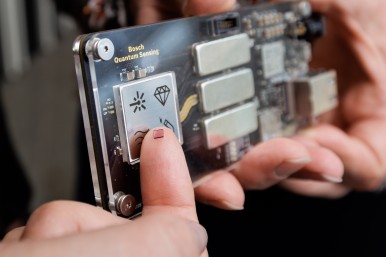
Stuttgart, Germany – They cannot be grasped, either literally or figuratively. Yet their potential is revolutionary, and they are a key technology of the future. We are talking about quanta. For more than ten years, Bosch has been researching in this field, and it is playing a decisive part in commercializing quantum sensors. Since 2023, it has had a development collaboration with Element Six, the world’s leading solutions provider of synthetic diamonds. Bosch is now significantly extending this alliance and establishing a joint venture, to be known as Bosch Quantum Sensing. The joint venture will be based on the in-house start-up of the same name, which Bosch set up in 2022. Domiciled in Ludwigsburg, Germany, Bosch Quantum Sensing currently employs 30 associates. Bosch itself will be the lead partner and be responsible for operations. Element Six will hold a 25 percent stake. It has been agreed that further financial details will not be disclosed. The establishment of the new company is still subject to official approval. Bosch Quantum Sensing sees many areas in which novel quantum sensors can be used, from exploration of natural resources to aircraft navigation and medical technology. By the middle of the next decade, Bosch estimates that the global market potential of medical and mobility applications will be in the mid-single-digit billion euros range per year. Synthetic diamonds are a key component of Bosch quantum sensors. In stepping up its partnership with Element Six, Bosch is making a determined move toward the commercialization of quantum sensors. Quantum sensors are a future technology with huge potential. They will bring about fundamental changes in many sectors of our economy, and improve people’s lives. In setting up this new company, we are underscoring this technology’s strategic significance for Bosch. As innovation leader of commercial quantum sensors, we will work with Element Six to further extend our technological lead,...says Stefan Hartung, chairman of the board of management of Robert Bosch GmbH. Quantum leap toward commercialization The distinctive qualities of these special-purpose synthetic diamonds allow quantum sensors based on them to detect even the tiniest magnetic fields. In this way, they satisfy the most exacting market requirements and make real innovations possible. “We want to work with Element Six to make quantum sensors economical and allow them to be produced on an industrial scale. In this way, we will create the basis for innovative applications that set new standards for precision and efficiency,” says Katrin Kobe, CEO of Bosch Quantum Sensing. “Through the new joint venture between Bosch and Element Six, which aligns with Element Six’ contribution towards De Beers Group’s Origins strategy, we will integrate our synthetic diamond technology with Bosch Quantum Sensing’s capabilities, unlocking new possibilities in critical sectors such as healthcare and navigation. Together, we will harness the respective decades of excellence and innovation to push the limits of what's possible, heralding a new era of synthetic diamond-enabled technologies”, says Siobhán Duffy, the CEO of Element Six. The synthetic diamond solutions provider is in a unique position to supply the highly engineered synthetic diamonds in the quantity and quality required for industrial applications, while Bosch will integrate them into robust and scalable sensor systems. It is a classic win-win situation. Even now, the latest Bosch quantum sensor prototype is the most compact of its kind for the level of sensitivity required – it is the same size as a modern smartphone. In the area of mobility, it could enable a robust navigation in the future, complementary to conventional GPS systems. It could also offer decisive advantages for the exploration of natural resources and, in medical technology, for the measurement of cardiac activity. The advantage of compact sensors is their portability, less expensive production, and better scalability. The long-term goal of Bosch Quantum Sensing is to make quantum sensors so small that they can be integrated onto a chip. Press photos and infocharts are available on the Bosch Media Service at www.bosch-press.com . Contact person for press inquiries: Athanassios Kaliudis Phone: +49 711 811-7497 E-mail: Athanassios.Kaliudis@de.bosch.com

Logistics and transportation industry: Bosch launches service platform in Europe ...

06.12.2023

Press release

Connected mobility

Logistics and transportation industry: Bosch launches service platform in Europe ...

Stuttgart, Germany – Bosch’s digital logistics platform L.OS, targeted for simplifying IT processes in the transport and logistics industry, is celebrating a successful market launch. In Europe, India, and the U.S., the Bosch offering has already won 50 customers. 20 logistics companies each from Germany and India and ten from the U.S. are among the first L.OS customers. In addition, the integration of more than 50 service providers into the digital marketplace is already underway. Last year, Bosch announced a s trategic collaboration with the U.S. cloud provider Amazon Web Services (AWS) to digitalize logistics . The transportation and logistics industry is the backbone of the global economy. Bosch sees great market opportunities for its logistics services driving efficiency improvement. The technology company aims to generate global sales of some 500 million euros with logistics services by 2030, and has set up a separate unit with more than 400 associates for its digital platforms business. With L.OS, Bosch has ushered in the digital age for freight carriers, fleet owners and logistics service providers. Our logistics platform offers a complete ecosystem and software environment for using and combining services from different providers. For Bosch, the transportation and logistics industry is strategically important...says Dr. Markus Heyn, member of the Bosch board of management and chairman of the Mobility business sector. Open platform for providers of logistics solutions Using the digital L.OS platform, logistics and transportation companies across the globe will have quick and easy access to IT services, and thus be able to operate more efficiently and sustainably. The distinctive feature of L.OS is that it is open to all providers of logistics solutions and facilitates the smooth interplay of disparate services and data. For freight carriers and freight companies, this presents a chance to reap far greater benefit from the opportunities of digitalization for themselves in accordance with their individual needs or requirements in the respective country without having to set up resource- and cost-intensive IT projects of their own. In India, for example, Bosch’s proprietary “TrakZeus” positioning solution for efficient fleet and transportation management as well as route and parking planning has been available on L.OS from the start. The “Digital CN” solution allows transport documents such as e-way bills to be digitized quickly and easily, so that they can be transmitted securely via cell phone. In Europe, L.OS has been launched with a first service integration enabling secure truck parking booking as an extra feature for existing transportation management systems, while in the U.S., a dedicated transportation management system simplifies and manages operations for fleets. New Bosch operating unit to build digital platforms In July 2023, Bosch established its new, transnational “Mobility Platform and Services” operating unit to build digital platforms. More than 400 associates in Europe, India, and the U.S. are responsible for the further development and support of Bosch digital platforms. This currently includes for example “Mobility Marketplace”, a neutral digital ecommerce marketplace as well as “ParkZeus”, an integrated parking platform, and the “Logistics Operating System” L.OS. “The establishment of a dedicated unit underscores the great importance Bosch attaches to the digitalization of mobility empowered by cloud-based platforms. We want to enable companies to come together to co-create, innovate and solve complex problems of mobility through our platforms. Together, we’re driving the vision of sustainable and safe mobility enabled by digital platforms and the inclusivity it brings with it.,” says Sandeep Nelamangala, the executive director responsible for the digital platforms business at Bosch.

CES world premiere: Bosch unites infotainment and driver assistance functions on ...

05.12.2023

Press release

Connected mobility

CES world premiere: Bosch unites infotainment and driver assistance functions on ...

Stuttgart – The trend toward software-defined mobility goes hand in hand with a centralized vehicle and electric/electronic (E/E) architecture. While numerous electronic control units usually control different functions in the car today, in the future just a few central vehicle computers will unite multiple system functions from previously separate domains. To do this, new computers with a powerful processor, known as a system on chip (SoC), are necessary. As an innovation and technology leader, Bosch is leading the charge and, at CES® 2024 in Las Vegas, will be the world’s first automotive supplier to demonstrate the fusion of infotainment and driver assistance functions in a software-intensive central computer on a single SoC. “We want to reduce the complexity of the electronics systems in cars and make them as secure as possible at the same time. With this demonstration of our new vehicle computer platform at CES, we are taking an important step in exactly this direction. Our goal in the medium term is to bring even more automated driving functions to the road, including to the compact and midsized car segments,” says Dr. Markus Heyn, member of the board of management at Robert Bosch GmbH and chairman of Bosch Mobility.At the core of the new vehicle computer from Bosch – called the cockpit & ADAS integration platform – is a single SoC, which processes a variety of functions from the two domains of infotainment and driver assistance simultaneously. This includes, for example, automated parking and lane detection, paired with smart, personalized navigation and voice assistance. Advantages for vehicle manufacturers: less space and cabling required, meaning lower costs. Central vehicle computers are the heart of software-defined cars. In the future, they will control all the domains in modern vehicles and reduce the currently high number of individual control units...says Dr. Markus Heyn, member of the board of management at Robert Bosch GmbH and chairman of Bosch Mobility. Overall, Bosch is already doing good business with vehicle computers: in 2026, the company expects sales revenue of three billion euros just for vehicle computers for infotainment and driver assistance. Modular system principle for maximum scalability For its central vehicle computers, Bosch uses a modular system principle. Together with stand-alone software solutions such as video perception for surround sensing, vehicle manufacturers can modularly and scalably assemble their individual solutions in combination with hardware components. Software-intensive central computers play a decisive role here, since they enable manufacturers to implement driving and assistance features. Software integration is in strong demand here. Bosch brings integrative expertise and enables software components from various sources to be combined. Bosch knowledge in all vehicle domains as a competitive advantage Nearly every vehicle maker in the world is currently investing massively in software-defined vehicles. Bosch predicts that the market for automotive software will reach a volume of around 200 billion euros by 2030. In the field of vehicle computers for infotainment and driver assistance systems, the company expects a market volume of 32 billion euros in 2030. Bosch’s advantage is its extensive knowledge in all vehicle domains. This means that the company is an expert not just for software but also for hardware, and develops and manufactures key components of modern vehicles, such as for drives, brakes, steering, infotainment, and automated driving, under one roof. Bosch’s approach allows maximum flexibility Bosch pursues what is known as a multi-SoC approach. The company’s new vehicle computers are designed so that the required SoCs can come from different chip manufacturers. Therefore, depending on the customer’s wishes, Bosch can use exactly the SoC that is requested. “Our software runs on chips from different manufacturers. This allows software and hardware to be decoupled from each other,” says Heyn. Bosch is one of the few companies that can develop a centralized electronic architecture from start to finish and has mastered the interplay of automotive electronics, software, and the cloud. New features, such as for driver assistance, are simply and easily sent to the car through over-the-air updates. This provides drivers with a personalized digital driving experience – even long after purchasing the car. Presskit #BoschCES 2024 Event #BoschCES 2024

TSMC, Bosch, Infineon, and NXP Establish Joint Venture to Bring Advanced Semicon ...

08.08.2023

Press release

Connected mobility

TSMC, Bosch, Infineon, and NXP Establish Joint Venture to Bring Advanced Semicon ...

Hsinchu, Stuttgart, Munich, Eindhoven, Aug 8, 2023 – TSMC (TWSE: 2330, NYSE: TSM), Robert Bosch GmbH, Infineon Technologies AG (FSE: IFX / OTCQX: IFNNY), and NXP Semiconductors N.V. (NASDAQ: NXPI) today announced a plan to jointly invest in European Semiconductor Manufacturing Company (ESMC) GmbH, in Dresden, Germany to provide advanced semiconductor manufacturing services. ESMC marks a significant step towards construction of a 300 mm fab to support the future capacity needs of the fast-growing automotive and industrial sectors, with the final investment decision pending confirmation of the level of public funding for this project. The project is planned under the framework of the European Chips Act. The planned fab is expected to have a monthly production capacity of 40,000 300 mm (12-inch) wafers on TSMC’s 28/22 nanometer planar CMOS and 16/12 nanometer FinFET process technology, further strengthening Europe’s semiconductor manufacturing ecosystem with advanced FinFET transistor technology and creating about 2,000 direct high-tech professional jobs. ESMC aims to begin construction of the fab in the second half of 2024 with production targeted to begin by the end of 2027. The planned joint venture will be 70 percent owned by TSMC, with Bosch, Infineon, and NXP each holding 10 percent equity stake, subject to regulatory approvals and other conditions. Total investments are expected to exceed 10 billion euros consisting of equity injection, debt borrowing, and strong support from the European Union and German government. The fab will be operated by TSMC. “This investment in Dresden demonstrates TSMC’s commitment to serving our customers’ strategic capacity and technology needs, and we are excited at this opportunity to deepen our long-standing partnership with Bosch, Infineon, and NXP,” said Dr. CC Wei, Chief Executive Officer of TSMC. “Europe is a highly promising place for semiconductor innovation, particularly in the automotive and industrial fields, and we look forward to bringing those innovations to life on our advanced silicon technology with the talent in Europe.” Dr. Stefan Hartung, chairman of the Bosch board of management: “Semiconductors are not only a crucial success factor for Bosch. Their reliable availability is also of great importance for the success of the global automotive industry. Apart from continuously expanding our own manufacturing facilities, we further secure our supply chains as an automotive supplier through close cooperation with our partners. With TSMC, we are pleased to gain a global innovation leader to strengthen the semiconductor ecosystem in the direct vicinity of our semiconductor plant in Dresden.” Semiconductors are not only a crucial success factor for Bosch. Their reliable availability is also of great importance for the success of the global automotive industry. Apart from continuously expanding our own manufacturing facilities, we further secure our supply chains as an automotive supplier through close cooperation with our partners. With TSMC, we are pleased to gain a global innovation leader to strengthen the semiconductor ecosystem in the direct vicinity of our semiconductor plant in Dresden....said Dr. Stefan Hartung, chairman of the Bosch board of management “Our joint investment is an important milestone to bolster the European semiconductor ecosystem. With this, Dresden is strengthening its position as one of the world’s most important semiconductor hubs that is already home to Infineon’s largest frontend site,” said Jochen Hanebeck, CEO of Infineon Technologies. “Infineon will use the new capacity to serve the growing demand particularly of its European customers, especially in automotive and IoT. The advanced capabilities will provide a basis for developing innovative technologies, products and solutions to address the global challenges of decarbonization and digitalisation.” “NXP is very committed to strengthening innovation and supply chain resilience in Europe,” said Kurt Sievers, President and CEO of NXP Semiconductors. “We thank the European Union, Germany, and the Free State of Saxony for their recognition of the semiconductor industry’s critical role and for their true commitment to boost Europe’s chip ecosystem. The construction of this new and significant semiconductor foundry will add much needed innovation and capacity for the range of silicon required to supply the sharply increasing digitalization and electrification of the automotive and industrial sectors.”About Infineon Infineon Technologies AG is a global semiconductor leader in power systems and IoT. Infineon drives decarbonization and digitalization with its products and solutions. The company has around 56,200 employees worldwide and generated revenue of about €14.2 billion in the 2022 fiscal year (ending 30 September). Infineon is listed on the Frankfurt Stock Exchange (ticker symbol: IFX) and in the USA on the over-the-counter market OTCQX International over-the-counter market (ticker symbol: IFNNY). Further information is available at www.infineon.com . Follow us: Twitter – Facebook – LinkedIn About NXP Semiconductors NXP Semiconductors N.V. (NASDAQ: NXPI) brings together bright minds to create breakthrough technologies that make the connected world better, safer and more secure. As a world leader in secure connectivity solutions for embedded applications, NXP is pushing boundaries in the automotive, industrial & IoT, mobile, and communication infrastructure markets while delivering solutions that advance a more sustainable future. Built on more than 60 years of combined experience and expertise, the company has approximately 34,500 team members in more than 30 countries and posted revenue of $13.21 billion in 2022. Find out more at www.nxp.com . About TSMC TSMC pioneered the pure-play foundry business model when it was founded in 1987, and has been the world’s leading dedicated semiconductor foundry ever since. The Company supports a thriving ecosystem of global customers and partners with the industry’s leading process technologies and portfolio of design enablement solutions to unleash innovation for the global semiconductor industry. With global operations spanning Asia, Europe, and North America, TSMC serves as a committed corporate citizen around the world. TSMC deployed 288 distinct process technologies, and manufactured 12,698 products for 532 customers in 2022 by providing broadest range of advanced, specialty and advanced packaging technology services. The Company is headquartered in Hsinchu, Taiwan. For more information please visit https://www.tsmc.com .

Bosch charging services support the ramp-up of electromobility

21.03.2023

Press release

Connected mobility

Bosch charging services support the ramp-up of electromobility

Stuttgart, Germany – Worldwide, there are more and more electric cars on the road. But how convenient is it to recharge electric vehicles? How quickly can drivers find a vacant charge point? And how easy is it to pay for the charging process? The answers to these questions will determine the success of electromobility – and thus also the achievement of climate targets. “Making it straightforward to recharge electric vehicles reduces range anxiety and is a prerequisite for their widespread acceptance. Bosch charging services offer the drivers of electric cars easy access to one of Europe’s biggest and steadily growing charging networks,” says Dr. Markus Heyn, member of the board of management of Robert Bosch GmbH and chairman of its Mobility Solutions business sector. Customers who use Bosch charging services already have access to some 450,000 publicly accessible charge points in 30 European countries – one of the largest charging networks in Europe. The Italian automaker Maserati has now made Bosch charging services available for the first time in its new electric model, the GranTurismo Folgore – not only in Europe but also, in the course of 2023, in the Asia-Pacific region. Charging services hold immense potential: by 2030, Bosch expects more than one in three new vehicles worldwide to be purely electric; in Europe, it could be as many as two in three. By 2035, it expects one in two newly registered passenger cars worldwide to be an electric car. “We expect a huge surge in growth for our charging services business over the course of the decade – because as electromobility ramps up, so does the need for straightforward and comprehensive charging solutions. We will benefit from this,” Heyn adds. By the end of the decade, Bosch is expecting its charging solutions business to expand by more than 50 percent each year. Bosch offers its solutions for recharging electric cars to vehicle manufacturers and companies. The charging services can be flexibly and easily integrated into a manufacturer’s look and feel and infotainment system, both functionally and visually, so that the driving and charging experience retain the manufacturer’s individual look and fit into its brand world. As a result, Bosch charging services are making electromobility even more suitable for everyday use. Making it straightforward to recharge electric vehicles reduces range anxiety and is a prerequisite for their widespread acceptance. Bosch charging services offer the drivers of electric cars easy access to one of Europe’s biggest and steadily growing charging networks ...says Dr. Markus Heyn, member of the board of management of Robert Bosch GmbH and chairman of its Mobility Solutions business sector. Maserati GranTurismo Folgore with Bosch charging services At Maserati, the Bosch charging services are now available for the first time in the recently unveiled GranTurismo Folgore. Once registered for the services, drivers of the GranTurismo Folgore can display the charge point information on their navigation system and on the app. It takes just a few taps to find a charge point, charge, and pay. For example, the service makes it simple to navigate to an available charge point directly, or to pull up information on restaurants and shopping centers in the vicinity of the customer’s position. Bosch also spares users the tedious task of researching car-electricity tariffs by listing which costs and terms of use apply at given charge points. Billing takes place automatically using the credit card details added to the app. Bosch charging services are for more than just charging electricity In addition to charging services for drivers of electric cars, Bosch also offers services for charge point operators. Bosch’s software services enable charge point operators to remotely control and manage their charge points and also integrate them into the Bosch charging network. For this purpose, the company concludes contracts with the charge point operators and connects their charge points to the network. On an especially encouraging note, the Bosch charging network is constantly growing. By mid-2023, it is expected to include around 700,000 charge points in Europe, North America, and the Asia-Pacific region. “With our charging services and our growing charging network, we are playing a decisive part in making electromobility a success story even faster. In this way, Bosch is also helping Germany achieve its climate targets,” Heyn says.

Bosch drives forward the development of 6G

27.02.2023

Press release

Connected mobility

Bosch drives forward the development of 6G

Stuttgart, Germany – Worldwide, research and development work on the future 6G mobile communications standard is picking up pace. Companies and states are investing massively in this technology. Bosch is leading the way and is actively involved in projects, alliances, and initiatives at both the national and international level to lay important foundations for 6G technology. “6G will be much more than just an infrastructure for connectivity; it will greatly increase the efficiency of autonomous driving cars, smart cities, and connected industries. That’s why 6G is a strategically important field of technology,” says Dr. Andreas Müller, who bundles and manages 6G activities at Bosch. The company currently has some 40 associates working on 6G technology. Over the next two years, that number is likely to double,” Müller says. Bosch is currently investing several millions of euros in research and development for 6G. 6G will be much more than just an infrastructure for connectivity; it will greatly increase the efficiency of autonomous driving cars, smart cities, and connected industries. That’s why 6G is a strategically important field of technology...says Dr. Andreas Müller, who bundles and manages 6G activities at Bosch. Bosch and Nokia expand their research alliance to include 6G At the Mobile World Congress 2023 in Barcelona, Bosch and Nokia have now announced that they will expand the alliance they entered into in 2017 to develop industrial IoT solutions in the area of 5G so that it also addresses the new 6G technology. The two companies are conducting joint research on the next generation of networks and investigating how to use future 6G networks for both communications and sensors. Comprehensive Bosch commitment at national and international level Bosch is currently contributing its expertise and experience to five publicly funded projects. In this context, the 6G-ICAS4Mobility , KOMSENS-6G , and 6G-BRAINS projects focus primarily on integrating communication and sensor-based environment recognition. Bosch leads the consortium for the first project . In addition to addressing relevant scenarios for road traffic, insights gained from the project will serve, in particular, as technical foundations for applications in the connected drones domain as well as in Industry 4.0 (e.g. for driverless transport systems). Meanwhile, the 6G-ANNA and 6G-SHINE projects focus on new connectivity structures. These are intended to enhance the efficiency of future E/E architectures in vehicles or robot cells. Bosch is also taking an active and leading role in early discussions and activities relating to future mobile communications standards within various industry alliances. In the 5G Automotive Association (5GAA) , for instance, leading companies from the automotive and telecommunications industries are working together to develop solutions for the mobility of the future. The 5G Alliance for Connected Industries and Automation (5GACIA) brings together industrial companies to focus on connectivity for machinery and equipment. Networks with a sixth sense through integration of sensor technology Among other things, the next generation of mobile communications will integrate new functionalities similar to radar sensors. With 6G, it will be possible to detect the position of objects in the network’s coverage area – without these objects having to be equipped with a radio module. 6G will enable extremely high data rates of up to one terabit per second, with very low latency in the order of some 100 microseconds – which is four times faster than a lightning strike. With the help of digital twins, this will for instance make it possible to monitor and simulate real-world manufacturing processes in a virtual world with no temporal and spatial restrictions. Experts predict that the first 6G standard will be completed by 2028. In recent months, Germany and Europe have launched a large number of 6G projects with the goal of strengthening their technological sovereignty. The German government, through the Federal Ministry of Education and Research (BMBF), is providing some 700 million euros over the next three years to fund 6G activities. In addition, the EU budget has earmarked a further almost 900 million euros until 2027. Japan and the United States have also launched corresponding investment programs totaling around 4.5 billion dollars.

GAIA-X 4 moveID project develops basis for secure mobile data exchange

08.09.2022

Press release

Business/economy

GAIA-X 4 moveID project develops basis for secure mobile data exchange

Stuttgart, Germany – Which parking garages currently have vacant charge spots available? Where are free parking spaces in the city center? And how can this information be digitally transmitted, and services billed, across providers? The answer to these and similar questions calls for secure data exchange between the vehicles and their environment. It is precisely this foundation that a research project consisting of universities, automotive suppliers, and system providers is now in the process of building, with Bosch leading the consortium. Over the next three years, the GAIA-X 4 moveID project is set to develop the necessary standards and technological concepts to enable the secure exchange of information between providers of mobility applications and their customers. The goal is to create decentralized digital vehicle identities. This is an important prerequisite for the mass use of electric vehicles, automated driving, and the establishment of connected cities. GAIA-X 4 moveID is supported to the tune of 14 million euros by the German Federal Ministry for Economic Affairs and Climate Action – covering half of the project costs.Connectivity for digital services across the board “An integrated and transparent system architecture for the exchange of data on the road that incorporates different products and players simply isn’t available today. While it’s true that some companies out there already offer services, those services are tailored for specific applications, vehicles, or customer groups,” explains Peter Busch, project manager at the consortium leader Bosch. They often map the infrastructure, for example, but they rarely provide information about availability due to a lack of connectivity between the many independently operating service providers. “Open standards are needed so that users, for example, can find all available charging stations or pay for charging processes,” Busch says. It’s important to always ensure that the data is processed securely and that individual providers don’t exploit it solely for their own purposes. For Busch, this is the only way that the necessary user confidence can grow and a broad range of all available services, such as so-called deep parking (use of otherwise unavailable parking spaces), can be created. That is why the consortium is building on the European GAIA-X system, which defines the technological, economic, and legal framework for a secure and trustworthy data infrastructure. GAIA-X relies on decentralization and the interplay of different cloud providers under common guidelines. In this spirit, the GAIA-X 4 moveID project is using open source software for its developments and making them available to all providers for various business models. Vehicles are becoming marketplaces The standards that GAIA-X 4 moveID is pursuing will allow vehicles to securely and independently exchange information with other vehicles and their environment without an “intermediary.” The vehicles’ “infrastructure partners” include charge spots, barriers, traffic lights, and parking lots. The research project will use internationally recognized hardware and software to develop management and administrative services to facilitate the interaction and trade between different players. This will enable providers to connect a great many services, such as news, entertainment, and navigation, with the car’s system, especially in automated driving. The market for services related to connected parking alone is estimated to be worth ten billion euros annually worldwide. What’s more, the ability to navigate directly to a vacant parking space significantly reduces congestion and emissions. After all, today, about a third of downtown urban traffic is people looking for parking spaces. The availability of information is also a crucial factor for the success of electromobility. It is estimated that about half of newly registered cars in Europe will be electric by 2030. “Their drivers need to know that they’ll be able to find a charge spot quickly whenever they need one. And that requires connected systems,” Busch says. Extensive data exchange as a basis for automated driving The mass use of automated vehicles is conceivable only if cars are able to quickly and reliably communicate with their environment. The data exchange this requires will enable climate-friendly traffic control based on the volume of traffic at any given moment. This will allow cities to regulate incoming traffic to particular areas in real time, thus preventing congestion. However, this method, known as zoning, requires that vehicles be able to immediately recognize changing conditions and to reroute accordingly. Zoning is being demonstrated with test vehicles – for the first time across borders – in the Germany-France-Luxembourg (Merzig/Saarbrücken) test area as part of the GAIA-X 4 moveID project. The cars receive dynamic information regarding their approach to defined zones.The project partners: Robert Bosch GmbH Materna Information & Communications SE Denso Automotive Deutschland GmbH Continental Automotive Technlogies GmbH WOBCOM GmbH ecsec GmbH HTW Saar (University of Applied Sciences) Atos Information Technology GmbH Chainstep GmbH Peaq Technology GmbH Zeppelin Universität gGmbH (Zeppelin University) Datarella GmbH 51nodes GmbH Bigchain DB GmbH Fetch.ai Research & Development GmbH ITK Engineering GmbH Deutsche Zentrum für Luft- und Raumfahrt e.V. (German Aerospace Center) Airbus Defence and Space GmbH Delta Dao AG

Bosch pools development activities for universal vehicle software in one unit

07.12.2021

Press release

Connected mobility

Bosch pools development activities for universal vehicle software in one unit

Stuttgart, Germany – Bosch is taking further strategic steps toward a leading position in the software-dominated future of mobility. In the future, under the umbrella of its subsidiary ETAS GmbH, the company will develop and sell basic vehicle software, middleware, cloud services, and development tools for universal application. A total of 2,300 experts from different development areas of Bosch and ETAS are to be brought together there as of mid-2022. “Software development is a longstanding core competence at Bosch. Every year, we put more than 200 million control units running our own software into vehicles worldwide. With this new set-up, we want to become the leading provider of application-independent vehicle software,” says Dr. Stefan Hartung, chairman of the Mobility Solutions business sector of Robert Bosch GmbH. A year ago, Bosch established its Cross-Domain Computing Solutions division, a powerful unit for application-specific vehicle software with specific hardware for numerous vehicle areas such as driver assistance and infotainment. Now the company is bringing together its portfolio of application-independent software for vehicles and the cloud at ETAS. The resulting central platform will allow it to develop automotive software more quickly and efficiently together with its partners. “Our universal software foundation is essential for the digitalization of modern, software-defined vehicles,” Stefan Hartung says. Bosch will combine its universal software platform with expertise in the development of innovative software functions. “Thereby we are creating a USP and a significant competitive advantage for Bosch,” says Dr. Markus Heyn, member of the Bosch board of management of Bosch. In the future, ETAS will offer this universal platform and the accompanying development environment to both automotive manufacturers and other suppliers. Software development is a longstanding core competence at Bosch. Every year, we put more than 200 million control units running our own software into vehicles worldwide. With this new set-up, we want to become the leading provider of application-independent vehicle software...says Dr. Stefan Hartung, chairman of the Mobility Solutions business sector of Robert Bosch GmbH. Thereby we are creating a USP and a significant competitive advantage for Bosch...says Dr. Markus Heyn, member of the Bosch board of management of Bosch. Software gaining in prominence for automakers Up to now, the rule was that vehicles were delivered as a finished product. In the future, though, a car’s software will be continuously improved and expanded – throughout its service life. This will give drivers a customized digital driving experience, and also form the basis for new business models for manufacturers. This development is just beginning. Experts predict that the market for automotive software will be worth billions in the next few years. Bosch expects double-digit annual growth until 2030. The organizational realignment Bosch is now planning for its application-independent automotive software units under the roof of its subsidiary ETAS bears witness to this transformation. “In the future development of vehicle operating systems, we want to position ourselves even better in the global market,” says Heyn. “With this move, we are providing existing and new customers with an integrated, horizontal, cross-domain platform that will allow them to achieve the aim of software-defined vehicles,” adds Christoph Hartung, the chairman of the board of management of ETAS GmbH. The partnership between Bosch and Microsoft that began in February will also be continued in the new organization. This partnership aims to develop a comprehensive software platform for seamless connectivity between cars and the cloud, making it quicker and easier to develop vehicle software throughout the car’s lifetime, as well as to download it to the control units and vehicle computers via the cloud. With this move, we are providing existing and new customers with an integrated, horizontal, cross-domain platform that will allow them to achieve the aim of software-defined vehicles,...says Christoph Hartung, the chairman of the board of management of ETAS GmbH. Universal and open portfolio for basic software and middleware Whether for electrically adjusting the seat, recharging the vehicle, deploying the airbag, or listening to the radio – software is already an integral part of almost every function in modern vehicles. It consists of different layers that build on each other. One layer comprises software modules that vehicle manufacturers use to create individual driving experiences – from the powertrain to infotainment and assistance systems. This is where the individual brands differ, sometimes enormously. Other layers, by contrast, such as the basic software for the control units and what is known as middleware, offer manufacturers almost no scope for USPs. These software components regulate the basic tasks performed by control units and vehicle computers – tasks that the driver doesn’t notice. For example, they manage processor performance and memory space, and they determine how control units communicate with each other or with the cloud to exchange data. Once developed, this software can be used on almost any ECU – regardless of where it is installed in the car and regardless of the vehicle model. This setup is familiar from smartphones, where a wide variety of apps use a central operating system. “Our new set-up will allow us to satisfy new requirements – both of the market and our customers – even better. Together with our partners, we are enabling existing and new customers to take a completely new approach to automotive software development,” Christoph Hartung says. In the future, open source software and the associated ecosystems will also play an increasingly important role. Vehicle manufacturers and automotive suppliers will thus be able to place software at the center of development even more effectively in the future. Application-independent software from a single source ETAS was founded in 1994 as a wholly owned subsidiary of Robert Bosch GmbH and employs some 1,500 associates in 12 countries. A further 800 Bosch associates will join them in mid-2022. Even today, the two companies are closely and successfully working together. This collaboration will be further intensified in a joint unit. The employee representatives responsible are currently involved in working out the details of the future organization.