Search & find:
Media, press releases, events for your editorial coverage

Bosch drives forward the development of 6G

27.02.2023

Press release

Connected mobility

Bosch drives forward the development of 6G

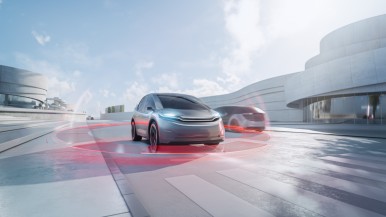
Stuttgart, Germany – Worldwide, research and development work on the future 6G mobile communications standard is picking up pace. Companies and states are investing massively in this technology. Bosch is leading the way and is actively involved in projects, alliances, and initiatives at both the national and international level to lay important foundations for 6G technology. “6G will be much more than just an infrastructure for connectivity; it will greatly increase the efficiency of autonomous driving cars, smart cities, and connected industries. That’s why 6G is a strategically important field of technology,” says Dr. Andreas Müller, who bundles and manages 6G activities at Bosch. The company currently has some 40 associates working on 6G technology. Over the next two years, that number is likely to double,” Müller says. Bosch is currently investing several millions of euros in research and development for 6G. 6G will be much more than just an infrastructure for connectivity; it will greatly increase the efficiency of autonomous driving cars, smart cities, and connected industries. That’s why 6G is a strategically important field of technology...says Dr. Andreas Müller, who bundles and manages 6G activities at Bosch. Bosch and Nokia expand their research alliance to include 6G At the Mobile World Congress 2023 in Barcelona, Bosch and Nokia have now announced that they will expand the alliance they entered into in 2017 to develop industrial IoT solutions in the area of 5G so that it also addresses the new 6G technology. The two companies are conducting joint research on the next generation of networks and investigating how to use future 6G networks for both communications and sensors. Comprehensive Bosch commitment at national and international level Bosch is currently contributing its expertise and experience to five publicly funded projects. In this context, the 6G-ICAS4Mobility , KOMSENS-6G , and 6G-BRAINS projects focus primarily on integrating communication and sensor-based environment recognition. Bosch leads the consortium for the first project . In addition to addressing relevant scenarios for road traffic, insights gained from the project will serve, in particular, as technical foundations for applications in the connected drones domain as well as in Industry 4.0 (e.g. for driverless transport systems). Meanwhile, the 6G-ANNA and 6G-SHINE projects focus on new connectivity structures. These are intended to enhance the efficiency of future E/E architectures in vehicles or robot cells. Bosch is also taking an active and leading role in early discussions and activities relating to future mobile communications standards within various industry alliances. In the 5G Automotive Association (5GAA) , for instance, leading companies from the automotive and telecommunications industries are working together to develop solutions for the mobility of the future. The 5G Alliance for Connected Industries and Automation (5GACIA) brings together industrial companies to focus on connectivity for machinery and equipment. Networks with a sixth sense through integration of sensor technology Among other things, the next generation of mobile communications will integrate new functionalities similar to radar sensors. With 6G, it will be possible to detect the position of objects in the network’s coverage area – without these objects having to be equipped with a radio module. 6G will enable extremely high data rates of up to one terabit per second, with very low latency in the order of some 100 microseconds – which is four times faster than a lightning strike. With the help of digital twins, this will for instance make it possible to monitor and simulate real-world manufacturing processes in a virtual world with no temporal and spatial restrictions. Experts predict that the first 6G standard will be completed by 2028. In recent months, Germany and Europe have launched a large number of 6G projects with the goal of strengthening their technological sovereignty. The German government, through the Federal Ministry of Education and Research (BMBF), is providing some 700 million euros over the next three years to fund 6G activities. In addition, the EU budget has earmarked a further almost 900 million euros until 2027. Japan and the United States have also launched corresponding investment programs totaling around 4.5 billion dollars.

Automotive industry to give manufacturing a facelift

23.11.2021

Press release

Industry 4.0

Automotive industry to give manufacturing a facelift

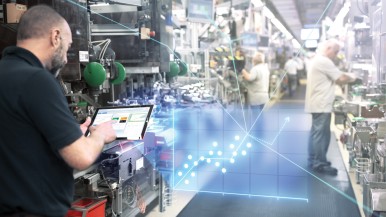
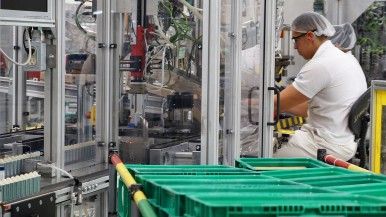
Stuttgart, Germany – Faster, more flexible, and more efficient: these characteristics are the automotive industry’s main demands when it comes to developing its own production systems. To achieve this, today’s manufacturing operations need to be put on a new technological footing. This is exactly what the participants in the SDM4FZI research project (Software-Defined Manufacturing for the Vehicle and Supplier Industry) have set out to do. Led by Bosch, the University of Stuttgart, and the Karlsruhe Institute of Technology (KIT), a total of thirty companies will define the foundations for software-defined manufacturing over the next three years. Their goal is to design software that can flexibly plan, manage, and modify everything from individual components to entire factories. In the automotive industry, this will pave the way for more variants and faster model and product changes. It will also improve competitiveness. The German Federal Ministry for Economic Affairs and Energy is funding the research project to the tune of some 35 million euros.Rigid systems hold vehicle production back Today, it often takes months, and sometimes years, for the technical elements of the manufacturing chain for a new model to be put in place, from supplier to final assembly. Together with the considerable economic cost involved, this stymies rapid market launches. The root cause of this is that many machines are designed and built specifically for one single new product. The software is usually inextricably coupled to particular machinery and products and is not transferable to other processes. SDM4FZI now aims to create a uniform framework for factories that will enable new products to be manufactured in existing operating environments without major retooling times. “By linking various Industry 4.0 approaches, we are getting one step closer to adaptable manufacturing,” says the Bosch project manager Matthias Meier. “An ecosystem for software-defined manufacturing allows us to bring the benefits of cloud technology to production. Software makes it possible to use automation technology and IT systems for individual, specific applications without having to build the hardware from scratch.” Uniform framework enables flexible manufacturing The project partners are developing prototypes for machinery and production lines that are largely defined by software. Such prototypes are based on digital twins, which make it possible to plan, build, and test production systems virtually. This conserves resources and saves on energy and costs. During production, moreover, it also makes the individual manufacturing stages more versatile, so they can be adapted more quickly to new market conditions. Thanks to the digital twins, companies can prepare and implement improvements, and also use AI to analyze them, without having to interrupt the production process. The main focus of the research alliance’s project is on making automation technology, machinery, and systems more flexible in order to boost efficiency in the production of supplier components and vehicles. New opportunities for the vehicle industry By pooling expertise from automation, mechanical engineering, IT, and the automotive industry, the consortium aims to create a common understanding of the requirements and to develop interoperable solutions. “The large number of project partners demonstrates how substantial a role software plays in the manufacturing of tomorrow,” says Michael Neubauer, chief technology officer for ISW at the University of Stuttgart. “We are working on pioneering approaches that will improve German companies’ competitiveness.” For example, the project partners are drafting a guide for the selection and use of suitable technologies, as well as standards for building software-defined factories. Further information on the project List of project partners

Bosch lays foundation stone for factory of the future

25.06.2018

Press release

Business/economy

Bosch lays foundation stone for factory of the future

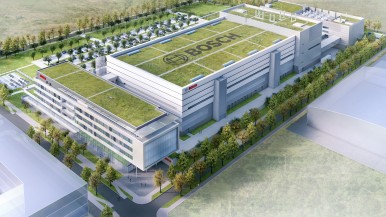
Stuttgart and Dresden, Germany – The foundation stone laid today in Dresden is a key milestone in the construction of the Bosch Group’s state-of-the-art wafer fab. Construction is scheduled to be completed in late 2019, when installation of the production machinery will start. “Today we are laying the foundation stone for the wafer fab of the future, and with it the foundation for improving people’s quality of life and their safety on the road,” said Dr. Dirk Hoheisel, member of the board of management of Robert Bosch GmbH, at the formal ceremony in Dresden. “Semiconductors are the key technology for the internet of things and the mobility of the future. When installed in cars’ control units, for example, they enable automated, efficient driving and the best possible passenger protection.” In his address, Peter Altmaier, the German Federal Minister for Economic Affairs, underlined the central importance of this Bosch investment: “We are today taking an important step toward securing the future competitiveness of Germany as an industrial location. The research community in Germany and Europe is an excellent one, but we cannot afford to rest on our laurels. In the field of microelectronics, we also need engineering skills and know-how, and especially industrial-scale manufacture and application, in Germany and Europe. Today’s ceremony is an important step on this route.” As a supplier of technology and services, Bosch is investing roughly one billion euros in its new location in the Saxony state capital. The first associates are due to start work in the new plant in early 2020. Today we are laying the foundation stone for the wafer fab of the future, and with it the foundation for improving people’s quality of life and their safety on the road....Dr. Dirk Hoheisel After Reutlingen, the Dresden plant is the Bosch Group’s second wafer fab in Germany. With it, the company aims to expand its manufacturing capacity, and thus to boost its competitive edge in global markets. Semiconductors are finding their way into more and more applications relating to the internet of things and mobility solutions. According to the market research company Gartner, semiconductor sales around the world rose by some 22 percent in 2017 alone. Otto Graf, who will manage the new plant, said: “Construction is proceeding right on schedule. “During the construction phase, we will move some 7,500 truckloads of earth, lay about 80 kilometers of piping and ductwork, and mix more than 65,000 cubic meters of concrete – 8,000 concrete mixers-worth.” Following a rollout phase, pilot manufacturing operations are expected to start at the end of 2021. The plot of land – measuring some 100,000 square meters, or roughly 14 soccer fields – will also be home to a nearly 72,000 square-meter multistory building housing offices and production space. Up to 700 associates will be involved in the highly automated chip manufacturing process, working to plan, manage, and monitor production. This also includes modifying the production processes and evaluating the data from Dresden in Bosch’s global manufacturing network. Saxony as a business location: driving Europe’s microelectronics industry “Bosch’s decision is an important milestone. The construction of the new wafer fab here in Dresden will create many other attractive jobs, strengthen Saxony’s reputation as a location for technology and business, and is good for Germany and Europe as well. This project will play a decisive part in securing a leading role for European industry as a whole in the technologies of the future,” said Michael Kretschmer, the Minister-President of the state of Saxony. “This investment in such a major project is a sign of confidence in Saxony, in its people, in the research and industrial network that has become established here, and in its innovativeness.” In its search for a new location, Bosch considered several cities around the world. In Hoheisel’s words, “Dresden is an excellent microelectronics cluster.” He added that the city’s infrastructure is excellent: everything is easily accessible, and the transportation connections are good. The cluster also includes automotive suppliers and service providers, as well as universities offering technological expertise. As Hoheisel pointed out: “We want to work closely with semiconductor companies and universities to increase semiconductor technology’s competitive edge – not only in Germany, but across Europe.” We are today taking an important step toward securing the future competitiveness of Germany as an industrial location....Peter Altmaier, the German Federal Minister for Economic Affairs Semiconductors: key technology for the internet of things Manufacturing semiconductor chips always starts with a silicon disc, or wafer. The bigger the wafer’s diameter, the more chips that can be made per manufacturing cycle. This is one reason why the new Bosch factory will focus on the production of 300 mm wafers: Compared with conventional 150 and 200 mm wafer fabs, 300 mm wafer technology offers greater economies of scale. Semiconductors are extremely small integrated circuits with structures measured in fractions of a micrometer. Manufacturing them requires a highly automated and complex process consisting of several hundred individual steps over several weeks. It takes place in clean-room conditions, as even the tiniest particles in the ambient air can damage the delicate circuits. Connected manufacturing: 22 metric tons of data a day for higher quality Wafer production is one of the forerunners of connected manufacturing. The Dresden plant is expected to generate production data equivalent to 500 text pages per second – written out on paper, that would be more than 42 million pages a day, weighing 22 metric tons. This is why artificial intelligence will play a special part in chip manufacturing in the factory: the highly automated production facilities analyze their own data in order to optimize their processes. As a result, the quality of the chips rises while production costs go down. Furthermore, planning and process engineers can access this production data at any time to accelerate the development of new wafer products or minimize tolerances early on in the manufacturing process. “We need creative minds for our connected and automated manufacturing operations – particularly experts in wafer technology, like process engineers, mathematicians, or software developers,” Graf said. Many new associates have already been hired for the Dresden plant, he added, and there has been no drop in the number of applications. Leading semiconductor manufacturer with 45 years of experience For more than 45 years, Bosch has been making semiconductor chips in various forms, above all as application-specific integrated circuits (ASICs). At its wafer fab in Reutlingen, Germany, Bosch currently manufactures ASICs, power semiconductors, and microelectromechanical systems (MEMS). Bosch ASICs have been used in vehicles since 1970. They are customized to individual applications, and essential for functions such as engine management or airbag deployment. In 2016, every car rolling off the production lines worldwide had on average more than nine Bosch chips on board.

Bosch scores big in Japan with clever technology

07.06.2018

Press release

Business/economy

Bosch scores big in Japan with clever technology

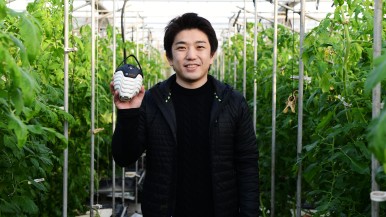
Tokyo – The Bosch Group is scoring big in Japan thanks to its innovative and intelligent solutions for the local market as well as for the global Japanese automotive industry. “Bosch has made impressive progress in Japan. We are working with Japanese automakers to drive forward the automation, electrification, and connectivity of mobility. In addition, we are increasingly focusing on IoT solutions, such as smart agriculture,” says Klaus Meder, the president of Bosch Japan. Last year, the leading supplier of technology and services recorded sales of 2.3 billion euros in Japan, an increase of roughly 10 percent over the previous year. Bosch Japan also made a good start to 2018, mainly due to strong growth for the Mobility Solutions business sector, which generates a significant share of the company’s sales in Japan. In 2017, the company grew twice as fast in this area as the local market. The Industrial Technology business sector also performed well. Bosch has been operating in Japan since 1911 and currently employs some 6,600 people in the country.Business with Japanese automakers sees double-digit growth In 2017, Bosch’s global sales to Japanese automakers rose year-on-year by around 11 percent, which makes it the sixth year in a row these have posted double-digit growth. Looking ahead, Bosch expects this trend to continue over the medium term. Bosch not only supplies Japanese automakers locally, but also works closely with them around the globe. In the ASEAN region, for example, Japanese automakers enjoy a market share of around 90 percent. Accordingly, the region is a focus of investment for the Bosch Group. For instance, at the end of 2017, the company opened its second plant for mobility solutions in Thailand, representing a total investment of 80 million euros. The new smart factory in Hemaraj manufactures components including injection valves, interconnect technology, and knock sensors. The site also houses a research and development center at which around 60 associates work on the further refinement of gasoline injection systems. Bosch is also expanding its manufacturing operations in Vietnam. Since 2008, the company has been producing push belts for continuously variable automatic transmissions in Dong Nai, which is located about 40 km east of Ho Chi Minh City. Bosch is currently investing around 60 million euros to convert this plant into a smart factory and increase its production capacity. By the end of 2018, total investment in the site will have exceed 320 million euros since 2011. Expanding IoT business: smart farming solutions In addition to its mobility solutions business, Bosch is also focusing on developing connected solutions in Japan, for which it is drawing on the country's high degree of innovative strength. Last year, for example, saw the launch of Plantec, a smart system for optimizing tomato cultivation in Japanese greenhouses. The solution is tailored to the local market, as greenhouse cultivation is particularly widespread in the country. Plantec uses sensors to measure humidity, temperature, carbon dioxide levels, and sunlight. These environmental parameters are crucial for plant growth and data on them is collected and sent via a gateway to a cloud server. There, a system analyzes the data and takes into account additional important agricultural parameters as well as the weather forecast. The results of the analysis are displayed in an app. The system can analyze the risk of infection and use artificial intelligence to plan the use of pesticides in advance. It can thus help farmers minimize crop loss. Work on this project is being carried out in conjunction with the Bosch Center for Artificial Intelligence (BCAI). At the end of 2018, the company plans to expand this service to strawberry and cucumber cultivation. Bosch's goal is to supply around 10 percent of Japan's greenhouses by 2020.

Manufacturing hub Mexico: Bosch plans smart plant for electronic components

17.04.2018

Press release

Business/economy

Manufacturing hub Mexico: Bosch plans smart plant for electronic components

Mexico City, Mexico, and Stuttgart, Germany – Bosch, a leading global provider of technology and services, is investing 100 million euros (120 million U.S. dollars) in a new plant in Celaya. The company plans to build a new smart factory for electronic components in the central Mexican city by 2020. The investment underlines the importance of this year's HANNOVER MESSE partner country for the company: “Bosch is committed to Mexico. The country is and will remain an important market and a hub for our global manufacturing and development network,” said Stefan Hartung , member of the Bosch board of management, ahead of the international industrial trade fair. The goal is to create more than 1,200 additional jobs at the new location in Celaya in the coming years. In total, the Bosch Group employs around 16,000 associates and is active with all four of its business divisions in Mexico. In 2016, the company generated sales of 1.1 billion euros in the country Bosch is committed to Mexico. The country is and will remain an important market and a hub for our global manufacturing and development network....Stefan Hartung, member of the Bosch board of management Industry 4.0 as a competitive advantage in Mexico The Latin American emerging market has become highly industrialized in recent years, driven mainly by the automotive industry. In 2017 alone, nearly 3.8 million vehicles were manufactured in Mexico. In order to increase efficiency and competitiveness as a leading global manufacturing location, Mexico is increasingly focusing on the use of Industry 4.0. Bosch is playing a part in this. “We are planning to make the new manufacturing facility in Celaya a smart factory with state-of-the-art, intelligent production lines,” Hartung said. For example, the plant will employ a manufacturing execution system (MES), which automatically collects data and shares production information in real time. This makes possible both preventive maintenance of machinery and higher product quality. The system also digitally connects the plant to the Bosch Group’s global manufacturing network. “By mid-2019, manufacturing at nearly all Bosch plants in Mexico will be equipped with our intelligent control system,” said René Schlegel, president of the Bosch Group in Mexico. In total, Bosch currently operates ten manufacturing locations around the country and has already introduced the use of smart technologies, for example at its Mobility Solutions sites in Toluca and Juárez. As a leading provider of Industry 4.0 solutions, the Bosch Group also sees local business opportunities in Mexico. Increasing demand for connected mobility The new approximately 21,000-square-meter facility in Celaya, which is located in the state of Guanajuato, will manufacture electronic control units (ECUs) for the American market. These are key components for connected mobility. Alongside Juárez, Celaya will be home to the Automotive Electronics division’s second plant in Mexico. “With the new location, we are responding to the increasing demand for electronic components in the American market,” René Schlegel said. With a total surface area of 170,000 square meters, the site will have capacity for further expansion in the future. In addition, the plan is to build a logistics center for Mexico on the adjacent property, which will also serve as a warehouse for the new plant. Bosch strengthens presence in North America With the investment in a new location, Bosch is continuing its long-term expansion in North America. Over the past five years, a total of around 2.6 billion euros has been spent on strengthening the company’s local presence. In Mexico, where Bosch has been active since 1955, the company opened a new manufacturing facility for driving safety systems in Aguascalientes in 2016. At the end of 2017, a plant for steering systems in Querétaro went into operation. The country is also gaining in significance as a development location: since 2014, Bosch has been operating a center for software development and engineering services for the American market in Guadalajara. A large proportion of the investment sum also went to the U.S. There, the Mobility Solutions plants in Charleston and Anderson are currently being expanded, and at the beginning of this month, Bosch opened a new research center in Sunnyvale in California’s Silicon Valley. Bosch at HANNOVER MESSE: the factory of the future – today! What will the factory of the future look like? How can people, robots, and machines work together? What role do 5G, data, software, and services play? Where can artificial intelligence (AI) be put to use? At Hannover Messe 2018 (hall 17, booth A40), Bosch is bringing the factory of the future to life – today. Entitled “Now, next, beyond: factory of the future,” the technology company’s 1,300-square-meter showcase demonstrates what it offers today (now), and what solutions it is developing for tomorrow (next) and the future (beyond). The main attractions are 1.5-meter-tall mobile robotic figures that give a Pixar-like face to Bosch’s connected-factory assistants. Another highlight is a football table that improves its soccer abilities with every game and every new opponent – thanks to AI.

A successful business year in 2017

30.01.2018

Press release

Business/economy

A successful business year in 2017

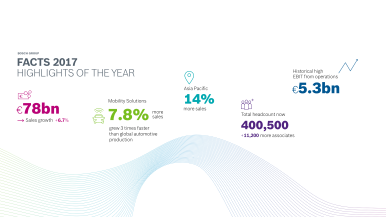
Presentation by Dr. Volkmar Denner, chairman of the board of management of Robert Bosch GmbH and Prof. Stefan Asenkerschbaumer, deputy chairman of the board of management of Robert Bosch GmbH, at the press briefing on January 29, 2018 Check against delivery.Ladies and gentlemen, Welcome to the 2018 press briefing on our preliminary figures. Thank you for being our guests this evening. We are also pleased to be welcoming international media to this event for the first time. Before we begin with the traditional presentation of our preliminary figures, I would like to say a few words about today’s event. We are here in the new offices of Bosch’s start-up platform, soon to be home to some 200 associates. Of those 200, 150 will work in innovation teams and 50 in start-ups currently supported by the platform; you had the chance to learn about one of these in more detail earlier. Werkzentrum Weststadt, the complex you are in this evening, offers our young entrepreneurs a professional home. Here they can create business models for the connected world, enjoy a creative freedom that allows ideas to grow, and flourish as entrepreneurs. From associate to CEO – here, short career paths are possible and desired. What role will new forms of leadership and collaboration play at Bosch in the future? And not just here in Ludwigsburg, but throughout the entire company? I will go into this in more detail later. After all, the ubiquitous topic of connectivity is not only a question of technology, but also one of corporate culture. First on the agenda this evening is a review of the 2017 business year, and an initial outlook for 2018. What progress is Bosch making with digital transformation? What kind of business success are we achieving with connectivity? This evening, we will show that, for Bosch, connectivity and digitalization are not mere hype or some topic of the far-off future. The company’s transformation has become part of day-to-day operations and is firmly anchored there. Bosch aims to be a leading IoT company. This has long been the case for our mobility solutions business, so we are taking that as our model – with foresight and especially with firm commitment. The transformation provides us with a further opportunity to show that excellence is not only something that exists on paper at Bosch, but in practice as well – in both a technological and a commercial sense. The digital transformation means a major break with the past, but it also offers a promising future. Connectivity delivers technical solutions for many fundamental challenges: population growth, urbanization, aging, and climate change. Our planet can only provide a livable home to billions of people if we find innovative solutions to the most pressing issues of our times. Such solutions need to be smart, connected, and digital – precisely what we are working on. Before we go into the details of the preliminary 2017 figures, I wish to say one thing in our characteristically understated way: we didn’t do too badly. In 2017, we exceeded our growth forecast, and further improved our result. Bosch remains on a growth course. Mr. Asenkerschbaumer will now present the details.Business year 2017: expectations exceeded, targets met Thank you, Mr. Denner. Good evening, ladies and gentlemen. I will start off with the highlights of the preliminary figures for 2017: 78 billion euros – sales in 2017 6.7 percent – sales growth in 2017 5.3 billion euros – EBIT from operations in 2017 6.8 percent – EBIT margin from operations in 2017 In business terms, 2017 can be summarized as follows: expectations exceeded, targets met. According to preliminary figures, Bosch Group sales rose from 73.1 billion euros to around 78 billion euros – a new record for our company. Sales growth amounted to 6.7 percent, or 8.3 percent after adjusting for exchange-rate effects. As in 2016, last year’s sales results were negatively impacted by exchange-rate effects to the tune of some 1.2 billion euros.Development of individual business sectors Now I’d like to review how our various business sectors developed. Encouragingly, all business sectors saw considerable growth in 2017. Sales in Mobility Solutions rose by 7.8 percent to 47.4 billion euros. Adjusted for exchange-rate effects, that figure is 9.2 percent. This means the business sector outpaced global automotive production by a factor of three. Many factors drove this highly positive development, including strong demand for diesel injection systems, especially from the commercial-vehicle segment, for gasoline injection systems, and for driver assistance and infotainment systems. Sales generated by the former Starter Motors and Generators division, now SEG Automotive, were included for the last time. We closed on the sale of the business to a Chinese purchaser consortium at the end of 2017. In the Consumer Goods business sector, BSH Hausgeräte and Power Tools generated sales of 18.5 billion euros. This equates to an increase of 4.5 percent, or 6.7 percent when adjusted for exchange-rate effects. Both divisions’ connected product innovations for the home and garden are enjoying ever more popularity. We were particularly pleased with the development of the Industrial Technology business sector. After two years of declining sales, the sector saw powerful growth of 7.7 percent, or 8.5 percent when adjusted for exchange-rate effects. Sales increased to 6.7 billion euros, thanks to the Drive and Control Technology division. Following a reorganization, the division has regained its former strength, and thus demonstrates how restructuring can encourage growth. The Energy and Building Technology business sector achieved sales of 5.4 billion euros, an increase of 3.1 percent, or 4.8 percent after adjusting for exchange-rate effects. Consumers in 2017 wanted connected solutions for heating and air conditioning, plus smart technology for building automation and security. Our services business continues to exhibit strong growth.Business developments by region Now to the development of sales in the individual regions. Overall, all regions except North America saw growth in 2017. In Europe , Bosch’s business developed well, with sales rising 5.5 percent (6.3 percent after adjusting for exchange-rate effects) to 40.7 billion euros. One of the reasons was continuing growth in western and central Europe. Bosch’s growth in North America was at the same level as the previous year after adjusting for exchange-rate effects. Sales reached 12.1 billion euros, a nominal decline of 2.3 percent. Growth in the automotive industry in particular failed to meet expectations. In South America , the recovery continues with double-digit sales growth of 15 percent. Sales now stand at 1.6 billion euros. After adjusting for exchange-rate effects, this is an increase of 12 percent. Relevant markets for Bosch, such as agriculture, automotive, and pharmaceuticals, continue to recover and are performing well. In Asia Pacific , the Bosch Group generated sales of 23.6 billion euros. Compared to last year, this is a significant increase of 14 percent, or 17 percent after adjusting for exchange-rate effects. The primary driver of this growth was positive business development in China and India.Development of result in 2017 Ladies and gentlemen, the improvement in our EBIT from operations (earnings from operations before interest and taxes) was even better than our positive sales development might suggest. According to preliminary figures, in 2017 the Bosch Group recorded EBIT from operations of 5.3 billion euros – another record high. This equates to an EBIT margin from operations of 6.8 percent. With this, we have surpassed last year’s EBIT from operations of 4.3 billion euros and EBIT margin of 5.8 percent. The increase in EBIT margin from operations by a full percentage point is primarily due to the positive business performance, as well as in small part to a change in how interest expenses for pension provisions are disclosed. Calculated on a like-for-like basis, the EBIT margin has increased by roughly 0.6 percentage points.Headcount development in 2017 As of December 31, 2017, Bosch Group headcount had increased by some 11,200 to approximately 400,500 associates worldwide. New associates were taken on primarily in Asia Pacific and in central and eastern Europe. In Germany, headcount grew by 3,800 associates. How can we summarize business developments in the Bosch Group last year? Sales growth – both nominal and adjusted for exchange-rate effects – exceeded our expectations. Bosch remains on a growth course. Development varied by region and by business sector. However, all business sectors saw considerable growth and contributed to the group’s overall growth. However dynamic the transformation in technology and markets, Bosch is steadfast in its investment in the future. Research and development spending totaled 7.5 billion euros last year. Business developments in 2017 would indicate that the Bosch Group’s innovative strength is still formidable. We are driving our core business forward with great success, even as we shift the company’s focus to connectivity and the internet of things.Business year 2018: a volatile geopolitical situation Before I speak about our business targets for the new year, let me first take a look at the general situation in 2018. Despite the positive development of the global economy over the past few months, our outlook for 2018 is cautious. Why is that? In contrast to 2017, we are expecting to see slower global growth. True, we expect the global economy to grow by at least a healthy 2.5 percent; however, we see several geopolitical risk factors, such as the Brexit negotiations, the situation in Turkey, and tensions in the Arab world. Other factors clouding the outlook are U.S. foreign policy, which is difficult to predict, and tensions with North Korea. In Europe, we expect the recovery following the years of crisis to continue, and with it, decent business developments in 2018. In view of the rapid growth seen at the end of 2017 and the cuts in the tax rate, our expectations for economic developments in North America are more positive that they were just a few months ago. That said, we anticipate a downturn in the economic cycle as the year proceeds. Despite structural weaknesses, South America will continue its recovery from the crisis and will post positive growth. In Asia Pacific, the slowdown in China’s growth will leave its mark. We assume the Chinese government will actively support measures to correct overcapacity and excessive levels of debt, which will slow economic growth temporarily. In terms of industrial sectors, the picture is a varied one: Growth in global vehicle production in 2018 will remain below 2017 levels. We are expecting weaker growth in automotive production in our core markets, such as China and Europe. For the mechanical engineering industry, we expect moderate, albeit initially strong, upward momentum. Due largely to continued low interest rates and low inflation, we expect a more positive picture in private demand, in keeping with the broader upward economic trend. We expect to see a slight uptick in developed countries in particular. Against this geopolitical backdrop, what are the Bosch Group’s business targets for 2018? We plan to further increase sales and earnings. In 2018, we must continue to systematically boost the competitiveness of all our business sectors. We will continue to invest large amounts in the future of the company, especially in mobility. Mr. Denner will now provide more specifics on our plans: how we will pool our expertise, leverage strategic progress, and take deliberate steps to translate the transformation into a commercial advantage.Digital transformation: day-to-day business at Bosch Thank you, Mr. Asenkerschbaumer. Ladies and gentlemen, I want to start the second half of our presentation by asking a question. Has the digital transformation already taken place, or is it still underway? I believe we need to be fully aware that we are just at the beginning. Industries and markets have yet to see the full disruptive impact of connectivity, which will lead to major upheaval. Bosch recognized this trend early on. As early as 2008, so ten years ago, we made our first acquisition for today’s internet of things in the form of Bosch Software Innovations. And back in 2011, we underlined the importance of seeing the car as part of the internet. It is perhaps because Bosch was a pioneer in this area that the company is already in the thick of the digital transformation today. In fact, it has become part of our day-to-day business. However, we must realize one thing: although Bosch had an excellent head start, there is still a long way to go. The digital transformation is becoming a constant in an environment driven by technology and market changes. Despite this, our IoT strategy is starting to bear fruit. Let me give you a few facts to illustrate this: Bosch Software Innovations has already designed, developed, and carried out 250 international IoT projects. We are currently working on 170 IoT projects of our own in areas as varied as connected mobility, connected buildings, connected industry, and connected agriculture. We sold 38 million web-enabled products in 2017. Today, the Bosch IoT Suite connects 6.2 million sensors, devices, and machines with users and company applications. We recognized the potential of connectivity early on, and have been systematically preparing ourselves for it for nearly ten years. For example, we have steadily expanded our software and IT expertise. With over 25,000 software experts, today we are a software company, too. But how do we differ from internet companies in the U.S. and Asia? Where Silicon Valley connects the digital world, Bosch connects the real world. Above all, our approach in the internet of things is aimed at achieving concrete improvements in people’s real, everyday lives.Broad range of IoT solutions for fundamental challenges Let’s take a look at some of the highlights in the range of Bosch IoT projects: Connected mobility : In major U.S. metropolitan areas and a number of cities in Europe, the community-based parking solution Bosch devised is helping to reduce the number of miles driven in the search for parking. Connected cities : Some 7,700 kilometers from here is the northern Chinese city of Tianjin, which Bosch plans to turn into a smart city. The Smart Tianjin initiative aims to enhance efficiency and quality of life in the port city, which is home to 15 million people. This smart city project is one of 14 beacon projects worldwide that Bosch is currently spearheading. For smart cities, we offer solutions for energy, buildings, mobility, security, safety, and e-governance. Connected homes : For the smart kitchen, for example, we offer not just connected household appliances, but also digital services. Our Home Connect ecosystem incorporates a cooking app created by the Kitchen Stories start-up; the app has already been downloaded more than 15 million times. Available in 12 languages, the app contains over 1,000 recipes and uses videos and photos to demonstrate how to prepare them. Connected agriculture : Located 9,500 kilometers from here, Fazenda Santa Fé is one of Brazil’s largest cattle ranches. With the help of Bosch sensors, software, and services, ranchers can monitor things like the weight gain of their livestock. Brazil alone has 100 million head of cattle, Argentina has 50 million, and the U.S. has another 100 million. Our customers are already using sensor-based solutions in the cultivation of produce such as tomatoes, strawberries, and asparagus. Bosch technology is even being used in oyster farming – a major industry in Tasmania. Meanwhile, our cloud-based milk monitoring system helps dairies and dairy farmers ensure that their milk doesn’t spoil. One of the biggest problems in agriculture is plant disease. In Japan, we are employing artificial intelligence (AI) and analyzing sensor data in the Bosch IoT Cloud to predict the risk of disease when growing tomatoes. We made further strides in broadening our AI expertise in 2017. In addition to the 300 million euros we’re investing in expanding the Bosch Center for Artificial Intelligence’s locations in Germany, India, and U.S., we’re investing further funds in research into concrete applications in partnerships as well. Bosch is working with the University of Amsterdam, a leader in the field of AI, on the Delta Lab research initiative. In total, 10 million euros are flowing into this partnership and into Cyber Valley, which we operate together with the University of Tübingen and other partners.Fewer accidents: automated driving is here We envision mobility that is without emissions, without stress, and without accidents. Simply making better cars will no longer be enough; we need new conceptions of mobility. To that end, we will automate, electrify, and connect road vehicles. Last spring, we premiered our onboard AI computer, which will guide cars through new and complex traffic situations in the future. The computer is capable of up to 30 trillion floating-point operations per second – three times as many as a human brain. Serving as the brain of self-driving cars, the onboard computer will go into production at the beginning of the next decade. At the same time, we are working with Daimler to enable fully automated and driverless driving in urban environments – driverless driving meaning vehicles such as robocabs and the driverless delivery of shared vehicles. The first test vehicles will be on the roads as early as sometime in the next few months. We also worked with Daimler last summer on realizing driverless parking in the Mercedes-Benz Museum parking garage. The world’s first infrastructure-based solution for automated valet parking will go live this year. In addition, we have set up a strategic partnership with Baidu in China to collaborate on applying connectivity to transport. These projects exemplify how Bosch is driving forward the automation of transport by collaborating with partners who could not be more different – computer companies, automakers, and IT and internet companies.Less stress: two-wheeler connectivity In response to the increasing number of mobility and IoT applications for semiconductors, we are building a new wafer fab in Dresden. Starting in 2021, as many as 700 associates will be producing 300-mm wafers in a facility worth over a billion euros. Semiconductors are the core components of all electronic systems, including connected e-bikes. Bosch has electrified the bicycle industry and helped e-bikes achieve a breakthrough. Before that, the sector was largely analog; we now aim to digitalize it further. As a counterpart to our Nyon e-bike computer, we bought the connected biking start-up COBI.Bike in 2017. Its products and technology platform allow cyclists to use their smartphones as navigation, infotainment, and display devices. You can already test Bosch’s newly developed ABS for bicycles yourself. It will make cycling much safer. Since we launched our COUP e-scooter service in Berlin in 2016, our customers there have been able to use an app to locate and reserve an e-scooter at any time, and then immediately drive it off. Since last summer, users in Paris have been able to head to the Arc de Triomphe on one of COUP’s 600 e-scooters in the French capital. Starting this summer, people in Madrid will be able to rent our e-scooters, too. All in all, there are approximately 3,500 COUP scooters on the road, producing zero emissions locally. Within a matter of months, COUP has evolved to become one of the leading e-scooter sharing services.A realistic goal: a low-emissions, carbon-neutral combustion engine This addresses one of the most urgent traffic problems facing cities today: how can goods be transported and people move from A to B without jeopardizing air quality? We are working on answers to this question. Considering environmental requirements and technical potential, we believe a mix of combustion engines and electric vehicles will be on the road for a long time yet. As regards diesel, our test vehicles already meet 2020 limits. In addition to that, we are currently working on systems that are comfortably beneath these limits. With gasoline engines, too, we want to do our part to protect the environment; hence our focus on particulate emissions. For this reason, as of the middle of last year, in Europe we no longer accept orders in which the engine design does not include a particulate filter. We see an alternative path for Bosch in the future: we no longer want to make do with the limits set by lawmakers. We have formulated a clear objective for our engineers: a combustion engine should fundamentally “breathe out” only what it “breathes in.” With the exception of CO 2 , emissions should not differ significantly from the ambient air. When powered with synfuels, such engines can even be carbon-neutral.Lower emissions: market and technological successes in electromobility At the same time, we are going full throttle with electromobility. We acquired numerous orders last year, some worth billions of euros. Our customers range from traditional automakers to new players, most of them in Europe and Asia. Our customers benefit from production-tested parts and from our expertise in systems integration. A new 48-volt battery for hybrid vehicles will go into production at the end of this year. Market forecasts estimate that some 15 million new vehicles will be partly electrified with 48-volt systems by 2025. Combining motor, control unit, charger, display, and app, the 48-volt system is a comprehensive drive system for small and light vehicles – a segment that is seeing strong growth, particularly in Asia. By 2020, some 100 million light electric vehicles will roll off production lines worldwide, many destined for the urban environment. Thanks to our complete, standardized system, established manufacturers and start-ups alike can eliminate long and expensive development processes, as electromobility becomes more affordable for a broader market. The same goes for our electric axle, or e-axle. This all-in-one solution integrates an electric motor, power electronics, and transmission in a single system. The e-axle offers tremendous business potential. Starting in 2019, it will be available for installation in hybrids and electric cars, compact cars, SUVs, and even light trucks. We are creating the world’s first e-axle for heavy trucks in collaboration with the U.S. start-up Nikola Motor Company. Powertrain-wise, the company is also very advanced: as of 2021, the Nikola One und Nikola Two trucks will be powered by hydrogen. Fuel cells in a heavy truck – another world first. The Chinese government has also recognized the potential of fuel cells, particularly for commercial vehicles, and has formulated an ambitious strategy for them as part of its current Five-Year Plan. By 2025, it intends to have the necessary infrastructure in place to allow hydrogen vehicles to be launched on the market. To this end, Bosch is partnering with Weichai, the country’s biggest truck engine manufacturer, to launch fuel-cell powertrains for commercial vehicles in what is currently the world’s largest electromobility market. We aim to mirror the momentum in the powertrain sector in our organizational structure. Our new division, Powertrain Solutions, began operations at the start of this year. It pools all our powertrain expertise – diesel, gasoline, and electromobility – in one organization. At more than 60 locations in 25 countries, some 88,000 associates are working together on the powertrain of the future. As you can see, whether hydrocarbon fuel or electricity, Bosch is driving the powertrain. In the electromobility business, no automotive supplier is as broadly diversified as Bosch – from bicycles to trucks, we electrify it all. As you know, we’re currently examining the possibility of manufacturing our own battery cells. By 2030, some 1,000 gigawatt hours of battery capacity will be required worldwide. In order to secure a market share of 20 percent and, with it, a leading position, an investment of some 20 billion euros would be necessary for a manufacturing capacity of 200 gigawatt hours. From an entrepreneurial perspective, such a decision needs to be weighed up carefully. Such a move offers opportunities, as well as many risks. After all, it’s not just a question of technology; entering into cell production is above all a commercial undertaking that has to make economic sense. Many unknowns as well as technological and especially market developments can only be predicted with difficulty or a high degree of uncertainty, due to the long planning period. Today’s cell market is primarily divided between five Asian manufacturers. And with future cell technologies as well, it will be the scene of a fierce price war. Established market players have a strong competitive advantage. Since materials costs – including raw materials – are responsible for three-quarters of the value created, there only remains a narrow scope for creating and exploiting competitive advantages. On the subject of cell production, there is another factor that will affect our decision. We have to ask ourselves how important it will be for commercial success in the electromobility arena. As I’ve already pointed out, Bosch is already very well positioned in the electromobility business as it is. We expect to be able to let you know our decision within the next few weeks.The city: a smart living space for six billion people Ladies and gentlemen, in about 30 years, two-thirds of the global population – six billion people – will be living in cities. Some conurbations in Africa and Asia will surpass 50 million residents. By 2050, urban traffic will nearly quadruple in volume. Cities today already cause 80 percent of all greenhouse-gas emissions and consume 75 percent of the world’s energy. Going forward, the quality of life in cities will depend to a large extent on intelligent and connected solutions. Between now and 2020, the smart-city market will grow 19 percent each year to reach 700 billion euros. And by 2025, 80 conurbations around the world will be smart cities. In this sector, we can draw on our broad portfolio and cross-domain expertise. One key factor for the quality of life in a city is its air quality. That is why Bosch collaborated with Intel to develop Climo, a mobile air lab. No larger than a shoebox, Climo measures 12 air-quality parameters. It can provide information about the concentration of carbon dioxide and even pollen in real time. The data can be used as a basis for managing traffic flows, for instance, or to help residents decide if the air quality is good enough for sports or other activities. The smart lab was recently honored with a CES Innovation Award.


A booming automotive market: Bosch opens first smart factory in Thailand

30.11.2017

Press release

Business/economy

A booming automotive market: Bosch opens first smart factory in Thailand

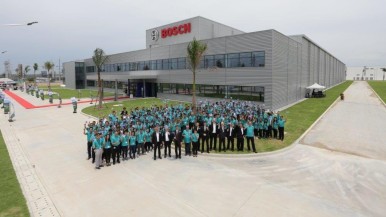
Rayong, Thailand – Thailand’s automotive market is booming: in 2016, nearly two million cars were manufactured there, significantly more than in the U.K. or Italy. Bosch is responding to this rising demand. Following a one-and-a-half-year construction phase, the company is opening a new plant for injection technology in Hemaraj, 130 kilometers east of Thailand’s capital Bangkok. It is the first smart factory in Thailand, and the second Bosch Mobility Solutions plant there. Prior to the opening ceremony, Peter Tyroller, the member of the Bosch board of management responsible for Asia Pacific, said: “Localization is a top priority at Bosch. The new plant will enable us to respond to growing automobile production in Thailand and to serve international as well as local automotive customers on the spot.” The supplier of technology and services is focusing heavily on connected manufacturing at the new factory. Between 2015 and the end of 2017, Bosch will have invested some 80 million euros in total in the new smart factory in Thailand.Bosch Industry 4.0 and R&D activities debut in Thailand In a facility covering 10,000 square meters, injection valves, connection technology, knock sensors, and other components roll off the production line. Using an “active cockpit,” manufacturing associates analyze the latest production data. This Industry 4.0 solution brings together a wide range of information in real time and helps increase competitiveness. The new location in Hemaraj also includes a research and development center, where some 60 associates work on the further development of gasoline injection systems. “It is our first R&D center in the country, and we are especially proud of this,” Tyroller says. He adds that the country of 68 million inhabitants is a gateway to Southeast Asia as a business location, which underscores Thailand’s strategic importance for the Bosch Group in Southeast Asia and worldwide. By 2020, it is planned to create 800 new jobs in total in Hemaraj – 300 associates are already employed there. Bosch’s total workforce in Thailand currently stands at 1,350 associates. Expansion of manufacturing in Vietnam In the year ahead, Bosch plans to expand its manufacturing activities in Vietnam as well. Since 2008, Bosch has been manufacturing pushbelts for continuously variable transmissions in Dong Nai, 40 km east of Ho Chi Minh City. Such transmissions work without any fixed shifting points, ensuring a smooth ride. Demand in Asian cities is rising more and more, as this kind of transmission is suited to stop-and-go traffic. Its compact design also means that it fits into small urban vehicles. “We are investing some 60 million euros to convert the Dong Nai plant into a smart factory and increase capacity,” Tyroller said at the ceremony to mark the tenth anniversary of the Bosch location in Vietnam. This will bring the total invested in the manufacturing site in Vietnam from 2011 to the end of 2018 to more than 320 million euros. Over the past ten years, Bosch has experienced strong growth in Vietnam. Although present in Vietnam since 1994, the company did not open its first branch operation in Ho Chi Minh City until early 2008. In 2010, it became the site of the company’s first software development center in Southeast Asia. In July 2014, an additional automotive engineering center followed. The plant in Dong Nai manufactured its 20 millionth pushbelt in March of this year. The location also includes a vocational training center for technical trades, modeled on Germany’s dual education system. Bosch is the largest German investor in the country in the fields of technology, manufacturing, and R&D. The company employs more than 3,100 associates in Vietnam, more than 40 percent of whom are researchers and engineers. Thailand and Vietnam driving growth in Southeast Asia “Southeast Asia is prospering. We continue to focus on sustainable growth in the region,” Peter Tyroller says. To support growth, Bosch is investing 120 million euros in Southeast Asia in the current year, a year-on-year increase of 50 percent. Investments on a similar scale are planned for 2018, and a large portion will go to Thailand and Vietnam. Business in the two countries is doing particularly well. “Thailand and Vietnam are key forces driving Bosch’s favorable development in Southeast Asia” (sales in 2016: 305 million euros in Thailand; 86 million euros in Vietnam; 770 million euros in Southeast Asia). Bosch in Southeast Asia Bosch has been operating in Southeast Asia since 1919. Today, it employs approximately 7,400 associates in ten ASEAN member states: Singapore, Malaysia, Philippines, Indonesia, Thailand, Vietnam, Brunei, Cambodia, Laos, and Myanmar. In the years ahead, the workforce is set to grow further. The company has had manufacturing operations in the region for more than 20 years, with eight manufacturing sites in total. In Malaysia, for example, Bosch produces power tools, car multimedia products, and steering systems, while in Thailand, the company manufactures packaging machinery and gasoline injection systems. Southeast Asia’s importance within the Bosch Group’s global R&D network also continues to grow. In Singapore, Vietnam, Thailand, and Malaysia, the company has been focusing on local R&D activities for a number of years.