Search & find:
Media, press releases, events for your editorial coverage

Bosch establishes company with the synthetic diamond solutions provider Element Six

07.04.2025

Press release

Business/economy

Bosch establishes company with the synthetic diamond solutions provider Element Six

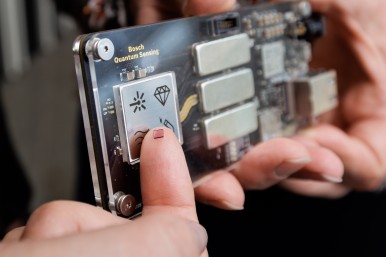
Stuttgart, Germany – They cannot be grasped, either literally or figuratively. Yet their potential is revolutionary, and they are a key technology of the future. We are talking about quanta. For more than ten years, Bosch has been researching in this field, and it is playing a decisive part in commercializing quantum sensors. Since 2023, it has had a development collaboration with Element Six, the world’s leading solutions provider of synthetic diamonds. Bosch is now significantly extending this alliance and establishing a joint venture, to be known as Bosch Quantum Sensing. The joint venture will be based on the in-house start-up of the same name, which Bosch set up in 2022. Domiciled in Ludwigsburg, Germany, Bosch Quantum Sensing currently employs 30 associates. Bosch itself will be the lead partner and be responsible for operations. Element Six will hold a 25 percent stake. It has been agreed that further financial details will not be disclosed. The establishment of the new company is still subject to official approval. Bosch Quantum Sensing sees many areas in which novel quantum sensors can be used, from exploration of natural resources to aircraft navigation and medical technology. By the middle of the next decade, Bosch estimates that the global market potential of medical and mobility applications will be in the mid-single-digit billion euros range per year. Synthetic diamonds are a key component of Bosch quantum sensors. In stepping up its partnership with Element Six, Bosch is making a determined move toward the commercialization of quantum sensors. Quantum sensors are a future technology with huge potential. They will bring about fundamental changes in many sectors of our economy, and improve people’s lives. In setting up this new company, we are underscoring this technology’s strategic significance for Bosch. As innovation leader of commercial quantum sensors, we will work with Element Six to further extend our technological lead,...says Stefan Hartung, chairman of the board of management of Robert Bosch GmbH. Quantum leap toward commercialization The distinctive qualities of these special-purpose synthetic diamonds allow quantum sensors based on them to detect even the tiniest magnetic fields. In this way, they satisfy the most exacting market requirements and make real innovations possible. “We want to work with Element Six to make quantum sensors economical and allow them to be produced on an industrial scale. In this way, we will create the basis for innovative applications that set new standards for precision and efficiency,” says Katrin Kobe, CEO of Bosch Quantum Sensing. “Through the new joint venture between Bosch and Element Six, which aligns with Element Six’ contribution towards De Beers Group’s Origins strategy, we will integrate our synthetic diamond technology with Bosch Quantum Sensing’s capabilities, unlocking new possibilities in critical sectors such as healthcare and navigation. Together, we will harness the respective decades of excellence and innovation to push the limits of what's possible, heralding a new era of synthetic diamond-enabled technologies”, says Siobhán Duffy, the CEO of Element Six. The synthetic diamond solutions provider is in a unique position to supply the highly engineered synthetic diamonds in the quantity and quality required for industrial applications, while Bosch will integrate them into robust and scalable sensor systems. It is a classic win-win situation. Even now, the latest Bosch quantum sensor prototype is the most compact of its kind for the level of sensitivity required – it is the same size as a modern smartphone. In the area of mobility, it could enable a robust navigation in the future, complementary to conventional GPS systems. It could also offer decisive advantages for the exploration of natural resources and, in medical technology, for the measurement of cardiac activity. The advantage of compact sensors is their portability, less expensive production, and better scalability. The long-term goal of Bosch Quantum Sensing is to make quantum sensors so small that they can be integrated onto a chip. Press photos and infocharts are available on the Bosch Media Service at www.bosch-press.com . Contact person for press inquiries: Athanassios Kaliudis Phone: +49 711 811-7497 E-mail: Athanassios.Kaliudis@de.bosch.com

Bosch invests millions in metal 3D printing center

18.03.2025

Press release

Business/economy

Bosch invests millions in metal 3D printing center

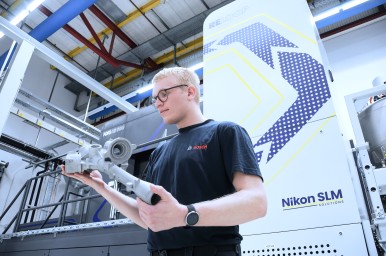
Nuremberg and Stuttgart, Germany – Speed, precision, flexibility, and energy efficiency: for Bosch, these factors are key when manufacturing the complex metal parts that it supplies to its in-house and third-party customers. With a new metal 3D printer at its Nuremberg plant, Bosch wants to bolster its pioneering role in the supplier industry. In fact, it is the first Tier-1 automotive supplier in Europe to have a facility in this performance class. The plant has invested almost six million euros in the center and in the associated purchase and installation of a Nikon SLM Solutions NXG XII 600 metal 3D printer. Bosch remains committed to Germany as an industrial location and is investing large sums of money here. By introducing new technologies in our plants, we are securing considerable sales potential....Klaus Mäder, member of the Bosch Mobility sector board responsible for operations. “Bosch remains committed to Germany as an industrial location and is investing large sums of money here. By introducing new technologies in our plants, we are securing considerable sales potential,” says Klaus Mäder, the member of the Bosch Mobility sector board responsible for operations, including all plants worldwide. The new 3D printer is intended to accelerate development cycles, especially for metal parts, which take a long time to make using conventional manufacturing processes. Commenting on the facility’s official start of operations, Alexander Weichsel, the commercial plant manager in Nuremberg, says: “By making the manufacture of metal parts faster and more productive, this new facility will increase our competitiveness.” And the technical plant manager Jörg Luntz adds: “With this facility, we are setting the highest standards in metal 3D printing. In volume production, this will open up completely new possibilities for us.” Whether components for hydrogen applications, motor housings for electric cars, components for e-axles, or engine blocks for racing: the facility’s sheer size and technical capabilities pave the way for a host of applications. Working from a computer-aided design file developed in advance, its twelve lasers melt metal powder layer by layer to create highly complex shapes. The new metal 3D printer is up to five times faster than the 3D printing systems that have been used up to now. Complex structures such as interior or curved channels, which are simply not feasible with conventional milling processes, can now be produced without any problem. While drilling around corners is not possible using conventional methods, 3D printing makes light work of this. The printer can produce unfinished parts on demand with no need for tooling. And because 3D printing slashes raw-material waste to almost zero, it also conserves resources. “Using the 3D printer to manufacture components not only increases sustainability in production, but also enables Bosch to respond flexibly to fluctuations in batch sizes and offer everything from a single source,” Weichsel says. Manufacturing a complete engine block using the 3D printing process One particularly vivid example of the new possibilities that the 3D printing process opens up is the engine block: with conventional manufacturing, it can take up to three years to get from the first draft design to volume production. Completing the casting mold for the engine block alone can take up to 18 months. 3D printing does away with this step. The design data is transmitted directly to the printer, eliminating the need for complex molds. The 3D printer delivers a finished engine block after just a few days, thus greatly reducing overall product development time. At full capacity, the facility can produce metal parts with a total weight of around 10,000 kilograms in under a year, achieving speeds of up to 1,000 cubic centimeters per hour. The main aim of this faster component production is to cut the time to market. “We want to be faster than with traditional manufacturing processes and use this technology to get products to market more quickly,” Luntz says. “Even today, only a few companies can produce technology on an industrial scale the way Bosch does. We’re now going one step further, taking volume production in metal 3D printing to the automotive level.” This opens the door to completely new opportunities and possibilities – in the automotive sector, but also in numerous other industries such as energy and aviation.

Into the hydrogen age: Bosch starts volume production of its fuel-cell power module

13.07.2023

Press release

Business/economy

Into the hydrogen age: Bosch starts volume production of its fuel-cell power module

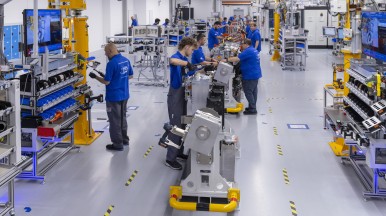
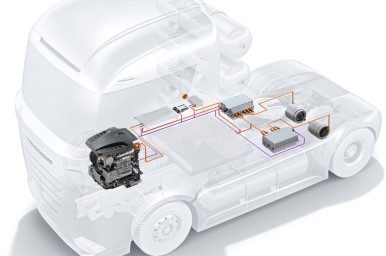
Stuttgart, Germany – Bosch is entering the hydrogen age of mobility. At its Stuttgart-Feuerbach location, the supplier of technology and services has now begun volume production of its fuel-cell power module. Nikola Corporation, based in the United States, will serve as the pilot customer with its Class 8 hydrogen fuel cell electric truck, which is scheduled to enter the North American market in the third quarter of 2023. “Here in Stuttgart-Feuerbach, in the plant whose history goes back further than any other Bosch plant, the hydrogen future is about to happen,” said Dr. Stefan Hartung, the chairman of the board of management of Robert Bosch GmbH, at the Bosch Tech Day 2023. “Bosch knows its way around hydrogen, and Bosch is growing with hydrogen.” The company operates along the entire hydrogen value chain, developing technology for its production and application. By 2030, Bosch plans to generate sales of roughly 5 billion euros with hydrogen technology. Here in Stuttgart-Feuerbach, in the plant whose history goes back further than any other Bosch plant, the hydrogen future is about to happen,...said Dr. Stefan Hartung, the chairman of the board of management of Robert Bosch GmbH, at the Bosch Tech Day 2023. In its solutions for the hydrogen economy as well, Bosch is relying on a global manufacturing network and the prowess of its German locations. For example, the Bosch plant in Bamberg, Germany, will supply the Feuerbach factory with the fuel-cell stack. And important system components such as the electric air compressor and the recirculation blower come from the Bosch plant in Homburg, Germany. “Bosch is one of the very few companies that are capable of mass producing technology as complex as fuel-cell stacks. We don’t just have the required systems expertise, but also the capability of quickly scaling up new developments to mass production,” said Markus Heyn, member of the Bosch board of management and chairman of Bosch Mobility. Production of the fuel-cell power module is not only starting in Feuerbach, but also in Chongqing, China. The components it requires will come from the Wuxi plant. “Bosch is the first company to produce these systems in both China and Germany,” Hartung said. In addition, Bosch is also planning to manufacture stacks for mobile applications in its U.S. plant in Anderson, South Carolina. Worldwide, the company expects that, by 2030, one in five new trucks weighing six tons or more will feature a fuel-cell powertrain. Bosch is helping to shape the hydrogen economy, and sees obligations on the part of policymakers Only with hydrogen can there be a climate-neutral world. For Bosch, that is crystal-clear. The company therefore strongly advocates the establishment of a hydrogen economy, and is stepping up its investments in hydrogen. Between 2021 and 2026, Bosch will have invested a total of nearly 2.5 billion euros in the development and manufacturing of its H 2 technologies. That is another billion euros more than was earmarked in the investment plan for 2021 to 2024. The business opportunities for Bosch are huge, as is the effect on jobs. Even now, there are more than 3,000 people at Bosch working on hydrogen technologies, more than half of them in Europe. Most of the vacancies can be filled from within the company, and especially with people who have so far worked in the Bosch powertrain business. However, the further prospects for the hydrogen business depend on the political environment. Hartung especially believes that Europe must do much more to create a counterweight to the rapid pace of developments in other regions of the world, such as the United States. More specifically, the Bosch chairman has four demands of German and European policymakers: “First, we have to step up the pace of hydrogen production in the EU. Second, global supply chains have to be set up, and third, hydrogen has to be used in all sectors of the economy.” As a fourth point, he stressed the importance of quickly setting up infrastructure for distributing hydrogen in Europe. Bosch technology starts with electrolysis and ends with the hydrogen engine At all events, Bosch is ready, and applying automotive experience to the hydrogen economy like no other company. This is why the company is also in demand in H 2 production. At the start of 2023, Bosch started constructing prototypes for electrolysis using proton exchange membranes – in other words, the reverse of the energy conversion method used in mobile fuel cells. Starting in the fall, the company intends to make 1.25-megawatt prototypes available for pilot applications, and is on track to start volume production in 2025. Bosch is exploring several options for the use of hydrogen. Stationary solid-oxide fuel cells can be used for the distributed supply of power and heat. In a pilot project at the hospital in Erkelenz, near Cologne in Germany, Bosch wants to use this technology to achieve overall efficiency of 90 percent. The micropower plant there will initially run on natural gas, but can be converted to green hydrogen. Apart from the fuel-cell powertrain, Bosch is also working on the hydrogen engine, developing systems for both port and direct injection of hydrogen. This solution is particularly suitable for heavy vehicles on long hauls with especially heavy loads. “A hydrogen engine can do everything a diesel engine does, but on top of that, it is carbon neutral. It also allows a fast and cost-effective entry into hydrogen-based mobility,” Heyn said. One major advantage is that more than 90 percent of the development and manufacturing technologies needed for it already exist. The H 2 engine is expected to be launched starting in 2024. Even now, Bosch has four orders for production projects from all the major economic regions, and expects six-figure unit volumes by 2030. In this field as well, Bosch is dynamically taking the hydrogen economy forward.


Mobility in the software age: Bosch to realign its automotive-supply business fo ...

04.05.2023

Press release

Business/economy

Mobility in the software age: Bosch to realign its automotive-supply business fo ...

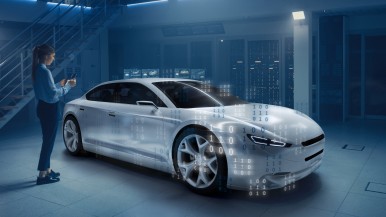
Stuttgart and Renningen, Germany – More than ever, innovations in the automotive sphere are coming about through bits and bytes. Bosch is responding to this trend toward software-based automotive engineering by realigning its automotive-supply business: within Robert Bosch GmbH, Bosch Mobility will in the future be managed as a business sector with responsibility for its own business and its own leadership team. At the Bosch annual press conference , Dr. Stefan Hartung , the chairman of the board of management of Robert Bosch GmbH, informed the audience about this. The aim is to be able to serve existing and new customer needs even better and faster with customized technologies and solutions from a single source. With some 230,000 associates at more than 300 locations in 66 countries worldwide, Bosch Mobility will be the biggest of Bosch’s four business sectors.“Software won’t only change how we use and experience cars in the future. It will also change the way cars are engineered. For some time now, Bosch has also seen itself as a mobility software company. Now, in response to customer requirements, our structure is changing to reflect this and to open up further growth,” said Dr. Markus Heyn , member of the Bosch board of management and the future chairman of the five-strong Bosch Mobility sector board. Organizationally speaking, some of the business sector’s individual divisions will be redrawn effective January 1, 2024, and all divisions will be given horizontal, cross-divisional responsibilities as well. With its mobility solutions alone, Bosch’s aim for this new structure is that it will generate sales revenue of more than 80 billion euros worldwide by 2029. First wave of software-defined vehicles expected from mid-decade One pillar of this growth will be the market for automotive software. Driven by the trend toward software-defined vehicles, this market is likely to reach a volume of significantly more than 200 billion euros by 2030. This is three times more than in 2020. Currently, Bosch growth in this market is in double digits. The entire automotive industry is presently putting a stronger focus on software development. Its share in development cost will be roughly 30 percent by 2030. At Bosch, it is already higher than that. Even now, more than 50 percent of all R&D associates working for Bosch Mobility are software engineers. Software-defined vehicles offer two outstanding advantages. The first is the speed of development. Instead of taking years, implementing new functions in existing systems will in the future be just a matter of days. The second is the decoupling of software and hardware development, which means that cars will feel like new for longer thanks to software updates. Explaining this, Heyn said: “Drivers across the globe want to seamlessly integrate their vehicles into their digital world. After all, we have gotten used to constant updates and new features on our smartphones. Now, we are applying this to cars as well.” From 2025, Bosch expects that software-defined vehicles will be introduced on a broad scale. New trend in automotive engineering reflected in Bosch organization The example of vehicle motion management shows how the reorganization of Bosch Mobility and intensified cross-divisional collaboration is conducive to this new trend in automotive engineering. It includes a new control concept that does an even faster and more accurate job of stabilizing vehicles. It can intervene not only in the braking system, but also in the electrical powertrain and electric steering system. This helps to shorten the braking distance, and the driver has to take considerably less corrective action. All this increases road safety. The technical basis is ESP10, the latest generation of the Bosch braking control system, and the Vehicle Dynamics Control 2.0 software function. The ingenious part is that the new control system does not have to form part of the ESP control unit, but can alternatively be integrated in the central vehicle computer – and, in the future, it will also be available as a standalone software package. But that’s just the start. Bosch anticipates a threefold increase in software applications and even a tenfold increase in applications that access the cloud. Bosch: a successful player in automotive hardware and software Software-defined vehicles go hand in hand with a new, centralized electrical and electronic (E/E) architecture. More than 100 control units are installed in the latest premium-class vehicles. Even today’s compact-class vehicles feature between 30 and 50 control units. “Our focus will be on making the complexity of electronic systems controllable and as reliable as possible,” Heyn said. In the future, it will be possible to significantly reduce the number of control units by using powerful computers for the various vehicle domains, such as cockpit and connectivity functions, driver assistance systems and automated driving, and the powertrain. This is why Bosch is developing a uniform IT architecture for the entire vehicle – from the cloud, to the central vehicle computer, to the individual control units. One major advantage is that Bosch is equally at home in the software and hardware domains. Whether brakes, steering systems, or eco-friendly powertrains – where Bosch pursues a technology-neutral approach with fuel cells, batteries, and hydrogen engines – the supplier of technology and services develops and manufactures the key components of modern vehicles under one roof. This includes more than 250 million control units each year, which are also configured with the company’s proprietary software. But that’s not all. Bosch specializes in a further field that is becoming increasingly important – the integration of software from diverse sources and resulting from collaboration between the automotive and IT industries. Bosch also has this integrative expertise, and will extend it by reorganizing its automotive-supply business. Sector board, executives, and associates contribute to realignment The Bosch Mobility sector board defined the business sector’s new configuration in consultation with associates and executives from the individual divisions. The reorganization is subject to observance of employee representatives' participatory rights. Organizationally speaking, the business sector will in the future comprise seven divisions. Some of them have been redrawn, and in some cases additional horizontal responsibilities have been created across all divisions. More specifically, the Electrified Motion division will be concerned with everything relating to electric motors, from the Bosch e-axle to seat adjusters. Vehicle Motion will deal with vehicle dynamics, from ABS and ESP to steering. Power Solutions will handle combustion-engine technology, mobile and stationary fuel cells, electrolyzers, and hydrogen engines. Cross-Domain Computing Solutions will develop solutions for areas ranging from automatic parking to automated driving. Mobility Electronics will drive forward the development of control units. It will also promote in-house semiconductor activities at Bosch. Mobility Aftermarket will deal with the spare-parts market and the Bosch Car Service workshop franchise. E-Bike Systems will supply systems solutions – comprising drive units, rechargeable batteries, ABS, and connected displays – for e-bikes. The Bosch subsidiary ETAS will be given horizontal responsibility for hardware-agnostic software for operating systems and engineering tools.

Rising demand for SiC chips: Bosch plans to acquire U.S. chipmaker TSI Semiconductors

26.04.2023

Press release

Business/economy

Rising demand for SiC chips: Bosch plans to acquire U.S. chipmaker TSI Semiconductors

Stuttgart, Germany – Bosch is expanding its semiconductor business with silicon carbide chips. The technology company plans to acquire assets of the U.S. chipmaker TSI Semiconductors, based in Roseville, California. With a workforce of 250, the company is a foundry for application-specific integrated circuits, or ASICs. Currently, it mainly develops and produces large volumes of chips on 200-millimeter silicon wafers for applications in the mobility, telecommunications, energy, and life sciences industries. Over the next years, Bosch intends to invest more than 1.5 billion USD in the Roseville site and convert the TSI Semiconductors manufacturing facilities to state-of-the-art processes. Starting in 2026, the first chips will be produced on 200-millimeter wafers based on the innovative material silicon carbide (SiC).In this way, Bosch is systematically reinforcing its semiconductor business, and will have significantly extended its global portfolio of SiC chips by the end of 2030. Above all, the global boom and ramp-up of electromobility are resulting in huge demand for such special semiconductors. The full scope of the planned investment will be heavily dependent on federal funding opportunities available via the CHIPS and Science Act as well as economic development opportunities within the State of California. Bosch and TSI Semiconductors have reached an agreement to not to disclose any financial details of the transaction, which is subject to regulatory approval. “With the acquisition of TSI Semiconductors, we are establishing manufacturing capacity for SiC chips in an important sales market while also increasing our semiconductor manufacturing, globally. The existing clean-room facilities and expert personnel in Roseville will allow us to manufacture SiC chips for electromobility on an even larger scale,” says Dr. Stefan Hartung, the chairman of the Bosch board of management. “The location in Roseville has existed since 1984. Over nearly 40 years, the U.S. company has built up vast expertise in semiconductor production. We will now be integrating this expertise into the Bosch semiconductor manufacturing network,” says Dr. Markus Heyn, member of the Bosch board of management and chairman of the Mobility Solutions business sector. “We are pleased to join a globally operating technology company with extensive semiconductor expertise. We are confident that our Roseville location will be a significant addition to Bosch’s SiC chipmaking operations,” says Oded Tal, CEO at TSI Semiconductors. With the acquisition of TSI Semiconductors, we are establishing manufacturing capacity for SiC chips in an important sales market while also increasing our semiconductor manufacturing, globally. The existing clean-room facilities and expert personnel in Roseville will allow us to manufacture SiC chips for electromobility on an even larger scale,...says Dr. Stefan Hartung, the chairman of the Bosch board of management. Acquisition of TSI Semiconductors creates new manufacturing capacity The new location in Roseville will reinforce Bosch’s international semiconductor manufacturing network. Starting in 2026, following a retooling phase, first SiC chips will be produced on 200-millimeter wafers in a facility offering roughly 10,000 square meters of clean-room space. At an early stage, Bosch invested in the development and production of SiC chips. Since 2021, it has been using its own proprietary, highly complex processes to mass-produce them at its Reutlingen location near Stuttgart. In the future, Reutlingen will also produce them on 200-millimeters wafers. By the end of 2025, the company will have extended its clean-room space in Reutlingen from roughly 35,000 to more than 44,000 square meters. “SiC chips are a key component for electrified mobility. By extending our semiconductor operations internationally, we are strengthening our local presence in an important electric vehicle market,” Heyn says. SiC chips are a key component for electrified mobility. By extending our semiconductor operations internationally, we are strengthening our local presence in an important electric vehicle market,...says Dr. Markus Heyn, member of the Bosch board of management and chairman of the Mobility Solutions business sector. Demand for chips for the automotive industry remains high. By 2025, Bosch expects to have an average of 25 of its chips integrated in every new vehicle. The market for SiC chips is also continuing to grow fast – by 30 percent a year on average. The main drivers of this growth are the global boom and ramp-up of electromobility. In electric vehicles, SiC chips enable greater range and more efficient recharging, as they use up to 50 percent less energy. Installed in these vehicles’ power electronics, they ensure that a vehicle can drive a significantly longer distance on one battery charge – on average, the possible range is 6 percent greater than with silicon-based chips. Systematic investments in pivotal semiconductor technology Semiconductors are key to the success of all Bosch business areas. The company recognized the potential of this technology early on, and has been producing semiconductors for more than 60 years. Bosch is one of the few companies to have not only electronic and software expertise but also a profound understanding of microelectronics. It can combine this decisive competitive advantage with its strength in semiconductor manufacturing. The supplier of technology and services has been manufacturing semiconductors in Reutlingen since 1970. They are used both in the automotive sphere and in consumer electronics. Modern electronics in vehicles is also the basis for reducing traffic emissions, preventing road accidents, and efficient powertrains. Production at the Bosch wafer fab in Dresden (300-millimeter wafers) started in July 2021. At nearly one billion euros, the wafer fab is the biggest single investment in the company’s history. In its wafer fabs in Reutlingen and Dresden, Bosch has invested more than 2.5 billion euros in total since 200-millimeter technology was introduced in 2010. On top of this, billions of euros have been invested in developing microelectronics. Independently of the investment now planned in the United States, the company announced in summer last year that it will be investing a further 3 billion euros in its semiconductor business in Europe, both as part of its investment planning and with the aid of the EU’s “Important Project of Common European Interest on Microelectronics and Communication Technologies” program.

GAIA-X 4 moveID project develops basis for secure mobile data exchange

08.09.2022

Press release

Business/economy

GAIA-X 4 moveID project develops basis for secure mobile data exchange

Stuttgart, Germany – Which parking garages currently have vacant charge spots available? Where are free parking spaces in the city center? And how can this information be digitally transmitted, and services billed, across providers? The answer to these and similar questions calls for secure data exchange between the vehicles and their environment. It is precisely this foundation that a research project consisting of universities, automotive suppliers, and system providers is now in the process of building, with Bosch leading the consortium. Over the next three years, the GAIA-X 4 moveID project is set to develop the necessary standards and technological concepts to enable the secure exchange of information between providers of mobility applications and their customers. The goal is to create decentralized digital vehicle identities. This is an important prerequisite for the mass use of electric vehicles, automated driving, and the establishment of connected cities. GAIA-X 4 moveID is supported to the tune of 14 million euros by the German Federal Ministry for Economic Affairs and Climate Action – covering half of the project costs.Connectivity for digital services across the board “An integrated and transparent system architecture for the exchange of data on the road that incorporates different products and players simply isn’t available today. While it’s true that some companies out there already offer services, those services are tailored for specific applications, vehicles, or customer groups,” explains Peter Busch, project manager at the consortium leader Bosch. They often map the infrastructure, for example, but they rarely provide information about availability due to a lack of connectivity between the many independently operating service providers. “Open standards are needed so that users, for example, can find all available charging stations or pay for charging processes,” Busch says. It’s important to always ensure that the data is processed securely and that individual providers don’t exploit it solely for their own purposes. For Busch, this is the only way that the necessary user confidence can grow and a broad range of all available services, such as so-called deep parking (use of otherwise unavailable parking spaces), can be created. That is why the consortium is building on the European GAIA-X system, which defines the technological, economic, and legal framework for a secure and trustworthy data infrastructure. GAIA-X relies on decentralization and the interplay of different cloud providers under common guidelines. In this spirit, the GAIA-X 4 moveID project is using open source software for its developments and making them available to all providers for various business models. Vehicles are becoming marketplaces The standards that GAIA-X 4 moveID is pursuing will allow vehicles to securely and independently exchange information with other vehicles and their environment without an “intermediary.” The vehicles’ “infrastructure partners” include charge spots, barriers, traffic lights, and parking lots. The research project will use internationally recognized hardware and software to develop management and administrative services to facilitate the interaction and trade between different players. This will enable providers to connect a great many services, such as news, entertainment, and navigation, with the car’s system, especially in automated driving. The market for services related to connected parking alone is estimated to be worth ten billion euros annually worldwide. What’s more, the ability to navigate directly to a vacant parking space significantly reduces congestion and emissions. After all, today, about a third of downtown urban traffic is people looking for parking spaces. The availability of information is also a crucial factor for the success of electromobility. It is estimated that about half of newly registered cars in Europe will be electric by 2030. “Their drivers need to know that they’ll be able to find a charge spot quickly whenever they need one. And that requires connected systems,” Busch says. Extensive data exchange as a basis for automated driving The mass use of automated vehicles is conceivable only if cars are able to quickly and reliably communicate with their environment. The data exchange this requires will enable climate-friendly traffic control based on the volume of traffic at any given moment. This will allow cities to regulate incoming traffic to particular areas in real time, thus preventing congestion. However, this method, known as zoning, requires that vehicles be able to immediately recognize changing conditions and to reroute accordingly. Zoning is being demonstrated with test vehicles – for the first time across borders – in the Germany-France-Luxembourg (Merzig/Saarbrücken) test area as part of the GAIA-X 4 moveID project. The cars receive dynamic information regarding their approach to defined zones.The project partners: Robert Bosch GmbH Materna Information & Communications SE Denso Automotive Deutschland GmbH Continental Automotive Technlogies GmbH WOBCOM GmbH ecsec GmbH HTW Saar (University of Applied Sciences) Atos Information Technology GmbH Chainstep GmbH Peaq Technology GmbH Zeppelin Universität gGmbH (Zeppelin University) Datarella GmbH 51nodes GmbH Bigchain DB GmbH Fetch.ai Research & Development GmbH ITK Engineering GmbH Deutsche Zentrum für Luft- und Raumfahrt e.V. (German Aerospace Center) Airbus Defence and Space GmbH Delta Dao AG

Bosch and AWS enter into collaboration to digitalize logistics

13.04.2022

Press release

Business/economy

Bosch and AWS enter into collaboration to digitalize logistics

Stuttgart, Germany – Bosch and U.S.-based cloud provider Amazon Web Services (AWS) aim to improve efficiency and sustainability in the transportation and logistics industry. Their plan is to offer logistics companies and freight forwarders across the globe quick and easy access to digital services through a platform powered by AWS. Going forward, they will offer support for topics ranging from capacity utilization of commercial vehicle fleets to monitoring goods flows to order processing – all from a single source. To this end, Bosch and AWS have now entered a strategic collaboration. Bosch will be responsible for developing and operating the logistics platform, the core of which is a marketplace for digital services, while AWS will contribute its comprehensive cloud offering and expertise. The platform will facilitate smooth interaction between a variety of services and data, enabling transportation and logistics companies to benefit much more from the opportunities of digitalization without having to set up their own resource- and cost-intensive IT projects. The marketplace will also be open to all digital logistics services providers. Industry and consumers will benefit from the initiative because of greater reliability and transparency in goods and parcel delivery, for example. The companies plan to present a preliminary version of the logistics platform at Hannover Messe, with the launch for Europe, India, and the U.S. set for late 2022. The transportation and logistics industry is the backbone of the global economy. In the years ahead, it will have to shoulder continuously increasing transport volumes for goods and commodities while simultaneously reducing its carbon footprint. In collaboration with AWS, we want to help the logistics industry with this. We aim to ring in the future of the industry and drive forward its digitalization,...Sandeep Nelamangala, Executive Director, Bosch Limited, and Executive Sponsor of logistics platform business at Bosch Greater efficiency through increased digitalization “The transportation and logistics industry is the backbone of the global economy. In the years ahead, it will have to shoulder continuously increasing transport volumes for goods and commodities while simultaneously reducing its carbon footprint. In collaboration with AWS, we want to help the logistics industry with this. We aim to ring in the future of the industry and drive forward its digitalization,” says Sandeep Nelamangala, Executive Director, Bosch Limited, and Executive Sponsor of logistics platform business at Bosch. “Developing hyperconnected transportation functions is one of the most complex technical challenges of our time. That’s why we are working with a market pioneer such as Bosch to master these unique challenges,” said Kathrin Renz, Vice President, Business Development and Industries, AWS. “The digital marketplace will enable logistics customers to quickly transform their business into a fully digital end-to-end value chain. Customers will benefit from the tools, frameworks, and modules we offer for digitalization, in addition to improving the sustainability of their transportation processes.” Years-long boom – and no end in sight The transportation and logistics industry has been booming for years. During the Covid 19 pandemic, online orders and parcel deliveries saw another sharp increase, giving the industry a further boost. By 2030, global goods transport will grow more than 40 percent, and by 2050 this figure is even expected to exceed 145 percent. This growth is hitting a market that is highly fragmented globally – as well as struggling with various areas of inefficiency. A few facts will illustrate this: More than 95 percent of the companies operating in this industry worldwide are SMEs. Approximately nine out of ten companies operate with fewer than five vehicles. The majority of freight forwarders still organize their daily business manually or with an assortment of unrelated computer programs. Moreover, according to the goods transport statistics of Germany’s Federal Ministry for Digital and Transport (available in German only), more than 150 million trips are empty runs, which adds up to more than 6.5 billion empty kilometers annually, or more than 160,000 unnecessary journeys around the earth. This weighs heavily not only on efforts to protect the climate, but also on the already problematic shortage of drivers. The Federal Association for Goods Traffic, Logistics, and Disposal estimates that there is a shortage of between 60,000 and 80,000 drivers in Germany alone – and the situation is becoming more and more acute across the globe. Many challenges – one solution With its logistics platform, Bosch aims to provide a key solution for many of the challenges facing the transportation and logistics industry. The advantage of this platform is that it will create an entire ecosystem and a software environment in which freight carriers and forwarders can select, book, and execute different providers’ services to meet their specific needs. The platform also allows for easy integration of applications that are already relevant to the market, for instance, in transportation management systems. Thanks to shared usage of data that is available through the telematics systems in commercial vehicles, for example from fleet management, it is also possible to link and allow interplay between different services from different areas. This makes it easier to leverage synergies.

Bosch accelerates software development for automated driving with acquisition of Five

12.04.2022

Press release

Business/economy

Bosch accelerates software development for automated driving with acquisition of Five

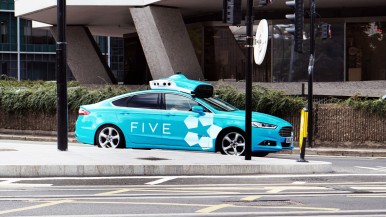
Stuttgart, Germany – The development of self-driving cars is regarded as the ultimate discipline for automakers. As one of the world’s biggest mobility providers, Bosch is a driving force behind the progress being made in this discipline. Now, it’s strengthening its hand by acquiring Five, Europe’s leading startup in the field of automated driving. At six locations in the United Kingdom, its roughly 140 associates are working on the vision of safe, self-driving vehicles. Five gave preference to Bosch over other takeover bidders. The two companies share a common vision of automated driving and of safe automated driving systems. The agreements with Five were signed at the beginning of April. It has been agreed that the financial details will not be disclosed. The acquisition is still subject to approval by the antitrust authorities.“Automated driving is set to make road traffic safer. We want Five to give an extra boost to our work in software development for safe automated driving, and offer our customers European-made technology,” says Dr. Markus Heyn, member of the Bosch board of management and chairman of the Mobility Solutions business sector. Headquartered in Cambridge, U.K., Five is to be part of the Bosch Cross-Domain Computing Solutions division. “Scale matters in building automated driving technology. Bosch is a global leader in driving assistance technologies, with core technologies and vast data lakes that will be essential in bringing safe self-driving systems to market. We’re excited for Five to become part of Europe’s most powerful SAE Level 4 player and to be a part of Bosch’s future success,” says Stan Boland, the CEO of Five. Automated driving is set to make road traffic safer. We want Five to give an extra boost to our work in software development for safe automated driving, and offer our customers European-made technology...says Dr. Markus Heyn, member of the Bosch board of management and chairman of the Mobility Solutions business sector Simulation environment allows software to be tested and validated Since it was set up in 2016, Five has built a team of experts in cloud software, safety assurance, robotics and machine learning, and has placed itself at the forefront of developing state-of-the-art software and artificial intelligence-based solutions for autonomous driving, through SAE Level 4. The startup now focuses primarily on a cloud-based development and testing platform for the software used in self-driving cars. This offers engineers the programs they need to create automated driving software at pace, and to test it before and during its deployment in test vehicles. The platform is able to analyze real data from a fleet of test vehicles, create advanced testing scenarios, and build a simulation environment that makes it possible to assess and validate system behavior at hyper-scale. Agile collaboration between Bosch and Five teams At Bosch, Five will strengthen the company’s agile project structure for the development of self-driving cars. The two teams’ software engineering environments complement each other very well, and will be merged to form a single solution. “Five is the perfect fit for our engineering activities – not least due to its associates’ mindset and agile approach. This brings us closer to our aim of getting safe automated driving onto our roads,” says Dr. Mathias Pillin, president of the Bosch Cross-Domain Computing Solutions division. For Bosch, moreover, the acquisition is a further step toward consolidating its market position in software and automated driving. Only recently, the company extended its portfolio by acquiring Atlatec GmbH, a specialist in the field of high-resolution digital maps. This means Bosch will be the only company that can offer its customers all the necessary building blocks of automated driving from a single source – from actuators, sensors, and maps to software and the engineering environment. Bosch is working on all levels of automated driving For Bosch, automated driving is and will remain a strategic business field. The company is the innovation leader in this area. With its driver assistance systems and the requisite sensor technology, it laid the foundation for all automation levels at an early stage. Bosch is taking a two-pronged approach. On the one hand, with the aim of making driving safer and more relaxed, it is developing solutions for private vehicles with a focus on driver assistance and on partially and conditionally automated systems (SAE Levels 1 to 3). On the other hand, the team is also working on solutions for higher levels of automation, with a focus on fleet vehicles and new operating models. In the logistics sector in particular, Bosch sees attractive applications and business potential for SAE Level 4 automated driving systems. Moreover, Bosch has already developed automated valet parking, the first production-ready driving function not to require a driver.

Automated driving: acquisition gives boost to Bosch engineering work on SAE Leve ...

24.02.2022

Press release

Business/economy

Automated driving: acquisition gives boost to Bosch engineering work on SAE Leve ...

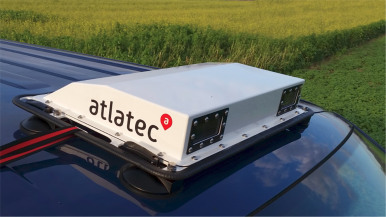
Stuttgart, Germany – Bosch is expanding its expertise in automated driving and strengthening its market position with an acquisition. Atlatec GmbH, based in Karlsruhe, Germany, is to become part of the Bosch Cross-Domain Computing Solutions division as an independently operated company. Bosch and Atlatec have now signed agreements to this effect. Atlatec is one of the world’s most innovative providers of high-resolution digital maps for driver assistance and automated driving. The company, which was spun off from the Karlsruhe Institute of Technology in 2014, employs around 25 people in Germany, Japan, and the United States. “The planned acquisition of Atlatec further expands our expertise in the field of high-resolution digital maps and makes us even more diversified. It makes Bosch the only company that can offer its customers all the necessary building blocks of automated driving – from actuators and sensors to software and maps – from a single source. We are thus consistently expanding our strong position in this area,” says Dr. Mathias Pillin, president of the Cross-Domain Computing Solutions division. “In Bosch, we have found the right partner for us as we take the next step in expanding our digital mapping expertise even further,” says Dr. Henning Lategahn, CEO of Atlatec GmbH. It has been agreed that the purchase price will not be disclosed. The acquisition is subject to approval by the antitrust authorities. The planned acquisition of Atlatec further expands our expertise in the field of high-resolution digital maps and makes us even more diversified. It makes Bosch the only company that can offer its customers all the necessary building blocks of automated driving – from actuators and sensors to software and maps – from a single source. We are thus consistently expanding our strong position in this area....Dr. Mathias Pillin, president of the Cross-Domain Computing Solutions division Digital maps are an additional sensor for automated driving High-resolution digital maps play an essential part in making automated driving functions safe and convenient to use. Atlatec offers all the necessary building blocks for mapping from a single source: its portfolio includes not only data recording and processing but also creation of the maps themselves as well as the requisite quality control. In addition to onboard sensors featuring radar, video, and ultrasonic technology, digital maps are another indispensable sensor in automated driving. The information they contain relating to the vehicle’s surroundings and traffic events goes far beyond the detection range of a vehicle’s onboard sensors. For the creation of maps, Atlatec has developed a scalable solution with its own sensor box and associated software. The raw data this solution collects is analyzed using artificial intelligence (AI) and enriched with important information such as traffic signs and the sharpness of bends, as well as structural features such as streetcar tracks. Since the AI algorithms are continuously learning, the proportion of road and environmental features detected purely by AI is constantly growing. On the basis of information from the map, an autonomously driving car can, say, adjust its speed in good time before a tight bend. In the development of automated driving, digital maps play a crucial role right from the start. And the higher the degree of automation, the more closely map creation and driving strategy programming must be dovetailed. “Atlatec GmbH’s technology package for creating high-resolution maps makes the company an ideal addition for Bosch. The resulting mapping solution is very intelligent and agile, which sets it apart from other vendors. For example, the AI it uses identifies and maps road features such as guardrails and lane markings with the highest accuracy and consistency. This lets us design our driving strategy algorithms even more precisely,” says Dr. Stephan Hönle, senior vice president of the Automated Driving unit in the Bosch Cross-Domain Computing Solutions division. Atlatec is also a useful complement to Bosch’s road signature technology, which uses swarm data to enable self-driving cars to determine their exact position on the basis of digital maps. Bosch is successfully collaborating with various partners in the field of automated driving and mapping. Atlatec will complement these partnerships. Bosch is working on every automation level from SAE Level 1 to 4 For Bosch, automated driving is a strategic area of business. The company is the innovation leader in this field. With driver assistance systems and the requisite sensor technology, it laid the foundation for all automation levels at an early stage. Bosch is taking a two-pronged approach. On the one hand, with the aim of making driving safer and more relaxed, it is developing solutions for private vehicles with a focus on driver assistance and on partially and conditionally automated systems (SAE Levels 1 to 3). On the other hand, the Bosch development team is also working on solutions for higher levels of automation, with a focus on fleet vehicles and new operating models. In the logistics sector in particular, the company sees attractive applications and huge business potential for SAE Level 4 automated driving systems. Moreover, Bosch has already developed automated valet parking, the first production-ready automated driving function not to require a driver at all.

More chips: Bosch to invest on extending semiconductor production in Reutlingen

22.02.2022

Press release

Business/economy

More chips: Bosch to invest on extending semiconductor production in Reutlingen

Reutlingen, Germany – In an additional move to combat the ongoing global chip shortage, Bosch plans to further extend its wafer fab in Reutlingen. More than a quarter of a billion euros is to be invested in creating new production space and the necessary clean-room facilities between now and 2025. This will give Bosch the firepower to meet the continuously growing demand for chips used in mobility and IoT applications. “We are systematically expanding our manufacturing capacity for semiconductors in Reutlingen,” says Dr. Stefan Hartung, chairman of the board of management of Robert Bosch GmbH. “This new investment will not only strengthen our competitive position, but will also benefit our customers and help combat the crisis in the semiconductor supply chain.” The construction of a new extension in Reutlingen will create an additional 3,600 square meters of ultramodern clean-room space. As of 2025, this additional capacity will produce semiconductors based on technology already in place at the Reutlingen plant. Bosch is also extending an existing power supply facility and will construct an additional building for media supply systems serving both the new and existing production areas. The new production area is scheduled to go into operation in 2025. We are systematically expanding our manufacturing capacity for semiconductors in Reutlingen, this new investment will not only strengthen our competitive position, but will also benefit our customers and help combat the crisis in the semiconductor supply chain....Dr. Stefan Hartung, chairman of the board of management of Robert Bosch GmbH In October 2021, Bosch announced it would be spending more than 400 million euros in 2022 alone on expanding its semiconductor operations in Dresden and Reutlingen, Germany, and in Penang, Malaysia. Around 50 million euros of this sum is earmarked for the wafer fab in Reutlingen. In addition, Bosch also announced plans to invest a total of 150 million euros in the creation of additional clean-room space in existing buildings at the Reutlingen facility over the period from 2021 to 2023. The further expansion of the site, which will see a new extension to the manufacturing facilities, will now supplement these measures. All in all, clean-room space in Reutlingen is set to grow from around 35,000 square meters at present to over 44,000 square meters by the end of 2025. State-of the-art semiconductor manufacture The Reutlingen wafer fabs use 150- and 200-millimeter technology, while the Dresden plant makes chips on 300-millimeter wafers. Both employ cutting-edge manufacturing methods based on data-driven process control. “AI methods combined with connectivity have helped us achieve continuous, data-driven improvement in manufacturing and thereby produce better and better chips,” says Markus Heyn, member of the board of management of Robert Bosch GmbH and chairman of the Mobility Solutions business sector. This includes the development of software to enable automated classification of defects. Bosch is also using AI to enhance materials flows. With its high level of automation, this state-of-the art production environment in Reutlingen will safeguard the plant’s future and the jobs of the people working there. Growing demand for semiconductors Bosch has been developing and manufacturing semiconductors for over 60 years, and for more than 50 of those years in Reutlingen – both for automotive applications and for the consumer electronics market. Bosch-manufactured semiconductor components include application-specific integrated circuits (ASICs), microelectromechanical systems (MEMS sensors), and power semiconductors. The further expansion of the Reutlingen site will primarily serve the growing demand for MEMS in the automotive and consumer sectors and for silicon-carbide power semiconductors. “Bosch is already a leading chip manufacturer for automotive applications,” Heyn says. “And this is a position we intend to consolidate.” Measures to achieve this include the development and manufacture of chips made of silicon carbide, which Bosch has been producing since December 2021. Chips made of this innovative material are destined to play an increasingly important role in electromobility. Bosch is currently the only automotive supplier worldwide manufacturing power semiconductors made of silicon carbide. The Reutlingen plant currently employs around 8,000 associates. They work in the development and production of semiconductors and electronic control units, in administration, and in the eBike Systems division.

New head of sales and customers for the Bosch Mobility Solutions business sector

21.01.2022

Press release

Business/economy

New head of sales and customers for the Bosch Mobility Solutions business sector

Stuttgart – Andreas Dempf (52) is to assume global responsibility as head of sales and customers for the Mobility Solutions business sector effective February 1, 2022. In his new role, he will report directly to Markus Heyn (57), the member of the board of management of Robert Bosch GmbH who has been chairman of the Mobility Solutions business sector since January 2022. “In creating this new position, we want to strengthen our centralized customer approach and cross-domain sales of mobility solutions,” Heyn says. “This will enable us to respond even better to the ever faster changing needs of our customers in the automotive industry, while offering them customized technologies and solutions from a single source at the same time.” The Mobility Solutions business sector pursues the vision of safe, sustainable, and exciting mobility, offering its customers integrated mobility solutions in the domains of personalization, automation, electrification, and connectivity.Andreas Dempf can look back on many years of experience in a wide variety of sales, product management, and marketing functions in the Bosch mobility-related divisions, as well as at Bosch headquarters. He is currently responsible for several major key accounts, as well as for original equipment sales in Germany and other European countries. In 1996, after completing a technically oriented degree in business administration at the University of Stuttgart, Dempf began his Bosch career in technical sales for active and passive safety systems.

Emission-free mobility: Bosch and Qingling Motors cooperate on fuel cells

14.04.2021

Press release

Business/economy

Emission-free mobility: Bosch and Qingling Motors cooperate on fuel cells

Stuttgart/Chongqing, China – Bosch is taking the next step to help fuel cells as emission-free drive solutions achieve a global breakthrough. Together with the premium commercial vehicle manufacturer Qingling Motors, the company has now established a joint venture in China, named Bosch Hydrogen Powertrain Systems (Chongqing) Co. Ltd. The new company will develop, assemble and market fuel cell systems – so-called Fuel Cell Power Modules – for the Chinese market. The goal is to pool the technology and market expertise of both partners and contribute to the development of the Chinese fuel cell market and the transformation of the automotive industry there. According to the Energy Saving and New Energy Vehicle Technology Roadmap 2.0 by the China Society of Automotive Engineers (China-SAE), more than one million vehicles with fuel cell drive systems could be registered in China by 2030. The joint venture aims to provide all Chinese vehicle manufacturers with fuel cell systems. The components required for this, such as the fuel cell stack, air compressor with power electronics, and control unit with sensors, come from Bosch, mainly from the plant in Wuxi. Small-scale production will start there this year. Also in 2021, a test fleet of 70 Qingling trucks equipped with Bosch's Fuel Cell Power Module will hit the road. The market launch of the fuel cell system is planned for 2022/2023. We are now literally picking up speed in the industrialization of the fuel cell. Innovative technologies and strategic partnerships are the ideal fuel for rapidly achieving the goal of making road traffic as climate-neutral as possible....Stefan Hartung, Bosch board of management member and chairman of the Mobility Solutions business sector Fuel cell expertise combined with market know-how “We are now literally picking up speed in the industrialization of the fuel cell. Innovative technologies and strategic partnerships are the ideal fuel for rapidly achieving the goal of making road traffic as climate-neutral as possible,” says Stefan Hartung, Bosch board of management member and chairman of the Mobility Solutions business sector. For years now, Bosch has been working with Qingling in China in the areas of fuel injection and the exhaust-gas treatment. “We are pleased to continue our successful cooperation with Bosch,” says Du Weidong, chairman of Qingling Motors. “The recent cooperation not only represents a milestone on the path to the industrialization of the mobile fuel cell, but also a significant contribution to the further development of the Chinese automotive industry.” Bosch is bringing its expertise in fuel cell systems to the joint venture. As a premium manufacturer with a complete portfolio ranging from light to medium to heavy trucks and a strong commitment to electrification and fuel cells, Qingling is contributing its commercial vehicle know-how as well as years of experience in the Chinese truck market. “China is the most important growth market for electromobility,” says Hartung. “Especially for large, heavy vehicles that travel long distances, the fuel cell offers clear advantages over the battery-electric powertrain.” Bosch is consistently driving forward the industrialization of the fuel cell Bosch believes in a hydrogen future and is continuously investing in this area. The company has already built up development and application competences with its fuel cell activities in China. Last year, the fuel cell center in Wuxi was built. The task now is to prepare the necessary manufacturing capacities for the components which will also be supplied to the joint venture. Bosch is thus strengthening its engagement in the Chinese market. At its German locations in Bamberg, Feuerbach, and Homburg, Bosch is also driving forward the industrialization of the fuel cell. Together with the Swedish specialist Powercell, Bosch is currently developing the fuel cell stack to be market ready, in order to start large-scale production on its own from 2022 onwards.