Search & find:
Media, press releases, events for your editorial coverage

The Bosch company retirement scheme in Germany

18.12.2024

Factsheet

Working at Bosch

The Bosch company retirement scheme in Germany

1929: With Bosch-Hilfe e.V., Robert Bosch establishes for all associates support for retirement and for the surviving dependants. 1999: Bosch merges more than 70 company pension plans into the Kapital Vorsorge Plan 2002: Bosch is the first German industrial company to set up its own pension fund and initially uses it to convert associates' salaries 2006: Bosch and the workers‘ council agree to transfer the Kapital Vorsorge Plans into the Bosch Vorsorge Plan with the Bosch Pensionsfonds as the central financing instrument 2016: Bosch introduces the Fondsrente, with which associates continue to participate in the performance of the Bosch Pensionsfonds during the retirement payout phase Bosch Vorsorge Plan With the Bosch Vorsorge Plan, Bosch offers its associates an attractive retirement benefit based on one of the most modern retirement schemes in Germany. In addition, associates and their families are already covered during their working life in the event of disability or death. Bosch builds up assets with company contributions for the associates and bears the costs for this. Associates can further increase this pension assets through their own contributions. All contributions are based on the investment result of the Bosch Pensionsfonds. The contributions themselves are guaranteed by the company as a minimum benefit. In retirement, the credit is available as an additional income with flexible payout options. 11.4 billion euros of assets in the Bosch Vorsorge Plan 138,000 active associates with retirement assets in the Bosch Vorsorge Plan 39,000 former associates with vested entitlements (including commitments before introducing Bosch Vorsorge Plan) 65,000 beneficiaries, including 15,000 surviving dependents (including commitments before introducing Bosch Vorsorge Plan) 3,300 recipients of disability payments Average annual return since foundation: around 6% in the investment segment up to age 55 just under 4% in the investment segment over age 55 Status: 31.12.2024

The Bosch plant in Feuerbach – where tradition meets high-tech

05.10.2020

Factsheet

Business/economy

The Bosch plant in Feuerbach – where tradition meets high-tech

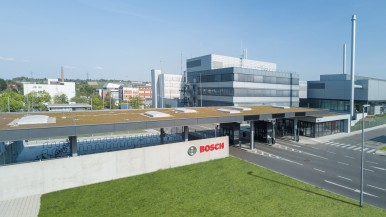
Feuerbach, in Germany, is home to Bosch’s biggest, as well as oldest, location worldwide. It was established by Robert Bosch himself in 1909, and is home to a Bosch plant that has been in existence for more than a century. In other words, it has a rich history. At the same time, it also has a very bright future – not least because the plant has kept pace with progress and is now profiting from the benefits of Industry 4.0 in the areas of manufacturing, maintenance, transport, and monitoring. For example, with a network of over 550 items of connected machinery throughout the plant, the condition of individual production systems can be monitored via a graphic display showing their current operating status. Equipped with this knowledge, plant engineers can intervene at a first sign of a problem, thereby reducing machinery downtime and increasing output. At the same time, the plant also benefits in the field of logistics, where seamless connectivity has substantially enhanced processes and brought greater transparency. For example, a smart supermarket system with put-to-light technology automates the management of inventory and simplifies sorting in a materials store that is located close to the production line. All parts removed are recorded by the inventory management system, and replacement orders automatically dispatched. The resulting transportation is undertaken by digitalized milk runs or fully autonomous ActiveShuttles. Alongside the extensive deployment of software-based solutions, the Feuerbach plant is also driving forward the development of human-machine interaction. This includes the use of APAS, an automatic production assistant that works hand in hand with human operatives without the need for a protective fence. In other words, Industry 4.0 is changing the face of manufacturing and, with it, the nature of manufacturing jobs. Feuerbach has been quick to respond to this trend. In spring 2018, skilled workers from the plant commenced training for the new, nationwide qualification for Industry 4.0 specialists established by the Chamber of Commerce and Industry (IHK). In addition, in its role at Industry 4.0 lead plant, Feuerbach is doing pioneering work on 5G for the entire Bosch manufacturing network with its approximately 250 plants. For this purpose, Bosch has applied for and received a 5G license to build a private campus network. The set up of the network is planned in 2020. General information Plant name Feuerbach Plant Established 1909 Surface area approx. 109,100 m² Workforce approx. 3,000 Products High-pressure pumps and components for exhaust-gas treatment Core competencies Lead plant functions, digitalization/Industry 4.0, carbon coating, contact measurement, Bainitic hardening Division Powertrain Solutions Facts and figures: Industry 4.0 in Feuerbach Over 550 items of connected machinery 10 percent reduction in cycle times Over 50 percent reduction in administrative overheads for production management due to introduction of the Active Cockpit interactive communication platform Over 50 percent reduction in energy requirements (as per January 2019 compared to 2007), also as a result of smart connectivity for diverse data sources

Working Out Loud

04.02.2019

Factsheet

Working at Bosch

Working Out Loud

Working Out Loud (WOL) is a new collaborative approach that imparts the skills associates need to work in a virtual network.Method Working Out Loud is a way of thinking and working. It gives the workforce a tool for collaborating in virtual networks, learning from others, and sharing knowledge. WOL is based on five key elements – relationships, generosity, a growth mindset, visible work, and purposeful discovery. Benefits By using the WOL method, Bosch aims to promote digital collaboration and revamp its learning and working culture, and in this way to boost the company's innovativeness. These days, all associates have to be able to establish and work in networks, as well as to use digital tools. WOL circles are a practical way of acquiring these skills. Circle method A WOL circle allows associates to experience work in networks, regardless of their place in the hierarchy, and to adopt and develop the skills needed to do this. Associates who wish to explore this opportunity register with an internal Bosch WOL community. The community hosts then assign them to groups called circles. Each circle comprises five people with diverse professional backgrounds. Participants first define a personal learning objective they wish to work on with the help of the circle method. The program lasts twelve weeks, during which participants carry out simple tasks and gradually establish a subject-based expert network. In its turn, the network helps them achieve their personal learning objective. In addition to the tasks, the participants meet in person or in virtual conferences for an hour a week. At these meetings, they share feedback on their tasks and learn from one another. On the basis of the feedback they receive by making their work visible in digital networks, associates are encouraged to rethink how they go about their work. Moreover, they use digital tools to work together more effectively, share knowledge, and offer feedback. WOL team WOL at Bosch started as a grassroots initiative. Today, a co-creation team of 14 people is developing the method further and adapting it for new applications worldwide, such as innovation processes. Co-creation means that participation is voluntary.WOL at Bosch WOL community >4,200 members Countries >50 Circles >550 Feedback 97% of the participants recommend the method, 75% have returned for another round, 96% confirm that WOL helps improve their digital skills. Applications Annual WOL conference with internal staff and external partners, on- and off-the-job training options, active contribution to on-boarding events for new associates, integration in innovation processes, leadership development, change programs, and cultural development.

23.02.2018

Factsheet

Working at Bosch

Factsheet: Bosch in Mexico

Important location for the global network of the Bosch Group Bosch has been active in Mexico since more than 60 years (1955) in Mexico. Today, it is present with all of its four business sectors. At ten locations (Aguascalientes, Guadalajara, Hermosillo, Juarez, Mexicali, Mexico City, Querétaro, San Luis Potosí, Tepotzotlán, Toluca), Bosch employs 16,000 associates in Mexico – more than double than in the beginning of the decade. In 2017, business developed well as Bosch generated sales of 1.2 million euros (1.3 billion US-Dollars). Mexico is an attractive market already today and remains an important location in the Bosch Group’s global manufacturing and research network. In Mexico, Bosch is developing and manufacturing both, for the local market as well as the Americas region. The company produces for example hydraulic systems, power tools, security systems as well as mobility solutions such as steering systems and driver assistance systems like ABS and ESP. As a leading user of Industry 4.0 Bosch is also using connected solutions at its Mexican manufacturing plants to increase efficiency, e.g. Juarez and Toluca. The company also offers a wide spectrum of solutions in the areas of drive and automation technology as well as sensors and software for the Mexican manufacturing industry. Mexico is also becoming an increasingly important development location for the Bosch Group. In 2014, the company opened its first software engineering center for the Americas in the Mexican city of Guadalajara. Bosch’s focuses on a strong localization strategy in Mexico: this includes local engineering, manufacturing as well as a high share of local supply.Dual education at Bosch in Mexico The dual education system has a long tradition at Bosch: Robert Bosch set up the first occupational training department at his company in 1913. Today, the supplier of technology and services is training some 7,300 apprentices in more than 30 countries – with nearly 2,500 of these apprentices based outside Germany. Vocational competence development is part of the localization strategy of the Bosch Group. In Mexico, too, the demand for qualified professionals is high. More than 150 apprentices are currently being trained at three Technical Training Centers (Centro de Capacitación Técnica) at Bosch in San Luis Potosí, Toluca and Juarez. The training center in San Luis Potosí opened in 2001 and celebrated its 15th anniversary in 2016. This made Bosch the first - and for a long time the only – company to offer dual training in Mexico. Meanwhile, the model is also used by other companies and is now officially recognized by the Mexican government. Based on the dual system, the center, in collaboration with the San Luis Potosí University of Technology (Universidad Tecnológica de SLP), offers a three-year training in mechatronics with a focus on flexible manufacturing. In addition to technology, subjects such as corporate governance, communication, teamwork, the Bosch Production System (BPS) and quality standards are part of the curriculum. Connected manufacturing requires new skills among skilled workers and trainees. The current dual training program therefore also includes topics in the fields of automation, robotics, IoT and Industry 4.0 in Mexico. Both training and exam requirements comply with the German standard. The training centers are IHK / AHK certified. Since autumn 2017, Bosch also offers apprenticeships for industrial business management for the first time. Market with potential With more than 120 million inhabitants, Mexico is an attractive market. Mexico is the 15th largest economy in the world and has a similar importance in international trade. Mexiko is the country with the most free trade agreements worldwide. In 2016, Mexico was the world's eighth largest market for machinery and equipment with a volume of more than 27 billion euros. Mexico is the seventh largest car manufacturer and the fourth largest exporting nation in the global automotive industry.In view of the country’s current health profile, this market offers increasing potential. Furthermore, Mexico’s food processing industry is the tenth largest worldwide.