03.03.2021
Factsheet
Industry 4.0
Bosch combines Industry 4.0 with AI
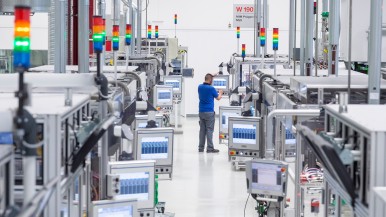
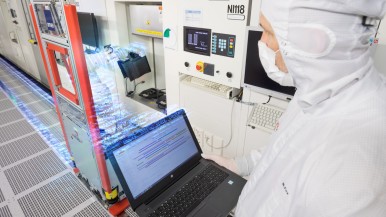
Stuttgart, Germany – Bosch is developing the factory of the future. In this endeavor, the company sees Industry 4.0 as the way forward. Once Bosch has tested and validated products in-house, it markets them to other companies. Its portfolio ranges from software packages for manufacturing and logistics, to robots that make and deliver parts, to workplace assistance systems. The company expects that the use of artificial intelligence will take its endeavors to the next level. It can help reduce reject rates in factories, for example, and improve the utilization of machines and systems.AI in action: Examples from Bosch manufacturing operations Industry 4.0 combined with artificial intelligence helps in finding solutions for complex tasks. Connected manufacturing provides data and AI evaluates it. One use case for artificial intelligence is in production scheduling in highly automated wafer fabs such as the Bosch plant in Reutlingen, Germany, where it saves time and costs as it guides the wafers through up to 1,000 processing steps. This means a five percent faster wafer throughput, with an investment payback time of just three months. Bosch also uses artificial intelligence in its quality control. At its Immenstadt location, the screen at the test bench for ABS systems lights up red to show the assembly workers if the component being tested is defective. This information is provided by a self-learning system that uses the data it has collected to recognize error patterns and, in this way, to distinguish relevant error messages from non-relevant ones. Weekly retraining of the algorithms constantly improves the high success rate. Quality improvement is also the focus at the Bosch Rexroth plant in Homburg, where machine tools process hydraulic valve housings for mobile applications such as tractors. Machine learning methods are applied to make near real-time statements about the quality of workpieces on the basis of the data collected by machine tools. If necessary, the production processes are immediately adjusted, thus reducing the number of reject parts. Having reached development maturity, the AI application eliminates the need for labor-intensive downstream lab tests. Bosch develops AI solutions for its own plants and for customers Bosch’s special-purpose machinery unit has designed Machine Vision AI, an application platform for machine-based visual inspection of workpieces. It helps detect hard-to-identify features such as scratches and chipping on surfaces and defects in weld seams. The salient features of this solution are its ease of use and high reproducibility. A gradual rollout of the technology is currently underway in Bosch plants. The Bosch Rexroth APAS inspector , a production assistant for automatic visual inspection, is already established in factories and available on the market. Its learning image processing software means the system can be “retrained” at any time without requiring extensive programming knowledge on the part of the operators. AI also helps make manufacturing more resource friendly. More than 100 Bosch plants and locations utilize the Energy Platform from the company’s Industry 4.0 portfolio. Also available to external customers, the platform uses intelligent algorithms to quickly detect machines’ energy consumption and cushion any peak loads. This further reduces carbon dioxide emissions in factories; for example, Bosch’s lead plant for Industry 4.0 in Homburg, Germany, cut its emissions by some ten percent within two years. Bosch is now adding what it calls a Balancing Energy Network to its Energy Platform. This software solution uses AI to control and optimize energy flows in manufacturing operations. In addition to boosting energy efficiency, it allows power from renewable energy sources to be put to the best use, enabling flexible operating schedules to be drawn up. Originally developed for manufacturing facilities, the software has the potential to help all types of larger building complexes reduce their environmental footprint, including hospitals, shopping malls, and sports arenas. Bosch is a pioneer and leader in Industry 4.0 Bosch has been adding connectivity to manufacturing and logistics since 2012, with almost all its plants now using Industry 4.0 solutions. Projects in this area deliver measurable benefit. Industry 4.0 solutions make it possible to increase productivity at individual locations by up to 25 percent. One example is the Nexeed software developed by Bosch Connected Industry, which enables real-time management, monitoring, and control of production activities. Validated and used in Bosch factories, Nexeed has already won over more than 100 customers from a wide range of sectors, including BMW and the sensor manufacturer Sick. While Bosch Connected Industry focuses on Industry 4.0 software for production, the Bosch.IO unit offers cloud-based IoT solutions aimed primarily at logistics and AI-based energy management. Bosch Rexroth develops smart hardware, intelligent robotics solutions such as APAS or ActiveShuttle, and pioneering automation technology for the factory of the future. It has now launched an open, 5G-capable automation control platform: ctrlX Automation. Bosch Manufacturing Solutions rounds off the Industry 4.0 portfolio. The special-purpose machinery unit provides customized systems for production, from assembly to process and testing technology.