Search & find:
Media, press releases, events for your editorial coverage

IAA Mobility 2025: Bosch is shaping the new vehicle world with intelligent hardw ...

08.09.2025

Press release

Automated mobility

IAA Mobility 2025: Bosch is shaping the new vehicle world with intelligent hardw ...

Munich, Germany – In the automotive industry, the Bosch name is synonymous with software. The technology company is demonstrating this to impressive effect at this year’s IAA Mobility in Munich. And there’s more: from a single source, Bosch also supplies hardware that’s tailored to the possibilities of the software – a compelling unique selling point for the company worldwide. “Bosch knows its way around software and hardware. Without sophisticated hardware, even the smartest car won’t move a single millimeter,” said Dr. Stefan Hartung, chairman of the Bosch board of management, at the trade fair. “Our aim is to continue playing a key role in shaping the industry in the age of software-driven mobility by offering tailored, intelligent solutions.” Bosch knows its way around software and hardware. Without sophisticated hardware, even the smartest car won’t move a single millimeter. Our aim is to continue playing a key role in shaping the industry in the age of software-driven mobility by offering tailored, intelligent solutions....Dr. Stefan Hartung, chairman of the Bosch board of management Initial indications point to success: Bosch has established a foothold in the software-driven world. One example is Bosch’s by-wire systems for braking and steering, which are considered a key technology for software-defined vehicles and automated driving. Here, the software takes control; a mechanical connection is no longer necessary. This is an important business for Bosch. With brake-by-wire and steer-by-wire, the company expects to achieve cumulative sales revenue of more than 7 billion euros by 2032. The market dynamics of this key technology will continue to accelerate in the 2030s. By-wire technology is a taste of what lies ahead for vehicle construction overall. “In the future, hardware will be designed to fit software requirements,” said Dr. Markus Heyn, member of the Bosch board of management and chairman of the Mobility business sector. In the future, hardware will be designed to fit software requirements,...Dr. Markus Heyn, member of the Bosch board of management and chairman of the Mobility business sector Bosch wants to turn cars into personal assistants In software-driven mobility, Bosch Mobility’s business continues to develop – from hardware with embedded software, to services, to completely independent software that manufacturers and partners then integrate into their ecosystems. “Whether stand-alone or interconnected, standardized, integrated, or decoupled – we can offer everything exactly as the customer wants it,” Hartung said. This is clearly having an impact: despite stagnating global vehicle production, weak demand, and delays in electromobility and automated driving, Bosch Mobility will grow slightly in the current year. The increase in sales revenue is expected to amount to a little less than 2 percent. Up to today, a vehicle was never as new as the moment it was delivered. “In the future, however, its software will be continuously updated and it will be constantly learning by means of artificial intelligence,” Heyn said. “More than anything else, the new mobility is user centered.” This is what that looks like: Bosch’s Vehicle Motion Management software coordinates all vehicle movements by centrally controlling the brakes, steering, powertrain, and chassis. This improves coordination between the individual systems – and also means they can be adjusted to the driver’s preferences. A particularly smooth ride today? A little more agility tomorrow? And jolt-free stopping the day after? No problem – at the touch of a button, the car feels completely different. Incidentally, Bosch’s Vehicle Motion Management is decoupled from the hardware, which makes it easy to use in different vehicle architectures. That’s not just theory, it’s happening: the Bosch software is in widespread use, with more than two dozen manufacturers in Europe, China, and Japan already having adopted it. Over the next three years, Bosch will be investing a nine-figure sum in Vehicle Motion Management and expanding its modular software and function portfolio across all domains. Vehicle Motion Management from Bosch works even better in combination with by-wire solutions, because the software can control the respective braking and steering actuators independently of the driver’s actions – for greater safety, improved convenience, or better vehicle dynamics. Bosch’s smart software makes the difference Bosch’s ADAS product family is also software-driven. For intelligent driver assistance systems, vehicle manufacturers can choose from three preconfigured variants that can then be put into production quickly and in a brand-specific way. Here, too, hardware and software can be integrated or purchased separately, depending on customer requirements. Both options benefit from a holistic approach: since Bosch understands the interaction between hardware and software, it can offer individually optimized solutions that can be seamlessly integrated into existing environments. Modern vehicles, which are designed and developed from a software standpoint, make use of ever fewer, but more powerful vehicle computers. These are a growth driver for Bosch: its high-performance computer business is currently growing by more than 5 percent every year, with automakers such as the BMW Group among the customers. Bosch also offers central vehicle computers that combine various functions, such as in driver assistance and infotainment, on just one control unit and one system on a chip (SoC). This saves space, costs, and energy. These systems have a modular structure and can flexibly integrate software from different manufacturers. In China, Bosch is supplying a high-performance computer to SAIC-GM to create a cockpit featuring artificial intelligence. Thanks to this AI cockpit, drivers can talk to their car in a completely natural way and interact with it as if it were a human being. Bosch’s knowledge and expertise make it a sought-after partner The software-driven future is fundamentally changing the automotive industry. Bosch wants to seize the opportunities this new world presents – and is in a good position to do so. Hardly any other company combines hardware and software expertise and global presence as seamlessly as Bosch. This makes the company a flexible and reliable partner for the development of intelligent and connected vehicles. After all, strategic partnerships are crucial, particularly where new business models and scalable software systems are concerned. In China, Bosch is already working with WeRide and Horizon Robotics on the development of systems for assisted and automated driving. In Europe, Bosch and the VW subsidiary Cariad are strategic partners in this area. Bosch assumes that such alliances will become increasingly important in the future, and that the proportion of software in vehicles will continue to rise – and with it, the benefits for drivers in the form of even safer and more convenient mobility.


Bosch and CARIAD are making automated driving even safer and more convenient with AI

11.08.2025

Press release

Automated mobility

Bosch and CARIAD are making automated driving even safer and more convenient with AI

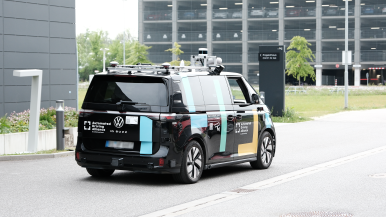
Bosch and CARIAD are intensifying their cooperation within the Automated Driving Alliance: the partners are developing their software stack for Level 2 and 3 assisted and automated driving by making full use of artificial intelligence. To this end, Bosch and CARIAD are expanding their existing approaches to include state-of-the-art AI methods. This should lead to more powerful, more intelligent driver assistance systems that act as naturally as a human driver – taking the driving experience to a new level and making it even safer. The software stack covers all essential cognitive tasks of perception, interpretation, decision-making, and action. When it comes to getting automated driving systems onto the roads reliably and at scale, data and AI are the key....Mathias Pillin, CTO of Bosch Mobility Expanding the use of modern AI brings the Automated Driving Alliance another step closer to its major goal: Bosch and CARIAD want to make automated driving available to millions of private motorists, from the mass-market to the premium segment. Their goal is for the new driving functions to allow drivers to take their hands off the steering wheel in various driving situations. The first versions have been implemented in test fleets and are now being systematically trained and further developed on a daily basis with large amounts of data. A software stack for application in production projects will then be available from mid-2026 onward. The Volkswagen Group plans to integrate Bosch and CARIAD’s automated driving functions into its new architecture for software-defined vehicles. Covering the range from individual driving functions to the complete software environment, Bosch will also make this scalable solution available to other manufacturers worldwide in order to actively promote automated driving on a broad scale. The project team of the two companies thus impressively demonstrates that dedicated partnership, technological excellence, and a clear focus on goals lead to innovative European solutions. Peter Bosch, the CARIAD CEO, says: “We’re demonstrating that the German automotive industry has mastered the key technologies of artificial intelligence and automated driving. With the expertise of our developers and engineers, we are securing an integral part of Europe’s digital sovereignty. Our goal in the Alliance is to make the convenience and safety of automated driving systems accessible to as many people as possible so that they can gain valuable time when they’re in their car.” Mathias Pillin, CTO of Bosch Mobility, adds: “When it comes to getting automated driving systems onto the roads reliably and at scale, data and AI are the key. We can only rise to this challenge together if we work as equal partners and abandon ingrained mindsets. Together with CARIAD in the Automated Driving Alliance, we’re showing how this can work.” Use of AI in all technology components The Automated Driving Alliance has been using AI since the partnership begin – in, for example, the area of perception for functions such as object recognition. AI is now being used along the entire software technology chain: in everything from object recognition and the fusion of various sensors such as cameras and radars to decision-making and the safe automated control of the powertrain, steering, and brakes. In the future, the automated driving functions will be based on an end-to-end AI architecture in which all modules will become even more powerful and intelligent through the use of AI. At the heart of these developments is the use of state-of-the-art technology familiar from generative AI applications. Just as language models understand complex semantic relationships, the Automated Driving Alliance’s new AI stack can analyze urban traffic scenarios and anticipate both the current and potential behavior of road users from different sensor modalities. Bosch and CARIAD are making these technological advances within the framework of a modern engineering environment and comprehensive hardware strategy that will ensure scalable and future-proof implementation in all vehicle classes. End-to-end development of all technology elements with their own source code and intellectual property forms the basis of the development partnership. This enables complete technical control of the source code with clear standards for data protection, security, driving safety, and transparency, as well as the ability to generate innovations quickly and flexibly through source code optimization and then deliver them to customers. The developers design the architecture in such a way that the AI’s decisions and actions remain safe, traceable, and explainable. The software stack also lays the groundwork for the possible integration of multimodal AI approaches that link visual and linguistic information. Called vision-language-action (VLA) approaches, they can imitate the logical thinking and actions of humans. Such a step would enable even more efficient training and an even deeper understanding of complex traffic situations. For example, VLAs can help detect hidden risks while driving and facilitate the appropriate response. Large test fleet for daily training of driving systems The AI stack will make automated driving in the Level 2 and Level 3 range even more robust. Up to the start of production, performance will be steadily improved by continuously collecting enormous amounts of data in order to maximize the system’s safety and reliability. A comprehensive test and validation fleet on public roads is essential for this. The CARIAD and Bosch teams are working together worldwide, testing the driving functions on public roads in Europe, Japan, and the U.S. – underlining their ambitious plan to create a software stack for automated driving that can be used in many global markets. Development is data-driven, which means that the software can be imported into the test vehicles several times a day with new updates and optimizations to the source code. The technology is already being used in test vehicles such as the ID.Buzz and the Audi Q8. This year alone, hundreds of additional test vehicles will be equipped with a comprehensive set of sensors in order to collect high-quality data. That data helps developers further optimize the AI stack and analyze rare and complex driving situations, known as corner cases. Thanks to the development of an end-to-end, AI-supported software solution, assisted and automated driving will become even safer and more convenient for the consumer.

Bosch at bauma 2025

07.04.2025

Press release

Powertrain systems

Bosch at bauma 2025

Stuttgart and Munich, Germany – Over one million new construction vehicles will be produced worldwide in 2025 alone. As different as their performance classes and tasks are, they almost all have one thing in common: a diesel engine. Its robustness and strength make it the ideal powertrain for a wide range of applications. At the bauma 2025 trade fair, Bosch will be showing how carbon emissions can be reduced even further in this vehicle segment. “Renewable synthetic fuels make operating both new and existing vehicles much more climate-friendly,” says Jan-Oliver Roehrl, executive vice president of the Bosch Power Solutions division and head of commercial vehicle activities at Bosch. “And in the future, hydrogen engines and electrification also stand to make construction machinery much more sustainable.” Renewable synthetic fuels make operating both new and existing vehicles much more climate-friendly. And in the future, hydrogen engines and electrification also stand to make construction machinery much more sustainable....Jan-Oliver Roehrl, executive vice president of the Bosch Power Solutions division and head of commercial vehicle activities at Bosch Renewable synthetic fuels make combustion engines more climate-friendly Construction vehicles are already subject to comprehensive exhaust-emission regulations, such as Stage V in Europe, Tier 4 in the U.S., and Phase IV in China. To date, however, their climate-relevant emissions have been regulated only to a limited extent, at least by law. One simple option for greatly reducing their carbon emissions that is already available today is to use renewable synthetic fuels such as HVO100. Because these fuels are based on residual and waste materials, they are much more climate-friendly than fossil fuels in terms of overall carbon emissions. They are also “drop-in” fuels, meaning they can be mixed with normal diesel fuel as required. Since Bosch already takes compatibility with these fuels into account when developing its injection technology, they are suitable for use in its products. According to Bosch forecasts, four out of five new construction vehicles worldwide with over 56 kilowatts will still have a diesel engine in 2035. That is why Bosch will continue to develop injection technology and urea dosing technology for exhaust-gas treatment in the future to suit the various segments of the construction machinery market. The Digital Fuel Twin documents the use of renewable synthetic fuels Renewable synthetic fuels can make construction machinery more climate-friendly: the more of it they use, the smaller the carbon footprint of each individual vehicle. Bosch makes this effect visible with a purely digital software solution called the Digital Fuel Twin. This documents the amounts of fuel distributed as well as the fuels’ sustainability, from production and transportation all the way to the filling station. It provides the operators of construction machinery with certificates corresponding to how they have refueled their vehicles; these document the total amounts of fuel used and even the proportionate carbon footprint when using the vehicle. Hydrogen engines build on tried-and-tested foundations When it comes to hydrogen engines, German manufacturers and suppliers can draw on decades of expertise, particularly in the field of engine technology: some 80 to 90 percent of the technology involved can be transferred from conventional combustion engines. If the hydrogen fueling the engines is produced with renewable energy, their use could mark a big step forward for the climate. Often, construction machinery is stationary and operates under heavy loads. “This is precisely where hydrogen engines, with their high efficiency and robustness, can really excel,” Roehrl says. “The first applications of hydrogen engines featuring Bosch injection technology will be launched this year.” Bosch is working on both port- and direct-injection systems and is already involved in more than 100 development projects with customers worldwide. Moreover, the hydrogen engine is also a promising option for large engines, for example as the powertrain for dump trucks in mining. Here, too, robustness and reliability combined with a compact design are essential for economical operation. Electrification solutions for construction machinery In certain construction machinery applications, electrification is another efficient and climate-friendly option for mobile and stationary functions. With its eLION electrification portfolio, Bosch Rexroth already offers a wide range of motors, inverters, gearboxes, software, and accessories, including the appropriate hydraulics. This Bosch subsidiary is currently expanding its range to include components for 96-volt vehicle electrical systems; at the end of 2025, it will introduce a standardized software platform for all voltage classes. Bosch Engineering, meanwhile, is presenting a newly developed high-performance solution for battery voltages of up to 800 volts. This subsidiary’s new electric powertrain system is compact and offers high power density as well as high efficiency. It is also suitable for construction machinery with high power requirements and limited installation space, such as wheel loaders. Bosch, Bosch Rexroth, and Bosch Engineering will be showcasing these solutions at bauma, at booths A3/327 and A4/526.

Bosch invests millions in metal 3D printing center

18.03.2025

Press release

Business/economy

Bosch invests millions in metal 3D printing center

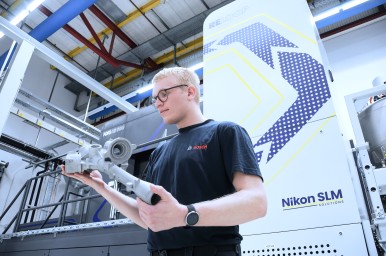
Nuremberg and Stuttgart, Germany – Speed, precision, flexibility, and energy efficiency: for Bosch, these factors are key when manufacturing the complex metal parts that it supplies to its in-house and third-party customers. With a new metal 3D printer at its Nuremberg plant, Bosch wants to bolster its pioneering role in the supplier industry. In fact, it is the first Tier-1 automotive supplier in Europe to have a facility in this performance class. The plant has invested almost six million euros in the center and in the associated purchase and installation of a Nikon SLM Solutions NXG XII 600 metal 3D printer. Bosch remains committed to Germany as an industrial location and is investing large sums of money here. By introducing new technologies in our plants, we are securing considerable sales potential....Klaus Mäder, member of the Bosch Mobility sector board responsible for operations. “Bosch remains committed to Germany as an industrial location and is investing large sums of money here. By introducing new technologies in our plants, we are securing considerable sales potential,” says Klaus Mäder, the member of the Bosch Mobility sector board responsible for operations, including all plants worldwide. The new 3D printer is intended to accelerate development cycles, especially for metal parts, which take a long time to make using conventional manufacturing processes. Commenting on the facility’s official start of operations, Alexander Weichsel, the commercial plant manager in Nuremberg, says: “By making the manufacture of metal parts faster and more productive, this new facility will increase our competitiveness.” And the technical plant manager Jörg Luntz adds: “With this facility, we are setting the highest standards in metal 3D printing. In volume production, this will open up completely new possibilities for us.” Whether components for hydrogen applications, motor housings for electric cars, components for e-axles, or engine blocks for racing: the facility’s sheer size and technical capabilities pave the way for a host of applications. Working from a computer-aided design file developed in advance, its twelve lasers melt metal powder layer by layer to create highly complex shapes. The new metal 3D printer is up to five times faster than the 3D printing systems that have been used up to now. Complex structures such as interior or curved channels, which are simply not feasible with conventional milling processes, can now be produced without any problem. While drilling around corners is not possible using conventional methods, 3D printing makes light work of this. The printer can produce unfinished parts on demand with no need for tooling. And because 3D printing slashes raw-material waste to almost zero, it also conserves resources. “Using the 3D printer to manufacture components not only increases sustainability in production, but also enables Bosch to respond flexibly to fluctuations in batch sizes and offer everything from a single source,” Weichsel says. Manufacturing a complete engine block using the 3D printing process One particularly vivid example of the new possibilities that the 3D printing process opens up is the engine block: with conventional manufacturing, it can take up to three years to get from the first draft design to volume production. Completing the casting mold for the engine block alone can take up to 18 months. 3D printing does away with this step. The design data is transmitted directly to the printer, eliminating the need for complex molds. The 3D printer delivers a finished engine block after just a few days, thus greatly reducing overall product development time. At full capacity, the facility can produce metal parts with a total weight of around 10,000 kilograms in under a year, achieving speeds of up to 1,000 cubic centimeters per hour. The main aim of this faster component production is to cut the time to market. “We want to be faster than with traditional manufacturing processes and use this technology to get products to market more quickly,” Luntz says. “Even today, only a few companies can produce technology on an industrial scale the way Bosch does. We’re now going one step further, taking volume production in metal 3D printing to the automotive level.” This opens the door to completely new opportunities and possibilities – in the automotive sector, but also in numerous other industries such as energy and aviation.

With brake-by-wire from Bosch to the Arctic Circle

28.01.2025

Press release

Electrified mobility

With brake-by-wire from Bosch to the Arctic Circle

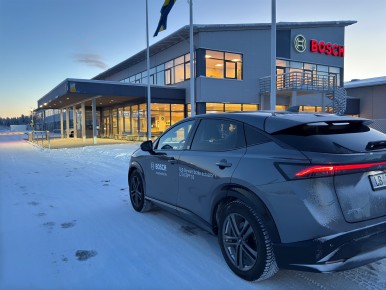
Stuttgart – For six days, over 3,300 kilometers and through different climate zones to the Arctic Circle: On an unusual test drive, a Bosch development team successfully tested the new hydraulic brake-by-wire system from Bosch for the first time on public roads. What sets brake-by-wire apart: This solution completely eliminates the mechanical connection between the brake pedal and the brake system. The driver’s brake request is transmitted to the brake-by-wire system purely as an electrical signal via redundant signal lines. For this fundamentally new approach, Bosch offers a robust and efficient solution with two independent hydraulic brake actuators – a by-wire brake actuator and an ESP ® . Today’s brake systems, such as the integrated power brake from Bosch, still ensure the required redundancy in the event of a fault via a mechanical connection to the brake pedal. This coupling via an input rod to the brake pedal is eliminated in the new Bosch brake-by-wire solution.As a leading company in braking and steering systems, Bosch is working on innovative by-wire solutions for both vehicle domains – including this hydraulic brake-by-wire system, which is planned to be launched on the market from fall 2025. In addition to the hydraulic solution, Bosch is also developing a purely electromechanical system. The company has already received orders from various vehicle manufacturers and expects that by 2030, more than 5.5 million vehicles worldwide will be equipped with brake-by-wire. Advantages of the Bosch brake-by-wire system New freedom in installation: Due to the omission of the mechanical connection, there is no longer any need to mount the brake system components at the vehicle’s firewall. Instead, the components can now be installed where it is most optimal in terms of crash safety, NVH, and manufacturing. The flexibility in choosing where to install the brake actuators helps to avoid the need for different variants for right-hand and left-hand drive vehicles. By-wire technology enables new pedal concepts with significantly shorter brake pedal travel to create space for new interior designs. The hydraulic brake-by-wire solution from Bosch is based on proven brake system technology and is a combination of a by-wire brake actuator and an ESP ® . Its slim design saves installation space and reduces the weight of the brake system. Since both the by-wire brake actuator and the ESP ® are assigned to different channels of the redundant electrical system, they can each independently build up the required brake pressure at all four wheel brakes in the event of a fault. Therefore, this Bosch solution is also suitable for highly automated vehicles, meeting the protection of the brake system required for safety reasons. Successful long-distance test provides valuable data for further development The brake-by-wire system is being developed at the Bosch development center in Abstatt near Heilbronn. The long-distance journey led the development team from the southwest of Germany via Hamburg, Copenhagen and Stockholm and a short detour to the Arctic Circle to the finish at the Bosch winter test center Vaitoudden in Arjeplog, in northern Sweden. Bosch has specifically applied for and obtained approval for public roadway use for the test vehicle in several countries, based on an extensive safety concept. “The whole team has worked towards this event with incredible motivation and is very proud of this achievement. Our hydraulic brake-by-wire system has worked perfectly on the journey. With our first long-distance test, we impressively demonstrated that we can bring a real brake-by-wire system safely and successfully from the test track to the road", explains Hagen Kuckert, project manager for the by-wire brake actuator at Bosch in Abstatt. „We performed thousands of braking operations during the journey, were able to obtain important insights and data on the behavior of the brake system in a wide variety of traffic situations and compare them with our previous simulations. All this is incorporated into the further development work to further optimize our hydraulic brake-by-wire system."

New Bosch radar-based assistance system used for first time by KTM

24.09.2024

Press release

Two Wheeler

New Bosch radar-based assistance system used for first time by KTM

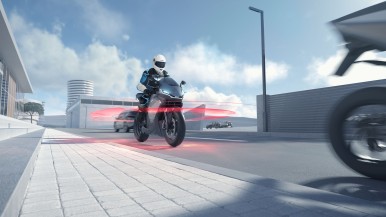
Stuttgart, Germany, and Yokohama, Japan – Thanks to Bosch, motorcyclists can now feel even safer in the saddle: the technology company has unveiled six new radar-based assistance systems, including five world-firsts. According to Bosch Accident Research, these could help prevent not just one in seven, like earlier systems, but as many as one in six accidents on German roads alone. Bosch already revolutionized the motorcycle market back in 2020 with its support functions for motorcyclists. Of the six new assistance functions, four will be unveiled in a new model from leading European motorbike manufacturer KTM in November 2024 and are set to enter production in 2025. “Bosch’s declared aim is to make motorcycling even safer and more comfortable by employing innovative new technologies – without diminishing riding enjoyment,” says Geoff Liersch, head of Two-Wheeler & Powersports at Bosch. “The new functions mark yet another step in this direction, and we’re delighted to have KTM as a customer.” The manufacturer will incorporate the four Bosch rider assistance functions that use front radar. This is not the first time Bosch and KTM have worked together: in 2013, the two companies collaborated on the successful launch of the MSC motorcycle stability control system. „We’re very satisfied with the longstanding collaborative relationship between our development teams, and we’re excited that KTM is the first to put these new functions to use,” says Stefan Haist, Lead KTM Chassis Control System – Street Development.Bosch assistance systems provide more support on two wheels Adaptive cruise control – stop and go (ACC S&G) For two-wheelers, traffic jams can be strenuous as well as dangerous. Riders have to constantly apply the clutch, use the brakes, and then start moving again. To make this task easier, Bosch launched ACC adaptive cruise control back in 2020. Once the desired speed has been set, this system constantly matches the vehicle’s speed to the flow of traffic while maintaining the necessary safe distance from the vehicle in front. Bosch has now taken this technology to a new level to offer increased riding comfort with its new ACC S&G function, which can bring the motorcycle to a controlled standstill in order to support the motorcyclist. This works best with an automatic transmission such as the one used in KTM’s new bike, which will be the first to incorporate this new function. If their motorcycle comes to a halt, there is no need for riders to use the clutch; they can set their bike in motion simply by pressing a button or briefly activating the throttle as soon as the vehicle in front starts moving. Group ride assist (GRA) Group riding in a staggered formation is popular among motorcyclists, though it can be challenging with ACC, because the function expects the motorcycles riding in front to be in the middle of the lane. GRA is a useful addition to ACC; using an algorithm, it detects when a group is riding in a staggered formation and regulates the speed to automatically maintain the same distance from the motorcycles in front. In this way, the function assists riders in achieving a natural group formation. When not riding in groups, the GRA system works the same as ACC. Riding distance assist (RDA) When traffic is flowing smoothly and RDA is activated, it helps maintain an appropriate distance from vehicles in front and thus prevent rear-end collisions. With ACC, a desired speed must be set; but when RDA is activated, the motorcycle can be controlled as normal via the throttle grip. While riding, the system automatically reduces the vehicle’s acceleration or applies the brakes as and when required. Riders can set the desired distance from the vehicle in front beforehand. If they wish, they can also use a switch to deactivate the function or apply the throttle to override the deceleration generated by the RDA system. This enables the function to blend naturally and comfortably into the dynamic flow of riding. Emergency brake assist (EBA) Hazardous situations on the road require not only a rapid response but, in many cases, emergency braking. Every second counts when it comes to preventing collisions and avoiding potentially serious consequences. EBA is triggered when the system detects a risk of collision and the rider doesn’t brake hard enough. In this case, the function actively increases the wheel brake pressure further to reduce the bike’s speed as quickly as possible. Rear distance warning (RDW) Even in a car, it can be hard to keep a constant eye on traffic approaching from behind; but on a motorcycle, it requires an extra level of concentration. RDW monitors the situation behind the rider and flashes a warning on the display if another vehicle gets too close. Based on this warning, the rider can take mitigating action to prevent a rear-end collision. Rear collision warning (RCW) RCW warns vehicles behind the motorcycle when a rear-end collision is imminent, for example by activating the hazard warning lights. In this way, the function protects motorcyclists from accidents caused by having to brake unexpectedly or by a vehicle failing to see them – whether waiting at traffic lights, sitting in a traffic jam, or riding in free-flowing traffic. These new functions supplement Bosch’s worldwide portfolio of radar-based assistance systems, thus expanding the “sensory world” of the motorcycle. In addition to basic safety features, increasing importance is also being given to convenience and experience features that focus on the motorcycle and take real-life riding situations into consideration – functions that ensure not only safety and convenience, but also unmatched riding enjoyment.

Innovative Bosch racetrack technology on the new Ducati Panigale V4

26.07.2024

Press release

Two Wheeler

Innovative Bosch racetrack technology on the new Ducati Panigale V4

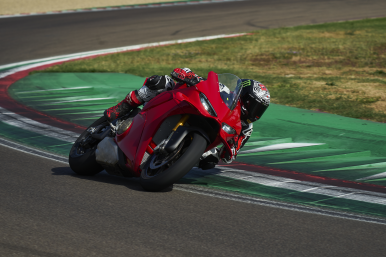
Stuttgart, Germany, and Misano, Italy – Gaining a few more seconds on corners, bettering the previous lap time, and delivering an outstanding performance – that’s what most riders on the racetrack have in their sights. But all this involves challenges. One of the biggest is the phase before entering the corner, where braking is crucial for success. With its new race eCBS, Bosch is delivering a solution specifically for the racetrack. Based on the proven eCBS, the new brake system will celebrate its premiere on the new Ducati Panigale V4 at World Ducati Week 2024 in Misano. “The Bosch and Ducati Engineering teams have worked very intensively and in numerous tests on a function that specifically improves racetrack braking and cornering performance,” says Fevzi Yildirim, head of Bosch Two-Wheeler and Powersports in Europe. “The Bosch race eCBS takes the safety and performance of sport motorcycles a big step forward, and is also further evidence of the ongoing fruitful cooperation between Bosch and Ducati.” The Bosch Race eCBS takes the safety and performance of sport motorcycles a big step forward, and is also further evidence of the ongoing fruitful cooperation between Bosch and Ducati....Fevzi Yildirim, head of Bosch Two-Wheeler and Powersports in Europe The development path started from the eCBS function powered by the Bosch ABS for premium bikes. This technology allows the front and rear brakes to be combined even if only one of them is applied. In practice, this means that once the front brake has been applied, the ABS unit automatically increases the rear brake pressure as well, without any rider input on the rear brake pedal. Starting from the existing eCBS function for everyday use, the development teams from Bosch and Ducati focused on improving performance specifically for the racetrack. Constant data checks for perfect brake pressure on the racetrack To generate perfect brake pressure on the rear wheel, the system checks front brake pressure, lean angle, side-slip angle, and rear-wheel slip 100 times per second and incorporates this data into the calculation. At all times, the aim is to brake the rear wheel as effectively as possible, while ensuring that the vehicle always remains stable. As this function is only available in racetrack ABS modes, there is no rear-wheel ABS, which leaves riders in full control of the rear brake if they want to use it manually. Moreover, race eCBS is able to keep the rear brake applied for a short moment at the apex of a corner, even after the rider has released the front brake, to bring the bike back into its racing line. The major advantages of this next-level technology are that it improves braking stability, average deceleration, and cornering while braking on the racetrack without any need for additional effort to manually control the rear brake. “This function is made for every type of rider level on the racetrack. The automatic and effective application of the rear brake will help even professional riders reach a better lap time, since they can concentrate on riding instead of on controlling the rear brake,” Yildirim says. "Ducati has always looked for innovative solutions and aimed for absolute performance from its products. The new race eCBS system has the dual value of both improving the bike’s braking performance and, above all, allowing every user to access riding levels that were previously out of their reach,” explains Alessandro Valia, the official Ducati tester who worked on the system’s development. “This relies on the principle of emulation of a professional rider’s braking technique. The system generates pressure at the rear brake even after the front brake has been completely released – a maneuver normally carried out by the rider to tighten the line on corner entry. This feature also benefits professional riders, who will be able to devote the attention normally spent on modulating the rear brake to other aspects of riding,” Valia says. This project is another milestone in the more than 15-year partnership between Bosch and Ducati and demonstrates their ability to develop innovative solutions for greater motorcycle safety without sacrificing riding experience and performance. “Together, we’re setting the standard for two-wheeler mobility now and in the future,” Yildirim says. Bosch will also be attending the World Ducati Week, the world’s biggest Ducati rally, which takes place from July 26 to 28 at the Marco Simoncelli Misano World Circuit. In collaboration with the Ducati Riding Academy and Ducati Riding Experience (DRE) courses, the automotive supplier will offer talks, round tables, and hands-on demonstrations. In this way, it wants to provide insights and discuss the technical topics associated with motorcycle safety, focusing on the Bosch technologies that feature in the latest Ducati models – including Bosch race eCBS. Click HERE to see the full program of the WDW 2024 event.

German industry proposes new development standard for safe automated driving

21.11.2023

Press release

Automated mobility

German industry proposes new development standard for safe automated driving

Stuttgart, Germany – Four years ago, the German automotive industry joined forces with 21 partners in a project to develop the world’s first structures for the verification of safety standards for automated vehicles in an urban environment. The results of the joint Verification and Validation Methods (VVM) project are now available. The findings of the pre-competitive research project, funded by the German Federal Ministry for Economic Affairs and Climate Action and initiated by the VDA flagship initiative autonomous and connected driving, will be discussed in detail at the final presentation at the Carl Benz Arena in Stuttgart today.The higher the level of automated driving and the more complex a system’s area of application, the more factors need to be taken into account during development. The first SAE Level 3 systems for freeway driving and an SAE Level 4 system for driverless parking have already been approved. Expanding the use of these systems to other applications – such as urban traffic – means that the vehicle and system become much more complex and subject to far stricter requirements. This explains the need for suitable verification and validation methods, which was the focus of the VVM project’s efforts. The challenge of urban traffic “Pedestrians, cyclists, motorized two-wheelers, intersections with limited visibility: one of the biggest challenges for automated driving systems is coping with traffic in an urban environment, which is characterized by a huge volume of road users, traffic light systems, traffic signs, and vehicles,” says Roland Galbas from Bosch, the coordinator of the VVM consortium project. “For future vehicles to be able to handle even extremely rare scenarios, they will need comprehensible structures and processes that not only enable the safe operation of a system in exceptional situations, but can also verify that maneuvering is done safely.” “The essence of the VVM research project is to verify that automated driving functions react safely and reliably, and that they also benefit customers in terms of precision and quality,” says Dr. Mark Schiementz from BMW, the co-coordinator of the project. “In addition to compliance with regulations, the guiding principle behind the German automotive industry’s work is not only to get technological progress onto the roads as quickly as possible, but also to provide safe vehicles and systems that can be relied on at all times. And this reliability starts right from the development of these systems.” Approval for road use requires verifiable safety Right from the very beginning of the design and development of automated driving functions, safety is the overriding consideration. And safety functions must be verified before a vehicle can be approved and certified for use in road traffic. To be able to provide this verification, the 21 project partners have jointly developed a model comprising a suite of procedures, methods, and tools. This allows a “security argumentation” to be employed to verify that the system is safe to use. To develop the methodology for this model, the partners worked together in several subprojects. If it were applied industry-wide, the defined model would provide the basis for verifying the safety of automated vehicles. “The models developed here make it possible for the first time to provide all automakers with the same structures for the verification and validation of automated driving systems in urban areas. This may then also lead to industry-wide standards that could make road traffic even safer for all road users,” explains Dr. Helmut Schittenhelm, project coordinator at Mercedes-Benz. Technology pioneer from Germany The VVM project’s methodological approach is the world’s first standard to also take industrial processes into account, once again underscoring the German automotive industry’s pioneering role in automated driving. The world’s first regulation for fully automated driving (SAE Level 4) came into force in 2021, when Germany enacted a law to that effect. In 2022, a corresponding regulation outlining the technical details was passed to allow such vehicles to be registered and operated on German roads. These latest developments are yet another example of how the German automotive industry is tackling the complexity of automated driving and making it more manageable. At the end of its project term, and building on the results of its Pegasus and SetLevel predecessor projects, VVM now delivers the world’s first consistent methodical approach to safety for automated driving in an urban environment, enabling industry-wide collaboration and value creation. The scenario-based safety verification approach pursued in the project could help to set global standards once it has been approved by the authorities. VVM has created a reference system for the industry that is relevant for the future, closes a methodological gap for practical validation, and secures the pioneering role of German industry in international competition on automated driving.

Bosch and Karlsruhe-based measuring technology specialist Palas team up for bett ...

21.09.2023

Press release

Electrified mobility

Bosch and Karlsruhe-based measuring technology specialist Palas team up for bett ...

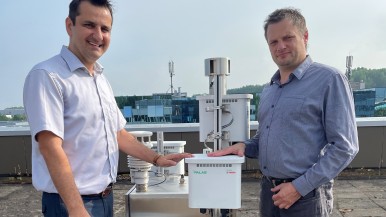
Stuttgart, Germany – Bosch and the Karlsruhe-based measuring technology specialist Palas GmbH want to work together to improve air quality. To this end, the two companies have now agreed to collaborate, each bringing their long-term expertise to the table. Palas will supply comprehensive know-how and technology for measuring a wide variety of gases and airborne particles. In the course of the partnership, Palas will also add the Environmental Connected Box (ECoB) measurement device developed by Bosch to its own portfolio and expand its product range. Bosch is to contribute cloud-based services such as device management and a software model that generates traffic emission data in real time. In addition, dispersion models help locate pollution hot spots, so that pinpointed countermeasures can be defined. The benefit of this alliance will be a comprehensive portfolio for environmentally sensitive urban traffic management, as well as for the fenceline monitoring of the concentration of substances in air at companies’ property lines. Working together with specialized integrators that coordinate all the partners involved in a project, Bosch and Palas will support city authorities and the operators of large industrial complexes. Their compatible products and services will create the basis for reliably and sustainably improving air quality. “With its analyses and simulations, Bosch technology complements Palas’s measuring technology,” says Christoph Kern, head of the Connected Powertrain Solution business unit at Bosch. This allows the actual number and placement of measurement devices required in the long term to be determined and put into cost-efficient operation in cities and at industrial sites. “The combination of Palas measurement devices and Bosch cloud services can help satisfy air pollution limits now and in the future,” says Palas CEO Dr. Maximilian Weiß. First projects with integrators both inside and outside Germany are already in preparation and are slated to start shortly. With its analyses and simulations, Bosch technology complements Palas’s measuring technology...says Christoph Kern, head of the Connected Powertrain Solution business unit at Bosch. The combination of Palas measurement devices and Bosch cloud services can help satisfy air pollution limits now and in the future...says Palas CEO Dr. Maximilian Weiß Two strong companies joining forces Palas air-quality measurement devices are already in use worldwide in official air-quality measurement networks. A range of certified measurement devices is available for various requirements, including EN particulate matter measurements. Now being expanded with the ECoB measurement device, it means that customers are no longer dependent on official measuring stations in many cases. It will be possible to carry out reliable measurements exactly where appropriate. Bosch’s focus within the partnership will be on cloud connectivity and device management, including firmware over-the-air (FOTA) updates, remote diagnostics, and software recalibrations on an as-required basis. These services shall be gradually rolled out to the existing Palas hardware. Additional Bosch services will process readings and allow both air quality and the contributory sources of emission to be assessed. This includes fine-tuned evaluations of traffic emissions and their expected dispersion in the environment in real time. Based on real traffic emission data, Bosch’s high-resolution 3D dispersion simulation can simulate the effects of different traffic control measures and thus identify the best strategies for reducing air pollution. Strong market growth expected On September 13, 2023, the EU Parliament voted to significantly tighten pollution limits including those for particulate matter. Compliance with daily mean and annual limits will require further action. And it is precisely in this context that the solutions offered by Bosch and Palas can assist cities, regions, and companies in Europe and beyond.

IAA Transportation: Bosch intends to grow further with climate-neutral powertrains

19.09.2022

Press release

Mobility

IAA Transportation: Bosch intends to grow further with climate-neutral powertrains

Stuttgart/Hannover, Germany – From climate action and cost pressure to driver shortages, the global transportation and logistics industry is facing enormous challenges. Bosch delivers appropriate solutions to meet these challenges. As it moves toward the goal of climate-neutral freight transport, the technology company is steadily expanding its powertrain portfolio. In addition to diesel powertrains, which will continue to play a vital role in commercial vehicles for some time to come, Bosch also offers battery-electric and fuel-cell powertrains. The company has now incorporated another option, the hydrogen engine, to fill the gap in alternative powertrains, particularly for heavy construction vehicles and agricultural machinery. “Climate action is moving freight transport in more diverse directions. We expect alternative powertrains to drive major growth in our business over the course of the decade,” said Dr. Markus Heyn, member of the Bosch board of management and chairman of the Mobility Solutions business sector, at this year’s IAA Transportation in Hannover. In a world full of uncertainties, sales in Bosch’s Mobility Solutions business sector have grown by 6 percent so far this year after adjusting for exchange-rate effects. Bosch generates one-fourth of its sales revenue from commercial-vehicle technology, ranging from vans to 40-ton trucks. In addition to powertrains, the other pillars of Bosch’s commercial-vehicle business are driver assistance systems and connectivity. Climate action is moving freight transport in more diverse directions. We expect alternative powertrains to drive major growth in our business over the course of the decade...Dr. Markus Heyn, member of the Bosch board of management and chairman of the Mobility Solutions business sector Bosch is bringing new energy to commercial-vehicle powertrains According to Bosch forecasts, over 80 percent of all trucks weighing six metric tons or more will still be diesel-powered in 2025. Powertrain diversity will subsequently increase and, by 2035, half of all new commercial vehicles will be electric, powered either by battery or hydrogen. “A technology-neutral approach is particularly useful in commercial vehicles. Depending on the application, there will be more than one climate-neutral option for the truck powertrain,” Heyn said. At Bosch, 3,400 engineers alone are working on the truck powertrain of the future. No other company offers as many electromobility options as Bosch: from e-bikes to construction machinery, and from silicon carbide chips to complete drive modules. This strategy is paying off: Bosch already has 30 major orders from manufacturers for battery-electric powertrains. Bosch also has big plans for the fuel cell. By 2025, the company aims to have over 40,000 Bosch fuel-cell systems on the road. To support this goal, Bosch also manufactures the stacks itself and is establishing global production capabilities close to its customers, specifically at its plants in Anderson (USA), Wuxi (China), and Bamberg (Germany). Fuel cells are not the only way to power trucks using hydrogen; there are also H2 engines. Bosch develops the control units and injection technology required for these engines and has already acquired a major project in India. Bosch is teaching trucks to drive Bosch is in its element not only in hardware, but also in software. Half the R&D associates in the Mobility Solutions business sector are software engineers. Among other things, this promotes the development of automated driving. Bosch has 1,100 engineers working on this topic, and it supplies software, sensors, vehicle computers, and actuators from a single source. “Automated driving is coming, due in part to the acute driver shortage. And nowhere does automated driving make more economic sense than in commercial vehicles,” Heyn said. Across Europe, there is already a shortage of 400,000 drivers. Bosch aims to implement driverless operation on freeways by the end of the decade. In 2025, a vehicle computer that enables sensor data to be processed in real time will go into large-scale production at a European truck manufacturer. Bosch technology will make the electronics architecture in future commercial vehicles significantly more powerful, thereby delivering the basis for the software-defined truck. On the road toward automated driving, the company is doing good business with driver assistance systems. Best example: corner radar sensor in trucks. This market will grow by 40 percent over the next few years, Bosch by almost 60 percent. The company’s efforts here are driven by various factors, including the legal requirements for preventing road accidents with commercial vehicles. For example, the turn assistant function will be a mandatory feature in Europe from 2024. Bosch prepares to launch logistics platform In its work on the future of freight transport, Bosch is also looking beyond the hood. Bosch has joined forces with U.S.-based cloud provider Amazon Web Services (AWS) to operate a software platform that bundles not only its own logistics services but also third-party services. Integrating these solutions delivers a boost in efficiency. Instead of using the multitude of independent solutions currently on offer, logistics companies and freight forwarders across the globe will have quick and easy access to digital services from a single source. “We will be launching our logistics platform in India within the next few weeks and then in Europe and the U.S. at the beginning of next year,” Heyn said. One example of Bosch services for the transportation and logistics industry is logistics monitoring. Bosch service centers monitor the condition of critical or even medically vital goods – between 30,000 and 40,000 truckloads annually. During the coronavirus pandemic, Bosch also took on the monitoring of vaccine shipments. There is also high demand for secure truck parking, a service that can be used to reserve truck parking spaces. Bosch already offers 100 suitable areas along the highways in eleven European countries. Bookings tripled in 2021 alone. Bosch is also expanding its service portfolio to include a retrofit solution for the keyless access system for commercial vehicles, which will be launched in 2023.BOSCH AT IAA TRANSPORTATION 2022 Panels with Bosch experts at the IAA Conference: Tuesday, September 20, 14:15 – 15:15 CEST in the Industry Forum: Presentation: “How to manage the operational challenges of multi-brand commercial EV fleets” by Michael Köhler, Senior Vice President Business Unit Battery at Robert Bosch GmbH Tuesday, September 20, 17:30 – 17:45 CEST on the Main Stage: Keynote: “Powertrain solutions for future transportation” by Jürgen Häusser, Vice President Product Management Commercial Vehicle & Off-Road at Robert Bosch GmbH Wednesday, September 21, 17:00 – 19:00 CEST at the Cummins booth (hall 20, booth A12): “Open dialog on the hydrogen engine” with Dr. Andreas Kufferath, Engineering System Diesel Powertrain at Robert Bosch GmbH Thursday, September 22, 11:30 – 12:00 CEST on the Main Stage: Presentation: “Global digitization in logistics” by Mariella Minutolo, Executive VP Progressive Mobility Players at Robert Bosch GmbH FOLLOW the Bosch IAA 2022 highlights at www.bosch-iaa.com and on Twitter: @BoschPress, #BoschIAA

GAIA-X 4 moveID project develops basis for secure mobile data exchange

08.09.2022

Press release

Business/economy

GAIA-X 4 moveID project develops basis for secure mobile data exchange

Stuttgart, Germany – Which parking garages currently have vacant charge spots available? Where are free parking spaces in the city center? And how can this information be digitally transmitted, and services billed, across providers? The answer to these and similar questions calls for secure data exchange between the vehicles and their environment. It is precisely this foundation that a research project consisting of universities, automotive suppliers, and system providers is now in the process of building, with Bosch leading the consortium. Over the next three years, the GAIA-X 4 moveID project is set to develop the necessary standards and technological concepts to enable the secure exchange of information between providers of mobility applications and their customers. The goal is to create decentralized digital vehicle identities. This is an important prerequisite for the mass use of electric vehicles, automated driving, and the establishment of connected cities. GAIA-X 4 moveID is supported to the tune of 14 million euros by the German Federal Ministry for Economic Affairs and Climate Action – covering half of the project costs.Connectivity for digital services across the board “An integrated and transparent system architecture for the exchange of data on the road that incorporates different products and players simply isn’t available today. While it’s true that some companies out there already offer services, those services are tailored for specific applications, vehicles, or customer groups,” explains Peter Busch, project manager at the consortium leader Bosch. They often map the infrastructure, for example, but they rarely provide information about availability due to a lack of connectivity between the many independently operating service providers. “Open standards are needed so that users, for example, can find all available charging stations or pay for charging processes,” Busch says. It’s important to always ensure that the data is processed securely and that individual providers don’t exploit it solely for their own purposes. For Busch, this is the only way that the necessary user confidence can grow and a broad range of all available services, such as so-called deep parking (use of otherwise unavailable parking spaces), can be created. That is why the consortium is building on the European GAIA-X system, which defines the technological, economic, and legal framework for a secure and trustworthy data infrastructure. GAIA-X relies on decentralization and the interplay of different cloud providers under common guidelines. In this spirit, the GAIA-X 4 moveID project is using open source software for its developments and making them available to all providers for various business models. Vehicles are becoming marketplaces The standards that GAIA-X 4 moveID is pursuing will allow vehicles to securely and independently exchange information with other vehicles and their environment without an “intermediary.” The vehicles’ “infrastructure partners” include charge spots, barriers, traffic lights, and parking lots. The research project will use internationally recognized hardware and software to develop management and administrative services to facilitate the interaction and trade between different players. This will enable providers to connect a great many services, such as news, entertainment, and navigation, with the car’s system, especially in automated driving. The market for services related to connected parking alone is estimated to be worth ten billion euros annually worldwide. What’s more, the ability to navigate directly to a vacant parking space significantly reduces congestion and emissions. After all, today, about a third of downtown urban traffic is people looking for parking spaces. The availability of information is also a crucial factor for the success of electromobility. It is estimated that about half of newly registered cars in Europe will be electric by 2030. “Their drivers need to know that they’ll be able to find a charge spot quickly whenever they need one. And that requires connected systems,” Busch says. Extensive data exchange as a basis for automated driving The mass use of automated vehicles is conceivable only if cars are able to quickly and reliably communicate with their environment. The data exchange this requires will enable climate-friendly traffic control based on the volume of traffic at any given moment. This will allow cities to regulate incoming traffic to particular areas in real time, thus preventing congestion. However, this method, known as zoning, requires that vehicles be able to immediately recognize changing conditions and to reroute accordingly. Zoning is being demonstrated with test vehicles – for the first time across borders – in the Germany-France-Luxembourg (Merzig/Saarbrücken) test area as part of the GAIA-X 4 moveID project. The cars receive dynamic information regarding their approach to defined zones.The project partners: Robert Bosch GmbH Materna Information & Communications SE Denso Automotive Deutschland GmbH Continental Automotive Technlogies GmbH WOBCOM GmbH ecsec GmbH HTW Saar (University of Applied Sciences) Atos Information Technology GmbH Chainstep GmbH Peaq Technology GmbH Zeppelin Universität gGmbH (Zeppelin University) Datarella GmbH 51nodes GmbH Bigchain DB GmbH Fetch.ai Research & Development GmbH ITK Engineering GmbH Deutsche Zentrum für Luft- und Raumfahrt e.V. (German Aerospace Center) Airbus Defence and Space GmbH Delta Dao AG