#Powertrain systems

Bosch commissions its first in-house electrolyzer with Hybrion electrolysis stacks

05.11.2025

Press release

Powertrain systems

Bosch commissions its first in-house electrolyzer with Hybrion electrolysis stacks

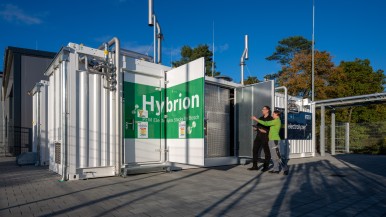
Stuttgart and Bamberg, Germany – Hydrogen is on the advance at Bosch: after officially launching Hybrion PEM electrolysis stacks (PEM = proton exchange membrane) in March, Bosch has now put two of them into operation in an electrolyzer at its Bamberg site. This 2.5 megawatts system converts water into hydrogen and oxygen using renewable electricity – and meets the EU’s requirements for renewable hydrogen. At the same time, the commissioning of the electrolyzer in Bamberg marks the start of a new chapter: it is part of an entire hydrogen landscape built to demonstrate various ways of producing, storing, and using hydrogen. “Hydrogen plays a central role in a climate-neutral world, which is something we’re committed to achieving as a society in Germany and Europe, and it’s an ideal energy source. It can be produced, stored, and transported almost anywhere, and in a climate-neutral way”, says Dr. Markus Heyn, member of the Bosch board of management and chairman of the Mobility business sector. For Bosch, hydrogen continues to be a strategically important business. The official start of operations for our electrolyzer and the opening of the hydrogen landscape here in Bamberg mark an important milestone for us....says Dr. Markus Heyn, member of the Bosch board of management and chairman of the Mobility business sector. At the heart of the electrolyzer, which was built by FEST, a company based in Goslar, Germany, are two Bosch Hybrion electrolysis stacks manufactured in Bamberg. Each of these stacks with a rated power of 1.25 megawatts produces around 23 kilograms of hydrogen per hour from water and electricity. At full load, the electrolyzer can produce more than 1 metric ton of hydrogen daily. That’s enough fuel for an electric 40-ton truck fitted with a Bosch fuel-cell power module (FCPM) to travel up to 14,000 kilometers. The Bamberg hydrogen landscape features just such an FCPM, equipped with a Bosch fuel-cell stack, in continuous operation inside a “lifetime container” with a view to testing the module’s durability. The hydrogen to power the FCPM flows into the container from the electrolyzer via a pipeline network. Here, the hydrogen-producing process that previously ran in the PEM electrolysis stacks is now reversed: hydrogen and oxygen are fed into the FCPM’s fuel-cell stacks, where they react to produce water and electrical energy. The electricity generated by the FCPM flows back into the electrolyzer, where it is used both to test the electrolyzer and to produce hydrogen locally. These around-the-clock tests inside the lifetime container simulate a wide range of usage scenarios to ensure the durability and reliability of the FCPMs. Large-scale production of the FCPM started in Bosch’s Stuttgart-Feuerbach plant in mid-2023. It was recently nominated for the prestigious German President’s Future Prize. “Bosch can do hydrogen, and at scale,” says Thomas Pauer, the president of the Power Solutions division. "We got involved in the area at an early stage, made upfront investments, and are now offering market-ready technical solutions. That includes our fuel-cell power module. The fact that it was nominated for the German Future Prize proves that this Bosch technology is at the cutting edge. And that applies both to the fuel cells and to the electrolysis.” Bamberg also has a second test station for the Hybrion PEM electrolysis stacks manufactured at the plant there. Before delivering stacks to customers, this is where Bosch ensures that they reliably achieve their performance and efficiency under real operating conditions. For example, various load profiles are simulated to test the reaction of each stack to electrical fluctuations. In addition, every Hybrion stack is activated before delivery so that it is immediately ready for use at the customer’s premises. Another feature of the hydrogen landscape is the 21-meter-high hydrogen tank, in which hydrogen from electrolysis can be stored at up to 50 bar. Bosch has already reached its first milestones in electrolysis technology in 2025. Following the market launch in the spring, deliveries have begun to various customers and partners, including companies such as IMI, Kyros Hydrogen Solutions, Neumann & Esser, Pietro Fiorentini, and the latter’s subsidiary Hyter.

Bosch puts its first hydrogen truck into service in plant traffic

08.10.2025

Press release

Powertrain systems

Bosch puts its first hydrogen truck into service in plant traffic

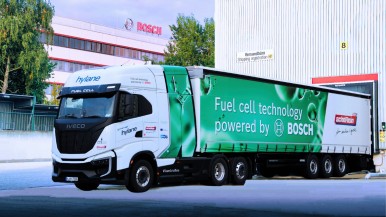
Nuremberg, Germany – Bosch has taken a further step on the road to climate-friendly logistics – with one of the technology company’s own products. Its Nuremberg plant recently started using a fuel-cell electric truck in plant traffic. The truck is equipped with the Bosch fuel-cell power module (FCPM), which was recently nominated for the prestigious German President’s Future Prize. “When we decided to make our plant traffic more climate-friendly, it was clear that we wanted a truck featuring Bosch’s FCPM,” explains Alexander Weichsel, the commercial plant manager in Nuremberg. “This deployment is an important building block that helps us reduce our emissions in logistics. The fact that several thousand trucks with Bosch fuel-cell systems are already on the road worldwide shows that the concept is proving its worth.” By converting hydrogen and oxygen into water and electricity, the 40-ton truck can be operated completely electrically. Using renewable hydrogen even makes the truck’s powertrain climate neutral. By switching to the new vehicle, Bosch also wants to set an example in Nuremberg and play an active role in developing a hydrogen value chain in line with the state of Bavaria’s Hydrogen Strategy 2.0.Real operation provides valuable data for further development The Iveco truck in question has a range of up to 800 kilometers. It is operated by the freight forwarder Schäflein on behalf of the Bosch plant. Schäflein in turn rents the vehicle from the rental provider Hylane, which specializes in emissions-free trucks. The vehicle, which primarily transports products from the plant’s own manufacturing operations, is expected to cover 12,000 kilometers per year. As a result, the Nuremberg plant will reduce Bosch’s CO 2 emissions – because the vehicle runs on hydrogen instead of diesel. Alongside this reduction of emissions in logistics, however, the primary reason for putting the truck into service is initially to gather experience and as much data as possible. This will flow into the further development of future powertrain systems such as the Compact 190 and Compact 300 models. Plant manager Weichsel is optimistic about the future: “The fact we’ve had no problems operating this truck shows that the fuel cell is ready for volume production.” At the same time, he says: “The key to a successful hydrogen economy is above all to ensure an abundance of affordable hydrogen and put in place an adequate H 2 infrastructure, including in Nuremberg. We’re actively working with industrial partners in the Nuremberg metropolitan region to implement Bavaria’s hydrogen strategy.” With the Iveco FCPM truck, Bosch has now put its own system into real operation in Europe for the first time. The truck’s five hydrogen tanks hold up to 70 kilograms at a pressure of 700 bar. Its fuel-cell system delivers a total output of over 200 kilowatts. Its e-axle is powered by the fuel-cell system, while two battery packs installed centrally in the truck serve as energy storage. The truck has a system output of 400 kilowatts and a gross weight rating of up to 44 metric tons. In addition to its robustness and long range – which, unlike battery-electric vehicles, is not affected by the outside temperature – the truck offers impressively short refueling times, which are similar to those of a diesel truck. Large-scale production of the FCPM started in Stuttgart-Feuerbach in mid-2023. The Bosch plant in Bamberg supplies the fuel-cell stack, while the Homburg plant supplies other components such as the electric air compressor and the recirculation blower. Bosch has been strongly committed to building an H2 economy for a long time, and is developing technical solutions for the production, infrastructure, and use of hydrogen. This spring, the company heralded its market entry with technology for electrolyzers and presented its Hybrion PEM electrolysis stacks. When it comes to hydrogen applications, Bosch is active not only in the field of mobile fuel cells but also in hydrogen engines.

Providing seamless proof of sustainability

28.05.2025

Press release

Powertrain systems

Providing seamless proof of sustainability

Stuttgart, Germany – Vehicle fleets are a driver of carbon dioxide emissions, particularly for freight forwarders and transport companies. Opting to use renewable synthetic fuels can greatly reduce their carbon footprint – but documenting this, say for sustainability reports, is a challenge. That’s precisely where Bosch’s Digital Fuel Twin comes in: this software solution, integrated into the vehicle, records the use of climate-friendly fuels and documents the reduced carbon emissions. “Bosch’s Digital Fuel Twin makes it easy for companies to prove that they’re using renewable synthetic fuels,” says Thomas Pauer, the president of Bosch’s Power Solutions division. “It gives them auditable proof of the quantities and the carbon footprint of the fuel used per vehicle, which they can then use in their reporting.” In this way, companies not only comply with ever increasing reporting obligations, but can also document their environmental awareness. The Digital Fuel Twin is currently being used on the Tour d’Europe for the first time, which will also stop off at Bosch in Feuerbach on May 28. This rally to Brussels will see a fleet of cars and trucks with combustion engines refueling exclusively with renewable synthetic fuels at public filling stations as they make their way across Europe. Bosch’s Digital Fuel Twin makes it easy for companies to prove that they’re using renewable synthetic fuels. It gives them auditable proof of the quantities and the carbon footprint of the fuel used per vehicle, which they can then use in their reporting....Thomas Pauer, the president of Bosch’s Power Solutions division A further field of application for the Digital Fuel Twin would open up in the event that it becomes possible to reclassify vehicles with combustion engines as zero-emission vehicles if they use only renewable synthetic fuels. The EU intends to review this option this year. Its current plan starting in 2035 is to fine all manufacturers of combustion vehicles at such a high level as to make it no longer economically viable to sell them. “Renewable synthetic fuels should be a part of the solution. That’s the only way to achieve the climate targets in the transport sector,” Pauer says. “If the EU decides in favor of reclassification, the Digital Fuel Twin can be an important tool in implementing that.” Purely digital records, plausibility checks, and documentation The new Bosch software enables the reliable tracking of all a fuel’s climate-relevant properties: from production through all stages of the supply chain to the filling station and into the vehicle. To begin with, manufacturers of renewable synthetic fuels report to Bosch how much fuel they have sold, to whom, and what the fuel’s carbon footprint is. Transport companies in turn report how much fuel they purchased and when. The Digital Fuel Twin compares this data. If the time and quantity match both in the respective company books and with the recorded pump and sensor data of the transfer interfaces, the fuel properties – the type of fuel, its CO 2 content, and reduction potential – are passed on in the supply chain. Any carbon emitted during further transportation is reassigned to the fuel – meaning the shorter the distances, the better for the climate. Finally, at the filling station, a “digital handshake” – an exchange of data between the filling station, vehicle, and cloud – documents exactly how much and what kind of fuel was purchased. Identification is carried out using, for example, a fleet management system. This database provides users of the Digital Fuel Twin with reliable information about the CO 2 values of the fuel used as well as auditable proof of use. The fuel data is always mapped digitally as a virtual twin in a protected data room in the cloud. Bosch’s software solution can be used in cars, trucks, and buses, but also in construction vehicles and even ships. The Digital Fuel Twin is currently undergoing testing in collaboration with many participants along the entire fuel supply chain. The system’s reliability and safety is being tested together with them and with vehicle manufacturers. To date, the Digital Fuel Twin has been retrofitted into vehicles. In the future, however, the plan is to integrate it into the vehicle’s own electronics as a pure software module, thereby ensuring the tamper-proof use of renewable synthetic fuels at the individual vehicle level. “We expect the Digital Fuel Twin to feature in production vehicles as early as 2026,” Pauer says. Renewable synthetic fuels have been available for many years Renewable synthetic fuels are produced either from plant-based materials or with the help of renewable electricity. In contrast to fuels based on crude oil, they do not release any additional carbon dioxide into the atmosphere. Some of these fuels have been available for years. The most widely used is HVO100 (100 % recycled hydrotreated vegetable oils), which is obtained from waste oils and plant residues. Overall – taking into account the carbon emissions of the fuel itself plus the carbon emitted during its production (“well-to-wheel”) – this diesel fuel offers a CO 2 advantage of up to 90 percent compared to its crude oil counterpart. Sales of this fuel have been freely permitted in Germany since 2024, but it has been available for much longer in countries such as Sweden and the Netherlands. For gasoline engines, there is also the ethanol-based fuel E85. Both fuels, HVO100 and E85, are each already available at more than 5,000 filling stations across Europe.

Bosch at bauma 2025

07.04.2025

Press release

Powertrain systems

Bosch at bauma 2025

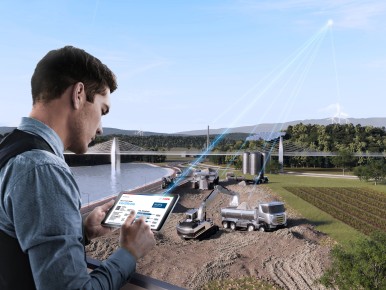
Stuttgart and Munich, Germany – Over one million new construction vehicles will be produced worldwide in 2025 alone. As different as their performance classes and tasks are, they almost all have one thing in common: a diesel engine. Its robustness and strength make it the ideal powertrain for a wide range of applications. At the bauma 2025 trade fair, Bosch will be showing how carbon emissions can be reduced even further in this vehicle segment. “Renewable synthetic fuels make operating both new and existing vehicles much more climate-friendly,” says Jan-Oliver Roehrl, executive vice president of the Bosch Power Solutions division and head of commercial vehicle activities at Bosch. “And in the future, hydrogen engines and electrification also stand to make construction machinery much more sustainable.” Renewable synthetic fuels make operating both new and existing vehicles much more climate-friendly. And in the future, hydrogen engines and electrification also stand to make construction machinery much more sustainable....Jan-Oliver Roehrl, executive vice president of the Bosch Power Solutions division and head of commercial vehicle activities at Bosch Renewable synthetic fuels make combustion engines more climate-friendly Construction vehicles are already subject to comprehensive exhaust-emission regulations, such as Stage V in Europe, Tier 4 in the U.S., and Phase IV in China. To date, however, their climate-relevant emissions have been regulated only to a limited extent, at least by law. One simple option for greatly reducing their carbon emissions that is already available today is to use renewable synthetic fuels such as HVO100. Because these fuels are based on residual and waste materials, they are much more climate-friendly than fossil fuels in terms of overall carbon emissions. They are also “drop-in” fuels, meaning they can be mixed with normal diesel fuel as required. Since Bosch already takes compatibility with these fuels into account when developing its injection technology, they are suitable for use in its products. According to Bosch forecasts, four out of five new construction vehicles worldwide with over 56 kilowatts will still have a diesel engine in 2035. That is why Bosch will continue to develop injection technology and urea dosing technology for exhaust-gas treatment in the future to suit the various segments of the construction machinery market. The Digital Fuel Twin documents the use of renewable synthetic fuels Renewable synthetic fuels can make construction machinery more climate-friendly: the more of it they use, the smaller the carbon footprint of each individual vehicle. Bosch makes this effect visible with a purely digital software solution called the Digital Fuel Twin. This documents the amounts of fuel distributed as well as the fuels’ sustainability, from production and transportation all the way to the filling station. It provides the operators of construction machinery with certificates corresponding to how they have refueled their vehicles; these document the total amounts of fuel used and even the proportionate carbon footprint when using the vehicle. Hydrogen engines build on tried-and-tested foundations When it comes to hydrogen engines, German manufacturers and suppliers can draw on decades of expertise, particularly in the field of engine technology: some 80 to 90 percent of the technology involved can be transferred from conventional combustion engines. If the hydrogen fueling the engines is produced with renewable energy, their use could mark a big step forward for the climate. Often, construction machinery is stationary and operates under heavy loads. “This is precisely where hydrogen engines, with their high efficiency and robustness, can really excel,” Roehrl says. “The first applications of hydrogen engines featuring Bosch injection technology will be launched this year.” Bosch is working on both port- and direct-injection systems and is already involved in more than 100 development projects with customers worldwide. Moreover, the hydrogen engine is also a promising option for large engines, for example as the powertrain for dump trucks in mining. Here, too, robustness and reliability combined with a compact design are essential for economical operation. Electrification solutions for construction machinery In certain construction machinery applications, electrification is another efficient and climate-friendly option for mobile and stationary functions. With its eLION electrification portfolio, Bosch Rexroth already offers a wide range of motors, inverters, gearboxes, software, and accessories, including the appropriate hydraulics. This Bosch subsidiary is currently expanding its range to include components for 96-volt vehicle electrical systems; at the end of 2025, it will introduce a standardized software platform for all voltage classes. Bosch Engineering, meanwhile, is presenting a newly developed high-performance solution for battery voltages of up to 800 volts. This subsidiary’s new electric powertrain system is compact and offers high power density as well as high efficiency. It is also suitable for construction machinery with high power requirements and limited installation space, such as wheel loaders. Bosch, Bosch Rexroth, and Bosch Engineering will be showcasing these solutions at bauma, at booths A3/327 and A4/526.

A more efficient drive, a faster recharge

30.08.2023

Press release

Powertrain systems

A more efficient drive, a faster recharge

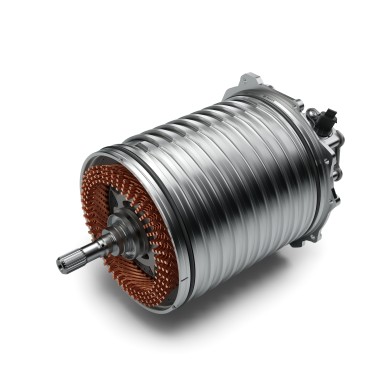
Stuttgart, Germany – Two of the things most drivers of electric vehicles wish for are efficient driving and the shortest possible recharging time. Bosch is now starting the production of new powertrain solutions based on 800-volt technology. This will make recharging faster and provide a further boost for electromobility. “Bosch is upping the voltage in electromobility. Our 800-volt technology is the next step toward more powerful electrical powertrains and shorter recharging times,” says Ralf Schmid, the executive vice president responsible for electrification in Bosch’s Powertrain Solutions division. The 800-volt version of the inverter is based on silicon carbide semiconductors. These increase efficiency, and thus also range. In the 800-volt variant of the electric motor, Bosch has increased the power density. This reduces weight and allows for a more compact design. A premium German automaker is now using the active parts of this powertrain, i.e. the rotor and stator, for the first time. Bosch is upping the voltage in electromobility. Our 800-volt technology is the next step toward more powerful electrical powertrains and shorter recharging times,...says Ralf Schmid, the executive vice president responsible for electrification in Bosch’s Powertrain Solutions division. 50 percent less heat loss with SiC technology In recent years, 400-volt solutions have become widely established as the industry standard. With the same current, but double the voltage, twice as much power can now be transmitted. This modification allows for thinner cables, which saves on space, weight, and copper. As a result, the inverter is more compact and powerful. With a 400-volt onboard network, the maximum charge power at charge spots that are powerful enough is 250 kilowatts. With 800 volts, twice this is possible in theory. In addition, the inverters feature SiC chips, in which carbon atoms have been introduced into the crystalline structure of the ultrapure silicon. This improves the semiconductors’ electrical conductivity. In power electronics, moreover, 50 percent less energy is lost in the form of heat. The SiC chips have even more energy-saving potential to offer: for example, they increase the inverters’ efficiency to as much as 99 percent. 35 percent greater power density thanks to new winding technology The standout features of the 800-volt variant of the Bosch electric motor now going into volume production are 830 Nm torque and 460 kilowatts output. Thanks to the use of I-pin bar winding, the motor’s efficiency, compactness, and level of automation in production can be further improved. In terms of power-to-weight ratio, this delivers 35 percent more power density, at 60 kilowatts per liter. On top of this, it offers an excellent torque density of 105 Newton meters per liter. This means that the Bosch motor achieves a maximum efficiency of up to 98 percent. The next generation of the electric motor will feature oil cooling. This will allow the heat generated in the electric motor to be drawn away better, and ensure continuously powerful operation over long distances, as well as in commercial vehicles. Extensive portfolio, from components to systems Bosch offers an innovative and extensive product portfolio, ranging from semiconductors to its complete powertrain units known as e-axles. Along the entire value chain, customers get the products they need for hybrid and electric vehicles – from passenger cars to trucks – from a single source. Bosch has now manufactured more than 3.5 million electric motors, and the same number of inverters. With engineering and manufacturing locations in the major markets, Bosch operates close to its customers around the world. Press kit IAA 2023 Eventpage IAA 2023

Hardware, software, and services: Bosch delivers smart solutions for software-de ...

24.08.2023

Press release

Connected mobility

Hardware, software, and services: Bosch delivers smart solutions for software-de ...

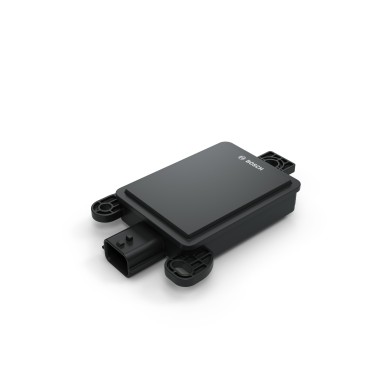
Stuttgart and Munich, Germany – Vehicles are an integral part of today’s digital world. In the future, new functions for connectivity, automation, personalization, and highly efficient powertrains will increasingly be delivered by software and smart hardware. Bosch is equally at home in both domains: from brakes, steering systems, and electric powertrains to sensors, vehicle computers, and software solutions, the supplier of technology and services develops and manufactures the key components of modern vehicles under one roof. Bosch will be presenting its latest fascinating solutions for safe and sustainable mobility at IAA Mobility 2023 in Munich. Hardware, software, and new services for the mobility sector will be on show at the Bosch booth in hall B3, booth D10.Powerful hardware One of the biggest trends in the mobility industry is toward high-performance vehicle components that are also compatible with software from other vendors. Bosch offers hardware whose intelligence can be embedded both in the components themselves and, for example, in central vehicle computers. Invisible, yet everywhere : Semiconductors are an essential part of technical devices: as one of the top ten semiconductor manufacturers in the automotive segment, Bosch is continually investing in research and development and in expanding its worldwide semiconductor manufacturing network. Its portfolio includes integrated circuits, MEMS (microelectromechanical systems) sensors, power semiconductors, and power modules. For automakers who define their own electrical/electronic (E/E) vehicle architectures, Bosch offers the ability to precisely tailor the functional scope of semiconductors to this architecture. Sensors for precise surround sensing : Surround sensing is indispensable for automated driving functions. Bosch’s new radar sensors enable assisted and automated driving functions at SAE Levels 0 to 3. For the sixth generation of these radar sensors, Bosch has incorporated artificial intelligence. This new generation performs better at measuring distance, high speeds, and angular resolution; as a result, objects such as motorcycles can also be reliably detected across the entire field of view. Bosch will also be presenting a new generation of ultrasonic sensors at the IAA. Thanks to AI-based height classification, these sensors offer more robust detection capabilities; this allows them, for example, to estimate the approximate height of an obstacle. Moreover, tripling of the echoes makes these sensors even more sensitive, enabling them to achieve quick and reliable detection of pedestrians and low-reflection objects, for example. The portfolio is rounded off with new camera housings . Image analysis no longer takes place in the camera itself, but rather in central vehicle computers such as Bosch’s ADAS Integration Platform. Available in 3- and 8-megapixel variants, plus the option of a 12-megapixel version for Level 4 applications, the camera housings are at the cutting edge of image sensor technology. Next-generation vehicle computers : Bosch offers modular and scalable components for customer-specific E/E architectures with individually configurable vehicle computers. The vehicle integration platform is the enabler of software-defined vehicles with centralized and zonal E/E architectures. The idea is to move the vehicle’s application software into central vehicle computers. This way, the vehicle integration platform enables functional integration across all domains, such as body, motion, and comfort. Over-the-air updates ensure that vehicle software is always kept up-to-date. The ADAS integration platform is a Bosch vehicle computer for the domain of advanced driver assistance systems. This powerful computer can deliver assisted and automated driving functions and parking at SAE Levels 0 to 4. Thanks to its modular and scalable architecture, the platform can be tailored to the specific requirements of each automaker – including the flexible integration of third-party software, for example. The cockpit integration platform combines the computing tasks of the infotainment and instrumentation domains in a single computer. Depending on performance and functional safety requirements, additional functions can be integrated into the computer from other domains, such as climate control, connectivity, driver assistance functions, and camera-based applications such as driver and occupant monitoring, surround view, and dashcam recording. The motion integration platform focuses on safety-related application software for the powertrain, chassis, and steering. To complement this portfolio, Bosch offers its zone ECUs , which act as a link between vehicle computers and distributed ECUs, sensors, and actuators. Reliable energy supply : The Bosch powernet guardian ensures that safety-related functions in the vehicle are supplied with power at all times. In the event of a fault, an electronic isolating switch separates the safety-relevant electrical system from the rest of the (standard) consumers, such as seat heating and window lifters. With a high depth of predictive diagnostics, the powernet guardian promptly detects safety-critical supply gaps, isolates faulty paths, and safeguards the energy supply with hardware redundancies. This functionality will play a central role in future E/E architectures and for automated driving. Next steps in electromobility : Bosch is continuing to expand its portfolio of electromobility solutions. For the first time, it will be manufacturing an electric motor and inverter using 800-volt technology. The motor offers improved power and torque density, while the inverter uses silicon carbide (SiC) power semiconductors that enable it to reach an efficiency of up to 99 percent. In addition, a charger-converter, which combines a charger and a high-voltage DC/DC converter in a single housing, will soon go into production. This solution will save space and cut costs. Setting the right temperature in electric cars and hybrids : Bosch uses intelligent thermal management to increase the range of electric and hybrid vehicles. Optimal coordination of the refrigerant circuit and the cooling circuit enables precise distribution of heat and cold, improves the efficiency of the battery, and ensures that all components are working within their optimum temperature range. For this purpose, Bosch is developing flexible thermal units as pre-integrated solutions. With fewer parts, assembly steps, and cables, these reduce installation space and weight. Passengers also benefit: the thermal management system delivers a pleasant temperature inside the vehicle. The global brushless blower plays an active part in increasing climate comfort in the passenger compartment. Depending on the outside temperature and the vehicle occupants’ requirements, it transports the flow of air into the vehicle interior for cooling or heating. Smart motor topology enables a compact design that significantly reduces weight, increases power density, and reduces noise emissions. The future of steering : Steer-by-wire systems eliminate the physical connection between a vehicle’s steering wheel and its wheels. This opens up new possibilities for redesigning the vehicle interior. Especially in an age of automated driving, this technology enables new cockpit concepts by allowing the steering wheel to be lowered or stowed away. In addition, steer-by-wire applications also provide the basis for new safety features in vehicle dynamics control. Bosch is systematically driving forward the development of this technology and wants to bring steer-by-wire systems to the market on a commercial scale by the middle of the decade. Enhanced brake systems : The latest generation of Bosch’s electronic stability program (ESP®) is a key component of modern brake systems. Combined with the electromechanical brake booster, iBooster , it ensures the requisite brake system redundancy during automated driving, provides a high degree of brake pressure build-up dynamics for automatic emergency braking, and improves the efficiency of braking energy recuperation in hybrid and electric vehicles. Vehicle dynamics control 2.0 is the new core control system of ESP®. Based on sensor information, it anticipates vehicle behavior and intervenes proactively. Enhanced performance, compact size : Performance Line SX is a compact drive unit from Bosch eBike Systems that allows e-cyclists to make their way through city traffic dynamically and efficiently. The new drive unit delivers a maximum torque of 55 newton meters (Nm) and a power-to-weight ratio of up to 300 watts per kilogram (W/kg). When riding in a sporty style, it provides a level of support disproportional to the cyclist’s performance while offering a natural riding sensation. Performance Line SX blends in with the sleek look of modern urban eBikes, so the result looks similar to a conventional bike. And its weight of around two kilograms offers real benefits when it comes to quickly getting from A to B or occasionally carrying the eBike up the stairs. Smart software New functions for greater efficiency, safety, and comfort are increasingly being introduced into vehicles through smart software. This trend affects not only product development and product use, but also the way in which people experience mobility. It also enables new business and collaboration models. Surround sensing as a standalone software module : Video-based surround sensing plays a key role on the journey from assisted to automated driving. Various camera sensors capture images of the vehicle’s surroundings and process this data in a way that allows it to be used for more advanced driver assistance and automated driving and parking functions. Bosch video perception is a purely software solution that can be deployed on various systems-on-a-chip (SoCs). Fast and reliable development of automated driving : Bosch subsidiary ETAS is launching a special middleware as a link between the operating system and individual software applications in the vehicle. This solution allows software functions for driver assistance and automated driving to be continuously improved. It enables instant communication between software applications at a bandwidth of more than 10 gigabytes per second (GB/s) without compromising security. Deterministic behavior allows many development steps to be performed virtually with recorded real data. Reproducible simulation-based validation makes it possible to reduce the number of costly test-drive kilometers in real traffic conditions. Boosting safety with assistance systems : Bosch driving assist makes driving safer and more comfortable. By putting together their desired package of functions from a modular system of longitudinal and lateral guidance, automatic lane change, and emergency braking, vehicle manufacturers can implement SAE Level 2 automated driving functions. The most advanced variant, Bosch driving assist premium, uses a 360-degree camera belt to expand the application of automated driving functions from the freeway to urban and rural traffic situations. Vehicle motion und vehicle dynamics : Bosch vehicle motion management controls and coordinates driving behavior by optimizing the interaction between braking, steering, chassis, and powertrain systems. Its functions include vehicle dynamics control 2.0, the latest generation of Bosch systems for vehicle dynamics, traction control, and antilock braking. This function anticipates likely vehicle behavior and intervenes proactively. The result is a driving experience that is very safe, agile, and relaxed. Development of connected vehicle systems : PANTARIS is a cloud-based platform that offers essential services and tools for the efficient development and scalable operation of software for vehicle systems. As well as ensuring the worldwide availability of mobility services, PANTARIS also includes a developer portal for managing vehicles and services. PANTARIS and the applications it offers are based on cloud-independent technology, making them compatible with all public cloud providers. PANTARIS Connect provides the basic services for vehicle connectivity and operation over the entire vehicle lifecycle. PANTARIS Creator provides easy access to software-as-a-service (SaaS) tools for the secure development and operation of cloud services. PANTARIS Workspace offers a central point of access for developers to book and manage services, making it quick and easy to implement specific applications. Energy management for electric vehicles : Bosch’s connected vehicle energy management system brings together an electric vehicle’s thermal management, powertrain, and electrical system. This ensures the optimum distribution of energy at the vehicle level, thereby reducing energy consumption and increasing comfort. It also paves the way for new functions such as safe home mode. This assists the vehicle in reaching its destination with the remaining battery charge by reducing the power consumption of comfort items such as heating and climate control as necessary. Digital world on two wheels : The eBike Flow app provides e-bikers with digital support on the go to help make their eBike part of the connected world. Increasing connectivity between key components with digital features allows bikers to tailor their eBike experience to their personal needs. over-the-air updates further enhance the eBike riding experience. Robust services Bosch is taking software-defined mobility a step further and launching new services to enhance customer safety, security, and convenience. This is also giving rise to new business models that Bosch is systematically advancing. Better range forecasts and suitable charge points : Important information for drivers of electric vehicles includes the available range of their vehicle and personalized charge point recommendations. To improve the accuracy of this information, Bosch supplements its route, topography, and consumption data with the latest updates on weather and traffic flow as well as information on which electrically powered comfort items – such as climate control or seat heating – are currently in use. Cloud-based algorithms calculate the actual range, select a suitable charge spot, and visualize this information in the navigation map. Connected map services for automated driving : Connected map services can play a major part in making mobility safe and convenient. These use swarm data (crowdsourcing) in combination with other information from the infrastructure to create a virtual sensor for use in driver assistance systems. The service provides real-time information about road conditions and risks such as aquaplaning, ice, and snow. This enables automated vehicles to correctly anticipate conditions, adapt their driving behavior accordingly, choose a different route, or ask the driver to take control. Thanks to this service, Bosch is able to improve the availability of driver assistance systems and enable new functions. Driverless parking and maneuvering : With automated valet parking , Bosch has brought the world’s first automated and driverless SAE Level 4 parking function to production models. Intelligent infrastructure guides the vehicle safely through the parking garage to a free parking spot. This improves the parking experience for drivers, helps parking garage operators achieve higher capacity utilization and other benefits, and enables automakers to offer new software-based services to their customers. Based on this technology, Bosch is now bringing the driverless maneuvering of vehicles to the realm of automotive production with automated vehicle maneuvering . Bosch equips automakers’ plants with an intelligent lidar-sensor infrastructure, which it supplements, where required, with Bosch stereo cameras. The driverless maneuvering service boosts efficiency and increases safety: automakers can finally get to grips with challenges such as the tight maneuvering of vehicles, downtimes in production due to absent drivers, accidents or damage caused by collisions, and a lack of information on where vehicles are located in the plant. Efficiency gains for fleet operators : Bosch helps mobility service providers run their fleets more efficiently. Available in three different service levels, RideCare connected rent provides fleet operators with information on the condition of their vehicles. With the end of rental report service module, mobility providers receive an automated report on the vehicle’s condition at the end of the rental period, including the battery level, kilometers driven, and any new damage to the vehicle. Rental car companies benefit from more efficient processes and lower operating costs thanks to reduced vehicle downtime and clear allocation of vehicle damage; end users benefit from greater convenience and transparency. In addition, RideCare connected rent uses the fleet utilization planner to provide information before, during, and after the rental period, including real-time notifications of vehicle condition, critical error messages, and missed service intervals. RideCare connected rent also offers support in planning the efficient charging of electric vehicles through the charging planner . Bosch plans to equip more than two million vehicles with this technology by 2030. Interior sensing : Bosch’s interior monitoring system combines various technologies to enable the reliable detection of vehicle occupants, especially children. Critical situations such as distraction, drowsiness, or an unfastened seat belt can be detected quickly, and the driver warned accordingly. The system is based on the detection of movements and vital signs, which can also be indicators of the vehicle occupants’ state of health. The combination of interior monitoring cameras with the highly sensitive cabin sensing radar – or alternatively with the ultra-wideband technology also used for Perfectly Keyless – enhances and expands the capabilities of the interior sensing system. This increases safety for everyone on the road. Press kit IAA 2023 Eventpage IAA 2023