Search & find:
Media, press releases, events for your editorial coverage

Commercial vehicle innovation enabler: Bosch brings advanced solutions to the ne ...

17.04.2019

Press release

Connected mobility

Commercial vehicle innovation enabler: Bosch brings advanced solutions to the ne ...

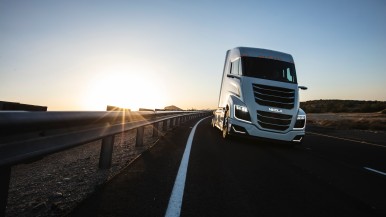
Scottsdale, Arizona – Nikola Motor Company showcased its hydrogen-electric powered semi-truck, the Nikola Two, live in action for the first time to the general public at its Nikola World event. Bosch technology and expertise helped Nikola to realize the fully functional Nikola Two hydrogen-electric truck with industry-ready heavy-duty truck components and systems. The technology and system approach is adaptable for use in Nikola’s full line of vehicles, including the Nikola One Sleeper Cab and the Nikola Tre, a hydrogen-electric truck for European markets. Bosch has been our innovation partner to help make our vision a reality....Trevor Milton, Nikola founder and CEO The Nikola trucks feature innovations in automation, connectivity and electrification enabled with Bosch’s assistance. The supplier of technology and services offers solutions for commercial vehicles to improve efficiency and safety in logistics. To enable the distinctive Nikola approach, engineering teams from Bosch locations in the United States and Germany contributed more than 220,000 hours into the development of the Nikola trucks. “This has been a two-and-a-half year cooperation targeted at implementing advanced technology into a totally new and unique approach to trucking with the highest levels of engineering excellence,” said Jason Roycht, vice president and regional business unit leader, Commercial Vehicles & Off-Road for Bosch in North America. “We’ve learned from each other and together pushed ourselves to achieve what seemed to everyone else to be impossible. The Nikola Two is not just a simple evolution of today’s heavy duty truck. It’s a revolution in both sophisticated control and design.” “Bosch has been our innovation partner to help make our vision a reality,” said Trevor Milton, founder and CEO of Nikola Motor Company. “We look for partners who provide us expertise and world-class solutions, but also ones that are willing to dream alongside us.” This has been a two-and-a-half year cooperation targeted at implementing advanced technology into a totally new and unique approach to trucking with the highest levels of engineering excellence....Jason Roycht, vice president and regional business unit leader, Commercial Vehicles & Off-Road for Bosch in North America The brain of the future – engineered by Nikola and Bosch The Nikola truck is more than just a fuel cell vehicle; it’s a rolling super computer. Bosch systems, software and engineering expertise have helped Nikola to build the brains of its Nikola Two super truck. One of the key elements of Nikola’s advanced system is the Bosch Vehicle Control Unit (VCU) , which provides higher computing power for advanced functions while reducing the number of standalone units. The VCU enables future innovations by providing a scalable platform for the highly complex electric/electronic (E/E) architecture needed to support the advanced features of the Nikola truck. The Nikola family of trucks will be connected with an advanced and secure operating system that provides real-time, over-the-air updates and monitoring. The commercial vehicle powertrain reimagined The essence of the Nikola truck lineup is a new commercial vehicle powertrain achieved thanks to a development partnership between Nikola and Bosch. The two organizations have reimagined the powertrain – and the vehicle chassis integrated together with it – from the ground up. The fuel-cell system designed to deliver benchmark vehicle range was custom-designed together by Nikola and Bosch. The two organizations also worked in tandem to develop the first true dual-motor commercial-vehicle eAxle for a long-haul truck. The eAxle features Bosch rotors and stators, and Bosch has also contributed functional safety efforts throughout the truck. Mirrorless and keyless - Bosch technology pervades the Nikola trucks Bosch technology is also prevalent in other areas of the Nikola trucks. Nikola’s vehicles will be missing one standard feature of previous class-8 trucks: side mirrors. In the place of the conventional main and wide-angle mirrors is a camera system, known as Mirror Cam System , which offers drivers a digital side and rear view from the truck cab. Two cameras, fitted left and right in place of traditional mirrors, feed real-time images to high-resolution displays mounted inside the cab. The system, developed by Bosch and Mekra Lang, adjusts the monitor display to match the driving situation digitally. It captures both rear-view fields of vision of a CV mirror with just one camera lens on each side of the vehicle cab. In addition to increasing safety, compact digital cameras instead of mirrors offer aerodynamic advantages as the cameras are considerably smaller than mirrors and therefore reduce drag. Fleet operators will be able to digitally manage vehicle keys for the Nikola trucks in their fleet thanks to the Perfectly Keyless system from Bosch. Freight and commercial vehicle rental companies can use a smartphone app to give their drivers access to specific fleet vehicles and to flexibly manage who has access and when. Sensors on the Nikola vehicles will connect with an app on a driver’s smartphone so that when the driver approaches the vehicle, Perfectly Keyless recognizes the smartphone, identifies the unique security key assigned to the driver’s phone, and unlocks the door. As soon as the driver moves away from the truck again, the vehicle is automatically securely locked. Nikola’s trucks are equipped for driver assistance and future automation thanks in part to the Bosch Servotwi n electrohydraulic steering system. The steering system will enable driver assistance systems that actively support the driver to enhance driving comfort and improve safety. On the Nikola vehicles, the Servotwin will help to enable features such as lane-keeping assistance, side-wind compensation and traffic jam assist. The system also provides a key building block for the rollout of automated features in the future.

CES 2019: Bosch extends its position as a leading IoT company

07.01.2019

Press release

Smart Home

CES 2019: Bosch extends its position as a leading IoT company

Las Vegas, NV – More and more, the internet of things (IoT) is changing our world. At CES 2019 in Las Vegas, Bosch is showing what it is already capable of today. From a concept for a shuttle vehicle that makes a new kind of mobility tangible, to fridges with connectivity that give advice on food storage, to smart lawn mowers that learn by doing – the spectrum of solutions Bosch is presenting at the world’s largest consumer electronics show is huge. “Bosch recognized the huge opportunities of the IoT early on. We have been actively shaping the connected world for nearly ten years now,” says the Bosch board of management member Dr. Markus Heyn. “Today, we are a leading IoT company. Step by step, we have extended our software and IT expertise.” Using its own IoT cloud, the company has already carried out more than 270 projects in field such as mobility, smart homes, smart cities, and agriculture. The number of sensors and devices connected over the Bosch IoT Suite has risen nearly 40 percent since last year, and now stands at 8.5 million.One of the keys to further growth and new business opportunities on the internet of things is artificial intelligence (AI). This is also a field in which Bosch is playing a decisive part in driving developments. “We will best be able to unlock the potential of the IoT if we combine it with AI, and take our IoT and AI activities forward in parallel,” Heyn says. In his view, the relationship between the two fields is complementary: “The IoT needs intelligence. The use of connected things to gather data can be a decisive boost for the development of AI. It is only through AI that connected things become intelligent and learn to draw their own conclusions. Above all, we aim to achieve concrete improvements in people’s real, everyday lives – things such as more time, more security, more efficiency, and more convenience.” Here, Heyn cites the example of video-based fire detection: by using intelligent image analysis, security cameras are able to identify fires within a few seconds, even before the system’s sensors detect heat and smoke. In this way, fires can be detected considerably earlier than with conventional fire or smoke alarm systems. This saves valuable minutes in which lives can be saved.A second key to success on the path to the IoT age is partnerships. Here, Bosch is opting for a mix of traditional and new players. The alliance recently agreed with the Canadian platform provider Mojio has already resulted in the first integrated IoT platform for connected vehicles: in the event of an accident, a special Bosch algorithm can identify where and when the accident happened, and how severe it is. Via the Mojio cloud, the data are transmitted without any delay to the Bosch emergency service center, which automatically sends an emergency call to local rescue services. At the same time, a message is sent to a predetermined list of recipients, either as a text message or via the Mojio app. “Together with Mojio, we are connecting vehicles directly with the cloud. This means rescue services can get to the scene of an accident even faster than before,” says Mike Mansuetti, the president of Bosch North America. From the middle of next year, the IoT emergency solution will be available for nearly a million drivers in North America and Europe. IoT on the roads: Bosch presents connected mobility of the future With the concept shuttle vehicle it developed in-house, Bosch is celebrating a world first at CES. In this vehicle, the company is its presenting solutions for the automation, connectivity, and electrification of vehicles, and is giving visitors the chance to experience at first hand a new kind of mobility: driverless shuttles, which will soon be a feature on the streets of the world’s cities. “This will pay into our vision of mobility that is as emissions-free, accident-free, and stress-free as possible,” Heyn says. For shuttle-based mobility such as this, Bosch will be supplying not only components and systems, but also a complete range of mobility services, such as reservation, sharing, and connectivity platforms, as well as parking and recharging services. Bosch believes that such connected services are essential for the shuttle-based mobility of the future. The forecast market volume for these services is also high: while it was 47 billion euros in 2017, it is estimated that it will be as much as 140 billion euros by 2022 (source: PwC). Bosch also wants to have a share in this, and aims for significant double-digit growth with the solutions it offers. For Heyn, there is no doubt: “In the future, every vehicle on the road will make use of Bosch digital services. We will consolidate them into a smart, seamlessly connected ecosystem.”One of the final obstacles for putting shuttle-based mobility into practice is the automation of vehicles in complex urban environments. Here, Bosch believes partnerships are the answer: In the second half of this year, San José in California’s Silicon Valley is set to become the pilot city for testing a fully automated, driverless ridesharing service provided by Bosch and Daimler. The three parties have already signed a letter of intent to this effect. With their development alliance, Bosch and Daimler want to improve urban traffic flows, enhance road safety, and provide an important building block for the traffic of the future. Their aim is to develop a driving system for fully automated driverless driving (SAE level 4/5) that is ready for production by the beginning of the next decade. IoT in the home: connected appliances make home owners’ lives noticeably easier It’s not just on the roads that connected products and services that make user’s lives easier are in demand. “We’re working on the idea of a connected home, and on appliances that think autonomously and understand what users want,” Heyn says. At CES, for example, the company is presenting a new function for web-enabled fridges that can recognize types of food and provide recommendations on storage. The interior camera automatically recognizes some 60 kinds of fruits and vegetables and suggests the ideal place to store them by means of an app. As a result, food is stored in the best possible way, stays fresh for longer, and doesn’t have to be thrown away so often. Another new development is the PAI projector, which can project a virtual user interface onto a kitchen counter top. An integrated 3D sensor captures any hand movements, allowing touch-screen operation of the interface. In this way, users can conveniently call up recipes online and make phone calls over the internet while they are cooking and baking. Designed especially for the kitchen environment, PAI does not have to be used with as much care as a smartphone or tablet. Even with sticky fingers, the projector can still be controlled perfectly. PAI is set to debut in China in February 2019, to be followed by market launch in the United States. Bosch is also presenting the Indego S+, its new robot lawn mower with internet connectivity, at CES. It is one of the first robot lawn mowers in the market to offer voice control by Amazon Alexa. It is also the only robot lawn mower that can use weather forecasts on the web to automatically decide when best to mow the lawn again. Bosch is using artificial intelligence to improve the way its robot lawn mower recognizes obstacles on the lawn by evaluating data such as motor flow, acceleration, motor speed, and direction. “We are using AI to make lawn care even easier and more convenient. Our vision is an Indego that adapts to its garden in order to mow the lawn perfectly every time,” Heyn says. IoT #LikeABosch: Bosch launches digital IoT campaign Bosch is also using CES 2019 to premiere its new IoT image campaign. The main plank of the campaign is a hip-hop video clip featuring a protagonist who is a savvy IoT user. Bosch is entering new territory with its “Like a Bosch” campaign; the decidedly different approach and tone marks a new departure for the company, which was founded in 1886.This PR move capitalizes on a rash of “like a boss” videos and memes that have gone viral on the internet, attracting tens of millions of clicks. These videos feature everyday people who stage bizarre stunts or find their way out of predicaments with technical finesse. The IoT image campaign changes a few letters in order to put a fresh spin on this internet phenomenon. The protagonist in the Bosch video is a young man who is always on top of things, thanks to connected solutions from Bosch. Smartphone in hand, he operates his car, lawn mower, or coffee machine in a cool, smart, and confident way – he’s in charge of things “like a Bosch.”


Bosch presents tomorrow’s mobility today

12.12.2018

Press release

Mobility

Bosch presents tomorrow’s mobility today

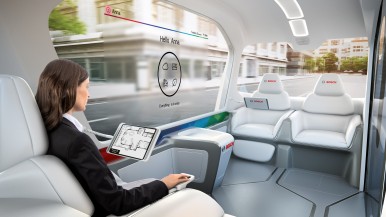
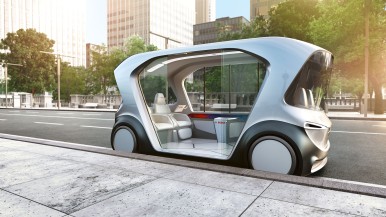
Stuttgart, Germany – A light, airy, minimalistic design, a futuristic outer shell made of display screens and glass, and a spacious interior – that is how architects might describe a novel structure, but in actuality the description also fits a completely new class of vehicle and a new kind of mobility: driverless electric shuttles that glide almost silently through city centers and are seamlessly connected with their environment. These will soon be a common sight on our city streets – whether they are transporting goods or people. Bosch provides components and systems for automating, connecting, and electrifying the shuttles, but shuttle mobility won’t be possible without mobility services. In the future, the company will offer these services too, bundling them into a smart, seamlessly connected ecosystem. That will include booking, sharing, and networking platforms, parking and charging services, and software solutions for managing and maintaining the vehicles, as well as infotainment during the journey. “Bosch is developing a unique package of hardware, software, and mobility services for shuttle mobility of the future,” says Dr. Markus Heyn, member of the board of management of Robert Bosch GmbH. At CES 2019 in Las Vegas, the world’s biggest electronics show, Bosch will be presenting its solutions for this area of transportation with a concept shuttle, and visitors will be able to experience its full range of services. Bosch is developing a unique package of hardware, software, and mobility services for shuttle mobility of the future....Dr. Markus Heyn, member of the board of management of Robert Bosch GmbH Bosch services for users and shuttle operators The emergence of the shuttle segment is a result of rising demand for ridesharing services: in Europe, the U.S., and China alone, about one million such on-demand shuttle buses will be on the roads as early as the year 2020, growing to 2.5 million by 2025 (source: Roland Berger ). Many of these vehicles, available 24/7, will be fully electric, and they will also be completely autonomous by the middle of the next decade at the latest. That’s why Bosch has packed every square centimeter of its concept shuttle with the appropriate technology – from electric powertrains and 360-degree surround sensors to connectivity management and vehicle computers. Yet these components and systems go only part of the way towards shuttle mobility. To make on-demand vehicles suitable for flexible everyday use, they must be connected to mobility services. “In the future, every vehicle on the road will make use of Bosch digital services,” Heyn says. These services allow users to book the vehicles, share rides with other passengers, and pay for the journey. Charging, repairing, and maintaining the vehicles, plus route planning and administrative activities, also call for services that Bosch will offer shuttle fleet operators in a seamlessly connected ecosystem. In the future, every vehicle on the road will make use of Bosch digital services....Dr. Markus Heyn, member of the board of management of Robert Bosch GmbH Booking and sharing Users can easily book a shuttle via smartphone, regardless of whether they’re relaxing on the sofa or sitting at their desk at work. Working behind the scenes, an algorithm identifies the vehicle closest to the requested location and finds other users who wish to travel a similar route. The more passengers a single shuttle can transport, the cheaper the journey for everyone. This approach also reduces the amount of traffic in cities and mitigates the impact on the environment. Bosch is developing the necessary software platforms to make this a reality. When the shuttle pulls up to the requested pick-up point, users again use their smartphones to identify themselves – thanks to Bosch’s Perfectly Keyless digital access service. It recognizes the owner’s smartphone as unmistakably as a digital fingerprint and opens the vehicle only for them. Every passenger always gets the seat that they reserved. Moving forward: electrified and automated Bosch’s electric axle drive makes the shuttles especially efficient yet affordable as they wend their way through the city. And the company’s Convenience Charging service knows just how long the battery charge will last and where to recharge the vehicle. This service means that even today, drivers no longer need to worry about being stranded with a dead battery. It also links vehicle information, such as the current state of battery charge or how much energy the heating and air-conditioning systems are consuming, with environmental data such as congestion and weather forecasts, so as to predict vehicle range with particular accuracy. Furthermore, Convenience Charging finds the ideal charging station and can reserve it in advance. And thanks to a standardized access and payment system, charging is easier than ever. Driverless e-shuttles provide users with transportation that is not only nearly emissions-free, but also very safe. For automation, Bosch develops and makes its own radar, video, and ultrasonic sensors, braking control systems, and power steering, to name a few examples. Smart digital services are indispensable here, too: Bosch predictive road-condition services let automated vehicles know in advance what environmental conditions to expect. They can thus adapt their driving style as needed so as to ensure maximum safety throughout the journey. The Bosch road signature is a map-based localization service with which automated vehicles can accurately determine their position in the lane down to a few centimeters – another crucial prerequisite for the safety of automated shuttles. Comfortable interior Bosch has designed the interior of its concept vehicle to provide space for four passengers, seating them across from one another to maximize legroom and comfort. Infotainment is provided on screens that can be used either by each passenger individually or in groups; for example, a family can watch a movie together as they travel somewhere for the weekend, or colleagues can work on a presentation on their way to the office. Smartphones use the on-board Wi-Fi and can integrate seamlessly with the infotainment system, thanks to Bosch connectivity technology. Its concierge service turns the shuttle into a personal assistant. With all kinds of information at its disposal, the shuttle can provide passengers with recommendations, advance bookings, weather reports, and travel tips at any time. Once the shuttle has arrived at its destination, the passengers can pay for their journey with Bosch’s e-payment service. Maintenance and administrative activities But Bosch services do not end when a rideshare journey is over: the company’s camera-based system for the vehicle interior checks whether anyone has forgotten their phone or handbag. If a passenger does forget something, the shuttle informs them directly via smartphone. The cameras can also detect gum on the seat or an overturned coffee cup – in other words, whether the shuttle needs cleaning – and can make the necessary arrangements immediately. This is so every passenger can start their journey in a clean shuttle. Bosch’s service for over-the-air updates can determine whether the driverless shuttles have the latest software version. The service detects software updates as soon as they are available and executes them in the vehicle securely and reliably. Thanks to sensors installed in the vehicle, predictive diagnostics can monitor the condition of key components and notify the shuttle before a fault actually occurs, so it has enough time to drive itself to a repair shop. This prevents the car from suddenly breaking down, which is a boon to operators. In the future, Bosch will pool updates from the data cloud and predictive diagnostics into a comprehensive connectivity platform . This will give vehicle manufacturers and shuttle service operators a constant overview of the condition of their fleets, so they can ensure that their shuttles are always ready for action. And finally, the Bosch subsidiary ESCRYPT’s security solutions handle vehicle security – whether for keyless access systems, data connectivity with the outside world, or software updates.

Bosch and Veniam ensure seamless vehicle-to- everything connectivity

05.12.2018

Press release

Connected mobility

Bosch and Veniam ensure seamless vehicle-to- everything connectivity

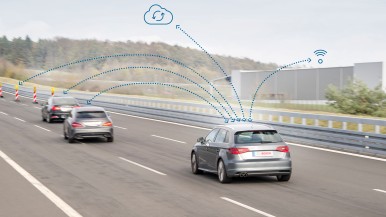
Hildesheim, Germany / Mountain View, USA – What is true for people is also true for cars: communication works best with a common language and a good connection. To enable connected and automated driving in the future, vehicles must be able to easily communicate with one another as well as with their surroundings. There is currently no globally standardized technical basis for this exchange of data, which is known as vehicle-to-everything communication, or V2X. Instead, vehicles will in future communicate using the wide variety of different standards implemented by countries and vehicle manufacturers around the world. “Bosch is taking a multi-standard approach when it comes to V2X. We have developed a universal connectivity unit capable of communicating using all of the transmission standards implemented in connected automobiles,” says Dr. Dirk Hoheisel, Member of the Board of Management at Robert Bosch GmbH. Bosch is taking a multi-standard approach when it comes to V2X. We have developed a universal connectivity unit capable of communicating using all of the transmission standards implemented in connected automobiles....Dr. Dirk Hoheisel, Member of the Board of Management at Robert Bosch GmbH The neat thing here is that Bosch has combined connectivity units and telematics units, which – individually – are only capable of a single transmission technology, to create an all-in-one central control unit for V2X data communication. Cars can then use the Wi-Fi networks available in cities, while elsewhere they can communicate using, for instance, cellular networks. The complex task of managing these diverse communication options is handled by a software solution from the Silicon Valley-based start-up Veniam. It continuously searches for the best transmission technology that suits the particular requirements and switches automatically between the available alternatives. The software therefore maintains continuous and seamless vehicle connectivity, ensuring cars can, for example, reliably alert one another to accidents and passengers can enjoy uninterrupted music streaming. Bosch develops a connectivity unit for all standards It is expected that the number of connected vehicles on the roads in Europe, the United States, and China alone will exceed 470 million by 2025 (source: PwC). Initially, most vehicles will connect directly to the cloud; but, thanks to V2X, increasing numbers of vehicles will in future also be able to communicate directly with one another as well as with traffic signals, road construction sites, pedestrian crossings, and buildings, etc. They will then be able to alert one another to potential hazards like the approaching tail end of a traffic jam, accidents, and icy conditions. Vehicles will also be able to take advantage of the green wave, because they will know when the next set of traffic lights is going to turn green. The vehicles can then adjust their speed accordingly. This ensures the traffic, particularly in cities, flows more smoothly. There is, however, no globally harmonized standard for V2X communication currently on the horizon. While China primarily uses Cellular-V2X technology (C-V2X), which is based on mobile communications, Europe and the United States are planning to additionally introduce transmission standards based on Wi-Fi (DSRC and ITS- G5) alongside C-V2X. A mishmash of standards is therefore emerging internationally, which may lead to vehicle communication issues. However, that will not be the case in the future when cars are equipped with the universal connectivity unit from Bosch. Equipped vehicles will be able to communicate with one another as well as with their surroundings regardless of the vehicle make or the country in which they are used. This will make V2X communication even more secure and reliable. “Thanks to Bosch’s all-in-one principle for connected vehicles, as many drivers as possible around the world can benefit from the added safety, comfort, and convenience provided by V2X,” says Dirk Hoheisel. The unique combination of Veniam’s smart networking software and Bosch’s connectivity unit boosts the vehicle’s data-handling capacities dramatically, paving the way for innovative cloud services and much safer future mobility....João Barros, founder and CEO of Veniam Software ensures the best connection The software from Veniam is the connection enhancer for the connectivity unit from Bosch. As well as keeping an eye on which V2X communication technologies are currently available for use, the software also closely monitors the costs and data transmission latency of each alternative connection option, since not every technology is suitable in every situation. For example, when it comes to alerting a driver to another vehicle that is about to pull out in front of them from a side street, every millisecond counts. This kind of critical information must be communicated in real time using highly reliable technology that is always ready for use – even if that means the resulting data transmission costs are greater. Software updates from the cloud or a navigation system map update, on the other hand, can be put on hold in that sort of situation until a low-cost stationary Wi-Fi network becomes available. Large volumes of data can be transmitted via Wi-Fi in a short space of time, though a downside is that public or home Wi-Fi hotspots are not always available. Veniam’s software is familiar with the pros and cons of each of the communication types and always establishes the optimal connection. “The unique combination of Veniam’s smart networking software and Bosch’s connectivity unit boosts the vehicle’s data-handling capacities dramatically, paving the way for innovative cloud services and much safer future mobility,” says João Barros, founder and CEO of Veniam. On the occasion of the world’s biggest consumer electronics trade show, CES 2019 in Las Vegas, Bosch and Veniam have been selected as CES 2019 Innovation Award Honorees in the “Vehicle Intelligence and Self-Driving Technology” category for their jointly developed solution. Bosch tests V2X in Europe, the United States, and China In the biggest European field trial to date (simTD, Safe Intelligent Mobility – Test Field Germany), V2X communication has proven its suitability for daily use under everyday conditions and in lab simulations. Bosch has played a significant role in this joint project. Since February 2017, Bosch and Vodafone have been performing trials of the V2X communication with the first 5G test modules − the first companies in Europe to do so. The A9 freeway in Bavaria north of Munich is the location for the field tests, which focus on real-time warning systems during lane changing maneuvers on the freeway or in case the vehicle in front brakes suddenly. V2X will also be able to make driver assistance functions even more comfortable, like adaptive cruise control (ACC). In the summer of 2018, Bosch tested secure, direct communication between vehicles and roadside infrastructure, cameras, and sensors in Detroit. The test showcased Wi-Fi- based DSRC technology, where equipped vehicles were provided with in-vehicle notifications about the status of traffic signals ahead and pedestrians crossing the street – functions designed to enhance safety in city traffic. ESCRYPT, a subsidiary in the Bosch Group, provided the cybersecurity technologies behind these V2X demonstrations. In China, Bosch is testing ad hoc communication using Wi-Fi as well as cellular technology. The tests are focusing on alerts that help the driver when overtaking or negotiating complex intersections.

Bosch and Daimler: San José targeted to become pilot city for an automated on-de ...

08.11.2018

Press release

Automated mobility

Bosch and Daimler: San José targeted to become pilot city for an automated on-de ...

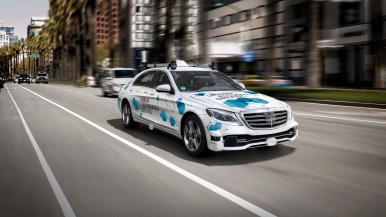
Stuttgart/San José – Located on the southern shore of San Francisco Bay in Silicon Valley, and with more than one million inhabitants, San José is the third biggest city in California. It is planned to be the pilot city for trials, targeted to begin during the second half of 2019, of the highly and fully automated driving (SAE Level 4/5) on-demand ride-hailing service recently announced by Bosch and Daimler. The three parties have signed a memorandum of understanding to pursue and finalize this activity. Using automated Mercedes-Benz S-Class vehicles, Bosch and Daimler propose to offer the service to a selected user community in the San Carlos/Stevens Creek corridor between downtown and west San José. With its population expected to grow 40 percent in the next two decades, the metropolitan area faces growing transportation challenges. Moreover, San José wants to prepare itself for a future in which autonomous cars hit the streets.“The pilot project is an opportunity to explore how autonomous vehicles can help us better meet future transportation needs,” says Sam Liccardo, mayor of San José. “Since many years we consequently push autonomous driving. With this pilot we will generate valuable insights to connect fully automated vehicles in the best way with users of future mobility services,” says Dr. Michael Hafner, Vice President Drive Technologies and Automated Driving at Daimler AG. “We have to rethink urban transportation. Automated driving will help us complete the picture of future urban traffic,” says Dr. Stephan Hönle, senior vice president of the Automated Driving business unit at Robert Bosch GmbH. The on-demand ride-hailing service app operated by Daimler Mobility Services will demonstrate how mobility services such as car sharing (car2go), ride-hailing (mytaxi), and multi-modal platforms (moovel) can be intelligently connected. The test operation will provide information about how highly and fully automated vehicles can be integrated into a multi-modal transportation network. The intent is to provide a seamless digital experience, in which a selected user community will have the opportunity to hail a self-driving car, monitored by a safety driver, from a designated pick-up location and drive automatically to their destination. Automated vehicles make urban mobility more attractive With their joint development work on highly and fully automated driving (SAE level 4/5) in urban environments, Bosch and Daimler aim to improve the flow of traffic in cities, enhance road safety, and provide an important building block for the way traffic will work in the future. Among other things, the technology will boost the attraction of car sharing. Without compromising driving safety, it will allow people to make the best possible use of the time they spend in their vehicles, and open up new mobility opportunities for people without a driver’s license. Bosch and Daimler associates share the same office space Bosch and Daimler associates involved in the development project work together in teams in two regions: in the greater Stuttgart area in Germany and, in the United States, around Sunnyvale in Silicon Valley between San José and San Francisco. Since they share the same office space, rapid communication across working disciplines is ensured, and decision-making paths are short. At the same time, they can draw on the combined know-how of their colleagues in the parent companies. The two companies’ associates are jointly developing the concepts and algorithms for the highly and fully automated drive system. Daimler’s task is to bring the drive system into the car. The company is providing the necessary development vehicles, test facilities, and vehicles for the test fleet. Bosch is responsible for the components specified during the development work, such as sensors, actuators, and control units. For test purposes, Bosch and Daimler use their laboratories and test rigs, plus their respective test sites in Germany. Since obtaining its Autonomous Vehicle Testing Permit from the California Department of Motor Vehicles in 2014, Mercedes-Benz has been testing automated vehicles in the Sunnyvale/California region. And since 2016, it has had similar approval for the greater Stuttgart area in Germany. In early 2013, Bosch was the world’s first automotive supplier to test automated driving (SAE level 3) on public roads in Germany and the United States.

Versatile semiconductors: Bosch launches new automotive system-ICs at electronic ...

05.11.2018

Press release

Connected mobility

Versatile semiconductors: Bosch launches new automotive system-ICs at electronic ...

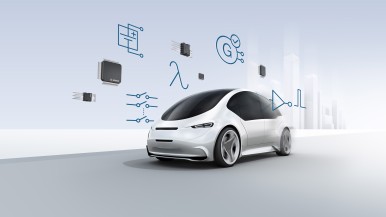
Munich and Reutlingen, Germany – System ICs are application-specific integrated circuits (ASICs) designed to meet special requirements in vehicle systems. They are integrated on a single silicon chip measuring only a few square millimeters, and house complex circuits with up to several million individual electronic functions. At electronica 2018, the world’s leading trade show for electronics, Bosch introduces four new system-ICs. A new chip for electric vehicles will shut off the power in the event of an accident, ensuring safety for driver and passengers and enable rescuers to work without being put in danger.Semiconductors make electric cars safer in an accident Pure electric or hybrid vehicles are equipped with special batteries that provide power to the electric motor at high voltages of 400 to 800 volts. For safety reasons, these high-voltage batteries, power electronics and their electrical wiring are designed to be highly robust. Nevertheless, the question of how secure a high-voltage battery is in the event of an accident is of vital concern to both the vehicle's occupants as well as any rescue workers. To prevent these persons from coming into contact with high voltage, while at the same time eliminating the risk of a vehicle fire, it must be possible to completely isolate the battery from the vehicle’s electrical system. During an accident, so-called "pyro fuses" blow out sections of the electrical wiring to the high-voltage battery by means of a small explosive charge, so that the circuit is interrupted quickly and effectively. Here, Bosch semiconductors play a crucial role: The integrated circuit CG912 can, as a part of the battery management, fire up to four pyro fuses in the battery wiring in the event of an accident,. This mitigates the risk of electrical shock when touching the vehicle’s chassis. In addition, this special IC can also provide power to the battery management. Bosch’s CG912 was originally developed for deploying airbags and has been proven in the field a million times over. New system ICs at electronica 2018 System ICs are truly versatile. They provide stable supply voltages, read sensor data, process information and drive actuators – in real time. The new oxygen sensor evaluation IC CJ138 offers, in comparison to its predecessors, extended options for adapting an engine control unit to a wide range of oxygen sensors, as well as accurate sensor cable diagnostic for short circuit or interruption. The highly integrated transmission IC CG270 precisely controls up to ten hydraulic valves in automatic transmissions and allows the design of more compact control units for modern multi-stage transmissions. CG135 is a transmission IC that monitors the supply voltages in a transmission control unit and prevents the transmission from being damaged in the event of a fault.

Semiconductors – market of the future: Bosch is growing faster than the market

05.11.2018

Press release

Connected mobility

Semiconductors – market of the future: Bosch is growing faster than the market

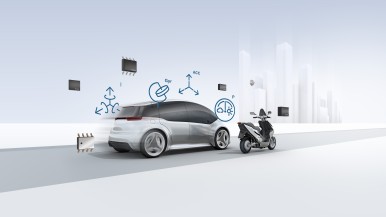
Reutlingen, Germany – Every car nowadays makes use of semiconductors, and that has been true for quite a while. A key technology in today’s modern world, these chips are core components of electrical systems – including those in vehicles. They regulate the powertrain and vehicle handling, tell the navigational system which way the vehicle is going, and signal the airbag to deploy when needed. Having been making semiconductors for more than 45 years, Bosch today is one of the world’s leading manufacturers of chips for mobility applications. “Semiconductors may have been around for a long time, but we have yet to realize their full potential. These components are key to modern-day mobility, and it is impossible to imagine cars today without them,” says Jens Fabrowsky, member of the executive management of Bosch’s Automotive Electronics division. In 2016, every vehicle newly registered worldwide had an average of more than nine Bosch chips on board. “When it comes to semiconductors for cars, we have a singular advantage: Bosch is the only company equally at home in both the automotive and semiconductor industries,” Fabrowsky says. In 2018, every new vehicle featured semiconductors worth 370 dollars (source: ZVEI), and thanks to increasing electrification and automation, demand for chips in vehicles is expected to rise further over the next few years. Semiconductors may have been around for a long time, but we have yet to realize their full potential. These components are key to modern-day mobility, and it is impossible to imagine cars today without them....Jens Fabrowsky, member of the executive management of Bosch’s Automotive Electronics division The ultimate discipline: semiconductors for the auto industry The global semiconductor market is worth billions: the market research company Gartner expects global semiconductor sales to reach 451 billion dollars in 2018. By 2019 alone, the market will have grown at an annual growth rate of more than 5 percent (source: PwC). “The Bosch semiconductor business is growing faster than the market,” Fabrowsky says. In the semiconductor market, the ultimate discipline is making chips for vehicles. Bosch has been making vehicles smart since the 1970s, when it started equipping them with its application-specific integrated circuits (ASICs). In a car, chips are exposed to strong vibrations and extreme temperatures that range from far below zero to far above 100 degrees Celsius. This requires higher standards for the toughness of these special components. Developing semiconductors that can withstand these stresses for a vehicle’s entire lifetime is an intensive process. Here is where Bosch leverages its special dual role: while other companies can process the information collected from semiconductors, Bosch can also apply its deep understanding of the physical principles at work in the chips, and of how to gather the data and ultimately integrate it into the vehicle systems. “Our comprehensive expertise in semiconductors helps us to both develop new automotive functions and steadily improve the chips themselves,” Fabrowsky says. Bosch holds over 1,500 patents and patent applications for engineering and manufacturing its semiconductors. Progress in microelectronics is what made development of assistance systems and automated driving possible in the first place....Jens Fabrowsky, member of the executive management of Bosch’s Automotive Electronics division Electromobility and driver assistance systems boost demand Bosch’s current semiconductor portfolio focuses on microelectromechanical systems (MEMS), ASICs for vehicle ECUs, and power semiconductors. Without the latter, there would be no hybrid or electric vehicles, as they regulate the electric motor and make sure that the battery is being used as efficiently as possible. “Power electronics for hybrid and electric vehicles are a growth driver for Bosch,” Fabrowsky says. Besides electrification, continued strong growth in demand for driver assistance systems is ensuring that more semiconductors with more and more functions are finding their way into cars. Chips with built-in “intelligence,” known as ASICs, are tailored to a particular application; for instance, signaling to airbags in a vehicle when they should deploy. These chips control handling to ensure a consistently safe journey. They also boost the measured signal from radar sensors, so that the proximity warning always functions reliably. “Progress in microelectronics is what made development of assistance systems and automated driving possible in the first place,” Fabrowsky says. Bosch microelectromechanical systems, or MEMS for short, are the sensory organs of modern vehicles. They supply a vehicle’s ECUs with important information regarding its handling, such as if the vehicle is braking or accelerating, or if it is skidding on a smooth road surface. The ESP electronic stability program uses this information to keeps cars, trucks, and even motorcycles safely on track and in their lanes. MEMS sensors tell runners how many calories they are burning As a key technology for the internet of things (IoT), Bosch semiconductors have applications that extend far beyond the world of vehicles. The company’s sensors can be found in more than half the world’s smartphones, and are indispensable for fitness trackers, drones, game consoles, and smart home applications. When it comes to MEMS sensors, Bosch is both a pioneer and the world’s leading manufacturer. More than 20 years ago, the supplier of technology and services itself developed the microfabrication technique, known worldwide as the “Bosch process,” used to make these semiconductors. One billion euros for one of Europe’s most advanced wafer fabs Bosch is underpinning its growth strategy for semiconductors with the single largest investment in the company’s history: it is putting some one billion euros into a new wafer fab in Dresden, which will manufacture 300 mm wafers. Following a rollout phase, pilot manufacturing operations are expected to start at the end of 2021. Compared with conventional 150 and 200 mm wafers, 300 mm wafer technology offers greater economies of scale. Up to 700 associates will be involved in the highly automated chip manufacturing process, working to plan, manage, and monitor production. After Reutlingen, the Dresden plant will be Bosch’s second wafer fab in Germany. With it, the company aims to expand its manufacturing capacity, and thus to further boost its competitive edge in global markets.

In automated vehicles, the seat-of-the-pants feel comes from the Bosch cloud

25.07.2018

Press release

Automated mobility

In automated vehicles, the seat-of-the-pants feel comes from the Bosch cloud

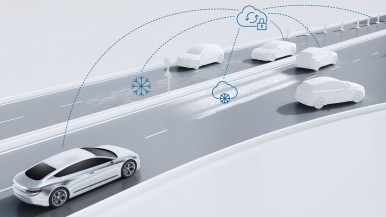
Stuttgart, Germany – Haptic sensation when driving is something that shouldn’t be underestimated. What condition is the road in, how well are the tires gripping? Having or developing a feeling for this can help drivers handle their cars appropriately and safely. Race drivers already have a word for it: seat-of-the-pants feel. They mean the contact between the seat of their pants and their driving seat, which allows them to feel the state of the road surface. Automated vehicles also urgently need information about road conditions. Unfortunately, however, they don’t have any feeling for such conditions – or haven’t up to now. Bosch has developed a system that gives automated vehicles seat-of-the-pants feel. “Wet roads, snow, ice – with our predictive road-condition services, we alert to hazards before critical situations can develop. We are helped here by the weather data provided by our partner Foreca. This means an automated vehicle will know exactly where it can drive autonomously, and how,” says the Bosch management board member Dr. Dirk Hoheisel. With our predictive road-condition services, we alert to hazards before critical situations can develop....Dr Dirk Hoheisel Foreca is one of the world’s leading providers of weather information, with two decades of experience in predicting road weather conditions. “Combining the expertise of Foreca and Bosch will lead to a new era of road-condition forecasting. Unlike weather forecasts in the media, the Bosch road-condition services take multiple possible forecast scenarios into consideration,” says Petri Marjava, Foreca’s sales director. The road-condition services boost driving safety and smoothness. In addition, the availability of automated driving functions is increased. The Bosch services package is to be rolled out worldwide in 2020, initially on the basis of weather data. As more and more connected cars appear on the roads, the service will be augmented by vehicle data. Automated vehicles adjust their speed in good time Up to the highly automated SAE level 4, the decision as to whether a car can assume the task of driving depends on factors such as road type, speed range, and environmental conditions. In future automated vehicles, this decision will also be based on the predictive road-condition services provided by Bosch. Thanks to their help, the automated vehicle will know in good time what environmental conditions to expect. This means it will have plenty of time to adapt its driving style, instead of having to hand over the driving task to the driver at the first sign of impaired road conditions, however minor. If the vehicle’s route takes it through rain, it will adapt its speed well in advance to a level that excludes any risk of aquaplaning and allows it to stop safely at any time. Whatever the SAE automation level, the result is a safe drive that is also smooth and comfortable. Driving automatically, whenever and wherever possible For its predictive road-condition services, Bosch is relying on a multiphase concept. By the time of its planned launch in 2020, it cannot be expected that there will be a sufficiently large proportion of connected vehicles on the roads. Bosch estimates it would take some 20 million connected cars to cover the roughly 80,000 kilometers of freeway in Europe alone. For this reason, road-weather forecasts will initially be the only reliable source of information for drawing sound conclusions about road conditions, especially in rural areas where there is less traffic. Bosch will get the constantly updated global road-weather data it needs for this from Foreca. Bosch’s thorough examination of several leading providers showed that the Finnish weather experts were the most accurate road-weather data provider globally. The more precisely hazardous conditions can be predicted and localized, the easier it will be to keep the availability of automated driving functions to a maximum. Thanks to a worldwide reference measuring fleet and machine learning methods, Bosch and Foreca have jointly been able to optimize the safety and availability of the road-weather models. In this way, the two companies have achieved a safety standard of the kind that will be necessary for life-critical systems such as automated driving. ESP interventions allow friction coefficient to be determined As a sufficient number of connected vehicles take to the roads, Bosch will supplement its predictive road-condition services with vehicle data. These data will include information stored on the CAN bus, the vehicle’s central data network, such as the temperatures measured inside and outside the vehicle, and whether the windshield wipers are in use. Thanks to connectivity, this data will not remain unused in the vehicle, but will find its way into the Bosch cloud via the respective automaker’s back-end server. In addition, Bosch will evaluate the regular interventions by the ESP anti-skid system. Using mathematical methods, engineers can measure the friction coefficient of the road surface at each individual wheel, as well as the status of each wheel. When all these data are combined and intelligently evaluated, the result is a package of smart Bosch services – and the comforting feeling of being in safe hands.

Bosch and Daimler: Metropolis in California to become a pilot city for automated ...

11.07.2018

Press release

Automated mobility

Bosch and Daimler: Metropolis in California to become a pilot city for automated ...

Stuttgart – Bosch and Daimler are speeding up the development of fully-automated and driverless driving (SAE Level 4/5) in the city and are decisively setting the course. The partners have chosen California as the pilot location for the first test fleet. In the second half of 2019, Bosch and Daimler will offer customers a shuttle service with automated vehicles on selected routes in a Californian metropolis. Daimler Mobility Services is envisaged as the operator of this test fleet and the app-based mobility service. The pilot project will demonstrate how mobility services such as car sharing (car2go), ride-hailing (mytaxi) and multi-modal platforms (moovel) can be intelligently connected to shape the future of mobility. In addition, the partners have decided on the US technology company Nvidia as the supplier of the artificial intelligence platform as part of their control unit network. Developing automated driving to a level ready for series production is like a decathlon. It’s not enough to be good in one or two areas. Like us, you have to master all disciplines....Dr. Stephan Hönle, Senior Vice President Business Unit Automated Driving at Bosch For the joint development of a driving system for fully-automated and driverless vehicles, Bosch and Daimler rely on their automotive expertise accumulated over many decades to bring mature and safe innovations to market. Both companies are guided by a shared philosophy: “The decisive factor is to introduce a safe, dependable and mature system,” says Dr. Michael Hafner, Head of Automated Driving at Daimler AG. “Safety has the highest priority, and is the constant theme of all aspects and development stages on our way to the start of series production. If in doubt, thoroughness comes before speed.” “Developing automated driving to a level ready for series production is like a decathlon”, according to Dr. Stephan Hönle, Senior Vice President Business Unit Automated Driving at Robert Bosch GmbH. “It’s not enough to be good in one or two areas. Like us, you have to master all disciplines. Only then will we succeed in bringing automated driving to the roads and the city safely.” Evaluation of sensor data within milliseconds A decisive factor for fully-automated and driverless driving in an urban environment is the reliable recognition of the vehicle’s surroundings with the aid of various sensors. Analyzing and interpreting the variety of incoming data and translating them into driving commands within a very short time requires enormous computing power – the fully-automated, driverless vehicle will be a mobile super-computer. At the same time, fully-automated, driverless driving in the city requires a versatile, redundant systems architecture and the highest level of functional safety. To achieve this level of safety, the necessary computing operations are performed in parallel in different circuits. This means that the system has instant recourse to these parallel computing results when necessary. For their driving system, Bosch and Daimler thus rely on a control unit network made up of several individual control units. The US technology company Nvidia supplies the platform required for this, which can run the Artificial Intelligence (AI) algorithms generated by Bosch and Daimler for the vehicle’s movement. The network of control units collates the data from all sensors with radar, video, lidar and ultrasound technology (sensor data fusion), evaluates them within milliseconds and plans the movements of the vehicle. All in all, the control unit network has a computing capacity of hundreds of trillion operations per second. That’s as much as several S-Class vehicles together could reach just a few years ago. Metropolis in California will be a pilot city for automated test fleet The control unit network will also be used in the fleet vehicles which Daimler and Bosch will put on the roads of California in the second half of 2019. Not only that: Both partners will offer customers an automated shuttle service on select routes in a city located in the San Francisco Bay in Silicon Valley. The test operation will provide information about how fully-automated and driverless vehicles can be integrated into a multi-modal transport network. Many cities face numerous challenges that are increasingly burdening the existing transport system. The test is to show how this new technology might be a solution to these challenges. Driverless driving makes urban mobility more attractive With their development cooperation on fully-automated and driverless driving in urban environments which began in April 2017, Bosch and Daimler aim to improve the flow of traffic in cities, enhance safety on the road and provide an important building block for the way traffic will work in the future. The technology will, among other things, boost the attraction of car sharing. In addition, it will allow people to make the best possible use of their time in the vehicle, and open up new mobility opportunities for people without a driver’s licence, for example. The vehicle comes to the driver, not the driver to the vehicle. Within a defined city area, users can conveniently order a car-sharing car or a vehicle that drives by without a driver. The project especially combines the overall vehicle and mobility expertise of one of the world’s leading premium manufacturer with the systems and hardware expertise of one of the world’s largest suppliers. The ensuing synergies’ purpose is to introduce the new technology early and fully validated. Bosch and Daimler employees share the same office space Bosch and Daimler employees work together in teams in two regions: In the greater Stuttgart area in Germany and around Sunnyvale in Silicon Valley to the south of San Francisco in the USA. Employees from both companies share the same office space. This ensures rapid communication across working disciplines and short decision-making paths. At the same time they have access to the entire know-how of the colleagues in the mother companies. The partners are equally financing the development work. The personnel in this cooperation are jointly developing the concepts and algorithms for the fully-automated, driverless drive system. Daimler's task is to bring the drive system into the car. To this end, the company is providing the necessary development vehicles, test facilities and later the vehicles for the test fleet. Bosch is responsible for the components (sensors, actuators and control units) specified during the development work. For test purposes the partners use their laboratories and test rigs, plus their respective test sites in Immendingen and Boxberg. Furthermore, since 2014 Mercedes-Benz has approval to test automated vehicles in the Sunnyvale/California region. The company also has comparable approval for the Sindelfingen/Böblingen region since 2016. Bosch was the world’s first automotive supplier to test automated driving on public roads in Germany and in the US in early 2013.

Manufacturing hub Mexico: Bosch plans smart plant for electronic components

17.04.2018

Press release

Business/economy

Manufacturing hub Mexico: Bosch plans smart plant for electronic components

Mexico City, Mexico, and Stuttgart, Germany – Bosch, a leading global provider of technology and services, is investing 100 million euros (120 million U.S. dollars) in a new plant in Celaya. The company plans to build a new smart factory for electronic components in the central Mexican city by 2020. The investment underlines the importance of this year's HANNOVER MESSE partner country for the company: “Bosch is committed to Mexico. The country is and will remain an important market and a hub for our global manufacturing and development network,” said Stefan Hartung , member of the Bosch board of management, ahead of the international industrial trade fair. The goal is to create more than 1,200 additional jobs at the new location in Celaya in the coming years. In total, the Bosch Group employs around 16,000 associates and is active with all four of its business divisions in Mexico. In 2016, the company generated sales of 1.1 billion euros in the country Bosch is committed to Mexico. The country is and will remain an important market and a hub for our global manufacturing and development network....Stefan Hartung, member of the Bosch board of management Industry 4.0 as a competitive advantage in Mexico The Latin American emerging market has become highly industrialized in recent years, driven mainly by the automotive industry. In 2017 alone, nearly 3.8 million vehicles were manufactured in Mexico. In order to increase efficiency and competitiveness as a leading global manufacturing location, Mexico is increasingly focusing on the use of Industry 4.0. Bosch is playing a part in this. “We are planning to make the new manufacturing facility in Celaya a smart factory with state-of-the-art, intelligent production lines,” Hartung said. For example, the plant will employ a manufacturing execution system (MES), which automatically collects data and shares production information in real time. This makes possible both preventive maintenance of machinery and higher product quality. The system also digitally connects the plant to the Bosch Group’s global manufacturing network. “By mid-2019, manufacturing at nearly all Bosch plants in Mexico will be equipped with our intelligent control system,” said René Schlegel, president of the Bosch Group in Mexico. In total, Bosch currently operates ten manufacturing locations around the country and has already introduced the use of smart technologies, for example at its Mobility Solutions sites in Toluca and Juárez. As a leading provider of Industry 4.0 solutions, the Bosch Group also sees local business opportunities in Mexico. Increasing demand for connected mobility The new approximately 21,000-square-meter facility in Celaya, which is located in the state of Guanajuato, will manufacture electronic control units (ECUs) for the American market. These are key components for connected mobility. Alongside Juárez, Celaya will be home to the Automotive Electronics division’s second plant in Mexico. “With the new location, we are responding to the increasing demand for electronic components in the American market,” René Schlegel said. With a total surface area of 170,000 square meters, the site will have capacity for further expansion in the future. In addition, the plan is to build a logistics center for Mexico on the adjacent property, which will also serve as a warehouse for the new plant. Bosch strengthens presence in North America With the investment in a new location, Bosch is continuing its long-term expansion in North America. Over the past five years, a total of around 2.6 billion euros has been spent on strengthening the company’s local presence. In Mexico, where Bosch has been active since 1955, the company opened a new manufacturing facility for driving safety systems in Aguascalientes in 2016. At the end of 2017, a plant for steering systems in Querétaro went into operation. The country is also gaining in significance as a development location: since 2014, Bosch has been operating a center for software development and engineering services for the American market in Guadalajara. A large proportion of the investment sum also went to the U.S. There, the Mobility Solutions plants in Charleston and Anderson are currently being expanded, and at the beginning of this month, Bosch opened a new research center in Sunnyvale in California’s Silicon Valley. Bosch at HANNOVER MESSE: the factory of the future – today! What will the factory of the future look like? How can people, robots, and machines work together? What role do 5G, data, software, and services play? Where can artificial intelligence (AI) be put to use? At Hannover Messe 2018 (hall 17, booth A40), Bosch is bringing the factory of the future to life – today. Entitled “Now, next, beyond: factory of the future,” the technology company’s 1,300-square-meter showcase demonstrates what it offers today (now), and what solutions it is developing for tomorrow (next) and the future (beyond). The main attractions are 1.5-meter-tall mobile robotic figures that give a Pixar-like face to Bosch’s connected-factory assistants. Another highlight is a football table that improves its soccer abilities with every game and every new opponent – thanks to AI.