Search & find:
Media, press releases, events for your editorial coverage

Bosch invests millions in metal 3D printing center

18.03.2025

Press release

Business/economy

Bosch invests millions in metal 3D printing center

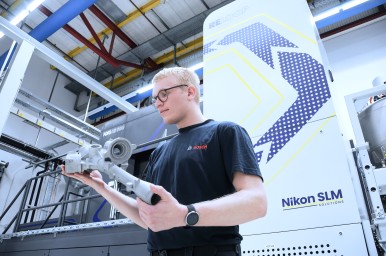
Nuremberg and Stuttgart, Germany – Speed, precision, flexibility, and energy efficiency: for Bosch, these factors are key when manufacturing the complex metal parts that it supplies to its in-house and third-party customers. With a new metal 3D printer at its Nuremberg plant, Bosch wants to bolster its pioneering role in the supplier industry. In fact, it is the first Tier-1 automotive supplier in Europe to have a facility in this performance class. The plant has invested almost six million euros in the center and in the associated purchase and installation of a Nikon SLM Solutions NXG XII 600 metal 3D printer. Bosch remains committed to Germany as an industrial location and is investing large sums of money here. By introducing new technologies in our plants, we are securing considerable sales potential....Klaus Mäder, member of the Bosch Mobility sector board responsible for operations. “Bosch remains committed to Germany as an industrial location and is investing large sums of money here. By introducing new technologies in our plants, we are securing considerable sales potential,” says Klaus Mäder, the member of the Bosch Mobility sector board responsible for operations, including all plants worldwide. The new 3D printer is intended to accelerate development cycles, especially for metal parts, which take a long time to make using conventional manufacturing processes. Commenting on the facility’s official start of operations, Alexander Weichsel, the commercial plant manager in Nuremberg, says: “By making the manufacture of metal parts faster and more productive, this new facility will increase our competitiveness.” And the technical plant manager Jörg Luntz adds: “With this facility, we are setting the highest standards in metal 3D printing. In volume production, this will open up completely new possibilities for us.” Whether components for hydrogen applications, motor housings for electric cars, components for e-axles, or engine blocks for racing: the facility’s sheer size and technical capabilities pave the way for a host of applications. Working from a computer-aided design file developed in advance, its twelve lasers melt metal powder layer by layer to create highly complex shapes. The new metal 3D printer is up to five times faster than the 3D printing systems that have been used up to now. Complex structures such as interior or curved channels, which are simply not feasible with conventional milling processes, can now be produced without any problem. While drilling around corners is not possible using conventional methods, 3D printing makes light work of this. The printer can produce unfinished parts on demand with no need for tooling. And because 3D printing slashes raw-material waste to almost zero, it also conserves resources. “Using the 3D printer to manufacture components not only increases sustainability in production, but also enables Bosch to respond flexibly to fluctuations in batch sizes and offer everything from a single source,” Weichsel says. Manufacturing a complete engine block using the 3D printing process One particularly vivid example of the new possibilities that the 3D printing process opens up is the engine block: with conventional manufacturing, it can take up to three years to get from the first draft design to volume production. Completing the casting mold for the engine block alone can take up to 18 months. 3D printing does away with this step. The design data is transmitted directly to the printer, eliminating the need for complex molds. The 3D printer delivers a finished engine block after just a few days, thus greatly reducing overall product development time. At full capacity, the facility can produce metal parts with a total weight of around 10,000 kilograms in under a year, achieving speeds of up to 1,000 cubic centimeters per hour. The main aim of this faster component production is to cut the time to market. “We want to be faster than with traditional manufacturing processes and use this technology to get products to market more quickly,” Luntz says. “Even today, only a few companies can produce technology on an industrial scale the way Bosch does. We’re now going one step further, taking volume production in metal 3D printing to the automotive level.” This opens the door to completely new opportunities and possibilities – in the automotive sector, but also in numerous other industries such as energy and aviation.

GAIA-X 4 moveID project develops basis for secure mobile data exchange

08.09.2022

Press release

Business/economy

GAIA-X 4 moveID project develops basis for secure mobile data exchange

Stuttgart, Germany – Which parking garages currently have vacant charge spots available? Where are free parking spaces in the city center? And how can this information be digitally transmitted, and services billed, across providers? The answer to these and similar questions calls for secure data exchange between the vehicles and their environment. It is precisely this foundation that a research project consisting of universities, automotive suppliers, and system providers is now in the process of building, with Bosch leading the consortium. Over the next three years, the GAIA-X 4 moveID project is set to develop the necessary standards and technological concepts to enable the secure exchange of information between providers of mobility applications and their customers. The goal is to create decentralized digital vehicle identities. This is an important prerequisite for the mass use of electric vehicles, automated driving, and the establishment of connected cities. GAIA-X 4 moveID is supported to the tune of 14 million euros by the German Federal Ministry for Economic Affairs and Climate Action – covering half of the project costs.Connectivity for digital services across the board “An integrated and transparent system architecture for the exchange of data on the road that incorporates different products and players simply isn’t available today. While it’s true that some companies out there already offer services, those services are tailored for specific applications, vehicles, or customer groups,” explains Peter Busch, project manager at the consortium leader Bosch. They often map the infrastructure, for example, but they rarely provide information about availability due to a lack of connectivity between the many independently operating service providers. “Open standards are needed so that users, for example, can find all available charging stations or pay for charging processes,” Busch says. It’s important to always ensure that the data is processed securely and that individual providers don’t exploit it solely for their own purposes. For Busch, this is the only way that the necessary user confidence can grow and a broad range of all available services, such as so-called deep parking (use of otherwise unavailable parking spaces), can be created. That is why the consortium is building on the European GAIA-X system, which defines the technological, economic, and legal framework for a secure and trustworthy data infrastructure. GAIA-X relies on decentralization and the interplay of different cloud providers under common guidelines. In this spirit, the GAIA-X 4 moveID project is using open source software for its developments and making them available to all providers for various business models. Vehicles are becoming marketplaces The standards that GAIA-X 4 moveID is pursuing will allow vehicles to securely and independently exchange information with other vehicles and their environment without an “intermediary.” The vehicles’ “infrastructure partners” include charge spots, barriers, traffic lights, and parking lots. The research project will use internationally recognized hardware and software to develop management and administrative services to facilitate the interaction and trade between different players. This will enable providers to connect a great many services, such as news, entertainment, and navigation, with the car’s system, especially in automated driving. The market for services related to connected parking alone is estimated to be worth ten billion euros annually worldwide. What’s more, the ability to navigate directly to a vacant parking space significantly reduces congestion and emissions. After all, today, about a third of downtown urban traffic is people looking for parking spaces. The availability of information is also a crucial factor for the success of electromobility. It is estimated that about half of newly registered cars in Europe will be electric by 2030. “Their drivers need to know that they’ll be able to find a charge spot quickly whenever they need one. And that requires connected systems,” Busch says. Extensive data exchange as a basis for automated driving The mass use of automated vehicles is conceivable only if cars are able to quickly and reliably communicate with their environment. The data exchange this requires will enable climate-friendly traffic control based on the volume of traffic at any given moment. This will allow cities to regulate incoming traffic to particular areas in real time, thus preventing congestion. However, this method, known as zoning, requires that vehicles be able to immediately recognize changing conditions and to reroute accordingly. Zoning is being demonstrated with test vehicles – for the first time across borders – in the Germany-France-Luxembourg (Merzig/Saarbrücken) test area as part of the GAIA-X 4 moveID project. The cars receive dynamic information regarding their approach to defined zones.The project partners: Robert Bosch GmbH Materna Information & Communications SE Denso Automotive Deutschland GmbH Continental Automotive Technlogies GmbH WOBCOM GmbH ecsec GmbH HTW Saar (University of Applied Sciences) Atos Information Technology GmbH Chainstep GmbH Peaq Technology GmbH Zeppelin Universität gGmbH (Zeppelin University) Datarella GmbH 51nodes GmbH Bigchain DB GmbH Fetch.ai Research & Development GmbH ITK Engineering GmbH Deutsche Zentrum für Luft- und Raumfahrt e.V. (German Aerospace Center) Airbus Defence and Space GmbH Delta Dao AG

Bosch and CATL collaborate on battery cells

05.09.2019

Press release

Business/economy

Bosch and CATL collaborate on battery cells

Stuttgart, Germany: Bosch and Contemporary Amperex Technology Co. Limited (CATL) have concluded a long-term strategic cooperation agreement. The partners are going to jointly specify high-performance battery cells. CATL will then design, develop, and manufacture these cells in accordance with Bosch requirements. The cells are to be used in the 48-volt battery developed by Bosch. This battery is the core element of 48-volt hybrid powertrain systems, whose efficiency is making them globally ever more important. In joining this alliance, the supplier of technology and services is also securing its long-term sourcing for battery cells. “We have to understand battery cells, but we do not have to make them ourselves,” says Dr. Stefan Hartung, member of the board of management and chairman of the Mobility Solutions business sector. “With CATL, we have brought an established cell specialist for lithium-ion batteries on board as a partner. In combination with our systems know-how and expertise in battery management, we will extend our strong position in the 48-volt battery market.” CATL, one of the world's leading experts of lithium-ion battery is currently building a battery factory in Erfurt, Germany. For Bosch, this alliance is another step on the path to market leadership in electromobility. Numerous global automakers already use Bosch’s 48-volt battery. This 48-volt hybridization is sure to be the minimum standard in tomorrow’s automotive market....Dr. Stefan Hartung, member of the board of management and chairman of the Mobility Solutions business sector 48-volt system destined to be the minimum standard in tomorrow’s automotive market Bosch’s portfolio for 48-volt systems extends beyond the 48-volt battery to encompass other system components such as DC/DC converters and electrical machines. With this technology, Bosch aims to gear up all classes of vehicles for future emissions requirements and offer affordable hybridization. Its 48-volt electrification augments the combustion engine with an electric motor. This motor is powered by the 48-volt battery, which in turn is charged by recovering energy expended during braking. This can cut fuel consumption by as much as 15 percent. If we want to improve efficiency, we can no longer afford to let brake energy dissipate unused,” Hartung says. “This 48-volt hybridization is sure to be the minimum standard in tomorrow’s automotive market.” The market for 48-volt solutions is growing worldwide. Bosch expects that by 2025, nearly 20 percent of new cars sold annually around the globe will have a 48-volt system and matching battery on board. Demand for 48-volt systems is rising, especially in Europe and China. Cost-effective and easy to integrate – the Bosch 48-volt battery The Bosch plant in Wuxi, China, started making the first generation of the 48-volt battery late last year. The USP of the latest version of this product is that the battery is compact and cooled passively. This means automakers can simply integrate it into their vehicle models, and do not require any additional cooling units. In addition, they can dispense with the long and costly effort of proprietary engineering work. “We are confident that our 48-volt battery will achieve a leading position in the market, and make the 48-volt hybrid affordable for the mass market,” Hartung says. Expertise across the e-mobility ecosystem Bosch is more broadly positioned in e-mobility than any other company. It aims to take the lead in the mass e-mobility market that will emerge in 2020 and beyond. The company is planning to increase its sales in this area more than tenfold by 2025, to five billion euros. Bosch electrical powertrain components already feature in more than a million vehicles around the world. The supplier of technology and services has carried out powertrain projects for 50 electric-vehicle platforms. It is the market leader in China, the world’s biggest and fastest-growing electric-vehicle market. Bosch technology can be found in practically every class of vehicle, from electric baby buggies, bicycles, and scooters to passenger cars and commercial vehicles. The company’s expertise thus extends across the entire e-mobility ecosystem. Bosch is partnering with various automakers to give e-vehicle drivers app-based access to some 40,000 charge spots in eight European countries.

Germany, high-tech hub: Semiconductors pave the way for better quality of life.

25.06.2018

Presentations

Business/economy

Germany, high-tech hub: Semiconductors pave the way for better quality of life.

Check against delivery.Ladies and gentlemen, It’s been only roughly a year since we jointly announced the decision to build a new plant for 300 mm wafers. Now here we are, following a complex planning process, laying the foundation stone for Bosch’s chip factory of the future. With it, we are laying the foundation for improving people’s quality of life, the foundation for more safety on the road – and the foundation for a technology crucial to the internet of things and the mobility of the future. Semiconductors are a core component of all electrical systems. Semiconductors are also turning data into a coveted raw material of the future – none of the cars made today would be able to drive without them. They enable automated and efficient driving, and provide the best passenger protection – such as when they are called on to deploy airbags. With the areas of application for semiconductors becoming larger and larger, we are expanding our manufacturing capacity. As a location, we have opted for Germany. With this plant, we are entering into 300 mm wafer production for the first time, in a drive to achieve further significant economies of scale and to bolster our competitiveness. We see Dresden, the capital of Saxony, as a driver of microelectronics in Europe – and thus as the first choice worldwide for our billion-euro investment. I firmly believe high-tech is something Germany does well. By working closely with semiconductor companies, researchers, and universities, we aim to strengthen both our innovative strength and the competitiveness of this high-tech industry – in Germany and throughout Europe. Ladies and gentlemen, every day in our wafer fab, we will use highly automated manufacturing processes to create the future in the shape of semiconductors. But we will be doing more than that: we’ll also be creating prospects for the future in the shape of highly attractive jobs. Our high-tech factory will employ up to 700 people. We are looking for creative minds – people who can bring their expertise to bear on the construction of this state-of-the-art Bosch wafer fab. We are counting heavily on finding specialists here in the region as well as international specialists and experts. Our new construction project is also the biggest single investment in Bosch history. We are putting roughly one billion euros into our new location, and are pleased that the German Ministry for Economic Affairs and Energy plans to support its construction and commissioning. And in addition to the federal government, the state of Saxony and the city of Dresden have also pledged their support. So at this point, I wish to express my thanks to you, Minister Altmaier, and you, Minister-President Kretschmer. It is also thanks to you and your predecessors that things have moved so fast, and we find ourselves here today, ready to lay the symbolic foundation stone together – for better quality of life, for the semiconductor industry in Dresden, and for the competitiveness of Germany as a high-tech location.

Bosch lays foundation stone for factory of the future

25.06.2018

Press release

Business/economy

Bosch lays foundation stone for factory of the future

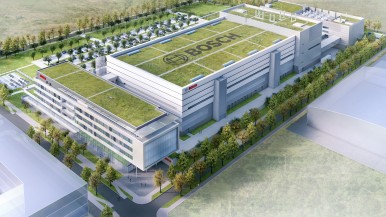
Stuttgart and Dresden, Germany – The foundation stone laid today in Dresden is a key milestone in the construction of the Bosch Group’s state-of-the-art wafer fab. Construction is scheduled to be completed in late 2019, when installation of the production machinery will start. “Today we are laying the foundation stone for the wafer fab of the future, and with it the foundation for improving people’s quality of life and their safety on the road,” said Dr. Dirk Hoheisel, member of the board of management of Robert Bosch GmbH, at the formal ceremony in Dresden. “Semiconductors are the key technology for the internet of things and the mobility of the future. When installed in cars’ control units, for example, they enable automated, efficient driving and the best possible passenger protection.” In his address, Peter Altmaier, the German Federal Minister for Economic Affairs, underlined the central importance of this Bosch investment: “We are today taking an important step toward securing the future competitiveness of Germany as an industrial location. The research community in Germany and Europe is an excellent one, but we cannot afford to rest on our laurels. In the field of microelectronics, we also need engineering skills and know-how, and especially industrial-scale manufacture and application, in Germany and Europe. Today’s ceremony is an important step on this route.” As a supplier of technology and services, Bosch is investing roughly one billion euros in its new location in the Saxony state capital. The first associates are due to start work in the new plant in early 2020. Today we are laying the foundation stone for the wafer fab of the future, and with it the foundation for improving people’s quality of life and their safety on the road....Dr. Dirk Hoheisel After Reutlingen, the Dresden plant is the Bosch Group’s second wafer fab in Germany. With it, the company aims to expand its manufacturing capacity, and thus to boost its competitive edge in global markets. Semiconductors are finding their way into more and more applications relating to the internet of things and mobility solutions. According to the market research company Gartner, semiconductor sales around the world rose by some 22 percent in 2017 alone. Otto Graf, who will manage the new plant, said: “Construction is proceeding right on schedule. “During the construction phase, we will move some 7,500 truckloads of earth, lay about 80 kilometers of piping and ductwork, and mix more than 65,000 cubic meters of concrete – 8,000 concrete mixers-worth.” Following a rollout phase, pilot manufacturing operations are expected to start at the end of 2021. The plot of land – measuring some 100,000 square meters, or roughly 14 soccer fields – will also be home to a nearly 72,000 square-meter multistory building housing offices and production space. Up to 700 associates will be involved in the highly automated chip manufacturing process, working to plan, manage, and monitor production. This also includes modifying the production processes and evaluating the data from Dresden in Bosch’s global manufacturing network. Saxony as a business location: driving Europe’s microelectronics industry “Bosch’s decision is an important milestone. The construction of the new wafer fab here in Dresden will create many other attractive jobs, strengthen Saxony’s reputation as a location for technology and business, and is good for Germany and Europe as well. This project will play a decisive part in securing a leading role for European industry as a whole in the technologies of the future,” said Michael Kretschmer, the Minister-President of the state of Saxony. “This investment in such a major project is a sign of confidence in Saxony, in its people, in the research and industrial network that has become established here, and in its innovativeness.” In its search for a new location, Bosch considered several cities around the world. In Hoheisel’s words, “Dresden is an excellent microelectronics cluster.” He added that the city’s infrastructure is excellent: everything is easily accessible, and the transportation connections are good. The cluster also includes automotive suppliers and service providers, as well as universities offering technological expertise. As Hoheisel pointed out: “We want to work closely with semiconductor companies and universities to increase semiconductor technology’s competitive edge – not only in Germany, but across Europe.” We are today taking an important step toward securing the future competitiveness of Germany as an industrial location....Peter Altmaier, the German Federal Minister for Economic Affairs Semiconductors: key technology for the internet of things Manufacturing semiconductor chips always starts with a silicon disc, or wafer. The bigger the wafer’s diameter, the more chips that can be made per manufacturing cycle. This is one reason why the new Bosch factory will focus on the production of 300 mm wafers: Compared with conventional 150 and 200 mm wafer fabs, 300 mm wafer technology offers greater economies of scale. Semiconductors are extremely small integrated circuits with structures measured in fractions of a micrometer. Manufacturing them requires a highly automated and complex process consisting of several hundred individual steps over several weeks. It takes place in clean-room conditions, as even the tiniest particles in the ambient air can damage the delicate circuits. Connected manufacturing: 22 metric tons of data a day for higher quality Wafer production is one of the forerunners of connected manufacturing. The Dresden plant is expected to generate production data equivalent to 500 text pages per second – written out on paper, that would be more than 42 million pages a day, weighing 22 metric tons. This is why artificial intelligence will play a special part in chip manufacturing in the factory: the highly automated production facilities analyze their own data in order to optimize their processes. As a result, the quality of the chips rises while production costs go down. Furthermore, planning and process engineers can access this production data at any time to accelerate the development of new wafer products or minimize tolerances early on in the manufacturing process. “We need creative minds for our connected and automated manufacturing operations – particularly experts in wafer technology, like process engineers, mathematicians, or software developers,” Graf said. Many new associates have already been hired for the Dresden plant, he added, and there has been no drop in the number of applications. Leading semiconductor manufacturer with 45 years of experience For more than 45 years, Bosch has been making semiconductor chips in various forms, above all as application-specific integrated circuits (ASICs). At its wafer fab in Reutlingen, Germany, Bosch currently manufactures ASICs, power semiconductors, and microelectromechanical systems (MEMS). Bosch ASICs have been used in vehicles since 1970. They are customized to individual applications, and essential for functions such as engine management or airbag deployment. In 2016, every car rolling off the production lines worldwide had on average more than nine Bosch chips on board.


25.06.2018

Factsheet

Business/economy

Laying the foundation stone for 300 mm wafer fab in Dresden

General information Total investment approx. 1 billion euros Site approx. 100,000 m2 (about 14 soccer fields) Total floor space approx. 72,000 m² of production area and office space Construction timeline Groundbreaking in spring 2018 installation of machinery mid-/end 2019 pilot production to start at end of 2021 Associates in the completed plant Up to 700 Qualified professionals needed Experts from the semiconductor industry, such as process, production, and maintenance engineers, mathematicians, software engineers, as well as professionals with degrees in physics, chemistry, and microsystems technologies Manufacturing technologye Highly automated wafer production (300 mm silicon substrate wafers with structures up to 65 nm in width – 1 nm equals one millionth of a millimeter) Connected manufacturing Every second, the machines will transmit one gigabit of production data. The volume of data produced is equivalent to more than 42 million written sheets of paper, weighing 22 metric tons.Details on the building Total building volume 600 000 m³ Concrete approx. 66,500 m³ (about 8,300 concrete mixer trucks) Steel approx. 16,400 metric tons (about 30 A380 passenger jets) Earth moved/excavated approx. 90,000 m³ (some 7,500 truckloads) Bored piles for the foundation approx. 860 Floor slabs 100 cm thick Length of piping and ductwork approx. 80 km Length of electrical cabling approx. 380 km (from Dresden to Berlin and back)Internet For job seekers www.bosch-career.de/jobs Site for the Dresden location https://www.bosch.de/en/ourcompany/bosch-in-germany/dresden Bosch semiconductors www.bosch-semiconductors.com

Political VIPs at Bosch: chancellor Merkel and prime minister Costa open technol ...

30.05.2018

Press release

Business/economy

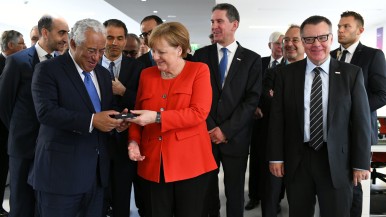
Political VIPs at Bosch: chancellor Merkel and prime minister Costa open technol ...

Braga, Portugal – Angela Merkel, the German chancellor, and António Costa, the prime minister of Portugal, today officially opened a new Bosch technology center in Braga together with Bosch board of management member Dr. Dirk Hoheisel . By the end of 2018, over 200 engineers will be working on developing sensors and software functions for automated driving at the location, which is situated about 50 km northeast of the coastal city of Porto. 100 new jobs will be created at the center. Some 100 associates have already transferred to the new 4,500 m2 technology center from the company’s main site, which is located four kilometers away. The German chancellor was in Portugal for talks on the development of German-Portuguese relations. In his speech, Portuguese prime minister Costa welcomed the opening of Bosch’s new technology center in his country, saying, “Portugal stands for innovative strength. Investments like the one Bosch has made here underscore this.” Our associates here will contribute to one of the key projects of future importance – the development of automated driving....Dirk Hoheisel, member of the board of management of Robert Bosch GmbH “Our new technology center in Braga is another indicator of the great potential we see in Portugal. It also reflects our confidence in the expertise of Portuguese engineers,” Hoheisel said, adding: “I am particularly pleased that our associates here will be able to make an even greater contribution to one of the key projects of future importance – the development of automated driving.” In recent years, Bosch has significantly expanded its presence in Portugal: between 2015 and 2017, it spent more than 200 million euros strengthening its activities there in the field of connected and automated mobility. In 2018, investments are expected to match the high levels of previous years. Bosch in Braga: solutions for tomorrow’s mobility The international supplier of technology and services currently employs more than 3,000 associates at its Braga location – around 1,000 more than just five years ago. The majority are involved in the development and manufacture of components for connected mobility, including technology for user-friendly display systems and infotainment. Among these is the eCall automatic emergency notification system for two-wheelers . If the vehicle is involved in an accident, the system automatically places a call for help. Particularly for motorcyclists, who have a much higher risk than car drivers of being involved in an accident, the system can mean the difference between life and death. About ten percent of associates at the Braga location work on developing components for automated mobility. In addition to developing and manufacturing sensors for vehicle safety systems like the ESP electronic stability program, the location also produces sensors that can, for instance, accurately determine the position of self-driving cars. In addition, the Bosch location in Braga has a longstanding research partnership with the local University of Minho, one of the country’s top universities. In a joint project with the university, the new technology center will also conduct research into sensors for automated driving. This partnership is scheduled to commence this year and continue for three years. Bosch Portugal: growing importance in the global engineering and manufacturing network Portugal is a key location within Bosch’s global engineering and manufacturing network. The company has had a presence in Portugal since 1911 and currently employs more than 4,500 associates at four locations. 500 of Bosch’s Portuguese associates work in R&D. In 2017, Bosch generated sales of around 240 million euros in the Portuguese market. Including deliveries to other Bosch companies, the total sales figure was 1.5 billion euros. Opened in 1990, the Braga plant is Bosch’s largest in Portugal. In Aveiro, Bosch’s Thermotechnology division develops and manufactures hot-water heaters, heat pumps, and heating appliances for private households. Ovar, the company’s third location in Portugal, is home to a manufacturing site as well as development activities of Bosch’s Building Technologies division. Video and fire alarm systems are one focus of activity at the site. Bosch’s regional headquarters in Lisbon is home to the company’s administrative as well as sales and marketing activities.