Search & find:
Media, press releases, events for your editorial coverage

Automotive industry to give manufacturing a facelift

23.11.2021

Press release

Industry 4.0

Automotive industry to give manufacturing a facelift

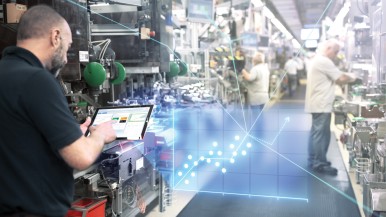
Stuttgart, Germany – Faster, more flexible, and more efficient: these characteristics are the automotive industry’s main demands when it comes to developing its own production systems. To achieve this, today’s manufacturing operations need to be put on a new technological footing. This is exactly what the participants in the SDM4FZI research project (Software-Defined Manufacturing for the Vehicle and Supplier Industry) have set out to do. Led by Bosch, the University of Stuttgart, and the Karlsruhe Institute of Technology (KIT), a total of thirty companies will define the foundations for software-defined manufacturing over the next three years. Their goal is to design software that can flexibly plan, manage, and modify everything from individual components to entire factories. In the automotive industry, this will pave the way for more variants and faster model and product changes. It will also improve competitiveness. The German Federal Ministry for Economic Affairs and Energy is funding the research project to the tune of some 35 million euros.Rigid systems hold vehicle production back Today, it often takes months, and sometimes years, for the technical elements of the manufacturing chain for a new model to be put in place, from supplier to final assembly. Together with the considerable economic cost involved, this stymies rapid market launches. The root cause of this is that many machines are designed and built specifically for one single new product. The software is usually inextricably coupled to particular machinery and products and is not transferable to other processes. SDM4FZI now aims to create a uniform framework for factories that will enable new products to be manufactured in existing operating environments without major retooling times. “By linking various Industry 4.0 approaches, we are getting one step closer to adaptable manufacturing,” says the Bosch project manager Matthias Meier. “An ecosystem for software-defined manufacturing allows us to bring the benefits of cloud technology to production. Software makes it possible to use automation technology and IT systems for individual, specific applications without having to build the hardware from scratch.” Uniform framework enables flexible manufacturing The project partners are developing prototypes for machinery and production lines that are largely defined by software. Such prototypes are based on digital twins, which make it possible to plan, build, and test production systems virtually. This conserves resources and saves on energy and costs. During production, moreover, it also makes the individual manufacturing stages more versatile, so they can be adapted more quickly to new market conditions. Thanks to the digital twins, companies can prepare and implement improvements, and also use AI to analyze them, without having to interrupt the production process. The main focus of the research alliance’s project is on making automation technology, machinery, and systems more flexible in order to boost efficiency in the production of supplier components and vehicles. New opportunities for the vehicle industry By pooling expertise from automation, mechanical engineering, IT, and the automotive industry, the consortium aims to create a common understanding of the requirements and to develop interoperable solutions. “The large number of project partners demonstrates how substantial a role software plays in the manufacturing of tomorrow,” says Michael Neubauer, chief technology officer for ISW at the University of Stuttgart. “We are working on pioneering approaches that will improve German companies’ competitiveness.” For example, the project partners are drafting a guide for the selection and use of suitable technologies, as well as standards for building software-defined factories. Further information on the project List of project partners

Germany, high-tech hub: Semiconductors pave the way for better quality of life.

25.06.2018

Presentations

Business/economy

Germany, high-tech hub: Semiconductors pave the way for better quality of life.

Check against delivery.Ladies and gentlemen, It’s been only roughly a year since we jointly announced the decision to build a new plant for 300 mm wafers. Now here we are, following a complex planning process, laying the foundation stone for Bosch’s chip factory of the future. With it, we are laying the foundation for improving people’s quality of life, the foundation for more safety on the road – and the foundation for a technology crucial to the internet of things and the mobility of the future. Semiconductors are a core component of all electrical systems. Semiconductors are also turning data into a coveted raw material of the future – none of the cars made today would be able to drive without them. They enable automated and efficient driving, and provide the best passenger protection – such as when they are called on to deploy airbags. With the areas of application for semiconductors becoming larger and larger, we are expanding our manufacturing capacity. As a location, we have opted for Germany. With this plant, we are entering into 300 mm wafer production for the first time, in a drive to achieve further significant economies of scale and to bolster our competitiveness. We see Dresden, the capital of Saxony, as a driver of microelectronics in Europe – and thus as the first choice worldwide for our billion-euro investment. I firmly believe high-tech is something Germany does well. By working closely with semiconductor companies, researchers, and universities, we aim to strengthen both our innovative strength and the competitiveness of this high-tech industry – in Germany and throughout Europe. Ladies and gentlemen, every day in our wafer fab, we will use highly automated manufacturing processes to create the future in the shape of semiconductors. But we will be doing more than that: we’ll also be creating prospects for the future in the shape of highly attractive jobs. Our high-tech factory will employ up to 700 people. We are looking for creative minds – people who can bring their expertise to bear on the construction of this state-of-the-art Bosch wafer fab. We are counting heavily on finding specialists here in the region as well as international specialists and experts. Our new construction project is also the biggest single investment in Bosch history. We are putting roughly one billion euros into our new location, and are pleased that the German Ministry for Economic Affairs and Energy plans to support its construction and commissioning. And in addition to the federal government, the state of Saxony and the city of Dresden have also pledged their support. So at this point, I wish to express my thanks to you, Minister Altmaier, and you, Minister-President Kretschmer. It is also thanks to you and your predecessors that things have moved so fast, and we find ourselves here today, ready to lay the symbolic foundation stone together – for better quality of life, for the semiconductor industry in Dresden, and for the competitiveness of Germany as a high-tech location.

Bosch lays foundation stone for factory of the future

25.06.2018

Press release

Business/economy

Bosch lays foundation stone for factory of the future

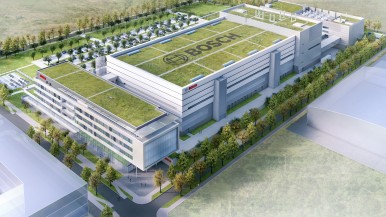
Stuttgart and Dresden, Germany – The foundation stone laid today in Dresden is a key milestone in the construction of the Bosch Group’s state-of-the-art wafer fab. Construction is scheduled to be completed in late 2019, when installation of the production machinery will start. “Today we are laying the foundation stone for the wafer fab of the future, and with it the foundation for improving people’s quality of life and their safety on the road,” said Dr. Dirk Hoheisel, member of the board of management of Robert Bosch GmbH, at the formal ceremony in Dresden. “Semiconductors are the key technology for the internet of things and the mobility of the future. When installed in cars’ control units, for example, they enable automated, efficient driving and the best possible passenger protection.” In his address, Peter Altmaier, the German Federal Minister for Economic Affairs, underlined the central importance of this Bosch investment: “We are today taking an important step toward securing the future competitiveness of Germany as an industrial location. The research community in Germany and Europe is an excellent one, but we cannot afford to rest on our laurels. In the field of microelectronics, we also need engineering skills and know-how, and especially industrial-scale manufacture and application, in Germany and Europe. Today’s ceremony is an important step on this route.” As a supplier of technology and services, Bosch is investing roughly one billion euros in its new location in the Saxony state capital. The first associates are due to start work in the new plant in early 2020. Today we are laying the foundation stone for the wafer fab of the future, and with it the foundation for improving people’s quality of life and their safety on the road....Dr. Dirk Hoheisel After Reutlingen, the Dresden plant is the Bosch Group’s second wafer fab in Germany. With it, the company aims to expand its manufacturing capacity, and thus to boost its competitive edge in global markets. Semiconductors are finding their way into more and more applications relating to the internet of things and mobility solutions. According to the market research company Gartner, semiconductor sales around the world rose by some 22 percent in 2017 alone. Otto Graf, who will manage the new plant, said: “Construction is proceeding right on schedule. “During the construction phase, we will move some 7,500 truckloads of earth, lay about 80 kilometers of piping and ductwork, and mix more than 65,000 cubic meters of concrete – 8,000 concrete mixers-worth.” Following a rollout phase, pilot manufacturing operations are expected to start at the end of 2021. The plot of land – measuring some 100,000 square meters, or roughly 14 soccer fields – will also be home to a nearly 72,000 square-meter multistory building housing offices and production space. Up to 700 associates will be involved in the highly automated chip manufacturing process, working to plan, manage, and monitor production. This also includes modifying the production processes and evaluating the data from Dresden in Bosch’s global manufacturing network. Saxony as a business location: driving Europe’s microelectronics industry “Bosch’s decision is an important milestone. The construction of the new wafer fab here in Dresden will create many other attractive jobs, strengthen Saxony’s reputation as a location for technology and business, and is good for Germany and Europe as well. This project will play a decisive part in securing a leading role for European industry as a whole in the technologies of the future,” said Michael Kretschmer, the Minister-President of the state of Saxony. “This investment in such a major project is a sign of confidence in Saxony, in its people, in the research and industrial network that has become established here, and in its innovativeness.” In its search for a new location, Bosch considered several cities around the world. In Hoheisel’s words, “Dresden is an excellent microelectronics cluster.” He added that the city’s infrastructure is excellent: everything is easily accessible, and the transportation connections are good. The cluster also includes automotive suppliers and service providers, as well as universities offering technological expertise. As Hoheisel pointed out: “We want to work closely with semiconductor companies and universities to increase semiconductor technology’s competitive edge – not only in Germany, but across Europe.” We are today taking an important step toward securing the future competitiveness of Germany as an industrial location....Peter Altmaier, the German Federal Minister for Economic Affairs Semiconductors: key technology for the internet of things Manufacturing semiconductor chips always starts with a silicon disc, or wafer. The bigger the wafer’s diameter, the more chips that can be made per manufacturing cycle. This is one reason why the new Bosch factory will focus on the production of 300 mm wafers: Compared with conventional 150 and 200 mm wafer fabs, 300 mm wafer technology offers greater economies of scale. Semiconductors are extremely small integrated circuits with structures measured in fractions of a micrometer. Manufacturing them requires a highly automated and complex process consisting of several hundred individual steps over several weeks. It takes place in clean-room conditions, as even the tiniest particles in the ambient air can damage the delicate circuits. Connected manufacturing: 22 metric tons of data a day for higher quality Wafer production is one of the forerunners of connected manufacturing. The Dresden plant is expected to generate production data equivalent to 500 text pages per second – written out on paper, that would be more than 42 million pages a day, weighing 22 metric tons. This is why artificial intelligence will play a special part in chip manufacturing in the factory: the highly automated production facilities analyze their own data in order to optimize their processes. As a result, the quality of the chips rises while production costs go down. Furthermore, planning and process engineers can access this production data at any time to accelerate the development of new wafer products or minimize tolerances early on in the manufacturing process. “We need creative minds for our connected and automated manufacturing operations – particularly experts in wafer technology, like process engineers, mathematicians, or software developers,” Graf said. Many new associates have already been hired for the Dresden plant, he added, and there has been no drop in the number of applications. Leading semiconductor manufacturer with 45 years of experience For more than 45 years, Bosch has been making semiconductor chips in various forms, above all as application-specific integrated circuits (ASICs). At its wafer fab in Reutlingen, Germany, Bosch currently manufactures ASICs, power semiconductors, and microelectromechanical systems (MEMS). Bosch ASICs have been used in vehicles since 1970. They are customized to individual applications, and essential for functions such as engine management or airbag deployment. In 2016, every car rolling off the production lines worldwide had on average more than nine Bosch chips on board.


25.06.2018

Factsheet

Business/economy

Laying the foundation stone for 300 mm wafer fab in Dresden

General information Total investment approx. 1 billion euros Site approx. 100,000 m2 (about 14 soccer fields) Total floor space approx. 72,000 m² of production area and office space Construction timeline Groundbreaking in spring 2018 installation of machinery mid-/end 2019 pilot production to start at end of 2021 Associates in the completed plant Up to 700 Qualified professionals needed Experts from the semiconductor industry, such as process, production, and maintenance engineers, mathematicians, software engineers, as well as professionals with degrees in physics, chemistry, and microsystems technologies Manufacturing technologye Highly automated wafer production (300 mm silicon substrate wafers with structures up to 65 nm in width – 1 nm equals one millionth of a millimeter) Connected manufacturing Every second, the machines will transmit one gigabit of production data. The volume of data produced is equivalent to more than 42 million written sheets of paper, weighing 22 metric tons.Details on the building Total building volume 600 000 m³ Concrete approx. 66,500 m³ (about 8,300 concrete mixer trucks) Steel approx. 16,400 metric tons (about 30 A380 passenger jets) Earth moved/excavated approx. 90,000 m³ (some 7,500 truckloads) Bored piles for the foundation approx. 860 Floor slabs 100 cm thick Length of piping and ductwork approx. 80 km Length of electrical cabling approx. 380 km (from Dresden to Berlin and back)Internet For job seekers www.bosch-career.de/jobs Site for the Dresden location https://www.bosch.de/en/ourcompany/bosch-in-germany/dresden Bosch semiconductors www.bosch-semiconductors.com