Search and find:
Photos, videos, releases, events to support your reporting about the Bosch Group

Bosch To Integrate NVIDIA DRIVE AGX Thor Into Next-Generation ADAS and Software- ...

30.09.2025

Press release

Business/economy

Bosch To Integrate NVIDIA DRIVE AGX Thor Into Next-Generation ADAS and Software- ...

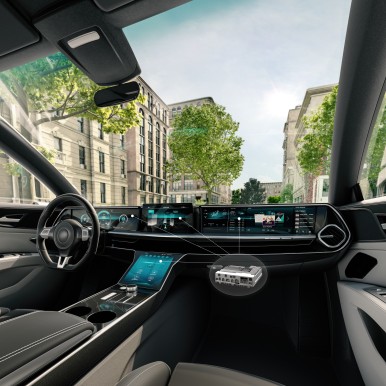
Farmington Hills, Mich. – Bosch today announced a strategic initiative to integrate the next-generation NVIDIA DRIVE AGX Thor centralized, high-performance compute platform into Bosch’s future compute and electronic control unit (ECU) architectures. This effort reinforces Bosch’s commitment to deliver cutting-edge, AI-driven solutions for software-defined vehicles (SDVs). As global automakers accelerate their shift to SDVs, demand is growing for centralized computing platforms that can handle both safety-critical driving tasks and increasingly complex AI workloads. Analysts forecast that by 2030, more than half of new vehicles sold will feature centralized, high-performance compute architectures, which allows for more comfort driving features and helps reduce system complexity. Combining the Bosch global ADAS footprint and high-performance computing expertise with NVIDIA’s leading AI solutions will allow automakers to bring advanced systems for assisted and highly automated driving into series production. The integration of NVIDIA DRIVE AGX Thor into Bosch’s ADAS compute platform helps to create an easier implementation for the OEMs, can reduce additional development efforts and helps enable a faster time-to-market product launch. Furthermore, this architectural platform is open and flexible for any kind of ADAS/AD software stack. “This collaboration further positions Bosch and NVIDIA at the forefront of the software-defined vehicle transformation, helping automakers deploy scalable platforms that meet rising performance demands while maintaining safety and reliability standards,” said Stefan Buerkle, regional president, Cross-Domain Computing Solutions, Bosch Mobility Americas. “By pairing NVIDIA’s advanced AI compute with our domain expertise in safety, system integration and sensors, we’re enabling automakers to deliver the next generation of personalized and reliable mobility experiences.” Technology Highlights NVIDIA DRIVE AGX Thor is built on the NVIDIA Blackwell architecture , optimized for advanced transformer models, large language models and generative AI workloads. With performance of up to 2,000 FP4 TFLOPS, the platform enables high-speed processing for complex driving and in-vehicle experience tasks. It runs the safety-certified NVIDIA DriveOS, leveraging the NVIDIA Halos comprehensive safety system. Bosch deploys NVIDIA’s powerful compute into production-ready vehicle computers designed to handle vast amounts of high-speed signals, manage thermal performance and meet high safety standards. Leveraging decades of ECU design expertise, Bosch delivers the system integration, validation and engineering know-how required to deploy advanced driver assistance and automated driving technologies at scale. The long-standing leadership Bosch has in functional safety along with the advanced safety features of DRIVE Thor platforms will enable customers to deploy production ready systems with safety and reliability at their core. The Bosch SDV strategy aligns with DRIVE AGX Thor’s unified architecture to reduce system complexity and enable faster software iteration for automakers. Customer Impact For automakers, the combined solution enables the delivery of intelligent, personalized and safer mobility experiences that drivers increasingly expect. The platform’s performance also facilitates the introduction of next-generation AI models into the demanding automotive environment, unlocking new possibilities for driver assistance and in-vehicle intelligence. Designed initially for premium passenger vehicles (L2++/- L4), the solution offers a clear path to scalability, supporting the industry’s transition toward more automated, connected and user-centric mobility. “As the auto industry moves toward smarter, safer mobility accelerated by autonomous driving, our work with Bosch reflects a key step in delivering safety-certified AI and accelerated computing directly into vehicles,” said Ali Kani, NVIDIA’s Vice President of Automotive. “Together, NVIDIA’s core technologies and Bosch’s proven integration know-how can help redefine how transportation evolves.” By integrating NVIDIA DRIVE AGX Thor into its portfolio, Bosch reinforces its role as a systems integrator capable of turning advanced compute into safer, validated automotive platforms, supporting OEMs as they navigate the shift to software-defined and AI-enabled vehicles.

IAA Mobility 2025: Bosch is shaping the new vehicle world with intelligent hardw ...

08.09.2025

Press release

Automated mobility

IAA Mobility 2025: Bosch is shaping the new vehicle world with intelligent hardw ...

Farmington Hills, Mich. – In the automotive industry, the Bosch name is synonymous with software. The technology company is demonstrating this to impressive effect at this year’s IAA Mobility in Munich. And there’s more: from a single source, Bosch also supplies hardware that’s tailored to the possibilities of the software – a compelling unique selling point for the company worldwide. “Bosch knows its way around software and hardware. Without sophisticated hardware, even the smartest car won’t move a single millimeter,” said Dr. Stefan Hartung, chairman of the Bosch board of management, at the trade fair. “Our aim is to continue playing a key role in shaping the industry in the age of software-driven mobility by offering tailored, intelligent solutions.” Bosch knows its way around software and hardware. Without sophisticated hardware, even the smartest car won’t move a single millimeter. Our aim is to continue playing a key role in shaping the industry in the age of software-driven mobility by offering tailored, intelligent solutions....Dr. Stefan Hartung, chairman of the Bosch board of management Initial indications point to success: Bosch has established a foothold in the software-driven world. One example is Bosch’s by-wire systems for braking and steering, which are considered a key technology for software-defined vehicles and automated driving. Here, the software takes control; a mechanical connection is no longer necessary. This is an important business for Bosch. With brake-by-wire and steer-by-wire, the company expects to achieve cumulative sales revenue of more than 7 billion euros by 2032. The market dynamics of this key technology will continue to accelerate in the 2030s. By-wire technology is a taste of what lies ahead for vehicle construction overall. “In the future, hardware will be designed to fit software requirements,” said Dr. Markus Heyn, member of the Bosch board of management and chairman of the Mobility business sector. In the future, hardware will be designed to fit software requirements...Dr. Markus Heyn, member of the Bosch board of management and chairman of the Mobility business sector Bosch wants to turn cars into personal assistants In software-driven mobility, Bosch Mobility’s business continues to develop – from hardware with embedded software, to services, to completely independent software that manufacturers and partners then integrate into their ecosystems. “Whether stand-alone or interconnected, standardized, integrated, or decoupled – we can offer everything exactly as the customer wants it,” Hartung said. This is clearly having an impact: despite stagnating global vehicle production, weak demand, and delays in electromobility and automated driving, Bosch Mobility will grow slightly in the current year. The increase in sales revenue is expected to amount to a little less than 2 percent. Up to today, a vehicle was never as new as the moment it was delivered. “In the future, however, its software will be continuously updated and it will be constantly learning by means of artificial intelligence,” Heyn said. “More than anything else, the new mobility is user centered.” This is what that looks like: Bosch’s Vehicle Motion Management software coordinates all vehicle movements by centrally controlling the brakes, steering, powertrain, and chassis. This improves coordination between the individual systems – and also means they can be adjusted to the driver’s preferences. A particularly smooth ride today? A little more agility tomorrow? And jolt-free stopping the day after? No problem – at the touch of a button, the car feels completely different. Incidentally, Bosch’s Vehicle Motion Management is decoupled from the hardware, which makes it easy to use in different vehicle architectures. That’s not just theory, it’s happening: the Bosch software is in widespread use, with more than two dozen manufacturers in Europe, China, and Japan already having adopted it. Over the next three years, Bosch will be investing a nine-figure sum in Vehicle Motion Management and expanding its modular software and function portfolio across all domains. Vehicle Motion Management from Bosch works even better in combination with by-wire solutions, because the software can control the respective braking and steering actuators independently of the driver’s actions – for greater safety, improved convenience, or better vehicle dynamics. Bosch’s smart software makes the difference Bosch’s ADAS product family is also software-driven. For intelligent driver assistance systems, vehicle manufacturers can choose from three preconfigured variants that can then be put into production quickly and in a brand-specific way. Here, too, hardware and software can be integrated or purchased separately, depending on customer requirements. Both options benefit from a holistic approach: since Bosch understands the interaction between hardware and software, it can offer individually optimized solutions that can be seamlessly integrated into existing environments. Modern vehicles, which are designed and developed from a software standpoint, make use of ever fewer, but more powerful vehicle computers. These are a growth driver for Bosch: its high-performance computer business is currently growing by more than 5 percent every year, with automakers such as the BMW Group among the customers. Bosch also offers central vehicle computers that combine various functions, such as in driver assistance and infotainment, on just one control unit and one system on a chip (SoC). This saves space, costs, and energy. These systems have a modular structure and can flexibly integrate software from different manufacturers. In China, Bosch is supplying a high-performance computer to SAIC-GM to create a cockpit featuring artificial intelligence. Thanks to this AI cockpit, drivers can talk to their car in a completely natural way and interact with it as if it were a human being. Bosch’s knowledge and expertise make it a sought-after partner The software-driven future is fundamentally changing the automotive industry. Bosch wants to seize the opportunities this new world presents – and is in a good position to do so. Hardly any other company combines hardware and software expertise and global presence as seamlessly as Bosch. This makes the company a flexible and reliable partner for the development of intelligent and connected vehicles. After all, strategic partnerships are crucial, particularly where new business models and scalable software systems are concerned. In China, Bosch is already working with WeRide and Horizon Robotics on the development of systems for assisted and automated driving. In Europe, Bosch and the VW subsidiary Cariad are strategic partners in this area. Bosch assumes that such alliances will become increasingly important in the future, and that the proportion of software in vehicles will continue to rise – and with it, the benefits for drivers in the form of even safer and more convenient mobility.

Southeastern Pennsylvania Transportation Authority to Install Tram Forward Colli ...

15.05.2025

Press release

Connected mobility

Southeastern Pennsylvania Transportation Authority to Install Tram Forward Colli ...

Detroit – The Southeastern Pennsylvania Transportation Authority (SEPTA), which serves a region of nearly four million people in Philadelphia and its surrounding counties, plans to deploy the tram forward collision warning system (TFCW) from Bosch across all trams in its entire trolley fleet. The plan to deploy to the entire SEPTA fleet follows a successful pilot program that began in 2022 to initially test the collision warning system in four SEPTA tram vehicles. The Bosch TFCW utilizes a multipurpose camera and mid-range radar sensor aiding drivers in reducing accidents. Especially in congested traffic or poor visibility conditions, the system warns the driver about obstacles on the rails, so the driver can aim to avoid accidents, or at least limit the effects. Ultimately, the warning system helps improve safety and increase the availability of trams by avoiding closures and tram repair. “We’re honored to provide an important safety solution to SEPTA’s full trolly fleet,” said Joe Capuano, Regional President of Bosch Engineering in North America. “There are over 50 cities across more than 12 countries that have Bosch tram forward collision warning system installed, and we’re excited to expand this fully to southeastern Pennsylvania.” The Bosch TFCW has more than a decade of experience in rail sector application, and this latest SEPTA fleet installation will be complete by June 2026. The TFCW can be integrated as a stand-alone product or combined with other solutions from the Bosch tram assist suite for complementary safety implementations. Learn more about the Tram Forward Collision Warning System at www.bosch-engineering.com/stories/collision-warning-system . Press photos are available on the Bosch Media Service at us.bosch-press.com .

Bosch launches RevX to help fleets find the best load every time

21.03.2024

Press release

Business/economy

Bosch launches RevX to help fleets find the best load every time

Louisville, Kentucky – Bosch has announced the launch of RevX , a solution designed to streamline fleets’ search for freight, today at the largest heavy-duty trucking show in North America, the Mid-American Trucking Show . RevX offers a seamless sign-on solution that simplifies logistics by consolidating spot market shipments across multiple sources into a single tool designed to aid dispatchers in finding the load. The new cloud-based service from Bosch aggregates search results across multiple brokers and load boards based on a specific criterion, calculates profits, and effortlessly helps with data driven decision making to eliminate empty miles. RevX is the second Bosch product to launch on the company’s Logistics Operating System (L.OS), which debuted last year in Europe, India and the United States. The L.OS platform aims to simplify technology and operational processes in the transportation and logistics industry. It is open to all providers of logistics solutions to facilitate the smooth interplay of disparate services and data for companies operating in the logistics space. Since its debut, more than 60 solutions have been integrated into the platform globally, including 17 in the U.S. “L.OS connects the logistics-related products, services, and technology offerings of our strategic partners to solve our customers' critical pain points that reduce cost and improve profitability across the logistics ecosystem,” said Luke Hugel, president and regional business responsible for Bosch Mobility Platform & Solutions, North America. “By adding RevX to the L.OS platform, fleets now have access to the fastest way to find and win the best load for them on the spot market, in that moment. Furthermore, with L.OS these loads can seamlessly integrate with the fleet’s transportation management system.” In the future, Bosch plans to offer increased functionality within RevX for topics ranging from search results in a scheduler to forecast driver and equipment capacity for loads up to a week into the future, enhanced load planning and process flows – all from a single source. RevX will use artificial intelligence to turn searches across millions of potential loads into recommendations for the best load and deliver one-click communication to help ensure dispatchers secure the revenue-generating loads swiftly while minimizing manual data entry and errors. Tight freight markets require technology to win The transportation and logistics industry moves the U.S. economy however the carrier freight market has become extremely competitive since the recovery after the Covid 19 pandemic, when online orders and parcel deliveries saw sharp increase. Economic projections indicate by 2030 global goods transport will grow more than 40 percent, and by 2050 this figure is expected to exceed 145 percent. Even with this growth, the majority of transportation companies still organize their daily business manually or with an assortment of disconnected computer programs, so the need for RevX to help generate additional revenue across the L.OS platform is greater than ever. Another RevX advantage is increased driver and equipment utilization. Reducing empty miles traveled has a positive impact on driver pay, fleet profitability, and industry sustainability efforts. According to the US Department of Transportation , up to 35 percent of the truck miles (106 billion) are empty miles. RevX aims to reduce this by over 5% bringing value to fleet owners, freight carriers, shippers and brokers.

Bosch eCall service now available via international fleet app

12.04.2022

Press release

Connected mobility

Bosch eCall service now available via international fleet app

Frankfurt am Main – “Working together for greater road safety” – this is the motto of the collaboration between Bosch Service Solutions, a provider of technology-based services, and the two US-based companies, Sfara, developers of app-based solutions for detecting accidents, and eDriving, a global provider of digital solutions for driver risk management. Applications for driver risk management help fleet operators to minimize traffic risks for their drivers and thus the risk of accidents. For example, eDriving’s Mentor app aims to improve the driving style with the help of eLearning and other capabilities. It is now being supplemented with the eCall services provided by Bosch. Thanks to the integration of these features, users of the Mentor app can receive help via their smartphone within seconds of a collision. This is made possible by collision detection software delivered by the partner Sfara. International emergency service “Every second counts in an accident. Our experienced service associates provide rapid assistance in the event of accidents or personal emergencies – in more than 50 countries and in more than 20 languages," says Stefan Gross, Head of Mobility Services at Bosch Service Solutions. Ed Dubens, CEO and founder of eDriving, adds: “The integration of Bosch’s eCall alarm and service functions benefits all companies worldwide that use the app now or plan using it in the future for their fleet drivers. The Mentor app not only helps them to prevent accidents in the first instance, but also requests the rescue services in the event of an accident." Sfara technology enables emergency calls via smartphone With around ten years of experience, Bosch is a pioneer in eCall service. In the event of an accident, the emergency call system is able to provide prompt assistance by contacting an emergency call point either automatically or at the push of a button. Until now, the emergency call service was primarily available for vehicles with the corresponding technology. With the integration of Sfara’s patented collision detection solution, the eCall service is now also available via smartphone, i.e. in older vehicles without embedded technology. Smartphone applications that incorporate Sfara’s technology can be used to detect vehicle collisions and personal emergencies within seconds using sensors. Then the smartphone app automatically sends an emergency notification to an international Bosch service location and transmits necessary information for prompt assistance. The solution can also be used in case of personal emergencies outside of the vehicle. For instance, if a person suffers from acute cardiovascular problems, he or she can trigger an emergency call manually by tapping the smartphone three times. Then the smartphone app establishes a voice connection to a member of the emergency service support team who quickly identifies the issue and – if necessary – alerts medical emergency services. "We are pleased that fleet operators in Sales, Service and Delivery benefit from our solution and our sensory based collision detection support in saving lives", says Erik Goldman, CEO of Sfara. Digital accident management for fleet operators Integrating the Bosch eCall solution with the eDriving app offers many advantages to users. The integration enables the digitalization of the accident management processes. From the first emergency call notification to the coordination of towing service and vehicle repair, to the support for providing a replacement vehicle and claims settlement - steps that were usually processed using paper documents are now digital. With the accident management service from Bosch, these steps can now be completed with just a few smartphone app clicks. It speeds up the handling process enormously. When processing data, Bosch complies with applicable legal requirements.

More chips: Bosch to invest on extending semiconductor production in Reutlingen

22.02.2022

Press release

Business/economy

More chips: Bosch to invest on extending semiconductor production in Reutlingen

Reutlingen, Germany – In an additional move to combat the ongoing global chip shortage, Bosch plans to further extend its wafer fab in Reutlingen. More than a quarter of $1.2 billion is to be invested in creating new production space and the necessary clean-room facilities between now and 2025. This will give Bosch the firepower to meet the continuously growing demand for chips used in mobility and IoT applications. “We are systematically expanding our manufacturing capacity for semiconductors in Reutlingen,” says Dr. Stefan Hartung, chairman of the board of management of Robert Bosch GmbH. “This new investment will not only strengthen our competitive position, but will also benefit our customers and help combat the crisis in the semiconductor supply chain.” The construction of a new extension in Reutlingen will create an additional 38,750 square feet of ultramodern clean-room space. As of 2025, this additional capacity will produce semiconductors based on technology already in place at the Reutlingen plant. Bosch is also extending an existing power supply facility and will construct an additional building for media supply systems serving both the new and existing production areas. The new production area is scheduled to go into operation in 2025. In October 2021, Bosch announced it would be spending more than $473 million in 2022 alone on expanding its semiconductor operations in Dresden and Reutlingen, Germany, and in Penang, Malaysia. Around $59 million of this sum is earmarked for the wafer fab in Reutlingen. In addition, Bosch also announced plans to invest a total of $177 million in the creation of additional clean-room space in existing buildings at the Reutlingen facility over the period from 2021 to 2023. The further expansion of the site, which will see a new extension to the manufacturing facilities, will now supplement these measures. All in all, clean-room space in Reutlingen is set to grow from around 376,737 square feet at present to over 473,612 square feet by the end of 2025.State-of the-art semiconductor manufacture The Reutlingen wafer fabs use 6- and 8-inch technology, while the Dresden plant makes chips on 12-inch wafers. Both employ cutting-edge manufacturing methods based on data-driven process control. “AI methods combined with connectivity have helped us achieve continuous, data-driven improvement in manufacturing and thereby produce better and better chips,” says Markus Heyn, member of the board of management of Robert Bosch GmbH and chairman of the Mobility Solutions business sector. This includes the development of software to enable automated classification of defects. Bosch is also using AI to enhance materials flows. With its high level of automation, this state-of-the art production environment in Reutlingen will safeguard the plant’s future and the jobs of the people working there.Growing demand for semiconductors Bosch has been developing and manufacturing semiconductors for over 60 years, and for more than 50 of those years in Reutlingen – both for automotive applications and for the consumer electronics market. Bosch-manufactured semiconductor components include application-specific integrated circuits (ASICs), microelectromechanical systems (MEMS sensors), and power semiconductors. The further expansion of the Reutlingen site will primarily serve the growing demand for MEMS in the automotive and consumer sectors and for silicon-carbide power semiconductors. “Bosch is already a leading chip manufacturer for automotive applications,” Heyn says. “And this is a position we intend to consolidate.” Measures to achieve this include the development and manufacture of chips made of silicon carbide, which Bosch has been producing since December 2021. Chips made of this innovative material are destined to play an increasingly important role in electromobility. Bosch is currently the only automotive supplier worldwide manufacturing power semiconductors made of silicon carbide. The Reutlingen plant currently employs around 8,000 associates. They work in the development and production of semiconductors and electronic control units, in administration, and in the eBike Systems division.

Bosch Information domain computer enables advanced in-vehicle features quickly a ...

09.12.2021

Press release

Connected mobility

Bosch Information domain computer enables advanced in-vehicle features quickly a ...

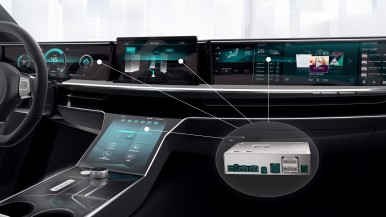
Plymouth, Mich. – In today’s world, vehicles need incredibly powerful brains. In-vehicle displays, voice assistants, infotainment systems and advanced human-machine interfaces (HMIs) are becoming more prominent and sophisticated, and more processing power is required to manage and control complex in-vehicle systems. Bosch has developed a high-performance infotainment domain computing system built precisely for the vehicles of today and tomorrow. It helps to bring features like in-car communication, in-car payment, video streaming, voice assistants and more to vehicles quickly. The Information domain computer delivers support for multiple in-vehicle systems within a single solution, and provides vehicle manufacturers with a cost-effective, flexible, scalable and powerful control unit for the future of in-vehicle technology. “With the Information domain computer, Bosch is providing connectivity and computing power to the modern world of mobility,” said Stefan Buerkle, senior vice president and head of Connected Information Solutions, Bosch in North America. “Bosch has experience working together with a network of leading technology companies, and has developed a powerful and flexible integration platform to support and enable the rapid evolution of in-vehicle features.”A collaborative network of technology industry leaders The Bosch Information domain computer combines Bosch’s leading expertise in automotive software solutions and domain-specific hardware expertise with solutions from a network of industry-leading technology companies in the hardware, component, software and services sectors. The result is a scalable platform that offers vehicle manufacturers the opportunity to utilize a combination of pre-integrated applications, the flexibility to support additional features developed in-house and the ability to accelerate time-to-market while managing cost efficiency. Bosch has developed a pre-integrated solution that features technology from several collaborating organizations. The pre-integrated solution, built on the QNX® Neutrino® Realtime Operating System (RTOS) and QNX® Hypervisor , is designed to deliver reliable functionality to address the requirements of today’s most advanced system designs. By combining a pre-integrated control unit with a customizable modular approach, the Bosch platform offers the flexibility to tailor in-vehicle features to customer preferences and market segments. The pre-integrated Information domain computer is powered by a 3rd generation Snapdragon® Automotive Cockpit Platform, a product of Qualcomm Technologies, Inc. In addition to supporting higher levels of compute and intelligence needed for advanced capabilities featured in next generation vehicles, the 3rd generation Snapdragon Automotive Platforms are engineered to deliver rich visual and audio experiences, as well as highly intuitive artificial intelligent experiences for in-vehicle assistance and contextual safety and support for precise positioning for enhanced navigation. The enhanced display experience is made possible by Texas Instruments’ FPD-Link™ SerDes technology for high-speed display and camera communications, which is supported by Molex ultra-reliable connector solutions. Further options available on the Bosch Information domain computer platform include voice assistants through Amazon Alexa and Cerence ; in-vehicle streaming with Access Twine4Car; and navigation experience via TomTom Navigation for Automotive embedded and cloud-based navigation. In addition, it will support the BlackBerry IVY™ Intelligent Vehicle Data Platform co-developed by BlackBerry and Amazon Web Services (AWS) to enable development of new applications and use cases. The user experience for the pre-integrated solution is tied together by Rightware with the award-winning Kanzi HMI toolchain for signature UI creation, in collaboration with software integration expert Wipro Limited, a leading global information technology, consulting, and engineering services company.Production-ready vehicle computers showcase continued Bosch leadership Vehicle computers are central to Bosch’s efforts to extend its leading role in software-intensive electronic systems. The customizable and flexible Information domain computer is the latest example of Bosch’s leadership in vehicle computers. Bosch is prepared to offer information domain computers to address the specific needs of vehicle manufacturers. Bosch has production-ready vehicle computers for every aspect of modern vehicles, including cockpit and connectivity functions, driver assistance systems and automated driving, and powertrain and body electronics.Bosch at CES 2022: PRESS CONFERENCE: Tuesday, January 4, 2022, from 8:00 to 8:45 a.m. local time (17:00–17:45 CET) with Dr. Tanja Rückert, Bosch CDO, and Mike Mansuetti, president of Bosch in North America, in Ballroom H, Mandalay Bay Hotel, Las Vegas South Convention Center, Level 2, as well as livestreamed on the Bosch Media Service . BOOTH: January 5–8, 2022, in the Central Hall, booth #16103 ELECTRIC BIKE TEST TRACK: January 5–8, 2022, at the eMobility Experience, LVCC, West Hall, West Plaza FOLLOW the Bosch CES 2022 highlights on Twitter: #BoschCES PANELS WITH BOSCH EXPERTS: Friday, January 7, 2022, 10:00 a.m., Venetian Hotel (local time) Building a Resilient Smart Home session with Dr. Carla Kriwet, CEO at BSH Hausgeräte GmbH

Bosch pools development activities for universal vehicle software in one unit

08.12.2021

Press release

Connected mobility

Bosch pools development activities for universal vehicle software in one unit

Stuttgart, Germany – Bosch is taking further strategic steps toward a leading position in the software-dominated future of mobility. In the future, under the umbrella of its subsidiary ETAS GmbH, the company will develop and sell basic vehicle software, middleware, cloud services, and development tools for universal application. A total of 2,300 experts from different development areas of Bosch and ETAS are to be brought together there as of mid-2022. “Software development is a longstanding core competence at Bosch. Every year, we put more than 200 million control units running our own software into vehicles worldwide. With this new set-up, we want to become the leading provider of application-independent vehicle software,” says Dr. Stefan Hartung, chairman of the Mobility Solutions business sector of Robert Bosch GmbH. A year ago, Bosch established its Cross-Domain Computing Solutions division, a powerful unit for application-specific vehicle software with specific hardware for numerous vehicle areas such as driver assistance and infotainment. Now the company is bringing together its portfolio of application-independent software for vehicles and the cloud at ETAS. The resulting central platform will allow it to develop automotive software more quickly and efficiently together with its partners. “Our universal software foundation is essential for the digitalization of modern, software-defined vehicles,” Stefan Hartung says. Bosch will combine its universal software platform with expertise in the development of innovative software functions. “Thereby we are creating a USP and a significant competitive advantage for Bosch,” says Dr. Markus Heyn, member of the Bosch board of management of Bosch. In the future, ETAS will offer this universal platform and the accompanying development environment to both automotive manufacturers and other suppliers.Software gaining in prominence for automakers Up to now, the rule was that vehicles were delivered as a finished product. In the future, though, a car’s software will be continuously improved and expanded – throughout its service life. This will give drivers a customized digital driving experience, and also form the basis for new business models for manufacturers. This development is just beginning. Experts predict that the market for automotive software will be worth billions in the next few years. Bosch expects double-digit annual growth until 2030. The organizational realignment Bosch is now planning for its application-independent automotive software units under the roof of its subsidiary ETAS bears witness to this transformation. “In the future development of vehicle operating systems, we want to position ourselves even better in the global market,” says Heyn. “With this move, we are providing existing and new customers with an integrated, horizontal, cross-domain platform that will allow them to achieve the aim of software-defined vehicles,” adds Christoph Hartung, the chairman of the board of management of ETAS GmbH. The partnership between Bosch and Microsoft that began in February will also be continued in the new organization. This partnership aims to develop a comprehensive software platform for seamless connectivity between cars and the cloud, making it quicker and easier to develop vehicle software throughout the car’s lifetime, as well as to download it to the control units and vehicle computers via the cloud.Universal and open portfolio for basic software and middleware Whether for electrically adjusting the seat, recharging the vehicle, deploying the airbag, or listening to the radio – software is already an integral part of almost every function in modern vehicles. It consists of different layers that build on each other. One layer comprises software modules that vehicle manufacturers use to create individual driving experiences – from the powertrain to infotainment and assistance systems. This is where the individual brands differ, sometimes enormously. Other layers, by contrast, such as the basic software for the control units and what is known as middleware, offer manufacturers almost no scope for USPs. These software components regulate the basic tasks performed by control units and vehicle computers – tasks that the driver doesn’t notice. For example, they manage processor performance and memory space, and they determine how control units communicate with each other or with the cloud to exchange data. Once developed, this software can be used on almost any ECU – regardless of where it is installed in the car and regardless of the vehicle model. This setup is familiar from smartphones, where a wide variety of apps use a central operating system. “Our new set-up will allow us to satisfy new requirements – both of the market and our customers – even better. Together with our partners, we are enabling existing and new customers to take a completely new approach to automotive software development,” Christoph Hartung says. In the future, open source software and the associated ecosystems will also play an increasingly important role. Vehicle manufacturers and automotive suppliers will thus be able to place software at the center of development even more effectively in the future.Application-independent software from a single source ETAS was founded in 1994 as a wholly owned subsidiary of Robert Bosch GmbH and employs some 1,500 associates in 12 countries. A further 800 Bosch associates will join them in mid-2022. Even today, the two companies are closely and successfully working together. This collaboration will be further intensified in a joint unit. The employee representatives responsible are currently involved in working out the details of the future organization.

17.02.2021

Press release

Automated mobility

Bosch teams up with Microsoft to develop software-defined vehicle platform for s ...

Stuttgart and Munich, Germany – Bosch teams up with Microsoft to develop a software platform to seamlessly connect cars to the cloud. The goal of this collaboration is to simplify and accelerate the development and deployment of vehicle software throughout a car’s lifetime in accordance with automotive quality standards. The new platform, which will be based on Microsoft Azure and incorporate software modules from Bosch, will enable software to be developed and downloaded to the control units and vehicle computers. A further focus of the collaboration will be on the development of tools that increase efficiency in the software development process. This in turn will drive innovation and reduce development costs for vehicle software within and across organizations. For drivers, the platform will mean quicker access to new functions and digital services. The collaboration between Bosch and Microsoft combines the wealth of software, electronics, and systems expertise of the world’s leading automotive supplier with Microsoft’s know-how in software engineering and cloud computing. Both companies intend to make the new software platform available for first vehicle prototypes by the end of 2021. “Bosch already securely updates car software over the air today. With the comprehensive platform for software-defined cars, we want to further empower automakers to develop new functions and get them on the road faster,” says Dr. Markus Heyn, member of the board of management of Robert Bosch GmbH. “Our collaboration with Bosch brings together the expertise of one of the world’s leading automotive suppliers with the power of the Microsoft cloud, AI and GitHub,” says Scott Guthrie, executive vice president, Cloud + AI, Microsoft. “With software quickly becoming a key differentiator in the automotive industry, our ambition is to help businesses accelerate the delivery of unique mobility services across passenger cars and commercial fleets at scale.” Developing the automotive future together Software will play an increasingly important role in future vehicle generations. New trends such as electromobility, automated driving, and modern mobility services would not be possible without it. This will also require more frequent updates and upgrades in the future. However, stringent safety requirements throughout the vehicle’s lifetime make wireless software updates and digital services for cars very complex. The wide range of different series and models makes things even more challenging. The collaboration will benefit from Bosch’s deep understanding of electrical and electronic architectures, control units, and vehicle computers, which is necessary for over-the-air vehicle updates. In addition, the company will contribute its expertise as well as software-based products and development tools for cars. This includes the basic software and middleware for vehicle computers and control units, as well as cloud-based software modules to bring over-the-air updates to entire vehicle fleets. “Having a comprehensive software platform from the vehicle to the cloud will reduce the complexity of the software development and the vehicle system integration. In this way we will create the conditions for wireless updates to work just as smoothly and conveniently in vehicles as they do in smartphones,” Heyn says. The pre-integrated platform will greatly reduce the complexity of over-the-air updates, which help ensure that a vehicle’s software is always up to date, thanks to the fact that the software architectures of vehicles and the cloud will now fit together seamlessly. New software services for developers Bosch and Microsoft also plan to enrich existing developer tools that will enable automakers and suppliers to simplify and accelerate their own software development, while adapting to the unique challenges in the automotive industry. The companies also plan to use GitHub’s fully integrated enterprise platform and to open-source important parts of the new software platform on GitHub.com to encourage code re-use and best practice sharing across the industry.

CES 2021: Bosch puts its faith in AI and connectivity – for the protection of pe ...

10.01.2021

Press release

Internet of Things

CES 2021: Bosch puts its faith in AI and connectivity – for the protection of pe ...

Stuttgart, Germany / Detroit, USA – To improve people’s health and to protect our planet, Bosch is counting on AIoT, taking advantage of the possibilities offered by data, artificial intelligence, and the internet of things to benefit people and the environment with technical solutions. “We combine AI and connectivity to form the AIoT, which helps us improve energy efficiency and fight the coronavirus,” says Michael Bolle, Bosch board of management member. “AIoT offers enormous potential. We are already unlocking this potential and plan to expand our efforts in the future.” Under the tagline “Sustainable #LikeABosch,” the company will be presenting intelligent, sustainable solutions for health, living, and mobility at the virtual tech trade fair CES 2021.Among the innovations Bosch is debuting at the tech show is the world’s first self-learning AI sensor for wearables and hearables in fitness tracking. Since the AI runs on the sensor itself (edge AI), there’s no longer any need for an internet connection during an exercise session – this improves energy efficiency and data privacy. The company is also presenting a sensor that measures factors such as air quality and relative humidity. This delivers information about the concentration of aerosols in the air – data that has become especially important in the fight against the coronavirus. Bosch security cameras can also help in the fight against the virus. AI makes it possible for them to execute a wide array of customer-specific applications. For example, a new camera solution with integrated intelligent video analysis measures body temperature contactlessly, anonymously, and with high precision – with a maximum deviation of half a degree. Moreover, using a software solution for the open camera platform of the Bosch startup Security and Safety Things, these cameras can detect whether the number of people in a shop complies with the prevailing coronavirus restrictions. This platform was designated a 2021 CES® Innovation Award Honoree, making it one of four Bosch solutions singled out this year. Another premiere is a portable hemoglobin monitor that can detect anemia by means of a finger scan. The device is particularly well suited for regions that have insufficient access to medical care. Equipped with AI, the hemoglobin monitor delivers a result within 30 seconds – no lab test or blood draw necessary. At the moment, the best example of how innovative Bosch technology can improve health and well-being is the coronavirus PCR test on the Bosch Vivalytic testing device. This now delivers results even more quickly: laboratories, doctors’ offices, nursing homes, and hospitals can evaluate five samples simultaneously in 39 minutes – technology literally “invented for life.” Thanks to improved software, positive samples can be detected even in under 30 minutes. The development of the Vivalytic system, which consists of an analysis device and test cartridges, grew out of a long-standing collaboration between Bosch’s corporate research and advance engineering, Bosch Healthcare Solutions, and the Robert Bosch Hospital. Sustainable #LikeABosch: Bosch as a pioneer in climate action A study recently published in Germany indicated that AIoT can go beyond health applications to support climate action as well. The study found that comprehensive digitalization in mobility, manufacturing, and building technology could help get the country nearly halfway to achieving the Paris Agreement emissions targets (source: Accenture ). Here is where Bosch takes a hand: its tagline for this year’s CES – “Sustainable #LikeABosch” – expresses one aspect of the company’s entrepreneurial responsibility. The sequel of the #LikeABosch image campaign highlights how everyone can do their part to protect the environment with sustainable products. Bosch itself is leading by example: according to in-house calculations, all the company’s 400 locations worldwide have been carbon neutral since 2020. Bosch is the first globally operating industrial enterprise to achieve net zero carbon emissions with respect to the energy it produces and the energy it sources externally. “The next step for Bosch is to address emissions along the entire value chain, from procurement to product use,” Bolle says. In that vein, Bosch is the first automotive supplier to join the Science Based Targets initiative with a specific and ambitious goal: by 2030, to cut upstream and downstream CO2 emissions by 15 percent. Bosch’s achievements in climate action have won recognition outside the company as well: the non-profit Carbon Disclosure Project (CDP) has added Bosch to its A List. Through its advisory company Bosch Climate Solutions, founded last year, Bosch shares its experience as a climate action pioneer with other companies. The Bosch startup markets several solutions, including the Bosch cloud-based energy platform, which applies intelligent algorithms to reduce the energy consumption of machines and thus increase the efficiency of production processes. Bosch has already deployed the platform at more than 100 locations, making a major contribution to improving energy efficiency – the main lever in the company’s efforts to go carbon neutral. Digital and sustainable is the way forward: into the pole position with industrial AI As this example shows, digitalization is paving the way for sustainability. “We want to be the leading AIoT company in every area that we operate in,” Bolle explains. Trust in AI is the most important prerequisite for it to become established, so that it can improve the lives of people and help limit climate change. To this end, Bosch relies on industrial AI, which explains the physical world to machines – instead of teaching them how to behave like people. Nonetheless, this requires ethical guidelines. To set them, Bosch has drawn up an AI code of ethics that centers on the idea that humans always retain control. In addition to improving energy efficiency in manufacturing, Bosch is systematically adding connectivity to its products for buildings and mobility to help consumers save energy. One of these products is an energy manager that the company offers for use in private homes. When combined with a heat pump and photovoltaic system, the manager can cut energy consumption by up to 60 percent. In the mobility sphere, drivers of electric vehicles can benefit from services such as Battery in the Cloud, which uses smart software analysis to reduce battery wear by up to 20 percent. In general, the combination of electrified and automated driving with personalized and connected services will open up a broad field for software applications. Vehicle computers are central to Bosch’s efforts to extend its leading role in software-intensive electronic systems. To meet this demand, the new Cross-Domain Computing Systems division and its 17,000 associates started operations at the beginning of the year. In this unit, Bosch is combining its capabilities in hardware and software engineering for vehicle computers, sensors, and control units for all vehicle domains. This reduces complexity in vehicle development and will get new functions on the road significantly faster. Expertise to help explore the moon: aiming high with Bosch AI From earthbound roads to activities in space: whereas last year’s CES saw the premiere of the SoundSee AI sensor system for the International Space Station, this time Bosch has set its sights on the moon. As part of NASA’s Tipping Point program, Bosch is joining forces with the companies Astrobotic and WiBotic as well as the University of Washington to research and develop technology to intelligently navigate and wirelessly charge small robots for operation on the moon. Bosch researchers working on the project in Pittsburgh and Silicon Valley are contributing their expertise in AI-based intelligent data analysis and wireless connectivity solutions. The resulting findings will flow into the further development of Bosch AIoT solutions back on earth. All this clearly shows how much potential AIoT offers, as well as the key role sustainability plays in it. “Only companies that pursue sustainability today and unlock the enormous potential of AIoT, will be successful tomorrow,” Bolle says.Bosch at CES 2021: VIRTUAL PRESS CONFERENCE: Monday, January 11, 2021, from 8:00 to 8:30 EST (14:00–14:30 CET) with Dr. Michael Bolle, Bosch CTO, CDO, and management board member, and Mike Mansuetti, president of Bosch North America, at the Bosch Media Service. VIRTUAL BOOTH: January 12 – February 15, 2021, at www.ces.tech FOLLOW the Bosch CES 2021 highlights on Twitter: #BoschCES DEEP-DIVE SESSIONS WITH BOSCH-EXPERTS: January 12 – February 15, 2021, at www.ces.tech Sustainable #LikeABosch: How a key global industry player drives carbon neutrality at its sites with Torsten Kallweit, Head of Corporate Office Health, Safety, Environmental and Fire Protection as well as Sustainability and Manager CTO Bosch Climate Solutions GmbH, and Annette Wagner, Head of Sustainability and Ideas Lab Move #LikeABosch: Technology for sustainable future mobility with Mike Mansuetti, President of Bosch North America, and Tim Frasier, Regional President Automotive Electronics North America Artificial intelligence in use: Application examples from the fields of fitness tracking and well-being to smart cameras with Kaustubh Gandhi, Senior Product Manager, and Sina Isabell Springer, Business Development Manager Perfectly keyless advanced with Tim Frasier, Regional President Automotive Electronics North America, Daniel Kornek, Head of Product Area Vehicle Access (Perfectly Keyless), and Jia Hou, Business Development Manager

The market of the future: Bosch wins orders worth billions for vehicle computers

15.12.2020

Press release

Connected mobility

The market of the future: Bosch wins orders worth billions for vehicle computers

Stuttgart, Germany – In modern cars, intelligence counts for a lot, and Bosch vehicle computers are there to provide it. These computers, the new all-rounders of automotive electronics, are incorporating ever more functions of individual control units into central, highly powerful electronic modules. For more than a year now, Bosch vehicle computers have been controlling functions such as driver assistance systems and motion in production vehicles. And soon, they will be joined by central computers for cockpit functions and body electronics. When it comes to vehicle computers, therefore, no other company can match Bosch’s broad portfolio, since the supplier of technology and services can offer production-ready computers for every aspect of modern vehicles. And business-wise as well, this is paying off. Bosch has now won orders worth several billion for its vehicle computers – 3 billion worth since last summer alone. “Vehicle computers have huge business potential for Bosch. Even now, our high-performance computers mean that automakers view us as one of their leading engineering and technology partners,” says Harald Kroeger, who sits on the board of management of Robert Bosch GmbH. Vehicle computers are central to Bosch’s efforts to extend its leading role in software-intensive electronic systems. The market for these systems is worth some 24 billion, and is set to grow 15 percent annually between now and 2030. To meet this demand, the new Cross-Domain Computing Solutions division and its 17,000 associates will start operations in January 2021. In this unit, Bosch is bringing together its hardware and software engineering for vehicle computers, sensors, and control units for all vehicle domains.Automotive electronics is getting fit for the future In the future, high-performance control units will be a must-have for all cars. These central nodes are where all the car’s “nerves” converge. Thanks to their prodigious computing power of several billion operations per second, central computers are even capable of processing the big data needed for automated driving, data-based services, and permanent software updates. According to McKinsey, software’s share in the value of a vehicle will rise from just 10 percent today to 30 percent in the future. This development underscores how important bits and bytes will be for vehicles in the future. And vehicle computers that can handle such software functions and data volumes will therefore soon be a standard feature in all vehicles, whether compacts, premium sedans, or 40-ton trucks. Bosch is developing computers for cockpit and connectivity functions, for driver assistance systems and automated driving, and for the powertrain and body electronics. This means it will be possible to concentrate control over all central vehicle functions in just a handful of high-performance central computers. Take the information domain computer Bosch is developing. In the next vehicle generation, it will assume the tasks done by as many as ten control units. Some vehicles now feature more than 100 control units in total, and this development will allow automakers to significantly reduce this number. “Vehicle computers are the key to significantly reducing the complexity of electronic systems, and to making them as secure as possible,” Kroeger says. Moreover, installing more central high-performance computers will save on wiring, and thus reduce cost, weight, and installation space. In the vanguard of automotive electronics In the years ahead, vehicle computers will be entrusted with tasks from different parts of the vehicle – or domains, as the experts call them. When this happens, just one central computer will be responsible for controlling not only vehicle motion, but also body electronics, say. Such central computers will then be all the more powerful: over the past 20 years, the computing power of a control unit originally intended for navigation has grown by a factor of 3,000. This is almost three times the increase predicted by Moore’s law, which states that computing power doubles every two years. The result is that a modern cockpit computer can control not only displays, infotainment, and voice commands, but also the tasks of other domains, such as certain assistance functions. “Bosch vehicle computers will make it possible to master even highly complex driving functions across individual vehicle domains,” says Dr. Mathias Pillin, who will be assuming the position of president of the new Cross-Domain Computing Solutions division from January 2021. The new division’s name is no coincidence. Here, under one roof, Bosch will be pooling its capabilities in software, electrical, and electronic engineering from the domains of driver assistance and automated driving, car multimedia, powertrain, and body electronics. Modular design offers business potential Bosch offers its vehicle computers as a scalable kit that contains the right electronic system, including hardware and software, for all requirements and conditions. The ultimate aim is a software and systems architecture for the entire vehicle, in which all central computers, sensors, and control units are perfectly compatible with each other. For automakers, the benefit of such a modular design is that it gives them extra flexibility when developing vehicle computers for different vehicle models. If, for example, a fundamental architecture has been defined for hardware and software, the computer can be designed along those lines, according to customer wishes. In the case of a premium vehicle, additional functions can be provided by adding extra software modules or special chips to the printed circuit boards. In the case of a compact vehicle, the structure of the vehicle computer can be modified so that it provides central control over basic safety-relevant functions. “Our modular design for vehicle computers and our broad portfolio mean that Bosch can cater to all automakers’ needs,” Pillin says. This design principle also means huge business potential for these high-performance computers, since it will allow Bosch to tap into an enormous market.