Search and find:
Photos, videos, releases, events to support your reporting about the Bosch Group

Bosch launches RevX to help fleets find the best load every time

21.03.2024

Press release

Business/economy

Bosch launches RevX to help fleets find the best load every time

Louisville, Kentucky – Bosch has announced the launch of RevX , a solution designed to streamline fleets’ search for freight, today at the largest heavy-duty trucking show in North America, the Mid-American Trucking Show . RevX offers a seamless sign-on solution that simplifies logistics by consolidating spot market shipments across multiple sources into a single tool designed to aid dispatchers in finding the load. The new cloud-based service from Bosch aggregates search results across multiple brokers and load boards based on a specific criterion, calculates profits, and effortlessly helps with data driven decision making to eliminate empty miles. RevX is the second Bosch product to launch on the company’s Logistics Operating System (L.OS), which debuted last year in Europe, India and the United States. The L.OS platform aims to simplify technology and operational processes in the transportation and logistics industry. It is open to all providers of logistics solutions to facilitate the smooth interplay of disparate services and data for companies operating in the logistics space. Since its debut, more than 60 solutions have been integrated into the platform globally, including 17 in the U.S. “L.OS connects the logistics-related products, services, and technology offerings of our strategic partners to solve our customers' critical pain points that reduce cost and improve profitability across the logistics ecosystem,” said Luke Hugel, president and regional business responsible for Bosch Mobility Platform & Solutions, North America. “By adding RevX to the L.OS platform, fleets now have access to the fastest way to find and win the best load for them on the spot market, in that moment. Furthermore, with L.OS these loads can seamlessly integrate with the fleet’s transportation management system.” In the future, Bosch plans to offer increased functionality within RevX for topics ranging from search results in a scheduler to forecast driver and equipment capacity for loads up to a week into the future, enhanced load planning and process flows – all from a single source. RevX will use artificial intelligence to turn searches across millions of potential loads into recommendations for the best load and deliver one-click communication to help ensure dispatchers secure the revenue-generating loads swiftly while minimizing manual data entry and errors. Tight freight markets require technology to win The transportation and logistics industry moves the U.S. economy however the carrier freight market has become extremely competitive since the recovery after the Covid 19 pandemic, when online orders and parcel deliveries saw sharp increase. Economic projections indicate by 2030 global goods transport will grow more than 40 percent, and by 2050 this figure is expected to exceed 145 percent. Even with this growth, the majority of transportation companies still organize their daily business manually or with an assortment of disconnected computer programs, so the need for RevX to help generate additional revenue across the L.OS platform is greater than ever. Another RevX advantage is increased driver and equipment utilization. Reducing empty miles traveled has a positive impact on driver pay, fleet profitability, and industry sustainability efforts. According to the US Department of Transportation , up to 35 percent of the truck miles (106 billion) are empty miles. RevX aims to reduce this by over 5% bringing value to fleet owners, freight carriers, shippers and brokers.

More chips: Bosch to invest on extending semiconductor production in Reutlingen

22.02.2022

Press release

Business/economy

More chips: Bosch to invest on extending semiconductor production in Reutlingen

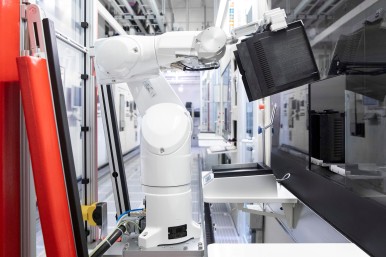
Reutlingen, Germany – In an additional move to combat the ongoing global chip shortage, Bosch plans to further extend its wafer fab in Reutlingen. More than a quarter of $1.2 billion is to be invested in creating new production space and the necessary clean-room facilities between now and 2025. This will give Bosch the firepower to meet the continuously growing demand for chips used in mobility and IoT applications. “We are systematically expanding our manufacturing capacity for semiconductors in Reutlingen,” says Dr. Stefan Hartung, chairman of the board of management of Robert Bosch GmbH. “This new investment will not only strengthen our competitive position, but will also benefit our customers and help combat the crisis in the semiconductor supply chain.” The construction of a new extension in Reutlingen will create an additional 38,750 square feet of ultramodern clean-room space. As of 2025, this additional capacity will produce semiconductors based on technology already in place at the Reutlingen plant. Bosch is also extending an existing power supply facility and will construct an additional building for media supply systems serving both the new and existing production areas. The new production area is scheduled to go into operation in 2025. In October 2021, Bosch announced it would be spending more than $473 million in 2022 alone on expanding its semiconductor operations in Dresden and Reutlingen, Germany, and in Penang, Malaysia. Around $59 million of this sum is earmarked for the wafer fab in Reutlingen. In addition, Bosch also announced plans to invest a total of $177 million in the creation of additional clean-room space in existing buildings at the Reutlingen facility over the period from 2021 to 2023. The further expansion of the site, which will see a new extension to the manufacturing facilities, will now supplement these measures. All in all, clean-room space in Reutlingen is set to grow from around 376,737 square feet at present to over 473,612 square feet by the end of 2025.State-of the-art semiconductor manufacture The Reutlingen wafer fabs use 6- and 8-inch technology, while the Dresden plant makes chips on 12-inch wafers. Both employ cutting-edge manufacturing methods based on data-driven process control. “AI methods combined with connectivity have helped us achieve continuous, data-driven improvement in manufacturing and thereby produce better and better chips,” says Markus Heyn, member of the board of management of Robert Bosch GmbH and chairman of the Mobility Solutions business sector. This includes the development of software to enable automated classification of defects. Bosch is also using AI to enhance materials flows. With its high level of automation, this state-of-the art production environment in Reutlingen will safeguard the plant’s future and the jobs of the people working there.Growing demand for semiconductors Bosch has been developing and manufacturing semiconductors for over 60 years, and for more than 50 of those years in Reutlingen – both for automotive applications and for the consumer electronics market. Bosch-manufactured semiconductor components include application-specific integrated circuits (ASICs), microelectromechanical systems (MEMS sensors), and power semiconductors. The further expansion of the Reutlingen site will primarily serve the growing demand for MEMS in the automotive and consumer sectors and for silicon-carbide power semiconductors. “Bosch is already a leading chip manufacturer for automotive applications,” Heyn says. “And this is a position we intend to consolidate.” Measures to achieve this include the development and manufacture of chips made of silicon carbide, which Bosch has been producing since December 2021. Chips made of this innovative material are destined to play an increasingly important role in electromobility. Bosch is currently the only automotive supplier worldwide manufacturing power semiconductors made of silicon carbide. The Reutlingen plant currently employs around 8,000 associates. They work in the development and production of semiconductors and electronic control units, in administration, and in the eBike Systems division.

Bosch Information domain computer enables advanced in-vehicle features quickly a ...

09.12.2021

Press release

Connected mobility

Bosch Information domain computer enables advanced in-vehicle features quickly a ...

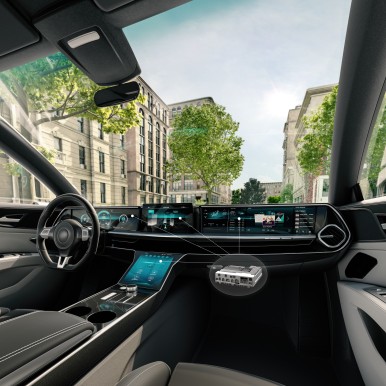
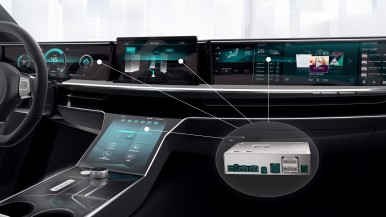
Plymouth, Mich. – In today’s world, vehicles need incredibly powerful brains. In-vehicle displays, voice assistants, infotainment systems and advanced human-machine interfaces (HMIs) are becoming more prominent and sophisticated, and more processing power is required to manage and control complex in-vehicle systems. Bosch has developed a high-performance infotainment domain computing system built precisely for the vehicles of today and tomorrow. It helps to bring features like in-car communication, in-car payment, video streaming, voice assistants and more to vehicles quickly. The Information domain computer delivers support for multiple in-vehicle systems within a single solution, and provides vehicle manufacturers with a cost-effective, flexible, scalable and powerful control unit for the future of in-vehicle technology. “With the Information domain computer, Bosch is providing connectivity and computing power to the modern world of mobility,” said Stefan Buerkle, senior vice president and head of Connected Information Solutions, Bosch in North America. “Bosch has experience working together with a network of leading technology companies, and has developed a powerful and flexible integration platform to support and enable the rapid evolution of in-vehicle features.”A collaborative network of technology industry leaders The Bosch Information domain computer combines Bosch’s leading expertise in automotive software solutions and domain-specific hardware expertise with solutions from a network of industry-leading technology companies in the hardware, component, software and services sectors. The result is a scalable platform that offers vehicle manufacturers the opportunity to utilize a combination of pre-integrated applications, the flexibility to support additional features developed in-house and the ability to accelerate time-to-market while managing cost efficiency. Bosch has developed a pre-integrated solution that features technology from several collaborating organizations. The pre-integrated solution, built on the QNX® Neutrino® Realtime Operating System (RTOS) and QNX® Hypervisor , is designed to deliver reliable functionality to address the requirements of today’s most advanced system designs. By combining a pre-integrated control unit with a customizable modular approach, the Bosch platform offers the flexibility to tailor in-vehicle features to customer preferences and market segments. The pre-integrated Information domain computer is powered by a 3rd generation Snapdragon® Automotive Cockpit Platform, a product of Qualcomm Technologies, Inc. In addition to supporting higher levels of compute and intelligence needed for advanced capabilities featured in next generation vehicles, the 3rd generation Snapdragon Automotive Platforms are engineered to deliver rich visual and audio experiences, as well as highly intuitive artificial intelligent experiences for in-vehicle assistance and contextual safety and support for precise positioning for enhanced navigation. The enhanced display experience is made possible by Texas Instruments’ FPD-Link™ SerDes technology for high-speed display and camera communications, which is supported by Molex ultra-reliable connector solutions. Further options available on the Bosch Information domain computer platform include voice assistants through Amazon Alexa and Cerence ; in-vehicle streaming with Access Twine4Car; and navigation experience via TomTom Navigation for Automotive embedded and cloud-based navigation. In addition, it will support the BlackBerry IVY™ Intelligent Vehicle Data Platform co-developed by BlackBerry and Amazon Web Services (AWS) to enable development of new applications and use cases. The user experience for the pre-integrated solution is tied together by Rightware with the award-winning Kanzi HMI toolchain for signature UI creation, in collaboration with software integration expert Wipro Limited, a leading global information technology, consulting, and engineering services company.Production-ready vehicle computers showcase continued Bosch leadership Vehicle computers are central to Bosch’s efforts to extend its leading role in software-intensive electronic systems. The customizable and flexible Information domain computer is the latest example of Bosch’s leadership in vehicle computers. Bosch is prepared to offer information domain computers to address the specific needs of vehicle manufacturers. Bosch has production-ready vehicle computers for every aspect of modern vehicles, including cockpit and connectivity functions, driver assistance systems and automated driving, and powertrain and body electronics.Bosch at CES 2022: PRESS CONFERENCE: Tuesday, January 4, 2022, from 8:00 to 8:45 a.m. local time (17:00–17:45 CET) with Dr. Tanja Rückert, Bosch CDO, and Mike Mansuetti, president of Bosch in North America, in Ballroom H, Mandalay Bay Hotel, Las Vegas South Convention Center, Level 2, as well as livestreamed on the Bosch Media Service . BOOTH: January 5–8, 2022, in the Central Hall, booth #16103 ELECTRIC BIKE TEST TRACK: January 5–8, 2022, at the eMobility Experience, LVCC, West Hall, West Plaza FOLLOW the Bosch CES 2022 highlights on Twitter: #BoschCES PANELS WITH BOSCH EXPERTS: Friday, January 7, 2022, 10:00 a.m., Venetian Hotel (local time) Building a Resilient Smart Home session with Dr. Carla Kriwet, CEO at BSH Hausgeräte GmbH

Bosch pools development activities for universal vehicle software in one unit

08.12.2021

Press release

Connected mobility

Bosch pools development activities for universal vehicle software in one unit

Stuttgart, Germany – Bosch is taking further strategic steps toward a leading position in the software-dominated future of mobility. In the future, under the umbrella of its subsidiary ETAS GmbH, the company will develop and sell basic vehicle software, middleware, cloud services, and development tools for universal application. A total of 2,300 experts from different development areas of Bosch and ETAS are to be brought together there as of mid-2022. “Software development is a longstanding core competence at Bosch. Every year, we put more than 200 million control units running our own software into vehicles worldwide. With this new set-up, we want to become the leading provider of application-independent vehicle software,” says Dr. Stefan Hartung, chairman of the Mobility Solutions business sector of Robert Bosch GmbH. A year ago, Bosch established its Cross-Domain Computing Solutions division, a powerful unit for application-specific vehicle software with specific hardware for numerous vehicle areas such as driver assistance and infotainment. Now the company is bringing together its portfolio of application-independent software for vehicles and the cloud at ETAS. The resulting central platform will allow it to develop automotive software more quickly and efficiently together with its partners. “Our universal software foundation is essential for the digitalization of modern, software-defined vehicles,” Stefan Hartung says. Bosch will combine its universal software platform with expertise in the development of innovative software functions. “Thereby we are creating a USP and a significant competitive advantage for Bosch,” says Dr. Markus Heyn, member of the Bosch board of management of Bosch. In the future, ETAS will offer this universal platform and the accompanying development environment to both automotive manufacturers and other suppliers.Software gaining in prominence for automakers Up to now, the rule was that vehicles were delivered as a finished product. In the future, though, a car’s software will be continuously improved and expanded – throughout its service life. This will give drivers a customized digital driving experience, and also form the basis for new business models for manufacturers. This development is just beginning. Experts predict that the market for automotive software will be worth billions in the next few years. Bosch expects double-digit annual growth until 2030. The organizational realignment Bosch is now planning for its application-independent automotive software units under the roof of its subsidiary ETAS bears witness to this transformation. “In the future development of vehicle operating systems, we want to position ourselves even better in the global market,” says Heyn. “With this move, we are providing existing and new customers with an integrated, horizontal, cross-domain platform that will allow them to achieve the aim of software-defined vehicles,” adds Christoph Hartung, the chairman of the board of management of ETAS GmbH. The partnership between Bosch and Microsoft that began in February will also be continued in the new organization. This partnership aims to develop a comprehensive software platform for seamless connectivity between cars and the cloud, making it quicker and easier to develop vehicle software throughout the car’s lifetime, as well as to download it to the control units and vehicle computers via the cloud.Universal and open portfolio for basic software and middleware Whether for electrically adjusting the seat, recharging the vehicle, deploying the airbag, or listening to the radio – software is already an integral part of almost every function in modern vehicles. It consists of different layers that build on each other. One layer comprises software modules that vehicle manufacturers use to create individual driving experiences – from the powertrain to infotainment and assistance systems. This is where the individual brands differ, sometimes enormously. Other layers, by contrast, such as the basic software for the control units and what is known as middleware, offer manufacturers almost no scope for USPs. These software components regulate the basic tasks performed by control units and vehicle computers – tasks that the driver doesn’t notice. For example, they manage processor performance and memory space, and they determine how control units communicate with each other or with the cloud to exchange data. Once developed, this software can be used on almost any ECU – regardless of where it is installed in the car and regardless of the vehicle model. This setup is familiar from smartphones, where a wide variety of apps use a central operating system. “Our new set-up will allow us to satisfy new requirements – both of the market and our customers – even better. Together with our partners, we are enabling existing and new customers to take a completely new approach to automotive software development,” Christoph Hartung says. In the future, open source software and the associated ecosystems will also play an increasingly important role. Vehicle manufacturers and automotive suppliers will thus be able to place software at the center of development even more effectively in the future.Application-independent software from a single source ETAS was founded in 1994 as a wholly owned subsidiary of Robert Bosch GmbH and employs some 1,500 associates in 12 countries. A further 800 Bosch associates will join them in mid-2022. Even today, the two companies are closely and successfully working together. This collaboration will be further intensified in a joint unit. The employee representatives responsible are currently involved in working out the details of the future organization.

17.02.2021

Press release

Automated mobility

Bosch teams up with Microsoft to develop software-defined vehicle platform for s ...

Stuttgart and Munich, Germany – Bosch teams up with Microsoft to develop a software platform to seamlessly connect cars to the cloud. The goal of this collaboration is to simplify and accelerate the development and deployment of vehicle software throughout a car’s lifetime in accordance with automotive quality standards. The new platform, which will be based on Microsoft Azure and incorporate software modules from Bosch, will enable software to be developed and downloaded to the control units and vehicle computers. A further focus of the collaboration will be on the development of tools that increase efficiency in the software development process. This in turn will drive innovation and reduce development costs for vehicle software within and across organizations. For drivers, the platform will mean quicker access to new functions and digital services. The collaboration between Bosch and Microsoft combines the wealth of software, electronics, and systems expertise of the world’s leading automotive supplier with Microsoft’s know-how in software engineering and cloud computing. Both companies intend to make the new software platform available for first vehicle prototypes by the end of 2021. “Bosch already securely updates car software over the air today. With the comprehensive platform for software-defined cars, we want to further empower automakers to develop new functions and get them on the road faster,” says Dr. Markus Heyn, member of the board of management of Robert Bosch GmbH. “Our collaboration with Bosch brings together the expertise of one of the world’s leading automotive suppliers with the power of the Microsoft cloud, AI and GitHub,” says Scott Guthrie, executive vice president, Cloud + AI, Microsoft. “With software quickly becoming a key differentiator in the automotive industry, our ambition is to help businesses accelerate the delivery of unique mobility services across passenger cars and commercial fleets at scale.” Developing the automotive future together Software will play an increasingly important role in future vehicle generations. New trends such as electromobility, automated driving, and modern mobility services would not be possible without it. This will also require more frequent updates and upgrades in the future. However, stringent safety requirements throughout the vehicle’s lifetime make wireless software updates and digital services for cars very complex. The wide range of different series and models makes things even more challenging. The collaboration will benefit from Bosch’s deep understanding of electrical and electronic architectures, control units, and vehicle computers, which is necessary for over-the-air vehicle updates. In addition, the company will contribute its expertise as well as software-based products and development tools for cars. This includes the basic software and middleware for vehicle computers and control units, as well as cloud-based software modules to bring over-the-air updates to entire vehicle fleets. “Having a comprehensive software platform from the vehicle to the cloud will reduce the complexity of the software development and the vehicle system integration. In this way we will create the conditions for wireless updates to work just as smoothly and conveniently in vehicles as they do in smartphones,” Heyn says. The pre-integrated platform will greatly reduce the complexity of over-the-air updates, which help ensure that a vehicle’s software is always up to date, thanks to the fact that the software architectures of vehicles and the cloud will now fit together seamlessly. New software services for developers Bosch and Microsoft also plan to enrich existing developer tools that will enable automakers and suppliers to simplify and accelerate their own software development, while adapting to the unique challenges in the automotive industry. The companies also plan to use GitHub’s fully integrated enterprise platform and to open-source important parts of the new software platform on GitHub.com to encourage code re-use and best practice sharing across the industry.

The market of the future: Bosch wins orders worth billions for vehicle computers

15.12.2020

Press release

Connected mobility

The market of the future: Bosch wins orders worth billions for vehicle computers

Stuttgart, Germany – In modern cars, intelligence counts for a lot, and Bosch vehicle computers are there to provide it. These computers, the new all-rounders of automotive electronics, are incorporating ever more functions of individual control units into central, highly powerful electronic modules. For more than a year now, Bosch vehicle computers have been controlling functions such as driver assistance systems and motion in production vehicles. And soon, they will be joined by central computers for cockpit functions and body electronics. When it comes to vehicle computers, therefore, no other company can match Bosch’s broad portfolio, since the supplier of technology and services can offer production-ready computers for every aspect of modern vehicles. And business-wise as well, this is paying off. Bosch has now won orders worth several billion for its vehicle computers – 3 billion worth since last summer alone. “Vehicle computers have huge business potential for Bosch. Even now, our high-performance computers mean that automakers view us as one of their leading engineering and technology partners,” says Harald Kroeger, who sits on the board of management of Robert Bosch GmbH. Vehicle computers are central to Bosch’s efforts to extend its leading role in software-intensive electronic systems. The market for these systems is worth some 24 billion, and is set to grow 15 percent annually between now and 2030. To meet this demand, the new Cross-Domain Computing Solutions division and its 17,000 associates will start operations in January 2021. In this unit, Bosch is bringing together its hardware and software engineering for vehicle computers, sensors, and control units for all vehicle domains.Automotive electronics is getting fit for the future In the future, high-performance control units will be a must-have for all cars. These central nodes are where all the car’s “nerves” converge. Thanks to their prodigious computing power of several billion operations per second, central computers are even capable of processing the big data needed for automated driving, data-based services, and permanent software updates. According to McKinsey, software’s share in the value of a vehicle will rise from just 10 percent today to 30 percent in the future. This development underscores how important bits and bytes will be for vehicles in the future. And vehicle computers that can handle such software functions and data volumes will therefore soon be a standard feature in all vehicles, whether compacts, premium sedans, or 40-ton trucks. Bosch is developing computers for cockpit and connectivity functions, for driver assistance systems and automated driving, and for the powertrain and body electronics. This means it will be possible to concentrate control over all central vehicle functions in just a handful of high-performance central computers. Take the information domain computer Bosch is developing. In the next vehicle generation, it will assume the tasks done by as many as ten control units. Some vehicles now feature more than 100 control units in total, and this development will allow automakers to significantly reduce this number. “Vehicle computers are the key to significantly reducing the complexity of electronic systems, and to making them as secure as possible,” Kroeger says. Moreover, installing more central high-performance computers will save on wiring, and thus reduce cost, weight, and installation space. In the vanguard of automotive electronics In the years ahead, vehicle computers will be entrusted with tasks from different parts of the vehicle – or domains, as the experts call them. When this happens, just one central computer will be responsible for controlling not only vehicle motion, but also body electronics, say. Such central computers will then be all the more powerful: over the past 20 years, the computing power of a control unit originally intended for navigation has grown by a factor of 3,000. This is almost three times the increase predicted by Moore’s law, which states that computing power doubles every two years. The result is that a modern cockpit computer can control not only displays, infotainment, and voice commands, but also the tasks of other domains, such as certain assistance functions. “Bosch vehicle computers will make it possible to master even highly complex driving functions across individual vehicle domains,” says Dr. Mathias Pillin, who will be assuming the position of president of the new Cross-Domain Computing Solutions division from January 2021. The new division’s name is no coincidence. Here, under one roof, Bosch will be pooling its capabilities in software, electrical, and electronic engineering from the domains of driver assistance and automated driving, car multimedia, powertrain, and body electronics. Modular design offers business potential Bosch offers its vehicle computers as a scalable kit that contains the right electronic system, including hardware and software, for all requirements and conditions. The ultimate aim is a software and systems architecture for the entire vehicle, in which all central computers, sensors, and control units are perfectly compatible with each other. For automakers, the benefit of such a modular design is that it gives them extra flexibility when developing vehicle computers for different vehicle models. If, for example, a fundamental architecture has been defined for hardware and software, the computer can be designed along those lines, according to customer wishes. In the case of a premium vehicle, additional functions can be provided by adding extra software modules or special chips to the printed circuit boards. In the case of a compact vehicle, the structure of the vehicle computer can be modified so that it provides central control over basic safety-relevant functions. “Our modular design for vehicle computers and our broad portfolio mean that Bosch can cater to all automakers’ needs,” Pillin says. This design principle also means huge business potential for these high-performance computers, since it will allow Bosch to tap into an enormous market.

Bosch Service Solutions to invest in U.S. startup Sfara

01.12.2020

Press release

Connected mobility

Bosch Service Solutions to invest in U.S. startup Sfara

Frankfurt am Main, Germany / Hoboken, NJ – As part of its plans to further expand its mobility service business, Bosch Service Solutions is acquiring a minority stake in the startup Sfara Inc., based in Hoboken, NJ (USA). The two companies have been working together since 2019. Set up in 2012, Sfara offers app-based technologies for mobile devices that detect vehicle collisions and other emergencies. The user’s smartphone triggers then an emergency call, such as the Bosch eCall service, to quickly contact first responders. The two companies signed an agreement on the investment of a minority stake on November 25, 2020. It has been agreed that the financial details will not be disclosed.“With this investment in Sfara, we are strengthening collaboration between our two companies and will continue our joint effort to expand the successful Bosch eCall emergency and breakdown service,” says Henning von Boxberg, President of Bosch Service Solutions. The automatic emergency call system – eCall for short – is a milestone in vehicle safety. For newly registered vehicle types, it has been mandatory in the European Union since March 31, 2018. Technology developed by Sfara now makes it possible for drivers to use this digital aide via a smartphone in vehicles without the eCall installed, usually in older vehicles that don’t include the necessary technology. This way, a significantly greater number of road users can benefit from this emergency call system and can automatically get help in the event of an accident. Thanks to the Sfara technology, users can also access eCall outside the vehicle from their smartphones, for example when moving around on foot. “We are delighted to be working with a well-known investor such as Bosch, and pleased that our technology can play a valuable part in expanding Bosch’s global eCall service portfolio,” says Erik Goldman, the CEO of Sfara. eCall by smartphone, regardless of age of car or means of transport Smartphone-based eCall means that vehicle manufacturers, auto insurers, and fleet operators can offer a comprehensive accident and breakdown service to their customers – independent of the age of their car or means of transport. A service app for customers’ smartphones is available from the respective provider. In case of an accident, the app connects the user with the Bosch accident and breakdown network. Accelerometers, GPS and other sensors are embedded in modern smartphones. Sfara’s proprietary app-based technology uses sensor fusion to detect accidents and suppress false positives. If an accident is detected, the app automatically triggers an emergency call to a Bosch service location and simultaneously transmits information necessary to get first responders to the scene quickly. An emergency call can also be triggered manually. This connects the user with a member of the service team, who will then contact emergency services, if required. The technology contains optimized crash detection functions that considerably reduce false positives, which are costly to the business and frustrating to end users. Digital accident and breakdown management The data for rapid assistance in case of an accident or breakdown is collected by Bosch and can be passed on to vehicle manufacturers, auto insurers, and fleet operators. This speeds up the process for all concerned, since the information includes useful accident data such as the location of impact. The report of an accident can also go hand in hand with a first notification of loss (FNOL). Insurers need this information to carry out smooth claims processing. In accordance with GDPR, only the data needed to perform service is transmitted, based on approval given by the user in advance. Bosch Service Solutions plans to extend the eCall service further with its partners and make all steps involved in accident and breakdown management available in digital form to its business customers. These range from the first notification of loss or accident, to repair and towing services and the provision of a replacement vehicle and claims management.

Stuttgart airport set to welcome fully automated and driverless parking

13.10.2020

Press release

Connected mobility

Stuttgart airport set to welcome fully automated and driverless parking

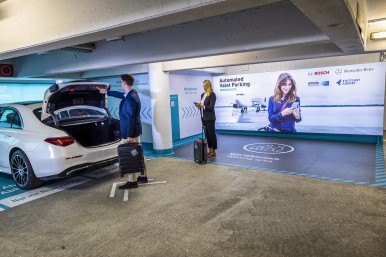
Stuttgart, Germany – Automated parking to drive down the airport stress: Bosch, Mercedes-Benz, and the parking garage operator Apcoa want to introduce driverless and fully automated parking at Stuttgart airport in the future. To this end, the automated valet parking (AVP) system co-developed by Bosch and Mercedes-Benz is to be made ready for commercial operation. The new Mercedes-Benz S-Class is already geared up to accommodate it as the world’s first production vehicle to feature the technology required for future infrastructurebased AVP. As an option, customers can buy the appropriate pre-installation for what the company calls the INTELLIGENT PARK PILOT, which makes the S-Class capable of receiving a smartphone command to drive itself to a reserved parking space. “With the new S-Class, it’s not just driving that’s a luxury, but parking as well,” says Dr. Michael Hafner, head of automated driving at Mercedes-Benz AG. The P6 parking garage at Stuttgart airport will serve as the pilot for the planned commercial automated parking service. Here, the companies will test how the vehicle technology onboard the S-Class interacts with the intelligent Bosch infrastructure and APCOA FLOW, the digital platform provided by the parking garage operator Apcoa. This platform makes the whole parking process ticketless and cashless. “Apcoa, Bosch, Mercedes-Benz, and Stuttgart airport want to work together to make parking fully automatic,” says Christoph Hartung, member of the executive management of Connected Mobility Solutions at Bosch. In the airport parking garage, preparations are currently underway to begin piloting the planned automated valet parking service. The aim of this trial with new S-Class vehicles at Stuttgart airport is to ensure that interactions between the vehicle, infrastructure technology, and parking garage operator run smoothly and are optimized for the customer.World’s first Level 4 park function in a production vehicle In July 2019, Bosch and Mercedes-Benz received the world’s first special permit to operate AVP for selected E-Class vehicles without a safety driver in real-life, mixed parking garage traffic at the Mercedes-Benz Museum in Stuttgart. Equipped with the appropriate pre-installation for the INTELLIGENT PARK PILOT, the new Mercedes-Benz S-Class is now the first production vehicle to feature AVP technology, which enables it to park without a driver. However, this is conditional on the future availability of parking garages with the appropriate infrastructure, as well as on national legislators giving AVP the green light. This makes the Mercedes-Benz S-Class the world’s first vehicle to feature a pre-installation for an SAE Level 4 automated driving function, the second-highest level of automation. “With automated valet parking, Mercedes-Benz is demonstrating that driverless parking will soon be possible,” Hafner says. To facilitate this new one-touch parking function, a spacious drop-off and pick-up area will be set up directly behind the entrance to the P6 parking garage, giving AVP users a convenient place to leave their vehicles. As they comfortably make their way to the terminal and check in, their S-Class will park itself in the basement, guided by information from the infrastructure technology. In other words, users no longer need to worry about maneuvering or having to squeeze out of their cars when the space they have finally found proves to be too narrow. “Automated valet parking really enhances our passengers’ comfort and convenience and saves them time, especially when they’re in a hurry and just want to drop their car off quickly at the airport”, says Walter Schoefer, management spokesman for Flughafen Stuttgart GmbH. For the test phase that is about to start, P6 will initially have two spaces available for self-parking vehicles. More spaces will be added when driverless parking becomes standard as planned in the future and as demand increases. Intelligent infrastructure and digital platforms The pilot parking garage at Stuttgart airport will be a premiere for new Bosch video cameras that can identify vacant parking spaces, monitor the driving aisle and its surroundings, and detect obstacles or people in the aisle. Until now, lidar sensors have been used for this purpose. A dedicated control center in the parking garage then calculates the route the vehicles need to take to reach an available space. “Our intelligent parking garage infrastructure forms the basis for the future of driverless parking,” Hartung says. Thanks to the information that the cameras provide, it is also possible for cars to drive themselves around the parking garage – even on narrow ramps, enabling them to move between different stories. The in-vehicle technology autonomously converts the information from the infrastructure into driving maneuvers. If the cameras detect an unexpected obstacle, for example, the vehicle safely performs an emergency stop. APCOA FLOW, the parking garage operator Apcoa’s digital platform, will also play a key role in driverless parking at Stuttgart airport. Drivers are already using the platform to help lighten the burden of parking. This ranges from making firm reservations for a parking space, to contactless entry into the parking garage, and to fully automated payment, invoicing, and contactless exit. The system recognizes the customer’s vehicle and the barriers open automatically, making a ticket and trip to the ticket machine redundant. “We want to be the first parking garage operator to fully support and enable automated parking services based on AVP technology in one of our parking garages,” says Frank van der Sant, chief commercial officer at Apcoa Parking Holdings GmbH. More vehicles, more parking garages A vehicle drop-off and collection service saves time and avoids long walks to the car: once parking garages are equipped with the appropriate infrastructure and national laws permit AVP, customers will be able to enjoy driverless parking services. Bosch and Mercedes-Benz are paving the way for this with the world’s first infrastructure-based solution for SAE Level 4 automated valet parking in real-life, mixed parking garage traffic. Uniform standards and interfaces ensure smooth communication between the vehicles and infrastructure technology. In the future, Bosch’s aim is to equip more and more parking garages with AVP infrastructure technology. As Europe’s largest parking garage operator, Apcoa also has a strategic interest in offering innovative premium services like AVP in more of its parking garages. “Looking ahead, we want to open up AVP to more customers at selected Apcoa locations,” van der Sant says. The company manages approximately 1.5 million individual parking spaces at over 9,500 locations in 13 European countries. By increasing the availability of driverless and fully automated parking services, the same amount of space could accommodate up to 20 percent more vehicles. In addition, driverless parking is especially suitable for narrow, remote, and therefore unattractive parking areas that people would otherwise avoid.

Bosch: the mobility of the future needs fuel cells

02.09.2020

Press release

Automated mobility

Bosch: the mobility of the future needs fuel cells

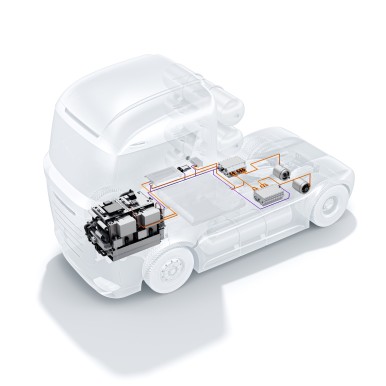
Stuttgart, Germany – Electromobility is picking up more and more speed. It is an important element in reducing CO2 emissions from traffic. But how economical is it to operate heavy-duty trucks with 40-ton payloads over long distances using only battery-electric power? Given the battery weight, long charging times, and limited range of today’s technology, electric powertrains aren’t the first choice for heavy trucks. Nevertheless, even 40-ton trucks will be able to travel more than 620 miles in all-electric mode in the near future. The key to this is the Bosch fuel-cell powertrain. When powered with hydrogen produced using renewable energy, this powertrain enables the climate-neutral transportation of goods and commodities. Bosch is taking the first step in this direction by developing the fuel-cell powertrain primarily with a focus on trucks, and the company plans to start production in 2022–2023. Once they have become established in trucks, Bosch fuel-cell powertrains will then increasingly find their way into passenger cars – rightly making them an integral part of tomorrow’s powertrain portfolio.Seven reasons why fuel cells and hydrogen are crucial building blocks of tomorrow’s mobility: 1) Climate neutrality In a fuel cell, hydrogen (H2) reacts with oxygen (O2) from the ambient air. The energy this reaction releases is converted into electricity, which is used for driving. Heat and pure water (H2O) are other products of the reaction. H2 is obtained using electrolysis, in which water is separated into hydrogen and oxygen with the aid of electricity. Generating this electricity from renewables makes the fuel-cell powertrain completely climate-neutral. Especially for large, heavy vehicles, fuel cells have a better carbon footprint than exclusively battery-electric powertrains if the CO2 emissions for production, operation, and disposal are added together. All that fuel-cell vehicles need in addition to their hydrogen tank is a much smaller battery for intermediate buffer storage. This greatly reduces their carbon footprint in production. “The advantages of the fuel cell really come into play in those areas where battery-electric powertrains don’t shine,” explains Dr. Uwe Gackstatter, president of the Bosch Powertrain Solutions division. “This means there’s no competition between fuel cells and batteries; instead, they complement each other perfectly.” 2) Potential applications Hydrogen has a high energy density. Two pounds of hydrogen contains as much energy as a gallon of diesel. To travel 62 miles, a passenger car needs only about two pounds; a 40-ton truck needs a good 15 pounds. As with diesel or gasoline, it takes just a few minutes to fill an empty H2 tank and continue the journey. “Fuel cells are the first choice for transporting larger loads for many miles every day,” Gackstatter says, summarizing the advantages. In the EU-funded H2Haul project, Bosch is currently working with other companies to build a small fleet of fuel-cell trucks and put them on the road. In addition to mobile applications, Bosch is developing fuel-cell stacks for stationary applications with solid-oxide fuel-cell (SOFC) technology. One intended use for them is as small, distributed power stations in cities, data centers, and charge points for electric vehicles. If the Paris climate action targets are to be met, in the future hydrogen will need to power not only cars and commercial vehicles, but also trains, aircraft, and ships. The energy and steel industries are also planning to make use of hydrogen. 3) Efficiency One of the decisive factors for a powertrain’s eco-friendliness and profitability is its efficiency. This is around a quarter higher for fuel-cell vehicles than for vehicles with combustion engines. Employing recuperative braking further increases efficiency. Battery-electric vehicles, which can store electricity directly in the vehicle and use it for propulsion, are even more effective. However, since energy production and energy demand do not always coincide in time and location, electricity from wind and solar plants often remains unused because it cannot find a consumer and cannot be stored. This is where hydrogen comes into its own. The surplus electricity can be used to produce it in a decentralized way, ready for flexible storage and transportation. 4) Costs The cost of green hydrogen will come down considerably when production capacities are expanded and the price of electricity generated from renewables declines. The Hydrogen Council, an association of over 90 international companies, expects costs for many hydrogen applications to fall by half in the next ten years – making them competitive with other technologies. Bosch is currently working with the startup Powercell to develop the stack, the core of the fuel cell, and make it market-ready, with manufacturing to follow. The goal is a high-performance solution that can be manufactured at low cost. “In the medium term, using a vehicle with a fuel cell won’t be more expensive than using one with a conventional powertrain,” Gackstatter says. 5) Infrastructure Today’s network of hydrogen filling stations doesn’t offer complete coverage, but the roughly 180 hydrogen filling stations in Europe are already sufficient for some important transport routes. Companies in many countries are cooperating to push ahead with the expansion, often supported by state subsidies. In Germany, too, politicians have recognized the important role of hydrogen in decarbonizing the economy and have anchored it in the National Hydrogen Strategy. For example, the H2 Mobility joint venture will have built around 100 publicly accessible filling stations in Germany by the end of 2020, while the EU-funded H2Haul project is working not only on trucks but also on the filling stations required on its planned routes. Japan, China, and South Korea also have comprehensive support programs. 6) Safety The use of gaseous hydrogen in vehicles is safe and no more hazardous than other automotive fuels or batteries. Hydrogen tanks do not pose an increased risk of explosion. It is true that H2 burns in combination with oxygen and that a mixture of the two beyond a certain ratio is explosive. But hydrogen is about 14 times lighter than air and therefore extremely volatile. For example, any H2 that escapes from a vehicle tank will rise faster than it can react with the ambient oxygen. In a fire test conducted on a fuel-cell car by U.S. researchers in 2003, there was a flash fire, but it quickly went out again. The vehicle remained largely undamaged. 7) Timing Hydrogen production is a proven and technologically straightforward process. This means it can be ramped up quickly to meet higher demand. In addition, fuel cells have now reached the necessary technological maturity for their commercialization and widespread use. According to the Hydrogen Council, the hydrogen economy can become competitive in the next ten years, provided there is sufficient investment and political will. “The time for entry into the hydrogen economy is now,” Gackstatter says.

Ford, Bedrock and Bosch are exploring highly automated vehicle technology in Det ...

27.08.2020

Press release

Automated mobility

Ford, Bedrock and Bosch are exploring highly automated vehicle technology in Det ...

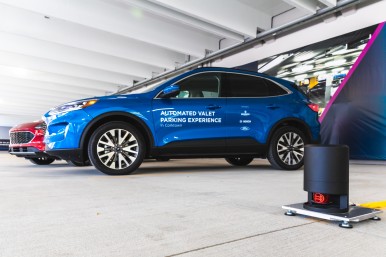
DETROIT – Many people enjoy driving… until it’s time to park. So why not leave the task to the vehicle?Ford Motor Company, Bedrock and Bosch are launching a demonstration project with connected Ford Escape test vehicles that can drive and park themselves inside Bedrock’s Assembly Garage in Detroit using Bosch smart infrastructure. This is the first U.S. infrastructure-based solution for automated valet parking where the vehicle will park itself inside a parking garage. The research will take place in the Corktown neighborhood, the site of Ford’s new mobility innovation district, anchored by Michigan Central Station. The district will draw mobility innovators and disruptors from around the world to develop, test, and launch new solutions to solve urban transportation challenges, improve mobility access for everyone and prepare for the increasingly connected and autonomous world ahead. “We are continually searching for opportunities to expand our leading suite of Ford Co-Pilot360 driver-assist technologies that help people drive more confidently and we believe automated valet parking technology holds great promise,” said Ken Washington, chief technology officer at Ford Motor Company. “Our work with Bosch and Bedrock also aligns with our vision for the future, which includes increasingly automated vehicles that are more aware of their surroundings while requiring less on-board computing to help improve design, packaging and affordability.” The demonstration project will be on display on the ground floor of Bedrock’s Assembly Garage, the real estate developer’s first residential redevelopment project in the Corktown neighborhood. The project aligns with Bedrock’s vision of combining ground up and historical developments with the newest technology in parking and mobility - including the current installation of the Midwest’s first automated parking stall, which parks and retrieves vehicles in the basement of the Free Press Building using street-level load bays. “We strive to be at the forefront of parking and mobility initiatives in Detroit because we recognize the importance of interconnectivity between real estate and mobility,” said Heather Wilberger, chief information officer at Bedrock. “In addition to drastically reducing park time, we see this solution as the first step to bringing automated parking to our city, providing the ultimate convenience for our tenants, visitors, neighborhoods and residents.” The automated valet parking technology will be running for Assembly tenant and private demonstrations through the end of September. Connected vehicle and smart infrastructure enhance automated parking The connected Ford test vehicles operate in a highly automated fashion by vehicle-to-infrastructure (V2I) communication with Bosch’s intelligent parking infrastructure. The infrastructure sensors recognize and localize the vehicle to guide its parking maneuver, including the ability to help avoid pedestrians and other hazards. If the infrastructure senses something in the vehicle’s path, it can stop the vehicle immediately. “For Bosch, automated valet parking brings together our deep cross-domain experience in mobility and building technologies to deliver a smart infrastructure solution that improves everyday life,” said Mike Mansuetti, president of Bosch in North America. “This technology enables consumers to see the benefit of highly automated technology as the vehicle handles a task such as parking in a garage.” Upon arriving into the garage, a driver will leave the vehicle in a designated area and use a smartphone app to send the vehicle into an automated parking maneuver. Drivers will also use the app to request the return of the vehicle to the designated pick-up area, expediting the parking experience and removing the responsibility of finding the vehicle upon return to the garage. New mobility requires collaboration The demonstration project at Assembly Garage brings together one of the world’s largest automakers, Ford, the largest property developer in the City of Detroit, Bedrock, and the world’s largest automotive supplier, Bosch, to demonstrate how organizations are working together on new mobility initiatives. “Michigan continues to lead the way through unprecedented investments in the smart infrastructure that is critical to developing and deploying the most advanced forms of mobility,” said Garlin Gilchrist II, Lt Governor. “With the Office of Future Mobility and Electrification, we are ensuring our state solidifies its position not only in the manufacturing of advanced automobiles, but also in the future of smart, connected roadways and parking areas. We will continue finding innovative ways to work with partners across both the public and private sector to deliver real-world solutions to today’s transportation challenges.” The demonstration project will enable the three companies to gain valuable insights regarding user experience, vehicle design, parking structure design and application to expand the technology and its application. “The City of Detroit continues to be at the forefront of mobility and the heart of the automotive industry,” said Mike Duggan, mayor of the City of Detroit. “Ford has a long and storied history with the Motor City and it is exciting to see them collaborate with Bosch and Bedrock on this innovative effort to propel the region into the future of mobility. I look forward to the day when Detroit residents and visitors alike will see a benefit from future technologies such as automated valet parking – it will undoubtedly save space in our garages and make the entire parking experience more convenient.” Efficient use of space and vehicle services make the case Automated parking solutions bring value to garage owners by allowing for the more efficient use of spaces inside a parking garage. With automated valet parking, the same amount of space can accommodate up to 20 percent more vehicles. The solution can be deployed via retrofitted solutions like the one in the Assembly Garage or with embedded infrastructure planned into construction of new garages that enables optimized design for maximum capacity. In addition to simply parking, a vehicle could also drive itself to areas within the garage for specific services such as vehicle charging or a car wash. During the demonstration project, Ford, Bedrock and Bosch will demonstrate vehicle paths showing how a vehicle would move between service areas and ultimately to a parking spot before the user calls it back to leave the garage.

From windshield wiper to e-bike ABS

19.05.2020

Press release

Artificial Intelligence

From windshield wiper to e-bike ABS

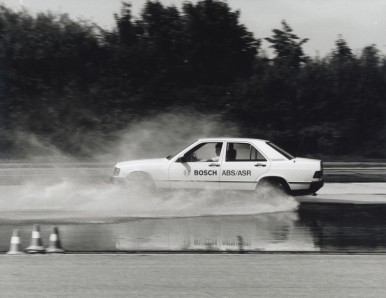
1926: Windshield wiper Goodbye to poor visibility: comprising an electric motor that drove a rubber-coated arm via a worm screw and gear, the Bosch electric windshield wiper finally gave drivers a clear view of the road ahead. It was followed in 1959 by an electric windshield washer system. Activated at the push of a button, an electric pump precisely sprayed water on to the windshield through one or several nozzles that were mounted on the hood. 1927: Power-assisted brake for commercial vehicles In the years after 1900, vehicles became increasingly fast and powerful, but braking force was unable to keep up. This prompted Bosch to develop a pneumatic brake booster for heavy trucks, whose heavy loads meant especially long braking distances. The system used the vacuum that arises in the induction tract of the engine, so that only one-third as much pressure now had to be applied to the brakes. 1928: Bosch brake assistant Bosch also used this innovative brake technology, premiered in 1927, in passenger cars. There were two challenges: to achieve a compact design that would allow it to be installed in the tight space available in the engine compartment, and to make it more affordable. The technology became established as standard equipment. As in the case of the Bosch brake for trucks, drivers now only had to apply one-third of the pedal pressure, and braking distance was also reduced by one-third. 1957: Asymmetric low-beam headlights In 1913, Bosch started production of a new automotive lighting system. The system comprised a generator, headlights, a battery, and a regulator. And while these lighting systems were continuously improved, they still had one disadvantage: they dazzled oncoming vehicles. The more cars there were on the roads, the more inconvenient and dangerous the situation became. In 1957, Bosch premiered asymmetric low-beam headlights. This system causes less dazzle for oncoming traffic and illuminates the driver’s own side of the road better. 1978: ABS antilock braking system Following nine years of development work, 1978 marked the start of the success story of ABS, the electronically controlled antilock braking system for four-wheeler passenger cars. If the wheels lock up, ABS reduces brake pressure then increases it again – up to 40 times a second. This keeps braking distances short, even on slippery surfaces, and the vehicle remains steerable. For motorcycles, the EU mandated the system for all new type approvals from 2016. 1926: Windshield wiper Goodbye to poor visibility: comprising an electric motor that drove a rubber-coated arm via a worm screw and gear, the Bosch electric windshield wiper finally gave drivers a clear view of the road ahead. It was followed in 1959 by an electric windshield washer system. Activated at the push of a button, an electric pump precisely sprayed water on to the windshield through one or several nozzles that were mounted on the hood. 1927: Power-assisted brake for commercial vehicles In the years after 1900, vehicles became increasingly fast and powerful, but braking force was unable to keep up. This prompted Bosch to develop a pneumatic brake booster for heavy trucks, whose heavy loads meant especially long braking distances. The system used the vacuum that arises in the induction tract of the engine, so that only one-third as much pressure now had to be applied to the brakes. 1928: Bosch brake assistant Bosch also used this innovative brake technology, premiered in 1927, in passenger cars. There were two challenges: to achieve a compact design that would allow it to be installed in the tight space available in the engine compartment, and to make it more affordable. The technology became established as standard equipment. As in the case of the Bosch brake for trucks, drivers now only had to apply one-third of the pedal pressure, and braking distance was also reduced by one-third. 1957: Asymmetric low-beam headlights In 1913, Bosch started production of a new automotive lighting system. The system comprised a generator, headlights, a battery, and a regulator. And while these lighting systems were continuously improved, they still had one disadvantage: they dazzled oncoming vehicles. The more cars there were on the roads, the more inconvenient and dangerous the situation became. In 1957, Bosch premiered asymmetric low-beam headlights. This system causes less dazzle for oncoming traffic and illuminates the driver’s own side of the road better. 1978: ABS antilock braking system Following nine years of development work, 1978 marked the start of the success story of ABS, the electronically controlled antilock braking system for four-wheeler passenger cars. If the wheels lock up, ABS reduces brake pressure then increases it again – up to 40 times a second. This keeps braking distances short, even on slippery surfaces, and the vehicle remains steerable. For motorcycles, the EU mandated the system for all new type approvals from 2016. 1980: Electronic airbag control In 1980, Bosch was the first European company to manufacture electronic triggering units for passive safety systems. This set the standard in road safety. The triggering unit comprised three components made up of some 170 individual parts, and controlled the driver airbag. It was first installed in the Mercedes-Benz S-class. Up to nine airbags are installed in today’s vehicles. They are deployed individually, depending on the accident scenario. 1986: TCS traction control system The TCS traction control system prevents the driven wheels from spinning. The electronic control unit reduces the speed of the spinning wheels until they recover their grip. TCS is an early example of networking diverse automotive electronic systems. When traction control is activated, it intervenes in the engine management or brake control system. Despite actuation of the accelerator, engine power is continuously lowered, or the brake is actuated, until the wheels recover their grip. Traction control can also brake a wheel individually in order to divert engine power to another drive wheel if the latter offers better traction. 1995: MEMS in mass production In the 1980s, Bosch worked on making sensors smaller, more reliable, and more energy efficient, as a way of providing ever more sensor data in cars. Following the start of mass production in 1995, these miniature helpers became ever more prevalent, furnishing control units with data about when the car brakes or accelerates, as well as about the direction the car is traveling. Information such as this is important for safety systems such as ESP®. 1995: ESP® electronic stability program Using smart sensors, ESP® compares 25 times per second whether the car is actually moving in the direction that the driver is steering it in. If it is not, the system intervenes. By reducing engine torque and deliberately braking each wheel individually, the system helps the driver stabilize the vehicle and prevent skidding accidents. Since its market launch in 1995, ESP® has prevented just under half a million accidents and saved more than 15,000 lives in the EU alone. Bosch celebrates a milestone this year: it has sold 250 million ESP® systems since production began 25 years ago. 2010: Predictive emergency braking system Ever more sensors in cars, sharing information with each other, make completely new applications possible: the emergency braking system that went into production in 2010 makes use of the information radar and video sensors share with the ESP®. If there is a threat of collision, it offers drivers multi-stage support. First, it alerts to the need to brake hard. If this alert is not heeded, the system initiates partial braking, and if the driver still does not react, it triggers emergency braking. 2013: MSC motorcycle stability control In 2013, Bosch took its ESP® success story, which began in 1995, and applied it to two-wheelers. In all riding situations, MSC motorcycle stability control ensures maximum stability: when braking and accelerating, on straight stretches and in bends. Wheel sensors measure wheel speed, and a further sensor measures lean and pitch angles. If the system detects a wheel on the verge of locking up, braking pressure is lowered and built up again within a fraction of a second, ensuring that the correct amount of pressure is constantly applied to prevent each wheel from locking up. This can save motorcyclists’ lives. 2018: eBike ABS Bosch has been manufacturing antilock braking systems for cars since 1978, and for motorcycles since 1995. They were joined in 2018 by an ABS for eBikes, which Bosch developed in collaboration with the brake manufacturer Magura. The world’s first production antilock braking system for pedelecs reduces the risk of becoming unseated in critical situations. In this front-wheel ABS, the hydraulic brakes and electronic brake system are perfectly tuned to each other. Wheel-speed sensors monitor the speed of both wheels. As soon as the front wheel threatens to lock up, the system regulates brake pressure to optimize riding stability. This is a huge added boost to rider safety. In addition, the rear wheel lift control function reduces the risk of a head-over-heels accident. If far too much brake force is applied, the ABS regulates the pressure applied to the front wheel, so that the rear wheel can quickly regain traction. In 1980, Bosch was the first European company to manufacture electronic triggering units for passive safety systems. This set the standard in road safety. The triggering unit comprised three components made up of some 170 individual parts, and controlled the driver airbag. It was first installed in the Mercedes-Benz S-class. Up to nine airbags are installed in today’s vehicles. They are deployed individually, depending on the accident scenario. 1986: TCS traction control system The TCS traction control system prevents the driven wheels from spinning. The electronic control unit reduces the speed of the spinning wheels until they recover their grip. TCS is an early example of networking diverse automotive electronic systems. When traction control is activated, it intervenes in the engine management or brake control system. Despite actuation of the accelerator, engine power is continuously lowered, or the brake is actuated, until the wheels recover their grip. Traction control can also brake a wheel individually in order to divert engine power to another drive wheel if the latter offers better traction. 1995: MEMS in mass production In the 1980s, Bosch worked on making sensors smaller, more reliable, and more energy efficient, as a way of providing ever more sensor data in cars. Following the start of mass production in 1995, these miniature helpers became ever more prevalent, furnishing control units with data about when the car brakes or accelerates, as well as about the direction the car is traveling. Information such as this is important for safety systems such as ESP®. 1995: ESP® electronic stability program Using smart sensors, ESP® compares 25 times per second whether the car is actually moving in the direction that the driver is steering it in. If it is not, the system intervenes. By reducing engine torque and deliberately braking each wheel individually, the system helps the driver stabilize the vehicle and prevent skidding accidents. Since its market launch in 1995, ESP® has prevented just under half a million accidents and saved more than 15,000 lives in the EU alone. Bosch celebrates a milestone this year: it has sold 250 million ESP® systems since production began 25 years ago. 2010: Predictive emergency braking system Ever more sensors in cars, sharing information with each other, make completely new applications possible: the emergency braking system that went into production in 2010 makes use of the information radar and video sensors share with the ESP®. If there is a threat of collision, it offers drivers multi-stage support. First, it alerts to the need to brake hard. If this alert is not heeded, the system initiates partial braking, and if the driver still does not react, it triggers emergency braking. 2013: MSC motorcycle stability control In 2013, Bosch took its ESP® success story, which began in 1995, and applied it to two-wheelers. In all riding situations, MSC motorcycle stability control ensures maximum stability: when braking and accelerating, on straight stretches and in bends. Wheel sensors measure wheel speed, and a further sensor measures lean and pitch angles. If the system detects a wheel on the verge of locking up, braking pressure is lowered and built up again within a fraction of a second, ensuring that the correct amount of pressure is constantly applied to prevent each wheel from locking up. This can save motorcyclists’ lives. 2018: eBike ABS Bosch has been manufacturing antilock braking systems for cars since 1978, and for motorcycles since 1995. They were joined in 2018 by an ABS for eBikes, which Bosch developed in collaboration with the brake manufacturer Magura. The world’s first production antilock braking system for pedelecs reduces the risk of becoming unseated in critical situations. In this front-wheel ABS, the hydraulic brakes and electronic brake system are perfectly tuned to each other. Wheel-speed sensors monitor the speed of both wheels. As soon as the front wheel threatens to lock up, the system regulates brake pressure to optimize riding stability. This is a huge added boost to rider safety. In addition, the rear wheel lift control function reduces the risk of a head-over-heels accident. If far too much brake force is applied, the ABS regulates the pressure applied to the front wheel, so that the rear wheel can quickly regain traction.