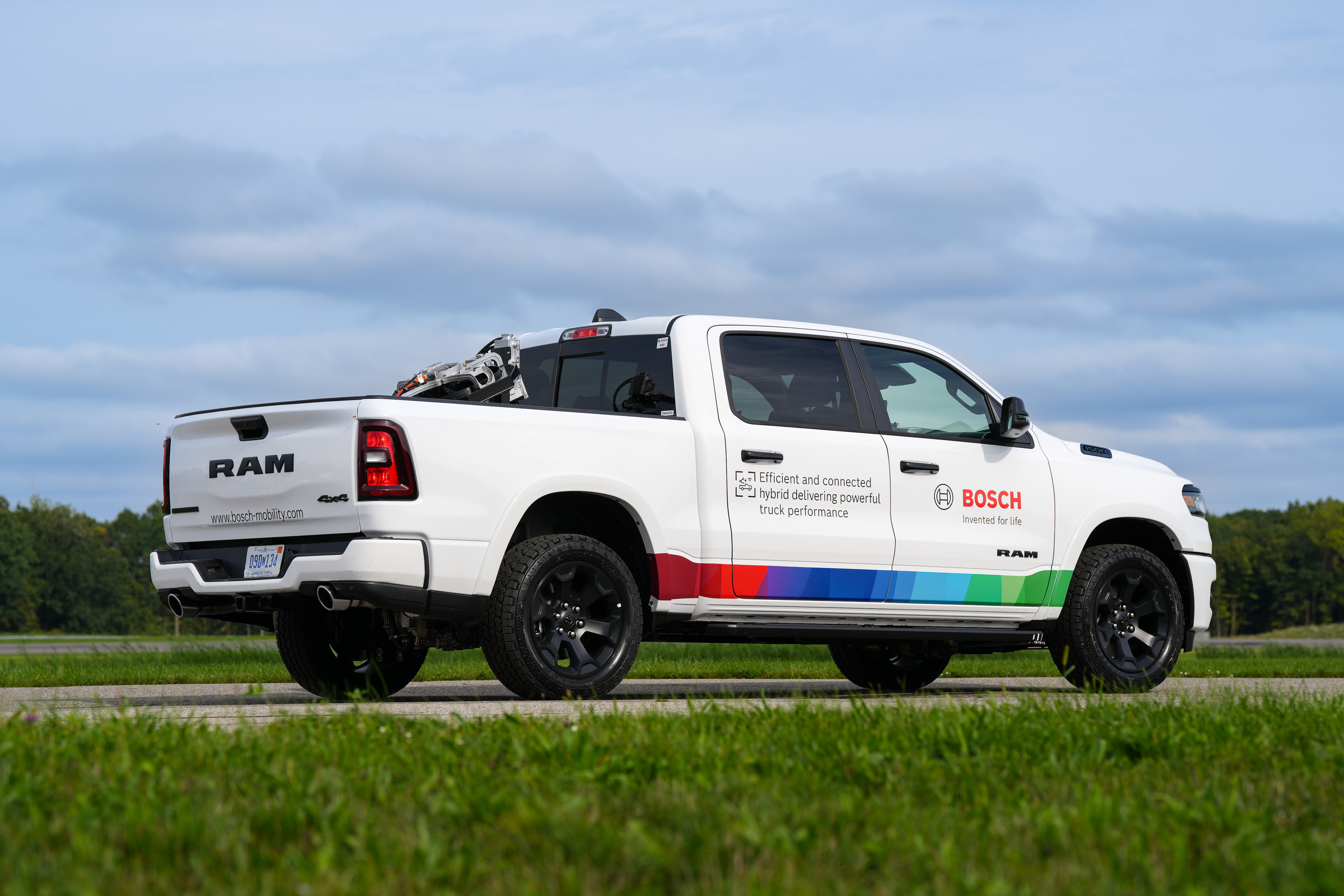
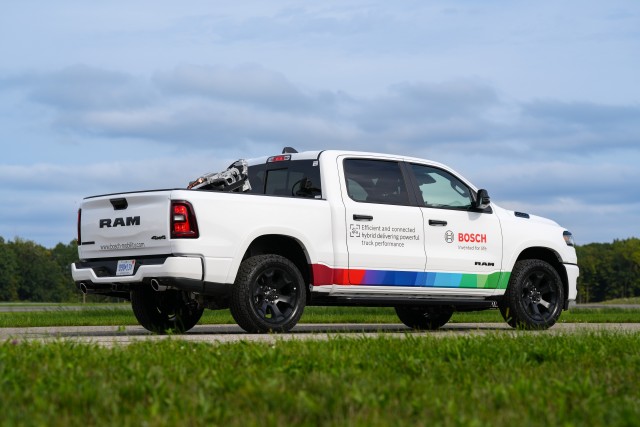


Flat Rock, Mich. September 22, 2026 – Bosch is highlighting the key elements of what it calls the “truck of the future,” a showcase of the software, sensors and powertrain technologies the company believes will define the next generation of pickups and large SUVs, as part of Mobility Experience Days at its proving grounds in Flat Rock, Mich.
The event comes as automakers face a central question: what will truck and SUV buyers demand next? Bosch’s answer is that no single powertrain will win. Instead, the company is betting on what it calls a “multi-lane highway” – Full Hybrid Electric Vehicles (FHEVs) and Range Extended Electric Vehicles (REEVs) and other configurations built to serve different customers and use cases, all without asking buyers to compromise on the capability they expect.
“The truck of the future isn’t defined by what’s under the hood. It’s defined by what the vehicle can do for the people who depend on it, and by the software and sensors that make that possible,” said Paul Thomas, president and CEO, Bosch in North America and president, Bosch Mobility, Americas.
Bosch research shows truck buyers expect a baseline of roughly 8,000 pounds of towing capacity, even when they rarely use it, and that two-thirds want vehicle-to-load power to run job-site tools or back up a home during an outage. Meeting those expectations while also improving efficiency, Bosch says, requires flexible vehicle architectures and common components that can scale across multiple platforms and powertrain types.
At its Mobility Experience Days event, the company highlighted how hybrid technology for the truck of the future does not mean sacrificing performance.
- The hybrid work-truck demonstrator showcases the pathway to meet emissions targets below Tier 4 Bin 20 standards while delivering performance – including towing – of a conventional internal-combustion only truck.
- For the next generation of eAxle systems from Bosch, silicon carbide MOSFETs (metal-oxide-semiconductor field-effect transistor) with advanced vertical trench technology combines with direct cooling of the motor’s stator windings and rotor magnets to create higher power density and significant cost reduction. By packaging the e-motor, compact inverter, and gearbox into a single, ultra-compact design, Bosch has created the ultimate modular solution for the multi-energy platform. Supporting the next generation of eAxle secondary drive for hybrid and battery electric vehicle applications, this unit operates as a dedicated boost system to provide on-demand power and instant all-wheel-drive (AWD) capability.
Software delivers vehicle dynamics control in new use cases
The truck of the future goes beyond propulsion. Software provides the opportunity for highly personalized experiences, particularly when it comes to vehicle dynamics. The baseline is Bosch Vehicle Motion Management software, which can be applied in multiple use cases.
- Bosch Vehicle Motion Management software combined with FOX semi-active suspension technology coordinates chassis actuators in real time to show how software-defined mobility is going off-road. The result is a vehicle that can balance off-road capability, comfort and stability by continuously adapting suspension behavior to terrain and driver inputs.
- With Vehicle Motion Management off-road propulsion and braking can be coordinated into a single pedal to help precisely modulate vehicle speed during trail driving, obstacle negotiation and rock crawling while maintaining control of vehicle dynamics.
- The combination of Vehicle Motion Management software with steer-by-wire provides a coordinated vehicle dynamics ecosystem where steering, braking, propulsion and suspension work together in real time. The result new levels of driving precision, personalization and automation while laying the groundwork for the next generation of software-defined vehicles.
Sensors and AI deliver personalized experiences and awareness
The truck of the future will also increasingly use sensors and AI to provide hyper-personalized experiences and situational awareness by the vehicle.
- Bosch will showcase its new AI cockpit inside a vehicle for the first time, as contextual awareness and scalable automotive computing work together to enable the next generation of user-centric vehicle functions and highly personalized in-cabin experiences.
- The Bosch AI extension platform allows vehicles to add AI features without changes to existing hardware or system architecture. This enables automakers to easily integrate their own AI models and agents in highly successful truck programs without major system overhauls.
- The truck of the future should sense and respond to its environment. Bosch will showcase its new Wet Road Detection feature for the first time in North America, which utilizes ultrasonic generation 7 to detect wetness levels in real time to help vehicle recognize changing driving conditions and adapt accordingly.
“At Bosch, our job is to give automakers the flexible architecture and the software foundation to meet the expectations of truck drivers here in the market,” Thomas said. “The result is that buyers get the capability, range and affordability they’re asking for, without automakers having to reinvent the vehicle for every option.”