Search and find:
Photos, videos, releases, events to support your reporting about the Bosch Group

IAA Mobility 2025: Bosch is shaping the new vehicle world with intelligent hardw ...

08.09.2025

Press release

Automated mobility

IAA Mobility 2025: Bosch is shaping the new vehicle world with intelligent hardw ...

Farmington Hills, Mich. – In the automotive industry, the Bosch name is synonymous with software. The technology company is demonstrating this to impressive effect at this year’s IAA Mobility in Munich. And there’s more: from a single source, Bosch also supplies hardware that’s tailored to the possibilities of the software – a compelling unique selling point for the company worldwide. “Bosch knows its way around software and hardware. Without sophisticated hardware, even the smartest car won’t move a single millimeter,” said Dr. Stefan Hartung, chairman of the Bosch board of management, at the trade fair. “Our aim is to continue playing a key role in shaping the industry in the age of software-driven mobility by offering tailored, intelligent solutions.” Bosch knows its way around software and hardware. Without sophisticated hardware, even the smartest car won’t move a single millimeter. Our aim is to continue playing a key role in shaping the industry in the age of software-driven mobility by offering tailored, intelligent solutions....Dr. Stefan Hartung, chairman of the Bosch board of management Initial indications point to success: Bosch has established a foothold in the software-driven world. One example is Bosch’s by-wire systems for braking and steering, which are considered a key technology for software-defined vehicles and automated driving. Here, the software takes control; a mechanical connection is no longer necessary. This is an important business for Bosch. With brake-by-wire and steer-by-wire, the company expects to achieve cumulative sales revenue of more than 7 billion euros by 2032. The market dynamics of this key technology will continue to accelerate in the 2030s. By-wire technology is a taste of what lies ahead for vehicle construction overall. “In the future, hardware will be designed to fit software requirements,” said Dr. Markus Heyn, member of the Bosch board of management and chairman of the Mobility business sector. In the future, hardware will be designed to fit software requirements...Dr. Markus Heyn, member of the Bosch board of management and chairman of the Mobility business sector Bosch wants to turn cars into personal assistants In software-driven mobility, Bosch Mobility’s business continues to develop – from hardware with embedded software, to services, to completely independent software that manufacturers and partners then integrate into their ecosystems. “Whether stand-alone or interconnected, standardized, integrated, or decoupled – we can offer everything exactly as the customer wants it,” Hartung said. This is clearly having an impact: despite stagnating global vehicle production, weak demand, and delays in electromobility and automated driving, Bosch Mobility will grow slightly in the current year. The increase in sales revenue is expected to amount to a little less than 2 percent. Up to today, a vehicle was never as new as the moment it was delivered. “In the future, however, its software will be continuously updated and it will be constantly learning by means of artificial intelligence,” Heyn said. “More than anything else, the new mobility is user centered.” This is what that looks like: Bosch’s Vehicle Motion Management software coordinates all vehicle movements by centrally controlling the brakes, steering, powertrain, and chassis. This improves coordination between the individual systems – and also means they can be adjusted to the driver’s preferences. A particularly smooth ride today? A little more agility tomorrow? And jolt-free stopping the day after? No problem – at the touch of a button, the car feels completely different. Incidentally, Bosch’s Vehicle Motion Management is decoupled from the hardware, which makes it easy to use in different vehicle architectures. That’s not just theory, it’s happening: the Bosch software is in widespread use, with more than two dozen manufacturers in Europe, China, and Japan already having adopted it. Over the next three years, Bosch will be investing a nine-figure sum in Vehicle Motion Management and expanding its modular software and function portfolio across all domains. Vehicle Motion Management from Bosch works even better in combination with by-wire solutions, because the software can control the respective braking and steering actuators independently of the driver’s actions – for greater safety, improved convenience, or better vehicle dynamics. Bosch’s smart software makes the difference Bosch’s ADAS product family is also software-driven. For intelligent driver assistance systems, vehicle manufacturers can choose from three preconfigured variants that can then be put into production quickly and in a brand-specific way. Here, too, hardware and software can be integrated or purchased separately, depending on customer requirements. Both options benefit from a holistic approach: since Bosch understands the interaction between hardware and software, it can offer individually optimized solutions that can be seamlessly integrated into existing environments. Modern vehicles, which are designed and developed from a software standpoint, make use of ever fewer, but more powerful vehicle computers. These are a growth driver for Bosch: its high-performance computer business is currently growing by more than 5 percent every year, with automakers such as the BMW Group among the customers. Bosch also offers central vehicle computers that combine various functions, such as in driver assistance and infotainment, on just one control unit and one system on a chip (SoC). This saves space, costs, and energy. These systems have a modular structure and can flexibly integrate software from different manufacturers. In China, Bosch is supplying a high-performance computer to SAIC-GM to create a cockpit featuring artificial intelligence. Thanks to this AI cockpit, drivers can talk to their car in a completely natural way and interact with it as if it were a human being. Bosch’s knowledge and expertise make it a sought-after partner The software-driven future is fundamentally changing the automotive industry. Bosch wants to seize the opportunities this new world presents – and is in a good position to do so. Hardly any other company combines hardware and software expertise and global presence as seamlessly as Bosch. This makes the company a flexible and reliable partner for the development of intelligent and connected vehicles. After all, strategic partnerships are crucial, particularly where new business models and scalable software systems are concerned. In China, Bosch is already working with WeRide and Horizon Robotics on the development of systems for assisted and automated driving. In Europe, Bosch and the VW subsidiary Cariad are strategic partners in this area. Bosch assumes that such alliances will become increasingly important in the future, and that the proportion of software in vehicles will continue to rise – and with it, the benefits for drivers in the form of even safer and more convenient mobility.

Comprehensive Bosch portfolio for software-driven mobility is a crowd-puller

03.09.2025

Press release

Business/economy

Comprehensive Bosch portfolio for software-driven mobility is a crowd-puller

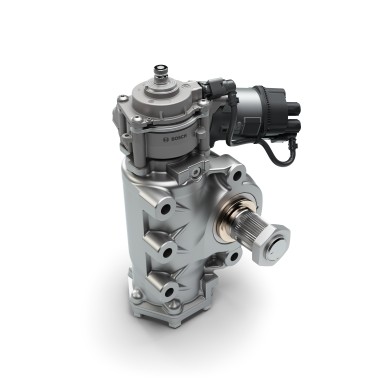
Farmington Hills, Mich. – The automotive industry is changing. Software and artificial intelligence are making cars even more digital, while codes and algorithms are turning driving into a customized experience. To develop its full potential, software needs the right hardware. After all, even the most modern car won’t move an inch without physical components. Bosch operates in all relevant areas of software-driven mobility, and is a partner for automakers across the globe – regardless of how much progress they have made in the transformation to the software-defined vehicle. With its profound automotive expertise, Bosch interconnects the various vehicle domains. From brakes, steering systems, and electric powertrains to sensors, vehicle computers, and software, the supplier of technology and services develops and manufactures the key components of modern vehicles under one roof. At booth D01 in hall B3, Bosch is showcasing its latest solutions for connected and intelligent transportation systems at IAA Mobility 2025 in Munich. Bosch driving assistance for more safety and convenience Automated driving is an essential feature of software-defined vehicles. Bosch is actively pressing ahead with its development, and systematically taking driver assistance systems to new levels – for greater safety and convenience. The company uses an End-to-End AI architecture: The use of AI along the entire technology chain accelerates development cycles and increases the performance of the software stack. For assisted driving and parking up to SAE Level 2, Bosch offers its ADAS (advanced driver assistance system) product family in three variants: entry-level, mid-range, and premium. These variants differ in scope of software function, the number and combination of sensors, and required computing power. Automakers can purchase the hardware and software as integrated or stand-alone packages. The number of automakers who have opted for various constellations of the Bosch ADAS product family now runs into double figures. Both the mid-range and luxury variants are already in series production in China. Also available to end customers on the market are connected map services that extend the vehicle's field of vision like an additional sensor. The crowd-based solution provides information on difficult weather and road conditions, accidents, or wrong-way drivers, for example. Sensors for precise surround sensing: More and more vehicles, including less expensive ones, are being equipped with comprehensive driver assistance systems. This explains why high-performance and cost-effective camera solutions are becoming increasingly important. The Bosch multi purpose camera is available as a camera-only solution, or alternatively as a new two-part system variant comprising camera head and control unit. In the camera-only solution, the entire ADAS function is installed in the camera itself, and computation is done there. This is particularly suitable for vehicles with decentralized architectures. The two-part system variant, on the other hand, is a step on the way to centralized architectures. It is particularly attractive for automakers who want to take advantage of advanced driver assistance functions in their existing architectures. In software-defined vehicles with centralized architectures, the camera’s safety-relevant computation is done in powerful computers. For its new radar sensor , Bosch has developed and manufactured all the key elements itself, including the system on a chip (SoC). Thanks to advanced semiconductor technology, the SX600 and SX601 radar sensors’ range is roughly 30 percent greater than that of comparable models. This technology also allows driving functions to be fully and cost-effectively integrated into the radar sensor. Both sensor types support AI-assisted signal processing. The SX601 offers significantly greater computing power than usual on the market, as well as even better detection properties. For improved system performance and maximum precision, two SX601s can be connected in series to use eight transmitting and eight receiving antennas. In software-driven mobility, centralized semiconductor architectures are taking on increasing importance. They govern many sensor-based functions, including ESP ® , navigation, and driver assistance systems. To reduce complexity, Bosch has developed the latest generation of especially powerful MEMS inertial sensors . They can provide several systems at once with the data they need. This “one-sensor-fits-all” approach features in Bosch sensors such as the SMU300 and SMI980 , which are already in use in inertial measurement units and in airbag control units. At the IAA, Bosch will also be presenting its new TB293 and TB193 chips for ultrasonic sensors , which offer the highest data transmission rate in the ultrasonic market. For even greater sensor performance, Bosch is also turning to raw data, with the signal being recorded directly at the ultrasonic sensor (at the transducer), which means that the full range of data is retained. This is a great advantage, especially for AI-based functions. As a result, the sensors allow much better object detection. Now, for the first time, these chips are freely available in the market, independent of any sensors. With this step, Bosch is also making its new VASI bus interface (versatile automotive sensor interface) available, thus setting a new standard in the market. This means that automakers have a wider choice of sensor supplier, benefit from state-of-the-art ultrasonic technology, and can avoid lock-in effects. New standards for Bluetooth-based tire pressure sensors: In the Bosch SMP290 , safety and energy efficiency go hand in hand. With its compact design, low power consumption, long life, and one-of-a-kind integration of acceleration and pressure sensor as well as ASIC including Bluetooth on one chip, it truly stands out. Not only that: it helps simplify vehicle architecture. Thanks to the standardized Bluetooth interface, the SMP290 also enables new applications such as direct interaction with a smartphone. Bosch solution for damage detection: With its small damage detection , Bosch demonstrates how to cleverly combine software and hardware. This solution uses existing vehicle components such as the airbag ECU and sensors, obviating the need for any additional hardware. And in software-defined vehicles, small damage detection can even be updated over the air, after the vehicle has been purchased. It accurately detects even minor damage to the vehicle – both while driving and when parked. Small damage detection registers shocks that are below the threshold for airbag deployment, storing the relevant data. The system thus enables fast, automated, and objective damage detection. Act-by-wire technology: the future of vehicle control Act-by-wire systems transmit the driver’s steering and braking commands purely electronically. They are highly relevant for software-driven mobility, especially for the personalization of vehicle dynamics and handling, and for higher-level modes of automated driving. New brakes and steering for greater flexibility: Braking and steering via electrical cables (act-by-wire) opens up the possibility of new concepts for the steering wheel and brake pedal, crash-optimized design, and the more flexible positioning of components and the design of the interior. Bosch is one of the pioneers in the development of this technology, and soon one of the first to market it. Its brake-by-wire solution , comprising a by-wire actuator and ESP®, will feature in a production vehicle of a major Asian automaker. What is special about the hydraulic Bosch by-wire braking system is that it requires absolutely no mechanical connection between the brake pedal and the braking system. Software systems solution for vehicle dynamics: Bosch Vehicle Motion Management assumes the task of intelligently controlling actuators. This systems solution perfectly synchronizes the brakes, steering, chassis, and powertrain. Vehicle Motion Management is suitable for all vehicles and marques in the passenger-car segment. It takes the driving experience to a new level. Thanks to a special software function, the vehicle can be transformed into a super-maneuverable urban vehicle, a powerful speedster, or a limousine with chauffeur-driven comfort – depending on the individual driver’s mood. It can be activated either at the push of a button or by AI, which works in the background to customize the vehicle. Software function against travel sickness: Vehicle Motion Management’s “Comfort Stop” function increases comfort and counters travel sickness. The interaction of the brakes and the electric motor can reduce the jerk resulting from braking by 70 to 90 percent and gently bring the vehicle to a standstill. The shift from decentralized to centralized vehicle architectures Software-defined functions require a completely different setup for the electronic components and systems. Intelligence in the vehicle will be centralized in a few high-performance computers, instead of being distributed among currently sometimes more than 100 individual control units. This reduces the need for wiring, and makes both centralized processing and over-the-air updates possible. Bosch can supply the basic framework for any vehicle. Powerful computers for the software-defined vehicle: The Bosch portfolio not only includes centralized, powerful computers and state-of-the-art software , but also scalable and adaptable vehicle infrastructure. Bosch’s centralized high-performance computers and all its other components feature state-of-the-art communication interfaces. Depending on requirements, the resulting communication infrastructure can either be fast and broadband or lean and especially cost-efficient. Here, a key role is played by zone-level control units, which aggregate and translate the various communication channels and media. Robust on-board networks with zone-based architecture and 48-volt technology create the basis for a stable power supply that satisfies the growing requirements of modern vehicles. On the level of power-supply infrastructure, the key components supplied by Bosch include its 48-volt Powernet Master, which ensures that the vehicle’s safety-relevant functions are supplied with power at all times. The portfolio also includes combined communication and power-supply solutions, and well as zone-level control units. The range is rounded out by intelligent solutions for power distribution. These not only open up new diagnostic and maintenance options, but also meet the most stringent functional safety requirements. Faster data transmission in modern vehicles: It takes automotive ECUs just milliseconds to exchange data. The invisible backbone of this communication is the controller area network, or CAN. In vehicle architectures, such networks ensure a high level of stability, simplicity, flexibility, and cost efficiency. And with the new Bosch CAN SIC XL transceiver , they work especially fast – up to 20 Mbit/s in the case of CAN XL networks. In addition to the customary CAN commands, the new CAN XL standard can transmit internet protocol (IP), and thus complies with the requirements of modern E/E architectures. ETAS software: The Bosch subsidiary ETAS offers a Vehicle Software Platform Suite , which provides a stable and secure basis for the efficient development and management of scalable vehicle architecture. It supports all modern vehicle architectures – from classic control units to powerful computers and platforms for assisted and automated driving. Customers can use it to efficiently create state-of-the-art vehicle platforms and market them more quickly. As a founding member of Eclipse S-Core, ETAS uses a code-first approach as an integral part of the platforms it offers, and in this way plays a major part in shaping the open-source initiative. Using the ETAS Comprehensive Measurement Solution , vehicle functions can be validated quickly and cost-effectively, and system behavior optimized efficiently. The platform software records data in real time, and perfectly synchronizes internal data from microprocessor-based control units. This scalable and flexible solution can be adapted to various E/E architectures and to vehicle domains such as assisted and automated driving (ADAS/AD), infotainment, and motion. Bosch powertrain solutions: powerful and efficient In the powertrain domain, too, Bosch is responding to the growing requirements of software-driven mobility, and is developing sophisticated solutions. Following a technology-neutral approach, Bosch offers concepts for powertrains ranging from combustion engines to electric motors. Silicon-carbide semiconductors for electromobility: Automakers, automotive suppliers, and distributors can draw on a wide range of Bosch silicon-carbide (SiC) power semiconductors for diverse automotive applications. Silicon carbide is seen as a key technology for electromobility. Bosch offers its dual-channel trench MOSFETs as 750 and 1200 volt versions – unpackaged for inverter modules or packaged for on-board chargers, DC/DC converters, and inverters. By 2030, Bosch predicts that one in three newly registered cars and light trucks will be battery-electric. In electromobility, the Chinese market is setting the pace. Bosch is playing an active part in its development. Here, scalable and standardized platforms are crucial in making innovations universally available and affordable. They are also the basis of the broad Bosch portfolio for electric and hybrid vehicles of all types (Mild Hybrid, Strong Hybrid, Plug-in Hybrid, Range-extended electric vehicle). A global platform for a wealth of variants: Oil-cooled Bosch e-axles can be used as primary or secondary powertrains. They are globally available and locally adaptable. The 3-in-1 e-axle combines an electric motor, power electronics, and transmission. Bosch is adding further energy management components to its e-axle, such as an on-board charger, a DC/DC converter, and a power distribution unit. This combination of several functions in one unit offers a number of benefits, including a more compact design, lighter weight, and optimized costs, while increasing efficiency at the same time. From electric vehicle to mobile energy storage unit: Although they take up 30 percent less space, the latest generation of bidirectional charger converters , which combine an on-board charger with a DC/DC converter, are even more efficient. This systems solution is much easier to integrate, whether close to the powertrain in the e-axle or close to the battery. With bidirectional flows of energy, an electric vehicle can also function as a mobile energy storage unit. Inverters with greater power density: A new generation of inverters featuring power modules and semiconductors as well as innovative inverter topologies is paving the way for significant progress in power density and efficiency. And in electric motors as well, Bosch is moving ahead. Automakers can benefit from a globally standardized technology platform comprising various electric motors and active components such as rotors and stators. Shorter winding heads, innovative cooling designs including a direct copper conductor and magnet solution, and innovative materials are having a positive effect on electric motors’ size, efficiency, and use of materials. Increased range, reduced charging time: Standardized hardware means that intelligent software is gaining in significance. It can be used to extend range and curtail recharging time. Synchronous control (voltage modulation) allows efficiency to be increased by 1.5 percent, and an electric vehicle’s peak power and continuous output by 10 percent. Solely by using software, switching behavior can be synchronized with the rotation of the electric motor, without modifying the hardware. This extends the vehicle's range and simultaneously enhances the driving experience. Through the software feature eAxle Heating , the electric vehicle's battery is optimally preconditioned prior to charging. This facilitates higher charging capacities and consequently reduces vehicle downtimes. Digital proof of renewable fuels: In addition to electric vehicles, hybrid vehicles can also reduce carbon emissions from road traffic. This is why Bosch is continuing to develop injection and exhaust-gas treatment technology for combustion engines. Apart from strong and plug-in hybrids, electric vehicles with range extenders are becoming increasingly common, especially in China. Using renewable fuels in hybrid vehicles makes them much more climate-friendly. Proof that such fuels are in the tank can be provided by a Bosch cloud solution, the Digital Fuel Twin . This also shows how much less CO2 has been emitted. Optimum battery temperature: Thermal management systems can further increase the efficiency of hybrid and electric vehicles. By deliberately controlling flows of cold and heat, they ensure that the high-voltage battery remains within the optimum temperature window at all times, that the electric motor does not overheat under heavier loads, and that as little electricity as possible is used for cooling and heating. For this, Bosch is developing pre-integrated modules that combine essential elements such as electric cooling compressors and coolant pumps. This considerably reduces complexity and installation effort. In new systems, the coolant used is propane (R290), which is already used in heat pumps and tumble dryers. Intelligent coordination of energy management: The modular software solutions used in Bosch Vehicle Energy Management distribute energy in the vehicle in an especially intelligent way. An integrated approach coordinates and optimizes energy management and its component subsystems such as thermal management, powertrain, on-board network, and charging system. This connected system also takes account of current and forecast vehicle parameters, as well as of road conditions and driver behavior. In this way, electric vehicles’ efficiency, convenience, and service life can be further improved. Bosch Vehicle Energy Management is also offered as a hardware-agnostic solution. Safety in critical operating states: Together with its electronic disconnect unit , the Bosch battery management system monitors and controls the high-voltage battery’s cells – in both electric cars and plug-in hybrids. In critical operating states, it provides the necessary safety mechanisms. It also optimizes power output and battery life. It comprises a control unit as well as elements that are attached to the individual battery modules and that monitor each individual cell. Software functions, such as the battery passport that will be required in the EU from 2027, can also be integrated. In the event of an accident, the electronic disconnect unit disconnects the battery from the vehicle electronics. The battery management system, the cell monitoring units, and the charger-converter can be brought together in this disconnect unit, thereby reducing complexity. New battery for the on-board network: To meet ever greater demands for power, more and more electric vehicles will feature a 48-volt on-board network in the future. To satisfy this need, Bosch is developing a 48-volt lithium-ion battery – in addition to the 48-volt battery for mild hybrids it has already manufactured millions of times. The new variant will consistently provide the power needed for safety-critical features and for highly automated driving, but also when the vehicle is stationary for a protracted period. The battery can be flexibly integrated into the vehicle. Unlike conventional 12-volt batteries, it is lead-free. Bosch ESI[tronic] adds Tesla to its diagnostic program: The range of vehicles covered by Bosch’s tried and tested ESI[tronic] diagnostic software now also includes Tesla models. For the first time, therefore, independent workshops will now be able to use their everyday multibrand solution to perform extensive diagnostic work on Tesla models . Accessing diagnostic data was a special challenge when integrating Tesla. In contrast to many other automakers whose data Bosch receives in advance and translates into [ESI]tronic languages, the original Tesla diagnosis interacts in English only. And while other documentation is available in several languages, it is not available in all 23 of the languages supported by [ESI]tronic. To deal with this language barrier, Bosch has now come up with a technical solution that works with artificial intelligence, and has integrated this automatic translation functionality directly into the diagnostic process. As soon as a mechatronics engineer hooks up to a Tesla, the English diagnostic information is translated in real time into the user’s selected [ESI]tronic system language. This innovative approach ensures that independent workshops can work on Tesla vehicles efficiently and precisely, without language difficulties. This addition is an important step toward providing independent workshops with a future-proof, comprehensive diagnostic solution for the growing electric-vehicle segment. Bosch press conference: Monday, September 8, 2025, 11:00–11:20 CEST: with Dr. Stefan Hartung, chairman of the board of management of Robert Bosch GmbH, and Dr. Markus Heyn, member of the Bosch board of management and chairman of Bosch Mobility, at the Bosch booth D01 in Hall B3 and via Livestream on the Bosch Media Service . Bosch eBike Systems at IAA Mobility | Open Space: The IAA Open Space in downtown Munich will be open from 11:00 to 21:00 CEST from September 9 to 13, 2025. On Sunday, September 14, 2025, the IAA Open Space will be open for guests from 10:00 until 17:00 CEST. During the IAA, visitors can take the Cargo Line and other innovations, as well as many digital features offered by Bosch eBike Systems, for a test ride on the cycling test track in Munich’s Englischer Garten park. In addition, Bosch eBike product experts will be on hand to answer questions in the Open Space at Odeonsplatz.

Driverless navigation to charge spots – thanks to Bosch and VW subsidiary Cariad

08.01.2024

Press release

Automated mobility

Driverless navigation to charge spots – thanks to Bosch and VW subsidiary Cariad

Stuttgart, Germany – Finding a parking space can be tiresome and time-consuming, especially in labyrinthine parking garages – and finding the vehicle again later is no different. The search for a free charge spot is a similar story. Together with the Volkswagen subsidiary Cariad, Bosch is now testing automated valet charging. This solution, which is based on Bosch’s automated valet parking system, guides electric vehicles driverlessly to an unoccupied parking space furnished with a charge spot, where a charging robot recharges them automatically. Once recharging is complete, the vehicle maneuvers driverlessly to another parking space. Bosch and Cariad are now testing the necessary technology in two in-house parking garages in Germany: in Cariad’s staff parking garage in Ingolstadt, the two companies are testing driverless parking with automated valet parking, while driverless charging with automated valet charging is being tested in Bosch’s development parking garage in Ludwigsburg. And at CES 2024 in Las Vegas, Bosch is also currently showcasing the technology needed for automated charging. Electromobility: automation to allay misgivings about range Easy, straightforward charging is at the top of the wish list for electric car drivers. But their everyday experience tells a different story: long queues at charge spots, blocking fees for disconnecting the power cable too late, and manhandling the cable. By addressing these challenges, automated valet charging greatly increases customer convenience when charging electric vehicles. What’s more, the technology offers a range of advantages for automakers, charge spot operators, parking garage operators, and energy suppliers. And for the environment, electric vehicles mean a reduction in carbon emissions from road traffic. “Automation plays a key role in the mobility revolution and the transition to electromobility. Our two services – automated valet parking and automated valet charging – make the mobility experience much smoother for users,” says Manuel Maier, vice president of the cross-domain Level 4 parking product area at Bosch. “Making it straightforward to recharge electric vehicles allays people’s misgivings about range, and is essential if electromobility is to find widespread acceptance. With this in mind, Bosch and Cariad can make parking and charging even more efficient and convenient.” Rolf Dubitzky, head of parking at Cariad, also sees great potential in this collaboration: “We’re particularly pleased to be shaping the future of automated parking and charging together with Bosch. Our collaboration allows us to test the technologies at an early stage of vehicle development, so that the end product is reliable and offers customers the best possible user experience.” Charging service: the automated route to even more convenience The infrastructure guides the vehicle to the parking space, where a robot opens the charging flap and automatically inserts the charging cable, removing it again once the vehicle battery is fully charged. The car then drives back to a regular parking space, freeing up the charge spot for the next electric vehicle with a low battery. All this makes it possible for several vehicles to be recharged and parked without human interaction. This increases the efficiency of the charging infrastructure, optimizes the use of charge spots, and saves customers the bother of long waits at the charge spot. Automated valet parking is the world’s first driverless SAE Level 4 parking service, and has been in operation in the P6 parking garage at Stuttgart airport for about a year now. Bosch has also started to equip other parking garages throughout Germany with the infrastructure technology.Bosch at CES 2024: • PRESS CONFERENCE: Monday, January 8, 2024 , from 9:00 to 9:45 a.m. (PST) with Dr. Tanja Rückert, member of the board of management of Robert Bosch GmbH, and Mike Mansuetti, president of Bosch in North America, in Ballroom Banyan ABCD, Mandalay Bay Hotel, Las Vegas, South Convention Center, Level 3 , as well as livestreamed on the Bosch Media Service . • BOOTH: January 9 – 12, 2024 , in the Central Hall, booth #17207. • FOLLOW the Bosch CES 2024 highlights on X: #BoschCES. • PANELS WITH BOSCH EXPERTS, Thursday, January 11, 2024: “Elevate Your Space: Enhancing your Home with Smart Appliances” , 15:00 p.m. (local time), Venetian Hotel, Lando 4302, session with Goncalo Costa, Vice President of Climate and Wellbeing North America. “Our Newest Cyber Threat is AI and AI is Our Biggest Defense” , 14:00 p.m. (local time), Las Vegas Convention Center West / N258, session with Dr. Zico Kolter, Chief Scientist of AI at Bosch. “Future of Care: How Other Industries Shape Health”, 11:00 a.m. (local time) , Las Vegas Convention Center / North Wing, session with Dr. Stefan Finkbeiner, General Manager at Bosch Sensortec.

CES world premiere: Bosch unites infotainment and driver assistance functions on ...

06.12.2023

Press release

Automated mobility

CES world premiere: Bosch unites infotainment and driver assistance functions on ...

Stuttgart – The trend toward software-defined mobility goes hand in hand with a centralized vehicle and electric/electronic (E/E) architecture. While numerous electronic control units usually control different functions in the car today, in the future just a few central vehicle computers will unite multiple system functions from previously separate domains. To do this, new computers with a powerful processor, known as a system on chip (SoC), are necessary. As an innovation and technology leader, Bosch is leading the charge and, at CES® 2024 in Las Vegas, will be the world’s first automotive supplier to demonstrate the fusion of infotainment and driver assistance functions in a software-intensive central computer on a single SoC. “We want to reduce the complexity of the electronics systems in cars and make them as secure as possible at the same time. With this demonstration of our new vehicle computer platform at CES, we are taking an important step in exactly this direction. Our goal in the medium term is to bring even more automated driving functions to the road, including to the compact and midsized car segments,” says Dr. Markus Heyn, member of the board of management at Robert Bosch GmbH and chairman of Bosch Mobility. At the core of the new vehicle computer from Bosch – called the cockpit & ADAS integration platform – is a single SoC, which processes a variety of functions from the two domains of infotainment and driver assistance simultaneously. This includes, for example, automated parking and lane detection, paired with smart, personalized navigation and voice assistance. Advantages for vehicle manufacturers: less space and cabling required, meaning lower costs. “Central vehicle computers are the heart of software-defined cars. In the future, they will control all the domains in modern vehicles and reduce the currently high number of individual control units,” says Heyn. Overall, Bosch is already doing good business with vehicle computers: in 2026, the company expects sales revenue of three billion euros just for vehicle computers for infotainment and driver assistance. Modular system principle for maximum scalability For its central vehicle computers, Bosch uses a modular system principle. Together with stand-alone software solutions such as video perception for surround sensing, vehicle manufacturers can modularly and scalably assemble their individual solutions in combination with hardware components. Software-intensive central computers play a decisive role here, since they enable manufacturers to implement driving and assistance features. Software integration is in strong demand here. Bosch brings integrative expertise and enables software components from various sources to be combined. Bosch knowledge in all vehicle domains as a competitive advantage Nearly every vehicle maker in the world is currently investing massively in software-defined vehicles. Bosch predicts that the market for automotive software will reach a volume of around 200 billion euros by 2030. In the field of vehicle computers for infotainment and driver assistance systems, the company expects a market volume of 32 billion euros in 2030. Bosch’s advantage is its extensive knowledge in all vehicle domains. This means that the company is an expert not just for software but also for hardware, and develops and manufactures key components of modern vehicles, such as for drives, brakes, steering, infotainment, and automated driving, under one roof. Bosch’s approach allows maximum flexibility Bosch pursues what is known as a multi-SoC approach. The company’s new vehicle computers are designed so that the required SoCs can come from different manufacturers. Therefore, depending on the customer’s wishes, Bosch can use exactly the SoC that is requested. “Our software runs on chips from different chip manufacturers. This allows software and hardware to be decoupled from each other,” says Heyn. Bosch is one of the few companies that can develop a centralized electronic architecture from start to finish and has mastered the interplay of automotive electronics, software, and the cloud. New features, such as for driver assistance, are simply and easily sent to the car through over-the-air updates. This provides drivers with a personalized digital driving experience – even long after purchasing the car.

Bosch Showcases Autonomous and Safety Technology for U.S. ADAS Market

22.09.2023

Press release

Business/economy

Bosch Showcases Autonomous and Safety Technology for U.S. ADAS Market

Plymouth, Mich. – The Advanced Driver Assistance System (ADAS) market is experiencing exponential growth across North America, as numerous automakers now offer SAE Level 2 to 3 ADAS features as optional upgrades across vehicle lineups. Bosch, a pioneering leader in mobility technology, unveiled its latest innovations during the Experience Days, hosted at the Bosch Technical Center in Plymouth, Mich. In 2023 Bosch expects to once again post double-digit growth globally in the area of driver assistance systems. The company has more than doubled engineering capacity for driver assistance and automated driving over the past five years. And as early as 2026, Bosch expects vehicle computers for driver assistance and infotainment to generate sales of more than $3.1 billion USD.“Advanced driver assistance features are becoming a standard offering across the vehicle portfolio and Bosch has been a pioneer in this space for decades,” said Tim Frasier, regional president of Cross-Domain Computing Solutions for Bosch in North America. A recent S&P study highlighted that consumers understand and want ADAS features that provide safer driving, and they expect them to be standard in new vehicles. “Today, Bosch’s ADAS expertise encompasses a wide spectrum, including alerts, driver task assistance, crash mitigation, and visual and environmental monitoring,” added Frasier. Bosch Experience Days highlights include:New parking solution for unique and complex settings Among the technologies showcased at the event, Bosch introduced its groundbreaking Anywhere Parking technology for the first time in North America. This innovation empowers drivers to use the vehicle’s infotainment system to define parking spaces in diverse scenarios, including unmarked pavement, grassy areas, or tight spaces. The system offers the flexibility for manual definition of parking slots on the touch display or selecting from detected parking slots, both in the same or separate views. Drivers can also adjust the parking orientation and position by shifting and rotating the slot on the screen. This advancement increases the availability of automatic parking in complex settings where existing solutions do not support parking assistance and can help contribute to reduced parking accidents and more efficient space utilization.Software-only solution for video perception Video-based perception of a vehicle's surroundings is a pivotal advancement in the shift from assisted to fully automated driving and parking systems. Recently at IAA Mobility 2023, Bosch premiered its standalone video-perception software and will showcase the technology for the first time publicly in the U.S. at Experience Days. Bosch’s transformative video perception solution uses camera sensors to capture and meticulously process image data from the vehicle's surroundings. The resulting dataset becomes a critical resource, empowering subsequent driver assistance and automated driving functions across a spectrum of driving and parking scenarios. The technology is entirely software-based and can be used independently of Bosch hardware on diverse SoCs (systems on chips). This gives automakers maximum flexibility.New generations of sensors feature artificial intelligence Surround sensing is indispensable for automated driving functions. Bosch’s new radar sensors enable assisted and automated driving functions at SAE Levels 0 to 3. For the sixth generation of these radar sensors, Bosch has incorporated artificial intelligence. This new generation performs better at measuring distance, high speeds, and angular resolution; as a result, objects such as motorcycles can also be reliably detected across the entire field of view. Bosch will also show a new generation of ultrasonic sensors that due toAI-based height classification, offer robust detection capabilities such as estimating the approximate height of an obstacle, including pedestrians and low-reflection objects. Alongside it's existing camera sensors with integrated intelligence, Bosch now also offers new camera heads that allow a flexible system for environment perception. Image analysis no longer takes place in the camera itself, but rather in central vehicle computers such as the company’s ADAS Integration Platform. Available in 3- and 8-megapixel variants, plus the option of a 12-megapixel version for Level 4 applications, the camera heads are at the cutting edge of image sensor technology. The combination of hardware and software expertise is one of Bosch’s strengths. The company will continue to develop new, intelligent sensors with embedded software. Bosch customers will also be able to put together their own individual, modular, and scalable solutions by combining camera heads and the ADAS integration platform, Bosch’s high-performance computer for the ADAS domain.Trailering solutions developed in North American market In North America, Bosch has its center of competence related to trailering solutions to support the large number of vehicles in the market that are utilized for towing. The National Highway Traffic Safety Administration (NHTSA) reports approximately 50,000 hitch accidents annually, causing around 21,000 injuries due to negligent towing or faulty hitches. Bosch's Transparent Trailer View , a camera-based system assists with visibility around the obstructed view of a towed trailer on the vehicle's display. This technology enables drivers to effectively see 'through' the trailer, enhancing rear visualization to assist with reversing and maneuvering. Furthermore, the system can display interior images of the trailer when a camera is installed inside to monitor the content inside the trailer. Bosch's Trailer Hitch Guidance system provides an efficient means of hitching a vehicle to a trailer. This system employs a rear-view camera and electronic power steering (EPS) to automatically guide the vehicle, aligning it precisely with the trailer coupler and lowering it onto the hitch. Initiated through the touchscreen, the driver can monitor the reversing path on the display, eliminating the need for a second person to guide the vehicle, helping to ensure proper hitching, and assisting with enhancing overall safety.

Steer-by-wire ready for large-scale production: Bosch and Arnold NextG enter int ...

20.06.2023

Press release

Business/economy

Steer-by-wire ready for large-scale production: Bosch and Arnold NextG enter int ...

Schwäbisch Gmünd, Germany – Bosch wants to bring steer-by-wire systems to the market on a commercial scale by the middle of the decade. Together with the startup Arnold NextG, the supplier of technology and services is taking the next step. The two partners have recently entered into an alliance to pool their development expertise and accelerate the process of readying the solutions for the market. Steer-by-wire systems are considered the steering systems of the future. As one of the world’s leading suppliers of electric steering systems, Bosch recognized the potential of steer-by-wire systems early on and is systematically driving their development forward. “We’re seeing rapidly rising demand for steer-by-wire systems. This should prove to be an exceptionally large market over the long term – especially, although by no means only, for the age of automated driving. We’re excited to see the momentum this alliance will lend to our work on system optimization,” says Dr. Gerta Marliani, president of Robert Bosch Automotive Steering GmbH. The aim of the partnership is to accelerate the large-scale production of steer-by-wire solutions.Arnold NextG specializes in the development of multi-redundant drive-by-wire systems with all interfaces for autonomous driving in small and very small batch sizes. Founded in 2021, the startup has employees with over 20 years’ combined experience in street legal drive-by-wire technology, giving the company unique expertise in developing retrofit solutions for all by-wire applications. Experience has shown that, thanks to the redundancy of Arnold NextG technology, the authorities can issue system approvals for driving on public roads more quickly and efficiently. Together, Bosch and Arnold NextG aim to accelerate the development of systems that can be manufactured on a commercial scale. Steer-by-wire applications eliminate the physical connection between a vehicle’s steering wheel and its wheels. This opens up new possibilities for, say, redesigning the vehicle interior: the steering wheel can be lowered or stowed away, giving rise to entirely new cockpit concepts, especially in an age of automated driving. The technology also enables new safety features in vehicle dynamics control. For instance, even small automated steering interventions can stabilize the vehicle without the driver at the wheel even noticing. In addition, the vehicle’s driving feel can be tailored to the requirements of individual vehicle manufacturers. The use of a vehicle-independent and add-on-capable drive-by-wire technology in the radically changing series vehicle platforms of the future is of crucial importance, especially for people with the most severe physical mobility impairments. Only in this way will it be possible for this target group to continue to benefit directly from all developments in the field of autonomous and automated driving, assistance and safety systems.Pooling by-wire expertise “The alliance with Arnold NextG provides ideal support and accelerates our product development. We can apply our expertise in large-scale production and, with the Arnold NextG technology installed, we can now carry out tests on public roads more quickly,” says Dr. Stefan Waschul, the member of the Robert Bosch Automotive Steering GmbH management board responsible for development. “We’ve seen that the Bosch steer-by-wire system has the best and most natural steering feel in the market. Bosch is one of the world’s leading suppliers of electric steering systems and already offers a strong package of control technology and performance for large-scale applications downstream. That’s why I’m proud, not only to be able to build on one of the best systems, but also to have Bosch – one of the biggest automotive suppliers in the world – at our side,” says Kevin Arnold, founder and CEO of Arnold NextG, in commenting on the new alliance. “With the Arnold NextG technology, Bosch has a vehicle-agnostic development platform for drive-by-wire retrofit solutions that makes it possible to validate data and requirements for large-scale production projects at an early stage of development. Together, we can further develop this technology for large-scale manufacturing. Access to Bosch technology and the experience of a global corporation in implementing large-scale production projects is crucial for the further development of our systems.”Innovative mobility solutions thanks to by-wire technology By-wire systems use electronics to transmit mechanical signals and pulses. They will also be a basic requirement for assisted and automated driving in order to fully tap the capabilities of individual functions. For example, the lane-keeping support system would be able to correct the direction of travel without the driver feeling it in the steering wheel. The vehicle can also avoid an unexpected obstacle without jerking the steering wheel and injuring the driver. With this technology, it may even be possible in the future to steer the wheels individually. This ensures a smaller turning radius and opens the door for new vehicle concepts for local traffic and goods transport in cities.

Bosch and Mercedes-Benz showcase automated valet parking at InterContinental Los ...

21.03.2022

Press release

Automated mobility

Bosch and Mercedes-Benz showcase automated valet parking at InterContinental Los ...

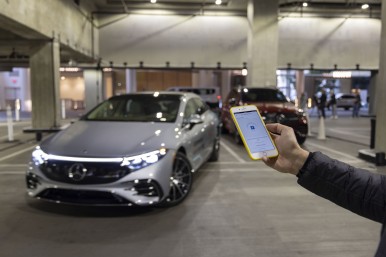
LOS ANGELES – Drive a fully-electric, luxury vehicle up to the hotel at an iconic skyscraper in Los Angeles and simply let the vehicle park itself. This scenario will become a reality in a demonstration of automated valet parking at the InterContinental Los Angeles Downtown featuring the EQS sedan from Mercedes-EQ. It is the first demonstration of infrastructure-based automated valet parking in a hotel setting in the United States. Automated valet parking technology from Bosch and Mercedes-Benz is at the core of the demonstration in Los Angeles. It features INTELLIGENT PARK PILOT in the Mercedes-Benz EQS and integration with the smartphone app as part of a holistic demonstration of the future vehicle experience for consumers. The demonstration is operated in conjunction with InterContinental Los Angeles Downtown, an 889-room property located in the tallest building west of Chicago. “The demonstration at the InterContinental Los Angeles Downtown will showcase how automated valet parking will operate in a working hotel environment where both automated and non-automated vehicles operate alongside pedestrian traffic,” said Dr. Kay Stepper, senior vice president of automated driving and driver assistance for Bosch in North America. “This allows us to dive into the dynamics of local deployments with the use of a highly-connected EQS from Mercedes-EQ to demonstrate how automated technology continues to move forward.” “Our vision is that getting time back is a key component of the luxury experience our customers are looking for. The EQS gives you time back by driving itself in traffic jams on highways, but with INTELLIGENT PARK PILOT, it may also be able park itself,” says Dr. Philipp Skogstad, president & CEO of Mercedes-Benz Research & Development North America. He adds: “INTELLIGENT PARK PILOT is a feature that together with the required infrastructure enables an automated valet service that gives customers even more comfort and relief in everyday life.”Mercedes showcases INTELLIGENT PARK PILOT The demonstration features the EQS, showcasing automated valet parking using its existing hardware that is already preinstalled in vehicles such as the S-Class and EQS in Germany/Europe with the required optional equipment. The vehicle interacts with the Bosch intelligent infrastructure installed in the parking garage in order to enable the vehicle to drive and park itself at the InterContinental Los Angeles Downtown. Sensors installed at the building will communicate with the vehicle and guide its maneuvering through the garage. The demonstration also highlights possibilities for additional services such as automated EV charging and a car wash where vehicles move in and out of service areas guided by the intelligent infrastructure. In conjunction with the necessary optional equipment* and the corresponding Connect service (both depending on country), the EQS has the onboard technology to enter and leave multi-story parking facilities equipped with the Bosch automated valet parking infrastructure in highly automated mode and without a driver, provided that the corresponding Connect service is available and booked for the respective vehicle variant of the EQS and national legislation permits such operation.Demonstration to utilize smartphone app as part of the holistic vehicle experience The vision: The driver securely parks the vehicle in a designated drop-off area of the parking facility, and after all passengers have exited they start the parking procedure using the smartphone app. The sensor system in the car park checks whether a suitable space is available or was already reserved for the vehicle. If so, the automated valet parking infrastructure confirms the handover of the vehicle for the driver in the App, and he/she can leave the EQS and depart. The vehicle is then started automatically and moves driverless to its parking space with the help of the infrastructure installed in the parking facility. On returning, the driver can let the EQS drive to a designated pick-up area by smartphone command. This means less time searching for parking spots and walking from the parking garage to their destination.A step on the path to fully automated driving Automated parking technology showcases the benefits of automation to drivers by providing value to drivers by easing the burden of the parking experience. “Low-speed maneuvers are part of the holistic opportunity for automated technology,” Stepper said. “Automated technology in the specific use case automated valet parking gets consumers comfortable with how automated technology works and how it can benefit them.” Bosch engineering teams have been working over the past few years to further develop automated valet parking and support specific testing and deployments around the world.Drivers and garage operators both benefit Automated valet parking presents benefits on both sides of the parking experience. For consumers, they will no longer have to search for a parking space and can save time once they arrive to their destination. For parking garage operators, they can increase parking capacity as vehicles no longer need to have room to open doors on all sides as all occupants have already exited the vehicle. Furthermore, operators can offer services such as charging, washing or maintenance.

Automated driving: Bosch and Volkswagen Group subsidiary Cariad agree on extensi ...

23.02.2022

Press release

Automated mobility

Automated driving: Bosch and Volkswagen Group subsidiary Cariad agree on extensi ...

Stuttgart, Wolfsburg, and Ingolstadt, Germany – More safety and less stress for drivers, more rapid deployment of automated driving functions across all vehicle classes: Bosch and the Volkswagen Group subsidiary Cariad are now collaborating to achieve this objective, and have agreed to form an extensive partnership. The companies want to make partially and highly automated driving suitable for volume production, and thus available to the broad mass of consumers. For the vehicles sold under the Volkswagen Group brands, the alliance aims to make functions available that will allow drivers to temporarily take their hands off the steering wheel. More specifically, these functions are Level 2 hands-free systems for urban, extra-urban, and freeway driving, as well as a system that takes over all driving functions on the freeway (SAE Level 3). The first of these functions are to be installed in 2023. For partially and highly automated driving, the two companies will jointly develop a state-of-the-art, standardized software platform. The aim is to use this platform in all privately used vehicle classes sold under Volkswagen Group brands – and thus in one of the world’s biggest vehicle fleets. It will also be possible to integrate all the component parts developed by the alliance in other automakers’ vehicles and ecosystems.Software and volume-production expertise “For privately owned vehicles, progress to automated driving happens one step at a time. At Bosch, we’ve been working successfully on this for many years now. Together with Cariad, we will now be accelerating the market launch of partially and highly automated driving functions across all vehicle classes, and thus making them available for everyone. This will make driving on the roads safer and more relaxed,” says the Bosch board of management member Dr. Markus Heyn. “We will be able to offer the solutions we create to our other customers as well, and in this way set new standards.” The two partners have got what it takes to make increasingly automated driving a common sight on our roads: they have decades of experience in the volume production, scalability, and approval of driving systems, as well as expertise in the areas of software, data-driven development, and artificial intelligence. “Automated driving is key to the future of our industry. With our cooperation, we’ll strengthen Germany’s reputation for innovativeness. Bosch and Cariad will further enhance their expertise in the development of pioneering technologies,” says Dirk Hilgenberg, the Cariad CEO. “This underscores our ambition to deliver the best possible solutions to our customers as soon as possible.”Intelligently processing information from the real environment At various locations belonging to the two companies, and especially in Stuttgart and Ingolstadt, associates from the Bosch Cross-Domain Computing Solutions division and Cariad will work together to develop partially and highly automated driving functions. Working in mixed, agile teams, they will be part of a global network. At peak times, it is expected that the various modules required by the project – from middleware to individual applications – will occupy more than 1.000 experts from the two companies. The two companies have already started recruiting fresh experts to work in the alliance as well. The focus of the project’s work will be data-driven software development on the basis of information from 360-degree surround sensing. For this purpose, a highly innovative development environment will be created for the recording, evaluation, and processing of data. The environment will also make use of AI methods. The idea behind this is a simple one. The more extensive the pool of data from real road traffic, the more robust and natural the design of the partially and highly automated driving functions can be. This applies, for example, to additional layers for high-resolution maps for the localization and lateral and longitudinal guidance of vehicles. The alliance will also be working on these layers. Moreover, it applies equally to everyday driving situations and to what are known as “corner cases” – the seldom occurring road-traffic incidents that are especially tricky for a system to resolve.Information processing in real time “The best proving ground for the development of automated driving is road traffic. With the help of one of the world’s biggest connected vehicle fleets, we will gain access to a huge database. This will allow us to take automated driving systems to a new level. All our customers will be able to benefit from this,” says Dr. Mathias Pillin, president of Bosch Cross-Domain Computing Solutions. “Together, we can test automated driving functions on a broader scale in actual vehicles and implement them more quickly. Our engineering work will be done jointly, with Bosch and Cariad as one team. There has never been an alliance like this in the automotive industry,” says Dr. Ingo Stürmer, the alliance’s project director at Cariad. This also involves feeding the data gathered in real traffic conditions into the development process – continuously and in real time. Each kilometer driven in real traffic conditions, and the data gathered, evaluated, and processed as a result, means a bigger pool of data and a better basis from which to make even higher levels of automated driving reality and get them safely and reliably onto our roads. The partners have also agreed to examine the possibility of joint development targets and timelines on the path the fully automated driving (SAE Level 4). The guiding principle behind this partnership on equal terms is as follows: one of the world’s biggest automaking groups plus one of the world’s biggest automotive suppliers equals a huge step forward in the development of automated driving.

Safe and sound from A to B: Bosch RideCare solution helps keep carsharing vehicl ...

03.11.2021

Press release

Automated mobility

Safe and sound from A to B: Bosch RideCare solution helps keep carsharing vehicl ...

Stuttgart, Germany – People who use shared vehicles expect the cars they reserve to be roadworthy, clean, and not full of unpleasant odors left by previous users. It’s frustrating to arrive at a vehicle that is scratched and dented, or when someone has smoked inside. Thanks to the new RideCare solutions Bosch is developing for fleet operators and mobility service providers, this will soon be a thing of the past. The goal is an even safer and more pleasant ride for every user. The first standard RideCare features are smoke and damage detection. Bosch combines a sensor box in the vehicle with cloud-based data analysis using artificial intelligence (AI). This allows carsharing providers to receive important, easily understood information in real time on whether a vehicle has been damaged or someone has smoked in it. Repairs or cleaning can then be carried out more quickly and more in line with demand, optimizing fleet management. “In carsharing, one of the main keys to customer satisfaction is to ensure users have a safe and pleasant driving experience at all times. With its RideCare solutions, Bosch is setting a new standard for an even better customer experience in the sharing market,” said Harald Kroeger, member of the board of management of Robert Bosch GmbH. Bosch is currently working on pilot projects with leading carsharing providers in Asia, North America, and Germany, aiming to launch a production version of its smoke and damage detection system soon. Bosch also recently received official approval for this system from globally-recognized testing and certification organization TÜV Süd, including a confirmation of the reliability of these fleet services.RideCare creates transparency and accountability Carsharing providers usually receive little if any information about whether their vehicles were damaged or smoked in during a given rental period. While users often report instances of major damage to the car, providers tend to be saddled with the cost of repairing supposedly minor damage. Another source of great dissatisfaction among users is taking possession of a vehicle in which the previous driver has been smoking – an activity that is almost ubiquitously prohibited inside rented vehicles but is difficult for carsharing operators to prevent. In such cases, the cost of professional interior cleaning can often run into several hundreds of dollars. With its RideCare solutions, Bosch can now give carsharing providers clarity instead of conjecture: a sensor box in the vehicle detects both cigarette smoke in the interior and damage to the exterior. Detecting these types of damages with just a single sensor unit is a first in the industry. The solutions available until now could detect either smoke or accidents, but not both. “Bosch’s combined smoke and damage detection system is the world’s first production solution that can reliably detect and incontrovertibly report both damage to and smoke inside the car,” Kroeger said. In addition, the box’s sensors are precise enough to detect not only accidents, but even small impacts that can occur during parking. This includes the detection of minor collisions involving a shared vehicle that is parked downtown and not currently rented out. Thanks to the RideCare solution, sharing providers can directly determine who caused the damage or smoked in the vehicle.Bosch combines artificial intelligence with the internet of things This innovative fleet service from Bosch comprises a sensor box which is semi-permanently installed on the inner windshield of shared vehicles, as well as intelligent software for data analysis in the cloud. As soon as sensor information about accidents or smoke in the vehicle interior has been transmitted to a cloud back end, Bosch can use AI methods to derive the intensity of any impact and classify it for the fleet operator. Intelligent algorithms incorporate both the vehicle’s driving dynamics data and additional information such as the condition of the road. This means sharing providers can know exactly whether damage is merely cosmetic or whether it needs to be assessed and repaired immediately to ensure that the vehicle remains roadworthy. “RideCare services are yet another demonstration of the potential of AIoT – the combination of AI and the internet of things. Now, its benefits will also be available to the users of sharing services,” Kroeger said. Thanks to AI data analysis, Bosch can also identify which part of the vehicle has been damaged –for example on the rear bumper or even on the underbody. This facilitates the documentation and appraisal of the damage. If the data from the sensor box is later combined with images of the damage, fleet and mobility service operators can also obtain an estimate of repair costs on request.Digital solution for fleet management For sharing providers, fast and transparent documentation of damage to individual vehicles in the fleet is hugely important, as it is the only way for them to improve roadworthiness and minimize downtime effectively and efficiently. In addition to damage classification, RideCare services also tell the carsharing provider exactly where and when the accident happened, and when someone smoked in the car. This information enables fleet managers and mobility service providers to keep their vehicles in as-perfect-as-possible condition at all times and to enhance driver and passenger well-being.

One-third of US vehicle crashes with injuries or fatalities could be avoided or  ...

14.09.2021

Press release

Automated mobility

One-third of US vehicle crashes with injuries or fatalities could be avoided or ...

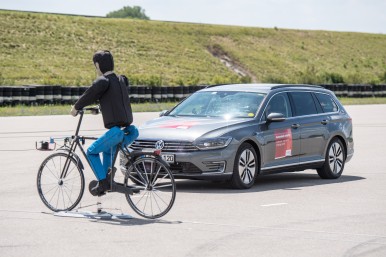
Plymouth, Mich. – New data from the National Highway Traffic Safety Administration (NHTSA) shows an increase in motor vehicle traffic crash fatalities of 10.5 percent for the first quarter of 2021 when compared to Q1 2020 . This is despite a 2.1 percent decrease in vehicle miles travelled (VMT) over that time as reported by the Federal Highway Administration (FHWA). For all of 2020, traffic fatalities in the United States were up 7.2 percent over 2019, despite a 13 percent decrease in VMT. Both the Q1 2021 and total year 2020 figures are the largest number of fatalities since 2007.Technology plays a key role in helping to reduce vehicle accidents and the associated fatalities and injuries. New accident research from Bosch shows the potential of Automatic Emergency Braking (AEB) to notably improve roadway safety. According to Bosch’s research, when AEB is present in all vehicles, it could help mitigate or avoid altogether up to 649,000 vehicle crashes with injuries or fatalities each year – a 35 percent reduction. “AEB technology for vehicles is available today to support safer traveling for all road users,” said Dr. Kay Stepper, senior vice president automated driving, driver assistance for Bosch in North America. “It only takes over in specific instances to help avoid or mitigate an incident.” Bosch’s research was conducted using data from Crash Report Sampling System (CRSS) provided by the U.S. Department of Transportation, which was analyzed to address relevant collision scenarios which could potentially be addressed by AEB technology. The process provided a model to estimate the potential impact of AEB technology assuming 100 percent vehicle penetration of the technology. Protecting vulnerable road users with applications of AEB AEB uses a forward-facing radar, camera sensors or a combination of both to monitor a vehicle’s path of travel for imminent collision threats. The technology was first launched by Bosch in 2010 to support avoidance of rear-end vehicle collisions. AEB’s capabilities have evolved to include detection of pedestrians (AEB for Pedestrians) and cyclists (AEB for Cyclists) – further elevating levels of safety for all roadway users. The Bosch accident research showed that of the more than 1.8 million vehicle crashes with injuries or fatalities in 2018 in U.S., nearly 594,000 could have been mitigated or avoided with AEB; 36,000 with AEB for Pedestrians; and 19,000 with AEB for Cyclists. The total of all three technologies together means AEB technologies could mitigate or avoid altogether up to 649,000 vehicle crashes with injuries or fatalities per year in the U.S. In other words, about one-third of U.S. vehicle crashes with injuries or fatalities could be avoided or mitigated with AEB technology annually. “We are continuing to advance vehicle safety in a way that protects vulnerable road users of many types – from drivers and passengers to pedestrians and cyclists,” Stepper said. “AEB is not a static technology, it’s one where we’ve leveraged Bosch’s ‘Invented for Life’ ethos to continue to push the boundaries of what’s possible to keep people safe.” Bosch camera technology continues to advance object recognition to support applications of AEB using a combination of a unique multi-path approach and artificial intelligence (AI). The camera can recognize and classify pedestrians, even when they are 50% concealed. In congested urban traffic, the camera can also recognize and classify partially obscured or crossing vehicles, pedestrians, and cyclists. Recognition and classification allows the vehicle to trigger a warning or emergency braking. The latest generation of Bosch radar sensors capture the vehicle's surroundings – and demonstrate improved performance in bad weather or poor light conditions due to their detection range, wide aperture, and high angular resolution. It starts with consumer education Encouraging higher adoption rates of AEB starts with consumer education, but requires joint efforts between academia, government and industry. NHTSA’s New Car Assessment Program (NCAP) provides comparative new vehicle safety information to assist consumers with purchasing decisions and encourages manufacturers to improve vehicle safety. The formal addition of AEB to the program, coupled with the creation of a new crash avoidance rating, could help improve consumer awareness and adoption of a technology that notably reduces crashes. Technology drives safety advancements Dating back to the early 1970s when Bosch started researching new safety technologies for vehicles, the goal has been to make roadways a safer place. From adapting radar systems for automotive use to the introduction of anti-lock braking systems (ABS), these foundational technologies have continued to advance to help make roads safer for everyone. In fact, NHTSA estimates that electronic stability control systems, which Bosch first unveiled in 1995 and which have been mandated since model year 2012 for all new cars in the U.S. weighing 10,000 pounds or less, saved approximately 9,000 lives in the U.S. between 2015 and 2018.

Bosch research shows benefits of driver-assistance systems in heavy trucks

16.03.2021

Press release

Automated mobility

Bosch research shows benefits of driver-assistance systems in heavy trucks

Plymouth, Mich. – The human costs associated with injuries and deaths from vehicular accidents are substantial and Bosch continues to seek and introduce products to avoid accidents and the associated injuries. New accident research from Bosch reveals that equipping heavy trucks with advanced driver assistance systems (ADAS) such as lateral actuator systems may also significantly reduce the costs of accidents influenced by heavy trucks. Lateral actuator systems are ADAS solutions that provide automated steering input for functions like Lane Change Assist (LCA) and Lane Keeping Support (LKS).The Bosch accident research, titled “Safety + Enhanced Driver Comfort: Steering in Commercial Vehicle ADAS Systems,” finds that lateral actuator systems in Class 7 and 8 trucks can reduce the costs of accidents by up to $0.04 per mile, or $3,700 annually per heavy truck. “Increasing levels of automation and driver assistance help to reduce accidents and make drivers’ lives easier,” said Kevin O’Keefe, regional president of Automotive Steering for Bosch in North America. “The Bosch accident research findings illustrate how features like Lane Change Assist and Lane Keeping Support can contribute positively in multiple ways – reducing property damage, injuries and fatalities.” Reducing damage and saving lives The Bosch accident research reviewed public crash data to identify correlating statistics between vehicle types and the severity of crashes. This data was utilized to calculate a Field of Effect (FoE) for accidents involving large trucks. To calculate FoE, crashes were examined that could have been mitigated or avoided by using lateral actuator systems – more specifically, LCA and LKS. Based on the accident research, the data shows injuries from class 7 & 8 truck crashes could be reduced by up to 23 percent and fatalities by up to 19 percent when they are the accident-triggering vehicle. Additionally, it is estimated that Lane Change Assist and Lane Keeping Support could reduce the property damage from class 7 & 8 trucks when they are the accident-triggering vehicle by up to 35 percent. Enhancing driver safety and comfort From automated transmissions and adaptive cruise control to automated emergency braking and the introduction of Level 2 steering systems in North America in 2020, technological innovations in trucking over the past 20 years have continually enhanced safety and driver comfort. Key enablers for higher levels of driver comfort include features such as active pull compensation, active steering damping, and reducing steering effort. Safety features such as lane keeping / centering assistance and active lane departure protection aid the driver and enhance safety for all road users. Furthermore, safety features like hydraulic failure detection and added steering assist can support the driver during hydraulic failure or drastic events like tire blow outs. The goal of all these technologies is to enhance safety on the road and driver comfort in the cab. Financial return for investment in safety technology The KABCO injury scale, developed by the National Safety Council, provides a specific process to classify the costs of crashes. Utilizing the KABCO scale and based on a driving distance of 100,000 miles per year – the Federal Highway Administration’s estimate for long-distance heavy trucks –the FoE was translated into dollars. The in-depth accident research ultimately shows lateral actuator systems can help reduce accident-related costs by nearly four cents per mile ($0.037) and up to $3,700 annually per heavy truck. The research shows that even at an assumed 50 percent efficiency of the FoE, the savings from a lateral actuator system could total more than $9,000 per truck in five years. “The full value when injuries or fatalities from vehicular accidents are avoided is ultimately incalculable,” O’Keefe said. “Safety technologies like LCA and LKS help to reduce accidents, which is the ultimate goal across the commercial vehicle industry.”

17.02.2021

Press release

Automated mobility

Bosch teams up with Microsoft to develop software-defined vehicle platform for s ...

Stuttgart and Munich, Germany – Bosch teams up with Microsoft to develop a software platform to seamlessly connect cars to the cloud. The goal of this collaboration is to simplify and accelerate the development and deployment of vehicle software throughout a car’s lifetime in accordance with automotive quality standards. The new platform, which will be based on Microsoft Azure and incorporate software modules from Bosch, will enable software to be developed and downloaded to the control units and vehicle computers. A further focus of the collaboration will be on the development of tools that increase efficiency in the software development process. This in turn will drive innovation and reduce development costs for vehicle software within and across organizations. For drivers, the platform will mean quicker access to new functions and digital services. The collaboration between Bosch and Microsoft combines the wealth of software, electronics, and systems expertise of the world’s leading automotive supplier with Microsoft’s know-how in software engineering and cloud computing. Both companies intend to make the new software platform available for first vehicle prototypes by the end of 2021. “Bosch already securely updates car software over the air today. With the comprehensive platform for software-defined cars, we want to further empower automakers to develop new functions and get them on the road faster,” says Dr. Markus Heyn, member of the board of management of Robert Bosch GmbH. “Our collaboration with Bosch brings together the expertise of one of the world’s leading automotive suppliers with the power of the Microsoft cloud, AI and GitHub,” says Scott Guthrie, executive vice president, Cloud + AI, Microsoft. “With software quickly becoming a key differentiator in the automotive industry, our ambition is to help businesses accelerate the delivery of unique mobility services across passenger cars and commercial fleets at scale.” Developing the automotive future together Software will play an increasingly important role in future vehicle generations. New trends such as electromobility, automated driving, and modern mobility services would not be possible without it. This will also require more frequent updates and upgrades in the future. However, stringent safety requirements throughout the vehicle’s lifetime make wireless software updates and digital services for cars very complex. The wide range of different series and models makes things even more challenging. The collaboration will benefit from Bosch’s deep understanding of electrical and electronic architectures, control units, and vehicle computers, which is necessary for over-the-air vehicle updates. In addition, the company will contribute its expertise as well as software-based products and development tools for cars. This includes the basic software and middleware for vehicle computers and control units, as well as cloud-based software modules to bring over-the-air updates to entire vehicle fleets. “Having a comprehensive software platform from the vehicle to the cloud will reduce the complexity of the software development and the vehicle system integration. In this way we will create the conditions for wireless updates to work just as smoothly and conveniently in vehicles as they do in smartphones,” Heyn says. The pre-integrated platform will greatly reduce the complexity of over-the-air updates, which help ensure that a vehicle’s software is always up to date, thanks to the fact that the software architectures of vehicles and the cloud will now fit together seamlessly. New software services for developers Bosch and Microsoft also plan to enrich existing developer tools that will enable automakers and suppliers to simplify and accelerate their own software development, while adapting to the unique challenges in the automotive industry. The companies also plan to use GitHub’s fully integrated enterprise platform and to open-source important parts of the new software platform on GitHub.com to encourage code re-use and best practice sharing across the industry.