Search and find:
Photos, videos, releases, events to support your reporting about the Bosch Group

Bosch and Mercedes-Benz showcase automated valet parking at InterContinental Los ...

21.03.2022

Press release

Automated mobility

Bosch and Mercedes-Benz showcase automated valet parking at InterContinental Los ...

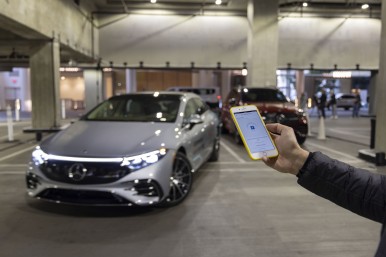
LOS ANGELES – Drive a fully-electric, luxury vehicle up to the hotel at an iconic skyscraper in Los Angeles and simply let the vehicle park itself. This scenario will become a reality in a demonstration of automated valet parking at the InterContinental Los Angeles Downtown featuring the EQS sedan from Mercedes-EQ. It is the first demonstration of infrastructure-based automated valet parking in a hotel setting in the United States. Automated valet parking technology from Bosch and Mercedes-Benz is at the core of the demonstration in Los Angeles. It features INTELLIGENT PARK PILOT in the Mercedes-Benz EQS and integration with the smartphone app as part of a holistic demonstration of the future vehicle experience for consumers. The demonstration is operated in conjunction with InterContinental Los Angeles Downtown, an 889-room property located in the tallest building west of Chicago. “The demonstration at the InterContinental Los Angeles Downtown will showcase how automated valet parking will operate in a working hotel environment where both automated and non-automated vehicles operate alongside pedestrian traffic,” said Dr. Kay Stepper, senior vice president of automated driving and driver assistance for Bosch in North America. “This allows us to dive into the dynamics of local deployments with the use of a highly-connected EQS from Mercedes-EQ to demonstrate how automated technology continues to move forward.” “Our vision is that getting time back is a key component of the luxury experience our customers are looking for. The EQS gives you time back by driving itself in traffic jams on highways, but with INTELLIGENT PARK PILOT, it may also be able park itself,” says Dr. Philipp Skogstad, president & CEO of Mercedes-Benz Research & Development North America. He adds: “INTELLIGENT PARK PILOT is a feature that together with the required infrastructure enables an automated valet service that gives customers even more comfort and relief in everyday life.”Mercedes showcases INTELLIGENT PARK PILOT The demonstration features the EQS, showcasing automated valet parking using its existing hardware that is already preinstalled in vehicles such as the S-Class and EQS in Germany/Europe with the required optional equipment. The vehicle interacts with the Bosch intelligent infrastructure installed in the parking garage in order to enable the vehicle to drive and park itself at the InterContinental Los Angeles Downtown. Sensors installed at the building will communicate with the vehicle and guide its maneuvering through the garage. The demonstration also highlights possibilities for additional services such as automated EV charging and a car wash where vehicles move in and out of service areas guided by the intelligent infrastructure. In conjunction with the necessary optional equipment* and the corresponding Connect service (both depending on country), the EQS has the onboard technology to enter and leave multi-story parking facilities equipped with the Bosch automated valet parking infrastructure in highly automated mode and without a driver, provided that the corresponding Connect service is available and booked for the respective vehicle variant of the EQS and national legislation permits such operation.Demonstration to utilize smartphone app as part of the holistic vehicle experience The vision: The driver securely parks the vehicle in a designated drop-off area of the parking facility, and after all passengers have exited they start the parking procedure using the smartphone app. The sensor system in the car park checks whether a suitable space is available or was already reserved for the vehicle. If so, the automated valet parking infrastructure confirms the handover of the vehicle for the driver in the App, and he/she can leave the EQS and depart. The vehicle is then started automatically and moves driverless to its parking space with the help of the infrastructure installed in the parking facility. On returning, the driver can let the EQS drive to a designated pick-up area by smartphone command. This means less time searching for parking spots and walking from the parking garage to their destination.A step on the path to fully automated driving Automated parking technology showcases the benefits of automation to drivers by providing value to drivers by easing the burden of the parking experience. “Low-speed maneuvers are part of the holistic opportunity for automated technology,” Stepper said. “Automated technology in the specific use case automated valet parking gets consumers comfortable with how automated technology works and how it can benefit them.” Bosch engineering teams have been working over the past few years to further develop automated valet parking and support specific testing and deployments around the world.Drivers and garage operators both benefit Automated valet parking presents benefits on both sides of the parking experience. For consumers, they will no longer have to search for a parking space and can save time once they arrive to their destination. For parking garage operators, they can increase parking capacity as vehicles no longer need to have room to open doors on all sides as all occupants have already exited the vehicle. Furthermore, operators can offer services such as charging, washing or maintenance.

Automated driving: Bosch and Volkswagen Group subsidiary Cariad agree on extensi ...

23.02.2022

Press release

Automated mobility

Automated driving: Bosch and Volkswagen Group subsidiary Cariad agree on extensi ...

Stuttgart, Wolfsburg, and Ingolstadt, Germany – More safety and less stress for drivers, more rapid deployment of automated driving functions across all vehicle classes: Bosch and the Volkswagen Group subsidiary Cariad are now collaborating to achieve this objective, and have agreed to form an extensive partnership. The companies want to make partially and highly automated driving suitable for volume production, and thus available to the broad mass of consumers. For the vehicles sold under the Volkswagen Group brands, the alliance aims to make functions available that will allow drivers to temporarily take their hands off the steering wheel. More specifically, these functions are Level 2 hands-free systems for urban, extra-urban, and freeway driving, as well as a system that takes over all driving functions on the freeway (SAE Level 3). The first of these functions are to be installed in 2023. For partially and highly automated driving, the two companies will jointly develop a state-of-the-art, standardized software platform. The aim is to use this platform in all privately used vehicle classes sold under Volkswagen Group brands – and thus in one of the world’s biggest vehicle fleets. It will also be possible to integrate all the component parts developed by the alliance in other automakers’ vehicles and ecosystems.Software and volume-production expertise “For privately owned vehicles, progress to automated driving happens one step at a time. At Bosch, we’ve been working successfully on this for many years now. Together with Cariad, we will now be accelerating the market launch of partially and highly automated driving functions across all vehicle classes, and thus making them available for everyone. This will make driving on the roads safer and more relaxed,” says the Bosch board of management member Dr. Markus Heyn. “We will be able to offer the solutions we create to our other customers as well, and in this way set new standards.” The two partners have got what it takes to make increasingly automated driving a common sight on our roads: they have decades of experience in the volume production, scalability, and approval of driving systems, as well as expertise in the areas of software, data-driven development, and artificial intelligence. “Automated driving is key to the future of our industry. With our cooperation, we’ll strengthen Germany’s reputation for innovativeness. Bosch and Cariad will further enhance their expertise in the development of pioneering technologies,” says Dirk Hilgenberg, the Cariad CEO. “This underscores our ambition to deliver the best possible solutions to our customers as soon as possible.”Intelligently processing information from the real environment At various locations belonging to the two companies, and especially in Stuttgart and Ingolstadt, associates from the Bosch Cross-Domain Computing Solutions division and Cariad will work together to develop partially and highly automated driving functions. Working in mixed, agile teams, they will be part of a global network. At peak times, it is expected that the various modules required by the project – from middleware to individual applications – will occupy more than 1.000 experts from the two companies. The two companies have already started recruiting fresh experts to work in the alliance as well. The focus of the project’s work will be data-driven software development on the basis of information from 360-degree surround sensing. For this purpose, a highly innovative development environment will be created for the recording, evaluation, and processing of data. The environment will also make use of AI methods. The idea behind this is a simple one. The more extensive the pool of data from real road traffic, the more robust and natural the design of the partially and highly automated driving functions can be. This applies, for example, to additional layers for high-resolution maps for the localization and lateral and longitudinal guidance of vehicles. The alliance will also be working on these layers. Moreover, it applies equally to everyday driving situations and to what are known as “corner cases” – the seldom occurring road-traffic incidents that are especially tricky for a system to resolve.Information processing in real time “The best proving ground for the development of automated driving is road traffic. With the help of one of the world’s biggest connected vehicle fleets, we will gain access to a huge database. This will allow us to take automated driving systems to a new level. All our customers will be able to benefit from this,” says Dr. Mathias Pillin, president of Bosch Cross-Domain Computing Solutions. “Together, we can test automated driving functions on a broader scale in actual vehicles and implement them more quickly. Our engineering work will be done jointly, with Bosch and Cariad as one team. There has never been an alliance like this in the automotive industry,” says Dr. Ingo Stürmer, the alliance’s project director at Cariad. This also involves feeding the data gathered in real traffic conditions into the development process – continuously and in real time. Each kilometer driven in real traffic conditions, and the data gathered, evaluated, and processed as a result, means a bigger pool of data and a better basis from which to make even higher levels of automated driving reality and get them safely and reliably onto our roads. The partners have also agreed to examine the possibility of joint development targets and timelines on the path the fully automated driving (SAE Level 4). The guiding principle behind this partnership on equal terms is as follows: one of the world’s biggest automaking groups plus one of the world’s biggest automotive suppliers equals a huge step forward in the development of automated driving.

Safe and sound from A to B: Bosch RideCare solution helps keep carsharing vehicl ...

03.11.2021

Press release

Automated mobility

Safe and sound from A to B: Bosch RideCare solution helps keep carsharing vehicl ...

Stuttgart, Germany – People who use shared vehicles expect the cars they reserve to be roadworthy, clean, and not full of unpleasant odors left by previous users. It’s frustrating to arrive at a vehicle that is scratched and dented, or when someone has smoked inside. Thanks to the new RideCare solutions Bosch is developing for fleet operators and mobility service providers, this will soon be a thing of the past. The goal is an even safer and more pleasant ride for every user. The first standard RideCare features are smoke and damage detection. Bosch combines a sensor box in the vehicle with cloud-based data analysis using artificial intelligence (AI). This allows carsharing providers to receive important, easily understood information in real time on whether a vehicle has been damaged or someone has smoked in it. Repairs or cleaning can then be carried out more quickly and more in line with demand, optimizing fleet management. “In carsharing, one of the main keys to customer satisfaction is to ensure users have a safe and pleasant driving experience at all times. With its RideCare solutions, Bosch is setting a new standard for an even better customer experience in the sharing market,” said Harald Kroeger, member of the board of management of Robert Bosch GmbH. Bosch is currently working on pilot projects with leading carsharing providers in Asia, North America, and Germany, aiming to launch a production version of its smoke and damage detection system soon. Bosch also recently received official approval for this system from globally-recognized testing and certification organization TÜV Süd, including a confirmation of the reliability of these fleet services.RideCare creates transparency and accountability Carsharing providers usually receive little if any information about whether their vehicles were damaged or smoked in during a given rental period. While users often report instances of major damage to the car, providers tend to be saddled with the cost of repairing supposedly minor damage. Another source of great dissatisfaction among users is taking possession of a vehicle in which the previous driver has been smoking – an activity that is almost ubiquitously prohibited inside rented vehicles but is difficult for carsharing operators to prevent. In such cases, the cost of professional interior cleaning can often run into several hundreds of dollars. With its RideCare solutions, Bosch can now give carsharing providers clarity instead of conjecture: a sensor box in the vehicle detects both cigarette smoke in the interior and damage to the exterior. Detecting these types of damages with just a single sensor unit is a first in the industry. The solutions available until now could detect either smoke or accidents, but not both. “Bosch’s combined smoke and damage detection system is the world’s first production solution that can reliably detect and incontrovertibly report both damage to and smoke inside the car,” Kroeger said. In addition, the box’s sensors are precise enough to detect not only accidents, but even small impacts that can occur during parking. This includes the detection of minor collisions involving a shared vehicle that is parked downtown and not currently rented out. Thanks to the RideCare solution, sharing providers can directly determine who caused the damage or smoked in the vehicle.Bosch combines artificial intelligence with the internet of things This innovative fleet service from Bosch comprises a sensor box which is semi-permanently installed on the inner windshield of shared vehicles, as well as intelligent software for data analysis in the cloud. As soon as sensor information about accidents or smoke in the vehicle interior has been transmitted to a cloud back end, Bosch can use AI methods to derive the intensity of any impact and classify it for the fleet operator. Intelligent algorithms incorporate both the vehicle’s driving dynamics data and additional information such as the condition of the road. This means sharing providers can know exactly whether damage is merely cosmetic or whether it needs to be assessed and repaired immediately to ensure that the vehicle remains roadworthy. “RideCare services are yet another demonstration of the potential of AIoT – the combination of AI and the internet of things. Now, its benefits will also be available to the users of sharing services,” Kroeger said. Thanks to AI data analysis, Bosch can also identify which part of the vehicle has been damaged –for example on the rear bumper or even on the underbody. This facilitates the documentation and appraisal of the damage. If the data from the sensor box is later combined with images of the damage, fleet and mobility service operators can also obtain an estimate of repair costs on request.Digital solution for fleet management For sharing providers, fast and transparent documentation of damage to individual vehicles in the fleet is hugely important, as it is the only way for them to improve roadworthiness and minimize downtime effectively and efficiently. In addition to damage classification, RideCare services also tell the carsharing provider exactly where and when the accident happened, and when someone smoked in the car. This information enables fleet managers and mobility service providers to keep their vehicles in as-perfect-as-possible condition at all times and to enhance driver and passenger well-being.

Bosch research shows benefits of driver-assistance systems in heavy trucks

16.03.2021

Press release

Automated mobility

Bosch research shows benefits of driver-assistance systems in heavy trucks

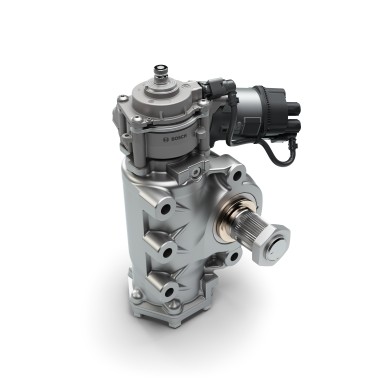
Plymouth, Mich. – The human costs associated with injuries and deaths from vehicular accidents are substantial and Bosch continues to seek and introduce products to avoid accidents and the associated injuries. New accident research from Bosch reveals that equipping heavy trucks with advanced driver assistance systems (ADAS) such as lateral actuator systems may also significantly reduce the costs of accidents influenced by heavy trucks. Lateral actuator systems are ADAS solutions that provide automated steering input for functions like Lane Change Assist (LCA) and Lane Keeping Support (LKS).The Bosch accident research, titled “Safety + Enhanced Driver Comfort: Steering in Commercial Vehicle ADAS Systems,” finds that lateral actuator systems in Class 7 and 8 trucks can reduce the costs of accidents by up to $0.04 per mile, or $3,700 annually per heavy truck. “Increasing levels of automation and driver assistance help to reduce accidents and make drivers’ lives easier,” said Kevin O’Keefe, regional president of Automotive Steering for Bosch in North America. “The Bosch accident research findings illustrate how features like Lane Change Assist and Lane Keeping Support can contribute positively in multiple ways – reducing property damage, injuries and fatalities.” Reducing damage and saving lives The Bosch accident research reviewed public crash data to identify correlating statistics between vehicle types and the severity of crashes. This data was utilized to calculate a Field of Effect (FoE) for accidents involving large trucks. To calculate FoE, crashes were examined that could have been mitigated or avoided by using lateral actuator systems – more specifically, LCA and LKS. Based on the accident research, the data shows injuries from class 7 & 8 truck crashes could be reduced by up to 23 percent and fatalities by up to 19 percent when they are the accident-triggering vehicle. Additionally, it is estimated that Lane Change Assist and Lane Keeping Support could reduce the property damage from class 7 & 8 trucks when they are the accident-triggering vehicle by up to 35 percent. Enhancing driver safety and comfort From automated transmissions and adaptive cruise control to automated emergency braking and the introduction of Level 2 steering systems in North America in 2020, technological innovations in trucking over the past 20 years have continually enhanced safety and driver comfort. Key enablers for higher levels of driver comfort include features such as active pull compensation, active steering damping, and reducing steering effort. Safety features such as lane keeping / centering assistance and active lane departure protection aid the driver and enhance safety for all road users. Furthermore, safety features like hydraulic failure detection and added steering assist can support the driver during hydraulic failure or drastic events like tire blow outs. The goal of all these technologies is to enhance safety on the road and driver comfort in the cab. Financial return for investment in safety technology The KABCO injury scale, developed by the National Safety Council, provides a specific process to classify the costs of crashes. Utilizing the KABCO scale and based on a driving distance of 100,000 miles per year – the Federal Highway Administration’s estimate for long-distance heavy trucks –the FoE was translated into dollars. The in-depth accident research ultimately shows lateral actuator systems can help reduce accident-related costs by nearly four cents per mile ($0.037) and up to $3,700 annually per heavy truck. The research shows that even at an assumed 50 percent efficiency of the FoE, the savings from a lateral actuator system could total more than $9,000 per truck in five years. “The full value when injuries or fatalities from vehicular accidents are avoided is ultimately incalculable,” O’Keefe said. “Safety technologies like LCA and LKS help to reduce accidents, which is the ultimate goal across the commercial vehicle industry.”

17.02.2021

Press release

Automated mobility

Bosch teams up with Microsoft to develop software-defined vehicle platform for s ...

Stuttgart and Munich, Germany – Bosch teams up with Microsoft to develop a software platform to seamlessly connect cars to the cloud. The goal of this collaboration is to simplify and accelerate the development and deployment of vehicle software throughout a car’s lifetime in accordance with automotive quality standards. The new platform, which will be based on Microsoft Azure and incorporate software modules from Bosch, will enable software to be developed and downloaded to the control units and vehicle computers. A further focus of the collaboration will be on the development of tools that increase efficiency in the software development process. This in turn will drive innovation and reduce development costs for vehicle software within and across organizations. For drivers, the platform will mean quicker access to new functions and digital services. The collaboration between Bosch and Microsoft combines the wealth of software, electronics, and systems expertise of the world’s leading automotive supplier with Microsoft’s know-how in software engineering and cloud computing. Both companies intend to make the new software platform available for first vehicle prototypes by the end of 2021. “Bosch already securely updates car software over the air today. With the comprehensive platform for software-defined cars, we want to further empower automakers to develop new functions and get them on the road faster,” says Dr. Markus Heyn, member of the board of management of Robert Bosch GmbH. “Our collaboration with Bosch brings together the expertise of one of the world’s leading automotive suppliers with the power of the Microsoft cloud, AI and GitHub,” says Scott Guthrie, executive vice president, Cloud + AI, Microsoft. “With software quickly becoming a key differentiator in the automotive industry, our ambition is to help businesses accelerate the delivery of unique mobility services across passenger cars and commercial fleets at scale.” Developing the automotive future together Software will play an increasingly important role in future vehicle generations. New trends such as electromobility, automated driving, and modern mobility services would not be possible without it. This will also require more frequent updates and upgrades in the future. However, stringent safety requirements throughout the vehicle’s lifetime make wireless software updates and digital services for cars very complex. The wide range of different series and models makes things even more challenging. The collaboration will benefit from Bosch’s deep understanding of electrical and electronic architectures, control units, and vehicle computers, which is necessary for over-the-air vehicle updates. In addition, the company will contribute its expertise as well as software-based products and development tools for cars. This includes the basic software and middleware for vehicle computers and control units, as well as cloud-based software modules to bring over-the-air updates to entire vehicle fleets. “Having a comprehensive software platform from the vehicle to the cloud will reduce the complexity of the software development and the vehicle system integration. In this way we will create the conditions for wireless updates to work just as smoothly and conveniently in vehicles as they do in smartphones,” Heyn says. The pre-integrated platform will greatly reduce the complexity of over-the-air updates, which help ensure that a vehicle’s software is always up to date, thanks to the fact that the software architectures of vehicles and the cloud will now fit together seamlessly. New software services for developers Bosch and Microsoft also plan to enrich existing developer tools that will enable automakers and suppliers to simplify and accelerate their own software development, while adapting to the unique challenges in the automotive industry. The companies also plan to use GitHub’s fully integrated enterprise platform and to open-source important parts of the new software platform on GitHub.com to encourage code re-use and best practice sharing across the industry.

Bosch: the mobility of the future needs fuel cells

02.09.2020

Press release

Automated mobility

Bosch: the mobility of the future needs fuel cells

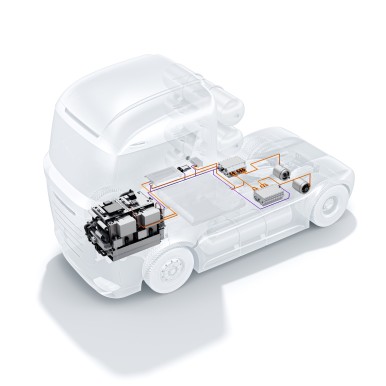
Stuttgart, Germany – Electromobility is picking up more and more speed. It is an important element in reducing CO2 emissions from traffic. But how economical is it to operate heavy-duty trucks with 40-ton payloads over long distances using only battery-electric power? Given the battery weight, long charging times, and limited range of today’s technology, electric powertrains aren’t the first choice for heavy trucks. Nevertheless, even 40-ton trucks will be able to travel more than 620 miles in all-electric mode in the near future. The key to this is the Bosch fuel-cell powertrain. When powered with hydrogen produced using renewable energy, this powertrain enables the climate-neutral transportation of goods and commodities. Bosch is taking the first step in this direction by developing the fuel-cell powertrain primarily with a focus on trucks, and the company plans to start production in 2022–2023. Once they have become established in trucks, Bosch fuel-cell powertrains will then increasingly find their way into passenger cars – rightly making them an integral part of tomorrow’s powertrain portfolio.Seven reasons why fuel cells and hydrogen are crucial building blocks of tomorrow’s mobility: 1) Climate neutrality In a fuel cell, hydrogen (H2) reacts with oxygen (O2) from the ambient air. The energy this reaction releases is converted into electricity, which is used for driving. Heat and pure water (H2O) are other products of the reaction. H2 is obtained using electrolysis, in which water is separated into hydrogen and oxygen with the aid of electricity. Generating this electricity from renewables makes the fuel-cell powertrain completely climate-neutral. Especially for large, heavy vehicles, fuel cells have a better carbon footprint than exclusively battery-electric powertrains if the CO2 emissions for production, operation, and disposal are added together. All that fuel-cell vehicles need in addition to their hydrogen tank is a much smaller battery for intermediate buffer storage. This greatly reduces their carbon footprint in production. “The advantages of the fuel cell really come into play in those areas where battery-electric powertrains don’t shine,” explains Dr. Uwe Gackstatter, president of the Bosch Powertrain Solutions division. “This means there’s no competition between fuel cells and batteries; instead, they complement each other perfectly.” 2) Potential applications Hydrogen has a high energy density. Two pounds of hydrogen contains as much energy as a gallon of diesel. To travel 62 miles, a passenger car needs only about two pounds; a 40-ton truck needs a good 15 pounds. As with diesel or gasoline, it takes just a few minutes to fill an empty H2 tank and continue the journey. “Fuel cells are the first choice for transporting larger loads for many miles every day,” Gackstatter says, summarizing the advantages. In the EU-funded H2Haul project, Bosch is currently working with other companies to build a small fleet of fuel-cell trucks and put them on the road. In addition to mobile applications, Bosch is developing fuel-cell stacks for stationary applications with solid-oxide fuel-cell (SOFC) technology. One intended use for them is as small, distributed power stations in cities, data centers, and charge points for electric vehicles. If the Paris climate action targets are to be met, in the future hydrogen will need to power not only cars and commercial vehicles, but also trains, aircraft, and ships. The energy and steel industries are also planning to make use of hydrogen. 3) Efficiency One of the decisive factors for a powertrain’s eco-friendliness and profitability is its efficiency. This is around a quarter higher for fuel-cell vehicles than for vehicles with combustion engines. Employing recuperative braking further increases efficiency. Battery-electric vehicles, which can store electricity directly in the vehicle and use it for propulsion, are even more effective. However, since energy production and energy demand do not always coincide in time and location, electricity from wind and solar plants often remains unused because it cannot find a consumer and cannot be stored. This is where hydrogen comes into its own. The surplus electricity can be used to produce it in a decentralized way, ready for flexible storage and transportation. 4) Costs The cost of green hydrogen will come down considerably when production capacities are expanded and the price of electricity generated from renewables declines. The Hydrogen Council, an association of over 90 international companies, expects costs for many hydrogen applications to fall by half in the next ten years – making them competitive with other technologies. Bosch is currently working with the startup Powercell to develop the stack, the core of the fuel cell, and make it market-ready, with manufacturing to follow. The goal is a high-performance solution that can be manufactured at low cost. “In the medium term, using a vehicle with a fuel cell won’t be more expensive than using one with a conventional powertrain,” Gackstatter says. 5) Infrastructure Today’s network of hydrogen filling stations doesn’t offer complete coverage, but the roughly 180 hydrogen filling stations in Europe are already sufficient for some important transport routes. Companies in many countries are cooperating to push ahead with the expansion, often supported by state subsidies. In Germany, too, politicians have recognized the important role of hydrogen in decarbonizing the economy and have anchored it in the National Hydrogen Strategy. For example, the H2 Mobility joint venture will have built around 100 publicly accessible filling stations in Germany by the end of 2020, while the EU-funded H2Haul project is working not only on trucks but also on the filling stations required on its planned routes. Japan, China, and South Korea also have comprehensive support programs. 6) Safety The use of gaseous hydrogen in vehicles is safe and no more hazardous than other automotive fuels or batteries. Hydrogen tanks do not pose an increased risk of explosion. It is true that H2 burns in combination with oxygen and that a mixture of the two beyond a certain ratio is explosive. But hydrogen is about 14 times lighter than air and therefore extremely volatile. For example, any H2 that escapes from a vehicle tank will rise faster than it can react with the ambient oxygen. In a fire test conducted on a fuel-cell car by U.S. researchers in 2003, there was a flash fire, but it quickly went out again. The vehicle remained largely undamaged. 7) Timing Hydrogen production is a proven and technologically straightforward process. This means it can be ramped up quickly to meet higher demand. In addition, fuel cells have now reached the necessary technological maturity for their commercialization and widespread use. According to the Hydrogen Council, the hydrogen economy can become competitive in the next ten years, provided there is sufficient investment and political will. “The time for entry into the hydrogen economy is now,” Gackstatter says.

Ford, Bedrock and Bosch are exploring highly automated vehicle technology in Det ...

27.08.2020

Press release

Automated mobility

Ford, Bedrock and Bosch are exploring highly automated vehicle technology in Det ...

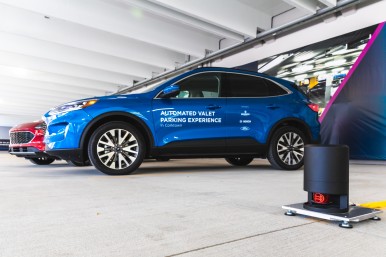
DETROIT – Many people enjoy driving… until it’s time to park. So why not leave the task to the vehicle?Ford Motor Company, Bedrock and Bosch are launching a demonstration project with connected Ford Escape test vehicles that can drive and park themselves inside Bedrock’s Assembly Garage in Detroit using Bosch smart infrastructure. This is the first U.S. infrastructure-based solution for automated valet parking where the vehicle will park itself inside a parking garage. The research will take place in the Corktown neighborhood, the site of Ford’s new mobility innovation district, anchored by Michigan Central Station. The district will draw mobility innovators and disruptors from around the world to develop, test, and launch new solutions to solve urban transportation challenges, improve mobility access for everyone and prepare for the increasingly connected and autonomous world ahead. “We are continually searching for opportunities to expand our leading suite of Ford Co-Pilot360 driver-assist technologies that help people drive more confidently and we believe automated valet parking technology holds great promise,” said Ken Washington, chief technology officer at Ford Motor Company. “Our work with Bosch and Bedrock also aligns with our vision for the future, which includes increasingly automated vehicles that are more aware of their surroundings while requiring less on-board computing to help improve design, packaging and affordability.” The demonstration project will be on display on the ground floor of Bedrock’s Assembly Garage, the real estate developer’s first residential redevelopment project in the Corktown neighborhood. The project aligns with Bedrock’s vision of combining ground up and historical developments with the newest technology in parking and mobility - including the current installation of the Midwest’s first automated parking stall, which parks and retrieves vehicles in the basement of the Free Press Building using street-level load bays. “We strive to be at the forefront of parking and mobility initiatives in Detroit because we recognize the importance of interconnectivity between real estate and mobility,” said Heather Wilberger, chief information officer at Bedrock. “In addition to drastically reducing park time, we see this solution as the first step to bringing automated parking to our city, providing the ultimate convenience for our tenants, visitors, neighborhoods and residents.” The automated valet parking technology will be running for Assembly tenant and private demonstrations through the end of September. Connected vehicle and smart infrastructure enhance automated parking The connected Ford test vehicles operate in a highly automated fashion by vehicle-to-infrastructure (V2I) communication with Bosch’s intelligent parking infrastructure. The infrastructure sensors recognize and localize the vehicle to guide its parking maneuver, including the ability to help avoid pedestrians and other hazards. If the infrastructure senses something in the vehicle’s path, it can stop the vehicle immediately. “For Bosch, automated valet parking brings together our deep cross-domain experience in mobility and building technologies to deliver a smart infrastructure solution that improves everyday life,” said Mike Mansuetti, president of Bosch in North America. “This technology enables consumers to see the benefit of highly automated technology as the vehicle handles a task such as parking in a garage.” Upon arriving into the garage, a driver will leave the vehicle in a designated area and use a smartphone app to send the vehicle into an automated parking maneuver. Drivers will also use the app to request the return of the vehicle to the designated pick-up area, expediting the parking experience and removing the responsibility of finding the vehicle upon return to the garage. New mobility requires collaboration The demonstration project at Assembly Garage brings together one of the world’s largest automakers, Ford, the largest property developer in the City of Detroit, Bedrock, and the world’s largest automotive supplier, Bosch, to demonstrate how organizations are working together on new mobility initiatives. “Michigan continues to lead the way through unprecedented investments in the smart infrastructure that is critical to developing and deploying the most advanced forms of mobility,” said Garlin Gilchrist II, Lt Governor. “With the Office of Future Mobility and Electrification, we are ensuring our state solidifies its position not only in the manufacturing of advanced automobiles, but also in the future of smart, connected roadways and parking areas. We will continue finding innovative ways to work with partners across both the public and private sector to deliver real-world solutions to today’s transportation challenges.” The demonstration project will enable the three companies to gain valuable insights regarding user experience, vehicle design, parking structure design and application to expand the technology and its application. “The City of Detroit continues to be at the forefront of mobility and the heart of the automotive industry,” said Mike Duggan, mayor of the City of Detroit. “Ford has a long and storied history with the Motor City and it is exciting to see them collaborate with Bosch and Bedrock on this innovative effort to propel the region into the future of mobility. I look forward to the day when Detroit residents and visitors alike will see a benefit from future technologies such as automated valet parking – it will undoubtedly save space in our garages and make the entire parking experience more convenient.” Efficient use of space and vehicle services make the case Automated parking solutions bring value to garage owners by allowing for the more efficient use of spaces inside a parking garage. With automated valet parking, the same amount of space can accommodate up to 20 percent more vehicles. The solution can be deployed via retrofitted solutions like the one in the Assembly Garage or with embedded infrastructure planned into construction of new garages that enables optimized design for maximum capacity. In addition to simply parking, a vehicle could also drive itself to areas within the garage for specific services such as vehicle charging or a car wash. During the demonstration project, Ford, Bedrock and Bosch will demonstrate vehicle paths showing how a vehicle would move between service areas and ultimately to a parking spot before the user calls it back to leave the garage.

Safety to the power of three: Bosch completes sensor portfolio for automated driving

05.01.2020

Press release

Automated mobility

Safety to the power of three: Bosch completes sensor portfolio for automated driving

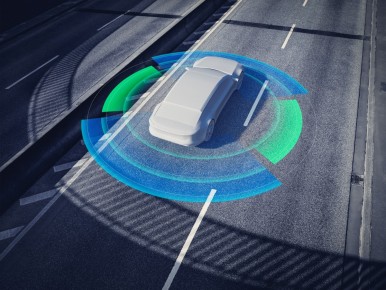
Stuttgart, Germany /Las Vegas, NV, USA – Good things come in threes – and automated driving is no exception. Before safe automated driving can become a reality, a third sensor principle is needed in addition to camera and radar. Consequently, Bosch is making long-range lidar sensors production-ready – the first lidar (light detection and ranging) system that is suitable for automotive use. This laser-based distance measurement technology is indispensable for driving functions at SAE Levels 3 to 5. The new Bosch sensor will cover both long and close ranges – on highways and in the city. By exploiting economies of scale, Bosch wants to reduce the price for the sophisticated technology and render it suitable for the mass market. “By filling the sensor gap, Bosch is making automated driving a viable possibility in the first place,” says Bosch management board member Harald Kroeger.This laser-based distance measurement technology is indispensable for driving functions at SAE Levels 3 to 5. The new Bosch sensor will cover both long and close ranges – on highways and in the city. By exploiting economies of scale, Bosch wants to reduce the price for the sophisticated technology and render it suitable for the mass market. “By filling the sensor gap, Bosch is making automated driving a viable possibility in the first place,” says Bosch management board member Harald Kroeger. Bosch technology is alert to all automated driving situations Only the parallel deployment of three sensor principles ensures that automated driving will offer maximum safety when it is rolled out. This has been confirmed by Bosch analyses, where developers investigated all use cases of automated driving functions – from highway assist to fully automated driving in cities. For example, if a motorcycle approaches an automated vehicle at high speed at a junction, lidar is needed in addition to camera and radar to ensure the reliable sensing of the two-wheeler. In this instance, radar can struggle to detect the bike’s narrow silhouette and plastic fairings. Moreover, a camera can always be dazzled by harsh light falling on it. As such, there is a need for radar, camera, and lidar, with the three technologies complementing each other perfectly and delivering reliable information in every driving situation. Lidar is an essential element in automated driving We can think of laser as a third eye: in lidar systems, the sensor emits laser pulses and captures the laser light that is scattered back. The system then calculates distances based on the measured time it takes for the light to bounce back. Lidar offers very high resolution with a long range and a wide field of vision. As a result, the laser-based distance measurement tool can reliably detect even non-metallic objects at a great distance, such as rocks on the road. This means there is plenty of time to initiate driving maneuvers such as braking or swerving. At the same time, using lidar in vehicles exposes the lidar system’s components, such as the detector and the laser, to many stresses – above all, with regard to temperature resistance and reliability over the vehicle’s entire lifetime. Because Bosch can draw on its sensor expertise and systems know-how in the fields of radar and camera technology when developing the lidar, the company can ensure that all three sensor technologies dovetail with each other. “We want to make automated driving safe, convenient, and fascinating. In this way, we will be making a decisive contribution to the mobility of the future,” says Kroeger. Bosch’s long-range lidar will not only fulfill all safety requirements for automated driving, it will also enable automakers to efficiently integrate the technology into a very wide range of vehicle types in the future. Artificial intelligence is making assistance systems even safer Bosch is an innovation leader in sensor technology for driver assistance systems and automated driving. The company has been developing and manufacturing millions of ultrasound, radar, and camera sensors in-house for many years now. In 2019, Bosch sales of driver assistance systems rose by 12 percent to around 2 billion euros. These assistance systems are paving the way for automated driving. Recently, Bosch engineers succeeded in taking the camera technology used in cars to a new level by enhancing it with artificial intelligence. The camera technology detects objects, categorizes them into classes such as vehicles, pedestrians, or bicycles, and measures their movement. In congested urban traffic, the camera can also recognize and classify partially obscured or crossing vehicles, pedestrians, and cyclists quickly and reliably. This allows the vehicle to trigger a warning or an emergency braking maneuver as required. Bosch engineers are also continuously refining radar technology. The latest generation of Bosch radar sensors is even better at capturing the vehicle’s surroundings – including in bad weather or poor light conditions. Their greater detection range, wide aperture, and high angular separability are the basis for this improved performance.

Camera-based lifesaver: Bosch helps cars keep an eye on their passengers

18.12.2019

Press release

Automated mobility

Camera-based lifesaver: Bosch helps cars keep an eye on their passengers

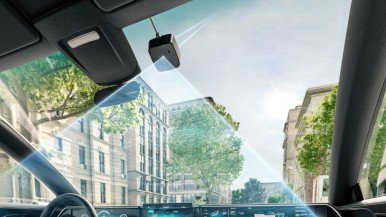
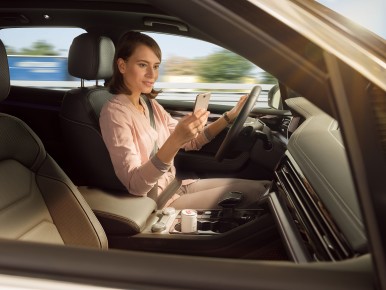
Stuttgart, Germany – Drowsiness, distraction, a seatbelt left undone – many things that happen inside a vehicle can have far-reaching consequences. To avert critical driving situations and possibly also accidents, future cars will use their sensors not only to monitor the road but also the driver and other passengers. For this purpose, Bosch has developed a new interior monitoring system featuring cameras and artificial intelligence (AI). If the car knows what its driver and occupants are doing, driving will become safer and more convenient....says Harald Kroeger, a member of the Robert Bosch GmbH board of management. The Bosch system may go into production in 2022. In that year, the EU will make safety technology that warns drivers of drowsiness and distraction, for example, a standard feature in new vehicles. The EU Commission expects the new safety requirements for vehicles will save more than 25,000 lives and help prevent at least 140,000 severe injuries by 2038. By tracking what is happening inside the car, technology can help solve a fundamental problem of self-driving cars. For example, if responsibility for driving is to be transferred to the driver following an automated drive, the car needs to be able to prove the driver is neither sleeping, nor reading the newspaper, nor writing emails on their smartphone. A smart camera constantly monitors the driver If a driver dozes off or looks at a smartphone for just three seconds, a vehicle traveling at approximately 30mph can cover about 130 feet completely unsupervised, and many people underestimate the associated risk. International studies state that nearly one in 10 accidents are caused by distraction or drowsiness, which has prompted Bosch to develop an interior monitoring system that detects and alerts to this danger and provides driving assistance. A camera integrated in the steering wheel detects when drivers’ eyelids are getting heavy, when they are distracted, and when they turn their head toward passenger or rear seats. Thanks to AI, the system draws the right conclusions from this information: it warns inattentive drivers, recommends a break if they are getting tired, or even reduces the speed of the vehicles – depending on the automaker’s wishes, as well as legal requirements. “Cameras and AI will turn the vehicle into a lifesaver,” Kroeger says. To achieve this, Bosch engineers have used intelligent image-processing algorithms and machine learning to teach the system to understand what the person in the driving seat is doing. For driver drowsiness, the system is trained using recordings of real driving situations, eyelid position and eye-blink rate to learn how tired the driver really is. This allows the system to give an alert that is appropriate to the situation, so driver assistance can be used to intervene. Warning systems that sound the alert, in the case of distraction and drowsiness, will be so important in the future that NCAP, the European New Car Assessment Program, will include them in the roadmap for its vehicle safety assessment by 2025. Further, only the software in the vehicle itself evaluates the information provided by the interior monitoring system – the information is neither saved nor shared with third parties. Like a relay race, responsibility for steering passes from car to driver and back At the very least when cars start driving automatically, it is important that they understand their drivers, as cars will drive along freeways without driver intervention. They will also have to hand back control to their drivers in tricky situations such as construction zones or when the exit ramp is drawing near. Drivers need the option to safely take the wheel again at any time during the automated driving phase. The camera makes sure they don’t fall asleep, and if their eyes remain closed for a prolonged period, an alarm is sounded. The system also interprets camera recordings to establish what drivers are currently doing and how ready they are to respond. The transfer of driving responsibility is then timed accordingly. “Bosch driver observation will be essential for safe automated driving,” Kroeger says. When the car keeps its camera eyes open The new Bosch system keeps its eye not only on the driver, it also tracks all the other passengers, whether next to or behind the driver. For this purpose, a camera mounted above or below the rearview mirror monitors the entire passenger compartment. It notices when children in the rear seats have carelessly unfastened their seat belts and warns the driver. If someone sitting in the back is leaning too far forward, at an angle, or with their feet up on the seat next to them, the airbags and belt tensioner will not be able to protect them properly in an accident. The interior monitoring camera can tell what position they are sitting in and set the airbags and belt tensioner to ensure the best possible protection. On the subject of children, it is a sad fact that parked vehicles can be dangerous for them. In the United States in 2018, parked vehicles claimed the lives of more than 50 children (source: KidsAndCars.org), either because they had been left in the car for a short while or had clambered in unnoticed. The new Bosch system can recognize this danger and warn parents quickly by sending a message to their smartphone. In an emergency, it also can alert the emergency services. As the Hot Cars Act currently being debated in the United States shows, legislators are interested in technology solutions to address this challenge. A camera for more convenience The Bosch interior monitoring camera can recognize preset driver preferences, such as seat position, rearview mirror adjustment, steering wheel height and infotainment profiles, for increased driver convenience. The camera can be used for eye- and hand-gesture control of the infotainment system as well.

13.12.2018

Press release

Internet of Things

CES 2019: The smart solutions Bosch will be presenting in Las Vegas

At CES 2019 in Las Vegas, Central Hall, booth #14020 from January 8 to 11, 2019, Bosch is presenting technological answers to today’s challenges, including urbanization, population growth, and climate change. The supplier of technology and services will be highlighting innovative solutions and services for the mobility of the future and for the smart home. World first: Bosch concept vehicle for a new kind of mobility At CES, Bosch wants people to experience a new kind of mobility in the form of a driverless electric concept shuttle with integrated services. This kind of mobility will soon feature on streets in major cities around the world: whisper-silent, driverless shuttles that are seamlessly connected with their surroundings. Bosch will provide the necessary hardware, software, and new digital services that will enable users to book vehicles, pay for their ride, or share it with other passengers.CES Innovation Awards: a total of six honorees for Bosch In the run-up to CES 2019, Bosch received a total of six CES Innovation Awards. The CES Innovation Awards are an annual program run by the Consumer Technology Association (CTA) covering 28 categories, and serve as an indicator of future trends. This year, awards went to the following Bosch products and solutions: 1. All-in-one principle for vehicle connectivity: For the future of connected, automated driving, vehicles need the ability to communicate smoothly both among themselves and with their environment. To this end, Bosch has developed a universal connectivity unit for all Wi-Fi-based and wireless-based transmission technologies used in vehicle-to-everything (V2X) communication. This enables vehicles to communicate with each other and with traffic infrastructure, regardless of the country or manufacturer. Software produced by the Portuguese startup Veniam handles the complex task of managing the data connections. It constantly searches for the best transmission technology for each requirement and switches automatically between the available options. 2. Trucks with no exterior mirror: The new Mercedes-Benz Actros is the first production truck to feature a camera system in place of conventional main and wide-angle mirrors. Known as Mirror Cam, this system offers better 360-degree vision. In addition to increasing safety, having compact digital cameras instead of mirrors improves the truck’s fuel consumption thanks to the cameras’ considerable aerodynamic advantages. Two cameras, fitted left and right on the roof of the driver’s cab, feed real-time images to two high-resolution 15-inch displays mounted on the A-pillars inside the cab. The system adjusts the monitor display to match the driving situation. Overall, Mirror Cam greatly improves the truck’s aerodynamics, safety, and vehicle handling. Daimler’s development partners for the Mirror Cam system are Bosch and Mekra Lang. 3. The smartphone as car key: The Bosch Perfectly Keyless access system will soon let car drivers, car-sharing fleet operators, and logistics companies manage their vehicle keys digitally. They can use a smartphone app to decide at any given time who should have access to cars or trucks and when. The ingenious feature of this Bosch system is that it makes the connection between smartphone and vehicle more secure than ever. Perfectly Keyless can pinpoint the authorized smartphone like a digital fingerprint. For CES 2019, Bosch has installed the system in a demonstration vehicle based on a Ford Mustang. 4. Radar-based assistance systems prevent motorcycle accidents: Blind-spot detection, collision warning, and adaptive cruise control: giving motorcycles radar as a sensory organ enables new motorcycle assistance and safety functions while providing an accurate picture of the vehicle’s surroundings. As a result, these assistance functions not only increase safety, they also enhance enjoyment and convenience by making life easier for riders. According to Bosch accident research estimates, radar-based assistance systems could prevent one in seven motorcycle accidents. These electronic assistants are always vigilant and, in emergencies, they respond more quickly than people can. They are based on a combination of radar sensor, brake system, engine management, and HMI. 5. App for connecting e-scooters: A new app turns e-scooters into connectivity pros. As well as displaying key information such as the e-scooter’s current battery charge, it allows rider-vehicle communication and the option to connect with other users via social networks. This makes it easy for users to find out which of their friends are in the area. In addition, there is a connected helmet holder on the e-scooter’s handlebar which is controlled by app. Whenever the e-scooter is parked, this provides a storage solution for the helmet while also protecting the vehicle against theft and its display against vandalism. 6. Retrofit solution for more efficient machinery and households: Bosch has developed the Phantom algorithm to help small and medium-sized enterprises assess and greatly increase the energy efficiency of their machinery. This retrofit solution, which takes just a few minutes to install, uses sensors to measure the load on each device in the customer’s energy consumption network to provide valuable insights into usage and potential faults. This enables users to improve the machinery’s operations and efficiency. In homes, too, Bosch Phantom can tell how much power each device is using. This energy transparency makes it possible to save electricity. Mobility of the future: selection of solutions and services Driving electric, yet stress-free – that is the goal of Convenience Charging, the Bosch service that the company is presenting at CES 2019 in a demonstration vehicle based on an Audi A3 e-tron. This integrated charging and navigation solution enhances the everyday benefits of electromobility. In the future, the service will tell electric cars precisely when their power will run out, but also where they can find the next charge spot. To this end, Convenience Charging combines information from the electric powertrain with both vehicle and environment data to produce a reliable range forecast. The service uses state-of-the-art route planning to determine charging opportunities based on the driver’s personal preferences. In the future, drivers of electric cars will be able to order food for delivery directly to their pre-booked charge spot, so they can make the best use of the charging time. Using the Convenience Charging app, drivers will also be able to plan the charging stops they need in the comfort of their own home, with the app then seamlessly transmitting the suggested routes between charge spots to the vehicle. Safe use of cell phones when driving: The mySPIN smartphone integration solution makes it safe for drivers to use smartphone apps while they are on the road. Now, mySPIN also supports the MirrorLink vehicle communication standard. In the future, it will take just a simple adapter for the vehicle’s infotainment system or instrument cluster to enlarge mySPIN-compatible apps and display a reduced set of their key functions. Drivers will then be able to operate the apps by touch or using the vehicle’s rotary push button. Bosch is also developing mySPIN smartphone integration for commercial vehicles, motorcycles, scooters, and powersports vehicles. Lifesavers from the data cloud: In Germany alone, some 2,000 warnings about wrong-way drivers are broadcast each year. In most cases, however, the warning comes too late, since such incidents generally end after an average of 500 meters – in the worst case with fatal consequences. Bosch has developed a cloud-based solution that sends a warning to wrong-way drivers and all road users at risk within ten seconds. Some 15 radio and navigation apps already use Bosch wrong-way driver warning technology to reach people in 13 European countries. The service relies on a software module for integration into existing infotainment systems and apps. Making the electronic horizon even more accurate: Today, the electronic horizon provides data on road inclines and the sharpness of bends to complement navigation data. Because the system enables vehicles to think ahead, it enhances both safety and convenience. Bosch is now working on the next-generation electronic horizon, which will be even more accurate and up to date. In addition to information on road classifications, bends, and vertical profiles, it will provide vehicle systems and navigation systems with geometries for each and every traffic lane as well as infrastructure data with 3D objects. This will help automated vehicles determine their precise location within the lane. A seat-of-the-pants feel for automated vehicles: Bosch predictive road-condition services will allow self-driving vehicles to determine how road conditions will develop over the course of a journey, based on weather data provided by the company’s partner Foreca. As a sufficient number of connected vehicles take to the roads, Bosch will supplement its predictive road-condition services with vehicle data. This will increase the safety, availability, and convenience of automated driving functions. Automated driving in cities: San José in California’s Silicon Valley is set to become the pilot city for an automated ridesharing service provided by Bosch and Daimler. The three parties have already signed a letter of intent to this effect. Bosch and Daimler plan to offer the app-based service with automated Mercedes-Benz S class vehicles to selected customers. The test area is centered on the San Carlos Street / Stevens Creek Boulevard traffic artery between Downtown and West San José. Bosch and Daimler are working together on solutions for automated driving in cities. Their aim is to develop a driving system for fully automated driverless driving (SAE level 4/5) that is ready for production by the beginning of the next decade. Integrated security solution for connected vehicles: Since April 2018, all newly registered vehicles are automatically connected vehicles – thanks to the automatic Emergency Call system. This makes it increasingly important to have integrated security concepts for connected vehicles. At CES, ESCRYPT will be presenting CycurACCESS, a security solution for keyless vehicle access systems. State-of-the-art cryptographic methods make these digital keys particularly secure. What’s more, the Bosch subsidiary is presenting an all-in-one solution for secure over-the-air software updates, Featuring efficient key and certificate management to guarantee end-to-end encryption from the car’s ECU to the vehicle manufacturer’s IT systems. Intelligent assistants: solutions for the smart home Food recognition for smart storage: Connected devices offer their owners tangible benefits both on the road and at home – for instance when it comes to optimizing how food is stored. Now, Bosch connected refrigerators with interior cameras offer a new function: food recognition with storage recommendations . The device automatically recognizes some 60 kinds of fruits and vegetables and suggests the ideal place to store them via an app. By storing food in the best possible way, it stays fresh for longer and doesn’t have to be thrown away so often. Cooking without sticky touchscreens: PAI is a Bosch projector that is mounted over the kitchen counter, turning the whole worktop into a touchscreen. An integrated 3D sensor records when users touch the surface, making touch control possible. That means users can access a wide variety of digital services while cooking or baking, for instance to pull up recipes with ease or control connected appliances. Thanks to its robust design, the PAI’s interface is easy to operate even with greasy fingers, unlike conventional smartphones or tablets. This approach also frees up space on the work surface. Easy lawn care thanks to artificial intelligence: Bosch is using machine learning to improve the way its Indego robot lawn mower recognizes obstacles on the lawn by evaluating data such as motor flow, acceleration, motor speed, and direction. Thanks to AI, Bosch is making lawn care even easier and more convenient by enabling the Indego to take over the chore of mowing. Each Indego adapts to its garden in order to mow it perfectly every time. And Bosch’s new connected Indego S+ opens up new possibilities for users. It now supports voice control via Amazon Alexa, making it one of the first robot lawn mowers on the market to offer this function. Turning shelves into personal assistants: The new BML100PI interactive projection module lets users create smart shelves in their closets or wardrobes. A single module projects touchscreen functions onto the surface of as many as six shelves at a time. These projections enable a wardrobe to display weather forecasts, an individual’s daily schedule, or reminders of upcoming events. This information forms the basis for daily outfit suggestions, which users can share on social media. Once clothing has disappeared from the shelves, users can use the virtual touchscreen to place an online order for something new or make an appointment with the laundry service. The interactive projection module turns any standard shelf into a personal assistant to make everyday life more convenient. Recognizing every movement: The new BMI270 sensor is an intelligent inertial measurement unit (IMU) sensor with extremely low energy consumption which was designed for use in wearable electronic devices. The BMI270 improves the functionality of these wearables, including step counting and gesture recognition, and can distinguish between different activities, such as standing, walking, running, or cycling, in addition to detecting the transition from one activity to another. It can also detect where activities are taking place – for instance, whether it is inside a vehicle. What’s more, the new sensor can detect movements such as bending or raising the arm and tilting the wrist, making it possible to operate wearables with intuitive gestures. The gesture recognition is fully compatible with the wearables operating system Wear OS from Google. The IMU’s high level of performance is the result of combining yaw-rate sensor technology used extensively in automotive applications with a significantly improved acceleration sensor. Getting to grips with the interior climate: The AIR well-being sensor offers innovative climate comfort for the home. It records and presents information on air quality, temperature, and humidity, as well as brightness and noise. Users can operate the well-being sensor even without a smartphone thanks to its easy-to-understand interface featuring traffic-light logic. In addition, the Bosch AIR app offers more detailed information about measurements over time and enables users to tailor the sensor’s settings. By offering specific recommendations for how to improve indoor air quality and achieve a healthy interior climate, AIR helps people perform, concentrate, and feel better. Voice control for heating systems: The .aino chatbot lets users communicate with their heating system using plain language. Typing or saying “I feel cold” instructs the system to increase the room’s temperature by two degrees Celsius. In addition, the chatbot even understands the difference between “a little cold” and “very cold,” expressing that as different degrees of temperature change. The system also provides useful energy-saving tips, for instance based on the weather forecast, and suggests how to improve the efficiency of the heating system. On request, .aino sends weekly or monthly reports of energy consumption including a year-on-year comparison. Bosch at CES 2019 PRESS CONFERENCE: Monday, January 7, 2019, from 9:00 to 9:45 a.m. local time, in the Mandalay Bay Hotel, Las Vegas South Convention Center, Level 2, Ballrooms B, C, and D BOOTH: Tuesday to Friday, January 8–11, 2019, in the Central Hall, #14020 FOLLOW the Bosch CES 2019 highlights on Twitter: #BoschCES PANELS WITH BOSCH EXPERTS: Wednesday, January 9, 2019, 9:00 – 10:00 a.m. (local time) “Connected Home Innovations” with Anne Rucker, global head of digital strategy, Venetian, Level 4 Marcello 4405 Wednesday, January 9, 2019, 9:00 – 10:00 a.m. (local time) “Technology, Jobs, and the Future of Work” with Charlie Ackerman, senior vice president of human resources North America, Las Vegas Convention Center, North Hall N258 Wednesday, January 9, 2019, 2:15 – 3:15 p.m. (local time) “IoT to the Max, Thanks to 5G” with Davie Sweis, vice president of web business, Las Vegas Convention Center, North Hall N256

Safe automated driving from Bosch: centimeters make all the difference

27.11.2018

Press release

Automated mobility

Safe automated driving from Bosch: centimeters make all the difference

Stuttgart, Germany – Automated driving is about more than just sensors, control units, and lots of computing power. It also requires a host of smart services, without which no vehicle will ever be able to drive autonomously. “Services are at least as important for automated driving as the hardware and software,” says the Bosch board of management member Dr. Dirk Hoheisel. “We must pursue all three paths simultaneously to get self-driving cars safely and reliably onto our roads.” Like barely any other global supplier of technology and services in the automotive industry, Bosch devotes significant effort into achieving a breakthrough in automated driving. In these efforts, it is creating integrated solutions. One area that demonstrates this is the safety-critical topic of localization. Self-driving vehicles can drive safely only if they know down to the nearest centimeter exactly where they are at any given time. To achieve this, Bosch offers a globally unrivaled localization package. Taken together, its hardware, software, and services serve as a redundant system for precisely determining the vehicle’s position.Hardware: Bosch has developed its own motion and position sensor Bosch has developed a sensor that allows automated vehicles to precisely determine their position: the vehicle motion and position sensor. This new sensor, which will be presented at the 2019 North American International Auto Show in Detroit January 14-17, includes a high-performance receiver unit for global navigation satellite system (GNSS) signals, which an automated vehicle needs to determine its absolute position. The challenge with satellite-based positioning lies in dealing with inaccuracies in the data. GNSS satellites orbit the earth at a distance of 25,000 kilometers and at speeds of 4,000 meters per second. As their signals make their way to the ground, they must pass through the ionosphere and layers of cloud in the troposphere, which disperse the signals and introduce errors. While the signals are still accurate enough for today’s navigation systems, they do not meet the needs of automated driving. This is why Bosch makes use of correction data supplied by various providers, and why it set up the Sapcorda joint venture in 2017. With the help of a network of terrestrial reference stations whose positions are precisely known, these providers can correct for the inaccuracy of GNSS positioning information. The correction data reaches the car via a cloud or geostationary satellites. GNSS signals are not the only information the vehicle motion and position sensor receives: thanks to wheel-speed and steering-angle sensors, which are akin to the human sense of touch, it knows where the car is headed and how fast. What’s more, the vehicle motion and position sensor features integrated inertial sensors – comparable to the inner ear in humans. Just as people can move around with the help of their senses of touch and balance, so the sensor can use this data to tell where the vehicle is going. Software: smart Bosch algorithms determine the vehicle’s position The vehicle motion and position sensor brings together the GNSS position signals, the correction data, and the information from the inertial sensors, the wheel-speed sensors, and the steering-angle sensor. However, this information alone is not sufficient for the exact localization of automated vehicles. For precise positioning, the data needs to be processed using intelligent software. Only then can an automated vehicle reliably know exactly where it is within an area stretching several meters around it and calculate its driving maneuvers accordingly. An automated vehicle is localized primarily on the basis of the corrected GNSS signals. If the satellite connection is lost, for instance when the vehicle enters a tunnel, the vehicle motion and position sensor can continue to determine the vehicle’s position for several seconds. This involves calculating the vehicle’s position relative to the last known point for which absolute positioning information is available. If the GNSS signal is interrupted for a longer period and it is no longer possible for the vehicle motion and position sensor to determine the vehicle’s position, the automated vehicle can refer to the Bosch road signature for localization information. Services: Bosch road signature is based on surround sensors The Bosch road signature is a map-based localization service based on the surround sensors in the vehicles of today and tomorrow. Bosch offers the service alongside its vehicle motion and position sensor-based localization solution. Bosch meets high safety requirements by combining the satellite- and vehicle motion and position sensor-based approach with the road signature’s map-based localization service. Video and radar sensors on board vehicles in motion generate the Bosch road signature by detecting stationary features on and by the road, such as lane markings, traffic signs, and guardrails. In this regard, radar sensors have a major advantage, since – unlike cameras – they can detect road features in the dark or when visibility is poor. Their detection range is also greater. A communication module in the car sends data relating to features on and by the road to the cloud. There, the features are used to generate an independent map level, which in turn forms part of a highly accurate map. For their part, automated vehicles detect the road features around them and consult the map to see whether the traffic signs or guardrails they have recognized match those recorded there. This comparison enables the cars to accurately determine their position in the lane – relative to the highly accurate map – down to the nearest centimeter. Bosch at NAIAS 2019: Monday – Thursday, January 14-17, 2019 at Cobo Center, Room 330A

Bosch and Daimler: San José targeted to become pilot city for an automated on-de ...

08.11.2018

Press release

Automated mobility

Bosch and Daimler: San José targeted to become pilot city for an automated on-de ...

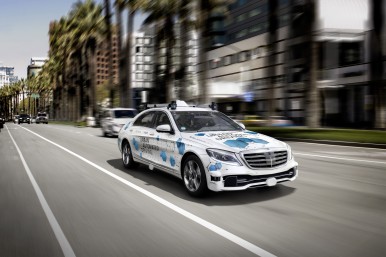
Stuttgart/San José – Located on the southern shore of San Francisco Bay in Silicon Valley, and with more than one million inhabitants, San José is the third biggest city in California. It is planned to be the pilot city for trials, targeted to begin during the second half of 2019, of the highly and fully automated driving (SAE Level 4/5) on-demand ride-hailing service recently announced by Bosch and Daimler. The three parties have signed a memorandum of understanding to pursue and finalize this activity. Using automated Mercedes-Benz S-Class vehicles, Bosch and Daimler propose to offer the service to a selected user community in the San Carlos/Stevens Creek corridor between downtown and west San José. With its population expected to grow 40 percent in the next two decades, the metropolitan area faces growing transportation challenges. Moreover, San José wants to prepare itself for a future in which autonomous cars hit the streets.“The pilot project is an opportunity to explore how autonomous vehicles can help us better meet future transportation needs,” says Sam Liccardo, mayor of San José. “Since many years we consequently push autonomous driving. With this pilot we will generate valuable insights to connect fully automated vehicles in the best way with users of future mobility services,” says Dr. Michael Hafner, Vice President Drive Technologies and Automated Driving at Daimler AG. “We have to rethink urban transportation. Automated driving will help us complete the picture of future urban traffic,” says Dr. Stephan Hönle, senior vice president of the Automated Driving business unit at Robert Bosch GmbH. The on-demand ride-hailing service app operated by Daimler Mobility Services will demonstrate how mobility services such as car sharing (car2go), ride-hailing (mytaxi), and multi-modal platforms (moovel) can be intelligently connected. The test operation will provide information about how highly and fully automated vehicles can be integrated into a multi-modal transportation network. The intent is to provide a seamless digital experience, in which a selected user community will have the opportunity to hail a self-driving car, monitored by a safety driver, from a designated pick-up location and drive automatically to their destination. Automated vehicles make urban mobility more attractive With their joint development work on highly and fully automated driving (SAE level 4/5) in urban environments, Bosch and Daimler aim to improve the flow of traffic in cities, enhance road safety, and provide an important building block for the way traffic will work in the future. Among other things, the technology will boost the attraction of car sharing. Without compromising driving safety, it will allow people to make the best possible use of the time they spend in their vehicles, and open up new mobility opportunities for people without a driver’s license. Bosch and Daimler associates share the same office space Bosch and Daimler associates involved in the development project work together in teams in two regions: in the greater Stuttgart area in Germany and, in the United States, around Sunnyvale in Silicon Valley between San José and San Francisco. Since they share the same office space, rapid communication across working disciplines is ensured, and decision-making paths are short. At the same time, they can draw on the combined know-how of their colleagues in the parent companies. The two companies’ associates are jointly developing the concepts and algorithms for the highly and fully automated drive system. Daimler’s task is to bring the drive system into the car. The company is providing the necessary development vehicles, test facilities, and vehicles for the test fleet. Bosch is responsible for the components specified during the development work, such as sensors, actuators, and control units. For test purposes, Bosch and Daimler use their laboratories and test rigs, plus their respective test sites in Germany. Since obtaining its Autonomous Vehicle Testing Permit from the California Department of Motor Vehicles in 2014, Mercedes-Benz has been testing automated vehicles in the Sunnyvale/California region. And since 2016, it has had similar approval for the greater Stuttgart area in Germany. In early 2013, Bosch was the world’s first automotive supplier to test automated driving (SAE level 3) on public roads in Germany and the United States. Bosch at CES 2019: PRESS CONFERENCE: In Ballrooms B, C, and D, Mandalay Bay Hotel, Las Vegas South Convention Center, Level 2, from 9:00 to 9:45 a.m. local time on Monday, January 7, 2019. BOOTH: Tuesday to Friday, January 8–11, 2019 , in the Central Hall, booth #14020 FOLLOW the Bosch CES 2019 highlights on Twitter: #BoschCES