Search & find:
Media, press releases, events for your editorial coverage

Bosch sensor platform turns robots into real movement talents

05.01.2026

Press release

Internet of Things

Bosch sensor platform turns robots into real movement talents

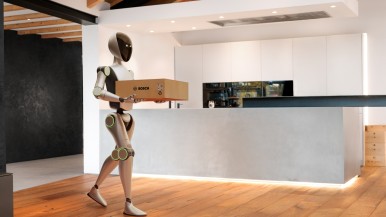
Las Vegas, NV – At the pulsating heart of the robotics revolution and the rapidly expanding world of Extended Reality (XR) lies a silent, yet indispensable technology: MEMS (Micro-Electro-Mechanical Systems) sensors. Much like the complex senses that guide living organisms, these tiny, sophisticated devices serve as the foundational pillar, endowing machines with the crucial ability to perceive and understand their own motion and orientation. This spatial awareness transforms complex algorithms into fluid movements and immersive digital experiences.Three new high-end sensors for the growth market At CES® 2026, Bosch Sensortec introduces the BMI5 platform, a new generation of inertial (acceleration and gyroscope) sensors designed to provide high-precision performance with ultra-low noise to capture every nuance of motion across multiple device classes. Built on a shared hardware foundation and adapted through intelligent software, the platform launches with three variants – BMI560, BMI563 and BMI570. The BMI5 family products are addressing the premium segments of consumer electronics device manufacturers, building the base for the growing MEMS sensor market. According to market research and strategy consulting company Yole Group, this market with Bosch as the market leader, is expected to grow to more than 19.2 billion USD by 2030, with an average compound annual growth rate (CAGR 2024-2030) of 4 percent.* To meet the high-volume serial production demands, the cleanroom area in its own Bosch wafer fab in Reutlingen, Germany was expanded from approximately 35,000 square meters to over 44,000 square meters by the end of 2025. Specific solutions for diverse applications The BMI560 sensor makes virtual and augmented reality experiences feel incredibly real. It precisely tracks head movements with almost no delay, allowing users to interact naturally in 3D environments. Advanced image stabilization helps smartphones and action cameras capture clear, shake-free photos and videos, even on the go. The BMI563 is handling vibrations and extreme movements, making it ideal for robots that need to navigate precisely or for controllers in virtual reality that track every subtle hand gesture. It helps these devices understand their surroundings and movements with exceptional accuracy. For example, Bosch's new MEMS sensor helps a humanoid robot find the right way, even if the camera lens is covered by an object. The BMI570 enhances smartwatches and wireless earbuds. Compared to its predecessor, the new platform delivers a doubled measurement range. This enables the detection of an even wider array of movements and gestures, particularly those in dynamic forms. For hearables it provides accurate head-orientation data for immersive 3D audio experiences. This means music or calls can sound like they're coming from a specific direction, reacting to how the user is moving. Technical AI excellence paired with responsible innovation An Edge-AI classification engine helps the device stay “always on” by recognizing movement patterns directly inside the sensor. This uses less power, makes reactions faster, and adds smart benefits — like automatic activity detection on a smartwatch without the user needing to interact. Across all variants, the BMI5 platform meets Bosch Sensortec’s highest ecological standards to date, combining technical performance with responsible innovation. This unified architecture enables device makers to streamline cutting-edge and at the same time a sustainable development across product lines. With the BMI5 platform, we are strengthening the foundation for the next generation of motion-aware devices...said Stefan Finkbeiner, CEO of Bosch Sensortec. “Our customers benefit from a consistent level of precision, robustness and exceptional performance across all variants - enabling responsive XR systems, reliable robotics and intuitive wearables. The platform combines technical excellence with responsible innovation, reflecting our core Bosch values of quality and sustainability supporting a wide range of applications with a single, scalable architecture. And this was just the beginning. The BMI5 family continues to grow, with more variants already in the pipeline.” *Source: Status of the MEMS Industry 2025 report, Yole Group. Availability: Samples are now available for direct customers, and the complete product line-up will go into high-volume series production from Q3 2026 onwards.

AI-enabled sensors deliver life-changing use cases

06.01.2025

Press release

Artificial Intelligence

AI-enabled sensors deliver life-changing use cases

Las Vegas, NV - Sensor technology is transforming our lives: tracking our fitness, making our gadgets easy to use, and monitoring air quality, to mention just a few examples. To provide all these sophisticated functions to consumers, Bosch Sensortec’s sensors are evolving to be smarter – by integrating MEMS technology with embedded microcontrollers, software, and AI runs inside the sensor itself. Bosch’s innovative cutting-edge sensor solutions are making an impact in diverse areas such as consumer health, smart homes and smart cities. AI and intelligent software are the key enabling technologies that make this possible. ...Stefan Finkbeiner, CEO at Bosch Sensortec At CES®, Bosch Sensortec is showcasing its latest AI-enabled sensors, and highlighting how software adds value not only to the sensor but to the entire system. Stefan Finkbeiner, CEO at Bosch Sensortec, said: “Bosch’s innovative cutting-edge sensor solutions are making an impact in diverse areas such as consumer health, smart homes and smart cities. AI and intelligent software are the key enabling technologies that make this possible.” Vision 2030: Bosch aims for more than 10 billion intelligent sensors According to market research and strategy consulting company Yole Group, Bosch is the market leader for MEMS for the fourth year in a row. In 2024 alone, Bosch Sensortec surpassed the milestone of delivering over 1 billion MEMS sensors featuring integrated microcontrollers and software. From 2027 onwards, 90 % of the products will include these integrated features. By 2030, the company aims to achieve a remarkable total of more than 10 billion MEMS sensors sold with this advanced integration. AI on the edge With AI running on the edge (meaning directly in the sensor), there’s no need for constant cloud connectivity. This ensures data remains private, dramatically reduces latency, and cuts power consumption, all while delivering accurate real-time feedback to users. State-of-the-art software solutions add value not only to the sensor but to the entire system, enabling new applications and forming the basis for AI inside the sensor itself. Always-on and ready to go Always-on technology is essential in consumer electronics, enabling continuous access to features without the need to activate the device and wake up the main processor. This significantly extends battery life, and creates a more intuitive and effortless experience for users, especially in smartphones and hearables. This is achieved with intelligent sensors combined with smart software, enabling quick access to voice assistants, health monitoring, and more, empowered by MEMS sensors with integrated microcontrollers. Examples of always-on use cases include voice activity detection and keyword triggering to activate voice assistants in hearables, fall detection in smartwatches for faster emergency assistance, and automatic orientation sensing in smartphones to adjust modes and enter sleep mode when inactive. Smart Connected Sensors (SCS): the personal AI feedback coach Can you imagine having unlimited access to a professional fitness trainer, with feedback at any time? This is the future of exercising – made possible by the Smart Connected Sensors platform from Bosch Sensortec. The platform gives users qualitative feedback on the movement execution, as well as measuring movements and repetitions. Specifically designed for full-body motion tracking, the SCS platform provides a fully integrated hardware and software solution (based on the BHI380, a programmable IMU-based sensor system with AI) that dramatically cuts development costs and time to market. A sound move for software-enabled voice control Wireless headsets have transformed how we listen to music, podcasts and audiobooks, providing free, unhindered movement – as well as new features enabled by sensors, such as activity recognition and indoor navigation. But shifting to voice control can cause problems, when the system is triggered unintentionally because it reacts to ambient noise. To fix this issue, Bosch Sensortec has come up with a software-based innovation: a new type of acceleration sensor, the BMA550, detects sound through bone vibrations. Intelligent algorithms then ensure voice control activates only when the wearer of the headset is actually speaking. Intelligent algorithms then ensure voice control activates only when the wearer of the headset is actually speaking. Take a breath: air quality sensing Poor indoor air quality is a problem: the concentration of PM2.5 particulates from domestic cooking can reach levels 100 times higher than acceptable limits. Localized, actionable data from Bosch's particulate matter sensor for PM2.5 and PM1 enables effective responses to poor air quality. A software update coming soon will activate PM10 measurement in addition. Almost the entire global population (99 %) breathes air that exceeds WHO air quality limits, and threatens their health. Bosch’s BMV080 sensor uses software and intelligent algorithms, in a tiny, fanless design which is more than 450 times smaller than any comparable device on the market. Open platform and strong collaboration Bosch can’t do all this alone and offers a framework that supports customers in creating movement classification algorithms specific for their own application. These models can then run on a smart motion sensor, such as the BHI360. For example, Bosch Sensortec and Doublepoint have partnered to develop a powerful microgesture control solution for smartwatches, using the BHI360. This enables always-available, reliable control, such as allowing users to adjust light brightness with an intuitive pinch gesture. This collaboration exemplifies Bosch Sensortec's commitment to innovation in the IoT and wearable markets, empowering manufacturers to bring advanced, user-friendly products to market more quickly. ... Lucas Ginzinger, Vice President Marketing and Business Strategy at Bosch Sensortec Doublepoint's advanced algorithms are seamlessly integrated into Bosch’s compact, low-power IMUs via a new software tool. Compared to camera-based solutions, this IMU-based approach enables obstruction-free gesture detection, offering greater reliability and efficiency. “This collaboration exemplifies Bosch Sensortec's commitment to innovation in the IoT and wearable markets, empowering manufacturers to bring advanced, user-friendly products to market more quickly,” said Lucas Ginzinger, Vice President Marketing and Business Strategy at Bosch Sensortec. Website: https://www.bosch-sensortec.com/

Bosch unveils cutting edge Smart Connected Sensors platform for full-body motion ...

08.01.2024

Press release

Internet of Things

Bosch unveils cutting edge Smart Connected Sensors platform for full-body motion ...

Las Vegas, Nevada / Reutlingen, Germany – Unlimited access to a personal feedback coach? That's the dream of many fitness and gaming enthusiasts. With the brand new Smart Connected Sensors platform, Bosch Sensortec ensures that movements and repetitions are not only measured, but that users get qualitative feedback on the movement execution. Specifically designed for full-body motion tracking, this new platform provides a fully integrated hardware and software solution that dramatically cuts development costs and time to market.Business customers wanting to integrate sensors in their designs are often faced with time-consuming and complicated tasks, combining and tweaking multiple devices to create the necessary hardware and software system. There is no sensor solution available on the market right now that provides wireless and ready-to-use full-body movement feedback. To meet this need and save developers precious time and effort, Bosch Sensortec provides business customers with the full package: BHI380, a programmable IMU-based sensor system using AI functionality. A wearable reference design (certified CE, FCC, ISED, MSIT, SRRC, MIC, NCC, UKCA) that can be straightforwardly attached to any part of the body without having to handle cable clutter, an external camera or dedicated bodysuits. Software features including gesture and activity recognition, body movement detection, relative body angle information, as well as a feedback coach. Multiple applications in rehabilitation, fitness and gaming The possibilities are almost endless. Key use cases will include rehabilitation, fitness, and gaming according to the motto “Move. Prove. Improve.” The Smart Connected Sensors platform provides complex feedback that enables users to properly perform rehabilitation exercises at home, thereby supporting their faster recovery. For highly responsive gaming applications, motion sensors will provide intuitive, accurate control by tracking even the tiniest movements. In the area of sports and fitness, the motion sensors can be used for complete body movement detection, for example to give detailed feedback on how well high-intensity exercises are performed. The sensors communicate wirelessly via Bluetooth Low Energy and thus do not restrict users' movement. Thanks to the platform principle, the system can be connected to numerous applications, such as wearables, hearables and AR/VR headsets. Engineers will find the Smart Connected Sensors platform easy to use and simple to scale, easily incorporating additional sensors and capabilities into their existing designs. Importantly, the platform enables up to eight nodes with various Bosch Sensortec sensors to be neatly connected to a central node, including Inertial Measurement Units (IMUs), magnetometers and pressure sensors. “For applications using Smart Connected Sensors, our new platform significantly reduces the amount of effort required from designers, enabling them to cut time to market and focus more on their specific expertise,” said Stefan Finkbeiner, General Manager and CEO at Bosch Sensortec. For applications using Smart Connected Sensors, our new platform significantly reduces the amount of effort required from designers, enabling them to cut time to market and focus more on their specific expertise...said Stefan Finkbeiner, General Manager and CEO at Bosch Sensortec. The sensor platform provides qualitative feedback based on integrated AI features and comes with a pattern creation software tool that helps customers customize their system design. By using this tool, the customer retains control over their data, as there is no need for regular data exchange with Bosch Sensortec. Availability: Smart Connected Sensors is available on direct request.

A new dimension of acceleration: Bosch launches world’s smallest MEMS accelerome ...

08.01.2024

Press release

Internet of Things

A new dimension of acceleration: Bosch launches world’s smallest MEMS accelerome ...

Las Vegas, Nevada / Reutlingen, Germany – Space is at a premium in hearables, smartwatches and other portable consumer products, and all components must be as small as possible. At the same time, OEMs are demanding plug-and-play step-counters and other sensors with built-in features that enable easy implementation without detailed application knowledge. To meet these challenges, Bosch Sensortec has announced the BMA530 and BMA580, the world's smallest MEMS accelerometers. Both devices include built-in features making them easy to design with. BMA530 tracks activities with its step counter and is especially suitable for wearables, and BMA580 targets hearables with voice activity detection.Compared to Bosch's current generation accelerometer (BMA253), the BMA530 and BMA580 have a 76 percent smaller footprint and have been reduced in height from 0.95 mm to 0.55 mm. This size reduction is achieved with an innovative Wafer Level Chip Scale Package (WLCSP). The small size of the accelerometers makes them easy to place on a PCB, and their integrated features make them easy for design engineers to integrate into their portable products. "The demand for tiny sensors with ever-increasing performance is growing as the industry moves towards more stylish and minimalist designs that require smaller sensors," said Stefan Finkbeiner, General Manager and CEO of Bosch Sensortec. "The new BMA530 and BMA580 provide an ultra-compact, fully-featured solution to meet this demand." The demand for tiny sensors with ever-increasing performance is growing as the industry moves towards more stylish and minimalist designs that require smaller sensors. The new BMA530 and BMA580 provide an ultra-compact, fully-featured solution to meet this demand. ...said Stefan Finkbeiner, General Manager and CEO of Bosch Sensortec. Bone conduction for reduced power consumption The BMA580 provides innovative voice activity detection and an advanced feature set for hearable devices. Typically, microphones in hearables consume a lot of power because they need to be always-on to listen for voice activity. Instead, the BMA580 uses bone conduction to detect the vibration of the user’s voice and then wakes the microphone from sleep – for an overall power saving. No other sensor on the market combines bone conduction with this miniature sensor size. The BMA580 enables user interaction with a hearable in response to the user tapping the device, for example to answer or end a call. The sensor’s software includes an algorithm that can distinguish between single, double and triple taps. In addition to wearables, the new BMA530 acceleration sensor is ideal for gesture recognition in toys, fall detection in laptops and other devices, and power management functions such as putting a smartphone to sleep when it is not moved. The new accelerometers offer multiple power modes and automatically switch from low-power to high-power modes to extend battery life. They offer a flexible set of connectivity options, including an I3C® interface. Availability: The new acceleration sensors from Bosch Sensortec can be ordered at our distribution partners from Q1 2024 onwards.

Sensor tech #LikeABosch: brand-new robust barometric pressure sensor is ready fo ...

04.01.2023

Press release

Sensortec

Sensor tech #LikeABosch: brand-new robust barometric pressure sensor is ready fo ...

Barometric pressure sensors are a key component in fitness tracking wearables and other applications, enabling altitude to be accurately determined. Bosch Sensortec continues to push the boundaries of possibilities and introduces the BMP585 at CES® in Las Vegas, Nevada. The BMP585 is a robust barometric pressure sensor that can be used underwater and in harsh environments – for example, in wearables for swimming.The BMP585 includes a liquid-proof gel cover, which means it can be used in wearables that will be exposed to water or other liquids, including salt water and chlorinated water in swimming pools. It includes all the features of Bosch’s existing BMP581 pressure sensor, with comparable best-in-class accuracy, while providing the robustness needed for new use cases. Low power consumption ensures long battery life in wearables, hearables, and portable applications. “With the BMP585, OEMs don’t need to sacrifice performance to achieve robustness – there’s no compromise necessary. With its extreme accuracy, the sensor measures a change in height of just a few centimeters. It can therefore detect movements in fitness training down to the level of individual pull-ups or push-ups. At the same time, users do not have to worry about environmental conditions - thanks to its ruggedness,” said Dr. Stefan Finkbeiner, CEO at Bosch Sensortec. Carefree and ready for any adventure: the BMP585 provides reliable mapping data for distance traveled and meters of altitude for hiking or running trips, thus supporting GPS data, and enabling accurate localization and navigation. With its resistance to water and chemicals, the BMP585 is also perfectly suited for a variety of industrial use cases such as liquid-level detection. Since its seal blocks access to dust, the sensor is ideally suited for clog detection in home appliances such as vacuum cleaners. With the BMP585, OEMs don’t need to sacrifice performance to achieve robustness – there’s no compromise necessary. With its extreme accuracy, the sensor measures a change in height of just a few centimeters. It can therefore detect movements in fitness training down to the level of individual pull-ups or push-ups. At the same time, users do not have to worry about environmental conditions - thanks to its ruggedness,...said Dr. Stefan Finkbeiner, CEO at Bosch Sensortec. Best-in-class performance and ultra-low current consumption The BMP585 delivers best-in-class performance similar to Bosch’s existing BMP581. It provides excellent relative accuracy of +/-0.06 hPa and typical absolute accuracy of +/-0.5 hPa. The BMP585 has a typical temperature coefficient offset (TCO) of just +/-0.5 Pa/K and low RMS noise of 0.08 Pa @ 1000 hPa (typical). Long-term drift over 12 months is only +/-0.2 hPa. Typical current consumption of just 1.3 μA at 1Hz data rate substantially extends battery life. The BMP585 offers an I2C, I3C, and SPI digital, serial interface. The BMP585 is provided in a compact 9-pin LGA package with a metal lid, measuring just 3.25 mm x 3.25 mm x 1.86 mm³, and is small enough to use in smartwatches and other wearables. Bosch at CES 2023 under the motto “Sensor tech #LikeABosch”: As a global market leader in MEMS sensor solutions, Bosch will showcase numerous innovations for consumer electronics. Click here for an overview of the sensor solutions from Bosch Sensortec. Availability: The BMP585 is available in Q2 2023. Website: BMP585

Sensor tech #LikeABosch: always on the right track thanks to a micro-sized digit ...

04.01.2023

Press release

Sensortec

Sensor tech #LikeABosch: always on the right track thanks to a micro-sized digit ...

For any portable device, other motion sensors may tell you where you are and how fast you’re moving, but to find out which direction you’re pointing you need a reliable magnetometer. Acting like a compass, it provides an accurate measurement of orientation in relation to the earth’s magnetic field.At CES® in Las Vegas, Nevada, Bosch Sensortec announces its next-generation magnetometer, the BMM350, which provides excellent performance with low current consumption to extend battery life. It enables a wide range of new use cases, including detecting head orientation for 3D audio, and pixel latency reduction in AR/VR to improve the user experience and avoid motion sickness. In indoor navigation, the digital pathfinder improves positioning accuracy where no GPS signal is available, and it enables position and speed detection in e-bikes, other vehicles, or industrial applications. The BMM350 is based on innovative TMR (tunnel magnetoresistance) technology and includes a unique field shock recovery feature. This capability, developed by Bosch, makes the device very robust against external magnetic fields, ensuring high accuracy at all times. “The market for magnetometers is growing, and our customers are asking for more accuracy – to keep up with the precision offered by our IMUs and pressure sensors,” said Dr. Stefan Finkbeiner, CEO at Bosch Sensortec. “It’s the right time to introduce the BMM350, with the benefits of its new TMR technology.” Compared to Bosch’s previous generation magnetometer, BMM150, the new device offers significantly improved performance. The average typical current consumption of the BMM350 is only 200 μA at a 100 Hz data rate, which is 20 times lower than the previous generation. Also, the noise is three times lower for the x/y axis, and the sensitivity is four times smaller compared to the BMM150. The BMM350 is provided in a slim WLCSP package measuring just 1.28 x 1.28 x 0.5 mm 3 . The market for magnetometers is growing, and our customers are asking for more accuracy – to keep up with the precision offered by our IMUs and pressure sensors,...said Dr. Stefan Finkbeiner, CEO at Bosch Sensortec. Bosch at CES 2023 under the motto “Sensor tech #LikeABosch”: As a global market leader in MEMS sensor solutions, Bosch will showcase numerous innovations for consumer electronics. Click here for an overview of the sensor solutions from Bosch Sensortec. Availability: The BMM350 is available in Q2 2023. Website: BMM350

Sensor tech #LikeABosch: new smart sensor system is more than a digital fitness  ...

04.01.2023

Press release

Sensortec

Sensor tech #LikeABosch: new smart sensor system is more than a digital fitness ...

Today’s consumers want portable and smart devices that have high performance and a full set of features, yet provide a long battery life. For product designers, this means making difficult decisions to minimize power consumption without affecting the user experience.At CES® in Las Vegas, Nevada, Bosch Sensortec announces a new smart sensor system that delivers a best-in-class performance/power consumption ratio, yet is simple to integrate due to its small size and built-in, ready-to-use software algorithms. The new BHI360 is a programmable IMU-based sensor system combining a gyroscope with an accelerometer that enables full customization. The integrated sensor fusion library enables 3D audio with head orientation for personalized sound experiences as well as simple gesture recognition. A product variant, the BHI380 equips the sensor with additional algorithms. BHI380 is based on the same architecture but also includes self-learning AI software suitable for a wide variety of fitness tracking, thus making training and tracking a breeze and enabling personalized workouts. Dedicated swim tracking software measures swimming style and boosts users to the next fitness level in the water, while the pedestrian dead reckoning (PDR) algorithm helps users reach their destination, even when the GPS signal drops out for a few minutes. This means it is particularly suitable for hearable and wearable devices. Typical applications include pedestrian navigation, 3D audio, personalized fitness tracking, and human-machine interaction. The smart sensor system has an integrated, low-power custom processor. This custom processor can run simpler sensor processing algorithms itself, such as gesture detection or step counting, thus avoiding waking the main device processor and keeping power consumption ultra-low. The custom processor also helps achieve better power consumption for high-end algorithms. “When we say that the BHI360/380 is the most intelligent programmable IMU ever, we mean it has the most powerful built-in microprocessor, paired with an extensive software library of integrated algorithms,” said Dr. Stefan Finkbeiner, CEO at Bosch Sensortec. The sensor is provided in a compact 20-pin LGA package measuring 2.5 x 3 x 0.95 mm 3 . This means it is 50% smaller than its previous generation, and that it is the smallest programmable dual-core IMU sensor in the market. Typical total current consumption is less than 600 µA for 3D orientation. It provides fast SPI (50MHz) and I2C (3.4MHz) host interfaces, as well as multiple SPI, I2C, and GPIO interfaces for external sensors. When we say that the BHI360/380 is the most intelligent programmable IMU ever, we mean it has the most powerful built-in microprocessor, paired with an extensive software library of integrated algorithms,...said Dr. Stefan Finkbeiner, CEO at Bosch Sensortec. Bosch at CES 2023 under the motto “Sensor tech #LikeABosch”: As a global market leader in MEMS sensor solutions, Bosch will showcase numerous innovations for consumer electronics. Click here for an overview of the sensor solutions from Bosch Sensortec. Availability: The BHI360 is available at our distribution partners from April 2023 onwards. The BHI380 is available on direct request from May 2023 onwards. Website: BHI360 BHI380

Sensor tech #LikeABosch: world's smallest particulate matter sensor revolutioniz ...

04.01.2023

Press release

Sensortec

Sensor tech #LikeABosch: world's smallest particulate matter sensor revolutioniz ...

Clean air is fundamental to our health and well-being. Today, people typically spend approximately 90% of their time indoors, which has a negative long-term impact on health because indoor air is three to five times more polluted than in the outdoor environment in most parts of the world. A major component of this pollution is fine dust known as PM2.5 particulates, which are solid and liquid particles smaller than 2.5 µm. These particulates are inhaled and enter the lungs, where they cause serious health problems.The most common air quality measurement stations only provide outdoor data averaged over time, which fails to deliver real-time, localized information most relevant to our health. At CES® in Las Vegas, Nevada, Bosch Sensortec is addressing this issue with its new BMV080, the world’s smallest PM2.5 air quality sensor, which provides accurate, actionable data. “Indoor air quality is a problem: in poorly ventilated homes, PM2.5 concentration from domestic cooking can reach levels 100 times higher than acceptable limits,” said Dr. Lucas Ginzinger, Head of Product Area Optics at Bosch Sensortec. “With localized, actionable data from the new BMV080, it’s now possible to identify and respond to poor air quality.” The BMV080 sensing element measures only 4.2 x 3.5 x 3 mm³ (W x L x H), which is more than 450 times smaller in volume than any comparable device on the market. The miniscule size and fanless, non-intrusive design of the BMV080 are a game-changer, and its noiseless operation means it does not disturb residents who may be sleeping or working. The new sensor is maintenance-free with no fan-induced dust buildup, which means that it’s more reliable, and less prone to malfunction. It is a natural fit for ultra-compact wearable or IoT devices such as air quality monitors, smart thermostats, smart speakers, smart switches and smart air purifiers. Comparable state-of-the-art PM2.5 sensors all rely on a fan to draw air across a laser beam, where a photodiode then detects and measures the particulates as they reflect or block the light from the laser. The BMV080 utilizes an innovative design based on ultra-compact lasers with integrated photodiodes. It applies sophisticated algorithms to measure the PM2.5 concentration directly in free space, without requiring a fan. The innovation brings awareness and choice to people who value healthy living. The new sensor is easily integrated into ultra-compact IoT-based smart home and smart building systems to deliver air quality notifications to residents when PM2.5 levels rise above a threshold level. To take action, the resident or home automation system can ventilate by switching on an exhaust fan or filter to clear the air. "The BMV080 provides timely, accurate and actionable information about particulate concentration levels in the air, enabling the identification and handling of indoor and outdoor pollution to improve people's well-being and health,” said Stefan Finkbeiner, CEO at Bosch Sensortec. "It is dramatically smaller than existing devices on the market and opens up an entirely new set of applications for design engineers to explore." The BMV080 provides timely, accurate and actionable information about particulate concentration levels in the air, enabling the identification and handling of indoor and outdoor pollution to improve people's well-being and health,...said Stefan Finkbeiner, CEO at Bosch Sensortec. Bosch at CES 2023 under the motto “Sensor tech #LikeABosch”: As a global market leader in MEMS sensor solutions, Bosch will showcase numerous innovations for consumer electronics. Click here for an overview of the sensor solutions from Bosch Sensortec. Availability: Product samples will be available in 2023. Website: BMV080

Many applications made easy: Bosch launches cost-effective motion sensor BMI323

20.10.2022

Press release

Sensortec

Many applications made easy: Bosch launches cost-effective motion sensor BMI323

The BMI323’s combination of simplicity with an excellent price-performance ratio will open up new applications for IMUs...said Dr. Stefan Finkbeiner, CEO at Bosch Sensortec. Tiny MEMS motion sensors are all around us. They make consumer products easier to use and improve how our smartphones and other gadgets interact with us. These sensors are precise, compact and power-efficient, however, until now, they have been complex for basic applications. To address this issue, Bosch Sensortec is launching the BMI323, an affordable Inertial Measurement Unit (IMU) with excellent performance and integrated features enabling a shorter development time. "The BMI323’s combination of simplicity with an excellent price-performance ratio will open up new applications for IMUs," said Dr. Stefan Finkbeiner, CEO at Bosch Sensortec. "These will include standard consumer products, such as toys, gaming controllers, remote controls, wearables, fitness trackers, smartwatches as well as tablets and laptops." Like its predecessor BMI160, the new BMI323 is a general-purpose, low-power IMU that combines precise acceleration and angular rate (gyroscopic) measurement with intelligent integrated features that are triggered by motion. Its integrated features make development faster and easier for OEMs. For example, the BMI323 already includes Bosch Sensortec’s plug-and-play step counter software, so customers don’t need to spend time developing their own algorithms. Other features include motion detection that can turn subsystems on or off when a device, such as a TV remote control, is put down or picked up, thus reducing overall power consumption. Compared to the BMI160, the BMI323 provides improved accelerometer performance as well as lower power consumption. In high-performance mode, using both the gyroscope and the accelerometer, the BMI323 has a current consumption of 790µA compared to 925µA on the BMI160, which represents a reduction of nearly 15%. The 6-axis BMI323 has a self-calibrating 16-bit triaxial gyroscope, a 16-bit triaxial accelerometer, and a 16-bit digital temperature sensor housed in a miniature 2.5 x 3.0 x 0.83 mm3 (14-pin) LGA package that is pin to pin compatible with the BMI160 and others. The BMI323 is the first IMU device announced by Bosch Sensortec to include the new I3C interface, in addition to the I2C and SPI interfaces. Availability: The BMI323 is available now. Website: https://www.bosch-sensortec.com/products/motion-sensors/imus/bmi323/ Contact person for press inquiries: Katharina Sorg phone: +49 711 811-26074 Twitter: @BoschMEMS

Bosch barometric pressure sensor raises the bar for accuracy and performance in  ...

05.04.2022

Press release

Smart Home

Bosch barometric pressure sensor raises the bar for accuracy and performance in ...

Bosch Sensortec introduces the BMP581, a barometric pressure sensor that couples low power consumption with extreme accuracy to provide altitude tracking in wearables, hearables or IoT devices. This capability makes it ideal for applications such as fitness tracking, fall detection, indoor localization and navigation, enabling new use cases that were previously impossible."Building on the excellent performance and low power consumption of previous generations of Bosch sensors, our new BMP581 now delivers an entirely new level of accuracy", says Dr. Stefan Finkbeiner, CEO at Bosch Sensortec. "It’s breathtakingly accurate: it can measure a barometric pressure fluctuation that's equivalent to one-thousandth of the weight of a mosquito (7.6 μg)." This extreme level of accuracy enables the sensor to detect an altitude change of just a few centimeters. It can, therefore, monitor movement in fitness applications down to the level of individual pull-ups or push-ups, and can provide highly accurate location information for indoor localization, navigation, and floor detection to provide key data for emergency call requirements (E-911) . The sensor can noticeably improve flight stability and landing accuracy in drones, and help detect water levels in household appliances to avoid flooding. Building on the excellent performance and low power consumption of previous generations of Bosch sensors, our new BMP581 now delivers an entirely new level of accuracy...Dr. Stefan Finkbeiner, CEO at Bosch Sensortec Low power consumption coupled with high accuracy The BMP581 provides an excellent relative accuracy of +/-0.06 hPa and a typical absolute accuracy of +/-0.3 hPa. Full accuracy is available over a wide measurement range from 300 hPa to 1100 hPa. The BMP581 has a typical temperature coefficient offset (TCO) of just +/-0.5 Pa/K and low RMS noise of 0.08 Pa @ 1000 hPa (typical). Long-term drift over 12 months is only +/-0.1 hPa. Compared to BMP390, the previous generation of Bosch barometric pressure sensors, the BMP581 draws 85% less current, noise is 80% lower, and TCO is reduced by 33%. Typical current consumption of just 1.3 μA at 1Hz substantially extends battery life, while the deep standby mode draws only 0.5 μA. The sensor provides an I2C, I3C and SPI (3-wire/4-wire) digital, serial interface. The BMP581 is provided in a compact 10-pin LGA package shielded by a metal cover, measuring just 2.0 x 2.0 x 0.75mm 3 . Virtual unveiling event: Watch the video to find more detailed information and application examples for the new sensor and to get an insight into the product's development. https://www.bosch-sensortec.com/unveil/event/ Availability: The BMP581 is available now and offers a strong price-performance ratio.

CES 2020: Bosch raises the bar when it comes to artificial intelligence

06.01.2020

Press release

Business/economy

CES 2020: Bosch raises the bar when it comes to artificial intelligence

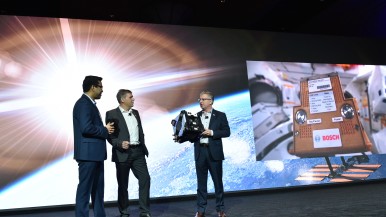
Las Vegas, NV, USA – Whether for automated driving, the smart home, or manufacturing: artificial intelligence (AI) has become an integral part of everyday life. Bosch uses AI and the internet of things (IoT) to make life easier for people and as safe as possible. Here, the slogan “Beneficial AI. Building trust together” sums up the technology and services company’s approach. The focus is on safe and robust AI for the manufacture of smart products, which Bosch will be showcasing at this year’s CES. One of these products is the Virtual Visor: an AI-based digital vehicle sun visor that will be making its debut at the world’s largest trade fair for consumer electronics. The product has also won a CES® Innovation Award, as has Bosch’s 3D display for the car.Other Bosch AI highlights at the show include an application for predictive maintenance of the International Space Station, a system for monitoring vehicle interiors, and a smart platform for medical diagnostics. “The solutions we’re showcasing at CES make it clear that Bosch aims to become an innovation leader in AI as well,” says Bosch management board member Michael Bolle. “As of 2025, every Bosch product will either contain artificial intelligence or will have been developed or manufactured with the help of AI.” The global market volume for AI applications is expected to be around 120 billion dollars over that same period, a twelvefold increase compared to 2018 (source: Tractica ). Bosch wants to tap into that potential: the company already invests 3.7 billion euros each year in software development, currently employs more than 30,000 software engineers, and has 1,000 associates working on AI. In addition, Bosch has established a comprehensive training program. “We plan to make nearly 20,000 associates AI-savvy over the next two years,” Bolle explains. “We must invest not only in artificial intelligence, but in human intelligence as well.” The program includes training formats at three different levels for managers, engineers, and AI developers and includes guidelines for using AI responsibly. To that end, Bosch has drawn up its own set of AI principles that address issues of AI security and ethics. With this in combination with its expertise, the company intends to build trust with customers and partners alike: “Anyone who has internalized technical and ethical principles knows how important data security and sovereignty are,” Bolle says. “In a way, trust is the product quality of the digital world.”Expertise saves lives In the future, Bosch believes one core area of expertise will be the industrial application of artificial intelligence. “We want to harness the power of artificial intelligence not for the purpose of creating models of human behavior, but instead to improve technology to benefit people,” Bolle says. “For this reason, industrial AI has to be safe, robust, and explainable.” According to Bosch, that means people should always remain in control, whether on the street, at home, or in manufacturing. As a pioneer in the development of life-saving driver safety systems such as ABS, ESP, and airbag control units, the company has already proved in the past that people benefit from reliable machines. AI can also make driver assistance systems even more efficient and intelligent: when Bosch’s AI camera for automated driving identifies partially concealed pedestrians, for example, the automatic emergency braking assistant can react even more reliably. Bosch is creating learning technology that is “Invented for life.”Bosch invests 100 million euros in an AI campus Innovations require investment. In addition to spending on software development, Bosch is investing worldwide in people and in competence centers. For example, the company is investing 100 million euros in the construction of a new AI campus in Tübingen, Germany. The move into the new research complex is planned for the end of 2022. It will then offer some 700 AI experts space for creative and productive exchange. These experts come from Bosch, external startups, and public research institutions. The new campus should strengthen exchange among experts in Cyber Valley. “Building trust together” will be a living reality there. Bosch is a founding member of Cyber Valley , which was established in 2016. This joint research venture brings together partners from industry, academia, and government to drive forward AI research and quickly transfer research findings into real-world industrial applications. In addition, the Bosch Center for Artificial Intelligence (BCAI) operates at seven locations worldwide, including two in the U.S.: in Sunnyvale, California and Pittsburgh, Pennsylvania. The BCAI currently has a total of some 250 AI specialists working on more than 150 projects in the domains of mobility, manufacturing, smart homes, and agriculture.World-first Virtual Visor originated in the U.S. Bosch has creative AI minds developing product innovations for mobility, the smart home, and Industry 4.0. Its AI world first for the automotive sector, which is celebrating its world premiere in Las Vegas, originated in the U.S.: the Virtual Visor, which is a transparent digital sun visor. A transparent LCD display connected to the interior monitoring camera detects the position of the driver’s eyes. Using intelligent algorithms, the Virtual Visor analyzes this information and darkens only the portion of the windshield through which the sun would dazzle the driver. The Virtual Visor scored the highest in its category at the CES Best of Innovation Awards. Bosch’s new 3D display won its category as well. Using passive 3D technology, the display generates a realistic three-dimensional effect for images and alerts. This allows visual information to be grasped faster than when displayed on conventional screens, increasing road safety. Additional safety comes from Bosch’s new interior monitoring system for vehicles. It detects when the driver is drowsy or looks at a smartphone based on eyelid movements, direction of gaze, and head position – and alerts the driver to critical situations. It also monitors the vehicle interior to determine how many occupants are present and where and in what position they are sitting. This makes it possible to optimize the operation of safety systems such as the airbags in an emergency. In 2019, Bosch sales of driver assistance systems rose by 12 percent to around 2 billion euros. They are paving the way for automated driving. In the future, when vehicles are in partially automated driving mode for sections of the journey such as on the freeway, the driver monitoring system will become an indispensable partner: In these situations, the camera will ensure that the driver can safely take the wheel again at any time. By 2022, the company will have spent around 4 billion euros on automated driving and will employ more than 5,000 engineers. To round out its sensor portfolio in this domain, Bosch is now working on making lidar sensors production-ready as well. In addition to radar and cameras, lidar is the third essential sensor technology. The Bosch long-range lidar sensor can also detect non-metallic objects at a great distance, such as rocks on the road.Bosch AI used in space and in medicine The company is aiming high with its SoundSee sensor system, which was sent into space at the end of 2019. Riding on NASA’s autonomous flying Astrobee robot, SoundSee will isolate unusual sounds on the ISS, analyze the audio using AI-driven analytics, and indicate when maintenance is necessary. Starting in early 2020, audio data captured by Soundsee will be delivered to a ground control facility configured to meet NASA specifications and built into the Bosch Research Center in Pittsburgh, PA. The system, which is barely bigger than a lunchbox, was developed in the U.S. together with Astrobotic as part of a NASA research collaboration.A completely earthbound but no less innovative product is Vivalution, a smart pathology platform that helps in medical diagnosis. Vivalution magnifies specimens like blood and other bodily fluids, digitizing the microscopic findings, and analyzing them with the help of artificial intelligence-powered algorithms. It is capable of precisely and rapidly identifying cell anomalies and providing physicians with useful support in evaluation and diagnosis.Smartglasses Light Drive make everyday glasses smart Bosch is also showcasing many non-AI innovations at CES. For example, its Light Drive smartglasses module is the world’s first sensor-based solution for making a normal pair of glasses smart. It is more than one-third thinner than other solutions on the market and weighs less than ten grams. The crystal-clear images projected into the wearer’s field of vision, which are clearly discernible even in direct sunlight, range from navigation information and text messages to calendar entries and operating instructions – depending on the information received from a smartphone or smartwatch. At CES, Bosch is using its IoT shuttle technology showpiece to present the solutions that the company offers automakers and mobility service providers for the electrification, automation, connectivity, and personalization of ridesharing vehicles. Its portfolio goes beyond components to include seamlessly connected mobility services that give users flexibility in how they operate, manage, charge, and maintain their fleet vehicles, as well as making each journey safe. At the Bosch booth, visitors can also see improved drive and sensor technologies for the connected and emissions-free mobility of the future.Solutions for the entire house: expanded portfolio for residential IoT Bosch is expanding the scope of its services for the residential internet of things (IoT). The highlight here is the open Home Connect platform, which is being showcased at CES. Starting in mid-2020, the platform’s app will also offer control of lighting and shade, entertainment, and smart gardening equipment from different manufacturers. The number of partner companies, which is currently at 40, is set to more than double, making life at home even more convenient and efficient.Smart technology protects the environment Underlying all these innovative products is Bosch’s entrepreneurial mindset. “We want to harmonize commercial, environmental, and social responsibility,” Bolle says. Climate protection is also a major concern here. According to Bolle, “Bosch not only develops environmentally friendly solutions, but also acts as a role model. By the end of 2020, all our 400 locations worldwide will be climate neutral and from development to manufacturing to administration no longer leave a carbon footprint. We’ve already achieved this for our German locations.” Artificial intelligence plays a role here, too: at individual locations, for example, an in-house energy platform uses intelligent algorithms to identify deviations in energy consumption. This alone has enabled some plants to reduce their CO2 emissions by more than 10 percent over the past two years. Considering that Bosch operates a total of 270 such plants, the savings potential is enormous. As Bolle explains, “That’s how we sum up our message at CES: Bosch has big plans for AI in many respects.”

CES 2020: Bosch presents intelligent technology that is “Invented for life”

06.01.2020

Press release

Smart Home

CES 2020: Bosch presents intelligent technology that is “Invented for life”

Stuttgart, Germany / Las Vegas, NV, USA – At CES® 2020 in Las Vegas, Central Hall, booth #12401 from January 7 to 10, 2020 , Bosch is presenting connected products for mobility and the home. Among the highlights at the trade fair are solutions that either make use of artificial intelligence (AI) or that were developed or manufactured with its help. The international supplier of technology and services wants to make AI safe, robust, and explainable, whether in manufacturing, smart homes, or automated driving.CES 2020 Innovation Awards: award-winning Bosch solutions In the run-up to CES 2020, Bosch twice received the highest score in the Innovation Awards and was also a three-time Honoree. The CES Innovation Awards are an annual program run by the Consumer Technology Association (CTA) covering 28 categories, and serve as an indicator of future trends. In addition to the 3D display for cars, a world first from the Car Multimedia division also received the coveted Best of Innovation award: the virtual visor. Both innovations were also designated Honorees in other categories. The third Honoree distinction goes to Bosch Vivalution (brand name was changed) – a smart platform for medical diagnostics.A world first: virtual visor – the transparent digital sun visor (AI inside): Conventional sun visors shield car drivers from dazzling light. But folding them down often also blocks significant areas of the driver’s field of vision. Bosch has solved this problem with a new, transparent LCD display that replaces opaque visors. The virtual visor is connected to the interior monitoring camera, which detects the position of the driver’s eyes. Using intelligent algorithms, the virtual visor analyzes this information and darkens only the portion of the windshield through which the sun or other light sources would dazzle the driver. The rest remains transparent, leaving the driver’s view of the road unobstructed.3D display – bringing the third dimension to the cockpit: The new Bosch 3D display uses passive 3D technology to generate a realistic three-dimensional effect for images and warning signals. This allows visual information to be grasped faster than when displayed on conventional screens, reducing driver distraction. Furthermore, this display system with spatial depth works completely without additional features such as eye tracking or 3D glasses.Vivalution (brand name was changed)– a smart pathology platform for medical diagnostics (AI inside): Bosch Vivalution can magnify microscopic samples of blood and other bodily fluids, take a digital picture of them, and analyze them using artificial intelligence powered algorithms. The device has already been trained on more than 30,000 images and some nine million discrete points of cells using machine learning methods – and it is still learning. It is able to determine irregularities in cells quickly and precisely, supporting doctors during evaluation and diagnosis.A Bosch must-see SoundSee – intelligent ears for the ISS (AI inside): Barely bigger than a lunch box, Bosch’s SoundSee is packed with state-of-the-art artificial intelligence (AI). SoundSee is already in orbit and will soon be deployed onboard on the International Space Station (ISS.) Riding on NASA’s flying autonomous Astrobee robot, the SoundSee uses integrated microphones to capture ambient noise in space and then analyze the audio using AI-driven analytics. By using artificial intelligence, SoundSee can analyze audio data to spot potential anomalies and give an indication of when maintenance work is needed. In early 2020, audio data captured by SoundSee will be delivered to a NASA-spec’d ground control facility built into the Bosch Research Center in Pittsburgh, PA. SoundSee was developed together with Astrobotic as part of a NASA research collaboration.Light Drive smart glasses – keeping information always in view : Bosch Sensortec is presenting Light Drive smart glasses – the world’s first solution for making a normal pair of glasses smart. The integrated projection system consists of MEMS mirrors, optical elements, sensors, and an intelligent software connection. Light Drive smart glasses are more than one-third thinner than previous solutions on the market and weigh less than ten grams. The crystal-clear images they project into the wearer’s field of vision, which are clearly discernible even in direct sunlight, range from navigation information and text messages to calendar entries and operating instructions – depending on the information they receive from a smartphone or smartwatch.Interior monitoring – safety, comfort, and convenience for all occupants (AI inside) : Based on eyelid movements, direction of gaze, and sitting position, this Bosch vehicle interior monitoring system detects when the driver is drowsy or looks at a smartphone – and alerts the driver to critical situations. It also monitors the vehicle interior to determine how many occupants are present and where they are seated. This makes it possible to optimize the operation of safety systems such as the airbags in an emergency. What’s more, the system increases occupants’ comfort and convenience. For instance, it automatically activates stored personal settings such as seat position. In the future, when vehicles are in partially automated driving mode for sections of the journey such as on the freeway, the driver monitoring system will become an indispensable partner: the camera will ensure that the driver can safely take the wheel again at any time.Bosch IoT Shuttle – the future of mobility : In the future, mobility service providers (MSPs) will increasingly use shuttles to offer customized on-demand mobility – whether for road freight or passenger transport. At CES, Bosch is using its IoT Shuttle technology showpiece to present the solutions that the company offers automakers and MSPs for the electrification, automation, connectivity, and personalization of shuttles. Its offering goes beyond components to include seamlessly connected mobility services that give users flexibility in how they operate, manage, recharge, and maintain their fleet vehicles, as well as making each journey safe.Mobility of the future: selection of solutions and services Intelligent front camera : understanding what it sees with computer vision and AI (AI inside) : This camera detects objects, categorizes them into classes such as vehicles, pedestrians, or bicycles, and measures their movement. The camera is also capable of interpreting what it sees to distinguish between the lane and the grass shoulder or roadside structures – even in the absence of road markings. In congested urban traffic, the camera can also recognize and classify partially obscured or crossing vehicles, pedestrians, and cyclists quickly and reliably. This allows the vehicle to trigger a warning or emergency braking. This camera intelligence is based on Bosch know-how and integrated into a chip, known as V3H, made by the Japanese company Renesas. It can also improve legacy driver assistance systems and extend their application range. For instance, it could enhance automatic emergency braking systems to prevent vehicles hitting various types of animals.Lidar sensors – the third type of sensor technology needed for automated driving, alongside radar and camera: Bosch is extending its sensor portfolio for automated driving and is starting production of long-range lidar sensors. Bosch long-range lidar will be the first solution available on the market suitable for automotive use. This means that it can be manufactured in large volumes and will work reliably throughout a car’s service life. Lidar plays a key role in ensuring that highly-automated vehicles can reliably detect hazards even in challenging driving situations – situations where radar and cameras come up short. The long-range lidar can also detect non-metallic objects at a great distance, such as rocks on the road.Radar sensors – surround sensors for complex driving situations : The latest generation of Bosch radar sensors are even better at capturing the vehicle’s surroundings – including in bad weather or poor light conditions. Their greater detection range, wide aperture, and high angular resolution mean automatic emergency braking systems can react more reliably.Automated valet parking – fully automated valet parking service : This joint development by Bosch and Daimler is the first SAE Level 4 system to be officially approved for everyday use in Germany. The sensors for the parking garage infrastructure and the communications technology come from Bosch. By the end of 2021, it is expected that a dozen other parking garages will be equipped with automated valet parking. Bosch is working on this together with parking garage operators and developers of major real-estate projects.Vehicle computer – next-generation electronics architecture : One key to the future of connected, automated, and electrified mobility is vehicles’ electronics architecture. Not only will new, high-performance vehicle control units make vehicles considerably more powerful in the future, but by reducing the number of ECUs, they will also reduce vehicle weight and complexity in the interactions between components and systems. Bosch vehicle computers will increase computing power by a factor of 1,000 by the start of the next decade. The company is already creating these kinds of computers for automated driving, the powertrain, and the integration of infotainment systems and driver assistance functions.Perfectly keyless – the smartphone as car key : In the future, Perfectly keyless will use not only Bluetooth for communication between the vehicle and a smartphone, but also ultra-wideband (UWB), a new communications technology that is already available in some smartphones. UWB lets smartphones be localized to within a few centimeters. It also makes communication with the vehicle particularly secure. Bosch is currently working with partners to standardize data transmission between smartphones and vehicles. At CES, Bosch is presenting a demonstration vehicle in which Perfectly keyless makes use of UWB for the first time.Fuel-cell system – electromobility for the long haul : Mobile fuel cells offer long ranges, short refueling times, and – with hydrogen produced using renewable energy – emissions-free operation of electric vehicles. Bosch is currently commercializing a fuel-cell stack together with the Swedish company Powercell. In addition to the stack, which converts hydrogen into electrical energy, Bosch is developing all the essential system components to a production-ready stage.Rolling chassis – electromobility platform : Electrical powertrains, steering systems, brakes – Bosch has all the building blocks of electromobility in its portfolio. As part of a development partnership with the chassis and automotive technology expert Benteler, the company is demonstrating how all Bosch products for electric vehicles can be integrated with one another. The rolling chassis showpiece is, among other things, helping Bosch to strategically refine products to meet such requirements.E-axle – SiC technology for high-performance electric vehicles : Bosch is presenting its new Performance e-axle, which incorporates new technological solutions to further increase the efficiency and power density of electrical powertrains. The new drive unit features improved system efficiency of up to 96 percent, which extends vehicle range by up to 6 percent in the WLTP test cycle. And at 3 kilowatts of power per kilogram, the power density is 50 percent higher than in the previous e-axle. These improvements are due to the pioneering use of silicon carbide (SiC) semiconductors in the power electronics as well as a space-saving arrangement of the electric motor, power electronics, and transmission.Connected biking – solutions that deliver a cycling experience 2.0 : The Kiox on-board computer keeps training data such as speed, pulse, and the rider’s own performance in view throughout the ride. Once the ride is over, users can evaluate the data in the eBike Connect smartphone app or in the online portal. Kiox also boasts a new premium function called Lock, which provides digital protection against theft. Meanwhile, the new SmartphoneHub lets e-bikers enjoy all-around connectivity when riding thanks to the COBI.Bike app, which offers a wide range of functions – from navigation and fitness tracking to connections with third-party services and apps such as Apple Health, Google Fit, and komoot.Intelligent assistants: safety and comfort on the road and at home Home Connect – an expanded platform for everyone : Bosch is expanding the scope of its services for the residential internet of things (IoT). Home Connect, the open IoT platform for all things relating to household appliances from Bosch and other brands, on which some 40 partners are already collaborating, is extending from the kitchen to the rest of the home. Starting in mid-2020, Home Connect will also offer control of connected devices such as lighting, heating, security, entertainment across different manufacturers. The number of partner companies is set to more than double, making life at home even more comfortable, convenient, and efficient.Bosch Smart Home – new degrees of openness: Bosch Smart Home is soon to be compatible with Apple HomeKit. In the future, it will be possible to control the Bosch smart-home system using the Apple Home app and the Siri voice assistant. To enhance customer benefits even more, in the future Bosch will offer its partners the option of including Bosch smart-home devices and services in their own offerings via an application programming interface (API).Application Store – everything under one roof : IoT connectivity has a key role to play, especially when it comes to security technology. Now the Bosch subsidiary Security and Safety Things has developed its own IT platform in an effort to make coordinating devices, software, and data for video and security applications in commercial buildings as effective as possible. Thanks to this platform, it takes no time at all to test the compatibility of an app with its intended application or to implement systems. Sample applications in the area of connected living and mobility will be on display at CES.A feeling of safety anytime, anywhere : This compact mobile alarm device can be placed wherever safety is paramount. Whether at home, in the car, in the motorhome, or in the shed – the new sensor is integrated into the intelligent Twinguard smoke alarm device. . The device is fitted with noise, motion, and air-pressure sensors, as well as GPS. If the device detects an intruder, it sends a warning to the user’s smartphone via Wi-Fi or the low power wide area (LPWA) IoT wireless technology standard.Bosch at CES 2020: PRESS CONFERENCE : In Ballrooms B, C, and D, Mandalay Bay Hotel, Las Vegas South Convention Center, Level 2 , from 9:00 to 10:30 a.m. local time on Monday, January 6, 2020 . BOOTH: Tuesday to Friday, January 7–10, 2020 , in the Central Hall, booth #12401 FOLLOW the Bosch CES 2020 highlights on Twitter: #BoschCES PANELS WITH BOSCH EXPERTS : Wednesday, January 8, 2020, 10:15 to 11:15 a.m. (local time) Event entitled “Growth of Apprenticeships for ‘New Collar’ Jobs” with Charlie Ackerman, Senior Vice President of Human Resources, Las Vegas, South Convention Center