#Internet of Things

Bosch sensor platform turns robots into real movement talents

05.01.2026

Press release

Internet of Things

Bosch sensor platform turns robots into real movement talents

Las Vegas, NV – At the pulsating heart of the robotics revolution and the rapidly expanding world of Extended Reality (XR) lies a silent, yet indispensable technology: MEMS (Micro-Electro-Mechanical Systems) sensors. Much like the complex senses that guide living organisms, these tiny, sophisticated devices serve as the foundational pillar, endowing machines with the crucial ability to perceive and understand their own motion and orientation. This spatial awareness transforms complex algorithms into fluid movements and immersive digital experiences.Three new high-end sensors for the growth market At CES® 2026, Bosch Sensortec introduces the BMI5 platform, a new generation of inertial (acceleration and gyroscope) sensors designed to provide high-precision performance with ultra-low noise to capture every nuance of motion across multiple device classes. Built on a shared hardware foundation and adapted through intelligent software, the platform launches with three variants – BMI560, BMI563 and BMI570. The BMI5 family products are addressing the premium segments of consumer electronics device manufacturers, building the base for the growing MEMS sensor market. According to market research and strategy consulting company Yole Group, this market with Bosch as the market leader, is expected to grow to more than 19.2 billion USD by 2030, with an average compound annual growth rate (CAGR 2024-2030) of 4 percent.* To meet the high-volume serial production demands, the cleanroom area in its own Bosch wafer fab in Reutlingen, Germany was expanded from approximately 35,000 square meters to over 44,000 square meters by the end of 2025. Specific solutions for diverse applications The BMI560 sensor makes virtual and augmented reality experiences feel incredibly real. It precisely tracks head movements with almost no delay, allowing users to interact naturally in 3D environments. Advanced image stabilization helps smartphones and action cameras capture clear, shake-free photos and videos, even on the go. The BMI563 is handling vibrations and extreme movements, making it ideal for robots that need to navigate precisely or for controllers in virtual reality that track every subtle hand gesture. It helps these devices understand their surroundings and movements with exceptional accuracy. For example, Bosch's new MEMS sensor helps a humanoid robot find the right way, even if the camera lens is covered by an object. The BMI570 enhances smartwatches and wireless earbuds. Compared to its predecessor, the new platform delivers a doubled measurement range. This enables the detection of an even wider array of movements and gestures, particularly those in dynamic forms. For hearables it provides accurate head-orientation data for immersive 3D audio experiences. This means music or calls can sound like they're coming from a specific direction, reacting to how the user is moving. Technical AI excellence paired with responsible innovation An Edge-AI classification engine helps the device stay “always on” by recognizing movement patterns directly inside the sensor. This uses less power, makes reactions faster, and adds smart benefits — like automatic activity detection on a smartwatch without the user needing to interact. Across all variants, the BMI5 platform meets Bosch Sensortec’s highest ecological standards to date, combining technical performance with responsible innovation. This unified architecture enables device makers to streamline cutting-edge and at the same time a sustainable development across product lines. With the BMI5 platform, we are strengthening the foundation for the next generation of motion-aware devices...said Stefan Finkbeiner, CEO of Bosch Sensortec. “Our customers benefit from a consistent level of precision, robustness and exceptional performance across all variants - enabling responsive XR systems, reliable robotics and intuitive wearables. The platform combines technical excellence with responsible innovation, reflecting our core Bosch values of quality and sustainability supporting a wide range of applications with a single, scalable architecture. And this was just the beginning. The BMI5 family continues to grow, with more variants already in the pipeline.” *Source: Status of the MEMS Industry 2025 report, Yole Group. Availability: Samples are now available for direct customers, and the complete product line-up will go into high-volume series production from Q3 2026 onwards.

Bosch Tech Compass: 70 percent see AI as the most influential technology

05.01.2026

Press release

Internet of Things

Bosch Tech Compass: 70 percent see AI as the most influential technology

Stuttgart, Germany – The world is ready for the age of artificial intelligence (AI). This is the broad consensus among the more than 11,000 people surveyed worldwide for this year’s Bosch Tech Compass. Never before have respondents seen AI in such a positive light as in this year’s survey: a majority believe that AI will be the most influential technology in the coming years and, out of all technologies, will have the greatest positive impact on society. More than half of all respondents worldwide feel ready for the changes brought about by AI. Yet there are also signs of a certain amount of “progress fatigue”: 57 percent want a pause button and would like to slow down technological development until we can better understand its effects.Germans have the highest expectations of AI In Germany, the expectations associated with AI are particularly high: 77 percent consider AI to be the most influential technology of the next ten years. However, as in previous years, skepticism about technological progress is also relatively high among respondents in Germany. Just 59 percent believe that technology will make the world a better place; only France is more skeptical (53 percent). Meanwhile, 71 percent of respondents worldwide are technology optimists. In Germany, only 40 percent currently feel prepared for the AI age – the lowest figure of all countries and at the same level as last year. Where does this technology skepticism in Germany come from? Two further results could provide an answer: only 30 percent of respondents there say that the education system encouraged them to develop innovative thinking, and only 23 percent think that the country’s regulation successfully promotes innovation – putting Germany at the bottom of the rankings in both respects. “The results of the Bosch Tech Compass indicate that we in Germany need to increase our society’s acceptance of innovations”, says Stefan Hartung, chairman of the board of management of Robert Bosch GmbH. However, to get innovations from the research lab onto the road, the innovation policy framework must also be right. This includes measures such as tax relief for investments in innovative technologies, more agility, and less bureaucracy. Overall, I would like us as a society to have more courage to take risks. And if something doesn’t work, we shouldn’t see it as a failure, but as part of the learning process...says Stefan Hartung, chairman of the board of management of Robert Bosch GmbH. Tanja Rueckert, member of the board of management and CDO of Robert Bosch GmbH, says: “We’re seeing a rapidly growing number of innovative AI solutions worldwide that we couldn’t have imagined even just a few years ago. It’s therefore not surprising that the number of people around the world who see AI as the most influential technology of our future has skyrocketed from 41 percent to 70 percent in just three years.” A full 59 percent would encourage their child to launch a startup A positive attitude toward innovation and risk is also a cultural issue: 59 percent of respondents worldwide would encourage their child to skip university and found a startup if they had a groundbreaking idea, but just 52 percent of German respondents share this courage to take risks. However, it’s only through this courage that the solutions of tomorrow are created. When people were asked about the areas that technological innovation should focus on, the top responses worldwide were climate change (37 percent), access to healthcare (31 percent), and cybersecurity (28 percent). AI has the greatest positive and greatest negative impact Not only will AI be the most influential technology of the next ten years, but it will also have the greatest positive impact on society – so say 43 percent of the survey respondents worldwide. Biotechnology and climate engineering follow at a clear distance behind, with 36 percent and 32 percent respectively believing they will have a particularly positive impact. Respondents also see a downside, however: 34 percent rank AI above all other technologies when it comes to negative effects on society. Humanoid robots and self-driving vehicles come next. For us at Bosch, this is a clear mission: innovation must go hand in hand with responsibility. That’s why it’s especially important that we introduce rules for trustworthy AI worldwide. At the same time, efforts should be made to avoid stifling the development and use of AI through overregulation ...says Tanja Rueckert, member of the board of management and CDO of Robert Bosch GmbH. About the study: For the Bosch Tech Compass , the Gesellschaft für Innovative Marktforschung mbH (GIM) surveyed more than 11,000 people over the age of 18 in seven countries in fall 2025. In Germany, France, and the United Kingdom, 1,000 people per country took part; in Brazil, China, India, and the United States, it was 2,000 people each. Bosch was not named as a client at any point during the survey.

Hannover Messe 2024: Bosch presents sustainable solutions for factory automation ...

22.04.2024

Press release

Business/economy

Hannover Messe 2024: Bosch presents sustainable solutions for factory automation ...

Stuttgart and Hannover, Germany – Industrial manufacturing is the engine of every economy. It creates jobs, secures prosperity, and ensures growth through trade. When industrial manufacturers come together again for this year’s Hannover Messe, there will be one major challenge that all of them continue to face: to respond to climate change, factories must become sustainable and conserve resources. Bosch is one of the leading factory outfitters; its broad portfolio of solutions for factory automation, the hydrogen economy, digitalization, and artificial intelligence (AI) helps industrial companies achieve a green transformation.Bosch industrial technology is in demand: in 2023, the supplier of technology and services was able to hold its own in a volatile market environment characterized by geopolitical tensions, the economic downturn, and interest-rate effects. Its sales of industrial technology rose to 7.4 billion euros. This equates to an increase of 6.8 percent, or 10.2 percent after adjusting for exchange-rate effects. The main drivers of this growth were Bosch’s acquisitions of HydraForce and Elmo Motion Control. “We are pursuing a long-term growth strategy with industrial technology,” says Tanja Rueckert, the member of the board of management of Robert Bosch GmbH responsible for the Industrial Technology business sector as well as the area of digital business and services. “We want to strengthen our market position, expand regional supply chains, and increase our industrial technology sales to 10 billion euros by 2028.” We want to strengthen our market position, expand regional supply chains, and increase our industrial technology sales to 10 billion euros by 2028....Tanja Rueckert, the member of the board of management of Robert Bosch GmbH At Hannover Messe 2024, Bosch will be presenting technologies and solutions in the fields of automation, digitalization, and hydrogen. “As an early adopter of artificial intelligence and digitalization applications, industrial technology is like almost no other sector,” Rueckert says. “Software and connectivity help increase efficiency, quality, and sustainability in production. The only way we can secure our standard of living and prosperity is with a strong industrial sector.” Generative AI: improve processes, increase quality In manufacturing, Bosch wants to use generative AI to further improve production management, monitoring, and control. In two Bosch plants in Germany, the company has launched initial projects through which generative AI creates synthetic images in order to develop and scale AI solutions for optical inspection and to optimize existing AI models. Bosch expects that this will reduce the time needed for planning, launching, and ramping up AI applications from the current six-to-twelve months to just a few weeks. Developed by Bosch researchers, this service for generating synthetic data is to be offered to all Bosch locations following successful piloting. ctrlX AUTOMATION: automation toolkit The ctrlX AUTOMATION system for factory automation developed by Bosch Rexroth comprises hardware, software, and apps. It is an open platform that provides all the building blocks for complete automation solutions, and reduces component and engineering costs by 30 to 50 percent. The platform’s community of partners, known collectively as ctrlX World, is continuously expanding the range of solutions with hardware, and above all with apps. So far, 100 partners have contributed their strengths and solutions. Since its launch five years ago, the number of customers has risen to around 1,500. Sales in this area increased 30 percent in 2023. Battery production: components for automated equipment Whether in electromobility, consumer electronics, or building technology, the demand for energy storage is greater than ever. Bosch Rexroth offers a comprehensive portfolio for battery production that includes individual components, systems solutions, and subsystems featuring linear, joining, and transfer technology in addition to the fully open ctrlX AUTOMATION system. Speed and precision are also important in battery production. Bosch Rexroth has developed linear robots that can be used quickly for typical applications such as handling cells and packs as well as joining and dispensing. These robots optimize processes in module and pack assembly and disassembly. Battery recycling: automation solution for deep discharge of batteries There are more and more electric cars driving quietly and with low emissions on the roads. Their batteries contain rare and valuable raw materials such as lithium and nickel, the recovery of which makes economic and ecological sense. Bosch Rexroth’s toolkit solution for diagnosing, discharging, and dismantling used vehicle batteries enables the automation of these process steps, which are upstream of the actual process of recovering the raw materials. This makes it possible to recycle batteries on an industrial scale and offers the possibility of flexible scaling. Stack and smart electrolysis module: technology for H2 electrolyzers Bosch not only plans to use hydrogen, but also to provide smart technology for its production. For this purpose, the company has developed an electrolysis stack, the central element of an electrolyzer. The stack comprises more than 100 electrolysis cells that use electricity to split water into oxygen and hydrogen. It is designed for an output of 1.25 megawatts. That is equivalent to the production of 23 kilograms of hydrogen per hour. The Bosch electrolysis stack is suitable for use in smaller-scale plants producing 1 megawatt and more, all the way up to large, gigawatt-scale plants. It is expected to be market-ready from 2025. In addition, Bosch is planning to combine its electrolyzer stack with a control unit, power electronics, and various sensors to create a smart electrolysis module. Manufacturing and testing technology: how fuel cells are made Bosch Manufacturing Solutions (BMG), the company’s special-purpose machinery unit, supplies advanced manufacturing equipment and testing technology for fuel-cell manufacturing – from individual components to complete systems. In total, more than 50 percent of the required manufacturing equipment comes from Bosch itself. When testing stacks and systems, natural conditions are simulated for the end-of-line functional test, where the PEM fuel cells are put through their paces. Here, gas composition, temperature, pressure, and humidity are the same as in the actual vehicle. The test benches work efficiently: 50 percent of the hydrogen used is recovered for new testing processes. A test bench for proton exchange membrane (PEM) electrolysis stacks will be presented for the first time at Hannover Messe. This type of test bench can be upgraded for development as well as for end-of-line functional testing, and is available in size classes between 50 kW and 3 MW. eSEA underwater actuator: electrification of offshore facilities In the future, hydrogen will often be produced in remote areas – in the desert or at sea – and thus far away from where it will later be used. To make it economical to operate the offshore facilities required for green hydrogen and the capture and storage of CO2, their plant technology needs to be significantly cheaper to purchase and operate than it has been to date. Bosch Rexroth has developed an electrical solution for controlling valves in underwater process plants at depths of up to 4,000 meters. Since this solution no longer feature valves operated via hydraulically driven actuators, it eliminates the need for miles of hydraulic lines to connect to hydraulic power units above water. Hydrogen filling stations: drive solutions for compressing hydrogen Hydrogen filling stations play a major role in decarbonizing the mobility sector. Within the next six years, several thousand hydrogen filling stations are set to go into operation worldwide. Together with partners, Bosch Rexroth has developed scalable solutions for servo-hydraulic compressor drives in the power range between 10 and 280 kW for the compression of hydrogen. To be able to refuel vehicles with hydrogen fuel quickly and simply, the gas has to be compressed to as much as 900 bar. A new electrohydraulically driven cryogenic pump has been developed in partnership with FirstElement Fuel, a leading company in the U.S. for the commercial operation of hydrogen filling stations. This cryogenic pump compresses liquid hydrogen directly to 875 bar. The aim is to refuel heavy trucks with 100 kg of hydrogen in under ten minutes. Direct refueling eliminates the need for intermediate storage tanks at filling stations. The first filling stations are set to be equipped starting in 2025. Moreover, Bosch Rexroth has worked with Maximator Hydrogen to develop scalable, low-maintenance drive units, with ratings currently up to 250 kW, that offer filling station operators an affordable way into hydrogen technology. The new container-based compressors can potentially reduce total cost of ownership by half compared with the commercially available alternatives. The Swiss Coop Group already uses hydrogen trucks for its goods transportation. They refuel at five filling stations equipped with Maximator and Bosch Rexroth technology. Bosch at Hannover Messe Bosch Rexroth – Hall 6, Booth D26 Bosch Connected Industries – Hall 9, Booth F27 Bosch Manufacturing Solutions – Hall 13, Booth C33 Selected panels with Bosch experts • Research Summit – Panel discussion with Dr. Tanja Rueckert, member of the board of management and chief digital officer, Robert Bosch GmbH, Monday, April 22, 2024, 2:30–3:15 p.m., Convention Center (CC), Room 1 • Panel discussion “The future of SMEs: Organizing sustainability & establishing digital business models” with Lisa Reehten, managing director, Bosch Climate Solutions, Tuesday, April 23, 2024, 5:15–5:35 p.m., Hall 8, Booth D17 • Panel discussion “AI meets automation” with Hans Michael Krause, director ctrlX World, Bosch Rexroth AG, Tuesday, April 23, 2024, 1:30–2:00 p.m. in Hall 3, Booth A76 • Lecture “Digital twins: What nobody is talking about” with Dr. Birgit Boss, Bosch Connected Industry, Thursday, April 25, 2024, 3:00–3:25 p.m., Industry 4.0 Conference Stage, Hall 8, Booth D17 • Panel discussion “The role of 6G in shaping the next industrial era” with Andreas Müller, Wednesday, April 24, 2024, 2:45–3:30 p.m., Hall 14, Booth H06


For safer roads: Bosch teams up with Microsoft to explore new frontiers with gen ...

28.02.2024

Press release

Automated mobility

For safer roads: Bosch teams up with Microsoft to explore new frontiers with gen ...

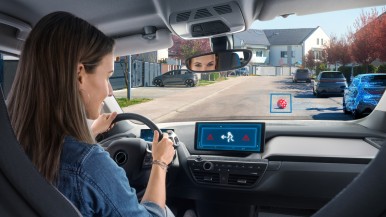
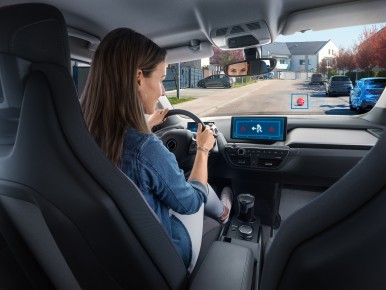
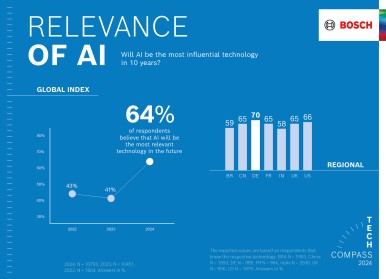
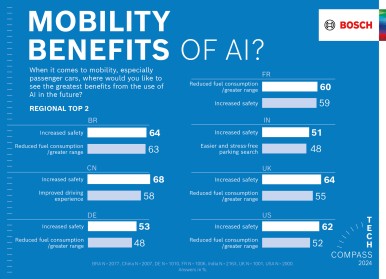
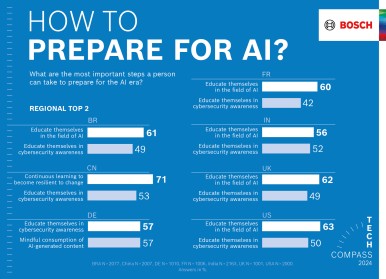
Stuttgart, Germany – It’s a scenario that no driver ever wants to see: a ball rolling out into the road. The chances are it will be followed immediately by a child in hot pursuit, oblivious to any traffic. But while human drivers can assess this situation using their contextual knowledge, today’s assisted and automated driving systems still have to learn how to do it. Bosch is pursuing the use of generative AI in terms to further improve automated driving functions. As part of this, Bosch and Microsoft are exploring opportunities to collaborate and leverage the power of generative AI. “Bosch is working on bringing a new dimension of AI applications into the vehicle,” said Dr. Stefan Hartung, chairman of the Bosch board of management, at this year’s Bosch Connected World (BCW) AIoT industry conference in Berlin. The expectation is that generative AI will enable vehicles to assess situations and react accordingly, and in this way keep road users even safer. Greater safety on the roads is also the wish of 60 percent of respondents to this year’s Bosch Tech Compass, a worldwide representative Bosch survey on the subjects of technology and AI. Bosch is working on bringing a new dimension of AI applications into the vehicle,...says Dr. Stefan Hartung, chairman of the board of management. Generative AI to make road traffic safer The two companies anticipate that a collaboration would take the performance of automated driving functions to the next level. They would like to see generative AI help enhance convenience in the vehicle and to provide greater safety for all road users. To achieve this, Bosch's comprehensive understanding of vehicles and automotive-specific AI expertise will be invaluable, as well as their access to vehicle sensor data to feed the generative AI. “In our unwavering commitment to safer roads, Microsoft is eager to explore collaboration opportunities with Bosch to pioneer the realm of generative AI,” said Uli Homann, Microsoft CVP and Distinguished Architect. Even today, when it comes to training systems for automated driving, AI quickly comes up against its limits. Today’s driver assistance systems can detect people, animals, objects, and vehicles, but in the near future generative AI could help determine whether a situation could potentially lead to an accident. Generative AI utilizes vast amounts of data to train systems for automated driving, enabling them to draw improved conclusions from this data. For example, it could deduce whether an object on the road ahead is a plastic bag or a damaged vehicle part. This information can be used either to communicate directly with the driver – such as by displaying a warning – or to initiate appropriate driving maneuvers, such as braking while switching on the hazard warning lights. Bosch and Microsoft have already partnered to develop a universal software platform for seamlessly connecting cars and the cloud, and are looking forward to work together to identify new opportunities to bring cutting-edge AI technology to their customers and the autonomous vehicle industry. Generative AI as a boost to innovation “Generative AI is a boost to innovation. It can transform industry in much the same way as the invention of the computer,” says Dr. Tanja Rueckert, member of the Bosch board of management and chief digital officer. The new 2024 Bosch Tech Compass shows this as well: 64 percent of respondents believe that AI is the technology with the greatest importance for the future. In comparison, only 41 percent of respondents were of the same opinion just one year ago. Generative AI is a boost to innovation. It can transform industry in much the same way as the invention of the computer,...says Dr. Tanja Rueckert, member of the Bosch board of management and chief digital officer. From manufacturing to everyday office work, generative AI is already being used in many areas at Bosch. In addition to Microsoft, the company is working with several partners, including AWS, Google, and Aleph Alpha. The Bosch Group’s venture capital unit, Bosch Ventures, invested in the AI company Aleph Alpha last year. Bosch also announced it would collaborate with the startup on finding new use cases both for Bosch associates and customers. “Bosch and Aleph Alpha want to learn from each other, benefit from each other’s know-how, and work together on cross-domain use cases,” Rueckert says. This partnership is now bearing its first fruits in North America: in collaboration with Aleph Alpha, Bosch is debuting AI-based speech recognition on behalf of a premium car manufacturer. In this solution, a chatbot understands and answers breakdown service calls with the help of natural language processing, which also recognizes dialects, accents, and moods. The call is taken directly, reducing the driver’s waiting time to a minimum. As many as 40 percent of calls can be processed and resolved automatically; for more complex queries, the bot transmits all relevant information to a service center agent who takes over the case immediately. From the AI search engine to manufacturing AI experts at Bosch are currently working on well over 120 specific applications that these new AI models open up for the company’s associates and customers. Such applications include the generation of software program code or powerful chatbots and voicebots to support technicians or interact with consumers. Another is AskBosch, the in-house AI-assisted search engine launched at the end of 2023. It offers faster natural-language access to a wide variety of data sources – sources scattered over the intranet, say. In addition to externally available data, AskBosch also includes internal data sources, so Bosch associates can research information specific to the company. Generative AI also ensures greater speed in manufacturing: in initial projects in two Bosch plants in Germany, generative AI creates synthetic images in order to develop and scale AI solutions for optical inspection and optimize existing AI models. Bosch expects that this will reduce the time needed for planning, launching, and ramping up AI applications from the current six-to-twelve months to just a few weeks. Following successful piloting, this service for generating synthetic data is to be offered to all Bosch locations. 2024 Bosch Tech Compass: setting the pace in the use of AI As AI is used in more and more areas of life, professional development is becoming increasingly important: 58 percent of respondents to the Bosch Tech Compass are convinced of this. This opinion is particularly prevalent in USA at 63 percent (Germany: 54 percent, China: 52 percent). Here, too, Bosch is setting the pace in the use of artificial intelligence and is getting its associates on board. In 2019, Bosch launched a training program, initially aimed at bringing 30,000 associates up to speed on the subject of AI. Up to now, some 28,000 associates have taken part in the program. Like the Bosch AI code of ethics, which sets ethical guidelines for dealing with artificial intelligence, this program has been supplemented with content about generative AI. For all the results of the 2024 Bosch Tech Compass, click here . About the survey: For the representative survey, people aged 18 and over in seven countries (Brazil, China, Germany, France, India, the U.K., and the U.S.) were polled online on behalf of Robert Bosch GmbH by the market researchers Gesellschaft für Innovative Marktforschung mbH (GIM) in December 2023. In Germany, France, and the U.K., at least 1,000 people were polled per country; in Brazil, China, India, and the U.S., it was at least 2,000 people each. The random samples are representative of their respective countries in terms of region, gender, and age (Brazil, Germany, France, U.K., U.S.: 18 to 69 years / China, India: 18 to 59 years).