Search & find:
Media, press releases, events for your editorial coverage

Bosch.IO: new company pools the Bosch Group’s IoT and digital expertise

17.02.2020

Press release

Business/economy

Bosch.IO: new company pools the Bosch Group’s IoT and digital expertise

Berlin, Germany – Bosch has consolidated its activities centered on the internet of things in a new subsidiary. With some 900 associates, Bosch.IO GmbH is now one of the driving forces for IoT (internet of things) solutions, covering everything from consulting to implementation and operation. “With Bosch.IO, we are strengthening our position as a leading IoT company,” says Bosch board of management member Michael Bolle. What sets this new Bosch subsidiary apart is that its software and hardware developers work with cloud specialists and user experience designers on IoT projects of future importance. “With Bosch.IO’s new setup, we are combining the I and T in IoT to bring the internet of things to everything from roads and factory floors to homes and fields,” says Bolle. The core element of the Bosch subsidiary’s product portfolio is the Bosch IoT Suite. It is the central technical platform for IoT solutions. With Bosch.IO, we are strengthening our position as a leading IoT company...says Bosch board of management member Michael Bolle Bosch.IO is a new Bosch subsidiary created by combining the former Bosch Software Innovations GmbH with other specialized IoT and digital teams at Bosch. Its executive management comprises Dr. Stefan Ferber, Dr. Aleksandar Mitrovic, and Yvonne Reckling. The company is headquartered in Berlin. Further locations are in Germany, Bulgaria, China, Japan, Singapore, Spain, and the United States.Even closer to the customer By creating Bosch.IO, Bosch has, for one, adopted a more sector-centric stance in its IoT business. For the other, customers’ requirements figure even more prominently. “Our goal is to realize IoT projects faster and more efficiently,” says Dr. Aleksandar Mitrovic, member of the Bosch.IO executive management. To this end, the company relies on interdisciplinary and agile teams that work together in ever-changing constellations. These include hardware and software developers, cloud specialists, solution architects, project managers, UX designers, business model innovators, and trainers. “We bring together people with the right skills for each IoT and digitalization project to meet customer requirements in the best possible way,” says Mitrovic. These associates also have extensive experience in various sectors such as retail, energy, building technology, agriculture, manufacturing, consumer goods, and mobility. For its projects, Bosch.IO collaborates with Bosch’s roughly 30,000 software developers and AI experts. “Together, we develop sustainable digital business models, seamless technical integration, and connected ecosystems for and with our customers,” says Mitrovic. Alongside highly specialized solutions for individual segments, certain services of the Bosch IoT Suite can be used for a multitude of applications. This increases efficiency in development and operation, since complex and labor-intensive basic tasks need only be performed once. This includes, for example, a service to connect and manage devices as well as update software and firmware over the air, which enables everything from vehicle fleets and security cameras to machinery to stay continuously up to date. We bring together people with the right skills for each IoT and digitalization project to meet customer requirements in the best possible way...says Dr. Aleksandar Mitrovic, member of the Bosch.IO executive management IoT projects with the help of artificial intelligence With the new Bosch subsidiary and Bosch engineers collaborating closely, AI technologies are set to feature more prominently in future IoT and digital projects. One example is the use of data mining methods to derive rules for machine learning from big data. The knowledge gained can serve to conveniently and securely control different manufacturers’ household appliances, among other things. Image comparison tools also benefit from AI: Bosch.IO uses them as part of Secure Product Fingerprint, an anti-counterfeiting solution. It identifies product surfaces, which offers consumers and business customers effective protection against counterfeit goods. AI-assisted methods also reliably detect when a two-wheeler has been involved in an accident and can automatically trigger an emergency call.More than 10 million connected things Bosch.IO can draw on many years’ experience gained in more than 250 IoT projects for international customers. The core product of Bosch.IO is the Bosch IoT Suite. It already connects more than ten million sensors, devices, and machines with their users and business applications, and it is Bosch’s central software platform for IoT solutions.

Bosch IoT Suite connects cars, mobile machinery, and baby buggies

17.02.2020

Press release

Internet of Things

Bosch IoT Suite connects cars, mobile machinery, and baby buggies

Berlin – What do cars, mobile machinery, an energy provider’s data platform, and baby buggies have in common? Their connectivity comes courtesy of the Bosch IoT Suite, the core product of Bosch.IO, the new wholly owned Bosch subsidiary. The subsidiary has already deployed its IoT platform to carry out more than 250 IoT projects jointly with customers in the retail, energy, building, manufacturing, consumer goods, agriculture, and mobility sectors. “Bosch.IO projects epitomize the efficient development of scalable and secure IoT solutions using the cloud and the open-source-based Bosch IoT Suite,” says Dr. Stefan Ferber, a member of the Bosch.IO executive management. The Bosch IoT Suite services customers opt for are then integrated into the cloud environments the customers prefer for their projects. Bosch.IO projects epitomize the efficient development of scalable and secure IoT solutions using the cloud and the open-source-based Bosch IoT Suite...says Dr. Stefan Ferber, a member of the Bosch.IO executive management Versatile and proven The Bosch IoT Suite is the core enabler of Daimler’s firmware over-the-air updates. Some four million car owners already receive new versions of vehicle software – for example, infotainment system updates – conveniently and securely via the cellular network. This means they no longer have to visit their dealer solely to get a software update. The Bosch IoT Suite is the communication hub for vehicles on the receiving end of wireless updates. For the Swedish baby buggy manufacturer Emmaljunga , Bosch has developed an assistance system with an extensive set of comfort and safety features. Called eStroller, it comes with powered push and automatic brake assist functions, as well as a link to a smartphone app. Based on the Bosch IoT Suite, this app puts added features such as an alarm function at users’ fingertips. The energy provider EWE uses the Bosch IoT Suite to manage power consumption data in an efficient way. This also opens the door to value-added services. For example, the data can be used to analyze consumption and provide detailed, clear information about the biggest electricity consumers in the home. This helps users save energy. The Bosch IoT Suite is not only used by customers such as Daimler, Emmaljunga, and EWE, but is also the central software platform for Bosch IoT solutions. For example, the Suite connects smart cameras from Bosch Building Technologies with the cloud and existing backends. This connection provides a cost-effective means of managing cameras throughout their life cycles and updating devices’ and gateways’ software and firmware. A use case at Bosch Rexroth illustrates how the Bosch IoT Suite can be adapted to the requirements of the manufacturing sector. This Bosch subsidiary, which specializes in drive and control technology, used the Bosch IoT Suite to build BODAS Connect, its solution for mobile machinery. Open and scalable, this solution for end-to-end connectivity affords access to specific machine information. After-sales services such as software updates can be delivered at the touch of a button, even without service staff present on site. Reform , a manufacturer of municipal and agricultural vehicles, has also adopted BODAS Connect to quickly troubleshoot malfunctions in its mobile machinery. Focus on edge computing and AI The Bosch IoT Suite already connects more than ten million sensors, devices, gateways, and machines with their users and enterprise systems. And as Bosch IoT solutions increasingly feature artificial intelligence (AI), these systems will become more and more intelligent in the future. Bosch uses AI and the internet of things (IoT) to make people’s lives easier and as safe as possible. Connecting devices directly to the cloud is one way to go, but more and more use cases are incorporating edge computing to great benefit. An edge device is internet-enabled, but can process its data locally. These devices send less data to the cloud to make the most of IT resources available across the network. The local logic enables these devices to respond faster and automatically to events. “More than 33,000 edge devices are now compatible with Bosch IoT Suite and connected via many protocols, both locally and over the internet,” Ferber says. In the future, Bosch.IO will also focus on pre-configured service packages that allow customers to implement IoT solutions more efficiently. To make these packages, experts combine various Bosch IoT Suite service modules. One such module is the Bosch IoT Hub, an upscalable service for directly connecting (edge) devices via a gateway to the Bosch IoT Suite. It supports connections using standard and customer-specific protocols. “From device to cloud, customers can use our new portfolio to make their own integrated IoT applications,” Ferber says. Over the medium term, we expect the market for IoT platforms to consolidate. Of the estimated three to five platforms that will prevail, one will be open-source-based...Ferber says Rated positively by analysts The Bosch IoT Suite is based on open-source software developed jointly by experts from Bosch and other companies in the Eclipse IoT working group. That makes the platform unusually versatile. In its latest report, PAC – a consultancy that is part of the teknowlogy Group, the leading independent European research and consulting firm for IT companies – rated the Bosch IoT Suite as the best in class among all open-source-based IoT platforms. “We are delighted with this excellent rating for the Bosch IoT Suite,” Ferber says. “Over the medium term, we expect the market for IoT platforms to consolidate. Of the estimated three to five platforms that will prevail, one will be open-source-based.”

Connected sensors and smart algorithms

29.11.2019

Press release

Internet of Things

Connected sensors and smart algorithms

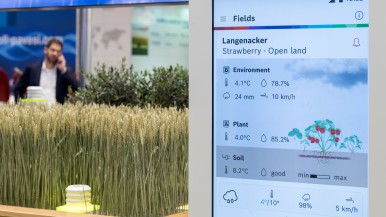
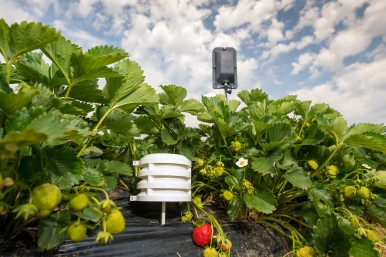
Stuttgart. While the world’s population continues to grow, the per capita area of arable land is shrinking. “Our aim is to maximize yields and use resources more purposefully and thus more efficiently,” says Dr.Bojan Ferhadbegović, head of the Deepfield Connect product family at Bosch Software Innovations. In keeping with the idea behind agriculture 4.0, he and his team are working on connected sensor systems and smart algorithms to make life easier for hardworking farmers.No unwelcome surprises with smartphone fruit-and-veg monitoring The Deepfield Connect Field Monitoring system transmits temperature and humidity data directly from the field to the farmer’s smartphone, at any time and to any place. The app is available for iOS version 11 or later and for Android version 5 or later. A customizable alert gives farmers a heads-up when readings reach critical levels. Featuring temperature, air humidity, and soil moisture sensors, the system comes in four versions that provide a conventional weather station’s key climate data. This information keeps users up to date on how their crops are faring in the field, the warehouse, or the seed-priming room. It also clues them in on how to improve their storage, foil management, and irrigation practices. “What’s more, the Deepfield Connect product family is very easy to install and use. Anyone can set up the systems on their own in five minutes and start using them straightaway,” says Ferhadbegović.Black or white side up? Asparagus bed sensors answer that and more Another option alongside the Field Monitoring system features special sensors for growing asparagus. Improper foil management can compromise quality and cost farmers up to 30 percent of their crop. The Deepfield Connect Asparagus Monitoring system minimizes this risk with sensors measuring at four depths in the asparagus bed to gauge temperature. The app’s customizable alert warns farmers before it gets too hot or cold, while a weather forecast specific to that field helps the farmer decide when to turn the foil. The temperature sum helps farmers predict the best time to start harvesting.Always take the weather with you – in the app “One of the great risk factors in farming is the weather. We can’t influence it, but our sensor systems and the Deepfield Connect app help farmers work with the weather to best support their crops’ growth,” says Ferhadbegović. The Deepfield Connect app comes with plant growth models for selected standard and specialty crops. The Bosch IoT Suite’s smart algorithms combine weather data with the science behind the growth models to keep farmers informed. They can consult the app at any time to gain insight into their plants’ current growth phase and in future get the right recommendations for each development stage. “For example, we can use our models to calculate which nutrients the plant has theoretically absorbed from the soil by the time it completes a given development stage. We can also use the weather forecast to recommend the best time to apply fertilizer, so this isn’t done when the soil is too dry or when rain would wash it right back out again,” says Ferhadbegović, pointing out another of the algorithms’ advantages. In near future, the app will also help farmers comply with documentation regulations, for example by providing an audit trail tracking fertilizer use.Accurate forecasting with the right data from the right spot “The Internet of Things (IoT) offers great potential for agriculture. Bosch can draw on its extensive expertise in software, sensor technology, and services to tap that potential. The bigger the database, the better the outcomes achieved with algorithms and artificial intelligence,” says Ferhadbegović. Even without the Deepfield Connect sensors, every app user enjoys free access to the weather data calculated for a given field. It is based on information from independent weather services and other sources. Users can order sensors right there in the app to obtain even better data and recommendations that are even more in tune with local conditions. “Then the exact readings taken in the user’s fieldwill be factored into the calculations. Particularly frost and soil moisture vary in intensity from one location to the next and can never be calculated accurately from general weather data. And if farmers grow the crop in tunnels, external sources won’t yield reliable calculations anyway,” explains Ferhadbegović.Keeping tabs on the tank via an app to maximize milk quality The Deepfield Connect Milk Monitoring system is the latest product to join this family. Asensor measures the temperature directly in the milk and takes other readings to track the tank’s functionality. This data is sent to the app on the smartphone. An alert warns the dairy farmer or tank truck driver when readings take a critical turn. “For example, the cooling system may be tailored precisely to the dairy’s specifications and thereby save energy,” says Ferhadbegović. Installation is an exercise in plug-and-play convenience: simply lower the sensor chain into the milk tank and attach the transmitter and warning lamp to the agitator respectively the tank. Independent bodies such as the Fraunhofer Institute for Manufacturing Engineering and Automation IPA have verified that the system is safe for food.Farm #LikeABosch – everything for the farmer in one app Ferhadbegović and his team are already thinking ahead. They want to add interfaces for manufacturing partners so that farmers have access to many important topics at one singlepoint. “What we have in mind are interfaces to irrigation and other control systems, but also for suppliers.” The team at Bosch Software Innovations also wants to offer special sensors as modular add-ons – for example to measure hydrostatic leaf pressure – alongside the model already available for asparagus beds. With its digital solutions for agriculture, Bosch Software Innovations is carrying on a tradition that started with founder Robert Bosch, who was a farmer himself in the 1920s. His old farmstead at Mooseurach near Munich still stands today. “We are perpetuating this legacy by making life a little easier for the hardworking farming community by delivering smart solutions that achieve higher quality with more efficient, resource-friendlier practices. That’s what Farm #LikeABosch is all about,” says Ferhadbegović. To learn all about the products and the app, visit www.deepfield-connect.com

A smart, pocket-sized operations assistant

29.10.2019

Press release

Internet of Things

A smart, pocket-sized operations assistant

Stuttgart/Hanover – Frost or excessive heat, too wet or too dry? “The weather is one of the biggest risk factors in agriculture,” says Dr. Bojan Ferhadbegovic, head of the Deepfield Connect product family at Bosch Software Innovations. “We can’t influence it, but our sensor systems and the Deepfield Connect app help farmers work hand in hand with the weather to provide optimum support for the growth of their crops.” Farmers who use the Deepfield Connect systems already get current weather data straight from their field on their smartphones, thanks to the Bosch IoT Suite – and they can set customized alerts to notify them when certain temperature or moisture levels are reached. The app is available for iOS (version 11 or later) and for Android (version 5 or later).There are also plans to expand the Deepfield Connect app in the near future to include plant growth models of all plants common in traditional agriculture and specialty crop production. The Bosch IoT Suite uses algorithms to combine weather data and scientific findings to model plant growth. The aim is to let users know which growth phase their crops are in at any given time and to provide appropriate recommendations for each development stage. “For example, we can use our models to calculate which nutrients the plant has absorbed from the soil by the time it completes a given development stage. We can also use the weather forecast to recommend the best time to spread fertilizer, so as to avoid fertilizing when the soil is too dry or when rain would wash it right back out again,” says Ferhadbegovic, citing one of the advantages of the algorithms. Precise forecast: the right data from the right location “The Internet of Things (IoT) offers great potential for agriculture, and Bosch can draw on its extensive expertise in software, sensor technology, and services,” says Ferhadbegovic, adding: “The more data there is available, the better the results of the algorithms and artificial intelligence will be.” Even without the Deepfield Connect sensors, anyone using the app can immediately access the weather data calculated for a given field, free of charge. It is based on data from independent weather services and other sources. To get even better data – and soon even more finely tuned recommendations – the sensors can also be ordered right in the app. “Then the calculations will incorporate precise values from the user’s own field. Particularly frost and soil moisture vary in intensity from one location to the next and can never be calculated accurately from general weather data. And if farmers use a tunnel, external sources won’t yield reliable calculations anyway,” explains Ferhadbegovic. Flexible and easy: installs in just minutes The Deepfield Connect system is available in several versions, allowing farmers to configure the scope of temperature, air humidity, and soil moisture sensors to fit their needs. In this way, users always know how their crops are doing in the field, the warehouse, or the seed-priming room – and what they need in order to optimize storage, foil management, or irrigation. In addition, a customizable alert enables farmers to respond promptly when critical values are recorded. The app allows farmers to document when they fertilize and when ground frost occurs. Only users themselves can access the data from their own fields; this data is not disclosed to third parties. “The Deepfield Connect product family is also very easy to install and use. Anyone can install the systems themselves in five minutes and start using them right away,” says Ferhadbegovic. And it’s just as easy to install the other Deepfield Connect systems for Asparagus Monitoring and Milk Monitoring as it is to install the Deepfield Connect system for Field Monitoring. These systems can be ordered online at www.deepfield-connect.de. The right amount at the right time: using resources efficiently A long-term study by the University of Bari in Italy on an olive plantation in southern Italy showed that the Deepfield Connect products reduced water usage by as much as 40 percent, for savings of up to 700 euros per hectare on this plantation. “Going forward, we also want to display the disease pressure on crops based on moisture levels at each plant. This will enable farmers to apply plant protection agents more sparingly and with even greater precision and to adjust irrigation for optimum crop health,” says Ferhadbegovic. Farm #LikeABosch: everything you need to know about plants in an App Ferhadbegovic and his team are already thinking ahead. For instance, they want to add interfaces for industry partners in order to give farmers access to as many important topics as possible in one convenient location. “We are thinking of interfaces for control systems, such as for irrigation, but also for suppliers. The required fertilizer, for example, could then be ordered directly in the app.” They also want to offer additional special sensors, such as the sensor that is already available for asparagus ridges, as modular add-ons. Bosch Software Innovations solutions for digital agriculture follow in the tradition of Robert Bosch: the company’s founder himself engaged in agriculture in the 1920s. His farm in Mooseurach, near Munich, still exists today. “We are continuing this legacy: we make life a little easier for hardworking farmers with smart solutions that help them work more efficiently, using fewer resources, while simultaneously improving quality – in other words, we help them to “Farm #LikeABosch”,” says Ferhadbegovic.

The internet of 10 million things

15.05.2019

Press release

Internet of Things

The internet of 10 million things

From 0 to 10,000,000 in roughly 10 years: What better way to express a landmark achievement by an IoT company than in ones and zeros? In this case it is the number of devices that Bosch Software Innovations and its customers have connected to the Bosch IoT Suite to date, in more than 250 IoT projects around the world. This number went up by around 20 percent between 2018 and 2019 alone. More than ten million devices is convincing proof that we have come a long way along the road to connecting the physical and virtual world. Bosch will continue this journey together with its customers and partners....Stefan Ferber, CEO of Bosch Software Innovations The open and flexible software platform provides the technological basis for applications in the Internet of Things. The more than ten million connected “things” include gateways in buildings, connected vehicles, and sensors in urban infrastructure or digital agriculture. The Bosch subsidiary’s playing field extends across the following growth areas for digitalization: agriculture, buildings, retail, energy, mobility, and manufacturing. “More than ten million devices is convincing proof that we have come a long way along the road to connecting the physical and virtual world. Bosch will continue this journey together with its customers and partners,” says Stefan Ferber, CEO of Bosch Software Innovations. Advocated: Market leaders opt for the Bosch IoT Suite One of our customers in the agricultural sector is HOLMER Maschinenbau, the world’s leading provider of self-propelled combine sugar-beet harvesters. The company, headquartered near Regensburg in Germany, has developed a remote diagnosis and maintenance package for its machines called EasyHelp 4.0. HOLMER based its solution on Bosch hardware, software, and services. Bosch IoT Insights, the Bosch IoT Suite’s data management service, is a central element of this solution. HOLMER uses it to process machine data and visualize the information on a custom-designed dashboard. Another customer who has chosen to work with the Bosch IoT Suite is MANN+HUMMEL. This company specializes in filtration technology and develops products and solutions to promote clean air and the sustainable use of water. In Asia, the Bosch IoT Suite helps MANN+HUMMEL to develop applications for monitoring filter systems in the field. EnBW is an energy provider based in Karlsruhe, Germany. Its SMIGHT initiative was launched to develop solutions for connected urban infrastructures. One of the first products to emerge from this initiative was a multipurpose streetlight with integrated environmental sensors, a charging point for electric vehicles, and a Wi-Fi hotspot. Other SMIGHT projects included developing a system for monitoring the occupation of parking spaces using in-ground sensors, which allows municipalities to assess and optimize their parking facilities. To bring all of these projects together on a single IoT platform, a unique SMIGHT solution was developed based on the Bosch IoT Suite. The list of customers goes on and on, and includes companies such as Deutsche Telekom, The Yield, Ponsse, Hager, Busch-Jaeger, and Amdocs – as well as numerous group-internal customers including the Bosch Rexroth subsidiary in the U.S. and Bosch Japan. Accoladed: Analysts and users concur on the positive advantages of the Bosch IoT Suite Not only users but also analysts rate the platform very highly. PAC, a member of the teknowlogy Group, the leading independent European market research and consulting firm in the IT sector, rated the Bosch IoT Suite as “best in class” for device management. To simulate the widest possible range of IoT scenarios, the Bosch solution supports all common types of device connectivity and communication protocols. In the teknowlogy Group’s IoT User Survey 2019, users awarded top marks to the Bosch IoT platform for security and said they were very willing to recommend the software to others. Augmented functionality: Bosch adheres to a hybrid-cloud and open-source strategy The services provided by the Bosch IoT Suite are integrated in the cloud environments that most customers prefer for their projects. Apart from the Bosch IoT Cloud, they also include Amazon Web Services (AWS), Microsoft Azure and – in China – the Huawei Cloud. The cloud providers and Bosch work together as partners to develop scalable IoT business models for their shared customers, with each contributing their respective business and technology skills. We firmly believe that open-source communities are the key to success in the IoT because a global Internet of Things can only be created on the basis of industry-wide, joint projects....Stefan Ferber, CEO of Bosch Software Innovations The Bosch IoT Suite is built using open-source software. Bosch is a strategic member of the Eclipse Foundation and participates in numerous open-source projects managed by the Eclipse IoT Working Group. These projects form the technological core around which the Bosch IoT Suite is built. “We firmly believe that open-source communities like the Eclipse IoT Working Group are the key to success in the IoT because a global Internet of Things can only be created on the basis of industry-wide, joint projects,” says Ferber, who represents Bosch on the Eclipse Foundation Board of Directors.

Bosch launches IoT software solutions on Huawei Cloud

10.10.2018

Press release

Connected mobility

Bosch launches IoT software solutions on Huawei Cloud

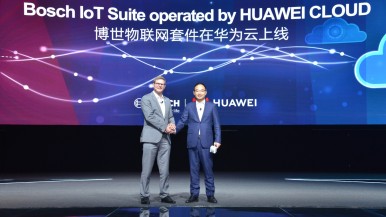
Stuttgart / Shanghai – Today at HUAWEI CONNECT 2018, Bosch, a leading global supplier of technology and services, and Huawei, a leading global provider of information and communications technology (ICT) infrastructure and smart devices, announced a partnership to accelerate the development of the internet of things (IoT) in China. The collaborative agreement will see the two partners make Bosch’s IoT Suite software services available in China on Huawei Cloud.“The demand for IoT solutions in China is rising. The partnership between Bosch and Huawei Cloud marks a decisive step for Bosch in one of the fastest growing IoT markets in Asia,” said Dr. Stefan Ferber, CEO of Bosch Software Innovations, a wholly-owned subsidiary of Bosch. The company expects China’s market for IoT platforms to grow by close to 70 percent over the coming years. “We are pleased to have the opportunity to collaborate with Huawei Cloud to offer cloud-based IoT services providing various functions needed to connect devices, users, and businesses. I am confident that by joining forces our companies will advance the development of the internet of things in China.” The Bosch software platform connects web-enabled objects to facilitate data sharing across a multitude of digital services and business models. The first service made available to Chinese consumers via Huawei Cloud will be the Bosch IoT Remote Manager – a service for managing and controlling gateways, sensors, and devices. Additional services of the Bosch IoT Suite will follow in 2019. The demand for IoT solutions in China is rising. The partnership between Bosch and Huawei Cloud marks a decisive step for Bosch in one of the fastest growing IoT markets in Asia....Dr. Stefan Ferber, CEO of Bosch Software Innovations With offices in Shanghai and Nanjing, Bosch Software Innovations has been active in China since 2012 and has successfully implemented IoT projects ranging from Industry 4.0 to connected transportation. A leading Chinese automaker has chosen to deploy the Bosch IoT Suite on Huawei Cloud for updating its vehicles’ firmware over the air (FOTA). The solution is expected to be rolled out to millions of connected cars in China over the coming years. “Bosch Software Innovations is one of the global leaders in IoT, providing cutting-edge IoT solutions and services,” said Mr. Zheng Yelai, the vice president of Huawei and president of Huawei Cloud BU. “Huawei Cloud is a fast growing global cloud provider, and has committed to cultivating this fertile environment for its partners. With the technical excellence of Bosch IoT Suite, and the reliable infrastructure services by Huawei Cloud, we will provide more intelligent IoT solutions to smart cities, enterprises, families, and individuals.” Most significantly, for consumers in China, the world’s largest automotive market, the Bosch IoT Suite enables vital services such as the Vehicle Management Solution, which is available locally on Huawei Cloud. This solution connects vehicles throughout their service life, providing the technological foundation for cloud-based services such as predictive diagnostics and over-the-air software updates. The software provides a secure communication interface between the vehicle, the cloud, and the services. Data management enables vehicle manufacturers and fleet managers to organize vehicle data, analyze it, and keep the vehicle software continuously updated. Following this announcement, Bosch and Huawei intend to develop an integrated end-to-end IoT offering. Huawei is developing IoT hardware gateways that will be pre-configured with Bosch IoT Gateway software and managed through the Bosch IoT Remote Manager to run on Huawei Cloud. This close integration will provide customers with a more complete IoT solution that is easier to deploy and manage. Bosch and Huawei share a similar vision for the IoT, based on open source and industry standards and a commitment to building strong ecosystems in the domains of connected vehicles, manufacturing, homes, cities, and agriculture. Both companies are also members of the Eclipse Foundation and serve in leadership roles within the Industrial Internet Consortium and the OSGi Alliance.

Bosch and Berlin Senate support innovative startups in the German capital

23.07.2018

Press release

Internet of Things

Bosch and Berlin Senate support innovative startups in the German capital

Berlin and Stuttgart, Germany – Bosch is joining forces with Berlin’s Senate Department for Economics, Energy, and Public Enterprises: as part of the European Social Fund’s Berlin Startup Stipendium program, they will support 27 entrepreneurs on the new Bosch IoT campus, located at Tempelhofer Hafen in Berlin’s creative Ullsteinhaus district. Ramona Pop, who is responsible for economic affairs on Berlin’s governing senate, visited Bosch Software Innovations today as part of her summer tour and used the opportunity to present the grant letter in person. The subsidiary of the globally operating Bosch Group develops software-based solutions for IoT applications. Pop said: “Through its IoT campus and support for startups, Bosch is playing an important role in Berlin, creating jobs that are fit for the future. I’m very happy that we can fund these efforts and in turn benefit from the extraordinary opportunities presented by a major international company. With the Berlin Startup Stipendium, we are promoting the development of innovations and the internationalization of Berlin’s economy.” Through its IoT campus and support for startups, Bosch is playing an important role in Berlin, creating jobs that are fit for the future....Ramona Pop, responsible for economic affairs on Berlin's governing senate Michael Hahn, member of the executive management of Bosch Software Innovations, said: “To drive forward IoT innovations in the best possible way, we need to open doors for partners. And that’s exactly what we’re doing at the Bosch IoT campus, where we pool our many years of experience and our expertise together with the innovative ideas of young startups.” To drive forward IoT innovations in the best possible way, we need to open doors for partners....Michael Hahn, member of the executive management of Bosch Software Innovations Encouraging innovative business ideas for the IoT Financing for the 17-month project, which has an overall cost of some 600,000 euros, comes from the European Social Fund (ESF) and the state of Berlin. The startups on the Bosch IoT campus consist of teams of two to four people, who contribute groundbreaking business ideas on various aspects of the internet of things (IoT). Over a five-month period, they receive monthly grants of 1,800 euros per person. Bosch, for its part, provides a state-of-the-art facility and technical expertise. Each startup can take advantage of the rooms and workstations on the Bosch IoT campus, all equipped with the latest technology, and specialized project staff coach and train the team members. The aim is to strengthen their entrepreneurial acumen and further refine their products and services to get them ready for market. Since 2005, the Senate Department for Economics has been working with the ESF to support innovative startups – to the tune of 39.8 million euros in the current funding period. Those funds have helped up to 1,330 entrepreneurs as they develop their technology-based business ideas in “founder workshops” and similar incubator formats until they are market-ready. Recently, the program has expanded to support transnational endeavors. This means it will promote the exchange of ideas and experience with similar European funding programs outside Germany, support collaboration with comparable projects and incubators, and assist with the launch of startups in international markets as well as the European single market.

Bosch opens IoT campus in Berlin

18.01.2018

Press release

Business/economy

Bosch opens IoT campus in Berlin

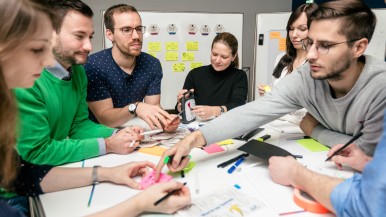
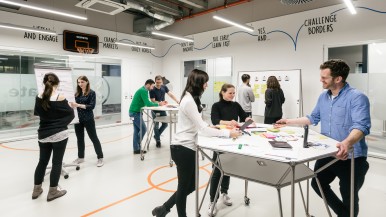
Stuttgart/Berlin, Germany – Bosch is bringing together its global IoT activities at a new hub in the German capital. In the presence of Berlin's mayor Michael Müller, the Bosch CEO Dr. Volkmar Denner inaugurated the company’s new IoT campus at the Tempelhofer Hafen in the creative Ullsteinhaus district. Ber-lin is a hotspot for many important players working on and with connected solu-tions. They include software and hardware providers, technology partners, and start-ups. “With our new premises, we are building bridges between our own IoT experts and others in Berlin’s creative and digital scenes,” Denner said. “The inauguration of the Bosch IoT campus is another important building block for Berlin as a digital capital,” Müller said, speaking before guests from politics, business, and the media. “We believe in openness for the internet of things – open ecosystems and open collaboration and partnership. This idea is also re-flected in the campus concept,” Denner added. With our new premises, we are building bridges between our own IoT experts and others in Berlin’s creative and digital scenes....Dr. Volkmar Denner, Chairman of the board of management of Robert Bosch GmbH Campus unites expertise in technology and transformation on the IoT More than 250 Bosch associates are working at the new campus. Over the next few years, the number of associates is expected to rise to around 400. They come from a range of different domains within the company. The IoT experts will advise and support customers during the development and implementation of projects for connected solutions. These encompass, for instance, solutions for Industry 4.0, connected mobility, smart cities, and smart homes. The new location is also the headquarters of Bosch Software Innovations GmbH, which was previously located at Berlin’s Schöneberger Ufer. This Bosch subsidiary has been playing an active role in shaping the internet of things for around ten years. IoT consultants, software developers, project managers, trainers, and other specialists have now realized more than 250 international IoT projects. Michael Hahn, a member of the executive management of Bosch Software Innovations, emphasized the significance of the new IoT campus: “With its cloud-based Bosch IoT Suite software platform, Bosch is a leader in technology. We are now combining this expertise with our broad knowledge of IoT consulting and applications at our new Berlin location. Our customers and partners will benefit from having their companies, some of which are still analog, seamlessly transported into the age of connectivity.” The inauguration of the Bosch IoT campus is another important building block for Berlin as a digital capital....Michael Müller, Mayor of Berlin Campus combines laboratory character with IoT vibe Visitors to the Bosch IoT campus immediately notice that the open-plan, three-story ensemble offers an unconventional working environment. Instead of desks, a caravan, workshops, and forest-themed workspaces catch the eye. “Associates helped to develop this creative environment. They have everything they need to create new IoT solutions either by themselves in quiet work zones, in agile teams, or together with customers and partners,” Hahn said. In total, Bosch has invested some 3 million euros in the location and its unusual workspaces. The workshops are there to help associates build prototypes quickly and easily, for example. In contrast, the caravan is all about user experience: together with customers and users, it is a place where prototypes can be tested in the very early phases of a project. All of this is based on the design thinking method of innovation, which is widespread in the software development world. “We want to understand customer needs in creative and structured processes, generate a lot of ideas quickly, and test them directly with future users,” Hahn said. From prototypes to productive solutions In order for customers and associates to get an even better idea of how a prototype becomes a productive solution, the campus itself functions as a kind of living IoT lab. The caravan has been converted into a Bosch smart home, and the office kitchens are equipped with connected home appliances. Associates are also encouraged to integrate new applications into their everyday work on an ongoing basis. One very recent example is an app that uses geodata to guide associates to the next free meeting room of the required size. “The internet of things only works when people connect with each other, which is why we are creating a lot of space for encounters and inviting the IoT community to come here to the campus,” Hahn said. Bosch versatile in terms of IoT Bosch’s strategic aim is to offer solutions for connected mobility and connected manufacturing, as well as for connected energy systems and connected buildings. The company is tapping new, promising markets such as, most recently, smart homes. At the same time, Bosch is harnessing every opportunity being provided by connectivity in traditional markets as well, such as in the field of connected mobility. The company focuses on the “3S’s” in its connectivity business: sensors, software, and services. In developing and implementing services and solutions for the connected world, Bosch benefits from its expertise in software and sensor technology as well as, in particular, its broad business portfolio. Bosch Connected World on February 21-22, 2018, at STATION Berlin For the fifth time, Bosch is organizing one of the largest international IoT conferences for developers, business representatives, and journalists. For further information and to register: http://bit.ly/2CFHzJ6

CES® 2018 Innovation Award: Bosch smart city solution Climo helps to manage air  ...

08.01.2018

Press release

Internet of Things

CES® 2018 Innovation Award: Bosch smart city solution Climo helps to manage air ...

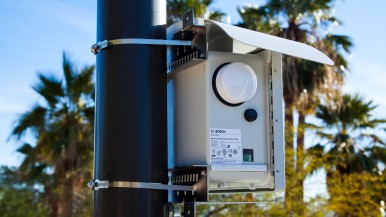
LAS VEGAS – Thanks to smart city technology, cities can now take action on the topic of air pollution. A first step towards improving air quality is the provision and management of data. At CES 2018, Bosch is presenting its micro-climate monitoring system Climo – a new solution, which helps cities around the world manage air-quality parameters in real time and at a much lower cost than existing technologies. The tiny box enables rapid and accurate measurement of data. It has been honored with a CES 2018 Innovation Award in the Smart Cities category. During CES 2018, Climo is monitoring air quality in the city of Las Vegas.“Sensors throughout the city provide a variety of valuable data. Climo gives cities quicker and easier access to this data, allowing them to take action on air quality,” said Mike Mansuetti, president of Bosch in North America at CES 2018. “The Bosch portfolio of sensors, software and services – combined with a wealth of cross-domain expertise – position us to be a partner for cities to solve challenges and positively impact quality of life of its inhabitants.” The Climo system, developed by Bosch in collaboration with Intel , enables the rapid and accurate measurement of air-quality parameters. It combines sensors and software to deliver a range of air-quality data, covering key air pollutants including: particulate matter, carbon monoxide, nitric oxide, nitrogen dioxide, sulphur dioxide and ozone. It also provides data from environmental parameters such as temperature, relative humidity, light, sound, pressure – and even pollen. Benefits for citizens in real time Ambient air quality is a key objective for urban environmental planning. The data provided by the Climo system can be utilized by cities in a variety of proactive approaches such as traffic-flow management. It can also serve to proactively message the local population with tips and information. For example, citizens who are asthmatic or suffer from allergies can instantly know whether it is better to stay indoors or avoid a certain part of the city. It is also a source of data generation for cities to make other decisions, such as future policy and planning. In rural or park areas, the system can also provide an early warning for fires. Wireless sensors that can connect over Wi-Fi and cellular networks The ability to enable micro-climate data collection comes via the connection of compact wireless sensors. Secure remote calibration and monitoring is enabled through both wireless (Wi-Fi and 3G) as well as a wired connection. The Climo system is powered with Intel IoT technologies and features cloud-based analytics, data management and visualization software. Units are pre-configured by location and can be further configured using over-the-air updates. The easy update capabilities are part of the Climo design to scale with future technologies, such as 5G, as they become available. Hundred times smaller, ten times more cost-effective While air-quality monitoring systems can often require large infrastructure investments and are complex to operate, the Climo system was designed for simple deployment and management. It measures 1/100th the size and 1/10th the cost of a traditional air quality monitoring system. Climo was designed to withstand a variety of weather conditions. Climo units feature options for power via either 110/220 V or 12V DC. This makes it an interesting solution for cities and countries around the globe – in different weather zones and with different economic environment. Originally, it was developed by Bosch engineers in India. Real time data of air quality in Las Vegas during CES 2018 At CES Unveiled in Las Vegas, Bosch will present a live demonstration utilizing Climo that shows air-quality measurements from cities around the world – including Las Vegas. It will also show an updated management interface for Climo that provides an even more comprehensive view for city officials. Bosch at CES 2018: PRESS CONFERENCE: In Ballrooms B, C, and D, Mandalay Bay Hotel, Las Vegas South Convention Center, Level 2 , from 8:00 to 8:45 a.m. local time on Monday, January 8, 2018. BOOTH: Tuesday to Friday, January 9–12, 2018 , in the Central Hall, booth #14028 FOLLOW the Bosch CES 2018 highlights on Twitter: #BoschCES PANELS WITH BOSCH EXPERTS: Tuesday, January 9, 1:30 – 3:15 p.m. (local time) “ Connect2Car: Next-Gen Automobility ” session with Kay Stepper, Vice President of Bosch in North America, head of driver assistance and automated driving, Las Vegas, Convention Center, North Hall, N256 Wednesday, January 10, 2018, 1:45–2:30 p.m. (local time) “ Connected Vehicles in Connected Ecosystems ” session with Mike Mansuetti, President Bosch North America, Smart Cities Conference, Westgate. Thursday, January 11, 2018, 11:30 a.m to 12:30 p.m. (local time) “ The Future of Robots at Work and Home ” session with Phil Roan, Senior Engineer Robotics, BSH Hausgeräte GmbH, Las Vegas Convention Center, North Hall, N258