Search & find:
Media, press releases, events for your editorial coverage

Automotive industry to give manufacturing a facelift

23.11.2021

Press release

Industry 4.0

Automotive industry to give manufacturing a facelift

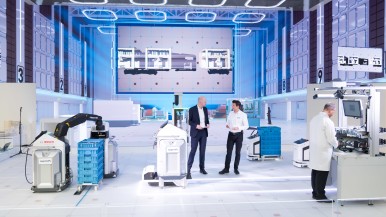
Stuttgart, Germany – Faster, more flexible, and more efficient: these characteristics are the automotive industry’s main demands when it comes to developing its own production systems. To achieve this, today’s manufacturing operations need to be put on a new technological footing. This is exactly what the participants in the SDM4FZI research project (Software-Defined Manufacturing for the Vehicle and Supplier Industry) have set out to do. Led by Bosch, the University of Stuttgart, and the Karlsruhe Institute of Technology (KIT), a total of thirty companies will define the foundations for software-defined manufacturing over the next three years. Their goal is to design software that can flexibly plan, manage, and modify everything from individual components to entire factories. In the automotive industry, this will pave the way for more variants and faster model and product changes. It will also improve competitiveness. The German Federal Ministry for Economic Affairs and Energy is funding the research project to the tune of some 35 million euros.Rigid systems hold vehicle production back Today, it often takes months, and sometimes years, for the technical elements of the manufacturing chain for a new model to be put in place, from supplier to final assembly. Together with the considerable economic cost involved, this stymies rapid market launches. The root cause of this is that many machines are designed and built specifically for one single new product. The software is usually inextricably coupled to particular machinery and products and is not transferable to other processes. SDM4FZI now aims to create a uniform framework for factories that will enable new products to be manufactured in existing operating environments without major retooling times. “By linking various Industry 4.0 approaches, we are getting one step closer to adaptable manufacturing,” says the Bosch project manager Matthias Meier. “An ecosystem for software-defined manufacturing allows us to bring the benefits of cloud technology to production. Software makes it possible to use automation technology and IT systems for individual, specific applications without having to build the hardware from scratch.” Uniform framework enables flexible manufacturing The project partners are developing prototypes for machinery and production lines that are largely defined by software. Such prototypes are based on digital twins, which make it possible to plan, build, and test production systems virtually. This conserves resources and saves on energy and costs. During production, moreover, it also makes the individual manufacturing stages more versatile, so they can be adapted more quickly to new market conditions. Thanks to the digital twins, companies can prepare and implement improvements, and also use AI to analyze them, without having to interrupt the production process. The main focus of the research alliance’s project is on making automation technology, machinery, and systems more flexible in order to boost efficiency in the production of supplier components and vehicles. New opportunities for the vehicle industry By pooling expertise from automation, mechanical engineering, IT, and the automotive industry, the consortium aims to create a common understanding of the requirements and to develop interoperable solutions. “The large number of project partners demonstrates how substantial a role software plays in the manufacturing of tomorrow,” says Michael Neubauer, chief technology officer for ISW at the University of Stuttgart. “We are working on pioneering approaches that will improve German companies’ competitiveness.” For example, the project partners are drafting a guide for the selection and use of suitable technologies, as well as standards for building software-defined factories. Further information on the project List of project partners

Bosch Rexroth achieves stable sales at previous year's record level in 2019

16.04.2020

Press release

Business/economy

Bosch Rexroth achieves stable sales at previous year's record level in 2019

Lohr am Main, Germany – Bosch Rexroth held up well in 2019 in a difficult environment and despite a sharp drop in incoming orders. At 6.2 billion euros, sales remained stable at the previous year’s record level. The company benefited from a solid core business in hydraulics and the further expansion of its product range in factory automation as an important door opener for new markets. “We draw a positive conclusion for 2019," says Rolf Najork, member of the Board of Management of Robert Bosch GmbH, responsible for the Industrial Technology division and Chairman of the board of Bosch Rexroth AG. "In view of the volatile markets and the noticeable economic slowdown, this very good result was anything but certain. It shows that our broad positioning with different divisions is a great advantage and that we have set the right course with our structural adjustments.” In 2019, Bosch Rexroth was able to match the success of the previous year in all regions. The core markets of Germany and Europe remained the strongest. Sales in Germany dropped by 4.1 percent to 1.4 billion euros. In the remaining European markets (excluding Germany), sales declined by 0.3 percent to 2.1 billion euros compared to the previous year. In the growth markets in the Asia-Pacific / Africa region, Bosch Rexroth achieved sales of 1.6 billion euros, which equals a slight increase of 0.6 percent. The region North and South America recorded a 5.3 percent rise to 1.1 billion euros. At the end of the fiscal year (December 31, 2019), the company employed around 31,000 people worldwide.Economic environment and COVID-19 pandemic cloud prospects for 2020 Bosch Rexroth expects business to decline in all regions and sectors in the current fiscal year 2020 due to the general economic weakness and the structural change in customer sectors closely linked to the automotive industry. Order intake declined by 20.3 percent in the course of 2019. Additionally, the global COVID-19 pandemic is currently clouding business expectations for 2020. Hence, the systematic implementation of measures to improve competitiveness in all areas is particularly important for Bosch Rexroth. "We are very much concerned with the current developments regarding COVID-19. We have taken extensive measures during the past weeks to protect our employees, customers and partners while ensuring the best possible supply," says Najork, "Safety is our top priority throughout. We want to be a reliable and responsible partner for our customers, also and especially in such global crises". Focus on innovations and new markets Bosch Rexroth remains one of the most significant innovation drivers and pioneer for new technologies in its markets. For example, the company invested some 348 million euros in research and development in fiscal year 2019 – an increase of 6.2 percent over the previous year. The company continues to focus on developing connected and fully automated solutions in the two major areas of hydraulics and factory automation. All divisions contributed to the success of Bosch Rexroth in 2019. While the core business with industrial and mobile hydraulics proved to be a solid foundation, the factory automation division with its focus on Industry 4.0 and the vision of the fully connected factory of the future, developed into an important door opener for new markets and customers.Machinery Applications and Engineering: connected and intelligent hydraulics Bosch Rexroth is actively driving change in its traditional core business of industrial hydraulics: smart hydraulic components and systems such as the compact hydraulic unit CytroBox can be quickly and easily integrated into connected manufacturing facilities. They are Industry 4.0 ready and offer services for the Internet of Things (IoT), for example for condition monitoring of machines and plants.Mobile Hydraulics: Smart Solutions for the mobile work machine of the future Despite the tense market environment, Bosch Rexroth was able to further expand its market share in mobile hydraulics in 2019. New activities in the fields of automation and driver assistance systems, electrification and IoT are future key topics. With BODAS Connect, Bosch Rexroth offers an open, scalable end-to-end solution to connect mobile work machines with each other. It enables customers to retrieve and analyze data from the mobile application. At the 2019 BAUMA trade fair for construction machinery, the company also presented the first components of a future range of electrification systems for work machines. These solutions support customers in reducing emissions, while further increasing performance. Here, Bosch Rexroth benefits from the long-standing Bosch expertise in electromobility. Factory Automation: new standards for connected manufacturing Connected assembly and intralogistics remain an important strategic focus for Bosch Rexroth’s factory automation division. The spotlight is on the vision of the factory of the future with software-based, automated and connected solutions. The company was able to further strengthen its position as an innovation driver in 2019, amongst others with the open ctrlX AUTOMATION platform. As the first 5G-capable automation platform from Bosch Rexroth, ctrlX AUTOMATION connects a wide range of devices with the new communication standard and ensures consistent connectivity in factories. Existing machines can be upgraded with the new technology via retrofit solutions. The Active Shuttle, which was also introduced in 2019, ensures greater flexibility and higher productivity in the automated factory. The autonomous transport system sets new standards in intralogistics, transports loads of up to 260 kilograms and is loaded and unloaded fully automatically using an integrated lifting platform."GoGreen" project: targets for energy and CO₂ savings exceeded In 2019, Bosch Rexroth was also able to record important achievements in CO2 neutrality: as part of the Bosch Group, the supplier of drive and control technologies has set itself ambitious goals to reduce energy consumption and CO₂ emissions. In the scope of the Bosch Rexroth project “GoGreen”, energy efficiency is being systematically improved in all plants and at customers' sites since 2011 – with an extremely positive outcome: by the end of fiscal 2019, Bosch Rexroth had saved 620 million kilowatt hours of electricity and gas worldwide thanks to "GoGreen," corresponding to more than 265,000 tons of CO₂. This equals the annual energy consumption of a city with some 80,000 inhabitants. Energy consumption at the Bosch Rexroth locations was reduced by 20 to 50 percent. Since the end of 2019, Bosch Rexroth has achieved a CO2-neutral “footprint” in Germany.

Bosch puts 5G machines in pole position

26.11.2019

Press release

Business/economy

Bosch puts 5G machines in pole position

Stuttgart, Germany – 5G is coming. The new communications standard accelerates the internet of things and boosts Industry 4.0. Control systems and sensors of the kind built into facilities, machinery, and logistics chains stand to gain from this fast, reliable real-time wireless data transfer. Preparing machines for state-of-the-art communication involves making them 5G-capable. Now Bosch has the solution: Bosch Rexroth’s new ctrlX AUTOMATION control technology comes with 5G built in and can connect a wide range of industrial devices with the new communications standard. ctrlX AUTOMATION will be showcased at the SPS trade fair in Nuremberg.Bosch opens the door to a new industrial age 5G is set to turbocharge manufacturing. Our new 5G-capable automation platform lays the groundwork and opens the door to a new industrial age,...says Rolf Najork, the member of the Bosch board of management responsible for industrial technology. 5G is the first communications standard designed to enable connectivity for people as well as for the internet of things. The new standard has impressive characteristics: it is up to 20 times faster than 4G, transfers data virtually instantaneously with a latency of one millisecond, and is up to 99.9999 percent reliable – making the receipt of a “digital shipment” as certain as with transmission through a wire. "5G is a revolution and an important building block for the factory of the future", Najork says. Engineers and designers now face the challenges of integrating 5G into their machines and products. Bosch is introducing the solution that meets their needs: the new automation platform’s hardware can be fitted with a 5G module. The operating system and software for ctrlX AUTOMATION are 5G-capable from the outset and support rapid commissioning. Retrofit solutions are also available for adding the new technology to existing machinery. Bosch Rexroth’s new automation platform is scheduled to have its market launch in 2020. 5G will be a competitive factor for connected industry Experts estimate that there will be up to 70 billion connected devices worldwide by 2025. Many of them will be in manufacturing, meaning that 5G will become a competitive factor. The new communications standard will enable applications that require high-power, extremely reliable wireless connections to be integrated securely and efficiently into manufacturing facilities. These include mobile robotics, autonomous transport vehicles, and human-machine interactions. For instance, workers wearing augmented reality glasses can access additional information in their field of vision, optimizing how they monitor and maintain machinery. Combining tasks in the virtual world with those in the real world calls for real-time data flows. And that’s what 5G promises. "This new form of communication eclipses everything we’ve had until now. 5G is the first wireless protocol to truly meet the needs of the manufacturing industry", Najork says. Bosch takes on leadership role in Industry 4.0 and 5G Bosch is developing the factory of the future. In this endeavor, the company is relying on Industry 4.0 . The company first tests and validates products in-house before they are available on the market. Bosch is taking this approach with 5G, too. The company presented its first 5G-capable autonomous transport system, ActiveShuttle , at the Hannover Messe. To support the further development of its factories, Bosch has applied to the German Federal Network Agency for 5G licenses with which to set up local campus networks. Moreover, Bosch has taken on the chair of the global 5G Alliance for Connected Industries and Automation (5G-ACIA) with the aim of shaping the new mobile standard so that it meets the needs of the manufacturing industry from the outset.

Software from Bosch Connected Industry boosts productivity in production

25.11.2019

Press release

Industry 4.0

Software from Bosch Connected Industry boosts productivity in production

Stuttgart / Nuremberg, Germany – Intelligent software reduces complexity, simplifies processes; the factory of the future is unthinkable without this tool. Bosch Connected Industry is now presenting a solution at the SPS trade fair in Nuremberg that makes production and logistics even more transparent, efficient and productive. The Nexeed Industrial Application System makes data available in a compatible and standardized form and provides information at a glance. NEXEED is the brain of the intelligent factory, in which every employee knows what has to be done when and where,...null says Sven Hamann, Senior Vice President of Bosch Connected Industry. Using open interfaces, the Bosch software can also be easily integrated into common industrial platforms and existing infrastructures. "NEXEED breathes new life into old systems and makes them fit for Industry 4.0," says Hamann. This makes it easier to implement this intelligent form of production and ensures manageable investments. To this end, Bosch Connected Industry uses solutions that successfully optimize production in Bosch plants all over the world.Nexeed Industrial Application System for connected manufacturing With the Nexeed Industrial Application System, Bosch relies on interoperability: "All components of the system speak the same language and work together optimally. NEXEED forms the basis for a fully connected, transparent production process," explains Hamann. The basic functionalities make work easier for users and administrators through simple operation, clear master data management and individually defined access rights. The applications enable, for example, live monitoring of production processes or central management of IIoT devices such as routers, machine controls and sensors. "With our solutions no one has to update the devices individually with the USB stick anymore. This enables us to consistently close security gaps in the factory," explains Hamann. If required, the system can be expanded with additional applications or subject-specific packages. Significant increase in productivity through intelligent software By connecting NEXEED with the new automation platform ctrlX AUTOMATION from Bosch Rexroth, production efficiency can be significantly increased: "Industry 4.0 solutions from Bosch provide a productivity boost. With the new automation platform, we are improving the overall equipment effectiveness of machines by up to ten percent. In conjunction with NEXEED, another ten percent can be added," says Hamann. Bosch software makes a decisive contribution to higher availability, better performance, and higher quality. It enables access to production-relevant information in real time, for example on the status of production or the whereabouts of individual components. In the event of malfunctions, employees can react more quickly or avoid them completely thanks to preventive maintenance. Strong demand for software and services for Industry 4.0 Since its establishment in 2018, Bosch Connected Industry has expanded its business considerably: NEXEED is already used successfully by around 100 international customers, including BMW, Sick and Trumpf. Users benefit from the experience of the Bosch plants and warehouses: all NEXEED solutions are developed, tested and evaluated there, before Bosch offers them to external customers. More than 100 Bosch factories now use solutions from the NEXEED portfolio. Bosch Connected Industry at SPS: November 26-28, 2019, booth 450, hall 7

Bosch applies for local 5G licenses

21.11.2019

Press release

Industry 4.0

Bosch applies for local 5G licenses

Stuttgart, Germany – Bosch believes 5G local area networks are the way forward. The company has applied for 5G operating licenses for selected German locations. “As an IoT company, Bosch began researching into 5G early. The new communications standard is a key to automated and connected driving, and an essential element of the factory of the future,” says Dr. Michael Bolle, the Bosch Group CDO and CTO. Following licensing by the regulatory authorities, Bosch intends to set up these local 5G networks in collaboration with selected partners over the course of 2020 in order to better exploit the potential of Industry 4.0. Over the next few months, 5G trials will be conducted at Bosch plants and at its research campus in Renningen, in preparation for rollout in the company’s manufacturing operations.5G campus networks for Bosch plants The Bundesnetzagentur – the regulatory authority responsible for frequency allocation in Germany – recently changed its policy and now allows companies to obtain licenses for their private use. This will enable Bosch to set up its own 5G networks and thereby improve its competitiveness. "Private campus networks offer a maximum of security and independence. 5G speeds up industrial manufacturing processes. By establishing local 5G networks, we will be able to take a significant leap forward in our ambitions to create the factory of the future", says Rolf Najork, the Bosch management board member responsible for industrial technology. Bosch has initially applied for 5G operating licenses for the lead plant for Industry 4.0 in Stuttgart-Feuerbach and the research campus in Renningen . “The pioneering work done by these selected locations will ultimately benefit the entire Bosch manufacturing network, with its roughly 270 plants worldwide,” Bolle says. 5G will play a central role in the factory of the future “In our vision of the factory of the future, the only fixed elements are floors, walls, and ceilings. Everything else is movable and can be reconfigured at will,” Najork says. Examples include mobile robots, autonomous transportation vehicles, and new assistance systems such as data glasses, which provide associates with optimum support. An important requirement for such flexible systems is a powerful wireless infrastructure enabling efficient communication between human operators, machines, and other equipment. “This calls for a reliable, secure, and high-speed data transmission system with short response times – all of which is possible with 5G,” says Andreas Müller, who works for Bosch as a researcher and is the chairman of the international 5G Alliance for Connected Industries and Automation (5G-ACIA). The advantage of 5G is that it not only provides a means of efficiently connecting mobile devices and wireless sensors, but also provides the basis for entirely new system concepts. For instance, 5G enables a mobile robot to be controlled in real time using data stored in a local manufacturing cloud. This reduces costs, increases flexibility, and simplifies maintenance. It also optimizes operation of the machines. “If you walk into a factory today, you’ll see that almost every machine has an operating console with an emergency off switch. Someone has to press that button to bring the machine to a standstill. With 5G, the operator doesn’t need to be near the machine: an emergency stop and other functions can be executed using a mobile device. This makes the operator’s work easier, and also helps save costs,” Müller says. 5G improves security in production Local 5G networks virtually eliminate dependence on third-party providers. By setting up and operating their own wireless networks, manufacturers can configure them to meet the often highly demanding requirements of industrial communication applications. This solution also gives them full control over relevant security concerns. For instance, if the public network is overloaded, local 5G networks permit factory operations to continue without losing control of the system. “Campus networks allow us to decide for ourselves what architecture and security features best suit our needs, and what equipment we will use to implement them. And we know who has access to specific components and data,” Müller says. This reduces business risks and preserves data sovereignty. Dedicated interfaces are used for connections to the internet and other public networks, and are continuously monitored. Germany takes the lead in 5G For the first time, the introduction of the new 5G standard gives companies in Germany the opportunity to set up and operate their own cellular local area networks. The German regulatory authorities have set aside the frequency band from 3,700 to 3,800 MHz for this purpose. Frequencies will be allocated according to demand, with preference given to Industry 4.0 or agricultural and forestry applications. Licenses will be granted for an initial period of ten years. The fee for each license is the sum of a basic EUR 1,000 fee, the allocated bandwidth (from at least 10 to a maximum of 100 megahertz), the number of years for which it is allocated, and the surface area (in square kilometers) to which the allocation applies (with a distinction being made between built-up areas and transport routes and other areas).

Bosch achieves sales in the billions with Industry 4.0

27.03.2019

Press release

Industry 4.0

Bosch achieves sales in the billions with Industry 4.0

Stuttgart, German y – Industry 4.0 has definitely become a part of the factory scene, where it is paying off: over the past four years, Bosch has made more than 1.5 billion euros with Industry 4.0 applications. As early as 2022, Bosch wants to generate annual sales of over a billion euros with Industry 4.0. The company is presenting the factory of the future at Hannover Messe: autonomous transport vehicles deliver components to digital workspaces, robotics solutions support workers in manufacturing, and quality inspection is performed with the help of artificial intelligence (AI). Thanks to 5G, communication between machines and systems runs smoothly and in near real time. Bosch is turning vision into reality. Industry 4.0 pays off. Digital and connected solutions are making factories more efficient, more flexible, and more productive....Bosch board of management member Rolf Najork Industry 4.0 improves competitiveness Bosch recognized the potential of Industry 4.0 early on: the company began connecting manufacturing and logistics in 2012. This strategy improves competitiveness, and Bosch’s Industrial Technology business sector is seeing robust growth: according to preliminary figures, last year it grew by 8.9 percent. After adjusting for exchange-rate effects, this growth measured 11 percent. Sales rose to 7.4 billion euros. “Industry 4.0 pays off. Digital and connected solutions are making factories more efficient, more flexible, and more productive,” says Bosch board of management member Rolf Najork, who oversees the business sector. Bosch projects are bearing this out. For example, Bosch’s plant at Blaichach in southern Germany introduced modern manufacturing technologies that increased ABS and ESP volumes to 200 percent over six years – without expanding facilities or making acquisitions. Bosch enters the intralogistics market with autonomous transport systems What use is highly automated manufacturing if the materials don’t arrive at the production line on time and in the right quantities? “If you take the idea of the factory of the future to its logical conclusion, distinctions break down and you see that manufacturing and logistics have to be thought of as one element. This is the only way for Industry 4.0 to succeed in practice,” Najork says. At Hannover Messe, Bosch Rexroth is presenting the ActiveShuttle: this autonomous transport vehicle carries materials from the warehouse to the precise spot on the production line where they need to be. An integrated hub platform facilitates autonomous loading and unloading, so there’s no need for workers to lift a finger. Equipped with laser scanners, the ActiveShuttle finds its own route, can recognize other vehicles and people – and can also learn: the transport system creates its own map of the site and updates it continuously. Software creates the foundation for Industry 4.0 The three pillars of success in the factory of the future are people, machines, and data. To ensure they work together harmoniously, they need intelligent software. “Industry 4.0 would be inconceivable without software. With our Bosch Connected Industry operating unit, we are further expanding our leading position in Industry 4.0 and pooling our software and services expertise under the name Nexeed,” says Dr. Stefan Aßmann, who heads up the Bosch Connected Industry business unit. This unit helps the company’s customers monitor transports, manufacture products quickly and efficiently, and deliver those products safely, securely, and on time. To give one example: using Nexeed Track and Trace, the freight itself transmits information on its location, temperature, and vibrations. This means logistics experts can monitor freight status at all times and determine if the goods will arrive on time. Artificial intelligence is a key technology of the future With the help of artificial intelligence, machines can learn how to be smart and to anticipate. This harbors huge potential as machines relieve people of time-consuming, strenuous tasks. “Bosch regards AI as a key technology. Our goal is for all Bosch products to be equipped with AI, or for AI to have played a part in their development and manufacture, by the middle of the next decade,” Najork says. To meet that goal, Bosch is focusing on AI that is safe, robust, and explainable. At Hannover Messe, Bosch will present ViPAS, an AI-based system for visual quality control. Equipped with a gripper arm, cutting-edge camera technology, and intelligent software, the system is simple and convenient to operate. In a pilot project at the Bosch plant in Nuremberg, ViPAS completed 12,000 test procedures with a success rate of 99.9 percent. This means ViPAS sorted the parts as “OK” or “not OK” with near-perfect accuracy. The next step is to further refine ViPAS in-house to get the technology ready for use at various plants. 5G accelerates Industry 4.0 The new 5G mobile communications standard plays a key role in many Industry 4.0 applications. 5G transmits data up to 100 times faster than the previous standard. Reliability has increased while data transmission delays have fallen to a minimum. “5G will be the central nervous system in the factory of the future,” predicts Andreas Müller, a Bosch researcher and chairman of the 5G Alliance for Connected Industries and Automation (5G-ACIA). To shape the new mobile standard right from the outset so that it meets the future needs of industry, Bosch took on the chair of the organization, which was set up in 2018. To date, the initiative has brought together more than 40 companies and research institutions from around the world. Bosch plans to test 5G in its own plants before the end of this year. At Hannover Messe, Bosch will be joining with its partners Nokia, Qualcomm, and BigRep to present the advantages of the new standard. To do so, the companies are bringing connectivity to a 3D printer for the first time with the help of 5G. This will make it possible to take some of the control elements that would normally be integrated into the machine and outsource them to a local manufacturing cloud. Machines with this feature are leaner, cheaper, and easier to maintain. Sweden is a strategically important partner for Bosch Bosch and Sweden are connected by a long tradition. The international supplier of technology and services has had a presence in this year’s Hannover Messe partner country since 1904. Bosch currently employs more than 1,600 associates at nine locations in Sweden, generating sales of around 1.1 billion euros there in 2018. Here, too, Bosch is focusing on connected solutions for improving quality and service. For example, Bosch Rexroth’s plant in Mellansel in eastern Sweden connects its Hägglunds brand high-performance hydraulic systems with sensors and cloud-based applications, and employs machine learning methods. This results in greater productivity and improved availability of the drive systems. One customer that has put the Industry 4.0 solution into practice is LKAB at the iron ore mine in Kiruna, the northernmost city in Sweden.

Robotics for people with disabilities

25.09.2018

Press release

Industry 4.0

Robotics for people with disabilities

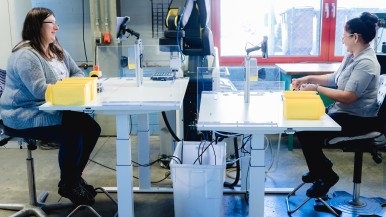
Stuttgart, Germany – Robots are well on the way to becoming ubiquitous in manufacturing, where they are having an impact on the work environment and on jobs themselves. But what does this new world of work look like? How does it divide work up between humans and machines? And how might robots help create attractive jobs for people with disabilities so they can be participate in the workforce? AQUIAS, a project conducted by Robert Bosch GmbH, the Fraunhofer Institutes for Industrial Engineering IAO and for Manufacturing Engineering and Automation IPA, and ISAK GmbH offers some answers. The project’s name is derived from its full title in German: work quality through tailored work-sharing between service robots and manufacturing workers with or without severe disabilities. It is funded by the German Federal Ministry of Education and Research (BMBF). In the AQUIAS project, we want to learn from severely disabled workers how to improve human-machine interactions....Wolfgang Pomrehn, product manager for APAS assistance systems at Bosch Making work more attractive The initiators of AQUIAS are taking a remarkable approach: they have deployed APAS, Bosch’s automated production assistant, at ISAK GmbH – a company that employs people with a variety of severe disabilities, some of whom have an extremely limited capacity for work. APAS is used in the assembly process for sanitary fixtures. Previously, a worker had to operate a hand-lever press up to 8,000 times a day to press intricate parts together, but now the robot has taken on this monotonous and physically demanding task. This eases the burden on workers and lets them focus on the final quality control. One outcome of this project has been to improve the quality of work: with strenuous tasks falling away, there is more space for higher-quality tasks and for direct person-to-person communication. “What we’ve done is to have robots take on only those tasks that are physically demanding for people. All other work tasks, such as work-step preparation or quality control, are still performed by people, which ensures that their jobs are full of variety,” says David Kremer of the Fraunhofer Institute for Industrial Engineering IAO, who is coordinating the project. This gives disabled people job prospects and the opportunity to participate in modern manufacturing. Tailoring robotics solutions to individual needs To enable ISAK GmbH to implement this pioneering robotics technology, Bosch adjusted the workplace to suit the manufacturing environment and the various needs of the workforce. This called for a reconfiguration of the interfaces between humans and machines. Now the robot can flexibly adjust to different table heights and the sensor skin means there is no need for a safety barrier: if a worker comes too close, APAS automatically stops without any contact at all. This makes it possible to safely hand over workpieces and avoid collisions. Learning from severely disabled workers “In the AQUIAS project, we want to learn from severely disabled workers how to improve human-machine interactions. A production assistant needs to meet a wide variety of requirements that are often different than the norm. That’s why we develop tailored solutions and are constantly expanding the spectrum of situations and tasks that APAS can support,” says Wolfgang Pomrehn, product manager for APAS assistance systems at Bosch. Bosch takes the project results and derives measures from them for further improving the deployment of robots in production and logistics. The company plans to set up workplaces in its Blaichach (Allgäu) plant for workers with and without disabilities. There the focus will be on how to handle heavy aluminum blocks for automotive manufacturing that need to be moved around under the microscope for quality inspections. About APAS As part of Bosch’s Industry 4.0 concept, automated production assistants such as APAS allow humans and machines to work safely side by side. At present, some 20 Bosch plants have deployed the collaborative robot in shift work around the clock. Prominent companies in the automotive industry, electronics, and control and automation technology are also putting APAS to good use in their manufacturing.

Bosch lays foundation stone for factory of the future

25.06.2018

Press release

Business/economy

Bosch lays foundation stone for factory of the future

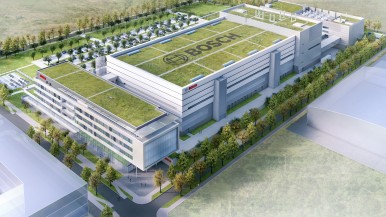
Stuttgart and Dresden, Germany – The foundation stone laid today in Dresden is a key milestone in the construction of the Bosch Group’s state-of-the-art wafer fab. Construction is scheduled to be completed in late 2019, when installation of the production machinery will start. “Today we are laying the foundation stone for the wafer fab of the future, and with it the foundation for improving people’s quality of life and their safety on the road,” said Dr. Dirk Hoheisel, member of the board of management of Robert Bosch GmbH, at the formal ceremony in Dresden. “Semiconductors are the key technology for the internet of things and the mobility of the future. When installed in cars’ control units, for example, they enable automated, efficient driving and the best possible passenger protection.” In his address, Peter Altmaier, the German Federal Minister for Economic Affairs, underlined the central importance of this Bosch investment: “We are today taking an important step toward securing the future competitiveness of Germany as an industrial location. The research community in Germany and Europe is an excellent one, but we cannot afford to rest on our laurels. In the field of microelectronics, we also need engineering skills and know-how, and especially industrial-scale manufacture and application, in Germany and Europe. Today’s ceremony is an important step on this route.” As a supplier of technology and services, Bosch is investing roughly one billion euros in its new location in the Saxony state capital. The first associates are due to start work in the new plant in early 2020. Today we are laying the foundation stone for the wafer fab of the future, and with it the foundation for improving people’s quality of life and their safety on the road....Dr. Dirk Hoheisel After Reutlingen, the Dresden plant is the Bosch Group’s second wafer fab in Germany. With it, the company aims to expand its manufacturing capacity, and thus to boost its competitive edge in global markets. Semiconductors are finding their way into more and more applications relating to the internet of things and mobility solutions. According to the market research company Gartner, semiconductor sales around the world rose by some 22 percent in 2017 alone. Otto Graf, who will manage the new plant, said: “Construction is proceeding right on schedule. “During the construction phase, we will move some 7,500 truckloads of earth, lay about 80 kilometers of piping and ductwork, and mix more than 65,000 cubic meters of concrete – 8,000 concrete mixers-worth.” Following a rollout phase, pilot manufacturing operations are expected to start at the end of 2021. The plot of land – measuring some 100,000 square meters, or roughly 14 soccer fields – will also be home to a nearly 72,000 square-meter multistory building housing offices and production space. Up to 700 associates will be involved in the highly automated chip manufacturing process, working to plan, manage, and monitor production. This also includes modifying the production processes and evaluating the data from Dresden in Bosch’s global manufacturing network. Saxony as a business location: driving Europe’s microelectronics industry “Bosch’s decision is an important milestone. The construction of the new wafer fab here in Dresden will create many other attractive jobs, strengthen Saxony’s reputation as a location for technology and business, and is good for Germany and Europe as well. This project will play a decisive part in securing a leading role for European industry as a whole in the technologies of the future,” said Michael Kretschmer, the Minister-President of the state of Saxony. “This investment in such a major project is a sign of confidence in Saxony, in its people, in the research and industrial network that has become established here, and in its innovativeness.” In its search for a new location, Bosch considered several cities around the world. In Hoheisel’s words, “Dresden is an excellent microelectronics cluster.” He added that the city’s infrastructure is excellent: everything is easily accessible, and the transportation connections are good. The cluster also includes automotive suppliers and service providers, as well as universities offering technological expertise. As Hoheisel pointed out: “We want to work closely with semiconductor companies and universities to increase semiconductor technology’s competitive edge – not only in Germany, but across Europe.” We are today taking an important step toward securing the future competitiveness of Germany as an industrial location....Peter Altmaier, the German Federal Minister for Economic Affairs Semiconductors: key technology for the internet of things Manufacturing semiconductor chips always starts with a silicon disc, or wafer. The bigger the wafer’s diameter, the more chips that can be made per manufacturing cycle. This is one reason why the new Bosch factory will focus on the production of 300 mm wafers: Compared with conventional 150 and 200 mm wafer fabs, 300 mm wafer technology offers greater economies of scale. Semiconductors are extremely small integrated circuits with structures measured in fractions of a micrometer. Manufacturing them requires a highly automated and complex process consisting of several hundred individual steps over several weeks. It takes place in clean-room conditions, as even the tiniest particles in the ambient air can damage the delicate circuits. Connected manufacturing: 22 metric tons of data a day for higher quality Wafer production is one of the forerunners of connected manufacturing. The Dresden plant is expected to generate production data equivalent to 500 text pages per second – written out on paper, that would be more than 42 million pages a day, weighing 22 metric tons. This is why artificial intelligence will play a special part in chip manufacturing in the factory: the highly automated production facilities analyze their own data in order to optimize their processes. As a result, the quality of the chips rises while production costs go down. Furthermore, planning and process engineers can access this production data at any time to accelerate the development of new wafer products or minimize tolerances early on in the manufacturing process. “We need creative minds for our connected and automated manufacturing operations – particularly experts in wafer technology, like process engineers, mathematicians, or software developers,” Graf said. Many new associates have already been hired for the Dresden plant, he added, and there has been no drop in the number of applications. Leading semiconductor manufacturer with 45 years of experience For more than 45 years, Bosch has been making semiconductor chips in various forms, above all as application-specific integrated circuits (ASICs). At its wafer fab in Reutlingen, Germany, Bosch currently manufactures ASICs, power semiconductors, and microelectromechanical systems (MEMS). Bosch ASICs have been used in vehicles since 1970. They are customized to individual applications, and essential for functions such as engine management or airbag deployment. In 2016, every car rolling off the production lines worldwide had on average more than nine Bosch chips on board.