Search & find:
Media, press releases, events for your editorial coverage

GAIA-X 4 moveID project develops basis for secure mobile data exchange

08.09.2022

Press release

Business/economy

GAIA-X 4 moveID project develops basis for secure mobile data exchange

Stuttgart, Germany – Which parking garages currently have vacant charge spots available? Where are free parking spaces in the city center? And how can this information be digitally transmitted, and services billed, across providers? The answer to these and similar questions calls for secure data exchange between the vehicles and their environment. It is precisely this foundation that a research project consisting of universities, automotive suppliers, and system providers is now in the process of building, with Bosch leading the consortium. Over the next three years, the GAIA-X 4 moveID project is set to develop the necessary standards and technological concepts to enable the secure exchange of information between providers of mobility applications and their customers. The goal is to create decentralized digital vehicle identities. This is an important prerequisite for the mass use of electric vehicles, automated driving, and the establishment of connected cities. GAIA-X 4 moveID is supported to the tune of 14 million euros by the German Federal Ministry for Economic Affairs and Climate Action – covering half of the project costs.Connectivity for digital services across the board “An integrated and transparent system architecture for the exchange of data on the road that incorporates different products and players simply isn’t available today. While it’s true that some companies out there already offer services, those services are tailored for specific applications, vehicles, or customer groups,” explains Peter Busch, project manager at the consortium leader Bosch. They often map the infrastructure, for example, but they rarely provide information about availability due to a lack of connectivity between the many independently operating service providers. “Open standards are needed so that users, for example, can find all available charging stations or pay for charging processes,” Busch says. It’s important to always ensure that the data is processed securely and that individual providers don’t exploit it solely for their own purposes. For Busch, this is the only way that the necessary user confidence can grow and a broad range of all available services, such as so-called deep parking (use of otherwise unavailable parking spaces), can be created. That is why the consortium is building on the European GAIA-X system, which defines the technological, economic, and legal framework for a secure and trustworthy data infrastructure. GAIA-X relies on decentralization and the interplay of different cloud providers under common guidelines. In this spirit, the GAIA-X 4 moveID project is using open source software for its developments and making them available to all providers for various business models. Vehicles are becoming marketplaces The standards that GAIA-X 4 moveID is pursuing will allow vehicles to securely and independently exchange information with other vehicles and their environment without an “intermediary.” The vehicles’ “infrastructure partners” include charge spots, barriers, traffic lights, and parking lots. The research project will use internationally recognized hardware and software to develop management and administrative services to facilitate the interaction and trade between different players. This will enable providers to connect a great many services, such as news, entertainment, and navigation, with the car’s system, especially in automated driving. The market for services related to connected parking alone is estimated to be worth ten billion euros annually worldwide. What’s more, the ability to navigate directly to a vacant parking space significantly reduces congestion and emissions. After all, today, about a third of downtown urban traffic is people looking for parking spaces. The availability of information is also a crucial factor for the success of electromobility. It is estimated that about half of newly registered cars in Europe will be electric by 2030. “Their drivers need to know that they’ll be able to find a charge spot quickly whenever they need one. And that requires connected systems,” Busch says. Extensive data exchange as a basis for automated driving The mass use of automated vehicles is conceivable only if cars are able to quickly and reliably communicate with their environment. The data exchange this requires will enable climate-friendly traffic control based on the volume of traffic at any given moment. This will allow cities to regulate incoming traffic to particular areas in real time, thus preventing congestion. However, this method, known as zoning, requires that vehicles be able to immediately recognize changing conditions and to reroute accordingly. Zoning is being demonstrated with test vehicles – for the first time across borders – in the Germany-France-Luxembourg (Merzig/Saarbrücken) test area as part of the GAIA-X 4 moveID project. The cars receive dynamic information regarding their approach to defined zones.The project partners: Robert Bosch GmbH Materna Information & Communications SE Denso Automotive Deutschland GmbH Continental Automotive Technlogies GmbH WOBCOM GmbH ecsec GmbH HTW Saar (University of Applied Sciences) Atos Information Technology GmbH Chainstep GmbH Peaq Technology GmbH Zeppelin Universität gGmbH (Zeppelin University) Datarella GmbH 51nodes GmbH Bigchain DB GmbH Fetch.ai Research & Development GmbH ITK Engineering GmbH Deutsche Zentrum für Luft- und Raumfahrt e.V. (German Aerospace Center) Airbus Defence and Space GmbH Delta Dao AG

From the wind tunnel to the sidewalk: Bosch is bringing smart electrical drives  ...

02.09.2019

Press release

Connected mobility

From the wind tunnel to the sidewalk: Bosch is bringing smart electrical drives ...

Bühl, Germany – Measuring a seven on the Beaufort scale, the air in the wind tunnel blasts the stroller at a speed of 60 kph. Its hood may be flapping wildly, but the stroller doesn’t budge. This isn’t because its parking brake is on, or because someone is holding it still. It’s all thanks to the new Bosch e-stroller system. This is much more than an electrical drive – it is an assistance system for strollers with a comprehensive range of comfort and safety features: in addition to offering push support and an automatic braking function, this includes connectivity via a smartphone app, an alarm function, and a variety of high-tech sensors. This new system marks Bosch’s entry into a new market. “The e-stroller system incorporates know-how from across the company. We’ve applied the same rigorous technology and quality standards here as we do in the automotive sector, including wind tunnel tests,” says Dr. Stefan Hartung, member of the board of management and chairman of the Mobility Solutions business sector. The variable Bosch system is equally suitable for single, twin, or sibling strollers. It will have its market launch in early 2020 with the Swedish stroller manufacturer Emmaljunga. Collaboration with additional manufacturers is planned. The e-stroller system incorporates know-how from across the company....Dr. Stefan Hartung, member of the board of management and chairman of the Mobility Solutions business sector Two electric motors help with acceleration and braking Demand for electric assistance for strollers is growing. Comfort and safety are the key criteria for nine out of ten parents when buying a stroller. This is the result of a representative Bosch survey of women and men with a child aged 0 to 4 years old as well as expectant parents. “Bosch wants its mobility solutions to offer help even before a child can walk, bringing intelligent mobility to all areas of life,” Hartung says. The system’s drive unit comprises two low-noise electric motors on the rear axle along with a Bluetooth module and a smart sensor system. The sensors, which are also employed in smartphones, measure things like the stroller’s speed and acceleration while assessing the road surface it is moving over. Using algorithms, they can calculate in fractions of a second what mom or dad wants to do next. On an uphill path, the motors automatically help push the stroller, as they do on an e-bike. When on a downhill slope, they step in to help brake. If the parents let go of the stroller, the motor brake prevents it from rolling away unchecked, and the electromechanical lock engages the parking brake. In line with Bosch’s typical approach of combining the highest technical standards with user-friendly operation, the e-stroller system has no need for additional switches or buttons on the push handle. The electric assistance not only increases comfort and safety, but also improves the stroller’s ergonomics. Bosch user testing showed that the e-stroller system can greatly improve parents’ posture, since it takes a lot less effort to push the stroller uphill, over uneven terrain, or into a headwind. Meanwhile, the self-braking electrical drive noticeably eases back strain when heading downhill. The system’s steering support also brings clear benefits when pushing with just one hand. Among other things, this makes bends easier to manage. What’s more, the drive system helps keep the stroller on course when on a laterally sloping path. After all, parents often push a stroller with one hand, for instance when holding their child’s older sibling with the other hand. Smartphone connectivity via Bluetooth Users can choose from three levels of electric assistance using the associated smartphone app (available for Android and iOS). The app communicates with the e-stroller system via Bluetooth. It also displays the charge level of the detachable battery and warns users in good time that power is running out. The stroller’s handy, lightweight 18-volt lithium-ion battery is housed in a lockable compartment. This is the same battery used in standard Bosch power tools such as cordless screwdrivers, which means that the stroller battery can be used to power other devices and vice-versa, whenever a spare battery is needed. With a charging time of some two and a half hours, the fully charged battery offers a range of up to 15 kilometers, depending on the level of assistance selected and the weight of the stroller. Parents can also charge their smartphone using the system’s USB port. The app can be used to activate the alarm function, too, for instance when parents leave the stroller parked outside a café. Provided a Bluetooth connection has been established with a parent’s smartphone, a warning will appear if anyone tries to push the stroller away. In addition, an alarm will sound from the stroller’s integrated loudspeaker and the parking brake will automatically reengage. Should the battery run out on the move after all, the stroller can still be used like a normal stroller – with no perceptible motor resistance.

World first: Bosch and Daimler obtain approval for driverless parking without hu ...

23.07.2019

Press release

Connected mobility

World first: Bosch and Daimler obtain approval for driverless parking without hu ...

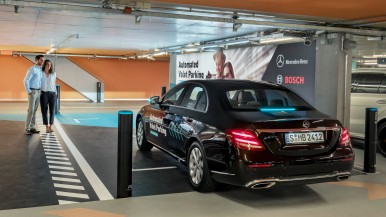
Stuttgart, Germany – Bosch and Daimler have reached a milestone on the way to automated driving: the two companies have now obtained approval from the relevant authorities in Baden-Württemberg for their automated parking system in the Mercedes-Benz Museum parking garage in Stuttgart. The automated valet parking service is accessed via a smartphone app and requires no safety driver. This makes it the world’s first fully automated driverless SAE Level 4 1 parking function to be officially approved for everyday use. This decision by the authorities shows that innovations like automated valet parking are possible in Germany first. ...Dr. Markus Heyn, member of the board of management of Robert Bosch GmbH “This decision by the authorities shows that innovations like automated valet parking are possible in Germany first,” says Dr. Markus Heyn, member of the board of management of Robert Bosch GmbH. “Driverless driving and parking are important building blocks for tomorrow’s mobility. The automated parking system shows just how far we have already progressed along this development path.” “This approval from the Baden-Württemberg authorities sets a precedent for obtaining approval in the future for the parking service in parking garages around the world,” says Dr. Michael Hafner, the head of drive technologies and automated driving at Daimler AG. “As a pioneer in automated driving, our project paves the way for automated valet parking to go into mass production in the future.” Driverless driving and parking are important building blocks for tomorrow’s mobility. The automated parking system shows just how far we have already progressed along this development path....Dr. Markus Heyn, member of the board of management of Robert Bosch GmbH Playing it safe: two partners with a common objective From the very beginning, Bosch and Daimler’s top priority for the driverless parking service was safety. Since there is as yet no official approval process for automated driving functions that do not require a driver, the local authorities – the Stuttgart regional administrative authority and the state of Baden-Württemberg’s transportation ministry – oversaw the project along with experts from the German technical inspection service TÜV Rheinland from the outset. Their aim was to assess the operating safety of the automotive and parking-garage technology. The result is a comprehensive safety concept with appropriate testing and approval criteria that can be applied beyond this pilot project. In the concept, the developers defined how the driverless vehicle detects pedestrians and other cars in its path and reliably comes to a halt when it encounters an obstacle. They also set up secure communications between all system components and took steps to ensure the reliable activation of the parking maneuver. The technology behind driverless parking Drive in to the parking garage, get out, and send the car to a parking space just by tapping on a smartphone screen – automated valet parking has no need for a driver. Once the driver has left the parking garage to go about their business, the car drives itself to an assigned space and parks. Later, the car returns to the drop-off point in exactly the same way. This process relies on the interplay between the intelligent parking garage infrastructure supplied by Bosch and Mercedes-Benz automotive technology. Bosch sensors in the parking garage monitor the driving corridor and its surroundings and provide the information needed to guide the vehicle. The technology in the car converts the commands from the infrastructure into driving maneuvers. This way, cars can even drive themselves up and down ramps to move between stories in the parking garage. If the infrastructure sensors detect an obstacle, the vehicle stops immediately. Project milestones Bosch and Daimler started developing fully automated driverless parking in 2015, and in the summer of 2017, their pilot solution in the Mercedes-Benz Museum parking garage in Stuttgart reached an important milestone: automated valet parking in real conditions, with and without drivers at the wheel, was presented to the public for the first time. This premiere was followed by an intensive testing and start-up phase. Starting in 2018, museum visitors could use the parking service live, accompanied by trained safety personnel, and share their experience. One aspect of the pilot project involved testing lighting concepts on the vehicles. Turquoise lighting indicates that a vehicle is in automated driving mode and informs passers-by and other road users that the vehicle is driving itself. The insights from these tests are reflected in the recently issued SAE standard 3134. Obtaining final approval from the authorities is a further major milestone for Bosch and Daimler: soon, interested parties will be able to experience the innovative valet parking service live in daily operation in the Mercedes-Benz Museum parking garage without additional supervision from a safety driver.

Commercial vehicle innovation enabler: Bosch brings advanced solutions to the ne ...

17.04.2019

Press release

Connected mobility

Commercial vehicle innovation enabler: Bosch brings advanced solutions to the ne ...

Scottsdale, Arizona – Nikola Motor Company showcased its hydrogen-electric powered semi-truck, the Nikola Two, live in action for the first time to the general public at its Nikola World event. Bosch technology and expertise helped Nikola to realize the fully functional Nikola Two hydrogen-electric truck with industry-ready heavy-duty truck components and systems. The technology and system approach is adaptable for use in Nikola’s full line of vehicles, including the Nikola One Sleeper Cab and the Nikola Tre, a hydrogen-electric truck for European markets. Bosch has been our innovation partner to help make our vision a reality....Trevor Milton, Nikola founder and CEO The Nikola trucks feature innovations in automation, connectivity and electrification enabled with Bosch’s assistance. The supplier of technology and services offers solutions for commercial vehicles to improve efficiency and safety in logistics. To enable the distinctive Nikola approach, engineering teams from Bosch locations in the United States and Germany contributed more than 220,000 hours into the development of the Nikola trucks. “This has been a two-and-a-half year cooperation targeted at implementing advanced technology into a totally new and unique approach to trucking with the highest levels of engineering excellence,” said Jason Roycht, vice president and regional business unit leader, Commercial Vehicles & Off-Road for Bosch in North America. “We’ve learned from each other and together pushed ourselves to achieve what seemed to everyone else to be impossible. The Nikola Two is not just a simple evolution of today’s heavy duty truck. It’s a revolution in both sophisticated control and design.” “Bosch has been our innovation partner to help make our vision a reality,” said Trevor Milton, founder and CEO of Nikola Motor Company. “We look for partners who provide us expertise and world-class solutions, but also ones that are willing to dream alongside us.” This has been a two-and-a-half year cooperation targeted at implementing advanced technology into a totally new and unique approach to trucking with the highest levels of engineering excellence....Jason Roycht, vice president and regional business unit leader, Commercial Vehicles & Off-Road for Bosch in North America The brain of the future – engineered by Nikola and Bosch The Nikola truck is more than just a fuel cell vehicle; it’s a rolling super computer. Bosch systems, software and engineering expertise have helped Nikola to build the brains of its Nikola Two super truck. One of the key elements of Nikola’s advanced system is the Bosch Vehicle Control Unit (VCU) , which provides higher computing power for advanced functions while reducing the number of standalone units. The VCU enables future innovations by providing a scalable platform for the highly complex electric/electronic (E/E) architecture needed to support the advanced features of the Nikola truck. The Nikola family of trucks will be connected with an advanced and secure operating system that provides real-time, over-the-air updates and monitoring. The commercial vehicle powertrain reimagined The essence of the Nikola truck lineup is a new commercial vehicle powertrain achieved thanks to a development partnership between Nikola and Bosch. The two organizations have reimagined the powertrain – and the vehicle chassis integrated together with it – from the ground up. The fuel-cell system designed to deliver benchmark vehicle range was custom-designed together by Nikola and Bosch. The two organizations also worked in tandem to develop the first true dual-motor commercial-vehicle eAxle for a long-haul truck. The eAxle features Bosch rotors and stators, and Bosch has also contributed functional safety efforts throughout the truck. Mirrorless and keyless - Bosch technology pervades the Nikola trucks Bosch technology is also prevalent in other areas of the Nikola trucks. Nikola’s vehicles will be missing one standard feature of previous class-8 trucks: side mirrors. In the place of the conventional main and wide-angle mirrors is a camera system, known as Mirror Cam System , which offers drivers a digital side and rear view from the truck cab. Two cameras, fitted left and right in place of traditional mirrors, feed real-time images to high-resolution displays mounted inside the cab. The system, developed by Bosch and Mekra Lang, adjusts the monitor display to match the driving situation digitally. It captures both rear-view fields of vision of a CV mirror with just one camera lens on each side of the vehicle cab. In addition to increasing safety, compact digital cameras instead of mirrors offer aerodynamic advantages as the cameras are considerably smaller than mirrors and therefore reduce drag. Fleet operators will be able to digitally manage vehicle keys for the Nikola trucks in their fleet thanks to the Perfectly Keyless system from Bosch. Freight and commercial vehicle rental companies can use a smartphone app to give their drivers access to specific fleet vehicles and to flexibly manage who has access and when. Sensors on the Nikola vehicles will connect with an app on a driver’s smartphone so that when the driver approaches the vehicle, Perfectly Keyless recognizes the smartphone, identifies the unique security key assigned to the driver’s phone, and unlocks the door. As soon as the driver moves away from the truck again, the vehicle is automatically securely locked. Nikola’s trucks are equipped for driver assistance and future automation thanks in part to the Bosch Servotwi n electrohydraulic steering system. The steering system will enable driver assistance systems that actively support the driver to enhance driving comfort and improve safety. On the Nikola vehicles, the Servotwin will help to enable features such as lane-keeping assistance, side-wind compensation and traffic jam assist. The system also provides a key building block for the rollout of automated features in the future.

Bosch software keeps people from harm

21.03.2019

Press release

Connected mobility

Bosch software keeps people from harm

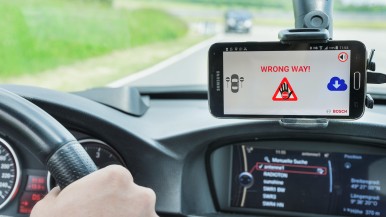
Stuttgart, Germany – Wrong-way drivers are a terrifying prospect. The danger of encountering a wrong-way driver on freeways is not as uncommon as many might think. In Germany alone, traffic news channels broadcast roughly five wrong-way driver alerts each day, or nearly 2,000 each year. Just a few thousand lines of software code can protect human lives – Bosch is demonstrating that with its cloud-based wrong-way driver alert system. This lifesaving cloud service not only alerts the driver who is heading in the wrong direction; it also warns other motorists in the danger zone, sending out push notifications in 13 European countries at lightning speed. Initially integrated into the radio apps of the German broadcasters Antenne Bayern and Rock Antenne in early 2018, the wrong-way driver alert already has 400,000 unique users and is primed for more. Some 15 navigation, streaming, and radio apps now feature the app function developed by Bosch. And with that, the service is able to reach several million people in Europe – from Ireland to Italy and Portugal to Poland. “No more road fatalities because of wrong-way drivers – that is Bosch’s goal,” says Dr. Markus Heyn, member of the board of management of Robert Bosch GmbH. Bosch has also developed a software module for this digital lifesaver. The only one of its kind worldwide, it integrates the alert into vehicle infotainment systems. No more road fatalities because of wrong-way drivers – that is Bosch’s goal. ...Dr. Markus Heyn, member of the board of management of Robert Bosch GmbH Software sweeping the world Swelling ranks of navigation services, radio stations, and news portals are integrating Bosch’s cloud-based wrong-way driver alert into their apps, dispatching out a digital guardian angel to keep users safe on every journey. With 8 million downloads and a million monthly active users on average, the Karta GPS navigation app marketed by the Portuguese startup NDrive is one of the world’s most popular cellphone apps of its kind. People in 140 countries use it not only to find the fastest way to their destination, but also – thanks to Bosch and cloud connectivity – as a wrong-way driver alert. The radio and streaming app provided by bigFM, which has more than half a million unique users, has featured Bosch’s app function since January 2019. Radioplayer.de, radio FFN, radio rainbow, rainbow 2, radio RPR, TCS, BikerSOS, and many others are offering this service to their app users. More partners are waiting in the wings, including the makers of the Focus Online, Calimoto, and V-Navi smartphone apps. “We want to roll out the Bosch wrong-way driver alert across the board. Every road fatality is one too many,” Heyn says. We want to roll out the Bosch wrong-way driver alert across the board. Every road fatality is one too many....Dr. Markus Heyn Smart connectivity software Nearly one-third of such incidents end after the wrong-way driver has traveled only 500 meters – in the worst case with fatal consequences. To detect whether a car is joining the freeway in the wrong direction, the cloud-based function compares the vehicle’s actual movements with the permitted direction of travel. Information about this is stored in a database. The driver simply has to have the app open in the background for this to work. Any driver who mistakes an off ramp for an on ramp is alerted by push notification. At the same time, oncoming cars in the vicinity are alerted to the danger. The more connected vehicles there are, the closer-knit the invisible safety net will become. This, in turn, will enhance the effectiveness of wrong-way driver warnings. Bosch will use a new software module to integrate the wrong-way driver alert system directly into future vehicles’ infotainment systems. The dash display will then give the driver a heads-up within just a few seconds. Bosch is talking to many automakers who want to offer the wrong-way driver alert as a standard feature.

CES 2019: Bosch extends its position as a leading IoT company

07.01.2019

Press release

Smart Home

CES 2019: Bosch extends its position as a leading IoT company

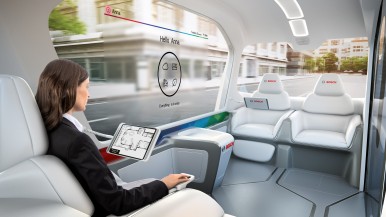
Las Vegas, NV – More and more, the internet of things (IoT) is changing our world. At CES 2019 in Las Vegas, Bosch is showing what it is already capable of today. From a concept for a shuttle vehicle that makes a new kind of mobility tangible, to fridges with connectivity that give advice on food storage, to smart lawn mowers that learn by doing – the spectrum of solutions Bosch is presenting at the world’s largest consumer electronics show is huge. “Bosch recognized the huge opportunities of the IoT early on. We have been actively shaping the connected world for nearly ten years now,” says the Bosch board of management member Dr. Markus Heyn. “Today, we are a leading IoT company. Step by step, we have extended our software and IT expertise.” Using its own IoT cloud, the company has already carried out more than 270 projects in field such as mobility, smart homes, smart cities, and agriculture. The number of sensors and devices connected over the Bosch IoT Suite has risen nearly 40 percent since last year, and now stands at 8.5 million.One of the keys to further growth and new business opportunities on the internet of things is artificial intelligence (AI). This is also a field in which Bosch is playing a decisive part in driving developments. “We will best be able to unlock the potential of the IoT if we combine it with AI, and take our IoT and AI activities forward in parallel,” Heyn says. In his view, the relationship between the two fields is complementary: “The IoT needs intelligence. The use of connected things to gather data can be a decisive boost for the development of AI. It is only through AI that connected things become intelligent and learn to draw their own conclusions. Above all, we aim to achieve concrete improvements in people’s real, everyday lives – things such as more time, more security, more efficiency, and more convenience.” Here, Heyn cites the example of video-based fire detection: by using intelligent image analysis, security cameras are able to identify fires within a few seconds, even before the system’s sensors detect heat and smoke. In this way, fires can be detected considerably earlier than with conventional fire or smoke alarm systems. This saves valuable minutes in which lives can be saved.A second key to success on the path to the IoT age is partnerships. Here, Bosch is opting for a mix of traditional and new players. The alliance recently agreed with the Canadian platform provider Mojio has already resulted in the first integrated IoT platform for connected vehicles: in the event of an accident, a special Bosch algorithm can identify where and when the accident happened, and how severe it is. Via the Mojio cloud, the data are transmitted without any delay to the Bosch emergency service center, which automatically sends an emergency call to local rescue services. At the same time, a message is sent to a predetermined list of recipients, either as a text message or via the Mojio app. “Together with Mojio, we are connecting vehicles directly with the cloud. This means rescue services can get to the scene of an accident even faster than before,” says Mike Mansuetti, the president of Bosch North America. From the middle of next year, the IoT emergency solution will be available for nearly a million drivers in North America and Europe. IoT on the roads: Bosch presents connected mobility of the future With the concept shuttle vehicle it developed in-house, Bosch is celebrating a world first at CES. In this vehicle, the company is its presenting solutions for the automation, connectivity, and electrification of vehicles, and is giving visitors the chance to experience at first hand a new kind of mobility: driverless shuttles, which will soon be a feature on the streets of the world’s cities. “This will pay into our vision of mobility that is as emissions-free, accident-free, and stress-free as possible,” Heyn says. For shuttle-based mobility such as this, Bosch will be supplying not only components and systems, but also a complete range of mobility services, such as reservation, sharing, and connectivity platforms, as well as parking and recharging services. Bosch believes that such connected services are essential for the shuttle-based mobility of the future. The forecast market volume for these services is also high: while it was 47 billion euros in 2017, it is estimated that it will be as much as 140 billion euros by 2022 (source: PwC). Bosch also wants to have a share in this, and aims for significant double-digit growth with the solutions it offers. For Heyn, there is no doubt: “In the future, every vehicle on the road will make use of Bosch digital services. We will consolidate them into a smart, seamlessly connected ecosystem.”One of the final obstacles for putting shuttle-based mobility into practice is the automation of vehicles in complex urban environments. Here, Bosch believes partnerships are the answer: In the second half of this year, San José in California’s Silicon Valley is set to become the pilot city for testing a fully automated, driverless ridesharing service provided by Bosch and Daimler. The three parties have already signed a letter of intent to this effect. With their development alliance, Bosch and Daimler want to improve urban traffic flows, enhance road safety, and provide an important building block for the traffic of the future. Their aim is to develop a driving system for fully automated driverless driving (SAE level 4/5) that is ready for production by the beginning of the next decade. IoT in the home: connected appliances make home owners’ lives noticeably easier It’s not just on the roads that connected products and services that make user’s lives easier are in demand. “We’re working on the idea of a connected home, and on appliances that think autonomously and understand what users want,” Heyn says. At CES, for example, the company is presenting a new function for web-enabled fridges that can recognize types of food and provide recommendations on storage. The interior camera automatically recognizes some 60 kinds of fruits and vegetables and suggests the ideal place to store them by means of an app. As a result, food is stored in the best possible way, stays fresh for longer, and doesn’t have to be thrown away so often. Another new development is the PAI projector, which can project a virtual user interface onto a kitchen counter top. An integrated 3D sensor captures any hand movements, allowing touch-screen operation of the interface. In this way, users can conveniently call up recipes online and make phone calls over the internet while they are cooking and baking. Designed especially for the kitchen environment, PAI does not have to be used with as much care as a smartphone or tablet. Even with sticky fingers, the projector can still be controlled perfectly. PAI is set to debut in China in February 2019, to be followed by market launch in the United States. Bosch is also presenting the Indego S+, its new robot lawn mower with internet connectivity, at CES. It is one of the first robot lawn mowers in the market to offer voice control by Amazon Alexa. It is also the only robot lawn mower that can use weather forecasts on the web to automatically decide when best to mow the lawn again. Bosch is using artificial intelligence to improve the way its robot lawn mower recognizes obstacles on the lawn by evaluating data such as motor flow, acceleration, motor speed, and direction. “We are using AI to make lawn care even easier and more convenient. Our vision is an Indego that adapts to its garden in order to mow the lawn perfectly every time,” Heyn says. IoT #LikeABosch: Bosch launches digital IoT campaign Bosch is also using CES 2019 to premiere its new IoT image campaign. The main plank of the campaign is a hip-hop video clip featuring a protagonist who is a savvy IoT user. Bosch is entering new territory with its “Like a Bosch” campaign; the decidedly different approach and tone marks a new departure for the company, which was founded in 1886.This PR move capitalizes on a rash of “like a boss” videos and memes that have gone viral on the internet, attracting tens of millions of clicks. These videos feature everyday people who stage bizarre stunts or find their way out of predicaments with technical finesse. The IoT image campaign changes a few letters in order to put a fresh spin on this internet phenomenon. The protagonist in the Bosch video is a young man who is always on top of things, thanks to connected solutions from Bosch. Smartphone in hand, he operates his car, lawn mower, or coffee machine in a cool, smart, and confident way – he’s in charge of things “like a Bosch.”


Bosch and Veniam ensure seamless vehicle-to- everything connectivity

05.12.2018

Press release

Connected mobility

Bosch and Veniam ensure seamless vehicle-to- everything connectivity

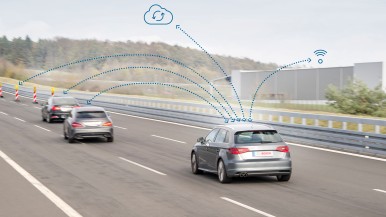
Hildesheim, Germany / Mountain View, USA – What is true for people is also true for cars: communication works best with a common language and a good connection. To enable connected and automated driving in the future, vehicles must be able to easily communicate with one another as well as with their surroundings. There is currently no globally standardized technical basis for this exchange of data, which is known as vehicle-to-everything communication, or V2X. Instead, vehicles will in future communicate using the wide variety of different standards implemented by countries and vehicle manufacturers around the world. “Bosch is taking a multi-standard approach when it comes to V2X. We have developed a universal connectivity unit capable of communicating using all of the transmission standards implemented in connected automobiles,” says Dr. Dirk Hoheisel, Member of the Board of Management at Robert Bosch GmbH. Bosch is taking a multi-standard approach when it comes to V2X. We have developed a universal connectivity unit capable of communicating using all of the transmission standards implemented in connected automobiles....Dr. Dirk Hoheisel, Member of the Board of Management at Robert Bosch GmbH The neat thing here is that Bosch has combined connectivity units and telematics units, which – individually – are only capable of a single transmission technology, to create an all-in-one central control unit for V2X data communication. Cars can then use the Wi-Fi networks available in cities, while elsewhere they can communicate using, for instance, cellular networks. The complex task of managing these diverse communication options is handled by a software solution from the Silicon Valley-based start-up Veniam. It continuously searches for the best transmission technology that suits the particular requirements and switches automatically between the available alternatives. The software therefore maintains continuous and seamless vehicle connectivity, ensuring cars can, for example, reliably alert one another to accidents and passengers can enjoy uninterrupted music streaming. Bosch develops a connectivity unit for all standards It is expected that the number of connected vehicles on the roads in Europe, the United States, and China alone will exceed 470 million by 2025 (source: PwC). Initially, most vehicles will connect directly to the cloud; but, thanks to V2X, increasing numbers of vehicles will in future also be able to communicate directly with one another as well as with traffic signals, road construction sites, pedestrian crossings, and buildings, etc. They will then be able to alert one another to potential hazards like the approaching tail end of a traffic jam, accidents, and icy conditions. Vehicles will also be able to take advantage of the green wave, because they will know when the next set of traffic lights is going to turn green. The vehicles can then adjust their speed accordingly. This ensures the traffic, particularly in cities, flows more smoothly. There is, however, no globally harmonized standard for V2X communication currently on the horizon. While China primarily uses Cellular-V2X technology (C-V2X), which is based on mobile communications, Europe and the United States are planning to additionally introduce transmission standards based on Wi-Fi (DSRC and ITS- G5) alongside C-V2X. A mishmash of standards is therefore emerging internationally, which may lead to vehicle communication issues. However, that will not be the case in the future when cars are equipped with the universal connectivity unit from Bosch. Equipped vehicles will be able to communicate with one another as well as with their surroundings regardless of the vehicle make or the country in which they are used. This will make V2X communication even more secure and reliable. “Thanks to Bosch’s all-in-one principle for connected vehicles, as many drivers as possible around the world can benefit from the added safety, comfort, and convenience provided by V2X,” says Dirk Hoheisel. The unique combination of Veniam’s smart networking software and Bosch’s connectivity unit boosts the vehicle’s data-handling capacities dramatically, paving the way for innovative cloud services and much safer future mobility....João Barros, founder and CEO of Veniam Software ensures the best connection The software from Veniam is the connection enhancer for the connectivity unit from Bosch. As well as keeping an eye on which V2X communication technologies are currently available for use, the software also closely monitors the costs and data transmission latency of each alternative connection option, since not every technology is suitable in every situation. For example, when it comes to alerting a driver to another vehicle that is about to pull out in front of them from a side street, every millisecond counts. This kind of critical information must be communicated in real time using highly reliable technology that is always ready for use – even if that means the resulting data transmission costs are greater. Software updates from the cloud or a navigation system map update, on the other hand, can be put on hold in that sort of situation until a low-cost stationary Wi-Fi network becomes available. Large volumes of data can be transmitted via Wi-Fi in a short space of time, though a downside is that public or home Wi-Fi hotspots are not always available. Veniam’s software is familiar with the pros and cons of each of the communication types and always establishes the optimal connection. “The unique combination of Veniam’s smart networking software and Bosch’s connectivity unit boosts the vehicle’s data-handling capacities dramatically, paving the way for innovative cloud services and much safer future mobility,” says João Barros, founder and CEO of Veniam. On the occasion of the world’s biggest consumer electronics trade show, CES 2019 in Las Vegas, Bosch and Veniam have been selected as CES 2019 Innovation Award Honorees in the “Vehicle Intelligence and Self-Driving Technology” category for their jointly developed solution. Bosch tests V2X in Europe, the United States, and China In the biggest European field trial to date (simTD, Safe Intelligent Mobility – Test Field Germany), V2X communication has proven its suitability for daily use under everyday conditions and in lab simulations. Bosch has played a significant role in this joint project. Since February 2017, Bosch and Vodafone have been performing trials of the V2X communication with the first 5G test modules − the first companies in Europe to do so. The A9 freeway in Bavaria north of Munich is the location for the field tests, which focus on real-time warning systems during lane changing maneuvers on the freeway or in case the vehicle in front brakes suddenly. V2X will also be able to make driver assistance functions even more comfortable, like adaptive cruise control (ACC). In the summer of 2018, Bosch tested secure, direct communication between vehicles and roadside infrastructure, cameras, and sensors in Detroit. The test showcased Wi-Fi- based DSRC technology, where equipped vehicles were provided with in-vehicle notifications about the status of traffic signals ahead and pedestrians crossing the street – functions designed to enhance safety in city traffic. ESCRYPT, a subsidiary in the Bosch Group, provided the cybersecurity technologies behind these V2X demonstrations. In China, Bosch is testing ad hoc communication using Wi-Fi as well as cellular technology. The tests are focusing on alerts that help the driver when overtaking or negotiating complex intersections.

Recharge your car’s battery wherever you want!

29.11.2018

Press release

Connected mobility

Recharge your car’s battery wherever you want!

Stuttgart, Germany – Finding a charge spot, recharging the battery, and paying for the electricity sounds easy enough in theory, but the reality is often quite different. Instead, what drivers usually encounter on the road is a bewildering jumble of operators, connectors, rates, and payment systems. In a bid to help drivers of electric cars locate exactly where they can recharge their vehicles, Bosch is joining forces with the German website clever-tanken.de. With over 20 million visits each month (IVW/Google Analytics August 2018), clever-tanken.de is the market leader for fuel-price information in Germany. The result of this collaboration is Clever Laden (“clever charging”), a new feature of the price-comparison website’s app. The app will not only feature prices for gasoline, diesel, and LPG, but also the locations of charge spots throughout Germany. Around 11,500 public charging points in Germany are already accessible through the apps thanks to the Bosch charging network. Integrated filters sort the charge spots by availability, charging capacity, and required connector. In addition, the app streamlines the charging process with a uniform access and payment system. “Bosch and clever-tanken.de are putting an end to the tangle of recharging options. Clever Laden gives drivers unrestricted access to charge spots,” says Dr. Markus Heyn, a member of the board of management of Robert Bosch GmbH. Bosch and clever-tanken.de are putting an end to the tangle of recharging options. Clever Laden gives drivers unrestricted access to charge spots....Dr. Markus Heyn, a member of the board of management of Robert Bosch GmbH Negotiating the recharging jungle It is not only price and depreciation that make people reluctant to buy an electric vehicle; range and charging infrastructure are also central concerns. According to Germany’s National Association for the Energy and Water Management Industries (BDEW), there were some 13,500 publicly accessible and web-enabled charge spots across the country in July 2018. Thanks to the Bosch charging network, Clever Laden covers approximately 85 percent of these charge spots. “Electric car drivers are afraid of getting stranded somewhere because they can’t find a charge spot. Clever Laden takes that fear away. In the future, the app will show drivers precisely where they can recharge their vehicle’s battery,” Heyn says. The app also knows which charge spots are unoccupied, what connector a customer has to have, what charge capacity is available, and what the total electricity price will be. All drivers of electric cars have to do is download the Clever Tanken app to their smartphone. Then they just select the “electric” powertrain type to display nearby charge spots in a list or on a map. Obstacle-free recharging Clever Laden not only helps make sense of the recharging jungle, but also makes the entire process simpler: without having to look into technical and contractual issues themselves beforehand, electric car drivers can use the app to start and pay for the recharging process at any charge spot stored in the system. To make this possible, Bosch negotiated agreements with the operators of the charge spots. Drivers only have to sign on once. After that, all they need to use the app is a PayPal account or credit card. Charge spot operators benefit as well, as Clever Laden increases the capacity utilization of their charging infrastructure. “This collaboration aims to offer electric car drivers consumer-friendly services by cutting down on the current jumble of recharging and payment options. This will boost drivers’ interest in e-mobility,” says Steffen Bock, the founder and CEO of clever-tanken.de. A high-performance data network What the users of Clever Laden don’t see is that behind the app is a powerful network of IT systems that are connected in real time. These keep the app constantly up to date, so drivers will know at any given time whether a charge spot is occupied or available. The technology behind this is provided by the Bosch IoT Suite, a cloud-enabled software package for developing applications on the internet of things. It covers the various regional power suppliers and charge spot providers as well as partner services, such as for payment transactions. Bosch has been offering apps for finding, recharging, and paying at charge spots since 2016. Available through car manufacturers such as Renault, the Bosch service is already used by several thousand electric car drivers. Clever Laden now expands the service to every electric car driver, regardless of vehicle make.

EICMA 2018: Bosch’s Two-Wheeler and Powersports business continues to gain speed

06.11.2018

Press release

Connected mobility

EICMA 2018: Bosch’s Two-Wheeler and Powersports business continues to gain speed

Milan, Italy – Bosch’s Two-Wheeler & Powersports business unit continues to gain momentum in the global motorcycle and powersports market. Bosch’s motorcycle technology sales for 2018 are forecasted to rise more than 20 percent compared to 2017. According to Bosch’s estimate, the business unit´s sales will continue to grow twice as fast as the market, heading towards the target of one billion euros of sales in 2020, generated by assistance, powertrain, electrification, and connectivity systems. Major growth is forecasted in India where Bosch supplies market-specific motorcycle powertrain and safety solutions to comply with the ABS and Bharat Stage 6 emission regulation as well as local market trends. Bosch continues to invest in a constantly growing market. The global demand for two-wheelers is forecasted to grow annually by more than four percent from 2017 to 2022, reaching 122 million bikes by 2022 (source: Freedonia). In 2018, Bosch has set up a dedicated Two-Wheeler & Powersports team in ASEAN, one of the Top 3 motorcycle markets in the world besides China and India, to address the local market needs. “Bosch continues to invest in dedicated motorcycle and powersports technologies, aiming at becoming the market leader,” says Dr. Dirk Hoheisel, Executive Board Member at Robert Bosch GmbH. Bosch continues to invest in dedicated motorcycle and powersports technologies, aiming at becoming the market leader....Dr. Dirk Hoheisel, Executive Board Member at Robert Bosch GmbH Bosch’s vision is to make the mobility of the future accident-free, stress-free, and nearly emissions-free – and this goes for motorcycles as well. Safety is one of the most pressing challenges in the motorcycle market. The fact is, motorcyclists are still the most vulnerable road users. Their risk of dying in an accident is up to 20 times higher than for car drivers. Bosch is tackling this with a comprehensive three-step safety concept towards accident-free mobility. Firstly, by keeping the bike stable in braking situations and acceleration; secondly, by realizing predictive safety and comfort functions with innovative surround-sensing; and thirdly, by connecting the bike with its environment. Comprehensive safety concept: three steps towards accident-free mobility Bosch has made motorcycle riding safer with assistance systems such as ABS and MSC. According to Bosch accident research, around one-third of powered two-wheeler accidents with injuries could be avoided with MSC. Now Bosch goes one step further by building a virtual safety shield for motorcycles. A new safety package for motorcycles, comprising adaptive cruise control, forward collision warning, and blind-spot detection is being shown at EICMA to a wide audience for the first time. These electronic assistants are always vigilant and, in emergencies, they respond more quickly than people can. According to Bosch accident research estimates, these radar-based assistance systems could prevent one in seven motorcycle accidents. The technology underpinning these systems is a combination of radar sensor, brake system, engine management, and human machine interface. Giving motorcycles radar as a sensory organ enables these new motorcycle assistance and safety functions while providing an accurate picture of the vehicle’s surroundings. As a result, these assistance functions not only increase safety, they also enhance enjoyment and convenience by making life easier for riders. “The motorcycle of the future must be able to see and feel,” says Geoff Liersch, Head of the Bosch Two-Wheeler and Powersports business unit. More safety, more enjoyment Assistance systems alone are not enough to make roads safer. Bosch’s vision for the future is to prevent accidents happening in the first place. According to estimates by Bosch accident research, motorcycle-to-car communication could prevent nearly one-third of motorcycle accidents. Up to ten times a second, vehicles within a radius of several hundred meters exchange information about vehicle types, speed, position, and direction of travel. Long before drivers or their vehicles’ sensors catch sight of a motorcycle, this technology informs them that a motorcycle is approaching, allowing them to adopt a more defensive driving strategy. If a crash is unavoidable, the eCall system will trigger the rescue chain to support the rider as soon as possible. “We will continue to develop new technologies to make motorcycle riding safer without reducing enjoyment,” says Geoff Liersch, Head of Two-Wheeler & Powersports. The evolution of electromobility for city riding Another major challenge for the motorcycle market is urbanization. Today, 55 percent of the world’s population lives in urban areas, a proportion that is expected to increase up to 70 percent by 2050 (source: UN). However, as populations grow, so too does the urban landscape with congested roads, higher noise levels, and poorer air quality. To cope with these challenges worldwide, Bosch offers electromobility solutions for nearly all vehicle segments – from eBike systems up to solutions for commercial vehicles. For the electrification of light vehicles on four, three, or two-wheels, for all performance classes between 0.25 and 20 kW, Bosch provides not only highly efficient mobility solutions for the urban environment but also a unique riding experience for the individual riders. As a part of Bosch’s integrated eScooter system, an app integrates vehicle information, connected functions, and social networking. Riders can easily manage trips with the app focusing on the riders’ needs for the specific situation. In addition, Bosch is not only electrifying personal vehicles, but also vehicles used in commercial applications. Electromobility is playing an increasingly important role in the fast and flexible delivery of goods within cities. The Bosch 48 V central drive system is also used to power the Ligier cargo three-wheeler, which delivery services use to carry letters and parcels the last mile to their destinations in urban areas.

EICMA 2018: Bosch’s two-wheelers and powersports innovations are designed to acc ...

06.11.2018

Press release

Connected mobility

EICMA 2018: Bosch’s two-wheelers and powersports innovations are designed to acc ...

Milan, Italy – Whether smart assistance systems, connectivity solutions, or new energy for the powertrain: Bosch has the right solutions for the motorcycles and powersport vehicles of the future. For Bosch, all innovative solutions and technologies are another steppingstone toward making the vision of stress-free, accident-free, and nearly emission-free mobility a reality.Highlights at the Bosch booth (Booth G55, Hall 13): Advanced rider assistance systems: According to Bosch accident research estimates, radar-based assistance systems could prevent one in seven motorcycle accidents. These electronic assistants are always vigilant and, in emergencies, they respond more quickly than people can. The technology underpinning these systems is a combination of radar sensor, brake system, engine management, and HMI (Human Machine Interface). Giving motorcycles radar as a sensory organ enables these new motorcycle assistance and safety functions while providing an accurate picture of the vehicle’s surroundings. Functionalities of the Bosch advanced rider assistance systems: ACC (adaptive cruise control) Riding in heavy traffic and maintaining the correct distance to the vehicle in front takes a great deal of concentration and is strenuous over longer periods. ACC adjusts the vehicle speed to the flow of traffic and maintains the necessary safe following distance. This can effectively prevent rear-end collisions caused by driving too close to the vehicle in front. And not only does ACC offer riders more convenience, it also allows them to concentrate more on the road, particularly in high-density traffic. Forward collision warning In road traffic, even the briefest lapse in concentration can have serious consequences. Bosch has developed a collision warning system for motorcycles to reduce the risk of a rear-end collision or to mitigate its consequences. The system is active as soon as the vehicle starts and it supports the rider in all relevant speed ranges. If the system detects that another vehicle is dangerously close and the rider does not react to the situation, it warns the rider by way of an acoustic or optical signal. Blind-spot detection This system keeps a lookout in all directions to help motorcyclists change lanes safely. A radar sensor serves as the blind-spot recognition system’s electronic eye, registering objects in hard-to-see areas. Whenever there is a vehicle in the rider’s blind spot, the technology warns them by way of an optical signal, for example in the rear-view mirror. ABS (antilock braking system) evolution: from eBikes to powersports: Since 1984, Bosch has continuously developed motorcycle ABS technology, and produced the smaller, lighter design with enhanced performance to increase riding safety for all riders of motorcycles in every region. Worldwide, an increasing number of countries, including the European Union, Japan, India, Taiwan, and Brazil are mandating motorcycle ABS or applying it in the near future. Nowadays, this safety system is not only for motorcycles but also for a wider range of vehicles such as powersports vehicles and eBikes. Bosch has launched the market’s first series-produced anti-lock braking system for eBikes. Due to this new development it will be possible to prevent the pedelec’s front wheel from locking up and also to limit the lifting of the rear wheel – thanks to an intelligent and innovative system. This reduces the braking distance as well as the risk of crashing and rollovers. According to accident researchers, almost a quarter of pedelec accidents could be avoided through the use of ABS. Moreover, the number of accidents with severe injuries could be reduced further. By the end of 2018, ABS for pedelecs will become commercially available on selected models. For powersports vehicles, in cooperation with BRP, Bosch has realized the world’s first application of ABS on an all-terrain vehicle (ATV). The BRP Outlander and Renegade models brought out in 2018 and 2019 are equipped with the Bosch ABS system. Solutions for electromobility: Mobility solutions for the urban environment must be flexible, affordable, and most importantly highly efficient. With the powertrain solutions from Bosch, bicycles, scooters, motorbikes, and three-wheelers can be electrified. Besides end customer vehicles, this can also be applied to commercial applications. Two commercial solutions are shown on this year’s EICMA: the e-cargo bike up to 25 km/h and the e-cargo tricycle up to 45 km/h. Electromobility solutions for Bosch cover more than just powertrain systems. As a part of Bosch’s integrated eScooter system, an app integrates vehicle information, connected functions, and social networking in two interfaces: range and compass modes. Riders can easily manage trips by this friendly and minimalistic design focusing on the users’ needs for the specific situation. Additional topics at the Bosch booth: New MSC Motorcycle Stability Control enhanced system: The new enhanced motorcycle stability control system is available as a semi or full integral system. The box volume was reduced by 35 % and weight by 20 % compared to the previous generation 9 unit. This reduces the installation effort for the motorcycle manufacturer and enables the installation on smaller motorcycles. The unit utilizes state of the art passenger car technologies and was designed to accommodate future functionalities such as advanced rider assistance systems. Its global premiere will be at the Bosch booth. Engine management systems: Electronic engine management systems are the core of efficient and economical technology, which allows two-wheelers to fulfill future emissions regulations such as Euro 5 and BS 6 (Bharat stage 6) including OBD l/ll. In combination with highly developed sensor technology, engine management systems have achieved considerable increases in efficiency compared to conventional carburetor systems and can reduce CO₂ emissions by up to 16 % (depending on the situation). The control unit is the main component of the new engine management system. This small computer analyzes all the data from the powertrain sensors and adjusts among other things, ignition timing and fuel injection quantity. To address the future emission regulations like Bharat Stage 6 in India, Bosch has also developed a new mini heated Lambda sensor which is specially designed for two-wheeler applications. Lambda measures the oxygen content in the exhaust gas and helps in optimizing the air/fuel-ratio.The M12 thread and the optimum protection tube design allows compact installation, with optimized heater power for two-wheelers. The planned life time is about 100,000 km. The new mini heated lambda sensor will go into series production in 2019. Integrated connectivity cluster with mySPIN: Advanced rider assistance systems require a user focused HMI (human machine interface) to visualize the functionalities for motorcycle riders. Bosch’s integrated connectivity cluster combines traditional instrumentation with a wide range of infotainment features in a single device. The integrated connectivity cluster connects to the rider’s smartphone via Bluetooth, and through intuitive controls on the handlebar, the riders are effortlessly able to make and receive phone calls, access their contact lists and listen to music.The mySPIN – smartphone integration solution enables further functionalities. It enables riders to bring riders’ smartphone content to their motorcycle, scooter, or powersports vehicle. This provides all vehicle manufacturers with an open platform featuring an extensive range of options. mySPIN also has the potential to leverage the expertise of key third party apps, for its usage simplicity and its capacity to minimize distractions, thus increasing riding comfort and convenience.

Versatile semiconductors: Bosch launches new automotive system-ICs at electronic ...

05.11.2018

Press release

Connected mobility

Versatile semiconductors: Bosch launches new automotive system-ICs at electronic ...

Munich and Reutlingen, Germany – System ICs are application-specific integrated circuits (ASICs) designed to meet special requirements in vehicle systems. They are integrated on a single silicon chip measuring only a few square millimeters, and house complex circuits with up to several million individual electronic functions. At electronica 2018, the world’s leading trade show for electronics, Bosch introduces four new system-ICs. A new chip for electric vehicles will shut off the power in the event of an accident, ensuring safety for driver and passengers and enable rescuers to work without being put in danger.Semiconductors make electric cars safer in an accident Pure electric or hybrid vehicles are equipped with special batteries that provide power to the electric motor at high voltages of 400 to 800 volts. For safety reasons, these high-voltage batteries, power electronics and their electrical wiring are designed to be highly robust. Nevertheless, the question of how secure a high-voltage battery is in the event of an accident is of vital concern to both the vehicle's occupants as well as any rescue workers. To prevent these persons from coming into contact with high voltage, while at the same time eliminating the risk of a vehicle fire, it must be possible to completely isolate the battery from the vehicle’s electrical system. During an accident, so-called "pyro fuses" blow out sections of the electrical wiring to the high-voltage battery by means of a small explosive charge, so that the circuit is interrupted quickly and effectively. Here, Bosch semiconductors play a crucial role: The integrated circuit CG912 can, as a part of the battery management, fire up to four pyro fuses in the battery wiring in the event of an accident,. This mitigates the risk of electrical shock when touching the vehicle’s chassis. In addition, this special IC can also provide power to the battery management. Bosch’s CG912 was originally developed for deploying airbags and has been proven in the field a million times over. New system ICs at electronica 2018 System ICs are truly versatile. They provide stable supply voltages, read sensor data, process information and drive actuators – in real time. The new oxygen sensor evaluation IC CJ138 offers, in comparison to its predecessors, extended options for adapting an engine control unit to a wide range of oxygen sensors, as well as accurate sensor cable diagnostic for short circuit or interruption. The highly integrated transmission IC CG270 precisely controls up to ten hydraulic valves in automatic transmissions and allows the design of more compact control units for modern multi-stage transmissions. CG135 is a transmission IC that monitors the supply voltages in a transmission control unit and prevents the transmission from being damaged in the event of a fault.