Search & find:
Media, press releases, events for your editorial coverage

How Bosch uses AI in manufacturing

05.12.2023

Factsheet

Industry 4.0

How Bosch uses AI in manufacturing

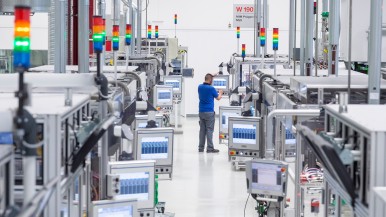
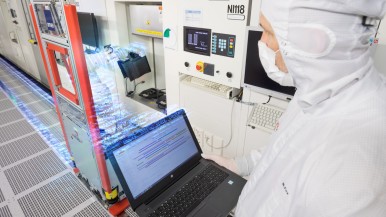
Bosch plant in Ansbach This plant manufactures printed circuit boards for use in control units for ABS and ESP as well as for electronic steering systems. In the assembly of these boards, particular attention has to be paid to the solder joints: there are between 5,000 and 8,000 of them on each board. The Ansbach plant uses an AI-based measuring process to check whether all circuit-board elements are soldered correctly. If this is not the case, an image of the faulty solder joint is presented to experienced visual inspectors for evaluation. All in all, the inspectors now receive only a fraction of the images they previously had to review. The AI significantly reduces the visual inspectors’ workload, improves the quality of the results, and increases productivity. Bosch plant in Blaichach The plant in Bavaria also uses AI for quality control. At the Immenstadt site, the screen at the test bench for ABS systems lights up red to show the assembly workers if the component being tested is defective. This information is provided by a self-learning system that uses the data it has collected to recognize error patterns and, in this way, to distinguish relevant error messages from non-relevant ones. Weekly retraining of the algorithms continuously improves the high success rate. Bosch plant in Changsha At this plant in China, Bosch has introduced an AI-based energy management system that it developed in-house. The system relies on AI algorithms to predict energy consumption on production lines, enable continuous production scheduling, and incorporate business and environmental factors. These factors include forecasts of customer demand, production plans, weather, temperature, and humidity. This saves energy and reduces emissions. With the help of the AI solution, the Changsha plant was able to cut its annual electricity consumption by 18 percent and carbon dioxide emissions by 14 percent. For its achievements, the plant was singled out as an Industry 4.0 lighthouse by the World Economic Forum in 2022. Bosch plant in Charleston At this U.S. location, Bosch manufactures mobility solutions such as ESP, electric motors, and fuel-injection valves. The plant uses a root-cause analysis to investigate causal relationships that can lead to rejects at the end of the production process. AI software lends support to this analysis by sifting through the billions of data points that a manufacturing execution system (MES) collects and records during production. From this data, the AI derives possible correlations between the measured values and quality deviations in the production line and sets them out clearly on a dashboard, where associates see a ranked list of possible causes sorted by descending probability. Bosch plant in Dresden In this wafer fab, which went into operation in 2021, the company employs an AI system developed by its own researchers to detect anomalies and faults in the manufacturing process at an early stage. Predictive maintenance means that work on machines and systems is carried out as necessary. Artificial intelligence guarantees high process stability in the wafer fab and increases quality continuously. This saves customers time-consuming tests and curtails month-long trials. As a result, Bosch not only manufactures faster, but can also be relied on to deliver on time. Bosch plant in Mexicali At this plant in Mexico, AI uses noise analysis to check the quality and functionality of the multifunctional tools manufactured on-site. Once production is complete, a microphone “listens” to the tools for three seconds before the AI software delivers its verdict: OK or not OK – and the results are much more reliable than is possible for human inspectors. Around 300,000 tools were tested during development of the AI solution. The plant aims to use this process to inspect over one million products per year. Bosch in Reutlingen Artificial intelligence is also used in production scheduling at highly automated wafer fabs such as the Bosch plant in Reutlingen, Germany, where it saves time and costs as it guides the wafers through up to 1,000 processing steps. The AI has an overview of all the materials available for a manufacturing step and sorts them on the assembly line so as to achieve optimum throughput. In many instances, production sequencing is determined completely by AI, thus ensuring optimum utilization of capacity.

Bosch combines Industry 4.0 with AI

03.03.2021

Factsheet

Industry 4.0

Bosch combines Industry 4.0 with AI

Stuttgart, Germany – Bosch is developing the factory of the future. In this endeavor, the company sees Industry 4.0 as the way forward. Once Bosch has tested and validated products in-house, it markets them to other companies. Its portfolio ranges from software packages for manufacturing and logistics, to robots that make and deliver parts, to workplace assistance systems. The company expects that the use of artificial intelligence will take its endeavors to the next level. It can help reduce reject rates in factories, for example, and improve the utilization of machines and systems.AI in action: Examples from Bosch manufacturing operations Industry 4.0 combined with artificial intelligence helps in finding solutions for complex tasks. Connected manufacturing provides data and AI evaluates it. One use case for artificial intelligence is in production scheduling in highly automated wafer fabs such as the Bosch plant in Reutlingen, Germany, where it saves time and costs as it guides the wafers through up to 1,000 processing steps. This means a five percent faster wafer throughput, with an investment payback time of just three months. Bosch also uses artificial intelligence in its quality control. At its Immenstadt location, the screen at the test bench for ABS systems lights up red to show the assembly workers if the component being tested is defective. This information is provided by a self-learning system that uses the data it has collected to recognize error patterns and, in this way, to distinguish relevant error messages from non-relevant ones. Weekly retraining of the algorithms constantly improves the high success rate. Quality improvement is also the focus at the Bosch Rexroth plant in Homburg, where machine tools process hydraulic valve housings for mobile applications such as tractors. Machine learning methods are applied to make near real-time statements about the quality of workpieces on the basis of the data collected by machine tools. If necessary, the production processes are immediately adjusted, thus reducing the number of reject parts. Having reached development maturity, the AI application eliminates the need for labor-intensive downstream lab tests. Bosch develops AI solutions for its own plants and for customers Bosch’s special-purpose machinery unit has designed Machine Vision AI, an application platform for machine-based visual inspection of workpieces. It helps detect hard-to-identify features such as scratches and chipping on surfaces and defects in weld seams. The salient features of this solution are its ease of use and high reproducibility. A gradual rollout of the technology is currently underway in Bosch plants. The Bosch Rexroth APAS inspector , a production assistant for automatic visual inspection, is already established in factories and available on the market. Its learning image processing software means the system can be “retrained” at any time without requiring extensive programming knowledge on the part of the operators. AI also helps make manufacturing more resource friendly. More than 100 Bosch plants and locations utilize the Energy Platform from the company’s Industry 4.0 portfolio. Also available to external customers, the platform uses intelligent algorithms to quickly detect machines’ energy consumption and cushion any peak loads. This further reduces carbon dioxide emissions in factories; for example, Bosch’s lead plant for Industry 4.0 in Homburg, Germany, cut its emissions by some ten percent within two years. Bosch is now adding what it calls a Balancing Energy Network to its Energy Platform. This software solution uses AI to control and optimize energy flows in manufacturing operations. In addition to boosting energy efficiency, it allows power from renewable energy sources to be put to the best use, enabling flexible operating schedules to be drawn up. Originally developed for manufacturing facilities, the software has the potential to help all types of larger building complexes reduce their environmental footprint, including hospitals, shopping malls, and sports arenas. Bosch is a pioneer and leader in Industry 4.0 Bosch has been adding connectivity to manufacturing and logistics since 2012, with almost all its plants now using Industry 4.0 solutions. Projects in this area deliver measurable benefit. Industry 4.0 solutions make it possible to increase productivity at individual locations by up to 25 percent. One example is the Nexeed software developed by Bosch Connected Industry, which enables real-time management, monitoring, and control of production activities. Validated and used in Bosch factories, Nexeed has already won over more than 100 customers from a wide range of sectors, including BMW and the sensor manufacturer Sick. While Bosch Connected Industry focuses on Industry 4.0 software for production, the Bosch.IO unit offers cloud-based IoT solutions aimed primarily at logistics and AI-based energy management. Bosch Rexroth develops smart hardware, intelligent robotics solutions such as APAS or ActiveShuttle, and pioneering automation technology for the factory of the future. It has now launched an open, 5G-capable automation control platform: ctrlX Automation. Bosch Manufacturing Solutions rounds off the Industry 4.0 portfolio. The special-purpose machinery unit provides customized systems for production, from assembly to process and testing technology.

The Bosch plant in Feuerbach – where tradition meets high-tech

05.10.2020

Factsheet

Business/economy

The Bosch plant in Feuerbach – where tradition meets high-tech

Feuerbach, in Germany, is home to Bosch’s biggest, as well as oldest, location worldwide. It was established by Robert Bosch himself in 1909, and is home to a Bosch plant that has been in existence for more than a century. In other words, it has a rich history. At the same time, it also has a very bright future – not least because the plant has kept pace with progress and is now profiting from the benefits of Industry 4.0 in the areas of manufacturing, maintenance, transport, and monitoring. For example, with a network of over 550 items of connected machinery throughout the plant, the condition of individual production systems can be monitored via a graphic display showing their current operating status. Equipped with this knowledge, plant engineers can intervene at a first sign of a problem, thereby reducing machinery downtime and increasing output. At the same time, the plant also benefits in the field of logistics, where seamless connectivity has substantially enhanced processes and brought greater transparency. For example, a smart supermarket system with put-to-light technology automates the management of inventory and simplifies sorting in a materials store that is located close to the production line. All parts removed are recorded by the inventory management system, and replacement orders automatically dispatched. The resulting transportation is undertaken by digitalized milk runs or fully autonomous ActiveShuttles. Alongside the extensive deployment of software-based solutions, the Feuerbach plant is also driving forward the development of human-machine interaction. This includes the use of APAS, an automatic production assistant that works hand in hand with human operatives without the need for a protective fence. In other words, Industry 4.0 is changing the face of manufacturing and, with it, the nature of manufacturing jobs. Feuerbach has been quick to respond to this trend. In spring 2018, skilled workers from the plant commenced training for the new, nationwide qualification for Industry 4.0 specialists established by the Chamber of Commerce and Industry (IHK). In addition, in its role at Industry 4.0 lead plant, Feuerbach is doing pioneering work on 5G for the entire Bosch manufacturing network with its approximately 250 plants. For this purpose, Bosch has applied for and received a 5G license to build a private campus network. The set up of the network is planned in 2020. General information Plant name Feuerbach Plant Established 1909 Surface area approx. 109,100 m² Workforce approx. 3,000 Products High-pressure pumps and components for exhaust-gas treatment Core competencies Lead plant functions, digitalization/Industry 4.0, carbon coating, contact measurement, Bainitic hardening Division Powertrain Solutions Facts and figures: Industry 4.0 in Feuerbach Over 550 items of connected machinery 10 percent reduction in cycle times Over 50 percent reduction in administrative overheads for production management due to introduction of the Active Cockpit interactive communication platform Over 50 percent reduction in energy requirements (as per January 2019 compared to 2007), also as a result of smart connectivity for diverse data sources

How Bosch factories are driving climate action

09.07.2020

Factsheet

Business/economy

How Bosch factories are driving climate action

Stuttgart, Germany – Green, smart, successful. The future of manufacturing lies in combination: in making obvious connections and harmonizing ecological and economic concerns. This presents companies with immense challenges. With the manufacturing industry accounting for around one-fifth of CO 2 emissions in Germany, for example, attention is turning above all to production processes and the indirect emissions resulting from the external procurement of electricity and heat. In 2019, Bosch emitted around 1.94 million metric tons of CO 2 worldwide (Scope 1+2) – around 90 percent of which arose in production. Examples from Bosch plants in Germany, France, India, Mexico, and Sweden show what measures the company is taking to achieve climate-neutral manufacturing.Salzgitter and Wernau, Germany – hydrogen as an important building block for the move to alternative energy In Salzgitter, Bosch is working with the Fraunhofer Institute and other local companies to establish a center for hydrogen, known as the Hydrogen Campus, which is funded by the city and the state of Lower Saxony. A pilot project is investigating the potential of hydrogen to reduce factories’ carbon footprint. Hydrogen is regarded as an important building block for the move to alternative energy. Using green electricity, an electrolyzer produces hydrogen and oxygen from water. Hydrogen can replace fuels such as oil or natural gas in the steel and chemicals industries. Used in fuel cells, it can power trains or cars. The Bosch plant in Salzgitter is being used to trial the use of hydrogen an an energy source for factories. The project partners will start building the Hydrogen Campus this year; the ramp-up phase will begin in 2021 with the aim of building a 50 MW electrolysis plant. This will produce around 7,500 metric tons of hydrogen a day, thereby saving up to 41,000 metric tons of CO 2 emissions. At the Bosch training center in Wernau, a pilot SOFC plant is being taken into operation. SOFC stands for solid-oxide fuel cell. The plant is made up of three fuel-cell systems for stationary applications. These will offer a low-carbon supplement to the Wernau plant’s existing power supply, as well as help accelerate the development of such distributed energy systems. When compared with the German electricity mix, an SOFC fuel-cell system saves as much as 40 percent of CO 2 emissions, even when running on natural gas. If the fuel-cell runs on hydrogen or green gas, no further direct emissions of CO 2 are caused. An SOFC unit with an output of 10 kilowatts can cover the annual electricity needs of more than 20 four-person households. In the case of the Wernau plant, this means that the three fuel-cell systems can almost completely cover the energy needs of one of the plant buildings.Homburg, Germany – crunching data to conserve energy and increase efficiency The Bosch plant in Homburg is edging ever closer to the vision of an energy-efficient, self-learning plant. In the past two years, this location has cut its carbon dioxide emissions by around 4,500 metric tons, and by more than 25,000 metric tons since 2007, by employing digitally connected sensors, self-programmed algorithms, and efficiency conversions on machinery. To achieve this, it followed a “maximum transparency meets technological innovation” approach. The energy management platform developed by Bosch uses data that has been collected from the machinery at some 12,000 measuring points. Associates can track, control, and optimize each individual machine’s power consumption. Technical solutions include ventilation of manufacturing shops on an as-required basis, waste heat recovery from various machining processes, and smart consumption management for machinery. In addition, the location is championing the efficiency technology of the future: last year, the prototype of a stationary fuel cell developed by Bosch was put into operation in Homburg. The fuel cell is integrated into the location’s energy supply network and covers peak electricity demand.Reutlingen, Germany – putting waste heat to intelligent use As the Reutlingen plant conducts its manufacturing operations in fully air-conditioned clean rooms, it requires year-round heating. Until now, this demand has been covered by boilers, with the heat in the summer months remaining largely unused. Now, there is a solution: heat exchangers have been added to the heating network at specific points to systematically lower the temperature curve of the heating circuit and thus allow the available waste heat to be used for heating throughout the entire location. In addition, this saves the energy that was previously used to dissipate excess heat. The boilers now run on an as-required basis and can be switched off for practically the entire summer. This reduces the time that heating systems are in operation from 7,500 hours to 4,000 hours per year. It also reduces annual energy consumption by 3,000 megawatt hours and carbon emissions by 700 metric tons.Feuerbach, Germany – people and machines work together to deliver energy efficiency The Bosch plant in Feuerbach has been in existence for more than a century and lies at the heart of the oldest and biggest Robert Bosch GmbH location. Established in 1909, the Feuerbach plant has steadily and systematically modernized its facilities and consistently improved its energy efficiency. With training sessions in its “Energieerlebniswelt” (energy experience world), a local team focuses on energy monitoring and increasing awareness among the workforce. The plant has pursued heat-recovery, room-automation, machine power shut-off management, and shop-renovation projects with great success. Its energy requirements are down more than 50 percent compared with 2007; its carbon emissions are down 47 percent.Nashik, India – reducing carbon footprint with power generated on site In India, Bosch is pursuing carbon neutrality by tapping natural sources of energy. Spurred on by the idea of supplying the location with fully renewable power during daytime hours, the team at the Nashik location began installing its first photovoltaic systems in 2015. It now has 50,000 solar panels in place on roofs, parking lots, and the grounds to generate around 20 percent of the power required by the plant each year. The facility has reduced its carbon emissions by some 25,000 metric tons and saved over 33,000 megawatt hours since 2015. This is equivalent to the power consumed by some 24,500 Indian households. Bosch experts have also developed an eco-friendly solution for cleaning the modules: the water is recycled several times.Rodez, France – sustainable heating system Reduce the site’s carbon footprint – that was what the team in Rodez in France set out to do when it started making plans in 2009. The location now has a biomass heating plant, up and running since 2013. It burns wood chips obtained from local forestry resources. Rodez uses its power to heat water and generate process heat. On average, the wood chip-fired plant covers 90 percent of the location’s heating requirements. It consumes some 6,600 metric tons of wood chips a year. Burning this biomass releases no more carbon than the trees had taken from the atmosphere. The factory has reduced its yearly emissions by around 600 metric tons.Bosch in Mexico – renewables cover four-fifths of demand Mexico has revamped its energy policy. A government energy reform program aims to source 35 percent of the country’s electricity from non-fossil fuels by 2024. With many hours of sunshine annually and high-wind regions, Mexico’s geography and climate are certainly conducive to that goal, providing a solid foundation for change alongside committed support from government and business. Bosch is part of this movement, and has already set a high standard: Power sourced exclusively from the Dominica wind farm in the state of San Luis Potosí covers up to 80 percent of the energy requirements of several Bosch locations in Mexico. Between 2015 and 2019, Bosch Mexico reduced its carbon emissions by 250,000 metric tons.Mellansel, Sweden – energy-efficient painting technology One of the most flexible and eco-friendly paint shops in European mechanical engineering is located in Mellansel, Sweden: the Bosch Rexroth plant there paints equipment such as heavy-duty hydraulic motors for recycling plants and raw materials handling equipment. It is also where engines that will subsequently come into contact with salt water are coated with several layers of corrosion-proofing. In this process, the temperature and the ratio of water to color pigments are closely monitored so that excess heat can be recovered. As a result, energy consumption is 75 percent lower than before.


The Factory of the Future: Bosch is turning vision into reality

27.03.2019

Factsheet

Industry 4.0

The Factory of the Future: Bosch is turning vision into reality

From theory to practice: at Hannover Messe 2019, Bosch is showcasing the connected factory live and up close. Autonomous transport systems deliver components to digital work stations, while robotics systems support workers. Software applications analyze and visualize data in the background. Artificial intelligence makes quality inspections ever more precise, while 5G enables communication in near real time.Industry 4.0 is an integral part of Bosch’s corporate strategy. The company is a pioneer that is setting the pace for connected manufacturing and logistics. At Hannover Messe, Bosch is presenting product innovations, introducing research and development projects, and showcasing what the factory of the future will look like. At a booth measuring some 1,300 square meters, the company is exhibiting the factory of tomorrow, today. A large stage at the center of the booth displays no mere reproduction of the factory – this model is live and interactive. Through a combination of real exhibits and futuristic animations, the company illustrates how Industry 4.0 makes the work in manufacturing and logistics easier, more efficient, and more flexible. Wireless power and communication In the factory of the future, the only fixed elements are the floor, the walls, and the roof – everything else is movable and flexible. LED lighting on the smart floor indicates where autonomous transport systems will be needed next and how they get there. The necessary power comes directly and wirelessly from the factory floor. Communication among the sensors, systems, and machinery is wireless as well. Here Bosch employs the new 5G mobile communications standard, which at more than ten gigabits per second is ten times faster than the top speed currently available. 5G also significantly increases the real-time capability and the reliability with which data can be sent and received. At Hannover Messe, the company is highlighting the standard’s advantages using Bosch Rexroth’s new autonomous transport system as an example: thanks to 5G, the ActiveShuttle maintains a constant and highly reliable connection with the local manufacturing network. The result is security – both in planning and in ongoing operations. 3D printing for industrial applications The manufacturing scenario starts with a BigRep PRO, the first 3D printer of its kind to be equipped with automation solutions from Bosch Rexroth and connected via 5G. Bosch Rexroth and BigRep, one of the leading suppliers of large-format 3D printers, are working on establishing 3D printing as industrial production technology. Automated additive manufacturing not only makes it possible to produce prototypes and models quickly and efficiently, it also makes the technology fit for serial manufacturing. According to estimates, the market for additive manufacturing could be worth some 20 billion euros. At Hannover Messe, the BigRep printer is additionally equipped with IoT solutions from Bosch Rexroth and Bosch Connected Industry. IoT devices, software and intelligent sensors monitor all machine conditions and help to optimize product quality. This data also increases the quality of the printed components. The software is able to detect wear and errors before they lead to machine downtime, thus enhancing the printer’s availability. ActiveShuttle sets intralogistics in motion Intralogistics is becoming increasingly important. After all, what use is highly automated manufacturing if the materials don’t arrive at the production line on time and in the right quantities? Autonomous transport systems make intralogistics flexible and transparent. Bosch Rexroth’s new ActiveShuttle moves loads weighing up to 260 kg quickly and safely through the production facility. An integrated hub platform helps in the fully automated loading and unloading of dollies equipped with small load carriers (SLC). This means ActiveShuttle can facilitate many kinds of transport concepts, ranging from cyclical deliveries to consumption-based material supply. Even when people are present and other transport vehicles are in play, the vehicle merges effortlessly into the intralogistics environment: dynamic map updates mean that ActiveShuttle has no difficulty handling changes in its driving area. Nexeed software for transparent value streams In the background, the Nexeed software harmonizes, analyzes, and visualizes huge volumes of data. It is an example of how the Bosch Connected Industry operating unit, set up in 2018, is further expanding the company’s expertise in Industry 4.0 software. The demand is there: internal Bosch projects indicate that by using Nexeed, it is possible to increase productivity at individual locations by up to 25 percent while reducing stock levels by up to 30 percent. Nexeed also makes plants more flexible: manufacturers can retool machines faster and gear them up for customized production – all the way down to batch sizes of one. Nexeed also facilitates higher transparency in the intralogistics material flow and in international supply chains. Visual inspection with artificial intelligence Artificial intelligence offers enormous potential for improving quality and productivity in manufacturing. At Hannover Messe, Bosch is offering insights derived from its own research project, ViPAS. This visual inspection unit can inspect all sorts of components, ranging from screws and pumps to common-rail injectors – or any part its integrated robot can pick up and hold in front of its camera in the lighting dome. After comparing the images with the stored information, it classifies the parts as either OK or NOK (defective). Deep learning lets the system train itself using sample images, so ViPAS can be deployed for various visual inspection duties. Connected hydraulics from Bosch Rexroth Hydraulics are used to generate high forces, achieve high efficiencies, ensure safety and reliability and guarantee uniform performance over a long period of time. This also applies to industrial production. Bosch Rexroth uses the CytroBox to show how hydraulic components can be connected and integrated into the factory of the future. The sensors in the hydraulic power unit provide information on the current filter, oil or drive status. A dashboard shows maintenance staff everything they need to know about the CytroBox – from component and operating status to upcoming maintenance work and predictive maintenance analyses. Combined with a significant noise reduction to 75 dB(A), the CytroBox makes working more pleasant.

A look at the company’s local operations

27.03.2019

Factsheet

Industry 4.0

A look at the company’s local operations

Bosch has a long history in Sweden . The international technology and services company has been operating there since 1904, and today all four of its business sectors – Mobility Solutions, Industrial Technology, Energy and Building Technology, and Consumer Goods – have local operations. Bosch employs more than 1,600 associates at nine locations in Sweden, including three plants. Bosch Rexroth manufactures high-performance hydraulic drives in Mellansel under the Hägglund brand name for a wide range of applications. This subsidiary also operates a cylinder factory in the Älvsjö district of Stockholm. The Thermotechnology division manufactures heat pumps in Tranas. The Swedish headquarter is located in Kista, a district in the northwest of Stockholm. In 2018, Bosch generated around 1.1 billion euros in domestic sales.An IoT innovation hub down south The company set up an R&D site at Lund at the southern tip of Sweden in 2016 to develop software and hardware solutions for the internet of things (IoT). The number of experts working there has doubled to around 100 since it opened. The Lund location develops connected mobility solutions for infotainment, cybersecurity, and other applications, as well as apps for vehicles and e-bikes. Its experts also create cross-domain IoT solutions for connected mobility, for example, in combination with energy and building technology. Testing in the Arctic Circle, at the cradle of automotive safety technology Bosch has been testing vehicle safety systems on ice and snow for more than 45 winters on the far-north Vaitoudden peninsula. Its first anti-lock braking system, for example, was born there. Bosch opened its Vaitoudden winter test center in 2003 for the company and its customers to test and further refine automated mobility solutions. Bosch locations in Sweden

Bosch Industry 4.0 solutions in practice

27.11.2018

Factsheet

Industry 4.0

Bosch Industry 4.0 solutions in practice

Stuttgart, Germany – Bosch is a leading user and a leading provider of Industry 4.0. The company is digitalizing and giving connectivity to both its own plants and those of its customers. Industry 4.0 solutions are first tested and validated in-house before Bosch markets them to other companies. This means customers benefit from the experience gathered in some 270 Bosch plants and over 700 logistics centers worldwide. One of Bosch’s lead plants for this new technology is in Feuerbach, a suburb of Stuttgart. The plant has implemented numerous Industry 4.0 solutions in production and logistics. Here is a selection.ActiveCockpit – manufacturing data at a glance Bosch Rexroth’s ActiveCockpit intelligent communications platform can visualize data to make it easy for anybody to understand. The large display gives workers information on the current status of production. To do this, the platform processes and visualizes data in real time. The increased transparency this brings to factory operations paves the way for clear, sound assessments. Workers and companies all benefit, as it means problems can be identified immediately, downtimes reduced, and quality increased. Nexeed – making work easier with software The Nexeed Production Performance Manager ensures systematic improvements in production by helping workers make decisions quickly and easily. To do so, it gathers and harmonizes real-time production and machine data from a variety of sources in the manufacturing environment, gives it a clear structure, and presents it to workers on their mobile devices. This saves both time and money. Intelligent supermarket – more transparency in logistics Bosch Connected Industry’s intelligent supermarket is an optimized solution for manufacturing-related warehouses. It involves equipping individual small load carriers or belts with technology including RFID tags and digital kanban cards. This automates the process of booking materials in and out, which used to have to be done manually. Not only does this make life easier for workers, but it also means the supermarket’s stock is available in near real time. In addition, the system indicates the belt onto which incoming stock should be directed. The intelligent supermarket is currently being piloted in the Feuerbach plant. Once the project has been successfully concluded, the solution will be made available in the market. Transport Management – intelligent planning for intralogistics Bosch Connected Industry’s sophisticated Transport Management solution facilitates dynamic planning of intra-plant logistics. The system stores all vehicles with their load status, position, route, and maximum load capacity. For incoming orders, this information is used as the basis for selecting the right means of transportation for the goods. Transport Management can also optimize existing milk run processes: using data from the system, bus-style routes that previously had to include a stop at all predefined waypoints can now focus on goods that are actually ready to be picked up. The system displays up-to-date information about routes and shipments on drivers’ tablets.

25.06.2018

Factsheet

Business/economy

Bosch in Brazil

About Hermann Scholl: Hermann Scholl has been the honorary chairman of the Bosch Group since mid-2012. Prior to that, he was chairman of the board of management of Robert Bosch GmbH until 2003 and, until 2012, chairman of the supervisory board of Robert Bosch GmbH and managing partner of Robert Bosch Industrietreuhand KG since mid-1995. Further informationQuotes: “ It has been some 25 years since I worked very closely with Bosch Brazil in my role as chairman of the board of management at Bosch. I am delighted that the German-Brazilian Chamber of Commerce still takes such a positive view of that time. This award is an honor for me. ” “ Bosch can look back on a long and successful history in Brazil. ” “ Brazil is a wonderful country with many impressive highlights. I remember the people as very endearing, open, and pragmatic. ” Bosch looks back on a long and successful history in Brazil Tradition: Bosch opened its first branch office in Brazil in 1910. The local subsidiary Robert Bosch Ltda. was established in 1954. The headquarters of Bosch Brazil, which remain responsible for the entire Latin America region to this day, were built just a few years later in Campinas, near São Paolo. Bosch has thus been active in Brazil for more than 100 years. All four business sectors operate there today. Local presence: In Brazil, the company focuses on localization. In Campinas, Bosch manufactures mobility solutions such as vehicle retrofitting components, powertrain systems, driver assistance systems, and power tools. The plant in Curitiba produces diesel injection systems. Aratu makes spark plugs, and Pomerode is home to a plant for hydraulic systems. Since 2010, the Bosch service center in Joinville has been providing service solutions for South America. Sales: A successful business year in 2017: sales rose to 4.9 billion reais (1.4 billion euros), with exports accounting for 28 percent in total. Bosch’s business in Brazil accounted for 80 percent of total sales in Latin America. The Mobility Solutions business sector in particular saw positive developments in 2017 due to growth in vehicle production in Brazil and Argentina. Investment: In 2017, Bosch invested some 53 million euros in Brazil. Headcount: Bosch employs some 8,300 associates in Brazil at 14 locations. Dual education model at Bosch in Brazil: In 1960, Bosch became one of the first companies to set up a dual education system in Campinas and Curitiba. Using this model, which is well-established in Germany, we train professionals such as mechatronics engineers according to German standards. To date, a total of over 1,400 young people have accordingly completed their occupational training. Bosch has also opened a center in Campinas that conveys and enhances knowledge throughout the spectrum of industrial occupations to facilitate efficient training. In addition, Bosch Brazil supports the promotion of talent and occupational training programs in the country. Local innovation: Strong localization is an important part of the Bosch strategy worldwide. The electronic control system for the flex-fuel engine is a good example of this. In 2003, Bosch developed a unique local solution for Brazil with this innovation, which allows drivers to choose flexibly between gasoline and ethanol at the pump. As a vehicle fuel, ethanol continues to have tremendous economic significance for Brazil. The flex-fuel engine is still used in most of the vehicles manufactured in Brazil. Smart solutions for Brazil: Demand for connected products is also growing in Latin America. In Brazil, Bosch is developing connected solutions for mining, logistics, and Industry 4.0. For the field of smart farming, Bosch offers a sensor system that reports animals’ weights to farmers and increases productivity on farms in Brazil. Corporate social responsibility: In Campinas, Bosch established the Centro Medico hospital in 1973. Originally set up to improve medical care for Bosch associates, the hospital was spun off into a foundation in 2004, ultimately opening it up to the general public. Instituto Bosch, which makes project funding of up to 3.5 million reais available every year, was also established in 2004. The school and vocational training projects it funds help to improve career opportunities for some 7,700 children and young people. The Primavera aid organization, established and financed by Bosch associates, operates worldwide and also receives donations from Brazilian associates. In Brazil, Primavera supports projects that are spearheaded by NGOs and schools, allowing it to reach an additional 2,000 children nationwide.

25.06.2018

Factsheet

Business/economy

Laying the foundation stone for 300 mm wafer fab in Dresden

General information Total investment approx. 1 billion euros Site approx. 100,000 m2 (about 14 soccer fields) Total floor space approx. 72,000 m² of production area and office space Construction timeline Groundbreaking in spring 2018 installation of machinery mid-/end 2019 pilot production to start at end of 2021 Associates in the completed plant Up to 700 Qualified professionals needed Experts from the semiconductor industry, such as process, production, and maintenance engineers, mathematicians, software engineers, as well as professionals with degrees in physics, chemistry, and microsystems technologies Manufacturing technologye Highly automated wafer production (300 mm silicon substrate wafers with structures up to 65 nm in width – 1 nm equals one millionth of a millimeter) Connected manufacturing Every second, the machines will transmit one gigabit of production data. The volume of data produced is equivalent to more than 42 million written sheets of paper, weighing 22 metric tons.Details on the building Total building volume 600 000 m³ Concrete approx. 66,500 m³ (about 8,300 concrete mixer trucks) Steel approx. 16,400 metric tons (about 30 A380 passenger jets) Earth moved/excavated approx. 90,000 m³ (some 7,500 truckloads) Bored piles for the foundation approx. 860 Floor slabs 100 cm thick Length of piping and ductwork approx. 80 km Length of electrical cabling approx. 380 km (from Dresden to Berlin and back)Internet For job seekers www.bosch-career.de/jobs Site for the Dresden location https://www.bosch.de/en/ourcompany/bosch-in-germany/dresden Bosch semiconductors www.bosch-semiconductors.com