Search & find:
Media, press releases, events for your editorial coverage

Hannover Messe 2025: Bosch embraces hydrogen production

26.03.2025

Press release

Industry 4.0

Hannover Messe 2025: Bosch embraces hydrogen production

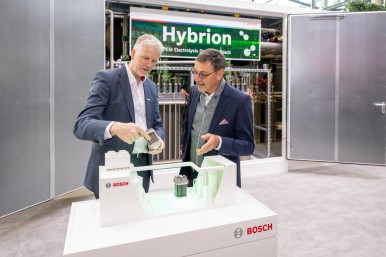
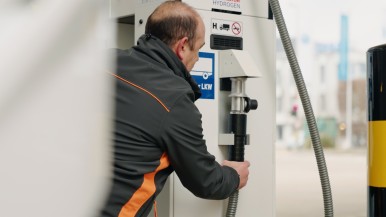
Stuttgart and Hannover, Germany – Whether in the chemicals, transportation, steel, or energy industries, there is enormous potential for decarbonization if hydrogen is used as an energy source – especially if it is produced using renewables. With an expected global capacity of 100–170 gigawatts by 2030, electrolysis is a strategic growth field for Bosch, despite the slowdown in the ramp-up of the hydrogen economy. To mark its entry into this market, the company is showcasing technology for electrolyzers at Hannover Messe. Bosch is premiering two Hybrion PEM (proton exchange membrane) electrolysis stacks as a modular container solution integrated into an electrolysis system. Such stacks are at the heart of the electrolyzer. The complete system, with an output of 2.5 megawatts, is supplied by FEST, based in Goslar, Germany. “To counter climate change, we need alternatives to fossil fuels. Green hydrogen, produced with renewable energy, will play a vital role in massively reducing carbon emissions in the industrial, transport, and energy sectors. Producing this hydrogen requires electrolysis systems – and Bosch’s Hybrion stack is the key component for them,” says Dr. Stefan Hartung, chairman of the board of management of Robert Bosch GmbH. To counter climate change, we need alternatives to fossil fuels. Green hydrogen, produced with renewable energy, will play a vital role in massively reducing carbon emissions in the industrial, transport, and energy sectors. Producing this hydrogen requires electrolysis systems – and Bosch’s Hybrion stack is the key component for them....Dr. Stefan Hartung, chairman of the board of management of Robert Bosch GmbH Bosch aims to apply its fuel-cell expertise to hydrogen production. The company wants to use its experience in volume production to achieve economies of scale and reduce costs in the future. In 2025, it is planning to work on several projects in Europe with various partners. Even before the official sales launch in April, Bosch has already acquired orders amounting to some 100 megawatts – for example, Neuman & Esser will be integrating 16 Bosch Hybrion stacks into an electrolyzer with a capacity of 20 megawatts. Bosch is also working with companies including AKA Energy Systems, Andritz, Pietro Fiorentini, Hyter, H2B2, iGas, IMI, Nikkiso, and Técnicas Reunidas. “Hydrogen is a strategic growth field for Bosch – we expect sales revenue to run into the billions by 2030,” says Dr. Markus Heyn, member of the board of management and chairman of Bosch Mobility. Hydrogen is a strategic growth field for Bosch – we expect sales revenue to run into the billions by 2030....Dr. Markus Heyn, member of the board of management and chairman of Bosch Mobility Stack production and hydrogen cycle in Bamberg The Hybrion stacks will initially be manufactured at the Bosch location in Bamberg, Germany. For each unit, over one hundred electrolysis cells are arranged in layers. For this, Bosch has developed a special clamping tool that greatly simplifies and accelerates the manufacturing process. Each stack can produce up to 23 kilograms of hydrogen per hour when supplied with a maximum power input of 1.25 megawatts. This is enough for a 40-ton truck with a fuel-cell powertrain to travel around 250 to 300 kilometers. In the individual electrolysis cells, a proton exchange membrane – made using a special polymer – separates the anode and cathode from each other. To produce hydrogen, ultrapure water is first fed into the anode side of the PEM electrolyzer. As a result of electrical voltage at the two electrodes, the water at the anode reacts to form oxygen and free electrons and protons. The protons cross the membrane and combine with the electrons to form hydrogen gas at the cathode. Bosch’s Hybrion PEM electrolysis stacks are suitable for hydrogen production in modular plants starting from 1 megawatt, but also for large, gigawatt-scale industrial plants. A FEST electrolyzer with integrated Bosch PEM electrolysis stacks is set to go into operation at the Bamberg plant as part of a hydrogen cycle in 2025. Bosch intends to use the hydrogen produced there for the endurance testing of mobile fuel-cell stacks, which are also manufactured in Bamberg. The power generated during that testing will in turn flow into the electrolyzer, thus closing the cycle. The hydrogen itself is initially intended for the company’s own use. Bosch offers a broad portfolio of products and solutions for hydrogen Bosch has an exhaustive hydrogen portfolio. “In developing hydrogen technologies, Bosch also relies on its proven expertise in industrial technology. We offer solutions from industry for industry,” says Dr. Tanja Rueckert, member of the Bosch board of management. Bosch Manufacturing Solutions, for example, offers water treatment systems that can be used to produce the ultrapure water required for electrolysis. These systems use thermal and electrochemical processes to remove impurities such as salts or metals from the water. Bosch is also actively using hydrogen in mobile fuel cells and hydrogen engines. Together with FirstElement Fuel, the U.S. market leader for the commercial operation of liquid hydrogen filling stations, Bosch Rexroth has achieved an important technology milestone for refueling infrastructure. CryoPump stations cut operating costs by up to 70 percent, bringing them down to an economical level, while shortening refueling processes for heavy trucks to around ten minutes.

Hannover Messe 2025: Bosch offers intelligent and efficient solutions for industry

19.03.2025

Press release

Business/economy

Hannover Messe 2025: Bosch offers intelligent and efficient solutions for industry

Stuttgart and Hannover, Germany – At Hannover Messe, Bosch presents solutions for industry – from hydraulics and electrolysis to software . In each case, the focus is always on improving the efficiency and productivity of manufacturing and enabling sustainable production. There is a significant role for hydrogen in making production sustainable – and in Hall 13, Booth C33, Bosch will be showcasing technologies for producing and using this resource. Bosch Rexroth will also be presenting its broad portfolio of industrial technology in Hall 6, Booth D26. In addition, Bosch experts will be sharing their thoughts with industry through presentations and panel discussions .Bosch technical highlights make industry fit for the future Hydraulic Hub: With its comprehensive range of digital services, the Hydraulic Hub simplifies and accelerates the servicing and maintenance of industrial hydraulic products, thereby increasing machine availability. Users of this digital service platform can access Bosch Rexroth’s hydraulics and service expertise 24/7 via its intuitive interface. The Hydraulic Hub also offers support with documentation and with proactive maintenance of hydraulic systems. AI-based tools provide answers to specific questions, such as what to do in the event of an oil leak, and help identify and rectify faults. Bosch Rexroth is working with Amazon Web Services, among others, to apply AI technologies. Electrolysis stack: Hydrogen production by way of electrolysis using renewable electricity has a central role to play on the path to a climate-neutral economy. In 2025, Bosch will launch its first electrolysis stack, the heart of every electrolyzer. The Bosch stack comprises more than 100 electrolysis cells that employ electricity to split water into oxygen and hydrogen. It is designed for an output of 1.25 megawatts, which corresponds to a hydrogen production rate of 23 kilograms per hour. On the hydrogen side, the resulting pressure is more than 30 bar. The stack is suitable for use in modular systems from 1 megawatt upward as well as in large gigawatt-class industrial systems. Water treatment system: The Pure Water System offered by Bosch Manufacturing Solutions (BMG) is a container system for the production of ultrapure water for electrolysis. Impurities in the water can render electrolyzers inoperative in a very short time. BMG’s water treatment system uses thermal and electrochemical processes to remove impurities such as salts or metals, thereby producing ultrapure water. The first step uses an energy-efficient and water-saving distillation technology called mechanical vapor compression. This is followed by electrodeionization (EDI), in which an electric field removes the remaining ions from the distillate. The Pure Water System requires no filter media or chemicals at all to treat salty water. The system’s product water meets the strict purity requirements of all electrolyzer technologies. Electrolyzer stack testing system: Bosch Manufacturing Solutions (BMG) offers an innovative system for the safe and efficient end-of-line testing of PEM electrolysis stacks up to a size of 1 megawatt. Automated contacting of the electrolyzers at the anode, cathode, and power supply increases precision and reduces the time required for testing. The software’s test procedures can be flexibly adapted to the specific requirements of different tests. Moreover, its customizable data evaluations enable a detailed analysis of the test results, which supports quality assurance in stack production. BMG also offers a modular, customizable electrolysis system for efficient hydrogen production, as well as a broad portfolio of assembly and testing systems for the development, manufacture, and quality assurance of fuel cells and fuel-cell power modules (FCPM). CryoPump station: Bosch Rexroth has worked together with FirstElement Fuel, the U.S. market leader for the commercial operation of liquid hydrogen filling stations, to develop an important technology milestone for refueling infrastructure. CryoPump stations cut operating costs by up to 70 percent, bringing them down to an economical level, while shortening refueling processes for heavy trucks to around ten minutes. Compared to conventional crankshaft-based pumps, the technology increases efficiency to over 95 percent and extends maintenance intervals to over 4,000 hours. With a footprint of less than 11 m² and a noise level of less than 65 dB(A), the stations are ideal for use in existing filling stations, even in residential areas. Battery production solutions: Battery production is considered a key technology for the energy transition. The only way manufacturers can hope to meet heavy future demand is by rapidly scaling up their battery production capacity. At Hannover Messe, Bosch Rexroth will be demonstrating how to realize complex value streams and extremely dynamic material movements using real material flow solutions along the entire value stream: from the virtual warehouse and cell preparation through module and pack assembly to transport and end-of-line testing. Compact gas compressor: Efficient and cost-effective hydrogen compression and storage is a key issue in the energy transition. Based on a proven automotive application, Bosch has developed a gas compressor that can compress over 11 standard cubic meters of hydrogen per hour to as much as 350 bar. This corresponds to more than one kilogram of hydrogen. The compressor’s compact dimensions and extremely low weight of less than ten kilograms make installation and maintenance considerably easier. In addition to hydrogen, the compressor is also suitable for other gases such as nitrogen, helium, and carbon dioxide, which greatly expands its range of application. HeyBosch: Bosch and Microsoft have expanded their partnership to introduce HeyBosch, an advanced AI platform based on Microsoft Azure. HeyBosch improves data management for industrial companies by providing insights into data and knowledge, making complex engineering data easy to understand, and using generative AI to enable user training. The platform integrates conversational AI, VR/AR functions, and business intelligence tools to offer a consistent and user-friendly experience.

Hannover Messe 2024: Bosch presents sustainable solutions for factory automation ...

22.04.2024

Press release

Business/economy

Hannover Messe 2024: Bosch presents sustainable solutions for factory automation ...

Stuttgart and Hannover, Germany – Industrial manufacturing is the engine of every economy. It creates jobs, secures prosperity, and ensures growth through trade. When industrial manufacturers come together again for this year’s Hannover Messe, there will be one major challenge that all of them continue to face: to respond to climate change, factories must become sustainable and conserve resources. Bosch is one of the leading factory outfitters; its broad portfolio of solutions for factory automation, the hydrogen economy, digitalization, and artificial intelligence (AI) helps industrial companies achieve a green transformation.Bosch industrial technology is in demand: in 2023, the supplier of technology and services was able to hold its own in a volatile market environment characterized by geopolitical tensions, the economic downturn, and interest-rate effects. Its sales of industrial technology rose to 7.4 billion euros. This equates to an increase of 6.8 percent, or 10.2 percent after adjusting for exchange-rate effects. The main drivers of this growth were Bosch’s acquisitions of HydraForce and Elmo Motion Control. “We are pursuing a long-term growth strategy with industrial technology,” says Tanja Rueckert, the member of the board of management of Robert Bosch GmbH responsible for the Industrial Technology business sector as well as the area of digital business and services. “We want to strengthen our market position, expand regional supply chains, and increase our industrial technology sales to 10 billion euros by 2028.” We want to strengthen our market position, expand regional supply chains, and increase our industrial technology sales to 10 billion euros by 2028....Tanja Rueckert, the member of the board of management of Robert Bosch GmbH At Hannover Messe 2024, Bosch will be presenting technologies and solutions in the fields of automation, digitalization, and hydrogen. “As an early adopter of artificial intelligence and digitalization applications, industrial technology is like almost no other sector,” Rueckert says. “Software and connectivity help increase efficiency, quality, and sustainability in production. The only way we can secure our standard of living and prosperity is with a strong industrial sector.” Generative AI: improve processes, increase quality In manufacturing, Bosch wants to use generative AI to further improve production management, monitoring, and control. In two Bosch plants in Germany, the company has launched initial projects through which generative AI creates synthetic images in order to develop and scale AI solutions for optical inspection and to optimize existing AI models. Bosch expects that this will reduce the time needed for planning, launching, and ramping up AI applications from the current six-to-twelve months to just a few weeks. Developed by Bosch researchers, this service for generating synthetic data is to be offered to all Bosch locations following successful piloting. ctrlX AUTOMATION: automation toolkit The ctrlX AUTOMATION system for factory automation developed by Bosch Rexroth comprises hardware, software, and apps. It is an open platform that provides all the building blocks for complete automation solutions, and reduces component and engineering costs by 30 to 50 percent. The platform’s community of partners, known collectively as ctrlX World, is continuously expanding the range of solutions with hardware, and above all with apps. So far, 100 partners have contributed their strengths and solutions. Since its launch five years ago, the number of customers has risen to around 1,500. Sales in this area increased 30 percent in 2023. Battery production: components for automated equipment Whether in electromobility, consumer electronics, or building technology, the demand for energy storage is greater than ever. Bosch Rexroth offers a comprehensive portfolio for battery production that includes individual components, systems solutions, and subsystems featuring linear, joining, and transfer technology in addition to the fully open ctrlX AUTOMATION system. Speed and precision are also important in battery production. Bosch Rexroth has developed linear robots that can be used quickly for typical applications such as handling cells and packs as well as joining and dispensing. These robots optimize processes in module and pack assembly and disassembly. Battery recycling: automation solution for deep discharge of batteries There are more and more electric cars driving quietly and with low emissions on the roads. Their batteries contain rare and valuable raw materials such as lithium and nickel, the recovery of which makes economic and ecological sense. Bosch Rexroth’s toolkit solution for diagnosing, discharging, and dismantling used vehicle batteries enables the automation of these process steps, which are upstream of the actual process of recovering the raw materials. This makes it possible to recycle batteries on an industrial scale and offers the possibility of flexible scaling. Stack and smart electrolysis module: technology for H2 electrolyzers Bosch not only plans to use hydrogen, but also to provide smart technology for its production. For this purpose, the company has developed an electrolysis stack, the central element of an electrolyzer. The stack comprises more than 100 electrolysis cells that use electricity to split water into oxygen and hydrogen. It is designed for an output of 1.25 megawatts. That is equivalent to the production of 23 kilograms of hydrogen per hour. The Bosch electrolysis stack is suitable for use in smaller-scale plants producing 1 megawatt and more, all the way up to large, gigawatt-scale plants. It is expected to be market-ready from 2025. In addition, Bosch is planning to combine its electrolyzer stack with a control unit, power electronics, and various sensors to create a smart electrolysis module. Manufacturing and testing technology: how fuel cells are made Bosch Manufacturing Solutions (BMG), the company’s special-purpose machinery unit, supplies advanced manufacturing equipment and testing technology for fuel-cell manufacturing – from individual components to complete systems. In total, more than 50 percent of the required manufacturing equipment comes from Bosch itself. When testing stacks and systems, natural conditions are simulated for the end-of-line functional test, where the PEM fuel cells are put through their paces. Here, gas composition, temperature, pressure, and humidity are the same as in the actual vehicle. The test benches work efficiently: 50 percent of the hydrogen used is recovered for new testing processes. A test bench for proton exchange membrane (PEM) electrolysis stacks will be presented for the first time at Hannover Messe. This type of test bench can be upgraded for development as well as for end-of-line functional testing, and is available in size classes between 50 kW and 3 MW. eSEA underwater actuator: electrification of offshore facilities In the future, hydrogen will often be produced in remote areas – in the desert or at sea – and thus far away from where it will later be used. To make it economical to operate the offshore facilities required for green hydrogen and the capture and storage of CO2, their plant technology needs to be significantly cheaper to purchase and operate than it has been to date. Bosch Rexroth has developed an electrical solution for controlling valves in underwater process plants at depths of up to 4,000 meters. Since this solution no longer feature valves operated via hydraulically driven actuators, it eliminates the need for miles of hydraulic lines to connect to hydraulic power units above water. Hydrogen filling stations: drive solutions for compressing hydrogen Hydrogen filling stations play a major role in decarbonizing the mobility sector. Within the next six years, several thousand hydrogen filling stations are set to go into operation worldwide. Together with partners, Bosch Rexroth has developed scalable solutions for servo-hydraulic compressor drives in the power range between 10 and 280 kW for the compression of hydrogen. To be able to refuel vehicles with hydrogen fuel quickly and simply, the gas has to be compressed to as much as 900 bar. A new electrohydraulically driven cryogenic pump has been developed in partnership with FirstElement Fuel, a leading company in the U.S. for the commercial operation of hydrogen filling stations. This cryogenic pump compresses liquid hydrogen directly to 875 bar. The aim is to refuel heavy trucks with 100 kg of hydrogen in under ten minutes. Direct refueling eliminates the need for intermediate storage tanks at filling stations. The first filling stations are set to be equipped starting in 2025. Moreover, Bosch Rexroth has worked with Maximator Hydrogen to develop scalable, low-maintenance drive units, with ratings currently up to 250 kW, that offer filling station operators an affordable way into hydrogen technology. The new container-based compressors can potentially reduce total cost of ownership by half compared with the commercially available alternatives. The Swiss Coop Group already uses hydrogen trucks for its goods transportation. They refuel at five filling stations equipped with Maximator and Bosch Rexroth technology. Bosch at Hannover Messe Bosch Rexroth – Hall 6, Booth D26 Bosch Connected Industries – Hall 9, Booth F27 Bosch Manufacturing Solutions – Hall 13, Booth C33 Selected panels with Bosch experts • Research Summit – Panel discussion with Dr. Tanja Rueckert, member of the board of management and chief digital officer, Robert Bosch GmbH, Monday, April 22, 2024, 2:30–3:15 p.m., Convention Center (CC), Room 1 • Panel discussion “The future of SMEs: Organizing sustainability & establishing digital business models” with Lisa Reehten, managing director, Bosch Climate Solutions, Tuesday, April 23, 2024, 5:15–5:35 p.m., Hall 8, Booth D17 • Panel discussion “AI meets automation” with Hans Michael Krause, director ctrlX World, Bosch Rexroth AG, Tuesday, April 23, 2024, 1:30–2:00 p.m. in Hall 3, Booth A76 • Lecture “Digital twins: What nobody is talking about” with Dr. Birgit Boss, Bosch Connected Industry, Thursday, April 25, 2024, 3:00–3:25 p.m., Industry 4.0 Conference Stage, Hall 8, Booth D17 • Panel discussion “The role of 6G in shaping the next industrial era” with Andreas Müller, Wednesday, April 24, 2024, 2:45–3:30 p.m., Hall 14, Booth H06


Bosch to use generative AI in manufacturing

07.12.2023

Press release

Industry 4.0

Bosch to use generative AI in manufacturing

Stuttgart, Germany – Bosch is piloting generative AI and foundation models in manufacturing. In initial projects in two Bosch plants in Germany, generative AI creates synthetic images in order to develop and scale AI solutions for optical inspection and optimize existing AI models. Bosch expects that this will reduce the time needed for planning, launching, and ramping up AI applications from the current six to twelve months to just a few weeks. Following successful piloting, this service for generating synthetic data is to be offered to all Bosch locations. Nearly half of all Bosch plants are already using AI in their manufacturing operations. With the help of generative AI, we’re not only improving existing AI solutions, but we’re also laying the foundations for the optimum take-up of this future technology in our global manufacturing network...says Stefan Hartung, chairman of the board of management of Robert Bosch GmbH. There are sound economic reasons for this move: depending on the size of the plant and type of production, artificial intelligence can be used to achieve productivity gains and six- to seven-figure cost savings – per year and plant. “AI has excellent potential for innovation and can make human work even more productive. As a manufacturing company, established factory outfitter, and Industry 4.0 trendsetter, Bosch aims to play a leading role in the development and application of industrial AI,” Hartung says.AI in practice: Bosch projects deliver substantial benefit Bosch pilot plants are already using AI in production scheduling, monitoring, and control. At the plant in Hildesheim, for example, AI-based data analysis has helped reduce cycle times during the production ramp-up of new lines by 15 percent. At the plant in Stuttgart-Feuerbach, new algorithms cut component-testing processes from three and a half to three minutes. “With generative AI, we’re now taking the next step in the evolution of artificial intelligence and advancing modern manufacturing to a new level,” says Tanja Rueckert, member of the Bosch board of management and chief digital officer. In this process, Bosch can build on its own expertise: the software models for generative AI were developed by Bosch research and are now being implemented in the field by Bosch factories. One plant uses an AI method of synthetically generated images to reliably inspect welds of copper wires in electric motor production, while another focuses on the quality assurance of high-pressure pumps. AI boost: generative AI pushes the boundaries of feasibility For years, the Feuerbach plant inspected fuel-injection components manually. The nature and complexity of the products, as well as differences in the structure of the production lines, meant that neither rule-based nor AI-assisted optical inspection was possible. The new approach is a scalable generative AI that recognizes variants of a product and error patterns and takes into account different arrangements and sequences in the production process. This is based on a foundation model developed by Bosch research and fed by large data sets from the Bosch manufacturing network. Synthetically generated data is used to refine the model and customize it for on-site applications. This is expected to make the AI capable of inspecting components independently, only submitting cases to visual inspectors where it is unsure. At the Hildesheim plant, synthetically generated images have already been successfully used for training purposes in the first standard systems in electric motor production. The human eye cannot distinguish the artificially generated images from real ones. The plant expects that project duration will be six months shorter with the new approach than with conventional methods, leading to annual productivity increases in the six figure euro range. Bosch plans to expand the AI approach to other locations. “In our work to develop AI solutions, we’re unlocking the potential offered by the Bosch manufacturing network and its roughly 230 plants. And we are using new technologies. Generative AI helps to harmonize individualization and scaling – the technology gives us the best of both worlds,” Rueckert says. AI status: widely used in Bosch plants Many Bosch plants have one thing in common: not only are they AI pioneers, but they also focus consistently on Industry 4.0. “Bosch has been digitalizing and connecting its own plants and those of its customers for more than ten years. Now we’re combining Industry 4.0 with artificial intelligence: connected manufacturing provides data and AI evaluates it,” Rueckert says. Errors are detected at an early stage, machine downtimes are kept to a minimum, scrap is reduced, and energy is applied in a focused way. “The use of AI will make factories more efficient, more productive, and more eco-friendly,” she adds. For example, Bosch research has developed an AI-based system that identifies anomalies and malfunctions in the manufacturing process and improves product quality. This software is now in use in around 50 Bosch plants, with over 2,000 production lines connected. Many Bosch plants also use artificial intelligence in the optical inspection of components. For example, over 20 plants use Machine Vision AI, a solution designed by Bosch’s special-purpose machinery unit that helps detect hard-to-identify features, such as scratches and chipping on surfaces and defects in weld seams. AI pioneers: World Economic Forum commends Bosch plants The Bosch plant in Bursa, Turkey, illustrates what AI can achieve in manufacturing. Starting from an already high level of technical expertise, the plant has used AI to further improve manufacturing quality: it has reduced water consumption by 30 percent, energy consumption by 6 percent, and scrap by 9 percent, while also increasing plant efficiency by almost 10 percent. This year, these achievements prompted the World Economic Forum (WEF) to single out the plant in Bursa as an Industry 4.0 lighthouse. This is the fourth time a Bosch plant has received such recognition from the World Economic Forum, and the second time specifically for developments in the field of artificial intelligence. All this shows that “AI’s importance is historic. It will fundamentally change industrial production – for the better,” Rueckert says.

Training campaign: Bosch trains over 130,000 associates in technologies of the future

13.09.2023

Press release

Industry 4.0

Training campaign: Bosch trains over 130,000 associates in technologies of the future

Stuttgart, Germany – It’s something that affects nearly every company. An aging society and labor shortages are social trends that are shaping the 21st century. “Bosch is facing up to these challenges as a committed employer: we’re focusing on training and upskilling as well as on intelligent technology that makes associates’ work easier,” says Stefan Grosch, member of the Bosch board of management and director of industrial relations. In 2022, the company offered more than 30,000 training seminars worldwide, with more than 520,000 Bosch associates taking part. One focus was technological expertise. More than 130,000 participants were able to acquire knowledge in technologies of the future such as electromobility, software engineering, and Industry 4.0. “Looking at the metrics for the first half of the year, we expect to train around 50 percent more Bosch participants in 2023 than we did the year before,” Grosch says. This commitment to training does not end at the company’s own factory gates. With academies, training centers, and training courses, Bosch also offers other companies, customers, and interested parties the opportunity to acquire knowledge. On the subject of Industry 4.0, for example, the company makes more than 100 Bosch training programs on digitalization and connectivity in manufacturing available externally through Bosch Connected Industry, Bosch Rexroth, and training institutes. Bosch is facing up to these challenges as a committed employer: we’re focusing on training and upskilling as well as on intelligent technology that makes associates’ work easier,...says Stefan Grosch, member of the Bosch board of management and director of industrial relations. Training: nurturing individual talent for collective success According to the European Commission, three-quarters of companies in the EU report difficulties in finding qualified workers, and only 37 percent of adults engage in regular further professional development (source: European Commission, 2022 ). “Bosch promotes lifelong learning. This is the key to lasting professional and business success,” Grosch says. It is also essential for a country’s economic output. "If we want to maintain prosperity in Germany and remain successful as an exporting and industrial nation, we must invest even more in upskilling and intelligent technology and actively encourage people to enroll,” Grosch says. Bosch offers all associates the opportunity for professional development. In 2022, Bosch associates attended one to two training courses on average; in addition, they completed two to three web-based courses. Roughly 6,000 seminars deal with technologies of the future. Lasting an average of two days, these seminars are particularly thorough. Digitalization often determines not only the topic and content of training courses, but also their form: in 2022, online courses accounted for two-thirds of all training hours for Bosch associates. “Digitalization is becoming a training booster for companies and their workforce; it enables learning independent of place and time and gives people a chance to experience new technologies such as artificial intelligence firsthand,” says Bosch CDO and member of the board of management Dr. Tanja Rückert. Last year alone, Bosch spent some 300 million euros on professional development for its associates. “At Bosch, we develop technology that is ‘Invented for life.’ To do that, we need the right team with talented people in all positions, and we need them to continuously improve and expand their skills,” Grosch says. Digitalization is becoming a training booster for companies and their workforce; it enables learning independent of place and time and gives people a chance to experience new technologies such as artificial intelligence firsthand,...says Bosch CDO and member of the board of management Dr. Tanja Rückert. Upskilling: Bosch focuses on the industrial base The labor shortage comes at a cost. The Boston Consulting Group estimates the loss in potential output for the German economy to be 86 billion euros. The German Chamber of Commerce and Industry puts it even higher, at just under 100 billion euros – annually (source: DIHK, 2023 ). In an international comparison of the nations with the strongest economies, the losses suffered by the German economy are the second highest after the United States. “In the competition for the best talent, companies have to put everything on the line. A future-oriented corporate approach also means identifying vocational training and professional development opportunities and offering them to the workforce. Having highly qualified personnel is a decisive competitive advantage,” Grosch says. As a manufacturer and technology company, Bosch pays close attention to professional development for its associates in manufacturing operations. This year, for example, its mobility business launched the LernWerk initiative to train 24,000 associates in readiness for the digital transformation, initially at German sites. “Manufacturing is where value creation begins in our company. This is where we lay the foundation for business success. Our progressive and efficient manufacturing operations feature an impressive degree of connectivity and digitalization. One important prerequisite for this is ensuring associates receive the necessary training,” Rückert says. Transfer: Bosch provides knowledge and training systems As part of Bosch’s training program for other companies, its Industry 4.0 courses are additionally offered in Germany and elsewhere through partners such as chambers of industry and commerce, colleges, and universities: “From France and the Czech Republic to China, India, and Singapore, companies are training their manufacturing workers according to the German model. Bosch is one of the Industry 4.0 pioneers, and we are sharing our knowledge all around the world. Industry 4.0 training ‘made in Germany’ is becoming the global standard,” Rückert says. In addition to vocational training and professional development programs, Bosch develops training systems that are compatible with the syllabuses of industrial and educational institutions. Bosch Rexroth is launching its new Automax 600 training system. Using internationally standardized programming languages and open interfaces, this gives users practical experience of the digitalization of production processes – including controlling robotic systems, operating autonomous transport systems, and using cloud applications such as data analysis and machine learning based on artificial intelligence. Automation: Bosch technology makes work easier There are various remedies for labor shortages. One is vocational training and professional development, and visa programs for skilled workers are another. And technology also has a key role to play. Bosch Rexroth, for example, has developed an automation solution that no longer requires any previous specialist knowledge of automation. Users of ctrlX Automation can choose from over 30 popular programming languages. The company is taking a similar approach to hydraulics: In the future, customers can use H4U to integrate Bosch Rexroth software into the automation architecture they are already familiar with, eliminating the need to build up their own hydraulics expertise. “By opening up systems, making technology interoperable, and moving hardware applications into software, we reduce complexity and dependencies, such as on specialists,” Rückert says. Moreover, technology makes life easier for workers whose tasks are monotonous, strenuous, or hazardous. Robotics supports loading and palletizing, artificial intelligence helps with the optical inspection of workpieces, augmented reality guides through work processes, and driverless transport systems take goods directly to where they are needed. “Only by increasing productivity can we manage the impact of an aging society. This calls for well-trained specialists, as well as technology that allows them to work rationally and efficiently. The interplay between humans and machines and between training and digitalization is a key success factor,” Grosch says.

Hannover Messe: seven Bosch highlights for manufacturers

14.04.2023

Press release

Industry 4.0

Hannover Messe: seven Bosch highlights for manufacturers

Hannover, Germany – Resource scarcity, an aging society, and labor shortages, coupled with the political and social goal of ecologically transforming the economy, mean German industry is facing major challenges. At the Hannover Messe, ideas and solutions for successfully overcoming these challenges will be presented and discussed. Bosch firmly believes that industrial technology has a significant part to play in this. It sees industrial technology as a rich source of potential growth. This growth will be driven by an increasing need for automation and Industry 4.0 solutions, the “merging” of electrical and hydraulic systems, and growing demand for GreenTech for the ecological transformation. Bosch will be presenting a range of new products and solutions at the Hannover Messe (April 17–21) (hall 6, booth D26 and hall 13, booth C16). In addition, Bosch experts will be giving deep dives into core topics at panel discussions and in lectures.Automated battery recycling: More and more electric cars are finding their way onto our roads. This is increasing demand for batteries and for the recycling of the raw materials they contain, such as lithium, cobalt, and nickel. Bosch has developed special machinery and software for this purpose. These include fully automated discharging and disassembly systems in which battery modules are chemically deactivated in just a few minutes in a reliable process, ensuring that further processing can take place without the risk of electric shocks. Battery Lifecycle Company is building Europe’s first fully automated plant at its site in Magdeburg, Germany – using Bosch technology. At Hannover Messe, Bosch is presenting its patented discharging solution. Electrification of mobile machinery: Bosch Rexroth is launching its eLION portfolio solutions for the electrification of mobile machinery such as excavators, wheel loaders, and tractors. With over 80 motor variants, graded according to power and size, the company offers the broadest range in the industry, helping to reduce carbon emissions on construction sites, in mining, and in ports. The motors cover a nominal power range from 20 to 200 kW (peak power up to 400 kW). International customers such as Sennebogen and Kalmar Cargotec are already using the new Bosch drives in their products, and in this way driving forward the electrification of mobile machinery. Stationary fuel cells: Bosch is the first company in Europe to work on the commercialization and mass production of solid-oxide fuel-cell systems. At Hannover Messe, Bosch is presenting stationary fuel cells with an overall efficiency of more than 85 percent. These fuel cells are suitable for distributed power generation on-site in buildings, urban neighborhoods, factories, trade and commerce, and data centers. The energy converters are currently being tested in some 60 pilot plants. Bosch plans to start volume production of stationary fuel cells in 2025. Connected hydraulics: Until now, hydraulic control technology has been tied to hardware. With its H4U platform , Bosch Rexroth has now mapped hydraulic functions into software, making them hardware-agnostic. Mechanical engineers can integrate the functions into existing automation architectures and use an app for the hydraulic control of parameters such as pressure and volume flow. In this way, Bosch Rexroth increases productivity, boosts energy efficiency, and reduces carbon emissions from plants. All-around tactile talent: Bosch Rexroth’s Smart Flex Effector is a module that combines the precision of a robot with the sensitivity of a hand. The module’s high-resolution position sensors detect positional deviations between the tool and the workpiece, so it can immediately initiates corrective movements. The Smart Flex Effector is suitable for handling or joining processes with narrow tolerances, for example when inserting glass plates into refrigerators or printed circuit boards into engine control units. At Hannover Messe, the Smart Flex Effector has been nominated for this year’s Hermes Award, the world’s most prestigious industry award. Lightweight cobots: Bosch Rexroth is showcasing the powerful, reliable helpers from Kassow Robots at its booth. These lightweight robots can perform a variety of tasks in industrial manufacturing. The cobots have a high payload and large reach, and they can work in confined spaces: equipped with seven axes, the cobots can reach around corners like an arm and offer flexibility that is unparalleled on the market to date. In 2022, Bosch Rexroth acquired a majority stake in Kassow Robots ApS, based in Copenhagen, Denmark. Automation toolkit: Consisting of hardware, software, and apps, Bosch Rexroth’s ctrlX AUTOMATION is an open platform that provides all the building blocks for complete automation solutions. It reduces component and engineering costs by 30 to 50 percent, and comes with an affiliated partner network. This enables users to develop apps and services themselves and offer them to others in the ctrlX World ecosystem. Three years after its market launch, more than 600 customers already rely on ctrlX AUTOMATION.

Hannover Messe: Bosch aims to increase sales of industrial technology to over 10 ...

13.04.2023

Press release

Business/economy

Hannover Messe: Bosch aims to increase sales of industrial technology to over 10 ...

Stuttgart, Germany – Bosch wants to achieve sustainable growth with industrial technology. Its sales of industrial technology are expected to rise from their current level of 7 billion euros to more than 10 billion euros by 2028. The aim is to achieve profitable growth: “We want to increase result more than sales and sustainably increase the value of the company. To this end, Bosch will invest a combined total of more than 3 billion euros in industrial technology in 2022 and 2023, ensuring organic and inorganic growth,” says the Bosch chairman Dr. Stefan Hartung. The acquisition of the U.S. hydraulics company HydraForce and its roughly 2,100 associates means that Bosch’s biggest current acquisition is in its Industrial Technology business sector. This merger sees Bosch Rexroth expanding its leading global position in hydraulics, supplying technology for excavators, cranes, tractors, and for plant and machinery in factories.Industrial technology offers enormous growth potential for Bosch. This is driven by an increasing need for automation and Industry 4.0 solutions, the “merging” of electrical and hydraulic systems, and growing demand for GreenTech for the ecological transformation of the economy. “By strengthening Industrial Technology, we are creating a better balance among our areas of business. Our broad diversification as a global technology company makes Bosch more creative and robust,” Hartung says. Within the Bosch Group as well, Industrial Technology is an important service provider, equipping the roughly 240 Bosch plants worldwide with manufacturing technology to ensure resource-efficient, customer-specific production. This saves the group from having to make orders worth over half a billion euros every year. At Hannover Messe (April 17–21, 2023), Bosch is showcasing its industrial technology portfolio, including innovations in collaborative robotics, control technology for Industry 4.0, energy-efficient hydraulics, electrified mobile machinery, stationary fuel cells for buildings and factories, and automated battery recycling. By strengthening Industrial Technology, we are creating a better balance among our areas of business. Our broad diversification as a global technology company makes Bosch more creative and robust,...says the Bosch chairman Dr. Stefan Hartung. GreenTech: Bosch sales with solutions for industry reach the billion mark Industrial technology is growing thanks both to various sectors of the economy moving toward climate neutrality and to the emergence of a circular economy. “Without capital goods, the ecological transformation of business would not be conceivable. Industrial technology enables the sustainable transformation of different sectors of the economy,” Hartung says. Bosch is developing solutions that conserve resources, reduce energy consumption, protect the environment, and mitigate global warming. In 2022, Bosch generated sales of more than 1 billion euros with environmental technology for industry – a year-on-year increase of 25 percent. In other words, Bosch reached its sales target for 2023 one year earlier than planned. And the company is continuing to expand its GreenTech portfolio. Bosch Rexroth, for example, is launching its eLION portfolio solutions for the electrification of mobile machinery such as excavators, wheel loaders, and tractors. With over 80 motor variants, graded according to power and size, the company offers the broadest range in the industry, helping to reduce carbon emissions on construction sites, in mining, and in ports. International customers such as Sennebogen and Kalmar Cargotec are already using the new Bosch drives in their products, and in this way driving forward the electrification of mobile machinery. The demand for GreenTech is also increasing in factories. As a result of climate-action measures, companies are modernizing their installed machinery and equipment on the one hand and building new manufacturing facilities on the other, for example for batteries and fuel cells. At Hannover Messe, Bosch is showcasing manufacturing technology for battery production – and for recycling. “The only way we can make a success of electromobility is if we recover the raw materials we use,” Hartung says. Bosch Rexroth has developed an automated battery discharge system that not only simplifies recycling, but is also more efficient than manual processes. The technology is being used for the first time by REMONDIS and Rhenus Automotive at their Magdeburg site in Germany. Hydrogen: Bosch is relying on its own know-how for technology development In addition to storage media such as batteries, “conversion artists” such as fuel cells are important elements of a climate-neutral future. At Hannover Messe, Bosch is presenting stationary solid-oxide fuel cells (SOFCs) with an overall efficiency of more than 85 percent. These distributed energy converters are currently being tested in some 60 pilot plants. One of them is the Hydrogen Campus in Salzgitter, Germany: at this Bosch site, ten SOFC fuel-cell systems have been integrated into the plant’s energy supply system. Bosch is aiming to launch the stationary fuel cells commercially in 2025. The components are manufactured using Bosch’s own know-how and technology. From cell to stack to the overall system: Bosch’s special-purpose machinery unit supplies more than 50 percent of the manufacturing equipment required for fuel-cell production. In the future, the Bosch portfolio will also feature components for electrolyzers. The market launch for the heart of the electrolyzer, known as the stack, is planned for 2025. Industry 4.0: Bosch software conserves resources Energy, factory supplies, raw materials – resources are rare and precious. “Our response to shortages is efficiency. Anyone looking to manufacture sustainably needs to adopt Industry 4.0,” Hartung says. For example, Bosch Connected Industry’s Nexeed Industry 4.0 software increases plant effectiveness in factories by an average of 5 percent, cuts maintenance costs by 25 percent, and reduces waste. Nexeed is already being put through its paces in more than half of Bosch’s roughly 240 plants and at more than 100 international customers. Software also helps combine conventional and novel technologies. One example is hydraulics: for more than 200 years, fluid mechanics have been used whenever large loads need to be moved with minimal effort, for example in plastics machinery or presses. Thanks to load-dependent control, Bosch Rexroth variable-speed pump drives are now always in the optimum operating mode. They switch to standby mode when not in use. Compared to conventional drives, this reduces the hydraulic systems’ energy consumption by up to 80 percent. Automation: Bosch technology reduces complexity Aging society, labor shortages, limited resources in general: the challenges are mounting. Bosch is focusing on an education and training campaign and on technology that supports companies and relieves workers of certain tasks. Bosch Rexroth’s ctrlX AUTOMATION modular automation system, for example, understands over 30 programming languages and allows users to develop their own apps and services. More than 600 customers already rely on this pioneering form of automation. “The only way we can overcome the pressing challenges of our time is by joining forces to make more of a difference. ‘Co-creation’ and making systems open for others are important considerations here,” Hartung says. Bosch Rexroth is pursuing this approach in hydraulics as well. Whereas control technology was previously tied to hardware, the company has now transferred this to software modules. This means mechanical engineers can continue to use existing automation architectures; specific hydraulics know-how is no longer required. Automation also supports workers directly, for example by relieving them of monotonous or strenuous tasks. At Hannover Messe, Bosch Rexroth is showcasing articulated, fine-motor lightweight cobots that reach around corners in seven axes and help workers load, palletize, and inspect workpieces. These cobots are in demand. The global market for industrial automation is growing rapidly: while sales of automation technology were just under 200 billion euros in 2021, they are expected to grow to more than 400 billion euros globally by 2030 – with annual growth rates of over 8 percent (source: Precedence Research, 2022 ). “Megatrends such as digitalization, an aging society, and efforts toward greater sustainability are driving the demand for automation. Factory automation is a strategic business area for Bosch in which we aim to achieve double-digit growth every year – and thus grow faster the market,” Hartung says.

Battery recycling: Bosch to develop Europe’s first fully automated battery-disch ...

05.04.2023

Press release

Business/economy

Battery recycling: Bosch to develop Europe’s first fully automated battery-disch ...

Stuttgart, Germany – More and more electric cars are finding their way onto the road. Bosch estimates that they will account for around 70 percent of all newly registered passenger cars in Europe by 2030. This is increasing demand for batteries and for the recycling of the raw materials they contain, such as lithium, cobalt, and nickel. Bosch has developed special machinery, equipment, and software for this purpose. The subsidiary Bosch Rexroth is supplying Battery Lifecycle Company, a joint venture between REMONDIS subsidiary TSR Recycling and Rhenus Automotive, with Europe’s first fully automated system for discharging and disassembling battery modules. “Electromobility can only establish itself in the long term if sufficient raw materials are available for battery production. Recycling plays a key role here, and helps place our output on a sustainable footing: we reuse what we use, and we recover raw materials,” says Dr. Stefan Hartung, chairman of the Bosch board of management. Experts predict that by 2030, Europe will require recycling capacity for up to 420,000 metric tons of battery material each year (Source: Fraunhofer ISI, 2023 ). “If we want to build a European circular economy, we need to integrate recycling firmly into the product life cycle and create the necessary infrastructure to do so. Bosch is contributing its technical expertise to this,” Hartung says. Bosch will present industrial technology for battery recycling at Hannover Messe (April 17–21, 2023). Electromobility can only establish itself in the long term if sufficient raw materials are available for battery production. Recycling plays a key role here, and helps place our output on a sustainable footing: we reuse what we use, and we recover raw materials,...says Dr. Stefan Hartung, chairman of the Bosch board of management. Efficient recycling as a building block of a circular economy Growing numbers of electric cars combined with limited resources and increasing legal requirements for recycling – the challenges are increasing. “What we do today sets the course for tomorrow. The batteries currently being installed in vehicles will have reached the end of their life in 10 to 15 years. We must use this window of opportunity to build the necessary recycling capacity,” says Steffen Haack, CEO of Bosch Rexroth. According to the Fraunhofer Institute for Systems and Innovation Research, the technical systems required for recycling will require investment of more than 6 billion euros by 2040 in Europe alone (Source: Fraunhofer, 2021 ). Recycling will be worthwhile: optimum recycling can recover up to 95 percent of a battery’s chemical elements and recycle them into the battery production process. The automated discharging system developed by Bosch not only simplifies recycling, but also increases efficiency and enhances safety: it takes just a few minutes to deep-discharge a module. The system recognizes different battery designs, minimizing risks such as short circuits and fires. Model project at Battery Lifecycle Company Battery Lifecycle Company is building Europe’s first fully automated plant at its site in Magdeburg, with Bosch Rexroth supplying the technology. The site will test used batteries from different manufacturers, deep-discharge them, and prepare them for subsequent shredding. The new plant’s workpiece carriers will each transport battery materials weighing up to 150 kilograms at a speed of 18 meters per minute. This means that it will take less than 15 minutes to automatically discharge eight lithium-ion batteries from electric cars. Bosch’s automated solution will greatly increase the speed of recycling: with the manual process currently used, it takes up to 24 hours to deep-discharge a battery. The model project in Magdeburg is the first to use this patented Bosch discharging solution: battery modules will be chemically deactivated in a reliable process, ensuring that further processing can take place without voltage. The residual energy in the modules can be used to operate the recycling system. In addition, the site will use proven Bosch industrial technology for battery production on-site, including flexible, modular transfer systems and the ctrlX AUTOMATION control platform. Each year, the Battery Lifecycle Company site will recycle up to 15,000 metric tons of battery materials. The plant is scheduled to go into operation in summer 2023. Bosch industrial technology for recycling Bosch has many years of experience in the development of automation and manufacturing technology for battery production. All the premium German automakers and many battery production facilities worldwide use Bosch industrial technology. Bosch is continuously expanding its portfolio along the value chain for battery production. The company has now developed hardware and software specifically for battery recycling, which is marketed worldwide together with partners and system integrators. In addition to fully automated battery module discharging stations, these include ergonomically flexible workstations for technical analysis and safe battery disassembly, transfer systems for transporting batteries of different weight classes, and software for guiding workers through the various process steps. Bosch also offers a track and trace solution for the condition, material origin, and processing status of batteries.

Bosch drives forward the development of 6G

27.02.2023

Press release

Connected mobility

Bosch drives forward the development of 6G

Stuttgart, Germany – Worldwide, research and development work on the future 6G mobile communications standard is picking up pace. Companies and states are investing massively in this technology. Bosch is leading the way and is actively involved in projects, alliances, and initiatives at both the national and international level to lay important foundations for 6G technology. “6G will be much more than just an infrastructure for connectivity; it will greatly increase the efficiency of autonomous driving cars, smart cities, and connected industries. That’s why 6G is a strategically important field of technology,” says Dr. Andreas Müller, who bundles and manages 6G activities at Bosch. The company currently has some 40 associates working on 6G technology. Over the next two years, that number is likely to double,” Müller says. Bosch is currently investing several millions of euros in research and development for 6G. 6G will be much more than just an infrastructure for connectivity; it will greatly increase the efficiency of autonomous driving cars, smart cities, and connected industries. That’s why 6G is a strategically important field of technology...says Dr. Andreas Müller, who bundles and manages 6G activities at Bosch. Bosch and Nokia expand their research alliance to include 6G At the Mobile World Congress 2023 in Barcelona, Bosch and Nokia have now announced that they will expand the alliance they entered into in 2017 to develop industrial IoT solutions in the area of 5G so that it also addresses the new 6G technology. The two companies are conducting joint research on the next generation of networks and investigating how to use future 6G networks for both communications and sensors. Comprehensive Bosch commitment at national and international level Bosch is currently contributing its expertise and experience to five publicly funded projects. In this context, the 6G-ICAS4Mobility , KOMSENS-6G , and 6G-BRAINS projects focus primarily on integrating communication and sensor-based environment recognition. Bosch leads the consortium for the first project . In addition to addressing relevant scenarios for road traffic, insights gained from the project will serve, in particular, as technical foundations for applications in the connected drones domain as well as in Industry 4.0 (e.g. for driverless transport systems). Meanwhile, the 6G-ANNA and 6G-SHINE projects focus on new connectivity structures. These are intended to enhance the efficiency of future E/E architectures in vehicles or robot cells. Bosch is also taking an active and leading role in early discussions and activities relating to future mobile communications standards within various industry alliances. In the 5G Automotive Association (5GAA) , for instance, leading companies from the automotive and telecommunications industries are working together to develop solutions for the mobility of the future. The 5G Alliance for Connected Industries and Automation (5GACIA) brings together industrial companies to focus on connectivity for machinery and equipment. Networks with a sixth sense through integration of sensor technology Among other things, the next generation of mobile communications will integrate new functionalities similar to radar sensors. With 6G, it will be possible to detect the position of objects in the network’s coverage area – without these objects having to be equipped with a radio module. 6G will enable extremely high data rates of up to one terabit per second, with very low latency in the order of some 100 microseconds – which is four times faster than a lightning strike. With the help of digital twins, this will for instance make it possible to monitor and simulate real-world manufacturing processes in a virtual world with no temporal and spatial restrictions. Experts predict that the first 6G standard will be completed by 2028. In recent months, Germany and Europe have launched a large number of 6G projects with the goal of strengthening their technological sovereignty. The German government, through the Federal Ministry of Education and Research (BMBF), is providing some 700 million euros over the next three years to fund 6G activities. In addition, the EU budget has earmarked a further almost 900 million euros until 2027. Japan and the United States have also launched corresponding investment programs totaling around 4.5 billion dollars.

Bosch aims to generate billions in sales with green tech for industry

24.05.2022

Press release

Business/economy

Bosch aims to generate billions in sales with green tech for industry

Stuttgart, Germany – In the fight against climate change, technology is paving the way, and Bosch is at the forefront of these endeavors. In February 2020, Bosch became the first global industrial company to achieve carbon-neutral production. It is developing green technologies that conserve resources, reduce energy consumption, protect the environment, and mitigate global warming. “Industry will become a driver of ecological transformation in business and society. Bosch is mobilizing all its resources and contributing its technological know-how and many years of manufacturing expertise,” says Rolf Najork, the member of the Bosch board of management responsible for industrial technology. In 2021, green tech for industry generated sales of over 800 million euros for the company. That is just under 14 percent of the total sales of Bosch’s Industrial Technology business sector (6.1 billion euros in 2021). The green tech market is growing by 8 percent annually (source: BMU, 2021 ). “Bosch is growing faster than the market. By 2023, we want to break the one-billion-euro mark in sales of green industrial technology,” Najork says. Ecological transformation is paying off: according to the VDMA, the association of German machinery and equipment manufacturers, the systematic use of green tech can cut industrial greenhouse gas emissions by almost 90 percent (source: VDMA, 2020 ). The VDMA study also says that by 2050, the expansion of climate-friendly technologies in the industrial sector will create a market potential of over 300 billion euros a year. At Hannover Messe (May 30–June 2, 2022), Bosch will be presenting its green tech solutions – from industry, for industry, and beyond. Industry will become a driver of ecological transformation in business and society. Bosch is mobilizing all its resources and contributing its technological know-how and many years of manufacturing expertise...says Rolf Najork, the member of the Bosch board of management responsible for industrial technology. Green factories: digitalized and connected Mitigating climate change is a challenge for society as a whole. The industrial sector accounts for around one-fifth of global CO 2 emissions. “Industry must and can play a crucial role in environmental and climate action,” Najork says. “Far from being a pipe dream, green factories are a reality. All we need now is more of them.” Energy efficiency is a key lever, helping machinery and equipment to consume less energy. This is where digitalization comes in. It also helps pinpoint where energy is being consumed. To manage the consumption of heat, electricity, and compressed air, Bosch relies on its own Energy Platform in combination with Nexeed Industry 4.0 software. This makes it easier to predict energy consumption, avoid peak loads, and recognize and correct deviations in individual machines. The platform is now used at more than 120 of the company’s locations and in more than 80 customer projects. In Bosch’s Industry 4.0 lead plant in Homburg, Germany, this software is helping cut energy requirements by over 40 percent per manufactured product. Artificial intelligence offers even more possibilities. At its Eisenach plant, also in Germany, Bosch is currently piloting its Balancing Energy Network . Based on the Energy Platform, this AI solution manages and optimizes the energy requirement of 1,000 machines. The AI shows how production and logistics data, weather information, and energy prices relate to each other and offers recommendations for action. AI is expected to help further lower the location’s annual energy costs by around 5 percent. Efficient machinery: higher performance, lower consumption Connecting machinery and processes intelligently and dovetailing them with information and communications technology creates the basis for energy-efficient production. Increasingly, this involves relocating functions from hardware to software, augmented by digital twins. “In the factory of the future, it will be possible to adjust many things at the touch of a button,” Najork says. Here, Bosch takes a modular approach. The only static elements of such a factory will be the floor, ceiling, and walls. Everything else will be dynamic and variable, with machines constantly rearranging their constellations and changing their configuration, depending on the job in hand. As a result, plant and equipment will last longer, and the amount of raw materials used in the production of new hardware will decrease. Digital twins provide ways of designing, developing, and testing production systems to make them more resource-efficient. “Virtual copies of physical assets in the real factory allow us to simulate and optimize workflows and processes – and this without interrupting operations,” Najork says. One striking example is ctrlX Automation , the new Bosch Rexroth control technology, with its app technology and web-based engineering. This allows the volume of all automation components to be reduced by up to 50 percent on average. What’s more, the drives weigh up to one-third less. The lighter the hardware, the less drive power and energy are required. Three years on from market launch, more than 300 customers are already using this Bosch automation technology, which works like a smartphone. The company is even rethinking hydraulics and unlocking its potential: machine tools, injection molding machinery, and presses often use smart hydraulic power units such as Bosch Rexroth’s CytroBox . The integrated variable-speed pump drive reduces energy consumption and electricity costs by up to 80 percent compared to conventional drives. CytroBox’s load-dependent control means that it is always in the optimum operating mode. It switches to standby mode when not in use. Sustainable industries: the basis and the trailblazers of the green economy German companies are among the leading providers of environmental technology, making up 15 percent of the global green tech market. Pre-eminent among these German companies are manufacturers of machinery and equipment – this sector has the largest share of the German green tech market (source: BMU, 2021 ). “Establishing a green economy hinges on industry. It’s where the innovations will be developed that sustainably shape not only industry, but also a variety of other sectors,” Najork says. To take the example of mobility: Bosch is the world’s biggest automotive supplier, and the innovation leader in electric driving. No other company offers such a broad portfolio – from e-bikes, to passenger cars, to commercial vehicles. Bosch Rexroth is taking this one step further and accelerating the electrification of mobile machinery such as excavators, forklifts, and tractors. Volume production of electric motors for off-highway applications is scheduled to start in the second half of 2022. But Bosch is also one of the leading suppliers of factory equipment. The company supplies both its own factories and those of its customers with machinery and equipment. It will only be possible to transition to electromobility if high-quality energy storage systems are developed that are sustainably produced and then recycled. For the production and recycling of battery modules and packs , Bosch offers everything from a single source, ranging from individual components and systems solutions to complete assembly lines. Together with Volkswagen, Bosch is looking to develop factory equipment for producing the core component of electromobility: the battery cell. A project unit is currently examining the market and is tasked with verifying and preparing the establishment of a new company by the end of the year. In addition to batteries, hydrogen-based fuel cells will power the mobility of the future. Bosch’s special-purpose machinery unit supplies efficient manufacturing and testing technology tailored to the individual requirements of automakers and suppliers, as well as customers from the aviation industry. For example, this year Bosch will equip the manufacturing facility operated by its partner Nikola in Arizona with production lines to assemble fuel-cell systems for trucks. When it comes to establishing infrastructure, the hydrogen extracted through electrolysis needs to be compressed at filling stations. Bosch Rexroth is developing hydraulic drives and electric controls, including software, for hydrogen compressors that raise the gas pressure to up to 900 bar. The aim is to equip some 4,000 hydrogen filling stations with Bosch technology by 2030. “Industry is opening the door to a climate-neutral future,” Najork says.

Automotive industry to give manufacturing a facelift

23.11.2021

Press release

Industry 4.0

Automotive industry to give manufacturing a facelift

Stuttgart, Germany – Faster, more flexible, and more efficient: these characteristics are the automotive industry’s main demands when it comes to developing its own production systems. To achieve this, today’s manufacturing operations need to be put on a new technological footing. This is exactly what the participants in the SDM4FZI research project (Software-Defined Manufacturing for the Vehicle and Supplier Industry) have set out to do. Led by Bosch, the University of Stuttgart, and the Karlsruhe Institute of Technology (KIT), a total of thirty companies will define the foundations for software-defined manufacturing over the next three years. Their goal is to design software that can flexibly plan, manage, and modify everything from individual components to entire factories. In the automotive industry, this will pave the way for more variants and faster model and product changes. It will also improve competitiveness. The German Federal Ministry for Economic Affairs and Energy is funding the research project to the tune of some 35 million euros.Rigid systems hold vehicle production back Today, it often takes months, and sometimes years, for the technical elements of the manufacturing chain for a new model to be put in place, from supplier to final assembly. Together with the considerable economic cost involved, this stymies rapid market launches. The root cause of this is that many machines are designed and built specifically for one single new product. The software is usually inextricably coupled to particular machinery and products and is not transferable to other processes. SDM4FZI now aims to create a uniform framework for factories that will enable new products to be manufactured in existing operating environments without major retooling times. “By linking various Industry 4.0 approaches, we are getting one step closer to adaptable manufacturing,” says the Bosch project manager Matthias Meier. “An ecosystem for software-defined manufacturing allows us to bring the benefits of cloud technology to production. Software makes it possible to use automation technology and IT systems for individual, specific applications without having to build the hardware from scratch.” Uniform framework enables flexible manufacturing The project partners are developing prototypes for machinery and production lines that are largely defined by software. Such prototypes are based on digital twins, which make it possible to plan, build, and test production systems virtually. This conserves resources and saves on energy and costs. During production, moreover, it also makes the individual manufacturing stages more versatile, so they can be adapted more quickly to new market conditions. Thanks to the digital twins, companies can prepare and implement improvements, and also use AI to analyze them, without having to interrupt the production process. The main focus of the research alliance’s project is on making automation technology, machinery, and systems more flexible in order to boost efficiency in the production of supplier components and vehicles. New opportunities for the vehicle industry By pooling expertise from automation, mechanical engineering, IT, and the automotive industry, the consortium aims to create a common understanding of the requirements and to develop interoperable solutions. “The large number of project partners demonstrates how substantial a role software plays in the manufacturing of tomorrow,” says Michael Neubauer, chief technology officer for ISW at the University of Stuttgart. “We are working on pioneering approaches that will improve German companies’ competitiveness.” For example, the project partners are drafting a guide for the selection and use of suitable technologies, as well as standards for building software-defined factories. Further information on the project List of project partners

Bosch Connected Industry and Capgemini expand their strategic collaboration for  ...

27.09.2021

Press release

Industry 4.0

Bosch Connected Industry and Capgemini expand their strategic collaboration for ...

Stuttgart/Berlin, 27. September 2021 – Bosch Connected Industry and Capgemini are set to continue their successful strategic collaboration in the coming years. Together they will focus on the consistent expansion of Bosch Connected Industry's Nexeed Industrial Application System and strengthen client activities. The collaboration between two leading providers of Industry 4.0 software and services will create a broad range of offerings, from which industrial companies in particular will benefit in the digitization and sustainability of their production plants. Together with our strategic partner Capgemini, we are now enabling even more customers to tap into the potential of Nexeed and deploy it in a way that fits their needs....Sven Hamann, CEO of Bosch Connected Industry Leveraging the potential of Industry 4.0 even more effectively The Nexeed Industrial Application System offers a comprehensive portfolio of solutions for the digital factory - from the integration of existing plants and intelligent maintenance solutions to the networking of complete factories. "The solutions from the Nexeed Industrial Application System are already being used successfully in more than half of the approximately 240 Bosch plants worldwide, and the trend is rising," says Sven Hamann, CEO of Bosch Connected Industry. The business unit is also seeing strong demand externally: "More than 100 international clients are already using our software and services in manufacturing and intralogistics. Together with our strategic partner Capgemini, we are now enabling even more customers to tap into the potential of Nexeed and deploy it in a way that fits their needs. We are looking forward to the extended collaboration with Capgemini in order to bring more benefits to our clients," continues Hamann. Capgemini is one of the world's leading service providers in the field of digital manufacturing. The company’s services range from transformation consulting and development to the implementation and operation of production-critical systems. "Capgemini has developed a compelling offering for the digitalization of core industrial processes with its Intelligent Industry approach that aims to enable the convergence between the digital and the physical worlds. In collaboration with Bosch Connected Industry, we contribute our deep market and technical expertise as well as our innovative and sustainable solutions. Our combined capabilities will enable us to evolve the Nexeed Industrial Application System into one of the leading digitalization offerings for industrial companies and to support the digitalization as well as sustainability targets of our joint clients," comments Jochen Bechtold, Head of Manufacturing Industries at Capgemini in Germany. Efficient solution for the digital factory The benefits of digitizing industrial processes have been very evident during the restrictions caused by COVID-19. Maintenance and commissioning of machines and plants remotely, increased transparency of the flow of materials and the safeguarding of logistics chains could often be achieved quickly thanks to intelligent software. However, many existing plants have still not entered the digital age. This is where Bosch Connected Industry comes in: with the combination of many years of experience, lean principles and the Nexeed Industrial Application to effectively digitize manufacturing. Through their long-term strategic cooperation Bosch Connected Industry and Capgemini want to accelerate the transformation towards intelligent manufacturing and sustainable production. To enable this, the Nexeed Industrial Application System, as an important component of production planning and control, will be continuously evolved.