Search & find:
Media, press releases, events for your editorial coverage

Bosch Rexroth achieves stable sales at previous year's record level in 2019

16.04.2020

Press release

Business/economy

Bosch Rexroth achieves stable sales at previous year's record level in 2019

Lohr am Main, Germany – Bosch Rexroth held up well in 2019 in a difficult environment and despite a sharp drop in incoming orders. At 6.2 billion euros, sales remained stable at the previous year’s record level. The company benefited from a solid core business in hydraulics and the further expansion of its product range in factory automation as an important door opener for new markets. “We draw a positive conclusion for 2019," says Rolf Najork, member of the Board of Management of Robert Bosch GmbH, responsible for the Industrial Technology division and Chairman of the board of Bosch Rexroth AG. "In view of the volatile markets and the noticeable economic slowdown, this very good result was anything but certain. It shows that our broad positioning with different divisions is a great advantage and that we have set the right course with our structural adjustments.” In 2019, Bosch Rexroth was able to match the success of the previous year in all regions. The core markets of Germany and Europe remained the strongest. Sales in Germany dropped by 4.1 percent to 1.4 billion euros. In the remaining European markets (excluding Germany), sales declined by 0.3 percent to 2.1 billion euros compared to the previous year. In the growth markets in the Asia-Pacific / Africa region, Bosch Rexroth achieved sales of 1.6 billion euros, which equals a slight increase of 0.6 percent. The region North and South America recorded a 5.3 percent rise to 1.1 billion euros. At the end of the fiscal year (December 31, 2019), the company employed around 31,000 people worldwide.Economic environment and COVID-19 pandemic cloud prospects for 2020 Bosch Rexroth expects business to decline in all regions and sectors in the current fiscal year 2020 due to the general economic weakness and the structural change in customer sectors closely linked to the automotive industry. Order intake declined by 20.3 percent in the course of 2019. Additionally, the global COVID-19 pandemic is currently clouding business expectations for 2020. Hence, the systematic implementation of measures to improve competitiveness in all areas is particularly important for Bosch Rexroth. "We are very much concerned with the current developments regarding COVID-19. We have taken extensive measures during the past weeks to protect our employees, customers and partners while ensuring the best possible supply," says Najork, "Safety is our top priority throughout. We want to be a reliable and responsible partner for our customers, also and especially in such global crises". Focus on innovations and new markets Bosch Rexroth remains one of the most significant innovation drivers and pioneer for new technologies in its markets. For example, the company invested some 348 million euros in research and development in fiscal year 2019 – an increase of 6.2 percent over the previous year. The company continues to focus on developing connected and fully automated solutions in the two major areas of hydraulics and factory automation. All divisions contributed to the success of Bosch Rexroth in 2019. While the core business with industrial and mobile hydraulics proved to be a solid foundation, the factory automation division with its focus on Industry 4.0 and the vision of the fully connected factory of the future, developed into an important door opener for new markets and customers.Machinery Applications and Engineering: connected and intelligent hydraulics Bosch Rexroth is actively driving change in its traditional core business of industrial hydraulics: smart hydraulic components and systems such as the compact hydraulic unit CytroBox can be quickly and easily integrated into connected manufacturing facilities. They are Industry 4.0 ready and offer services for the Internet of Things (IoT), for example for condition monitoring of machines and plants.Mobile Hydraulics: Smart Solutions for the mobile work machine of the future Despite the tense market environment, Bosch Rexroth was able to further expand its market share in mobile hydraulics in 2019. New activities in the fields of automation and driver assistance systems, electrification and IoT are future key topics. With BODAS Connect, Bosch Rexroth offers an open, scalable end-to-end solution to connect mobile work machines with each other. It enables customers to retrieve and analyze data from the mobile application. At the 2019 BAUMA trade fair for construction machinery, the company also presented the first components of a future range of electrification systems for work machines. These solutions support customers in reducing emissions, while further increasing performance. Here, Bosch Rexroth benefits from the long-standing Bosch expertise in electromobility. Factory Automation: new standards for connected manufacturing Connected assembly and intralogistics remain an important strategic focus for Bosch Rexroth’s factory automation division. The spotlight is on the vision of the factory of the future with software-based, automated and connected solutions. The company was able to further strengthen its position as an innovation driver in 2019, amongst others with the open ctrlX AUTOMATION platform. As the first 5G-capable automation platform from Bosch Rexroth, ctrlX AUTOMATION connects a wide range of devices with the new communication standard and ensures consistent connectivity in factories. Existing machines can be upgraded with the new technology via retrofit solutions. The Active Shuttle, which was also introduced in 2019, ensures greater flexibility and higher productivity in the automated factory. The autonomous transport system sets new standards in intralogistics, transports loads of up to 260 kilograms and is loaded and unloaded fully automatically using an integrated lifting platform."GoGreen" project: targets for energy and CO₂ savings exceeded In 2019, Bosch Rexroth was also able to record important achievements in CO2 neutrality: as part of the Bosch Group, the supplier of drive and control technologies has set itself ambitious goals to reduce energy consumption and CO₂ emissions. In the scope of the Bosch Rexroth project “GoGreen”, energy efficiency is being systematically improved in all plants and at customers' sites since 2011 – with an extremely positive outcome: by the end of fiscal 2019, Bosch Rexroth had saved 620 million kilowatt hours of electricity and gas worldwide thanks to "GoGreen," corresponding to more than 265,000 tons of CO₂. This equals the annual energy consumption of a city with some 80,000 inhabitants. Energy consumption at the Bosch Rexroth locations was reduced by 20 to 50 percent. Since the end of 2019, Bosch Rexroth has achieved a CO2-neutral “footprint” in Germany.

Bosch puts 5G machines in pole position

26.11.2019

Press release

Business/economy

Bosch puts 5G machines in pole position

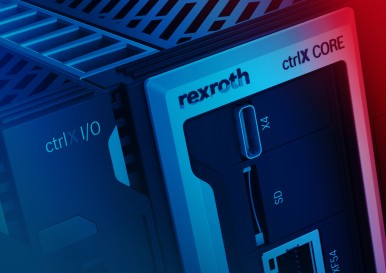
Stuttgart, Germany – 5G is coming. The new communications standard accelerates the internet of things and boosts Industry 4.0. Control systems and sensors of the kind built into facilities, machinery, and logistics chains stand to gain from this fast, reliable real-time wireless data transfer. Preparing machines for state-of-the-art communication involves making them 5G-capable. Now Bosch has the solution: Bosch Rexroth’s new ctrlX AUTOMATION control technology comes with 5G built in and can connect a wide range of industrial devices with the new communications standard. ctrlX AUTOMATION will be showcased at the SPS trade fair in Nuremberg.Bosch opens the door to a new industrial age 5G is set to turbocharge manufacturing. Our new 5G-capable automation platform lays the groundwork and opens the door to a new industrial age,...says Rolf Najork, the member of the Bosch board of management responsible for industrial technology. 5G is the first communications standard designed to enable connectivity for people as well as for the internet of things. The new standard has impressive characteristics: it is up to 20 times faster than 4G, transfers data virtually instantaneously with a latency of one millisecond, and is up to 99.9999 percent reliable – making the receipt of a “digital shipment” as certain as with transmission through a wire. "5G is a revolution and an important building block for the factory of the future", Najork says. Engineers and designers now face the challenges of integrating 5G into their machines and products. Bosch is introducing the solution that meets their needs: the new automation platform’s hardware can be fitted with a 5G module. The operating system and software for ctrlX AUTOMATION are 5G-capable from the outset and support rapid commissioning. Retrofit solutions are also available for adding the new technology to existing machinery. Bosch Rexroth’s new automation platform is scheduled to have its market launch in 2020. 5G will be a competitive factor for connected industry Experts estimate that there will be up to 70 billion connected devices worldwide by 2025. Many of them will be in manufacturing, meaning that 5G will become a competitive factor. The new communications standard will enable applications that require high-power, extremely reliable wireless connections to be integrated securely and efficiently into manufacturing facilities. These include mobile robotics, autonomous transport vehicles, and human-machine interactions. For instance, workers wearing augmented reality glasses can access additional information in their field of vision, optimizing how they monitor and maintain machinery. Combining tasks in the virtual world with those in the real world calls for real-time data flows. And that’s what 5G promises. "This new form of communication eclipses everything we’ve had until now. 5G is the first wireless protocol to truly meet the needs of the manufacturing industry", Najork says. Bosch takes on leadership role in Industry 4.0 and 5G Bosch is developing the factory of the future. In this endeavor, the company is relying on Industry 4.0 . The company first tests and validates products in-house before they are available on the market. Bosch is taking this approach with 5G, too. The company presented its first 5G-capable autonomous transport system, ActiveShuttle , at the Hannover Messe. To support the further development of its factories, Bosch has applied to the German Federal Network Agency for 5G licenses with which to set up local campus networks. Moreover, Bosch has taken on the chair of the global 5G Alliance for Connected Industries and Automation (5G-ACIA) with the aim of shaping the new mobile standard so that it meets the needs of the manufacturing industry from the outset.

Bosch reaches settlements with 50 U.S. States and Territories as well as with U. ...

10.01.2019

Press release

Business/economy

Bosch reaches settlements with 50 U.S. States and Territories as well as with U. ...

Stuttgart / New York / San Francisco – On January 10, 2019, Bosch resolved pending civil litigation with U.S. consumers and used car dealers, as well as investigations by 50 U.S. states and territories into Bosch by entering into two sets of settlement agreements. Settlement 1: Agreement with U.S. plaintiffs regarding Fiat Chrysler Together with Fiat Chrysler, Bosch reached agreement with U.S. civil plaintiffs to resolve pending class action litigation against Bosch and Fiat Chrysler concerning Fiat Chrysler diesel vehicles sold in the United States. The settlement agreement was concluded with the Plaintiffs Steering Committee (“PSC”) on behalf of a proposed settlement class. The respective documents were filed on January 10 with the competent court, the United States District Court for the Northern District of California, and will require that court’s approval. The agreement settles the claims of U.S. consumers and used car dealers against Robert Bosch GmbH, its affiliates, employees and management concerning approximately 100,000 Fiat Chrysler diesel Ram 1500 and Jeep Grand Cherokee vehicles from model years 2014 to 2016. The agreement also settles claims against Fiat Chrysler. Bosch supplied engine control units for these vehicles. Fiat Chrysler will pay for most of the settlement. Bosch will contribute up to USD 27.5 million. The settlement agreement requires the approval of Judge Edward Chen, who conducts the nationwide multi-district proceedings in which all pending private lawsuits against Bosch concerning these vehicles have been combined. The Court will hold a hearing on January 23 to consider preliminary approval of the settlement notice, after which the class members will be informed of their rights and options. A hearing to consider final approval of the settlement is anticipated by early May 2019. Settlement 2: Agreement with U.S. states regarding Fiat Chrysler and Volkswagen The settlement reached with 50 U.S. states and territories will terminate the participating U.S. states’ investigations of Bosch related to Volkswagen and Fiat Chrysler diesel vehicles sold in the U.S. The settlement, which will be implemented state-by-state, will release Robert Bosch GmbH, its respective affiliates, employees, directors and officers as well as the management, from all potential current and future claims under the state laws named in the agreement with regard to Bosch’s supply of engine control units and software for Volkswagen and Fiat Chrysler diesel vehicles. For this purpose, Bosch will pay as settlement different amounts to each state as agreed with all 50 of the jurisdictions. A total of approximately USD 98 million will be paid to the participating U.S. states. The settlement amount will be distributed among the participating states based primarily on the number of vehicles registered in each state. Additional USD 5 million will also be paid to the National Association of Attorneys General. In the determination of the settlement with the U.S. states, Bosch's robust compliance systems as well as its full cooperation during the investigations were positively taken into account. Since 2016 the already existing extensive compliance policies and procedures have been substantially enhanced. The maintenance of these is part of the agreement. By entering into the settlements, Bosch does not accept liability, nor does Bosch admit to the factual allegations of the U.S. plaintiffs or U.S. states. The settlements reflect Bosch’s desire to move forward and to spare the company the very substantial costs and the burden on the company’s resources that would be required to litigate these issues. “Upon careful consideration of all relevant aspects, we have decided to enter into settlement agreements. Legal disputes would have resulted in lengthy and costly proceedings in numerous U.S. states and with a large number of different claimants. As an innovation leader, we want to devote our attention and resources to developing our businesses and to intensifying our efforts to shape the future in our areas of activity," stated Dr. Stefan Hartung, Member of the Board of Management of Robert Bosch GmbH and Chairman of the Business Sector Mobility Solutions. Bosch will continue to defend its interests in all other civil and criminal law proceedings and to cooperate comprehensively with the investigating authorities in Germany and in other countries.

Manufacturing hub Mexico: Bosch plans smart plant for electronic components

17.04.2018

Press release

Business/economy

Manufacturing hub Mexico: Bosch plans smart plant for electronic components

Mexico City, Mexico, and Stuttgart, Germany – Bosch, a leading global provider of technology and services, is investing 100 million euros (120 million U.S. dollars) in a new plant in Celaya. The company plans to build a new smart factory for electronic components in the central Mexican city by 2020. The investment underlines the importance of this year's HANNOVER MESSE partner country for the company: “Bosch is committed to Mexico. The country is and will remain an important market and a hub for our global manufacturing and development network,” said Stefan Hartung , member of the Bosch board of management, ahead of the international industrial trade fair. The goal is to create more than 1,200 additional jobs at the new location in Celaya in the coming years. In total, the Bosch Group employs around 16,000 associates and is active with all four of its business divisions in Mexico. In 2016, the company generated sales of 1.1 billion euros in the country Bosch is committed to Mexico. The country is and will remain an important market and a hub for our global manufacturing and development network....Stefan Hartung, member of the Bosch board of management Industry 4.0 as a competitive advantage in Mexico The Latin American emerging market has become highly industrialized in recent years, driven mainly by the automotive industry. In 2017 alone, nearly 3.8 million vehicles were manufactured in Mexico. In order to increase efficiency and competitiveness as a leading global manufacturing location, Mexico is increasingly focusing on the use of Industry 4.0. Bosch is playing a part in this. “We are planning to make the new manufacturing facility in Celaya a smart factory with state-of-the-art, intelligent production lines,” Hartung said. For example, the plant will employ a manufacturing execution system (MES), which automatically collects data and shares production information in real time. This makes possible both preventive maintenance of machinery and higher product quality. The system also digitally connects the plant to the Bosch Group’s global manufacturing network. “By mid-2019, manufacturing at nearly all Bosch plants in Mexico will be equipped with our intelligent control system,” said René Schlegel, president of the Bosch Group in Mexico. In total, Bosch currently operates ten manufacturing locations around the country and has already introduced the use of smart technologies, for example at its Mobility Solutions sites in Toluca and Juárez. As a leading provider of Industry 4.0 solutions, the Bosch Group also sees local business opportunities in Mexico. Increasing demand for connected mobility The new approximately 21,000-square-meter facility in Celaya, which is located in the state of Guanajuato, will manufacture electronic control units (ECUs) for the American market. These are key components for connected mobility. Alongside Juárez, Celaya will be home to the Automotive Electronics division’s second plant in Mexico. “With the new location, we are responding to the increasing demand for electronic components in the American market,” René Schlegel said. With a total surface area of 170,000 square meters, the site will have capacity for further expansion in the future. In addition, the plan is to build a logistics center for Mexico on the adjacent property, which will also serve as a warehouse for the new plant. Bosch strengthens presence in North America With the investment in a new location, Bosch is continuing its long-term expansion in North America. Over the past five years, a total of around 2.6 billion euros has been spent on strengthening the company’s local presence. In Mexico, where Bosch has been active since 1955, the company opened a new manufacturing facility for driving safety systems in Aguascalientes in 2016. At the end of 2017, a plant for steering systems in Querétaro went into operation. The country is also gaining in significance as a development location: since 2014, Bosch has been operating a center for software development and engineering services for the American market in Guadalajara. A large proportion of the investment sum also went to the U.S. There, the Mobility Solutions plants in Charleston and Anderson are currently being expanded, and at the beginning of this month, Bosch opened a new research center in Sunnyvale in California’s Silicon Valley. Bosch at HANNOVER MESSE: the factory of the future – today! What will the factory of the future look like? How can people, robots, and machines work together? What role do 5G, data, software, and services play? Where can artificial intelligence (AI) be put to use? At Hannover Messe 2018 (hall 17, booth A40), Bosch is bringing the factory of the future to life – today. Entitled “Now, next, beyond: factory of the future,” the technology company’s 1,300-square-meter showcase demonstrates what it offers today (now), and what solutions it is developing for tomorrow (next) and the future (beyond). The main attractions are 1.5-meter-tall mobile robotic figures that give a Pixar-like face to Bosch’s connected-factory assistants. Another highlight is a football table that improves its soccer abilities with every game and every new opponent – thanks to AI.

CES 2018: Bosch sees future in smart-city business

08.01.2018

Press release

Business/economy

CES 2018: Bosch sees future in smart-city business

Las Vegas, NV – Urban populations are growing: according to the United Nations , roughly two-thirds of the global population will live in conurbations by 2050. In 2014, this figure was just one-half. Urbanization is increasing, and with it the challenges cities have to solve. Even today, therefore, there is a considerable need for smart solutions. Speaking at CES in Las Vegas, the Bosch management board member Stefan Hartung said: “We need a new conception of the city. One key factor here is technologies that make cities smart and worth living in. In the long run, cities without intelligence will not survive, but succumb to gridlock.”Bosch is working to equip cities and neighborhoods for the future, offering smart mobility, better air quality, more convenience, greater security, and many new services. In short, the aim is significantly better quality of life in cities and neighborhoods. “When it comes to smart cities, few other companies can match Bosch’s comprehensive portfolio, cross-domain knowledge, and outstanding expertise in sensors, software, and services – and all this from a single source,” Hartung said. From January 9 to 12, the supplier of technology and services will be presenting many new solutions that make cities smart at CES 2018, the world’s largest electronics show. These range from a new compact unit that measures and analyzes air quality in real time, to a system that digitally monitors river water levels and gives early warning of flood risks, to a completely automatic parking space service that makes drivers’ lives easier. For more business: the smart-city market is booming Some of the world’s major metropolises are already synonymous with the term “smart,” among them Barcelona, Seoul, and London. Across the globe, cities large and small are investing in smart-city technologies. According to a study on behalf of Bosch, the smart-city market will grow 19 percent each year between now and 2020, reaching a volume of 800 billion dollars (680 billion euros). Bosch believes this is a great business opportunity: “For a long time, the smart city was a vision. We’re helping make it reality. Bosch is in an excellent position to make the connected city a technological and commercial success,” Hartung said. The company is currently involved in 14 extensive smart-city projects in places such as San Francisco, Singapore, Tianjin, Berlin, and Stuttgart. Others are planned to follow. Within the past two years, the company has doubled its sales from cross-domain projects to nearly one billion euros, and this figure is set to rise further. For a long time, the smart city was a vision. We’re helping make it reality. Bosch is in an excellent position to make the connected city a technological and commercial success....Stefan Hartung, Bosch management board member In the Bay Area city of San Leandro, for example, the company has equipped roughly 5,000 streetlights with LEDs and supplied a system for remote management of the city’s street lighting. In this way, the lights are only switched on when they are actually needed. With this solution, San Leandro will be able to save roughly 8 million dollars over the next 15 years. At the Bosch CES press conference, Mike Mansuetti, the president of Bosch North America, said: “Whether cities are big or small, our smart solutions will help them save energy, and money too.” In the case of San Leandro and its 100,000 inhabitants, sensors can be used to measure and analyze air quality, and cameras can automatically re-route traffic in the event of congestion. For more connectivity: IoT and artificial intelligence The internet of things (IoT) has laid one of the main foundations for the connected city. The IoT is finding its way into all walks of life: a Gartner study predicts that some 230 million homes worldwide – roughly 15 percent of all homes – will be intelligently connected by 2020. Here as well, the potential is huge, with market volume estimated to reach 250 billion dollars annually by 2020. By the same year, more than 20 billion devices worldwide will be connected with each other – smoke detectors, burglar alarms, electricity meters, home appliances, and many more. “Bosch recognized this potential early on,” Hartung said. “Even now, more than half our electronic product classes are web-enabled – and the aim is for this to be 100 percent by 2020. Not only that: for each of our products, we want to offer accompanying services.” Another driver of the rapid development of smart cities is artificial intelligence (AI). Bosch intends to further expand its research in this field. Last year, the company opened a research center for artificial intelligence, which now employs some 100 associates in Renningen, Germany, Palo Alto, CA, and Bengaluru, India. By 2021, Bosch will invest some 300 million euros in expanding the center. The company anticipates that, ten years from now, scarcely any product will be conceivable without AI. For better air quality: Climo creates basis for targeted action Air quality is one of the greatest challenges cities face. Thanks to smart technologies, cities can take faster and more targeted action to improve it. However, this depends on accurate measurements. At CES 2018, Bosch is presenting a new solution that it developed together with Intel – the Climo microclimate monitoring system. Climo measures and analyzes 12 parameters that are important for air quality, including carbon dioxide, nitrogen oxide, temperature, and relative humidity. The appliance is one-hundredth the size of conventional systems – and one-tenth the cost. Climo won a CES Honoree Innovation Award in the “smart cities” category. For early warning: digital monitoring of rivers In many regions, climate change is resulting in unpredictable weather. Researchers expect that heavier rainfall will result in more frequent flash flooding. Up to now, mechanical devices have been used to measure river water levels. Hours may pass before these measurements become available for others. However, the flood monitoring system changes all this. In real time, it monitors the water level in rivers and other bodies of water close to cities, and warns of an impending flood. In a pilot project, Bosch is testing the new system on the Neckar river near Ludwigsburg, Germany. Ultrasonic sensor probes and cameras track changes in water level, speed, and throughput. The data is sent to the Bosch IoT Cloud for processing. Should critical thresholds be exceeded, the affected municipalities, residents, and business owners are alerted well in advance by text message. This gives them enough time to take precautions against flooding and flood-related damage. Among those interested in the solution are a number of Indian and South American municipalities that frequently have to combat flooding. For more time: connected parking Urban traffic will increase by roughly one-third by 2050 . Bosch is working to make tomorrow’s mobility free of accidents, stress, and emissions. At CES 2018, the company is presenting many solutions that lead toward this goal. Urban traffic plays a role in roughly half the smart-city projects Bosch is involved in. Parking is a particular focal point. U.S. drivers now spend more than 40 hours a year stuck in congestion, wasting some 160 billion dollars in the process. Of this time, roughly one-third is wasted on the search for parking alone. This is where Bosch can help: with its community-based parking, the company simplifies the search for a suitable space. As they drive by, cars automatically recognize and measure the size of the gaps between parked cars, transmitting the data in real time to a digital map. In this way, drivers can have themselves guided directly to free parking spaces. Bosch is already testing this service in German cities, including Stuttgart. This year, as many as 20 U.S. cities will follow, including Los Angeles, Miami, and Boston. In early 2018, moreover, Bosch and Daimler will be launching a new automated valet parking service. Cars in the Mercedes-Benz Museum parking garage in Stuttgart will look for a parking space and park themselves, without a driver. This cuts out stress, and makes more efficient use of parking lots – the same amount of space can accommodate up to 20 percent more vehicles. One factor making fully automated parking a reality is smart parking-garage infrastructure, which connects with the vehicle’s on-board software. Bosch recently won a Frost & Sullivan’s 2017 Technology Innovation Award for this driverless parking solution. For energy and cost savings: Bosch DC microgrids According to the International Panel on Climate Change (IPCC) , cities account for roughly 75 percent of total global energy consumption. Forty percent of this is attributable to buildings alone. And the BP Energy Outlook 2035 estimates that global energy consumption will rise 30 percent by 2035. Bosch has many smart energy management solutions that can reduce power consumption. One of these is the Bosch DC (direct current) microgrid, which can be used to supply power to large buildings or building complexes. Since microgrids are generally fed by renewable sources, they are especially eco-friendly. DC microgrids consume up to 10 percent less energy than conventional power plants. Another major advantage is their self-sufficiency, which makes them a reliable source of power when a weather- or security-related outage affects the broader grid. Bosch at CES 2018: PRESS CONFERENCE: In Ballrooms B, C, and D, Mandalay Bay Hotel, Las Vegas South Convention Center, Level 2 , from 8:00 to 8:45 a.m. local time on Monday, Jan 8 . BOOTH: Tuesday to Friday, Jan 9–12 , in the Central Hall, booth #14028 FOLLOW the Bosch CES 2018 highlights on Twitter: #BoschCES PANELS WITH BOSCH EXPERTS: Tuesday, January 9, 1:30 – 3:15 p.m. (local time): “ Connect2Car: Next-Gen Automobility ” session with Kay Stepper, Vice President of Bosch in North America, head of driver assistance and automated driving, Las Vegas, Convention Center, North Hall, N256 Wednesday, Jan 10, 1:45–2:30 p.m. (local time): “ Connected Vehicles in Connected Ecosystems ” session with Mike Mansuetti, President Bosch North America, Smart Cities Conference, Westgate. Thursday, Jan 11, 11:30 a.m to 12:30 p.m. (local time): “ The Future of Robots at Work and Home ” session with Phil Roan, Senior Engineer Robotics, BSH Hausgeräte GmbH, Las Vegas Convention Center, North Hall, N258