Search & find:
Media, press releases, events for your editorial coverage

Bosch puts 5G machines in pole position

26.11.2019

Press release

Business/economy

Bosch puts 5G machines in pole position

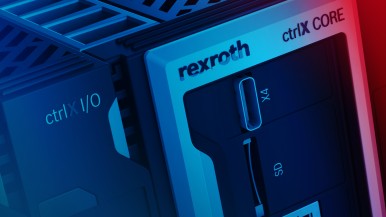
Stuttgart, Germany – 5G is coming. The new communications standard accelerates the internet of things and boosts Industry 4.0. Control systems and sensors of the kind built into facilities, machinery, and logistics chains stand to gain from this fast, reliable real-time wireless data transfer. Preparing machines for state-of-the-art communication involves making them 5G-capable. Now Bosch has the solution: Bosch Rexroth’s new ctrlX AUTOMATION control technology comes with 5G built in and can connect a wide range of industrial devices with the new communications standard. ctrlX AUTOMATION will be showcased at the SPS trade fair in Nuremberg.Bosch opens the door to a new industrial age 5G is set to turbocharge manufacturing. Our new 5G-capable automation platform lays the groundwork and opens the door to a new industrial age,...says Rolf Najork, the member of the Bosch board of management responsible for industrial technology. 5G is the first communications standard designed to enable connectivity for people as well as for the internet of things. The new standard has impressive characteristics: it is up to 20 times faster than 4G, transfers data virtually instantaneously with a latency of one millisecond, and is up to 99.9999 percent reliable – making the receipt of a “digital shipment” as certain as with transmission through a wire. "5G is a revolution and an important building block for the factory of the future", Najork says. Engineers and designers now face the challenges of integrating 5G into their machines and products. Bosch is introducing the solution that meets their needs: the new automation platform’s hardware can be fitted with a 5G module. The operating system and software for ctrlX AUTOMATION are 5G-capable from the outset and support rapid commissioning. Retrofit solutions are also available for adding the new technology to existing machinery. Bosch Rexroth’s new automation platform is scheduled to have its market launch in 2020. 5G will be a competitive factor for connected industry Experts estimate that there will be up to 70 billion connected devices worldwide by 2025. Many of them will be in manufacturing, meaning that 5G will become a competitive factor. The new communications standard will enable applications that require high-power, extremely reliable wireless connections to be integrated securely and efficiently into manufacturing facilities. These include mobile robotics, autonomous transport vehicles, and human-machine interactions. For instance, workers wearing augmented reality glasses can access additional information in their field of vision, optimizing how they monitor and maintain machinery. Combining tasks in the virtual world with those in the real world calls for real-time data flows. And that’s what 5G promises. "This new form of communication eclipses everything we’ve had until now. 5G is the first wireless protocol to truly meet the needs of the manufacturing industry", Najork says. Bosch takes on leadership role in Industry 4.0 and 5G Bosch is developing the factory of the future. In this endeavor, the company is relying on Industry 4.0 . The company first tests and validates products in-house before they are available on the market. Bosch is taking this approach with 5G, too. The company presented its first 5G-capable autonomous transport system, ActiveShuttle , at the Hannover Messe. To support the further development of its factories, Bosch has applied to the German Federal Network Agency for 5G licenses with which to set up local campus networks. Moreover, Bosch has taken on the chair of the global 5G Alliance for Connected Industries and Automation (5G-ACIA) with the aim of shaping the new mobile standard so that it meets the needs of the manufacturing industry from the outset.

Machine learning: Bosch sends sensor system to ISS

19.11.2018

Press release

Research

Machine learning: Bosch sends sensor system to ISS

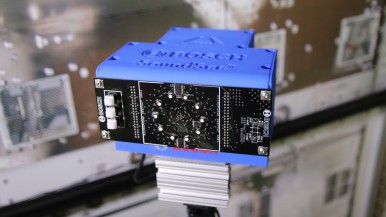
Pittsburgh, USA – Bosch in North America and Astrobotic Technology Inc. today announced a research partnership to send experimental sensor technology to the International Space Station (ISS) as early as May 2019. Bosch’s SoundSee technology is a deep audio analytics capability that uses a custom array of microphones and machine learning to analyze information contained in emitted noises. SoundSee’s analytics will investigate whether audio data from equipment could be learned and understood using advanced software, such that it could be used to improve the operations of the ISS. “Machines, such as motors and pumps, emit noise signatures while they operate,” said Dr. Samarjit Das, principal researcher and SoundSee project lead at Bosch’s Research and Technology Center in Pittsburgh . “Our SoundSee AI (artificial intelligence) algorithm uses machine learning to analyze these subtle acoustic clues and determine whether a machine, or even a single component of a machine, needs to be repaired or replaced.” The SoundSee payload will ride on NASA’s Astrobee Robot, an autonomous free-flying vehicle capable of navigating throughout the ISS. The NASA Ames Research Center’s Astrobee team has also provided support for ground testing. “The support from NASA has been critical,” said Dr. Andrew Horchler, Astrobotic research scientist and director of Future Missions and Technology. “They have provided feedback and requirements that have helped us design our operational plans and understand the challenges of sending a hardware payload to the ISS.” On the ISS, researchers will collect data and send it to Earth for Bosch to study. As research progresses, the team expects to update the software or adjust operational routines to improve data-collection results. “This data should allow us to gain insights into the state of the space station,” said Jon Macoskey, research engineer intern at Bosch. “Our long-term goal is to show that we can detect anomalies in the operation of the station and return that intelligence to crewmembers or ground control.” The research has promise for numerous terrestrial applications and other crewed spacecraft, including missions to the Moon and Mars. “For some time, Bosch has been interested in using audio analytics to monitor critical machines and equipment, such as car engines or HVAC systems,” said Dr. Joseph Szurley, a Bosch research scientist on the project. “The ISS will allow us to study how these techniques can extend to even more challenging and unique environments.” Astrobotic’s Future Missions and Technology team , a space robotics research group, is developing the flight version of the sensor, known as the SoundSee payload. The team will also lead ground testing and preparation for flight. “Conducting research in space, even when you have an asset like the ISS, is significantly more challenging than testing on the ground,” Horchler said. “As a space robotics company, we are able to help Bosch prepare for operating in this highly controlled space environment.” The SoundSee project has been in development since the Center for the Advancement of Science in Space (CASIS) approved funding for launch costs and astronaut time aboard the space station earlier this year. CASIS is the organization tasked by NASA with managing the ISS U.S. National Laboratory. Recently, Bosch and Astrobotic researchers began testing engineering units of the SoundSee payload and added former ISS Commander Dr. Colin “Mike” Foale to the team. “Since meeting the team at Astrobotic in Pittsburgh for the SoundSee preliminary design review, I am convinced that this novel, cutting-edge approach to using machine learning in space will not only have great benefits for troubleshooting ISS problems, but especially throughout industry on Earth,” Foale said. “Commander Foale has provided invaluable operational insights into how the mission might operate within the ISS and helped us complete our preliminary design review this summer,” Bosch’s Das said. “Our test facility at Astrobotic is helping us validate the techniques that we will deploy on the ISS.” The SoundSee payload will launch to the International Space Station as part of NASA’s Astrobee robot, and will be delivered on a future commercial resupply services mission. “We have a dedicated team and clear path to flight,” Horchler said. “We couldn’t be more excited to work with Bosch, NASA and CASIS on this critical work.”

Finger on the pulse of Silicon Valley: Bosch expands its Research and Technology ...

05.04.2018

Press release

Artificial Intelligence

Finger on the pulse of Silicon Valley: Bosch expands its Research and Technology ...

Sunnyvale, USA, and Stuttgart, Germany – More space and more attractive working conditions for innovative research, development, trend scouting, and venture capital: Bosch has moved to a larger location in Silicon Valley, opening a new Research and Technology Center (RTC) in Sunnyvale. The RTC was previously located in Palo Alto, roughly 15 kilometers to the west. The cost of the new location amounts to 36 million euros (40 million dollars). “We have had a presence here for nearly 20 years. Moving forward, the new offices will help us keep our finger on the pulse of Silicon Valley, thanks also to our excellent connections to the local research community and local businesses,” said Mike Mansuetti, president of Bosch in North America, at the grand opening of the new RTC. The facilities bring together 200 associates under one roof for the first time. Covering almost 10,000 square meters, the new location offers 40 percent more space in total and room for up to 300 associates. Going forward, the new location will help Bosch keep its finger on the pulse of Silicon Valley....Mike Mansuetti, president of Bosch in North America “From basic research to market-ready solutions, as part of Bosch’s international research network, our associates in Silicon Valley have laid the foundation for innovative products and solutions in areas such as sensor technology and automated and connected vehicle systems,” said Hauke Schmidt, head of the Bosch Research and Technology Center, at the grand opening. Roughly half the company’s associates in Sunnyvale work in basic research and advance engineering to develop processes and solutions in fields such as data mining, sensors, artificial intelligence, and automated driving. The building, which has been leased for ten years, is also home to engineering activities for nine different Bosch divisions. Associates there work to transition research results into deployable solutions and conduct trend-scouting activities. The RTC also houses an office of Robert Bosch Venture Capital GmbH. The Bosch Group’s venture capital organization invests in innovative start-up companies around the world at all stages of development. Associates played a role in the design of the new location. Apart from modern laboratories, workshops, and offices, the location offers spaces for collaboration and creativity as well as an outdoor area that provide creative minds with sufficient opportunities to explore ideas and advance them through dialogue with each other or with the company’s scientific and business partners in the region. Long-standing presence in the U.S. and Silicon Valley Bosch has had a presence in the United States since 1906, and currently employs some 18,000 associates in the country, more than 2,000 of whom are researchers and engineers. The global supplier of technology and services remains highly confident of its prospects in the U.S. market, as its continuing investments show: from 2013 to 2017, Bosch invested roughly 1.3 billion euros in total in the United States. This included work to expand the Mobility Solutions plants in Charleston and Anderson. The Research and Technology Center in Silicon Valley was the company’s first research operation outside Europe. It started out in 1999, with just three associates. In its research and development activities in the United States, Bosch also relies on its long-term partnerships with renowned U.S. universities such as Stanford University and the University of California in Berkeley. The RTC also maintains offices near Carnegie Mellon University in Pittsburgh and directly opposite the MIT campus in Boston.