“Software won’t only change how we use and experience cars in the future. It will also change the way cars are engineered. For some time now, Bosch has also seen itself as a mobility software company. Now, in response to customer requirements, our structure is changing to reflect this and to open up further growth,” said Dr. Markus Heyn, member of the Bosch board of management and the future chairman of the five-strong Bosch Mobility sector board.
Organizationally speaking, some of the business sector’s individual divisions will be redrawn effective January 1, 2024, and all divisions will be given horizontal, cross-divisional responsibilities as well. With its mobility solutions alone, Bosch’s aim for this new structure is that it will generate sales revenue of more than 80 billion euros worldwide by 2029.
First wave of software-defined vehicles expected from mid-decade
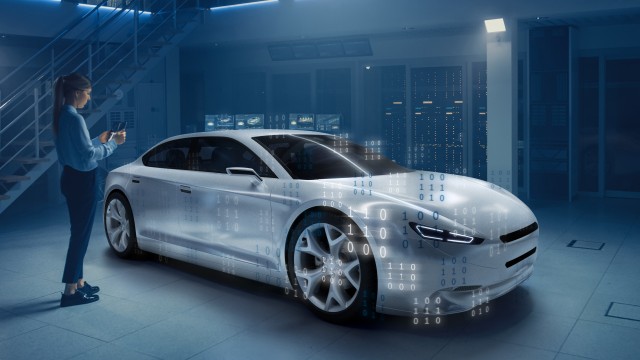
One pillar of this growth will be the market for automotive software. Driven by the trend toward software-defined vehicles, this market is likely to reach a volume of significantly more than 200 billion euros by 2030. This is three times more than in 2020. Currently, Bosch growth in this market is in double digits. The entire automotive industry is presently putting a stronger focus on software development. Its share in development cost will be roughly 30 percent by 2030. At Bosch, it is already higher than that. Even now, more than 50 percent of all R&D associates working for Bosch Mobility are software engineers. Software-defined vehicles offer two outstanding advantages. The first is the speed of development. Instead of taking years, implementing new functions in existing systems will in the future be just a matter of days. The second is the decoupling of software and hardware development, which means that cars will feel like new for longer thanks to software updates. Explaining this, Heyn said: “Drivers across the globe want to seamlessly integrate their vehicles into their digital world. After all, we have gotten used to constant updates and new features on our smartphones. Now, we are applying this to cars as well.” From 2025, Bosch expects that software-defined vehicles will be introduced on a broad scale.
New trend in automotive engineering reflected in Bosch organization
The example of vehicle motion management shows how the reorganization of Bosch Mobility and intensified cross-divisional collaboration is conducive to this new trend in automotive engineering. It includes a new control concept that does an even faster and more accurate job of stabilizing vehicles. It can intervene not only in the braking system, but also in the electrical powertrain and electric steering system. This helps to shorten the braking distance, and the driver has to take considerably less corrective action. All this increases road safety. The technical basis is ESP10, the latest generation of the Bosch braking control system, and the Vehicle Dynamics Control 2.0 software function. The ingenious part is that the new control system does not have to form part of the ESP control unit, but can alternatively be integrated in the central vehicle computer – and, in the future, it will also be available as a standalone software package. But that’s just the start. Bosch anticipates a threefold increase in software applications and even a tenfold increase in applications that access the cloud.
Bosch: a successful player in automotive hardware and software
Software-defined vehicles go hand in hand with a new, centralized electrical and electronic (E/E) architecture. More than 100 control units are installed in the latest premium-class vehicles. Even today’s compact-class vehicles feature between 30 and 50 control units. “Our focus will be on making the complexity of electronic systems controllable and as reliable as possible,” Heyn said. In the future, it will be possible to significantly reduce the number of control units by using powerful computers for the various vehicle domains, such as cockpit and connectivity functions, driver assistance systems and automated driving, and the powertrain. This is why Bosch is developing a uniform IT architecture for the entire vehicle – from the cloud, to the central vehicle computer, to the individual control units. One major advantage is that Bosch is equally at home in the software and hardware domains. Whether brakes, steering systems, or eco-friendly powertrains – where Bosch pursues a technology-neutral approach with fuel cells, batteries, and hydrogen engines – the supplier of technology and services develops and manufactures the key components of modern vehicles under one roof. This includes more than 250 million control units each year, which are also configured with the company’s proprietary software. But that’s not all. Bosch specializes in a further field that is becoming increasingly important – the integration of software from diverse sources and resulting from collaboration between the automotive and IT industries. Bosch also has this integrative expertise, and will extend it by reorganizing its automotive-supply business.
Sector board, executives, and associates contribute to realignment
The Bosch Mobility sector board defined the business sector’s new configuration in consultation with associates and executives from the individual divisions. The reorganization is subject to observance of employee representatives' participatory rights. Organizationally speaking, the business sector will in the future comprise seven divisions. Some of them have been redrawn, and in some cases additional horizontal responsibilities have been created across all divisions. More specifically, the Electrified Motion division will be concerned with everything relating to electric motors, from the Bosch e-axle to seat adjusters. Vehicle Motion will deal with vehicle dynamics, from ABS and ESP to steering. Power Solutions will handle combustion-engine technology, mobile and stationary fuel cells, electrolyzers, and hydrogen engines. Cross-Domain Computing Solutions will develop solutions for areas ranging from automatic parking to automated driving. Mobility Electronics will drive forward the development of control units.
It will also promote in-house semiconductor activities at Bosch. Mobility Aftermarket will deal with the spare-parts market and the Bosch Car Service workshop franchise. E-Bike Systems will supply systems solutions – comprising drive units, rechargeable batteries, ABS, and connected displays – for e-bikes. The Bosch subsidiary ETAS will be given horizontal responsibility for hardware-agnostic software for operating systems and engineering tools.