Search & find:
Media, press releases, events for your editorial coverage

Bosch at Agritechnica 2025

06.11.2025

Press release

Commercial vehicles

Bosch at Agritechnica 2025

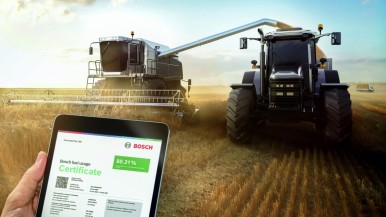
Stuttgart/Hannover, Germany – In 2025 alone, more than two million tractors and other agricultural vehicles will be produced worldwide. And according to Bosch, over 90 percent of them will be powered by a diesel engine. Its robustness and high performance combined with low weight make it ideal for almost all applications and performance classes. At the Agritechnica trade fair in Hannover, Bosch will be demonstrating how CO 2 emissions can be further reduced using this established technology. “Renewable synthetic fuels immediately make operating both new and existing vehicles much more climate-friendly,” says Jan-Oliver Roehrl, executive vice president of the Bosch Power Solutions division and head of commercial vehicle activities at Bosch. “And in the future, hydrogen engines and electrification also stand to help make agriculture much more sustainable.”Even in 2035, Bosch expects that nine out of ten new agricultural vehicles will still have a diesel engine. The company will therefore continue to offer and further develop the appropriate injection and urea-metering technology for exhaust-gas treatment for the different vehicle types in this market segment. At the same time, Bosch offers new options for the most climate-friendly powertrain possible with components for the hydrogen engine along with various electrification solutions. Renewable synthetic fuels make combustion engines more climate-friendly All major markets worldwide have already instituted comprehensive emissions regulations for agricultural vehicles that set maximum values for nitrogen oxides and particulates. As a result, SCR exhaust-gas treatment systems with urea metering are standard for diesel engines in vehicle classes above 56 kilowatts. To date, however, their climate-relevant emissions have been regulated by law only to a limited extent. One simple option for greatly reducing the carbon emissions of existing and new vehicles that is already available today is to use renewable synthetic fuels such as HVO100. Because these fuels are based predominantly on residual and waste materials, they are much more climate-friendly than fossil fuels in terms of overall carbon emissions. They are also “drop-in” fuels, meaning they can be mixed with normal diesel fuel as required. And, again like diesel, they are easy to store. Since Bosch already takes compatibility with these fuels into account when developing its injection technology, they are suitable for use in numerous products. The Digital Fuel Twin documents the use of renewable synthetic fuels Just how comprehensively renewable synthetic fuels reduce the carbon footprint of each individual vehicle is shown by Bosch’s Digital Fuel Twin (DFT). A purely digital software solution, the DFT documents the amounts of fuel distributed as well as the fuels’ sustainability – from production and transportation all the way to the filling station. It provides the operators with certificates corresponding to the ratio of fossil to renewable synthetic fuels used in their vehicles; these document the total amounts of fuel used and even the proportionate carbon footprint when using the vehicle. Hydrogen engines build on tried-and-tested foundations The hydrogen engine is a new type of powertrain that takes climate action a step further. If the hydrogen fueling the engines is produced with renewable energy, it could mark a big step forward for the climate. Bosch is working on systems with intake manifold and direct injection and can draw on decades of expertise: some 80 percent of the technology involved can be transferred from conventional combustion engines. The technology company is already involved in more than 100 development projects with customers worldwide. “Agricultural vehicles are often operated at low speeds and high loads. This is precisely where hydrogen engines, with their high efficiency and robustness, can really excel,” Roehrl says. “The first applications of hydrogen engines featuring Bosch injection technology will be launched this year.” Electrification solutions for agricultural machinery Electrification of the drive systems and powered implements is another efficient, climate-friendly option for agricultural machinery. With its eLION electrification portfolio, Bosch Rexroth already offers a wide range of motors, inverters, on-board chargers, DC/DC converters, software, and accessories. Geared toward demanding applications, the portfolio is designed for operation in the DC voltage range up to 850 volts and is supplemented by the right transmissions and hydraulic solutions. The portfolio is currently being expanded to include components for 96-volt vehicle electrical systems; at the end of 2025, it will also feature the comprehensive eLION Power and Motion Control software package. Bosch Engineering, meanwhile, is presenting a newly developed high-performance solution for battery voltages of up to 800 volts. This new electric powertrain system is compact and offers high power density as well as high efficiency, which makes the electrification of existing device platforms easier. Depending on the application, the system can be used in small to medium-sized agricultural machines as a purely battery-electric powertrain or in large agricultural machines as a hybrid in conjunction with a diesel engine. In addition to electric powertrains for auxiliary systems, Bosch also offers other mechatronic subsystems with high-voltage technology for electrified commercial and off-highway vehicles – cooling fans, for example. Here, too, the special requirements of the commercial vehicle segment, including those relating to safety and security, were taken into account. The components are compact and use a common inverter concept, which makes it possible to implement customer-specific adaptations with little effort. Bosch, Bosch Rexroth, and Bosch Engineering will be showcasing these solutions at Agritechnica in hall 16 at booths 16A05 and 16A12.

Bosch at bauma 2025

07.04.2025

Press release

Powertrain systems

Bosch at bauma 2025

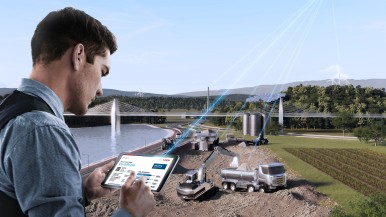
Stuttgart and Munich, Germany – Over one million new construction vehicles will be produced worldwide in 2025 alone. As different as their performance classes and tasks are, they almost all have one thing in common: a diesel engine. Its robustness and strength make it the ideal powertrain for a wide range of applications. At the bauma 2025 trade fair, Bosch will be showing how carbon emissions can be reduced even further in this vehicle segment. “Renewable synthetic fuels make operating both new and existing vehicles much more climate-friendly,” says Jan-Oliver Roehrl, executive vice president of the Bosch Power Solutions division and head of commercial vehicle activities at Bosch. “And in the future, hydrogen engines and electrification also stand to make construction machinery much more sustainable.” Renewable synthetic fuels make operating both new and existing vehicles much more climate-friendly. And in the future, hydrogen engines and electrification also stand to make construction machinery much more sustainable....Jan-Oliver Roehrl, executive vice president of the Bosch Power Solutions division and head of commercial vehicle activities at Bosch Renewable synthetic fuels make combustion engines more climate-friendly Construction vehicles are already subject to comprehensive exhaust-emission regulations, such as Stage V in Europe, Tier 4 in the U.S., and Phase IV in China. To date, however, their climate-relevant emissions have been regulated only to a limited extent, at least by law. One simple option for greatly reducing their carbon emissions that is already available today is to use renewable synthetic fuels such as HVO100. Because these fuels are based on residual and waste materials, they are much more climate-friendly than fossil fuels in terms of overall carbon emissions. They are also “drop-in” fuels, meaning they can be mixed with normal diesel fuel as required. Since Bosch already takes compatibility with these fuels into account when developing its injection technology, they are suitable for use in its products. According to Bosch forecasts, four out of five new construction vehicles worldwide with over 56 kilowatts will still have a diesel engine in 2035. That is why Bosch will continue to develop injection technology and urea dosing technology for exhaust-gas treatment in the future to suit the various segments of the construction machinery market. The Digital Fuel Twin documents the use of renewable synthetic fuels Renewable synthetic fuels can make construction machinery more climate-friendly: the more of it they use, the smaller the carbon footprint of each individual vehicle. Bosch makes this effect visible with a purely digital software solution called the Digital Fuel Twin. This documents the amounts of fuel distributed as well as the fuels’ sustainability, from production and transportation all the way to the filling station. It provides the operators of construction machinery with certificates corresponding to how they have refueled their vehicles; these document the total amounts of fuel used and even the proportionate carbon footprint when using the vehicle. Hydrogen engines build on tried-and-tested foundations When it comes to hydrogen engines, German manufacturers and suppliers can draw on decades of expertise, particularly in the field of engine technology: some 80 to 90 percent of the technology involved can be transferred from conventional combustion engines. If the hydrogen fueling the engines is produced with renewable energy, their use could mark a big step forward for the climate. Often, construction machinery is stationary and operates under heavy loads. “This is precisely where hydrogen engines, with their high efficiency and robustness, can really excel,” Roehrl says. “The first applications of hydrogen engines featuring Bosch injection technology will be launched this year.” Bosch is working on both port- and direct-injection systems and is already involved in more than 100 development projects with customers worldwide. Moreover, the hydrogen engine is also a promising option for large engines, for example as the powertrain for dump trucks in mining. Here, too, robustness and reliability combined with a compact design are essential for economical operation. Electrification solutions for construction machinery In certain construction machinery applications, electrification is another efficient and climate-friendly option for mobile and stationary functions. With its eLION electrification portfolio, Bosch Rexroth already offers a wide range of motors, inverters, gearboxes, software, and accessories, including the appropriate hydraulics. This Bosch subsidiary is currently expanding its range to include components for 96-volt vehicle electrical systems; at the end of 2025, it will introduce a standardized software platform for all voltage classes. Bosch Engineering, meanwhile, is presenting a newly developed high-performance solution for battery voltages of up to 800 volts. This subsidiary’s new electric powertrain system is compact and offers high power density as well as high efficiency. It is also suitable for construction machinery with high power requirements and limited installation space, such as wheel loaders. Bosch, Bosch Rexroth, and Bosch Engineering will be showcasing these solutions at bauma, at booths A3/327 and A4/526.