Search & find:
Media, press releases, events for your editorial coverage

Bosch at bauma 2025

07.04.2025

Press release

Powertrain systems

Bosch at bauma 2025

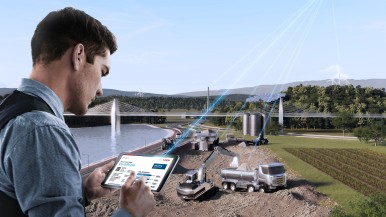
Stuttgart and Munich, Germany – Over one million new construction vehicles will be produced worldwide in 2025 alone. As different as their performance classes and tasks are, they almost all have one thing in common: a diesel engine. Its robustness and strength make it the ideal powertrain for a wide range of applications. At the bauma 2025 trade fair, Bosch will be showing how carbon emissions can be reduced even further in this vehicle segment. “Renewable synthetic fuels make operating both new and existing vehicles much more climate-friendly,” says Jan-Oliver Roehrl, executive vice president of the Bosch Power Solutions division and head of commercial vehicle activities at Bosch. “And in the future, hydrogen engines and electrification also stand to make construction machinery much more sustainable.” Renewable synthetic fuels make operating both new and existing vehicles much more climate-friendly. And in the future, hydrogen engines and electrification also stand to make construction machinery much more sustainable....Jan-Oliver Roehrl, executive vice president of the Bosch Power Solutions division and head of commercial vehicle activities at Bosch Renewable synthetic fuels make combustion engines more climate-friendly Construction vehicles are already subject to comprehensive exhaust-emission regulations, such as Stage V in Europe, Tier 4 in the U.S., and Phase IV in China. To date, however, their climate-relevant emissions have been regulated only to a limited extent, at least by law. One simple option for greatly reducing their carbon emissions that is already available today is to use renewable synthetic fuels such as HVO100. Because these fuels are based on residual and waste materials, they are much more climate-friendly than fossil fuels in terms of overall carbon emissions. They are also “drop-in” fuels, meaning they can be mixed with normal diesel fuel as required. Since Bosch already takes compatibility with these fuels into account when developing its injection technology, they are suitable for use in its products. According to Bosch forecasts, four out of five new construction vehicles worldwide with over 56 kilowatts will still have a diesel engine in 2035. That is why Bosch will continue to develop injection technology and urea dosing technology for exhaust-gas treatment in the future to suit the various segments of the construction machinery market. The Digital Fuel Twin documents the use of renewable synthetic fuels Renewable synthetic fuels can make construction machinery more climate-friendly: the more of it they use, the smaller the carbon footprint of each individual vehicle. Bosch makes this effect visible with a purely digital software solution called the Digital Fuel Twin. This documents the amounts of fuel distributed as well as the fuels’ sustainability, from production and transportation all the way to the filling station. It provides the operators of construction machinery with certificates corresponding to how they have refueled their vehicles; these document the total amounts of fuel used and even the proportionate carbon footprint when using the vehicle. Hydrogen engines build on tried-and-tested foundations When it comes to hydrogen engines, German manufacturers and suppliers can draw on decades of expertise, particularly in the field of engine technology: some 80 to 90 percent of the technology involved can be transferred from conventional combustion engines. If the hydrogen fueling the engines is produced with renewable energy, their use could mark a big step forward for the climate. Often, construction machinery is stationary and operates under heavy loads. “This is precisely where hydrogen engines, with their high efficiency and robustness, can really excel,” Roehrl says. “The first applications of hydrogen engines featuring Bosch injection technology will be launched this year.” Bosch is working on both port- and direct-injection systems and is already involved in more than 100 development projects with customers worldwide. Moreover, the hydrogen engine is also a promising option for large engines, for example as the powertrain for dump trucks in mining. Here, too, robustness and reliability combined with a compact design are essential for economical operation. Electrification solutions for construction machinery In certain construction machinery applications, electrification is another efficient and climate-friendly option for mobile and stationary functions. With its eLION electrification portfolio, Bosch Rexroth already offers a wide range of motors, inverters, gearboxes, software, and accessories, including the appropriate hydraulics. This Bosch subsidiary is currently expanding its range to include components for 96-volt vehicle electrical systems; at the end of 2025, it will introduce a standardized software platform for all voltage classes. Bosch Engineering, meanwhile, is presenting a newly developed high-performance solution for battery voltages of up to 800 volts. This subsidiary’s new electric powertrain system is compact and offers high power density as well as high efficiency. It is also suitable for construction machinery with high power requirements and limited installation space, such as wheel loaders. Bosch, Bosch Rexroth, and Bosch Engineering will be showcasing these solutions at bauma, at booths A3/327 and A4/526.


Commercial vehicle innovation enabler: Bosch brings advanced solutions to the ne ...

17.04.2019

Press release

Connected mobility

Commercial vehicle innovation enabler: Bosch brings advanced solutions to the ne ...

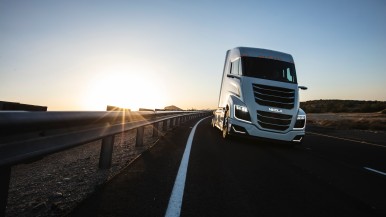
Scottsdale, Arizona – Nikola Motor Company showcased its hydrogen-electric powered semi-truck, the Nikola Two, live in action for the first time to the general public at its Nikola World event. Bosch technology and expertise helped Nikola to realize the fully functional Nikola Two hydrogen-electric truck with industry-ready heavy-duty truck components and systems. The technology and system approach is adaptable for use in Nikola’s full line of vehicles, including the Nikola One Sleeper Cab and the Nikola Tre, a hydrogen-electric truck for European markets. Bosch has been our innovation partner to help make our vision a reality....Trevor Milton, Nikola founder and CEO The Nikola trucks feature innovations in automation, connectivity and electrification enabled with Bosch’s assistance. The supplier of technology and services offers solutions for commercial vehicles to improve efficiency and safety in logistics. To enable the distinctive Nikola approach, engineering teams from Bosch locations in the United States and Germany contributed more than 220,000 hours into the development of the Nikola trucks. “This has been a two-and-a-half year cooperation targeted at implementing advanced technology into a totally new and unique approach to trucking with the highest levels of engineering excellence,” said Jason Roycht, vice president and regional business unit leader, Commercial Vehicles & Off-Road for Bosch in North America. “We’ve learned from each other and together pushed ourselves to achieve what seemed to everyone else to be impossible. The Nikola Two is not just a simple evolution of today’s heavy duty truck. It’s a revolution in both sophisticated control and design.” “Bosch has been our innovation partner to help make our vision a reality,” said Trevor Milton, founder and CEO of Nikola Motor Company. “We look for partners who provide us expertise and world-class solutions, but also ones that are willing to dream alongside us.” This has been a two-and-a-half year cooperation targeted at implementing advanced technology into a totally new and unique approach to trucking with the highest levels of engineering excellence....Jason Roycht, vice president and regional business unit leader, Commercial Vehicles & Off-Road for Bosch in North America The brain of the future – engineered by Nikola and Bosch The Nikola truck is more than just a fuel cell vehicle; it’s a rolling super computer. Bosch systems, software and engineering expertise have helped Nikola to build the brains of its Nikola Two super truck. One of the key elements of Nikola’s advanced system is the Bosch Vehicle Control Unit (VCU) , which provides higher computing power for advanced functions while reducing the number of standalone units. The VCU enables future innovations by providing a scalable platform for the highly complex electric/electronic (E/E) architecture needed to support the advanced features of the Nikola truck. The Nikola family of trucks will be connected with an advanced and secure operating system that provides real-time, over-the-air updates and monitoring. The commercial vehicle powertrain reimagined The essence of the Nikola truck lineup is a new commercial vehicle powertrain achieved thanks to a development partnership between Nikola and Bosch. The two organizations have reimagined the powertrain – and the vehicle chassis integrated together with it – from the ground up. The fuel-cell system designed to deliver benchmark vehicle range was custom-designed together by Nikola and Bosch. The two organizations also worked in tandem to develop the first true dual-motor commercial-vehicle eAxle for a long-haul truck. The eAxle features Bosch rotors and stators, and Bosch has also contributed functional safety efforts throughout the truck. Mirrorless and keyless - Bosch technology pervades the Nikola trucks Bosch technology is also prevalent in other areas of the Nikola trucks. Nikola’s vehicles will be missing one standard feature of previous class-8 trucks: side mirrors. In the place of the conventional main and wide-angle mirrors is a camera system, known as Mirror Cam System , which offers drivers a digital side and rear view from the truck cab. Two cameras, fitted left and right in place of traditional mirrors, feed real-time images to high-resolution displays mounted inside the cab. The system, developed by Bosch and Mekra Lang, adjusts the monitor display to match the driving situation digitally. It captures both rear-view fields of vision of a CV mirror with just one camera lens on each side of the vehicle cab. In addition to increasing safety, compact digital cameras instead of mirrors offer aerodynamic advantages as the cameras are considerably smaller than mirrors and therefore reduce drag. Fleet operators will be able to digitally manage vehicle keys for the Nikola trucks in their fleet thanks to the Perfectly Keyless system from Bosch. Freight and commercial vehicle rental companies can use a smartphone app to give their drivers access to specific fleet vehicles and to flexibly manage who has access and when. Sensors on the Nikola vehicles will connect with an app on a driver’s smartphone so that when the driver approaches the vehicle, Perfectly Keyless recognizes the smartphone, identifies the unique security key assigned to the driver’s phone, and unlocks the door. As soon as the driver moves away from the truck again, the vehicle is automatically securely locked. Nikola’s trucks are equipped for driver assistance and future automation thanks in part to the Bosch Servotwi n electrohydraulic steering system. The steering system will enable driver assistance systems that actively support the driver to enhance driving comfort and improve safety. On the Nikola vehicles, the Servotwin will help to enable features such as lane-keeping assistance, side-wind compensation and traffic jam assist. The system also provides a key building block for the rollout of automated features in the future.