Search and find:
Photos, videos, releases, events to support your reporting about the Bosch Group

Bosch: the mobility of the future needs fuel cells

02.09.2020

Press release

Automated mobility

Bosch: the mobility of the future needs fuel cells

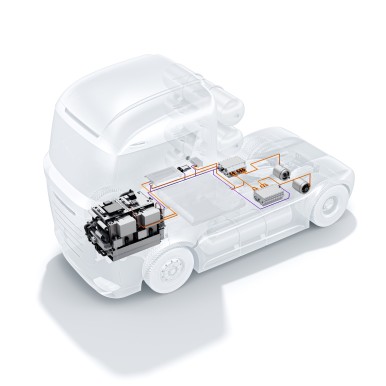
Stuttgart, Germany – Electromobility is picking up more and more speed. It is an important element in reducing CO2 emissions from traffic. But how economical is it to operate heavy-duty trucks with 40-ton payloads over long distances using only battery-electric power? Given the battery weight, long charging times, and limited range of today’s technology, electric powertrains aren’t the first choice for heavy trucks. Nevertheless, even 40-ton trucks will be able to travel more than 620 miles in all-electric mode in the near future. The key to this is the Bosch fuel-cell powertrain. When powered with hydrogen produced using renewable energy, this powertrain enables the climate-neutral transportation of goods and commodities. Bosch is taking the first step in this direction by developing the fuel-cell powertrain primarily with a focus on trucks, and the company plans to start production in 2022–2023. Once they have become established in trucks, Bosch fuel-cell powertrains will then increasingly find their way into passenger cars – rightly making them an integral part of tomorrow’s powertrain portfolio.Seven reasons why fuel cells and hydrogen are crucial building blocks of tomorrow’s mobility: 1) Climate neutrality In a fuel cell, hydrogen (H2) reacts with oxygen (O2) from the ambient air. The energy this reaction releases is converted into electricity, which is used for driving. Heat and pure water (H2O) are other products of the reaction. H2 is obtained using electrolysis, in which water is separated into hydrogen and oxygen with the aid of electricity. Generating this electricity from renewables makes the fuel-cell powertrain completely climate-neutral. Especially for large, heavy vehicles, fuel cells have a better carbon footprint than exclusively battery-electric powertrains if the CO2 emissions for production, operation, and disposal are added together. All that fuel-cell vehicles need in addition to their hydrogen tank is a much smaller battery for intermediate buffer storage. This greatly reduces their carbon footprint in production. “The advantages of the fuel cell really come into play in those areas where battery-electric powertrains don’t shine,” explains Dr. Uwe Gackstatter, president of the Bosch Powertrain Solutions division. “This means there’s no competition between fuel cells and batteries; instead, they complement each other perfectly.” 2) Potential applications Hydrogen has a high energy density. Two pounds of hydrogen contains as much energy as a gallon of diesel. To travel 62 miles, a passenger car needs only about two pounds; a 40-ton truck needs a good 15 pounds. As with diesel or gasoline, it takes just a few minutes to fill an empty H2 tank and continue the journey. “Fuel cells are the first choice for transporting larger loads for many miles every day,” Gackstatter says, summarizing the advantages. In the EU-funded H2Haul project, Bosch is currently working with other companies to build a small fleet of fuel-cell trucks and put them on the road. In addition to mobile applications, Bosch is developing fuel-cell stacks for stationary applications with solid-oxide fuel-cell (SOFC) technology. One intended use for them is as small, distributed power stations in cities, data centers, and charge points for electric vehicles. If the Paris climate action targets are to be met, in the future hydrogen will need to power not only cars and commercial vehicles, but also trains, aircraft, and ships. The energy and steel industries are also planning to make use of hydrogen. 3) Efficiency One of the decisive factors for a powertrain’s eco-friendliness and profitability is its efficiency. This is around a quarter higher for fuel-cell vehicles than for vehicles with combustion engines. Employing recuperative braking further increases efficiency. Battery-electric vehicles, which can store electricity directly in the vehicle and use it for propulsion, are even more effective. However, since energy production and energy demand do not always coincide in time and location, electricity from wind and solar plants often remains unused because it cannot find a consumer and cannot be stored. This is where hydrogen comes into its own. The surplus electricity can be used to produce it in a decentralized way, ready for flexible storage and transportation. 4) Costs The cost of green hydrogen will come down considerably when production capacities are expanded and the price of electricity generated from renewables declines. The Hydrogen Council, an association of over 90 international companies, expects costs for many hydrogen applications to fall by half in the next ten years – making them competitive with other technologies. Bosch is currently working with the startup Powercell to develop the stack, the core of the fuel cell, and make it market-ready, with manufacturing to follow. The goal is a high-performance solution that can be manufactured at low cost. “In the medium term, using a vehicle with a fuel cell won’t be more expensive than using one with a conventional powertrain,” Gackstatter says. 5) Infrastructure Today’s network of hydrogen filling stations doesn’t offer complete coverage, but the roughly 180 hydrogen filling stations in Europe are already sufficient for some important transport routes. Companies in many countries are cooperating to push ahead with the expansion, often supported by state subsidies. In Germany, too, politicians have recognized the important role of hydrogen in decarbonizing the economy and have anchored it in the National Hydrogen Strategy. For example, the H2 Mobility joint venture will have built around 100 publicly accessible filling stations in Germany by the end of 2020, while the EU-funded H2Haul project is working not only on trucks but also on the filling stations required on its planned routes. Japan, China, and South Korea also have comprehensive support programs. 6) Safety The use of gaseous hydrogen in vehicles is safe and no more hazardous than other automotive fuels or batteries. Hydrogen tanks do not pose an increased risk of explosion. It is true that H2 burns in combination with oxygen and that a mixture of the two beyond a certain ratio is explosive. But hydrogen is about 14 times lighter than air and therefore extremely volatile. For example, any H2 that escapes from a vehicle tank will rise faster than it can react with the ambient oxygen. In a fire test conducted on a fuel-cell car by U.S. researchers in 2003, there was a flash fire, but it quickly went out again. The vehicle remained largely undamaged. 7) Timing Hydrogen production is a proven and technologically straightforward process. This means it can be ramped up quickly to meet higher demand. In addition, fuel cells have now reached the necessary technological maturity for their commercialization and widespread use. According to the Hydrogen Council, the hydrogen economy can become competitive in the next ten years, provided there is sufficient investment and political will. “The time for entry into the hydrogen economy is now,” Gackstatter says.

A classic performance vehicle reimagined

24.08.2018

Press release

Powertrain systems

A classic performance vehicle reimagined

FARMINGTON HILLS, Michigan – Imagine your favorite classic vehicle, but with modern performance. That is what Singer Vehicle Design has done with the 964-era Porsche 911 vehicles restored for their clients. A key aspect of bringing modern performance to these vehicles has been Bosch technology such as electronic stability control, also known as electronic stability program (ESP), and engineering expertise from the Bosch team.Singer revealed its newest client-inspired work, the Dynamics and Lightweighting Study (DLS), at the 2018 Goodwood Festival of Speed. DLS is a collaboration with Williams Advanced Engineering and a formation of technical partners, including Bosch, in pursuit of the most advanced air-cooled Porsche 911 in the world. The DLS was showcased as part of both a static display outside the Goodwood House and performed as part of the Michelin Supercar Paddock Hillclimb Run. The vehicle is on display for the first time publicly in the U.S. at Monterey Car Week beginning August 23. Additionally, the car will be displayed upon the famed concept lawn at the globally renowned Pebble Beach Concours d’Elegance on Sunday, August 26. Original 964-era Porsche 911s came equipped with a Bosch ABS 2U system, which Singer currently restores for their Classic Commissions. For the DLS, however, Singer desired a new level of technology and refinement and turned to Bosch. “It’s really important for us that the addition of these systems shouldn’t spoil the driving experience, and still allow the driver to explore the dynamic limits of the vehicle, with varying levels of driver-selected assistance,” said Mazen Fawaz, Managing Director at Singer Vehicle Design. “We’re delighted with the way that the Bosch team have been able to work with us to develop the system to deliver the level of performance in the way that we always intended. We’ve created something together that we think is really quite special.” The engineering team at Bosch focused on integrating a modern ESP system to provide not only safety, but also high-level racetrack performance. Singer, Williams and Bosch worked together to ensure that the sensors and communication architecture necessary for modern ESP controls were integrated into the custom design of the vehicle from the beginning. “Singer’s meticulous level of detail in all facets of their work aligned well with our Invented for Life vision of developing technology that provides benefit – in this case through improved safety and performance,” said Keith Andrews, regional president of Bosch Engineering Group in North America. “Our team embraced the challenge to integrate the ESP in a modern fashion while respecting the heritage.” The Bosch Engineering Group team in North America has spent the past 10 years refining a Brake Controls solution optimized for racetrack driving. Multiple sports car programs and thousands of hours later; Singer is tapping into this experience and expertise. “When we were planning the Dynamics and Lightweighting Study, coming to Bosch for the ABS, traction control & ESP system was a natural choice for us,” Fawaz said. “From an early stage of discussions, it was obvious that the team there were really enthusiastic and understood the character that we are trying to give to the vehicle.”

Worlds Converge: Humans at the heart of the mobility revolution

23.05.2018

Press release

Two Wheeler

Worlds Converge: Humans at the heart of the mobility revolution

Flat Rock, Mich . –The mobility industry is the epicenter of innovation as new technologies promise to transform the entire concept of transportation. As a partner to both established and new mobility manufacturers with a portfolio that extends across automation, connectivity and electrification, Bosch has a broad view of the shifting landscape.The global supplier of technology and services provided a glimpse into the future of mobility from multiple perspectives at the Bosch Mobility Experience U.S. 2018, held at the Bosch Proving Grounds in Flat Rock, Mich. Bosch presented technologies at the middle of drivers’ changing relationship with the vehicle and showcased how the convergence of technology is driving the future of mobility. “While many feel a collision of worlds is imminent between traditional and new, the developments on the horizon are rather a convergence than a collision,” said Mike Mansuetti, president of Bosch in North America. “When we take a convergent approach, we bring together the benefits of multiple worlds for the benefit of all.” At its mobility showcase event, Bosch focused specifically on the positive impact to society as part of its Invented for Life brand promise. “The center of development isn’t whose approach is right – the center of development is the human being,” Mansuetti said. “The people inside these next-generation vehicles, their safety and their overall experience are the primary focus. Together we can foster consumer trust instead of anxiety, uncertainty and fear.” Redundancy and driver assistance blaze the path to automated driving Advanced driver assistance systems (ADAS) has been a major growth driver for Bosch. As early as 2019, the company expects to generate sales of two billion euros globally with driver assistance systems and its sales are growing faster than the market. While the global market for radar and video sensors is forecast to grow 20 percent this year, sales of Bosch radar and video sensors are expected to increase by 40 percent globally. Bosch will debut for the first time in North America automatic emergency braking for cyclists . The technology uses sensors to detect cyclists alongside and ahead of the vehicle, monitoring speed, distance, and direction of travel to calculate the risk of an accident. In the case of an imminent collision, the system automatically brings the vehicle to a stop in order to avoid — or at least reduce the severity of — an accident. Driver assistance technologies such as automatic emergency braking are coming to prominence and extending into new use cases as the technology is applied to help keep consumers and drivers safer. As levels of automation continue to increase, partially automated driving functions can help make the driver's trip safer and more relaxing. Bosch highway assist , a partially automated driving function installed in the Maserati MY 2018 Ghibli, Levante and Quattroporte, combines ACC Stop & Go and lane centering functions to control the vehicle's speed, acceleration and braking. To help reach new levels of automation, Bosch is working on redundant solutions for all levels of automated driving . Redundancy ensures safety in a vehicle where a human driver may no longer be able to operate as the backup function. At the Bosch Mobility Experience, the company will feature a redundant braking system that combines Bosch’s electromechanical brake booster (iBooster) and electronic stability control (ESP®) systems, each of which is capable of independently performing braking functions for the vehicle in the rare case of a single failure. Bosch also will present the Servolectric® Paraxial Servo Unit (EPSapa) that provides operational steering in the event the primary system is unable to operate, another redundant solution that makes highly automated driving possible. Connectivity solutions come to life Whether through connected solutions, in-vehicle interaction or the architecture within the vehicle, connectivity is at the heart of future mobility experiences. Bosch’s systems and cross-domain expertise position it to bring connectivity solutions to life. Bosch will showcase vehicle-to-anything (V2X) technologies that sense what is beyond the line of sight by facilitating communication between vehicles and the world around them. At the heart of these solutions is the Bosch connectivity control unit. The result is more time for drivers to react to potentially dangerous situations in scenarios such as left turns and pedestrians in intersections to keep drivers and pedestrians safe. The technology also will provide autonomous vehicles with decision-making information. Connectivity solutions from Bosch also help keep drivers safe inside the vehicle by helping drivers seamlessly and safely connect while reducing time when eyes are off the road. The next generation cockpit designed by Bosch is a system that runs multiple displays and electronics from one electronic control unit. The system implements smart, multimodal human machine interface (HMI) including voice print smart voice recognition, driver identification and a haptic control panel to make the vehicle increasingly driver-centric. It also includes Motion Intelligence HALO Software which limits use of the screen of any smart device that enters the driver’s area, preventing dangerous activity like texting, posting to social media, or emailing while driving. Connectivity also turns the smartphone into a car key. Perfectly keyless uses the driver’s mobile phone as a digital car key to allow passive vehicle access and start. Vehicle access can be securely granted to other users, enabling families, companies, sharing providers and fleet operators to flexibly manage who can access their vehicles and when. Bosch expertise powers new visions of electrification At the beginning of 2018, Bosch combined its powertrain expertise – gasoline, diesel, electric and battery systems – underneath a new business unit: Powertrain Solutions. Consumers in the U.S. have multiple options for powertrains, and Bosch helps manufacturers to provide these choices. As interest in pure electric vehicles increases, Bosch offers e-axle, e-machine, and power electronics technologies to many manufacturers – both established and new. Bosch electrified components are already featured in more than 800,000 vehicles around the world, and the organization has carried out over 30 production projects with OEM partners. One such example is with Nikola Motor Company. The Nikola NZT™ is the most advanced electric UTV in the world with staggering performance and capabilities. It features more than 500 horsepower coming from the state-of-the-art battery and four wheel-independent motors. Impressively, the Nikola NZT™ accelerates from 0-60 in less than 3.5 seconds. Bosch will supply the Vehicle Control Unit and controls software for the vehicle as well as anti-lock braking system as part of an overall energy management solution. Bosch also will provide high-efficiency electric motors for the Nikola two-motor e-axles. Thanks to Bosch components and systems expertise, Nikola’s vision for the NZT is becoming a reality.