Search and find:
Photos, videos, releases, events to support your reporting about the Bosch Group

Bosch and Mercedes-Benz showcase automated valet parking at InterContinental Los ...

21.03.2022

Press release

Automated mobility

Bosch and Mercedes-Benz showcase automated valet parking at InterContinental Los ...

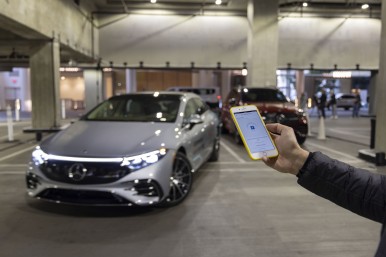
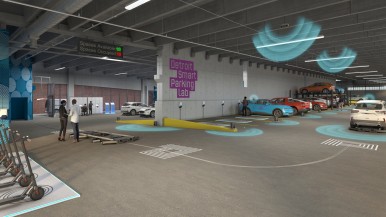
LOS ANGELES – Drive a fully-electric, luxury vehicle up to the hotel at an iconic skyscraper in Los Angeles and simply let the vehicle park itself. This scenario will become a reality in a demonstration of automated valet parking at the InterContinental Los Angeles Downtown featuring the EQS sedan from Mercedes-EQ. It is the first demonstration of infrastructure-based automated valet parking in a hotel setting in the United States. Automated valet parking technology from Bosch and Mercedes-Benz is at the core of the demonstration in Los Angeles. It features INTELLIGENT PARK PILOT in the Mercedes-Benz EQS and integration with the smartphone app as part of a holistic demonstration of the future vehicle experience for consumers. The demonstration is operated in conjunction with InterContinental Los Angeles Downtown, an 889-room property located in the tallest building west of Chicago. “The demonstration at the InterContinental Los Angeles Downtown will showcase how automated valet parking will operate in a working hotel environment where both automated and non-automated vehicles operate alongside pedestrian traffic,” said Dr. Kay Stepper, senior vice president of automated driving and driver assistance for Bosch in North America. “This allows us to dive into the dynamics of local deployments with the use of a highly-connected EQS from Mercedes-EQ to demonstrate how automated technology continues to move forward.” “Our vision is that getting time back is a key component of the luxury experience our customers are looking for. The EQS gives you time back by driving itself in traffic jams on highways, but with INTELLIGENT PARK PILOT, it may also be able park itself,” says Dr. Philipp Skogstad, president & CEO of Mercedes-Benz Research & Development North America. He adds: “INTELLIGENT PARK PILOT is a feature that together with the required infrastructure enables an automated valet service that gives customers even more comfort and relief in everyday life.”Mercedes showcases INTELLIGENT PARK PILOT The demonstration features the EQS, showcasing automated valet parking using its existing hardware that is already preinstalled in vehicles such as the S-Class and EQS in Germany/Europe with the required optional equipment. The vehicle interacts with the Bosch intelligent infrastructure installed in the parking garage in order to enable the vehicle to drive and park itself at the InterContinental Los Angeles Downtown. Sensors installed at the building will communicate with the vehicle and guide its maneuvering through the garage. The demonstration also highlights possibilities for additional services such as automated EV charging and a car wash where vehicles move in and out of service areas guided by the intelligent infrastructure. In conjunction with the necessary optional equipment* and the corresponding Connect service (both depending on country), the EQS has the onboard technology to enter and leave multi-story parking facilities equipped with the Bosch automated valet parking infrastructure in highly automated mode and without a driver, provided that the corresponding Connect service is available and booked for the respective vehicle variant of the EQS and national legislation permits such operation.Demonstration to utilize smartphone app as part of the holistic vehicle experience The vision: The driver securely parks the vehicle in a designated drop-off area of the parking facility, and after all passengers have exited they start the parking procedure using the smartphone app. The sensor system in the car park checks whether a suitable space is available or was already reserved for the vehicle. If so, the automated valet parking infrastructure confirms the handover of the vehicle for the driver in the App, and he/she can leave the EQS and depart. The vehicle is then started automatically and moves driverless to its parking space with the help of the infrastructure installed in the parking facility. On returning, the driver can let the EQS drive to a designated pick-up area by smartphone command. This means less time searching for parking spots and walking from the parking garage to their destination.A step on the path to fully automated driving Automated parking technology showcases the benefits of automation to drivers by providing value to drivers by easing the burden of the parking experience. “Low-speed maneuvers are part of the holistic opportunity for automated technology,” Stepper said. “Automated technology in the specific use case automated valet parking gets consumers comfortable with how automated technology works and how it can benefit them.” Bosch engineering teams have been working over the past few years to further develop automated valet parking and support specific testing and deployments around the world.Drivers and garage operators both benefit Automated valet parking presents benefits on both sides of the parking experience. For consumers, they will no longer have to search for a parking space and can save time once they arrive to their destination. For parking garage operators, they can increase parking capacity as vehicles no longer need to have room to open doors on all sides as all occupants have already exited the vehicle. Furthermore, operators can offer services such as charging, washing or maintenance.

Automated driving: Bosch and Volkswagen Group subsidiary Cariad agree on extensi ...

23.02.2022

Press release

Automated mobility

Automated driving: Bosch and Volkswagen Group subsidiary Cariad agree on extensi ...

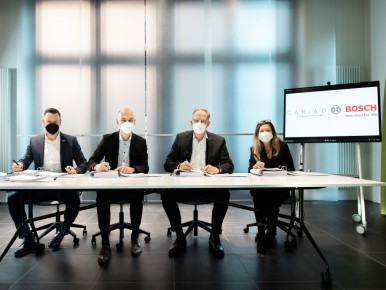
Stuttgart, Wolfsburg, and Ingolstadt, Germany – More safety and less stress for drivers, more rapid deployment of automated driving functions across all vehicle classes: Bosch and the Volkswagen Group subsidiary Cariad are now collaborating to achieve this objective, and have agreed to form an extensive partnership. The companies want to make partially and highly automated driving suitable for volume production, and thus available to the broad mass of consumers. For the vehicles sold under the Volkswagen Group brands, the alliance aims to make functions available that will allow drivers to temporarily take their hands off the steering wheel. More specifically, these functions are Level 2 hands-free systems for urban, extra-urban, and freeway driving, as well as a system that takes over all driving functions on the freeway (SAE Level 3). The first of these functions are to be installed in 2023. For partially and highly automated driving, the two companies will jointly develop a state-of-the-art, standardized software platform. The aim is to use this platform in all privately used vehicle classes sold under Volkswagen Group brands – and thus in one of the world’s biggest vehicle fleets. It will also be possible to integrate all the component parts developed by the alliance in other automakers’ vehicles and ecosystems.Software and volume-production expertise “For privately owned vehicles, progress to automated driving happens one step at a time. At Bosch, we’ve been working successfully on this for many years now. Together with Cariad, we will now be accelerating the market launch of partially and highly automated driving functions across all vehicle classes, and thus making them available for everyone. This will make driving on the roads safer and more relaxed,” says the Bosch board of management member Dr. Markus Heyn. “We will be able to offer the solutions we create to our other customers as well, and in this way set new standards.” The two partners have got what it takes to make increasingly automated driving a common sight on our roads: they have decades of experience in the volume production, scalability, and approval of driving systems, as well as expertise in the areas of software, data-driven development, and artificial intelligence. “Automated driving is key to the future of our industry. With our cooperation, we’ll strengthen Germany’s reputation for innovativeness. Bosch and Cariad will further enhance their expertise in the development of pioneering technologies,” says Dirk Hilgenberg, the Cariad CEO. “This underscores our ambition to deliver the best possible solutions to our customers as soon as possible.”Intelligently processing information from the real environment At various locations belonging to the two companies, and especially in Stuttgart and Ingolstadt, associates from the Bosch Cross-Domain Computing Solutions division and Cariad will work together to develop partially and highly automated driving functions. Working in mixed, agile teams, they will be part of a global network. At peak times, it is expected that the various modules required by the project – from middleware to individual applications – will occupy more than 1.000 experts from the two companies. The two companies have already started recruiting fresh experts to work in the alliance as well. The focus of the project’s work will be data-driven software development on the basis of information from 360-degree surround sensing. For this purpose, a highly innovative development environment will be created for the recording, evaluation, and processing of data. The environment will also make use of AI methods. The idea behind this is a simple one. The more extensive the pool of data from real road traffic, the more robust and natural the design of the partially and highly automated driving functions can be. This applies, for example, to additional layers for high-resolution maps for the localization and lateral and longitudinal guidance of vehicles. The alliance will also be working on these layers. Moreover, it applies equally to everyday driving situations and to what are known as “corner cases” – the seldom occurring road-traffic incidents that are especially tricky for a system to resolve.Information processing in real time “The best proving ground for the development of automated driving is road traffic. With the help of one of the world’s biggest connected vehicle fleets, we will gain access to a huge database. This will allow us to take automated driving systems to a new level. All our customers will be able to benefit from this,” says Dr. Mathias Pillin, president of Bosch Cross-Domain Computing Solutions. “Together, we can test automated driving functions on a broader scale in actual vehicles and implement them more quickly. Our engineering work will be done jointly, with Bosch and Cariad as one team. There has never been an alliance like this in the automotive industry,” says Dr. Ingo Stürmer, the alliance’s project director at Cariad. This also involves feeding the data gathered in real traffic conditions into the development process – continuously and in real time. Each kilometer driven in real traffic conditions, and the data gathered, evaluated, and processed as a result, means a bigger pool of data and a better basis from which to make even higher levels of automated driving reality and get them safely and reliably onto our roads. The partners have also agreed to examine the possibility of joint development targets and timelines on the path the fully automated driving (SAE Level 4). The guiding principle behind this partnership on equal terms is as follows: one of the world’s biggest automaking groups plus one of the world’s biggest automotive suppliers equals a huge step forward in the development of automated driving.

Safe and sound from A to B: Bosch RideCare solution helps keep carsharing vehicl ...

03.11.2021

Press release

Automated mobility

Safe and sound from A to B: Bosch RideCare solution helps keep carsharing vehicl ...

Stuttgart, Germany – People who use shared vehicles expect the cars they reserve to be roadworthy, clean, and not full of unpleasant odors left by previous users. It’s frustrating to arrive at a vehicle that is scratched and dented, or when someone has smoked inside. Thanks to the new RideCare solutions Bosch is developing for fleet operators and mobility service providers, this will soon be a thing of the past. The goal is an even safer and more pleasant ride for every user. The first standard RideCare features are smoke and damage detection. Bosch combines a sensor box in the vehicle with cloud-based data analysis using artificial intelligence (AI). This allows carsharing providers to receive important, easily understood information in real time on whether a vehicle has been damaged or someone has smoked in it. Repairs or cleaning can then be carried out more quickly and more in line with demand, optimizing fleet management. “In carsharing, one of the main keys to customer satisfaction is to ensure users have a safe and pleasant driving experience at all times. With its RideCare solutions, Bosch is setting a new standard for an even better customer experience in the sharing market,” said Harald Kroeger, member of the board of management of Robert Bosch GmbH. Bosch is currently working on pilot projects with leading carsharing providers in Asia, North America, and Germany, aiming to launch a production version of its smoke and damage detection system soon. Bosch also recently received official approval for this system from globally-recognized testing and certification organization TÜV Süd, including a confirmation of the reliability of these fleet services.RideCare creates transparency and accountability Carsharing providers usually receive little if any information about whether their vehicles were damaged or smoked in during a given rental period. While users often report instances of major damage to the car, providers tend to be saddled with the cost of repairing supposedly minor damage. Another source of great dissatisfaction among users is taking possession of a vehicle in which the previous driver has been smoking – an activity that is almost ubiquitously prohibited inside rented vehicles but is difficult for carsharing operators to prevent. In such cases, the cost of professional interior cleaning can often run into several hundreds of dollars. With its RideCare solutions, Bosch can now give carsharing providers clarity instead of conjecture: a sensor box in the vehicle detects both cigarette smoke in the interior and damage to the exterior. Detecting these types of damages with just a single sensor unit is a first in the industry. The solutions available until now could detect either smoke or accidents, but not both. “Bosch’s combined smoke and damage detection system is the world’s first production solution that can reliably detect and incontrovertibly report both damage to and smoke inside the car,” Kroeger said. In addition, the box’s sensors are precise enough to detect not only accidents, but even small impacts that can occur during parking. This includes the detection of minor collisions involving a shared vehicle that is parked downtown and not currently rented out. Thanks to the RideCare solution, sharing providers can directly determine who caused the damage or smoked in the vehicle.Bosch combines artificial intelligence with the internet of things This innovative fleet service from Bosch comprises a sensor box which is semi-permanently installed on the inner windshield of shared vehicles, as well as intelligent software for data analysis in the cloud. As soon as sensor information about accidents or smoke in the vehicle interior has been transmitted to a cloud back end, Bosch can use AI methods to derive the intensity of any impact and classify it for the fleet operator. Intelligent algorithms incorporate both the vehicle’s driving dynamics data and additional information such as the condition of the road. This means sharing providers can know exactly whether damage is merely cosmetic or whether it needs to be assessed and repaired immediately to ensure that the vehicle remains roadworthy. “RideCare services are yet another demonstration of the potential of AIoT – the combination of AI and the internet of things. Now, its benefits will also be available to the users of sharing services,” Kroeger said. Thanks to AI data analysis, Bosch can also identify which part of the vehicle has been damaged –for example on the rear bumper or even on the underbody. This facilitates the documentation and appraisal of the damage. If the data from the sensor box is later combined with images of the damage, fleet and mobility service operators can also obtain an estimate of repair costs on request.Digital solution for fleet management For sharing providers, fast and transparent documentation of damage to individual vehicles in the fleet is hugely important, as it is the only way for them to improve roadworthiness and minimize downtime effectively and efficiently. In addition to damage classification, RideCare services also tell the carsharing provider exactly where and when the accident happened, and when someone smoked in the car. This information enables fleet managers and mobility service providers to keep their vehicles in as-perfect-as-possible condition at all times and to enhance driver and passenger well-being.