Search and find:
Photos, videos, releases, events to support your reporting about the Bosch Group

Bosch launches RevX to help fleets find the best load every time

21.03.2024

Press release

Business/economy

Bosch launches RevX to help fleets find the best load every time

Louisville, Kentucky – Bosch has announced the launch of RevX , a solution designed to streamline fleets’ search for freight, today at the largest heavy-duty trucking show in North America, the Mid-American Trucking Show . RevX offers a seamless sign-on solution that simplifies logistics by consolidating spot market shipments across multiple sources into a single tool designed to aid dispatchers in finding the load. The new cloud-based service from Bosch aggregates search results across multiple brokers and load boards based on a specific criterion, calculates profits, and effortlessly helps with data driven decision making to eliminate empty miles. RevX is the second Bosch product to launch on the company’s Logistics Operating System (L.OS), which debuted last year in Europe, India and the United States. The L.OS platform aims to simplify technology and operational processes in the transportation and logistics industry. It is open to all providers of logistics solutions to facilitate the smooth interplay of disparate services and data for companies operating in the logistics space. Since its debut, more than 60 solutions have been integrated into the platform globally, including 17 in the U.S. “L.OS connects the logistics-related products, services, and technology offerings of our strategic partners to solve our customers' critical pain points that reduce cost and improve profitability across the logistics ecosystem,” said Luke Hugel, president and regional business responsible for Bosch Mobility Platform & Solutions, North America. “By adding RevX to the L.OS platform, fleets now have access to the fastest way to find and win the best load for them on the spot market, in that moment. Furthermore, with L.OS these loads can seamlessly integrate with the fleet’s transportation management system.” In the future, Bosch plans to offer increased functionality within RevX for topics ranging from search results in a scheduler to forecast driver and equipment capacity for loads up to a week into the future, enhanced load planning and process flows – all from a single source. RevX will use artificial intelligence to turn searches across millions of potential loads into recommendations for the best load and deliver one-click communication to help ensure dispatchers secure the revenue-generating loads swiftly while minimizing manual data entry and errors. Tight freight markets require technology to win The transportation and logistics industry moves the U.S. economy however the carrier freight market has become extremely competitive since the recovery after the Covid 19 pandemic, when online orders and parcel deliveries saw sharp increase. Economic projections indicate by 2030 global goods transport will grow more than 40 percent, and by 2050 this figure is expected to exceed 145 percent. Even with this growth, the majority of transportation companies still organize their daily business manually or with an assortment of disconnected computer programs, so the need for RevX to help generate additional revenue across the L.OS platform is greater than ever. Another RevX advantage is increased driver and equipment utilization. Reducing empty miles traveled has a positive impact on driver pay, fleet profitability, and industry sustainability efforts. According to the US Department of Transportation , up to 35 percent of the truck miles (106 billion) are empty miles. RevX aims to reduce this by over 5% bringing value to fleet owners, freight carriers, shippers and brokers.

More chips: Bosch to invest on extending semiconductor production in Reutlingen

22.02.2022

Press release

Business/economy

More chips: Bosch to invest on extending semiconductor production in Reutlingen

Reutlingen, Germany – In an additional move to combat the ongoing global chip shortage, Bosch plans to further extend its wafer fab in Reutlingen. More than a quarter of $1.2 billion is to be invested in creating new production space and the necessary clean-room facilities between now and 2025. This will give Bosch the firepower to meet the continuously growing demand for chips used in mobility and IoT applications. “We are systematically expanding our manufacturing capacity for semiconductors in Reutlingen,” says Dr. Stefan Hartung, chairman of the board of management of Robert Bosch GmbH. “This new investment will not only strengthen our competitive position, but will also benefit our customers and help combat the crisis in the semiconductor supply chain.” The construction of a new extension in Reutlingen will create an additional 38,750 square feet of ultramodern clean-room space. As of 2025, this additional capacity will produce semiconductors based on technology already in place at the Reutlingen plant. Bosch is also extending an existing power supply facility and will construct an additional building for media supply systems serving both the new and existing production areas. The new production area is scheduled to go into operation in 2025. In October 2021, Bosch announced it would be spending more than $473 million in 2022 alone on expanding its semiconductor operations in Dresden and Reutlingen, Germany, and in Penang, Malaysia. Around $59 million of this sum is earmarked for the wafer fab in Reutlingen. In addition, Bosch also announced plans to invest a total of $177 million in the creation of additional clean-room space in existing buildings at the Reutlingen facility over the period from 2021 to 2023. The further expansion of the site, which will see a new extension to the manufacturing facilities, will now supplement these measures. All in all, clean-room space in Reutlingen is set to grow from around 376,737 square feet at present to over 473,612 square feet by the end of 2025.State-of the-art semiconductor manufacture The Reutlingen wafer fabs use 6- and 8-inch technology, while the Dresden plant makes chips on 12-inch wafers. Both employ cutting-edge manufacturing methods based on data-driven process control. “AI methods combined with connectivity have helped us achieve continuous, data-driven improvement in manufacturing and thereby produce better and better chips,” says Markus Heyn, member of the board of management of Robert Bosch GmbH and chairman of the Mobility Solutions business sector. This includes the development of software to enable automated classification of defects. Bosch is also using AI to enhance materials flows. With its high level of automation, this state-of-the art production environment in Reutlingen will safeguard the plant’s future and the jobs of the people working there.Growing demand for semiconductors Bosch has been developing and manufacturing semiconductors for over 60 years, and for more than 50 of those years in Reutlingen – both for automotive applications and for the consumer electronics market. Bosch-manufactured semiconductor components include application-specific integrated circuits (ASICs), microelectromechanical systems (MEMS sensors), and power semiconductors. The further expansion of the Reutlingen site will primarily serve the growing demand for MEMS in the automotive and consumer sectors and for silicon-carbide power semiconductors. “Bosch is already a leading chip manufacturer for automotive applications,” Heyn says. “And this is a position we intend to consolidate.” Measures to achieve this include the development and manufacture of chips made of silicon carbide, which Bosch has been producing since December 2021. Chips made of this innovative material are destined to play an increasingly important role in electromobility. Bosch is currently the only automotive supplier worldwide manufacturing power semiconductors made of silicon carbide. The Reutlingen plant currently employs around 8,000 associates. They work in the development and production of semiconductors and electronic control units, in administration, and in the eBike Systems division.

Bosch Information domain computer enables advanced in-vehicle features quickly a ...

09.12.2021

Press release

Connected mobility

Bosch Information domain computer enables advanced in-vehicle features quickly a ...

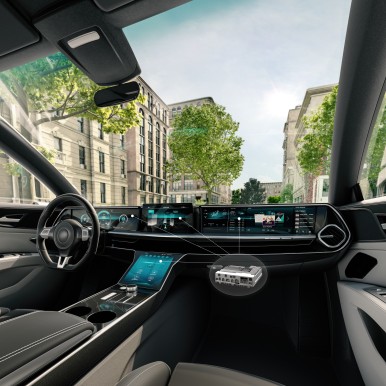
Plymouth, Mich. – In today’s world, vehicles need incredibly powerful brains. In-vehicle displays, voice assistants, infotainment systems and advanced human-machine interfaces (HMIs) are becoming more prominent and sophisticated, and more processing power is required to manage and control complex in-vehicle systems. Bosch has developed a high-performance infotainment domain computing system built precisely for the vehicles of today and tomorrow. It helps to bring features like in-car communication, in-car payment, video streaming, voice assistants and more to vehicles quickly. The Information domain computer delivers support for multiple in-vehicle systems within a single solution, and provides vehicle manufacturers with a cost-effective, flexible, scalable and powerful control unit for the future of in-vehicle technology. “With the Information domain computer, Bosch is providing connectivity and computing power to the modern world of mobility,” said Stefan Buerkle, senior vice president and head of Connected Information Solutions, Bosch in North America. “Bosch has experience working together with a network of leading technology companies, and has developed a powerful and flexible integration platform to support and enable the rapid evolution of in-vehicle features.”A collaborative network of technology industry leaders The Bosch Information domain computer combines Bosch’s leading expertise in automotive software solutions and domain-specific hardware expertise with solutions from a network of industry-leading technology companies in the hardware, component, software and services sectors. The result is a scalable platform that offers vehicle manufacturers the opportunity to utilize a combination of pre-integrated applications, the flexibility to support additional features developed in-house and the ability to accelerate time-to-market while managing cost efficiency. Bosch has developed a pre-integrated solution that features technology from several collaborating organizations. The pre-integrated solution, built on the QNX® Neutrino® Realtime Operating System (RTOS) and QNX® Hypervisor , is designed to deliver reliable functionality to address the requirements of today’s most advanced system designs. By combining a pre-integrated control unit with a customizable modular approach, the Bosch platform offers the flexibility to tailor in-vehicle features to customer preferences and market segments. The pre-integrated Information domain computer is powered by a 3rd generation Snapdragon® Automotive Cockpit Platform, a product of Qualcomm Technologies, Inc. In addition to supporting higher levels of compute and intelligence needed for advanced capabilities featured in next generation vehicles, the 3rd generation Snapdragon Automotive Platforms are engineered to deliver rich visual and audio experiences, as well as highly intuitive artificial intelligent experiences for in-vehicle assistance and contextual safety and support for precise positioning for enhanced navigation. The enhanced display experience is made possible by Texas Instruments’ FPD-Link™ SerDes technology for high-speed display and camera communications, which is supported by Molex ultra-reliable connector solutions. Further options available on the Bosch Information domain computer platform include voice assistants through Amazon Alexa and Cerence ; in-vehicle streaming with Access Twine4Car; and navigation experience via TomTom Navigation for Automotive embedded and cloud-based navigation. In addition, it will support the BlackBerry IVY™ Intelligent Vehicle Data Platform co-developed by BlackBerry and Amazon Web Services (AWS) to enable development of new applications and use cases. The user experience for the pre-integrated solution is tied together by Rightware with the award-winning Kanzi HMI toolchain for signature UI creation, in collaboration with software integration expert Wipro Limited, a leading global information technology, consulting, and engineering services company.Production-ready vehicle computers showcase continued Bosch leadership Vehicle computers are central to Bosch’s efforts to extend its leading role in software-intensive electronic systems. The customizable and flexible Information domain computer is the latest example of Bosch’s leadership in vehicle computers. Bosch is prepared to offer information domain computers to address the specific needs of vehicle manufacturers. Bosch has production-ready vehicle computers for every aspect of modern vehicles, including cockpit and connectivity functions, driver assistance systems and automated driving, and powertrain and body electronics.Bosch at CES 2022: PRESS CONFERENCE: Tuesday, January 4, 2022, from 8:00 to 8:45 a.m. local time (17:00–17:45 CET) with Dr. Tanja Rückert, Bosch CDO, and Mike Mansuetti, president of Bosch in North America, in Ballroom H, Mandalay Bay Hotel, Las Vegas South Convention Center, Level 2, as well as livestreamed on the Bosch Media Service . BOOTH: January 5–8, 2022, in the Central Hall, booth #16103 ELECTRIC BIKE TEST TRACK: January 5–8, 2022, at the eMobility Experience, LVCC, West Hall, West Plaza FOLLOW the Bosch CES 2022 highlights on Twitter: #BoschCES PANELS WITH BOSCH EXPERTS: Friday, January 7, 2022, 10:00 a.m., Venetian Hotel (local time) Building a Resilient Smart Home session with Dr. Carla Kriwet, CEO at BSH Hausgeräte GmbH

Bosch pools development activities for universal vehicle software in one unit

08.12.2021

Press release

Connected mobility

Bosch pools development activities for universal vehicle software in one unit

Stuttgart, Germany – Bosch is taking further strategic steps toward a leading position in the software-dominated future of mobility. In the future, under the umbrella of its subsidiary ETAS GmbH, the company will develop and sell basic vehicle software, middleware, cloud services, and development tools for universal application. A total of 2,300 experts from different development areas of Bosch and ETAS are to be brought together there as of mid-2022. “Software development is a longstanding core competence at Bosch. Every year, we put more than 200 million control units running our own software into vehicles worldwide. With this new set-up, we want to become the leading provider of application-independent vehicle software,” says Dr. Stefan Hartung, chairman of the Mobility Solutions business sector of Robert Bosch GmbH. A year ago, Bosch established its Cross-Domain Computing Solutions division, a powerful unit for application-specific vehicle software with specific hardware for numerous vehicle areas such as driver assistance and infotainment. Now the company is bringing together its portfolio of application-independent software for vehicles and the cloud at ETAS. The resulting central platform will allow it to develop automotive software more quickly and efficiently together with its partners. “Our universal software foundation is essential for the digitalization of modern, software-defined vehicles,” Stefan Hartung says. Bosch will combine its universal software platform with expertise in the development of innovative software functions. “Thereby we are creating a USP and a significant competitive advantage for Bosch,” says Dr. Markus Heyn, member of the Bosch board of management of Bosch. In the future, ETAS will offer this universal platform and the accompanying development environment to both automotive manufacturers and other suppliers.Software gaining in prominence for automakers Up to now, the rule was that vehicles were delivered as a finished product. In the future, though, a car’s software will be continuously improved and expanded – throughout its service life. This will give drivers a customized digital driving experience, and also form the basis for new business models for manufacturers. This development is just beginning. Experts predict that the market for automotive software will be worth billions in the next few years. Bosch expects double-digit annual growth until 2030. The organizational realignment Bosch is now planning for its application-independent automotive software units under the roof of its subsidiary ETAS bears witness to this transformation. “In the future development of vehicle operating systems, we want to position ourselves even better in the global market,” says Heyn. “With this move, we are providing existing and new customers with an integrated, horizontal, cross-domain platform that will allow them to achieve the aim of software-defined vehicles,” adds Christoph Hartung, the chairman of the board of management of ETAS GmbH. The partnership between Bosch and Microsoft that began in February will also be continued in the new organization. This partnership aims to develop a comprehensive software platform for seamless connectivity between cars and the cloud, making it quicker and easier to develop vehicle software throughout the car’s lifetime, as well as to download it to the control units and vehicle computers via the cloud.Universal and open portfolio for basic software and middleware Whether for electrically adjusting the seat, recharging the vehicle, deploying the airbag, or listening to the radio – software is already an integral part of almost every function in modern vehicles. It consists of different layers that build on each other. One layer comprises software modules that vehicle manufacturers use to create individual driving experiences – from the powertrain to infotainment and assistance systems. This is where the individual brands differ, sometimes enormously. Other layers, by contrast, such as the basic software for the control units and what is known as middleware, offer manufacturers almost no scope for USPs. These software components regulate the basic tasks performed by control units and vehicle computers – tasks that the driver doesn’t notice. For example, they manage processor performance and memory space, and they determine how control units communicate with each other or with the cloud to exchange data. Once developed, this software can be used on almost any ECU – regardless of where it is installed in the car and regardless of the vehicle model. This setup is familiar from smartphones, where a wide variety of apps use a central operating system. “Our new set-up will allow us to satisfy new requirements – both of the market and our customers – even better. Together with our partners, we are enabling existing and new customers to take a completely new approach to automotive software development,” Christoph Hartung says. In the future, open source software and the associated ecosystems will also play an increasingly important role. Vehicle manufacturers and automotive suppliers will thus be able to place software at the center of development even more effectively in the future.Application-independent software from a single source ETAS was founded in 1994 as a wholly owned subsidiary of Robert Bosch GmbH and employs some 1,500 associates in 12 countries. A further 800 Bosch associates will join them in mid-2022. Even today, the two companies are closely and successfully working together. This collaboration will be further intensified in a joint unit. The employee representatives responsible are currently involved in working out the details of the future organization.