Search and find:
Photos, videos, releases, events to support your reporting about the Bosch Group

For safer roads: Bosch teams up with Microsoft to explore new frontiers with gen ...

28.02.2024

Press release

Artificial Intelligence

For safer roads: Bosch teams up with Microsoft to explore new frontiers with gen ...

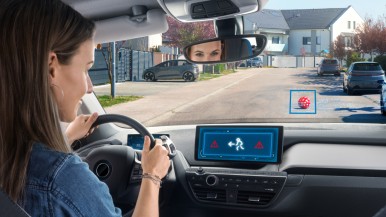
Stuttgart, Germany – It’s a scenario that no driver ever wants to see: a ball rolling out into the road. The chances are it will be followed immediately by a child in hot pursuit, oblivious to any traffic. But while human drivers can assess this situation using their contextual knowledge, today’s assisted and automated driving systems still have to learn how to do it. Bosch is pursuing the use of generative AI in terms to further improve automated driving functions. As part of this, Bosch and Microsoft are exploring opportunities to collaborate and leverage the power of generative AI. “Bosch is working on bringing a new dimension of AI applications into the vehicle,” said Dr. Stefan Hartung, chairman of the Bosch board of management, at this year’s Bosch Connected World (BCW) AIoT industry conference in Berlin. The expectation is that generative AI will enable vehicles to assess situations and react accordingly, and in this way keep road users even safer. Greater safety on the roads is also the wish of 60 percent of respondents to this year’s Bosch Tech Compass, a worldwide representative Bosch survey on the subjects of technology and AI. Generative AI to make road traffic safer The two companies anticipate that a collaboration would take the performance of automated driving functions to the next level. They would like to see generative AI help enhance convenience in the vehicle and to provide greater safety for all road users. To achieve this, Bosch's comprehensive understanding of vehicles and automotive-specific AI expertise will be invaluable, as well as their access to vehicle sensor data to feed the generative AI. “In our unwavering commitment to safer roads, Microsoft is eager to explore collaboration opportunities with Bosch to pioneer the realm of generative AI,” said Uli Homann, Microsoft CVP and Distinguished Architect. Even today, when it comes to training systems for automated driving, AI quickly comes up against its limits. Today’s driver assistance systems can detect people, animals, objects, and vehicles, but in the near future generative AI could help determine whether a situation could potentially lead to an accident. Generative AI utilizes vast amounts of data to train systems for automated driving, enabling them to draw improved conclusions from this data. For example, it could deduce whether an object on the road ahead is a plastic bag or a damaged vehicle part. This information can be used either to communicate directly with the driver – such as by displaying a warning – or to initiate appropriate driving maneuvers, such as braking while switching on the hazard warning lights. Bosch and Microsoft have already partnered to develop a universal software platform for seamlessly connecting cars and the cloud, and are looking forward to work together to identify new opportunities to bring cutting-edge AI technology to their customers and the autonomous vehicle industry. Generative AI as a boost to innovation “Generative AI is a boost to innovation. It can transform industry in much the same way as the invention of the computer,” says Tanja Rueckert, member of the Bosch board of management and chief digital officer. The new 2024 Bosch Tech Compass shows this as well: 64 percent of respondents believe that AI is the technology with the greatest importance for the future. In comparison, only 41 percent of respondents were of the same opinion just one year ago. From manufacturing to everyday office work, generative AI is already being used in many areas at Bosch. In addition to Microsoft, the company is working with several partners, including AWS, Google, and Aleph Alpha. The Bosch Group’s venture capital unit, Bosch Ventures, invested in the AI company Aleph Alpha last year. Bosch also announced it would collaborate with the startup on finding new use cases both for Bosch associates and customers. “Bosch and Aleph Alpha want to learn from each other, benefit from each other’s know-how, and work together on cross-domain use cases,” Rueckert says. This partnership is now bearing its first fruits in North America: in collaboration with Aleph Alpha, Bosch is debuting AI-based speech recognition on behalf of a premium car manufacturer. In this solution, a chatbot understands and answers breakdown service calls with the help of natural language processing, which also recognizes dialects, accents, and moods. The call is taken directly, reducing the driver’s waiting time to a minimum. As many as 40 percent of calls can be processed and resolved automatically; for more complex queries, the bot transmits all relevant information to a service center agent who takes over the case immediately. From the AI search engine to manufacturing AI experts at Bosch are currently working on well over 120 specific applications that these new AI models open up for the company’s associates and customers. Such applications include the generation of software program code or powerful chatbots and voicebots to support technicians or interact with consumers. Another is AskBosch, the in-house AI-assisted search engine launched at the end of 2023. It offers faster natural-language access to a wide variety of data sources – sources scattered over the intranet, say. In addition to externally available data, AskBosch also includes internal data sources, so Bosch associates can research information specific to the company. Generative AI also ensures greater speed in manufacturing: in initial projects in two Bosch plants in Germany, generative AI creates synthetic images in order to develop and scale AI solutions for optical inspection and optimize existing AI models. Bosch expects that this will reduce the time needed for planning, launching, and ramping up AI applications from the current six-to-twelve months to just a few weeks. Following successful piloting, this service for generating synthetic data is to be offered to all Bosch locations. 2024 Bosch Tech Compass: setting the pace in the use of AI As AI is used in more and more areas of life, professional development is becoming increasingly important: 58 percent of respondents to the Bosch Tech Compass are convinced of this. This opinion is particularly prevalent in USA at 63 percent (Germany: 54 percent, China: 52 percent). Here, too, Bosch is setting the pace in the use of artificial intelligence and is getting its associates on board. In 2019, Bosch launched a training program, initially aimed at bringing 30,000 associates up to speed on the subject of AI. Up to now, some 28,000 associates have taken part in the program. Like the Bosch AI code of ethics, which sets ethical guidelines for dealing with artificial intelligence, this program has been supplemented with content about generative AI. For all the results of the 2024 Bosch Tech Compass, click here . About the survey: For the representative survey, people aged 18 and over in seven countries (Brazil, China, Germany, France, India, the U.K., and the U.S.) were polled online on behalf of Robert Bosch GmbH by the market researchers Gesellschaft für Innovative Marktforschung mbH (GIM) in December 2023. In Germany, France, and the U.K., at least 1,000 people were polled per country; in Brazil, China, India, and the U.S., it was at least 2,000 people each. The random samples are representative of their respective countries in terms of region, gender, and age (Brazil, Germany, France, U.K., U.S.: 18 to 69 years / China, India: 18 to 59 years).

CES 2022: For better quality of life and more climate action – connected and sma ...

04.01.2022

Press release

Artificial Intelligence

CES 2022: For better quality of life and more climate action – connected and sma ...

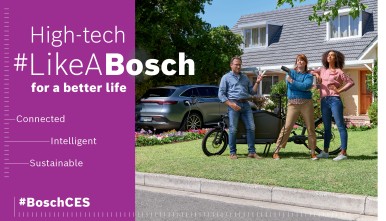
Las Vegas – At home, on the road, at work, in the hospital, or even in orbit: Bosch is improving the everyday lives of people from all walks of life with smart and connected solutions. At the same time, the company is tapping into new areas of business through software, services, and licenses. “We are systematically digitalizing our core business to increase the benefits for our customers. Going forward, we aim turn the sale of every digital product into services-based revenue as well,” says Tanja Rückert, the Bosch Group’s chief digital officer, at CES in Las Vegas. To achieve this goal, Bosch is focusing on the connection of IoT with AI – in other words, it is linking the internet of things (IoT) with artificial intelligence (AI). This creates a virtuous circle in which connected products deliver information that, in turn, is processed by means of AI and incorporated into software updates for these products. At the core of this approach is the benefit for customers, since it allows users to be an integral part of the development process and enables solutions to be tailored precisely to their needs. Furthermore, neither development nor value creation ends with the sale of the products. “We see the combination of AI and IoT as holding the key to leveraging the most user benefit from both of these technologies,” Rückert says. “Besides enabling us to develop new business models, this approach helps us offer better products and solutions that deliver real added value for individuals and society as a whole.”Expanding software expertise: Bosch is already shaping the future today Bosch laid the foundation for this long ago. As of the new year, all electronics product classes will be connectable. Sales of connected power tools, household appliances, and heating systems alone have grown by 50 percent within one year – from four million units in 2020 to more than six million in 2021. With the Bosch Center for Artificial Intelligence (BCAI), the company has established a strong unit in the field of AI that has already contributed some 300 million euros to result. In addition, the company invests a total of more than four billion euros every year in its software expertise, around three billion of which goes to the mobility business. To shape the software-defined future of mobility, Bosch will also be pooling development activities for application-independent software in one unit as of mid-2022. In the future, under the umbrella of its subsidiary ETAS GmbH, the company will develop and sell basic vehicle software, middleware, cloud services, and development tools for universal application. Bosch is also rapidly advancing connected and automated driving. Over the past five years, Bosch has generated some nine billion euros in sales just with driver assistance systems and the associated sensors.Bosch Tech Compass: a survey conducted in five countries around the world The Bosch Tech Compass – a representative survey conducted in five countries and presented for the first time at CES – shows what people across the globe expect from new technologies. According to the survey, the majority of respondents (72 percent) are convinced that technological progress is making the world a better place, for instance as a key to fighting climate change (76 percent). At the same time, four out of five people think technology should be more focused on tackling the great challenges of our time rather than serving individual needs. “We at Bosch also believe that technology offers a broad range of benefits,” Rückert says. “When we talk about high-tech, we’re not talking only about pushing the envelope on what’s possible. We use technology as a means to improve people’s lives wherever they are.”From space to pediatric medicine: the Bosch SoundSee sensor system One example of the benefit of AI and connectivity is the SoundSee sensor system. Since late 2019, it has been traveling through space to identify unusual sounds on the ISS, using AI algorithms to analyze and indicate when maintenance is required. Now, in collaboration with the non-profit healthcare company Highmark in Pittsburgh (USA), Bosch is pursuing a completely down-to-earth application of this technology: investigating how audio AI can be used as a diagnostic tool in pediatric medicine. Specifically, Bosch and Highmark are working to adapt the sensors in a way that will enable them to detect pulmonary conditions such as asthma at an early stage just by listening to children’s breathing patterns. “Using innovative technology to improve children’s health – that’s exactly what we mean with high tech,” says Mike Mansuetti, president of Bosch in North America. SoundSee’s use in medicine also illustrates Bosch’s understanding of its “Invented for life” strategic imperative. Bosch’s new gas sensor – the first on the market to contain AI – serves to protect both humans and nature. Part of Dryad’s Silvanet Wildfire Sensor, it is essentially a digital nose that helps detect forest fires early on. Dryad’s sensors are attached to trees, where they continuously monitor the local microclimate to detect incipient fires – and to wirelessly notify the local authorities, long before camera- or satellite-based systems can. Not only can this protect against devastation by fire, it can also reduce global carbon emissions from forest fires. “These sensors are going to help save lives, homes, and tons of CO2 from entering the atmosphere – all thanks to AI and connectivity,” Mansuetti says.High-tech #LikeABosch: new campaign for smart solutions A new, lighthearted Bosch campaign shows the solutions the company has developed to improve the little things in people’s everyday lives. Called “High tech #LikeABosch – with many connected, intelligent, and sustainable solutions,” its protagonist takes viewers on a tour through her daily routine and uses several Bosch solutions, from smart glasses to a connected e-bike to a digital access pass for work. This makes her teenage son, who at the start of the clip said his mom was “old school,” look pretty out of touch.

From windshield wiper to e-bike ABS

19.05.2020

Press release

Artificial Intelligence

From windshield wiper to e-bike ABS

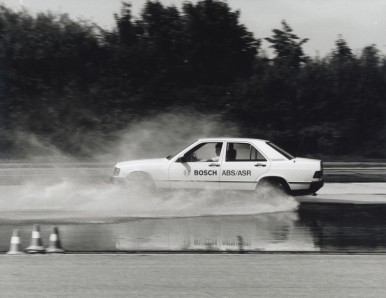
1926: Windshield wiper Goodbye to poor visibility: comprising an electric motor that drove a rubber-coated arm via a worm screw and gear, the Bosch electric windshield wiper finally gave drivers a clear view of the road ahead. It was followed in 1959 by an electric windshield washer system. Activated at the push of a button, an electric pump precisely sprayed water on to the windshield through one or several nozzles that were mounted on the hood. 1927: Power-assisted brake for commercial vehicles In the years after 1900, vehicles became increasingly fast and powerful, but braking force was unable to keep up. This prompted Bosch to develop a pneumatic brake booster for heavy trucks, whose heavy loads meant especially long braking distances. The system used the vacuum that arises in the induction tract of the engine, so that only one-third as much pressure now had to be applied to the brakes. 1928: Bosch brake assistant Bosch also used this innovative brake technology, premiered in 1927, in passenger cars. There were two challenges: to achieve a compact design that would allow it to be installed in the tight space available in the engine compartment, and to make it more affordable. The technology became established as standard equipment. As in the case of the Bosch brake for trucks, drivers now only had to apply one-third of the pedal pressure, and braking distance was also reduced by one-third. 1957: Asymmetric low-beam headlights In 1913, Bosch started production of a new automotive lighting system. The system comprised a generator, headlights, a battery, and a regulator. And while these lighting systems were continuously improved, they still had one disadvantage: they dazzled oncoming vehicles. The more cars there were on the roads, the more inconvenient and dangerous the situation became. In 1957, Bosch premiered asymmetric low-beam headlights. This system causes less dazzle for oncoming traffic and illuminates the driver’s own side of the road better. 1978: ABS antilock braking system Following nine years of development work, 1978 marked the start of the success story of ABS, the electronically controlled antilock braking system for four-wheeler passenger cars. If the wheels lock up, ABS reduces brake pressure then increases it again – up to 40 times a second. This keeps braking distances short, even on slippery surfaces, and the vehicle remains steerable. For motorcycles, the EU mandated the system for all new type approvals from 2016. 1926: Windshield wiper Goodbye to poor visibility: comprising an electric motor that drove a rubber-coated arm via a worm screw and gear, the Bosch electric windshield wiper finally gave drivers a clear view of the road ahead. It was followed in 1959 by an electric windshield washer system. Activated at the push of a button, an electric pump precisely sprayed water on to the windshield through one or several nozzles that were mounted on the hood. 1927: Power-assisted brake for commercial vehicles In the years after 1900, vehicles became increasingly fast and powerful, but braking force was unable to keep up. This prompted Bosch to develop a pneumatic brake booster for heavy trucks, whose heavy loads meant especially long braking distances. The system used the vacuum that arises in the induction tract of the engine, so that only one-third as much pressure now had to be applied to the brakes. 1928: Bosch brake assistant Bosch also used this innovative brake technology, premiered in 1927, in passenger cars. There were two challenges: to achieve a compact design that would allow it to be installed in the tight space available in the engine compartment, and to make it more affordable. The technology became established as standard equipment. As in the case of the Bosch brake for trucks, drivers now only had to apply one-third of the pedal pressure, and braking distance was also reduced by one-third. 1957: Asymmetric low-beam headlights In 1913, Bosch started production of a new automotive lighting system. The system comprised a generator, headlights, a battery, and a regulator. And while these lighting systems were continuously improved, they still had one disadvantage: they dazzled oncoming vehicles. The more cars there were on the roads, the more inconvenient and dangerous the situation became. In 1957, Bosch premiered asymmetric low-beam headlights. This system causes less dazzle for oncoming traffic and illuminates the driver’s own side of the road better. 1978: ABS antilock braking system Following nine years of development work, 1978 marked the start of the success story of ABS, the electronically controlled antilock braking system for four-wheeler passenger cars. If the wheels lock up, ABS reduces brake pressure then increases it again – up to 40 times a second. This keeps braking distances short, even on slippery surfaces, and the vehicle remains steerable. For motorcycles, the EU mandated the system for all new type approvals from 2016. 1980: Electronic airbag control In 1980, Bosch was the first European company to manufacture electronic triggering units for passive safety systems. This set the standard in road safety. The triggering unit comprised three components made up of some 170 individual parts, and controlled the driver airbag. It was first installed in the Mercedes-Benz S-class. Up to nine airbags are installed in today’s vehicles. They are deployed individually, depending on the accident scenario. 1986: TCS traction control system The TCS traction control system prevents the driven wheels from spinning. The electronic control unit reduces the speed of the spinning wheels until they recover their grip. TCS is an early example of networking diverse automotive electronic systems. When traction control is activated, it intervenes in the engine management or brake control system. Despite actuation of the accelerator, engine power is continuously lowered, or the brake is actuated, until the wheels recover their grip. Traction control can also brake a wheel individually in order to divert engine power to another drive wheel if the latter offers better traction. 1995: MEMS in mass production In the 1980s, Bosch worked on making sensors smaller, more reliable, and more energy efficient, as a way of providing ever more sensor data in cars. Following the start of mass production in 1995, these miniature helpers became ever more prevalent, furnishing control units with data about when the car brakes or accelerates, as well as about the direction the car is traveling. Information such as this is important for safety systems such as ESP®. 1995: ESP® electronic stability program Using smart sensors, ESP® compares 25 times per second whether the car is actually moving in the direction that the driver is steering it in. If it is not, the system intervenes. By reducing engine torque and deliberately braking each wheel individually, the system helps the driver stabilize the vehicle and prevent skidding accidents. Since its market launch in 1995, ESP® has prevented just under half a million accidents and saved more than 15,000 lives in the EU alone. Bosch celebrates a milestone this year: it has sold 250 million ESP® systems since production began 25 years ago. 2010: Predictive emergency braking system Ever more sensors in cars, sharing information with each other, make completely new applications possible: the emergency braking system that went into production in 2010 makes use of the information radar and video sensors share with the ESP®. If there is a threat of collision, it offers drivers multi-stage support. First, it alerts to the need to brake hard. If this alert is not heeded, the system initiates partial braking, and if the driver still does not react, it triggers emergency braking. 2013: MSC motorcycle stability control In 2013, Bosch took its ESP® success story, which began in 1995, and applied it to two-wheelers. In all riding situations, MSC motorcycle stability control ensures maximum stability: when braking and accelerating, on straight stretches and in bends. Wheel sensors measure wheel speed, and a further sensor measures lean and pitch angles. If the system detects a wheel on the verge of locking up, braking pressure is lowered and built up again within a fraction of a second, ensuring that the correct amount of pressure is constantly applied to prevent each wheel from locking up. This can save motorcyclists’ lives. 2018: eBike ABS Bosch has been manufacturing antilock braking systems for cars since 1978, and for motorcycles since 1995. They were joined in 2018 by an ABS for eBikes, which Bosch developed in collaboration with the brake manufacturer Magura. The world’s first production antilock braking system for pedelecs reduces the risk of becoming unseated in critical situations. In this front-wheel ABS, the hydraulic brakes and electronic brake system are perfectly tuned to each other. Wheel-speed sensors monitor the speed of both wheels. As soon as the front wheel threatens to lock up, the system regulates brake pressure to optimize riding stability. This is a huge added boost to rider safety. In addition, the rear wheel lift control function reduces the risk of a head-over-heels accident. If far too much brake force is applied, the ABS regulates the pressure applied to the front wheel, so that the rear wheel can quickly regain traction. In 1980, Bosch was the first European company to manufacture electronic triggering units for passive safety systems. This set the standard in road safety. The triggering unit comprised three components made up of some 170 individual parts, and controlled the driver airbag. It was first installed in the Mercedes-Benz S-class. Up to nine airbags are installed in today’s vehicles. They are deployed individually, depending on the accident scenario. 1986: TCS traction control system The TCS traction control system prevents the driven wheels from spinning. The electronic control unit reduces the speed of the spinning wheels until they recover their grip. TCS is an early example of networking diverse automotive electronic systems. When traction control is activated, it intervenes in the engine management or brake control system. Despite actuation of the accelerator, engine power is continuously lowered, or the brake is actuated, until the wheels recover their grip. Traction control can also brake a wheel individually in order to divert engine power to another drive wheel if the latter offers better traction. 1995: MEMS in mass production In the 1980s, Bosch worked on making sensors smaller, more reliable, and more energy efficient, as a way of providing ever more sensor data in cars. Following the start of mass production in 1995, these miniature helpers became ever more prevalent, furnishing control units with data about when the car brakes or accelerates, as well as about the direction the car is traveling. Information such as this is important for safety systems such as ESP®. 1995: ESP® electronic stability program Using smart sensors, ESP® compares 25 times per second whether the car is actually moving in the direction that the driver is steering it in. If it is not, the system intervenes. By reducing engine torque and deliberately braking each wheel individually, the system helps the driver stabilize the vehicle and prevent skidding accidents. Since its market launch in 1995, ESP® has prevented just under half a million accidents and saved more than 15,000 lives in the EU alone. Bosch celebrates a milestone this year: it has sold 250 million ESP® systems since production began 25 years ago. 2010: Predictive emergency braking system Ever more sensors in cars, sharing information with each other, make completely new applications possible: the emergency braking system that went into production in 2010 makes use of the information radar and video sensors share with the ESP®. If there is a threat of collision, it offers drivers multi-stage support. First, it alerts to the need to brake hard. If this alert is not heeded, the system initiates partial braking, and if the driver still does not react, it triggers emergency braking. 2013: MSC motorcycle stability control In 2013, Bosch took its ESP® success story, which began in 1995, and applied it to two-wheelers. In all riding situations, MSC motorcycle stability control ensures maximum stability: when braking and accelerating, on straight stretches and in bends. Wheel sensors measure wheel speed, and a further sensor measures lean and pitch angles. If the system detects a wheel on the verge of locking up, braking pressure is lowered and built up again within a fraction of a second, ensuring that the correct amount of pressure is constantly applied to prevent each wheel from locking up. This can save motorcyclists’ lives. 2018: eBike ABS Bosch has been manufacturing antilock braking systems for cars since 1978, and for motorcycles since 1995. They were joined in 2018 by an ABS for eBikes, which Bosch developed in collaboration with the brake manufacturer Magura. The world’s first production antilock braking system for pedelecs reduces the risk of becoming unseated in critical situations. In this front-wheel ABS, the hydraulic brakes and electronic brake system are perfectly tuned to each other. Wheel-speed sensors monitor the speed of both wheels. As soon as the front wheel threatens to lock up, the system regulates brake pressure to optimize riding stability. This is a huge added boost to rider safety. In addition, the rear wheel lift control function reduces the risk of a head-over-heels accident. If far too much brake force is applied, the ABS regulates the pressure applied to the front wheel, so that the rear wheel can quickly regain traction.