#Mobility Solutions

Bosch introduces comfort stop feature in the U.S. to make coming to a complete s ...

13.11.2025

Press release

Business/economy

Bosch introduces comfort stop feature in the U.S. to make coming to a complete s ...

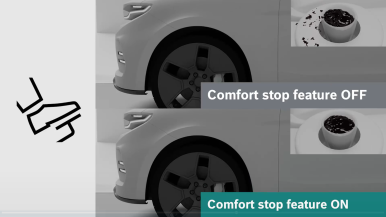
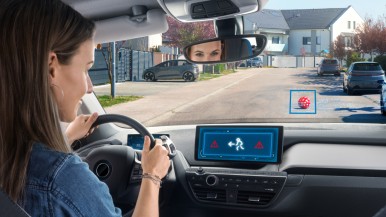
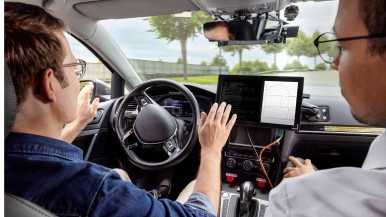
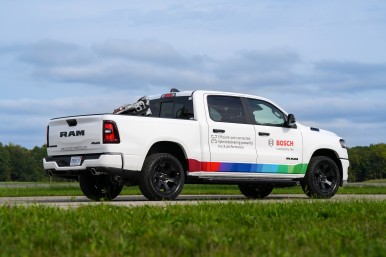
Farmington Hills, Mich. – Nothing ruins a ride faster than a sudden jolt at a stoplight. That jerk forward, the “head-bob” that can make passengers queasy, is a common complaint in everyday commuting. In fact, one-third of Americans report motion-related discomfort as passengers (according to the National Institute of Health); it’s a problem many drivers don’t even realize they’re creating. The new Bosch comfort stop feature aims to address this issue. By using intelligent software to gently manage the last portion before a vehicle comes to a complete standstill, the comfort stop feature delivers braking that feels more like a chauffeured ride than a jerky commute. Resulting in possible decrease in motion sickness and fatigue, and a calmer drive experience. As vehicles become increasingly electrified and automated, this kind of seamless stopping is more than a comfort feature, it unlocks the many opportunities of software-driven mobility. Software at the Wheel End At the heart of the comfort stop feature is intelligent software. By coordinating signals from braking systems, drivetrain controls and vehicle dynamics software, comfort stop feature is designed to precisely manage the final moments at the end of stop. This software-driven approach allows automakers to integrate the comfort stop feature across powertrains, vehicle classes and segments. How It Works The comfort stop feature is supported across Bosch decoupled braking architectures. Drivers maintain steady pressure on the brake, while the system subtly manages the final moments of bringing the vehicle to standstill. The comfort stop feature offers two technical solutions: one using a conventional friction brake system and the other harnessing electric motors in battery-electric vehicles. Benefits of each variant may include: Achieving up to a 70%–90% reduction in end-of-stop jerk compared to conventional braking (numbers are based on a comparison with the deactivated state of the function in the same vehicle and driving maneuver) Increased passenger comfort, especially in stop-and-go traffic A smoother overall experience during commutes and daily driving Passengers Notice a Difference To validate these results, Bosch invited 65 consumers, from backseat passengers to seasoned drivers, to experience the comfort stop feature firsthand. Participants in the user experience study said the smoother braking made stopping noticeably more comfortable, further supporting that the comfort stop feature delivers a better in-car experience as Bosch brings this feature to the U.S. market. “I have severe motion sickness, and this would really help me!” – adult driver “You don’t have to feel the pressure of the seatbelt which gives me confidence.” – adult driver “It’s like landing on a cloud.” – adult driver “Awesome with an exclamation point!” – child passenger Built for the Future of Mobility The comfort stop feature is built on the Bosch Vehicle Motion Management software stack, a next-generation platform that bridges physical components with intelligent motion control systems. This architecture enables automakers to add features such as smoother braking or more responsive steering through software, including over-the-air updates. “The comfort stop feature helps redefine what it means to bring a vehicle to a complete standstill,” said Christian Sperrle, Director of product management for Vehicle Motion, Bosch Mobility Americas. “By smoothing the final phase of braking through advanced software coordination, we’re helping to enhance ride quality, deliver greater comfort, and set a new benchmark for driver and passenger experiences.” In electric vehicles, the comfort stop feature coordinates with regenerative braking to maximize energy recovery while maintaining a comfortable stop. For automated driving, bringing a vehicle smoothly and predictably to a standstill is an important factor in building user trust and acceptance. The comfort stop feature is one part of the larger Bosch Vehicle Motion Management ecosystem. This software-defined approach enables automakers to scale advanced motion control across vehicle classes, from passenger cars to light commercial vehicles and autonomous fleets. For more information on Bosch mobility visit the website here .

Electromobility: Bosch provides access to more than one million charging station ...

29.08.2024

Press release

Business/economy

Electromobility: Bosch provides access to more than one million charging station ...

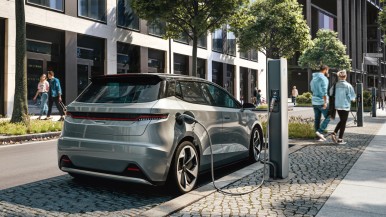
Stuttgart, Germany – Charging their electric car quickly, conveniently, and most importantly, anywhere: for many drivers of electric cars around the world, this is often more of a wish than a reality. Along with range and costs, charging is one of car drivers’ biggest concerns, as a study by the German Association of Energy and Water Industries (BDEW) shows. Bosch wants to remedy this with its proprietary platform, so it is now setting the next milestone for better access to charging infrastructure: offering more than one million charging stations on four continents. This now makes the technology company’s network one of the biggest in the world. “Bosch’s declared aim is to make charging stations widely accessible and put an end to the chaos caused by different charging apps,” says Marco Zehe, president of Bosch’s Electrified Motion division. Users can access Bosch’s charging services with a smartphone app, and Bosch also offers its solutions for charging electric cars to vehicle manufacturers and companies. These services can be flexibly and easily integrated into a manufacturer’s look and feel and infotainment system, both functionally and visually, so that the driving and charging experience retain the manufacturer’s individual look and fit into its brand world. It takes just a few clicks to charge and pay – with full cost transparency. The charging stations currently included can be found across Europe, North America, Asia, and Australia. At present, there are around 800,000 charging stations in Europe alone and another 130,000 in North America; by the end of 2024, there will be some 200,000 across Australia, New Zealand, and Asia – and the number is growing all the time. “By integrating over one million charging stations into one platform, we’re making it much easier for drivers of electric cars to search for and find them – all over the world. In this way, we’re making electromobility more and more suitable for everyday use by the general public,” Zehe says. Inventive charging services are needed: by 2030, Bosch expects one in three newly registered vehicles worldwide to be purely electric; by 2035, it will be one in two. “We anticipate a huge surge in growth for the charging services business over the course of the decade – because as the number of electric vehicles grows, so does the need for straightforward and comprehensive charging solutions. And that’s good for us,” Zehe says. By the end of the decade, Bosch is expecting its charging solutions business to expand by more than 50 percent each year.

Bosch Ventures Amplifies Commitment to Cleantech with Two Battery Recycling Inve ...

15.05.2024

Press release

Sustainability

Bosch Ventures Amplifies Commitment to Cleantech with Two Battery Recycling Inve ...

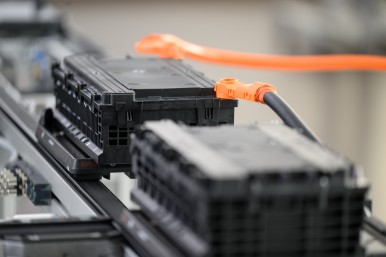
Stuttgart (Germany) / Boston (USA): Bosch Ventures, the corporate venture capital unit of the Bosch Group, announces two significant investments in the battery recycling sector within a week, marking a significant step towards sustainable technology development. "In an electrified world, battery recycling makes a significant contribution to conserving natural resources," explains Dr. Ingo Ramesohl, Managing Director of Bosch Ventures. "With our investments, we can help cylib and Li Industries to scale their production." Bosch Ventures led $36 million investment round in Li Industries On May 9, 2024, Bosch Ventures investment in Li Industries was announced. Li Industries is poised to tackle significant challenges in the Li-ion battery's circular supply chain with innovative, scalable solutions. “Li Industries is the first and only company in the U.S. capable of economically and sustainably recycling low/no cobalt batteries, such as Lithium Iron Phosphate (LFPs), at scale using their unique Direct E2ETM recycling technology,”, said Dr. Ramesohl. Bosch Ventures co-led the $36 million Series B funding round together with Khosla Ventures and LG Tech Ventures. “We are thrilled to be backed by such a strong group of investors,” said Dr. Zheng Li, co-founder and CEO of Li Industries. German cylib raised €55 million round less than 24 months after start of operations Founded in 2022, the company offers market-leading proprietary technology for end-to-end recycling of lithium-ion batteries and has already delivered a successful pilot line and completed projects with major automotive OEMs as well as battery manufacturers. cylib’s process is characterized by an efficient, resource- and climate-friendly recovery of raw materials, including lithium, graphite, nickel, cobalt and manganese from battery packs, black mass or production scraps. Lilian Schwich, CEO of cylib, said: “The funding round we announced today will empower us to embark on our next phase of expansion and deepen existing collaborations, as we grow our next-generation battery recycling at an industrial scale.” Bosch Ventures joined the oversubscribed round on cylib’s way to become Europe’s primary battery recycler. Rapidly growing market with high local interest With the rapid growth of battery-driven electric vehicles, eBikes, powertools and household appliances, the demand for battery recycling is soaring. Similar to the U.S., the EU has already ranked the materials inside EV batteries as strategic critical raw materials and set its latest stringent battery recycling regulations accordingly. cylib’s market-leading process enables battery producers, automotive OEMs and all companies operating in the battery value chain to recycle elements locally and achieve these requirements. "Our investments in cutting-edge battery recycling startups underscore our commitment to pioneering technologies that not only promise substantial market growth but also offer solutions to one of the most pressing environmental challenges of our time," stated Ramesohl. "We are excited to be at the forefront of this vital industry, and we are proud to support and connect multiple companies from different geographies in this space".

Bosch launches RevX to help fleets find the best load every time

21.03.2024

Press release

Business/economy

Bosch launches RevX to help fleets find the best load every time

Louisville, Kentucky – Bosch has announced the launch of RevX , a solution designed to streamline fleets’ search for freight, today at the largest heavy-duty trucking show in North America, the Mid-American Trucking Show . RevX offers a seamless sign-on solution that simplifies logistics by consolidating spot market shipments across multiple sources into a single tool designed to aid dispatchers in finding the load. The new cloud-based service from Bosch aggregates search results across multiple brokers and load boards based on a specific criterion, calculates profits, and effortlessly helps with data driven decision making to eliminate empty miles. RevX is the second Bosch product to launch on the company’s Logistics Operating System (L.OS), which debuted last year in Europe, India and the United States. The L.OS platform aims to simplify technology and operational processes in the transportation and logistics industry. It is open to all providers of logistics solutions to facilitate the smooth interplay of disparate services and data for companies operating in the logistics space. Since its debut, more than 60 solutions have been integrated into the platform globally, including 17 in the U.S. “L.OS connects the logistics-related products, services, and technology offerings of our strategic partners to solve our customers' critical pain points that reduce cost and improve profitability across the logistics ecosystem,” said Luke Hugel, president and regional business responsible for Bosch Mobility Platform & Solutions, North America. “By adding RevX to the L.OS platform, fleets now have access to the fastest way to find and win the best load for them on the spot market, in that moment. Furthermore, with L.OS these loads can seamlessly integrate with the fleet’s transportation management system.” In the future, Bosch plans to offer increased functionality within RevX for topics ranging from search results in a scheduler to forecast driver and equipment capacity for loads up to a week into the future, enhanced load planning and process flows – all from a single source. RevX will use artificial intelligence to turn searches across millions of potential loads into recommendations for the best load and deliver one-click communication to help ensure dispatchers secure the revenue-generating loads swiftly while minimizing manual data entry and errors. Tight freight markets require technology to win The transportation and logistics industry moves the U.S. economy however the carrier freight market has become extremely competitive since the recovery after the Covid 19 pandemic, when online orders and parcel deliveries saw sharp increase. Economic projections indicate by 2030 global goods transport will grow more than 40 percent, and by 2050 this figure is expected to exceed 145 percent. Even with this growth, the majority of transportation companies still organize their daily business manually or with an assortment of disconnected computer programs, so the need for RevX to help generate additional revenue across the L.OS platform is greater than ever. Another RevX advantage is increased driver and equipment utilization. Reducing empty miles traveled has a positive impact on driver pay, fleet profitability, and industry sustainability efforts. According to the US Department of Transportation , up to 35 percent of the truck miles (106 billion) are empty miles. RevX aims to reduce this by over 5% bringing value to fleet owners, freight carriers, shippers and brokers.

For safer roads: Bosch teams up with Microsoft to explore new frontiers with gen ...

28.02.2024

Press release

Artificial Intelligence

For safer roads: Bosch teams up with Microsoft to explore new frontiers with gen ...

Stuttgart, Germany – It’s a scenario that no driver ever wants to see: a ball rolling out into the road. The chances are it will be followed immediately by a child in hot pursuit, oblivious to any traffic. But while human drivers can assess this situation using their contextual knowledge, today’s assisted and automated driving systems still have to learn how to do it. Bosch is pursuing the use of generative AI in terms to further improve automated driving functions. As part of this, Bosch and Microsoft are exploring opportunities to collaborate and leverage the power of generative AI. “Bosch is working on bringing a new dimension of AI applications into the vehicle,” said Dr. Stefan Hartung, chairman of the Bosch board of management, at this year’s Bosch Connected World (BCW) AIoT industry conference in Berlin. The expectation is that generative AI will enable vehicles to assess situations and react accordingly, and in this way keep road users even safer. Greater safety on the roads is also the wish of 60 percent of respondents to this year’s Bosch Tech Compass, a worldwide representative Bosch survey on the subjects of technology and AI. Generative AI to make road traffic safer The two companies anticipate that a collaboration would take the performance of automated driving functions to the next level. They would like to see generative AI help enhance convenience in the vehicle and to provide greater safety for all road users. To achieve this, Bosch's comprehensive understanding of vehicles and automotive-specific AI expertise will be invaluable, as well as their access to vehicle sensor data to feed the generative AI. “In our unwavering commitment to safer roads, Microsoft is eager to explore collaboration opportunities with Bosch to pioneer the realm of generative AI,” said Uli Homann, Microsoft CVP and Distinguished Architect. Even today, when it comes to training systems for automated driving, AI quickly comes up against its limits. Today’s driver assistance systems can detect people, animals, objects, and vehicles, but in the near future generative AI could help determine whether a situation could potentially lead to an accident. Generative AI utilizes vast amounts of data to train systems for automated driving, enabling them to draw improved conclusions from this data. For example, it could deduce whether an object on the road ahead is a plastic bag or a damaged vehicle part. This information can be used either to communicate directly with the driver – such as by displaying a warning – or to initiate appropriate driving maneuvers, such as braking while switching on the hazard warning lights. Bosch and Microsoft have already partnered to develop a universal software platform for seamlessly connecting cars and the cloud, and are looking forward to work together to identify new opportunities to bring cutting-edge AI technology to their customers and the autonomous vehicle industry. Generative AI as a boost to innovation “Generative AI is a boost to innovation. It can transform industry in much the same way as the invention of the computer,” says Tanja Rueckert, member of the Bosch board of management and chief digital officer. The new 2024 Bosch Tech Compass shows this as well: 64 percent of respondents believe that AI is the technology with the greatest importance for the future. In comparison, only 41 percent of respondents were of the same opinion just one year ago. From manufacturing to everyday office work, generative AI is already being used in many areas at Bosch. In addition to Microsoft, the company is working with several partners, including AWS, Google, and Aleph Alpha. The Bosch Group’s venture capital unit, Bosch Ventures, invested in the AI company Aleph Alpha last year. Bosch also announced it would collaborate with the startup on finding new use cases both for Bosch associates and customers. “Bosch and Aleph Alpha want to learn from each other, benefit from each other’s know-how, and work together on cross-domain use cases,” Rueckert says. This partnership is now bearing its first fruits in North America: in collaboration with Aleph Alpha, Bosch is debuting AI-based speech recognition on behalf of a premium car manufacturer. In this solution, a chatbot understands and answers breakdown service calls with the help of natural language processing, which also recognizes dialects, accents, and moods. The call is taken directly, reducing the driver’s waiting time to a minimum. As many as 40 percent of calls can be processed and resolved automatically; for more complex queries, the bot transmits all relevant information to a service center agent who takes over the case immediately. From the AI search engine to manufacturing AI experts at Bosch are currently working on well over 120 specific applications that these new AI models open up for the company’s associates and customers. Such applications include the generation of software program code or powerful chatbots and voicebots to support technicians or interact with consumers. Another is AskBosch, the in-house AI-assisted search engine launched at the end of 2023. It offers faster natural-language access to a wide variety of data sources – sources scattered over the intranet, say. In addition to externally available data, AskBosch also includes internal data sources, so Bosch associates can research information specific to the company. Generative AI also ensures greater speed in manufacturing: in initial projects in two Bosch plants in Germany, generative AI creates synthetic images in order to develop and scale AI solutions for optical inspection and optimize existing AI models. Bosch expects that this will reduce the time needed for planning, launching, and ramping up AI applications from the current six-to-twelve months to just a few weeks. Following successful piloting, this service for generating synthetic data is to be offered to all Bosch locations. 2024 Bosch Tech Compass: setting the pace in the use of AI As AI is used in more and more areas of life, professional development is becoming increasingly important: 58 percent of respondents to the Bosch Tech Compass are convinced of this. This opinion is particularly prevalent in USA at 63 percent (Germany: 54 percent, China: 52 percent). Here, too, Bosch is setting the pace in the use of artificial intelligence and is getting its associates on board. In 2019, Bosch launched a training program, initially aimed at bringing 30,000 associates up to speed on the subject of AI. Up to now, some 28,000 associates have taken part in the program. Like the Bosch AI code of ethics, which sets ethical guidelines for dealing with artificial intelligence, this program has been supplemented with content about generative AI. For all the results of the 2024 Bosch Tech Compass, click here . About the survey: For the representative survey, people aged 18 and over in seven countries (Brazil, China, Germany, France, India, the U.K., and the U.S.) were polled online on behalf of Robert Bosch GmbH by the market researchers Gesellschaft für Innovative Marktforschung mbH (GIM) in December 2023. In Germany, France, and the U.K., at least 1,000 people were polled per country; in Brazil, China, India, and the U.S., it was at least 2,000 people each. The random samples are representative of their respective countries in terms of region, gender, and age (Brazil, Germany, France, U.K., U.S.: 18 to 69 years / China, India: 18 to 59 years).

Bosch Ventures invests in Point2 to revolutionize multi-terabit interconnect for ...

15.02.2024

Press release

Mobility Solutions

Bosch Ventures invests in Point2 to revolutionize multi-terabit interconnect for ...

Stuttgart, Germany – Bosch Ventures, the corporate venture capital unit of the Bosch Group, participates in the $22 million Series B extension from Point2. This round positions Point2 as a potential disruptor for network interconnect in the automotive market. Shattering the “copper or optics” paradigm for high-speed cable interconnect, E-Tube breaks the barriers of copper and optical cabling and is poised to become the next-generation multi-terabit interconnect technology for datacenter applications and the automotive sector. The new E-Tube platform uses RF data transmission via a plastic dielectric waveguide to enable multi-terabit active cables. According to Point2, this results in 80% lower weight, 50% less bulk compared with copper cables, and 50% lower power consumption and costs compared with optical cables. This profile gives the E-Tube platform the potential to replace both. A potential disruption for the automotive connectivity market Advanced driver assistance systems (ADAS) in automotive are adopting a network-centric architecture to connect hundreds of sensors, driving the need for low-power, low-latency, lightweight, and flexible interconnect for future automotive applications. "We are thrilled to have support from Bosch Ventures and Molex as we advance our mission to revolutionize interconnect technology in AI/ML data centers and next-generation automotive applications," said Sean Park, Point2's founder and CEO. "Our investment from Bosch Ventures underlines the importance and high potential of Point2’s low-power, low-latency, scalable interconnect technologies in the expansive automotive sector, and further amplifying our impact connecting AI workloads for the growing data center market.” “Moving forward, interconnect provides critical infrastructure for high-performance and energy-efficient data centers and networked automotive applications," said Ingo Ramesohl, Managing Director of Bosch Ventures. "Point2’s unique interconnect SoC solutions deliver the high-bandwidth interconnect required in the data center and automotive sector while reducing energy consumption and minimizing carbon footprint. The company and its technologies have a high potential to become a disruptor in network interconnect in both markets.” Strong partnerships Besides Bosch Ventures, strategic investor Molex is also joining the round, and plans to support the future commercialization of the E-Tube technology. Existing investors are participating and make up the rest of the oversubscribed round. The boost in funding comes at a time when the use of AI in data centers is skyrocketing. Generative AI and large language models are increasing the demand for computing resources and network interconnect capacity in next-generation hyperscale data centers, where the integration of Point2 interconnect chips is set to revolutionize connectivity. In the past, Point2 has already gained recognition for its ultra-low-power, low-latency, cloud-optimized mixed-signal SoCs, which are purpose-built for active electrical cables (AECs). AECs built with Point2’s Cloud Connect Engines require significantly less power and space than other AEC solutions.

IAA Mobility 2023: Bosch is growing with solutions and technology for the softwa ...

06.09.2023

Press release

Business/economy

IAA Mobility 2023: Bosch is growing with solutions and technology for the softwa ...

Stuttgart and Munich, Germany – Software is the linchpin for the future of mobility. No other company can match the solutions and technology Bosch offers for the software-defined vehicle across all domains – from central vehicle computers to cloud solutions to semiconductors. Here, Bosch benefits from its strength not only in automotive software but also in the hardware required for it, and is already posting robust growth in vehicle computers. The company expects sales of $3.2 billion in 2026 from computers for driver assistance and infotainment alone. Overall, business developments for Bosch are positive, even though the environment remains volatile and challenging.In the Mobility business sector, sales are expected to grow by a solid 10 percent in 2023, after adjusting for exchange-rate effects. This growth includes price effects, but also marked volume increases. “Bosch knows its way around software and is using it to shape the future of mobility. Our technology will make the software-defined vehicle a reality and help get it onto the road,” said Dr. Stefan Hartung, chairman of the Bosch board of management, at IAA Mobility 2023 in Munich. “In the software-defined future of mobility, it’s not only hardware that will be vital, but the interaction of software from various sources as well,” Hartung continued. More than ever, Bosch is also positioning itself as a software company for mobility, while at the same time further developing its hardware expertise. As part of this effort, the company is reorganizing its Mobility business sector effective January 1, 2024. This will strengthen cross-divisional collaboration. Bosch employs 38,000 software developers in its mobility operations alone – more than any other company in the automotive industry.Bosch software makes mobility safer and more sustainable Software-defined vehicles call for a new, centralized IT and electronic architecture. Bosch is one of the few companies that is developing this architecture – and that knows how to control the interaction between automotive electronics and the cloud. The company offers hardware-agnostic software that runs on chips made by different manufacturers. One result of this is special middleware for driver assistance and automated driving systems, which also helps decouple software and hardware. Vehicles in which software is the starting point of design and development can give drivers a personalized, digital driving experience. New functions in areas such as driver assistance can be added to the car over the air via software updates. “We’ve gotten used to constant updates on our smart devices. Cars, too, should be able to receive new functions at any time, regardless of any facelifts or model changes. With Bosch solutions for automotive software, cars will be capable of more,” said Dr. Markus Heyn, member of the board of management and chairman of the Mobility business sector. “That’s because software is the key to further enhancing convenience and sustainability,” he continued. In electric cars, for example, software facilitates connected energy and thermal management, thus reducing battery charging time by up to 20 percent. The electromobility business is developing well for Bosch. The company is on track to achieve sales of $6.3 billion in 2026. Even last year, Bosch was able to increase its output of components for electric cars by some 50 percent. In 2023, production of electric motors alone will double. Bosch software plays a key role in the wider electromobility industry as well; for example, in automated battery recycling systems. Not only is software able to identify the origin and condition of batteries, but by guiding users through process steps, it also enables quick and safe disassembly of battery packs.New control concept independent of any hardware Although hardware and software engineering are becoming separated, they are also mutually beneficial. This is particularly evident in modern accident protection systems such as the new ESP generation. The key innovation here is a new control concept: Vehicle Dynamics Control 2.0. This software can intervene not only in the braking system, but also in the electric powertrain and electric steering system. This means less countersteering and shorter braking distances, and thus greater safety for drivers. The major benefit for automakers is that the new control system can be integrated into either a central vehicle computer or the ESP control unit, and will be available in the future as a discrete software package. It will be part of vehicle motion management, a software solution that coordinates all aspects of vehicle motion by centrally controlling the brakes, steering, powertrain, and chassis.Bosch industrial technology along the entire value chain However, it is not only driving that Bosch software will change, but also the way vehicles are manufactured. For example, the company secures automotive supply chains with the help of a track and trace solution. By recording the position and condition of transport crates in real time, this solution provides for transparent and secure tracking. The industry 4.0 software Nexeed helps significantly reduce scrap rates in battery-cell factories from their current level of 10 to 15 percent. In addition, Bosch can use artificial intelligence (AI) to detect anomalies and errors in automotive production at an early stage, thereby reducing manufacturing costs. Bosch is already using such AI software at 50 of its own plants. At the company’s location in Bursa, Turkey, the software has already helped reduce manufacturing costs significantly.BOSCH PRESS CONFERENCE: Monday, September 4, 2023, 11:20–11:40 CEST: with Dr. Stefan Hartung, chairman of the board of management of Robert Bosch GmbH , and Dr. Markus Heyn, member of the Bosch board of management and chairman of Bosch Mobility , at the Bosch booth D10 in Hall B3 and via livestream on the Bosch Media Service. Panels with Bosch experts at the IAA Conference: Wednesday, September 6, 10:00–10:15 CEST on the Main Stage: Keynote: “Life in motion – Why sustainable mobility is about more than just technology,” with Dr. Stefan Hartung, chairman of the board of management of Robert Bosch GmbH. Thursday, September 7, 11:15–11:30 CEST on the Main Stage: Keynote: “Paving the way to centralized architectures & software-defined vehicles,” with Dr. Mathias Pillin, Bosch Mobility CTO. Thursday, September 7, 15:00–15:45 CEST on the Yellow Stage: Session on data & next-level user experience: “Software-defined mobility enabling a completely new vehicle motion experience” with Mariella Minutolo, member of the board of management, ETAS GmbH, and Stephan Stass, member of the divisional board of management, Chassis Systems Control, Robert Bosch GmbH. Bosch at the IAA Experience: The IAA Experience at the IAA Open Space in downtown Munich will be open from September 5 to 9, 2023, from 10:00 to 20:00 CEST . On Sunday, September 10, 2023, the IAA Experience is open until 17:00 CEST . During the IAA, the new Performance Line SX and other products from Bosch eBike Systems can be taken for a test ride on the cycling test track in Munich’s Englischer Garten park. In addition, Bosch e-bike product experts will be on hand to answer questions in the Open Space at Odeonsplatz. moveID, a project led by Bosch within the “Gaia-X 4 Future Mobility” project family, will be holding a live demo with two electric vehicles. moveID will give its first insight into the MOBIX app, which allows users to park and charge anonymously at any location in compliance with the general data protection regulation. It will also showcase novel mobility services and business opportunities created by the use of decentralized technologies. FOLLOW the Bosch IAA 2023 highlights at www.bosch-iaa.com and on Twitter: @BoschPress, #BoschIAA

Bosch highlights essential role of software in its products at Software Day 2023

08.06.2023

Press release

Business/economy

Bosch highlights essential role of software in its products at Software Day 2023

Plymouth, Mich. – Across its broad portfolio of solutions, software lives at the core of Bosch solutions that deliver on the company’s “Invented for Life” brand promise. At Software Day 2023, Bosch in North America is highlighting its history, expertise and future potential of software and the essential role of software across the company’s four sectors: mobility, industrial technology, consumer goods and energy and building technology. The company is announcing plans for growth in its Bosch Mobility business sector, fueled by software. It will demonstrate how decades of experience in vehicle motion have been applied to a new software-only solution as well as how software is utilized in interior sensing to detect driver distraction and drowsiness behaviors as well as children left behind in a vehicle. Bosch is also announcing a new intelligent transportation systems deployment in the M1 Intelligent Corridor in Detroit that is powered by Bosch AI technology. By enabling smart infrastructure with intelligent AI-powered video sensors and cloud-based data services Bosch helps to improve safety and efficiency of roads. “Our associates are utilizing software to deliver product experiences that delight our customers across the region and throughout the world,” said Mike Mansuetti, president of Bosch in North America. “We have a strong legacy of software expertise to build from to continue pushing the possibilities utilizing software.”Intelligent Traffic Systems in new M-1 Intelligent Corridor The role of software in the company’s cross-domain expertise is seen in the use of video cameras for Intelligent Traffic Systems. The company announced at Software Day its role in the M1 Intelligent Corridor, an $11.5 million project with $5 million in federal funding from the U.S. Department of Transportation. Bosch is collaborating with the Michigan Department of Transportation (MDOT), the Federal Highway Administration (FHWA), the City of Detroit, WSP Michigan Inc., MH Corbin, Derq USA and Wayne State University. The project will deploy and evaluate an intelligent transportation network along the M-1 (Woodward Avenue) transportation corridor to serve the citizens of Detroit and surrounding communities. The Bosch contribution includes both hardware and software-as-a-service. Software powers edge computing and data analytics to help optimize transportation systems. The deployment will feature pedestrian detection, prioritization and alerts; traffic intersection preemption and signal priority for authorized vehicles; and vehicle-to-vehicle and vehicle-to-infrastructure communications. “Ultimately Bosch hardware and software solutions work together to solve the challenge of inefficient road traffic,” Mansuetti said. “Our intelligent cameras with on-board AI and edge computing enable real-time alerts and data to help improve safety and efficiency.”Software-defined vehicle growth enabled by 40+ years of software expertise By 2029, Bosch Mobility in the Americas aims to contribute around $20 billion annually to the global revenue of Bosch Mobility. This would represent an increase from approximately one fifth of global Bosch Mobility revenue in 2022 to approximately one quarter of global Bosch Mobility revenue by 2029. A major driver of that growth will be the company’s software expertise as the industry doubles down on the software-defined vehicle. Bosch has a long history in mobility software – more than four decades – and the company is comfortable in various business models for software based on customer needs. As software and hardware de-coupling increases, Bosch has strong experience already supporting customers in software-defined vehicle solutions. Bosch Mobility has recently booked significant business in the Americas with lifetime revenues amounting to several billion dollars spanning hardware plus software as well as software-only solutions. Beginning in 2023, the Americas region will already realize revenue in the billions annually from hardware plus software projects including driver assistance, vehicle architecture, powertrain and vehicle motion. “Our expertise in software means we can provide customers a variety of solutions,” said Paul Thomas, who will assume the role of president, Americas for Bosch Mobility beginning January 2024. “It’s essential to be comfortable in different software business models and approaches to capture the benefits of the software-defined vehicle that ultimately bring benefit to drivers on the road.” Software is evident across the Bosch Mobility portfolio. Already more than half of its R&D associates globally for the mobility business are software engineers and the company produces more than 250 million control units globally every year, all configured with its proprietary software. At Software Day, Bosch is showcasing software solutions ranging from vehicle motion and battery management to monitoring inside the vehicle for driver drowsiness, children left behind or if someone smoked in a rental vehicle.Software Day Highlights Vehicle motion management shows how the reorganization of Bosch Mobility and intensified cross-divisional collaboration is conducive to software-defined vehicle approaches in engineering. For 45 years, Bosch has been developing solutions for vehicle motion beginning with the introduction of anti-lock braking in 1978 and electronic stability control, also known as ESP®, in 1995. Bosch has continued to introduce motion software features and functions that are available in advanced braking, steering and powertrain solutions. Now the company is launching Vehicle Dynamics Control 2.0 , which incorporates all the company’s hardware and software knowledge to seamlessly enable multi-actuator motion control. This helps to potentially shorten braking distances and can help the driver to take fewer corrective actions regarding controlling the vehicle. The Vehicle Dynamics Control can be deployed as a software-only solution independent of any Bosch hardware and can be integrated for example in a central vehicle computer. In the United States, the software is applicable for market-specific developments like trucks and electrification. Software is a tool to help consumers get to know their batteries better. Range anxiety is a major barrier to mass EV adoption and the Bosch software-as-a-service solution Battery in the Cloud helps to address this challenge by forming a digital twin of the battery and collecting data periodically from the vehicle. Information from Battery in the Cloud can help to enable increased battery life or charging speed based on individual driving profiles, projections on aging of a battery three to eight years in the future and even provide a usage certificate regarding the battery health to support residual value of the vehicle or second life use of the battery. Bosch interior sensing solutions help to enhance safety, comfort, and convenience for all vehicle occupants. The system leverages different hardware approaches as interior cabin-sensing radar is combined with an occupant monitoring camera. Software brings the system together through sensor fusion merging multiple types of sensing data. Software algorithms are capable of aiding in the detection of specific scenarios in the vehicle including driver drowsiness and driver impairment based on eye behavior. Additionally, the system utilizes new methods for detecting if a child has been left behind in a vehicle. Interior sensing solutions from Bosch help to fulfill requirements defined in regulations and consumer testing programs like the European New Car Assessment Program. For the company’s RideCare Insight solution, software engineers have worked to help rental company operators and fleet owners know when someone has smoked in the vehicle or damaged the vehicle during a rental. This data combined with vehicle data allows a rental return agent a complete picture of the vehicle condition from the start to the end of the rental. The solution combines Bosch expertise in sensors as the Bosch BMI270 IMU (Accelerometer/Gyroscope) sensor – which can be found in smartphone and smart watches – helps to detect crashes while a combination of sensors allows for smoking detection. A smoking detection algorithm helps to detect a likely smoking event – cigarette, vaping or similar product – inside a vehicle event even if it is as short as 30 seconds. “Software is the lifeblood of our solutions,” Thomas said. “Software enhances our hardware and also powers new software-as-a-service offerings that diversify our portfolio of offerings to help us achieve our goals in the Americas.”Sales in North America increase as organization invests for growth Bosch ended its 2022 fiscal year with $15.1 billion (14.3 euros) in sales to third parties, an increase of nearly 12 percent year-over-year. The region achieved total net sales of more than $16 billion USD when accounting for internal sales. The Mobility Solutions business sector increased sales by more than 12 percent to nearly $9 billion USD in the North American region. Energy and Building Technology as well as Industrial Technology business sectors both posted double digit growth in the region. Energy and Building Technology increased by around 30 percent to more than $1.3 billion while Industrial Technology increased around 20 percent to more than $1.2 billion. After two straight years of double-digit growth in 2020 and 2021, the Consumer Goods business sector once again achieved sales of $3.5 billion USD in 2022, which equaled 2021. To build on its success in the North American region, Bosch is investing for growth. In April 2023, the company announced plans to acquire U.S. chipmaker TSI Semiconductors in Roseville, California. The company intends to invest more than $1.5 billion USD in the site for upgrades to produce silicon carbide chips for electromobility. “The North American market – and in particular the United States – holds strong promise for growth at Bosch as part of a diverse global portfolio,” Mansuetti said. “We are focused on identifying and delivering products and services that meet the regional needs of our customers across all areas of our business.”

Bosch and AWS enter into collaboration to digitalize logistics

14.04.2022

Press release

Business/economy

Bosch and AWS enter into collaboration to digitalize logistics

Stuttgart, Germany – Bosch and U.S.-based cloud provider Amazon Web Services (AWS) aim to improve efficiency and sustainability in the transportation and logistics industry. Their plan is to offer logistics and transportation companies across the globe quick and easy access to digital services through a platform powered by AWS. Going forward, they will offer support for topics ranging from capacity utilization of commercial vehicle fleets to monitoring goods flows to order processing – all from a single source. To this end, Bosch and AWS have now entered a strategic collaboration. Bosch will be responsible for developing and operating the logistics platform, the core of which is a marketplace for digital services, while AWS will contribute its comprehensive cloud offering and expertise. The platform will facilitate smooth interaction between a variety of services and data, enabling transportation and logistics companies to benefit much more from the opportunities of digitalization without having to set up their own resource- and cost-intensive IT projects. The marketplace will also be open to all digital logistics services providers. Industry and consumers will benefit from the initiative because of greater reliability and transparency in goods and parcel delivery, for example. The companies plan to present a preliminary version of the logistics platform at Hannover Messe, with the launch for Europe, India, and the U.S. set for late 2022.Greater efficiency through increased digitalization “The transportation and logistics industry is the backbone of the global economy. In the years ahead, it will have to shoulder continuously increasing transport volumes for goods and commodities while simultaneously reducing its carbon footprint. In collaboration with AWS, we want to help the logistics industry with this. We aim to ring in the future of the industry and drive forward its digitalization,” says Sandeep Nelamangala, executive director, Bosch Limited, and executive sponsor of logistics platform business at Bosch. “Developing hyperconnected transportation functions is one of the most complex technical challenges of our time. That’s why we are working with a market pioneer such as Bosch to master these unique challenges,” said Kathrin Renz, Vice President, Business Development and Industries, AWS. “The digital marketplace will enable logistics customers to quickly transform their business into a fully digital end-to-end value chain. Customers will benefit from the tools, frameworks, and modules we offer for digitalization, in addition to improving the sustainability of their transportation processes.”Years-long boom – and no end in sight The transportation and logistics industry has been booming for years. During the Covid 19 pandemic, online orders and parcel deliveries saw another sharp increase, giving the industry a further boost. By 2030, global goods transport will grow more than 40 percent, and by 2050 this figure is even expected to exceed 145 percent. This growth is hitting a market that is highly fragmented globally – as well as struggling with various areas of inefficiency. A few facts will illustrate this: More than 95 percent of the companies operating in this industry worldwide are SMEs. Approximately nine out of ten companies operate with fewer than five vehicles. The majority of transportation companies still organize their daily business manually or with an assortment of unrelated computer programs. According to the US Department of Transportation, the U.S. transportation industry is currently experiencing a shortage of over 80,000 drivers and the gap continues to grow as demand for drivers continues to outpace supply. Additionally, up to 35 percent of the truck miles (106 billion) are empty miles. This weighs heavily not only on efforts to protect the climate, but also on the already problematic shortage of drivers. Empty miles reduce pay opportunities for drivers and revenue generation for transportation companies. A long-haul truck driver can average anywhere from 80,000 - 120,000 miles per year. A 50 percent reduction in empty miles would create 53,000 additional drivers annually.Many challenges – one solution With its logistics platform, Bosch aims to provide a key solution for many of the challenges facing the transportation and logistics industry. The advantage of this platform is that it will create an entire ecosystem and a software environment in which freight carriers and transportation companies can select, book, and execute different providers’ services to meet their specific needs. The platform also allows for easy integration of applications that are already relevant to the market, for instance, in transportation management systems. Thanks to shared usage of data that is available through the telematics systems in commercial vehicles, for example from fleet management, it is also possible to link and allow interplay between different services from different areas. This makes it easier to leverage synergies.

Bosch and Mercedes-Benz showcase automated valet parking at InterContinental Los ...

21.03.2022

Press release

Automated mobility

Bosch and Mercedes-Benz showcase automated valet parking at InterContinental Los ...

LOS ANGELES – Drive a fully-electric, luxury vehicle up to the hotel at an iconic skyscraper in Los Angeles and simply let the vehicle park itself. This scenario will become a reality in a demonstration of automated valet parking at the InterContinental Los Angeles Downtown featuring the EQS sedan from Mercedes-EQ. It is the first demonstration of infrastructure-based automated valet parking in a hotel setting in the United States. Automated valet parking technology from Bosch and Mercedes-Benz is at the core of the demonstration in Los Angeles. It features INTELLIGENT PARK PILOT in the Mercedes-Benz EQS and integration with the smartphone app as part of a holistic demonstration of the future vehicle experience for consumers. The demonstration is operated in conjunction with InterContinental Los Angeles Downtown, an 889-room property located in the tallest building west of Chicago. “The demonstration at the InterContinental Los Angeles Downtown will showcase how automated valet parking will operate in a working hotel environment where both automated and non-automated vehicles operate alongside pedestrian traffic,” said Dr. Kay Stepper, senior vice president of automated driving and driver assistance for Bosch in North America. “This allows us to dive into the dynamics of local deployments with the use of a highly-connected EQS from Mercedes-EQ to demonstrate how automated technology continues to move forward.” “Our vision is that getting time back is a key component of the luxury experience our customers are looking for. The EQS gives you time back by driving itself in traffic jams on highways, but with INTELLIGENT PARK PILOT, it may also be able park itself,” says Dr. Philipp Skogstad, president & CEO of Mercedes-Benz Research & Development North America. He adds: “INTELLIGENT PARK PILOT is a feature that together with the required infrastructure enables an automated valet service that gives customers even more comfort and relief in everyday life.”Mercedes showcases INTELLIGENT PARK PILOT The demonstration features the EQS, showcasing automated valet parking using its existing hardware that is already preinstalled in vehicles such as the S-Class and EQS in Germany/Europe with the required optional equipment. The vehicle interacts with the Bosch intelligent infrastructure installed in the parking garage in order to enable the vehicle to drive and park itself at the InterContinental Los Angeles Downtown. Sensors installed at the building will communicate with the vehicle and guide its maneuvering through the garage. The demonstration also highlights possibilities for additional services such as automated EV charging and a car wash where vehicles move in and out of service areas guided by the intelligent infrastructure. In conjunction with the necessary optional equipment* and the corresponding Connect service (both depending on country), the EQS has the onboard technology to enter and leave multi-story parking facilities equipped with the Bosch automated valet parking infrastructure in highly automated mode and without a driver, provided that the corresponding Connect service is available and booked for the respective vehicle variant of the EQS and national legislation permits such operation.Demonstration to utilize smartphone app as part of the holistic vehicle experience The vision: The driver securely parks the vehicle in a designated drop-off area of the parking facility, and after all passengers have exited they start the parking procedure using the smartphone app. The sensor system in the car park checks whether a suitable space is available or was already reserved for the vehicle. If so, the automated valet parking infrastructure confirms the handover of the vehicle for the driver in the App, and he/she can leave the EQS and depart. The vehicle is then started automatically and moves driverless to its parking space with the help of the infrastructure installed in the parking facility. On returning, the driver can let the EQS drive to a designated pick-up area by smartphone command. This means less time searching for parking spots and walking from the parking garage to their destination.A step on the path to fully automated driving Automated parking technology showcases the benefits of automation to drivers by providing value to drivers by easing the burden of the parking experience. “Low-speed maneuvers are part of the holistic opportunity for automated technology,” Stepper said. “Automated technology in the specific use case automated valet parking gets consumers comfortable with how automated technology works and how it can benefit them.” Bosch engineering teams have been working over the past few years to further develop automated valet parking and support specific testing and deployments around the world.Drivers and garage operators both benefit Automated valet parking presents benefits on both sides of the parking experience. For consumers, they will no longer have to search for a parking space and can save time once they arrive to their destination. For parking garage operators, they can increase parking capacity as vehicles no longer need to have room to open doors on all sides as all occupants have already exited the vehicle. Furthermore, operators can offer services such as charging, washing or maintenance.