

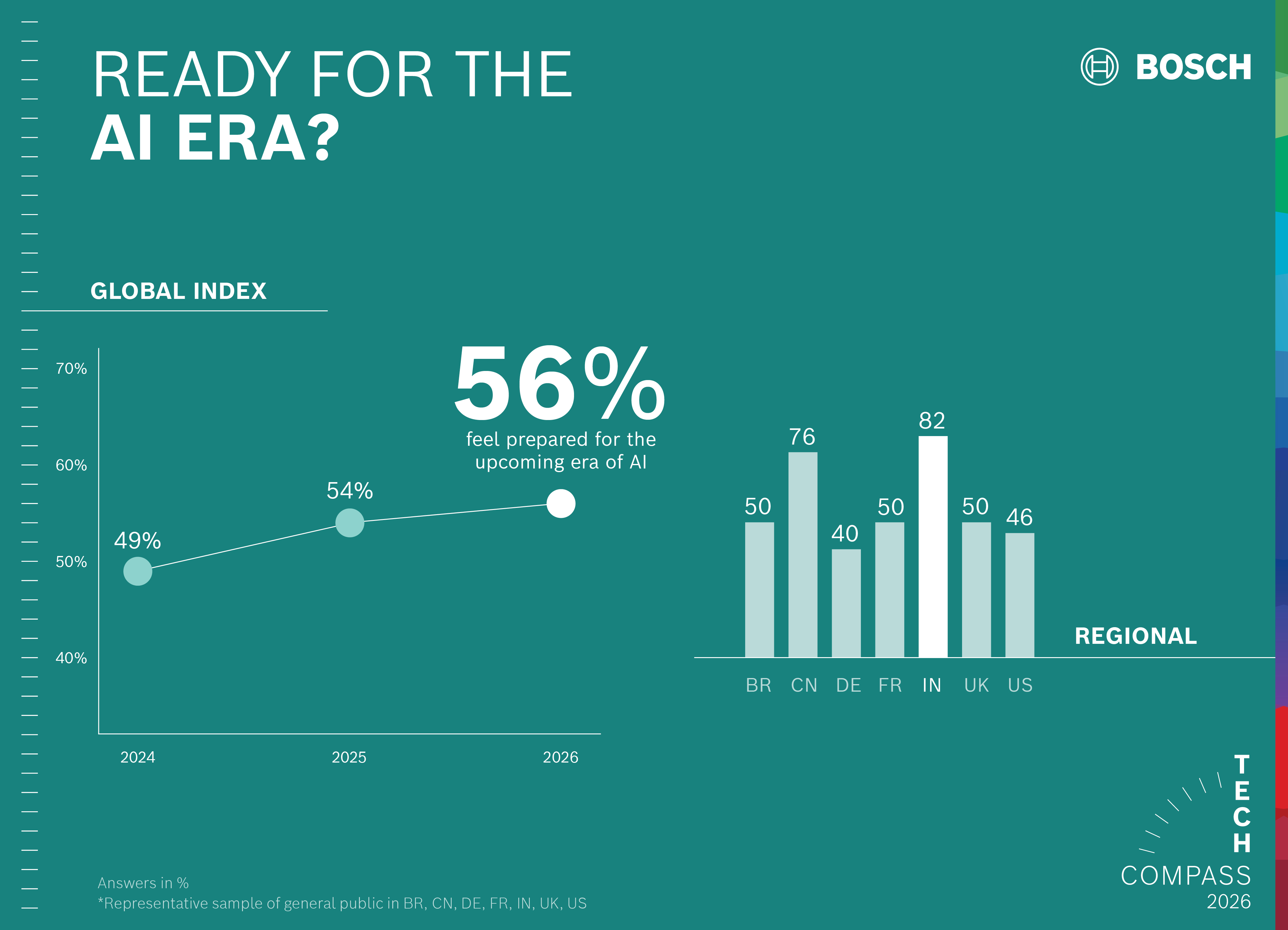
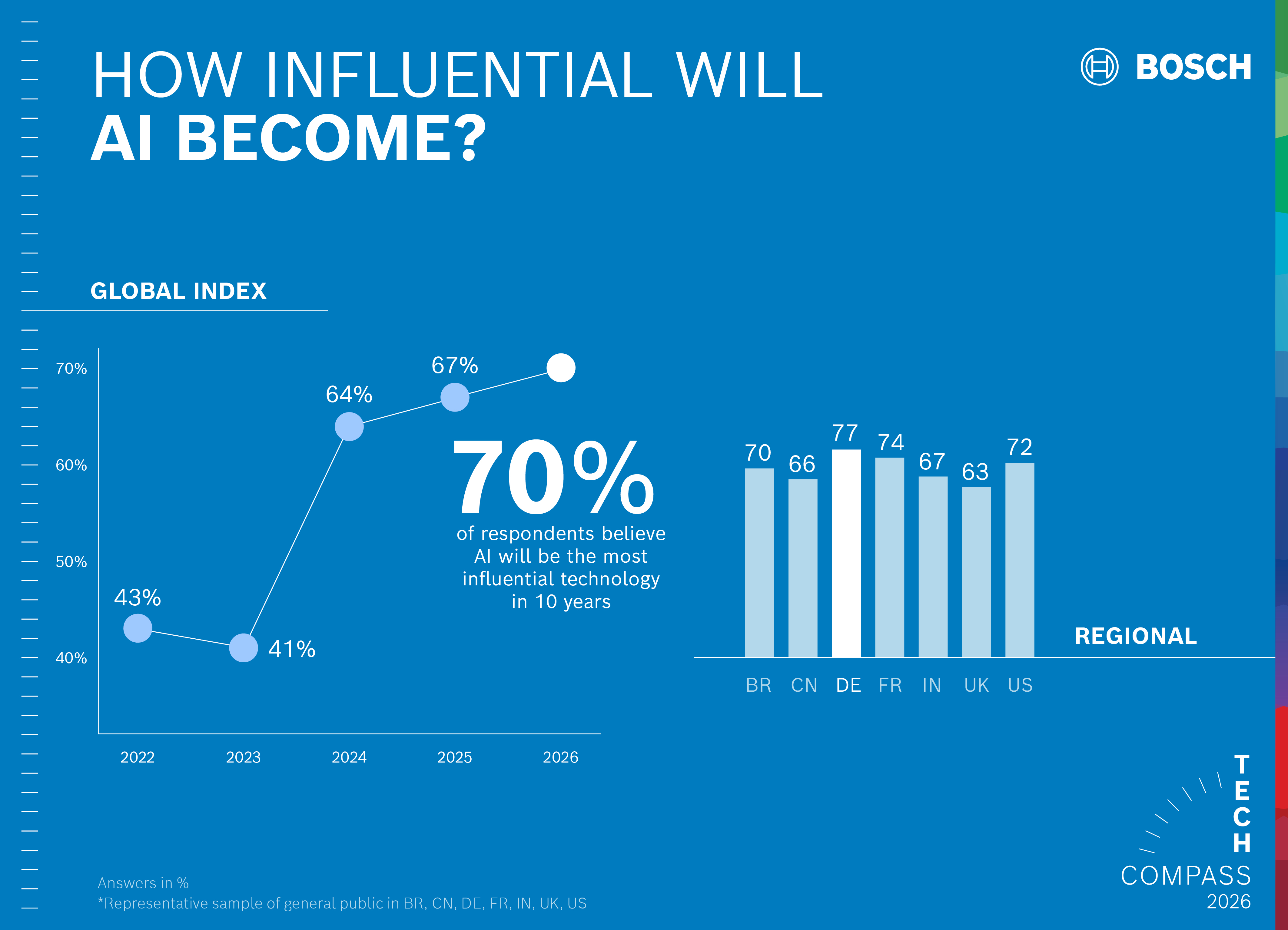
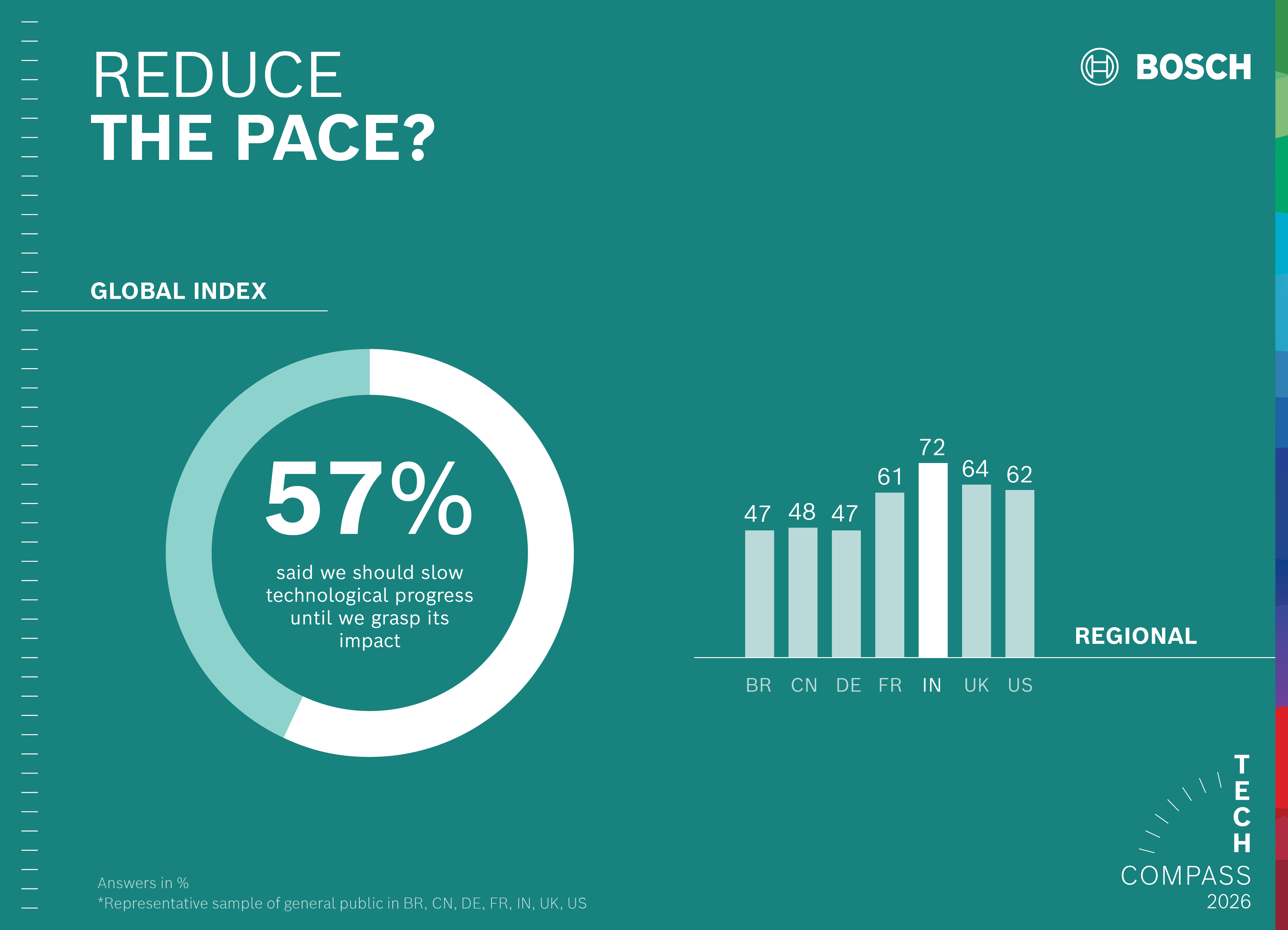
Stuttgart, Germany – The world is ready for the age of artificial intelligence (AI). This is the broad consensus among the more than 11,000 people surveyed worldwide for this year’s Bosch Tech Compass. Never before have respondents seen AI in such a positive light as in this year’s survey: a majority believe that AI will be the most influential technology in the coming years and, out of all technologies, will have the greatest positive impact on society. More than half of all respondents worldwide feel ready for the changes brought about by AI. Yet there are also signs of a certain amount of “progress fatigue”: 57 percent want a pause button and would like to slow down technological development until we can better understand its effects.
Contact person for press inquiries:
Matthias Jekosch
Phone: +49 711 811 17645
E-mail: matthias.jekosch@de.bosch.com
Bosch at CES 2026:
- PRESS CONFERENCE: Monday, Jan. 5, from 9:00 to 9:45 a.m. PST (from 18:00 to 18:45 p.m. CET) with Dr. Tanja Rückert, member of the board of management of Robert Bosch GmbH, and Paul Thomas, president of Bosch in North America, in Ballroom Banyan ABCD, Mandalay Bay Hotel, Las Vegas, South Convention Center, Level 3, as well as livestreamed on the Bosch Media Service.
- BOOTH: Jan. 6 – 9, in the Central Hall, booth #16203.
- PANELS WITH BOSCH EXPERTS:
- Jan. 6
Personalized by Software & AI: Reimagining the In-Vehicle Experience
11:20 a.m. PST, West Hall Mobility Stage, session with Christopher Prediger, vice president, Compute Performance, Cross-Domain Computing Solutions, Bosch. - Advancing Human Security and Smart Mobility in Connected Communities
4 p.m. PST, Las Vegas Convention Center North / N261, session with Oliver Steinbis, managing director at Bosch Secure Authentication GmbH.
- Jan. 6
- Jan. 7
- Personalized Performance: Software-Defined Power, Steering and Braking
9:40 a.m. PST, West Hall Mobility Stage, session with Philipp Ibele, executive vice president, engineering and board member, Electrified Motion, Bosch, and Rich Nesbitt, vice president for product management, Vehicle Motion, Bosch. - The Latest in Smart Devices and Smart Home Integration
11 a.m. PST, Las Vegas Convention Center West / N218, session with Darcy Clarkson, CEO BSH in North America. - From Data to Experience: Al at the Core of Next Gen Mobility
4:30 p.m. PST, AI Foundry Stage at Fontainebleau Las Vegas, session with Mariela Minutolo, executive vice president, sales & marketing, and board member, ETAS, and Christian Koepp, senior vice president, Compute Performance, Cross-Domain Computing Solutions, Bosch.
- Personalized Performance: Software-Defined Power, Steering and Braking
- Jan. 8
- From Hands Off to Eyes Off: The Race to Level 4 Automation
9 a.m. PST, Las Vegas Convention Center West / W219, session with Fedra Ribeiro, executive vice president, sales, and board member, Cross-Domain Computing Solutions, Bosch. - Collaborating for Software-Driven Mobility
Jan. 8, 9:40 a.m. PST, West Hall Mobility Stage, session with Eric Cesa, vice president, ETAS Americas.
- From Hands Off to Eyes Off: The Race to Level 4 Automation
Contact persons for press inquiries:
Bosch at CES: Irina Ananyeva, +49 152 597-53284, Megan Bonelli, +1 947 281-7062, Tim Wieland, +1 248 410-0288
Mobility, software: Athanassios Kaliudis, +49 152 086-51292
Artificial intelligence: Matthias Jekosch, +49 711 811-17645
Connected manufacturing: Manuela Kaiser, +49 711 811-44203
Further links
About Bosch
The Bosch Group is a leading global supplier of technology and services. It employs roughly 413,000 associates worldwide (as of December 31, 2025). The company generated sales of 91 billion euros in 2025. Its operations are divided into four business sectors: Mobility, Industrial Technology, Consumer Goods, and Energy and Building Technology. With its business activities, the company aims to use technology to help shape universal trends such as automation, digitalization, electrification, and artificial intelligence. In this context, Bosch’s broad diversification across regions and industries strengthens its innovativeness and robustness. Bosch uses its proven expertise in hardware, software, and services to offer customers cross-domain solutions from a single source. It also applies its expertise in connectivity and artificial intelligence in order to develop and manufacture intelligent and user-friendly products. With technology that is “Invented for life,” Bosch wants to help improve quality of life. The Bosch Group comprises Robert Bosch GmbH and its roughly 500 subsidiary and regional companies in over 60 countries. Including sales and service partners, Bosch’s global manufacturing, engineering, and sales network covers nearly every country in the world. Bosch’s innovative strength is key to the company’s further development. Bosch employs some 82,000 associates in research and development.
The company was set up in Stuttgart in 1886 by Robert Bosch (1861-1942) as “Workshop for Precision Mechanics and Electrical Engineering.” The special ownership structure of Robert Bosch GmbH guarantees the entrepreneurial freedom of the Bosch Group, making it possible for the company to plan over the long term and to undertake significant upfront investments in the safeguarding of its future. Ninety-four percent of the share capital of Robert Bosch GmbH is held by Robert Bosch Stiftung GmbH, a limited liability company with a charitable purpose. The remaining shares are held by Robert Bosch GmbH and by a company owned by the Bosch family. The majority of voting rights are held by Robert Bosch Industrietreuhand KG. It is entrusted with the task of safeguarding the company’s long-term existence and in particular its financial independence – in line with the mission handed down in the will of the company’s founder, Robert Bosch.
Additional information is available online at www.bosch.com, www.bosch-press.com.