Search & find:
Media, press releases, events for your editorial coverage

For safer roads: Bosch teams up with Microsoft to explore new frontiers with gen ...

28.02.2024

Press release

Automated mobility

For safer roads: Bosch teams up with Microsoft to explore new frontiers with gen ...

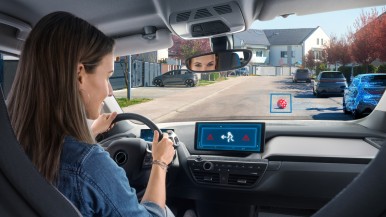
Stuttgart, Germany – It’s a scenario that no driver ever wants to see: a ball rolling out into the road. The chances are it will be followed immediately by a child in hot pursuit, oblivious to any traffic. But while human drivers can assess this situation using their contextual knowledge, today’s assisted and automated driving systems still have to learn how to do it. Bosch is pursuing the use of generative AI in terms to further improve automated driving functions. As part of this, Bosch and Microsoft are exploring opportunities to collaborate and leverage the power of generative AI. “Bosch is working on bringing a new dimension of AI applications into the vehicle,” said Dr. Stefan Hartung, chairman of the Bosch board of management, at this year’s Bosch Connected World (BCW) AIoT industry conference in Berlin. The expectation is that generative AI will enable vehicles to assess situations and react accordingly, and in this way keep road users even safer. Greater safety on the roads is also the wish of 60 percent of respondents to this year’s Bosch Tech Compass, a worldwide representative Bosch survey on the subjects of technology and AI. Bosch is working on bringing a new dimension of AI applications into the vehicle,...says Dr. Stefan Hartung, chairman of the board of management. Generative AI to make road traffic safer The two companies anticipate that a collaboration would take the performance of automated driving functions to the next level. They would like to see generative AI help enhance convenience in the vehicle and to provide greater safety for all road users. To achieve this, Bosch's comprehensive understanding of vehicles and automotive-specific AI expertise will be invaluable, as well as their access to vehicle sensor data to feed the generative AI. “In our unwavering commitment to safer roads, Microsoft is eager to explore collaboration opportunities with Bosch to pioneer the realm of generative AI,” said Uli Homann, Microsoft CVP and Distinguished Architect. Even today, when it comes to training systems for automated driving, AI quickly comes up against its limits. Today’s driver assistance systems can detect people, animals, objects, and vehicles, but in the near future generative AI could help determine whether a situation could potentially lead to an accident. Generative AI utilizes vast amounts of data to train systems for automated driving, enabling them to draw improved conclusions from this data. For example, it could deduce whether an object on the road ahead is a plastic bag or a damaged vehicle part. This information can be used either to communicate directly with the driver – such as by displaying a warning – or to initiate appropriate driving maneuvers, such as braking while switching on the hazard warning lights. Bosch and Microsoft have already partnered to develop a universal software platform for seamlessly connecting cars and the cloud, and are looking forward to work together to identify new opportunities to bring cutting-edge AI technology to their customers and the autonomous vehicle industry. Generative AI as a boost to innovation “Generative AI is a boost to innovation. It can transform industry in much the same way as the invention of the computer,” says Dr. Tanja Rueckert, member of the Bosch board of management and chief digital officer. The new 2024 Bosch Tech Compass shows this as well: 64 percent of respondents believe that AI is the technology with the greatest importance for the future. In comparison, only 41 percent of respondents were of the same opinion just one year ago. Generative AI is a boost to innovation. It can transform industry in much the same way as the invention of the computer,...says Dr. Tanja Rueckert, member of the Bosch board of management and chief digital officer. From manufacturing to everyday office work, generative AI is already being used in many areas at Bosch. In addition to Microsoft, the company is working with several partners, including AWS, Google, and Aleph Alpha. The Bosch Group’s venture capital unit, Bosch Ventures, invested in the AI company Aleph Alpha last year. Bosch also announced it would collaborate with the startup on finding new use cases both for Bosch associates and customers. “Bosch and Aleph Alpha want to learn from each other, benefit from each other’s know-how, and work together on cross-domain use cases,” Rueckert says. This partnership is now bearing its first fruits in North America: in collaboration with Aleph Alpha, Bosch is debuting AI-based speech recognition on behalf of a premium car manufacturer. In this solution, a chatbot understands and answers breakdown service calls with the help of natural language processing, which also recognizes dialects, accents, and moods. The call is taken directly, reducing the driver’s waiting time to a minimum. As many as 40 percent of calls can be processed and resolved automatically; for more complex queries, the bot transmits all relevant information to a service center agent who takes over the case immediately. From the AI search engine to manufacturing AI experts at Bosch are currently working on well over 120 specific applications that these new AI models open up for the company’s associates and customers. Such applications include the generation of software program code or powerful chatbots and voicebots to support technicians or interact with consumers. Another is AskBosch, the in-house AI-assisted search engine launched at the end of 2023. It offers faster natural-language access to a wide variety of data sources – sources scattered over the intranet, say. In addition to externally available data, AskBosch also includes internal data sources, so Bosch associates can research information specific to the company. Generative AI also ensures greater speed in manufacturing: in initial projects in two Bosch plants in Germany, generative AI creates synthetic images in order to develop and scale AI solutions for optical inspection and optimize existing AI models. Bosch expects that this will reduce the time needed for planning, launching, and ramping up AI applications from the current six-to-twelve months to just a few weeks. Following successful piloting, this service for generating synthetic data is to be offered to all Bosch locations. 2024 Bosch Tech Compass: setting the pace in the use of AI As AI is used in more and more areas of life, professional development is becoming increasingly important: 58 percent of respondents to the Bosch Tech Compass are convinced of this. This opinion is particularly prevalent in USA at 63 percent (Germany: 54 percent, China: 52 percent). Here, too, Bosch is setting the pace in the use of artificial intelligence and is getting its associates on board. In 2019, Bosch launched a training program, initially aimed at bringing 30,000 associates up to speed on the subject of AI. Up to now, some 28,000 associates have taken part in the program. Like the Bosch AI code of ethics, which sets ethical guidelines for dealing with artificial intelligence, this program has been supplemented with content about generative AI. For all the results of the 2024 Bosch Tech Compass, click here . About the survey: For the representative survey, people aged 18 and over in seven countries (Brazil, China, Germany, France, India, the U.K., and the U.S.) were polled online on behalf of Robert Bosch GmbH by the market researchers Gesellschaft für Innovative Marktforschung mbH (GIM) in December 2023. In Germany, France, and the U.K., at least 1,000 people were polled per country; in Brazil, China, India, and the U.S., it was at least 2,000 people each. The random samples are representative of their respective countries in terms of region, gender, and age (Brazil, Germany, France, U.K., U.S.: 18 to 69 years / China, India: 18 to 59 years).


Bosch unveils cutting edge Smart Connected Sensors platform for full-body motion ...

08.01.2024

Press release

Internet of Things

Bosch unveils cutting edge Smart Connected Sensors platform for full-body motion ...

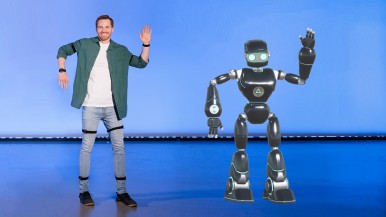
Las Vegas, Nevada / Reutlingen, Germany – Unlimited access to a personal feedback coach? That's the dream of many fitness and gaming enthusiasts. With the brand new Smart Connected Sensors platform, Bosch Sensortec ensures that movements and repetitions are not only measured, but that users get qualitative feedback on the movement execution. Specifically designed for full-body motion tracking, this new platform provides a fully integrated hardware and software solution that dramatically cuts development costs and time to market.Business customers wanting to integrate sensors in their designs are often faced with time-consuming and complicated tasks, combining and tweaking multiple devices to create the necessary hardware and software system. There is no sensor solution available on the market right now that provides wireless and ready-to-use full-body movement feedback. To meet this need and save developers precious time and effort, Bosch Sensortec provides business customers with the full package: BHI380, a programmable IMU-based sensor system using AI functionality. A wearable reference design (certified CE, FCC, ISED, MSIT, SRRC, MIC, NCC, UKCA) that can be straightforwardly attached to any part of the body without having to handle cable clutter, an external camera or dedicated bodysuits. Software features including gesture and activity recognition, body movement detection, relative body angle information, as well as a feedback coach. Multiple applications in rehabilitation, fitness and gaming The possibilities are almost endless. Key use cases will include rehabilitation, fitness, and gaming according to the motto “Move. Prove. Improve.” The Smart Connected Sensors platform provides complex feedback that enables users to properly perform rehabilitation exercises at home, thereby supporting their faster recovery. For highly responsive gaming applications, motion sensors will provide intuitive, accurate control by tracking even the tiniest movements. In the area of sports and fitness, the motion sensors can be used for complete body movement detection, for example to give detailed feedback on how well high-intensity exercises are performed. The sensors communicate wirelessly via Bluetooth Low Energy and thus do not restrict users' movement. Thanks to the platform principle, the system can be connected to numerous applications, such as wearables, hearables and AR/VR headsets. Engineers will find the Smart Connected Sensors platform easy to use and simple to scale, easily incorporating additional sensors and capabilities into their existing designs. Importantly, the platform enables up to eight nodes with various Bosch Sensortec sensors to be neatly connected to a central node, including Inertial Measurement Units (IMUs), magnetometers and pressure sensors. “For applications using Smart Connected Sensors, our new platform significantly reduces the amount of effort required from designers, enabling them to cut time to market and focus more on their specific expertise,” said Stefan Finkbeiner, General Manager and CEO at Bosch Sensortec. For applications using Smart Connected Sensors, our new platform significantly reduces the amount of effort required from designers, enabling them to cut time to market and focus more on their specific expertise...said Stefan Finkbeiner, General Manager and CEO at Bosch Sensortec. The sensor platform provides qualitative feedback based on integrated AI features and comes with a pattern creation software tool that helps customers customize their system design. By using this tool, the customer retains control over their data, as there is no need for regular data exchange with Bosch Sensortec. Availability: Smart Connected Sensors is available on direct request.

A new dimension of acceleration: Bosch launches world’s smallest MEMS accelerome ...

08.01.2024

Press release

Internet of Things

A new dimension of acceleration: Bosch launches world’s smallest MEMS accelerome ...

Las Vegas, Nevada / Reutlingen, Germany – Space is at a premium in hearables, smartwatches and other portable consumer products, and all components must be as small as possible. At the same time, OEMs are demanding plug-and-play step-counters and other sensors with built-in features that enable easy implementation without detailed application knowledge. To meet these challenges, Bosch Sensortec has announced the BMA530 and BMA580, the world's smallest MEMS accelerometers. Both devices include built-in features making them easy to design with. BMA530 tracks activities with its step counter and is especially suitable for wearables, and BMA580 targets hearables with voice activity detection.Compared to Bosch's current generation accelerometer (BMA253), the BMA530 and BMA580 have a 76 percent smaller footprint and have been reduced in height from 0.95 mm to 0.55 mm. This size reduction is achieved with an innovative Wafer Level Chip Scale Package (WLCSP). The small size of the accelerometers makes them easy to place on a PCB, and their integrated features make them easy for design engineers to integrate into their portable products. "The demand for tiny sensors with ever-increasing performance is growing as the industry moves towards more stylish and minimalist designs that require smaller sensors," said Stefan Finkbeiner, General Manager and CEO of Bosch Sensortec. "The new BMA530 and BMA580 provide an ultra-compact, fully-featured solution to meet this demand." The demand for tiny sensors with ever-increasing performance is growing as the industry moves towards more stylish and minimalist designs that require smaller sensors. The new BMA530 and BMA580 provide an ultra-compact, fully-featured solution to meet this demand. ...said Stefan Finkbeiner, General Manager and CEO of Bosch Sensortec. Bone conduction for reduced power consumption The BMA580 provides innovative voice activity detection and an advanced feature set for hearable devices. Typically, microphones in hearables consume a lot of power because they need to be always-on to listen for voice activity. Instead, the BMA580 uses bone conduction to detect the vibration of the user’s voice and then wakes the microphone from sleep – for an overall power saving. No other sensor on the market combines bone conduction with this miniature sensor size. The BMA580 enables user interaction with a hearable in response to the user tapping the device, for example to answer or end a call. The sensor’s software includes an algorithm that can distinguish between single, double and triple taps. In addition to wearables, the new BMA530 acceleration sensor is ideal for gesture recognition in toys, fall detection in laptops and other devices, and power management functions such as putting a smartphone to sleep when it is not moved. The new accelerometers offer multiple power modes and automatically switch from low-power to high-power modes to extend battery life. They offer a flexible set of connectivity options, including an I3C® interface. Availability: The new acceleration sensors from Bosch Sensortec can be ordered at our distribution partners from Q1 2024 onwards.

Security With Award-Winning Design

31.08.2023

Press release

Smart Home

Security With Award-Winning Design

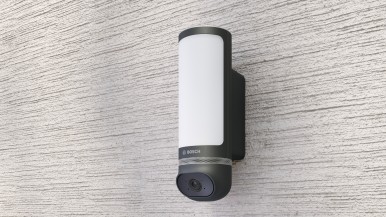
Stuttgart – The new Bosch Smart Home Eyes Outdoor Camera II is more than just a high-precision security camera for home. Its stylish design with a bright front lamp and colour-customisable top and bottom lights also makes it a handsome eye-catcher outdoors. The integrated 75-decibel siren sounds a loud alarm to frighten burglars away. The Eyes Outdoor Camera II can be used independently with the Bosch Smart Home Camera app or integrated into the Bosch Smart Home system.*Smart motion detection for enhanced security Reliably protecting their own homes is the top priority for many people. With a 145° field of view, DualRadar sensors, and manually rotatable and tiltable camera head, the Eyes Outdoor Camera II provides ideal monitoring of the area under surveillance. Thanks to 3D motion detection and smart video analysis, the camera automatically distinguishes human activities from other motions such as a roving cat or a windblown branch – which avoids false alarms. The masking function blacks out predefined zones (for example, neighbouring properties) and excludes them from the recording, thus protecting the privacy of third parties. The Eyes Outdoor Camera II easily masters darkness too thanks to its front lamp, which shines with a brightness up to 1 100 lumens, thus enabling the camera to also capture sharply focused images in full HD colour both day and night. If motion is detected while the Eyes Outdoor Camera II is in security mode, the device shows another of its talents. In addition to high-precision video recording, its integrated 75-decibel siren sounds a loud alarm and its red upper and lower lights begin to flash, thus providing both audible and visual deterrence in emergencies. Of course, when a stranger enters one’s property, it doesn’t necessarily mean danger. For example, the visitor could simply be a parcel carrier arriving at the door with a long-awaited delivery when no one is at home. In this case, the Eyes Outdoor Camera II acts like an intercom system. Via livestream on their smartphone, the user can see who is standing in front of the door and can communicate with them by means of the integrated loudspeaker and microphone. This makes it easy to instruct parcel carriers where they can safely leave their deliveries. Brings light into the darkness The integrated lighting options provide an additional sense of security. Using innovative DualRadar technology, the camera detects movements and measures distances with two modern radar sensors. It covers a field of vision of 180° and, as soon as movement is detected, it illuminates the property in the desired brightness. The property can initially be lit by subdued lighting or, as a deterrent, by bright lamps shining at full intensity. This way, passing cars or passers-by outside the monitored area do not trigger the motion light. The Bosch Smart Camera app enables its user to adjust the brightness of the front lamp (from warm to cool white) as well as the top and bottom lights, which can optimally illuminate the property in more than 1 500 colours. All lamps can also be individually switched and used with automatic twilight or individual time settings. The Bosch Smart Camera app enables its user to adjust the brightness of the front lamp (from warm to cool white) as well as the top and bottom lights, which can optimally illuminate the property in more than 1 500 colours. All lamps can also be individually switched and used with automatic twilight or individual time settings. Uncompromising design Available in silver or anthracite metallic, the Eyes Outdoor Camera II convinces users thanks to its thoroughly stylish design, which earned it both the Red Dot “Best of Best” Design Award (2023) and the iF Design Award (2023). With its modern style and clever combination of a camera and outdoor lighting, it appealingly yet unobtrusively welcomes guests and residents alike. Access-protected storage The 100 most recent video clips are automatically saved free of charge for seven days in the access-protected cloud storage. This enables users to re-evaluate or save individual video recordings. People who need even more storage space can opt for the Cloud+ extension , which lets them customise clip lengths, save video recordings for 30 days and permanently store up to 25 of their favourite clips. Particularly clever: the Cloud+ extension covers all cameras in the Bosch Smart Home system. Even smarter in the system The Eyes Outdoor Camera II can be integrated* into existing Bosch Smart Home systems to trigger smart automations and individual scenarios. For example, the customisable “Coming Home” scenario automatically deactivates the device when its user returns home after a day at work. Integrating the Eyes Outdoor Camera II into the Bosch Smart Home system enables the device to provide even greater security and convenience in one’s own home. Further features Resolution: 1080-pixel full HD (1920 x 1080 pixels) IP protection class: IP 55 Ambient temperature range: -20° to +50° Celsius Power supply: 230-volt alternating current Weight: 900 grams (including accessories and packaging: 1406g +/- 10g) Monitored areas: 130° horizontal (+80° rotation), 70° vertical (+25° inclination), 145° diagonal Radar detection range: 180° (range of 8 metres) Connections: Wi-Fi IEEE 802.11 b/g/n 2.4 GHz Wireless free-field range: 100 m Availability The Eyes Outdoor Camera II is expected to be available from the first half of 2024 in Germany, Austria, Switzerland, France, Great Britain, Belgium, the Netherlands, Luxembourg, Italy, Spain, Portugal, Denmark, Sweden, Norway and Finland. Requirements The Bosch Smart Camera app is required to use the Eyes Outdoor Camera II. To take advantage of further benefits, the Eyes Outdoor Camera II can be integrated into the Bosch Smart Home system via the Bosch Smart Home app.* * Integration of the Eyes Outdoor Camera II into the Bosch Smart Home system is expected to become possible from the first half of the year 2024.

GAIA-X 4 moveID project develops basis for secure mobile data exchange

08.09.2022

Press release

Business/economy

GAIA-X 4 moveID project develops basis for secure mobile data exchange

Stuttgart, Germany – Which parking garages currently have vacant charge spots available? Where are free parking spaces in the city center? And how can this information be digitally transmitted, and services billed, across providers? The answer to these and similar questions calls for secure data exchange between the vehicles and their environment. It is precisely this foundation that a research project consisting of universities, automotive suppliers, and system providers is now in the process of building, with Bosch leading the consortium. Over the next three years, the GAIA-X 4 moveID project is set to develop the necessary standards and technological concepts to enable the secure exchange of information between providers of mobility applications and their customers. The goal is to create decentralized digital vehicle identities. This is an important prerequisite for the mass use of electric vehicles, automated driving, and the establishment of connected cities. GAIA-X 4 moveID is supported to the tune of 14 million euros by the German Federal Ministry for Economic Affairs and Climate Action – covering half of the project costs.Connectivity for digital services across the board “An integrated and transparent system architecture for the exchange of data on the road that incorporates different products and players simply isn’t available today. While it’s true that some companies out there already offer services, those services are tailored for specific applications, vehicles, or customer groups,” explains Peter Busch, project manager at the consortium leader Bosch. They often map the infrastructure, for example, but they rarely provide information about availability due to a lack of connectivity between the many independently operating service providers. “Open standards are needed so that users, for example, can find all available charging stations or pay for charging processes,” Busch says. It’s important to always ensure that the data is processed securely and that individual providers don’t exploit it solely for their own purposes. For Busch, this is the only way that the necessary user confidence can grow and a broad range of all available services, such as so-called deep parking (use of otherwise unavailable parking spaces), can be created. That is why the consortium is building on the European GAIA-X system, which defines the technological, economic, and legal framework for a secure and trustworthy data infrastructure. GAIA-X relies on decentralization and the interplay of different cloud providers under common guidelines. In this spirit, the GAIA-X 4 moveID project is using open source software for its developments and making them available to all providers for various business models. Vehicles are becoming marketplaces The standards that GAIA-X 4 moveID is pursuing will allow vehicles to securely and independently exchange information with other vehicles and their environment without an “intermediary.” The vehicles’ “infrastructure partners” include charge spots, barriers, traffic lights, and parking lots. The research project will use internationally recognized hardware and software to develop management and administrative services to facilitate the interaction and trade between different players. This will enable providers to connect a great many services, such as news, entertainment, and navigation, with the car’s system, especially in automated driving. The market for services related to connected parking alone is estimated to be worth ten billion euros annually worldwide. What’s more, the ability to navigate directly to a vacant parking space significantly reduces congestion and emissions. After all, today, about a third of downtown urban traffic is people looking for parking spaces. The availability of information is also a crucial factor for the success of electromobility. It is estimated that about half of newly registered cars in Europe will be electric by 2030. “Their drivers need to know that they’ll be able to find a charge spot quickly whenever they need one. And that requires connected systems,” Busch says. Extensive data exchange as a basis for automated driving The mass use of automated vehicles is conceivable only if cars are able to quickly and reliably communicate with their environment. The data exchange this requires will enable climate-friendly traffic control based on the volume of traffic at any given moment. This will allow cities to regulate incoming traffic to particular areas in real time, thus preventing congestion. However, this method, known as zoning, requires that vehicles be able to immediately recognize changing conditions and to reroute accordingly. Zoning is being demonstrated with test vehicles – for the first time across borders – in the Germany-France-Luxembourg (Merzig/Saarbrücken) test area as part of the GAIA-X 4 moveID project. The cars receive dynamic information regarding their approach to defined zones.The project partners: Robert Bosch GmbH Materna Information & Communications SE Denso Automotive Deutschland GmbH Continental Automotive Technlogies GmbH WOBCOM GmbH ecsec GmbH HTW Saar (University of Applied Sciences) Atos Information Technology GmbH Chainstep GmbH Peaq Technology GmbH Zeppelin Universität gGmbH (Zeppelin University) Datarella GmbH 51nodes GmbH Bigchain DB GmbH Fetch.ai Research & Development GmbH ITK Engineering GmbH Deutsche Zentrum für Luft- und Raumfahrt e.V. (German Aerospace Center) Airbus Defence and Space GmbH Delta Dao AG

Bosch strives to simplify the smart home of the future and is driving the Matter ...

02.06.2022

Press release

Smart Home

Bosch strives to simplify the smart home of the future and is driving the Matter ...

Stuttgart – In line with our guiding principle "Invented for Life", Bosch strives to create technical product solutions that make our users' lives easier. Bosch is now pursuing this aim through the new Matter connection standard, to satisfy our customer's need for the simplest smart home solution possible. For this reason, Matter is being actively endorsed by Bosch and will be gradually integrated into all relevant product from 2023 onwards. Under the CSA, hundreds of companies including Apple, Google and Amazon, are working to establish a common wireless protocol in the form of Matter. This simplifies the interoperability of smart home devices from different manufacturers as well as the standardization of setup and update processes. The intention is to further reduce the complexity of the smart home and thus enable the use of basic applications (such as simple operation of devices) from the user's preferred smart home app. To further meet individual customer needs, Bosch will also provide complete solutions in the form of apps and advanced applications (such as preconfigured services). "We are pleased to be a part of the CSA and are now further expanding our involvement in Matter", said Tanja Rückert, Chief Digital Officer of the Bosch Group. We are pleased to be a part of the CSA and are now further expanding our involvement in Matter...said Tanja Rückert, Chief Digital Officer of the Bosch Group. In this context, Bosch is now increasingly contributing its comprehensive knowledge to the definition of Matter standards for various device classes (e.g. security, kitchen appliances or energy management) and their applications. In all relevant Bosch corporate divisions that offer solutions for smart homes or connected home appliances, work is already underway to ensure that end devices and apps can support Matter as soon as possible. In 2023, Matter-compatible Bosch Smart Home devices will be the front runners, closely followed by the overarching smart home management app "Home Connect Plus" and products from Bosch Thermotechnik GmbH. Other company segments and offers will follow in due course. Bosch is convinced that Matter will be the future standard for smart home products and will give the market a significant push.

Bosch barometric pressure sensor raises the bar for accuracy and performance in  ...

05.04.2022

Press release

Smart Home

Bosch barometric pressure sensor raises the bar for accuracy and performance in ...

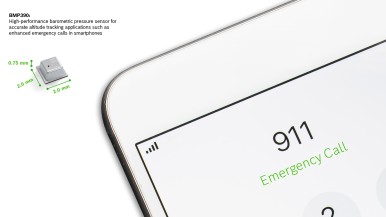
Bosch Sensortec introduces the BMP581, a barometric pressure sensor that couples low power consumption with extreme accuracy to provide altitude tracking in wearables, hearables or IoT devices. This capability makes it ideal for applications such as fitness tracking, fall detection, indoor localization and navigation, enabling new use cases that were previously impossible."Building on the excellent performance and low power consumption of previous generations of Bosch sensors, our new BMP581 now delivers an entirely new level of accuracy", says Dr. Stefan Finkbeiner, CEO at Bosch Sensortec. "It’s breathtakingly accurate: it can measure a barometric pressure fluctuation that's equivalent to one-thousandth of the weight of a mosquito (7.6 μg)." This extreme level of accuracy enables the sensor to detect an altitude change of just a few centimeters. It can, therefore, monitor movement in fitness applications down to the level of individual pull-ups or push-ups, and can provide highly accurate location information for indoor localization, navigation, and floor detection to provide key data for emergency call requirements (E-911) . The sensor can noticeably improve flight stability and landing accuracy in drones, and help detect water levels in household appliances to avoid flooding. Building on the excellent performance and low power consumption of previous generations of Bosch sensors, our new BMP581 now delivers an entirely new level of accuracy...Dr. Stefan Finkbeiner, CEO at Bosch Sensortec Low power consumption coupled with high accuracy The BMP581 provides an excellent relative accuracy of +/-0.06 hPa and a typical absolute accuracy of +/-0.3 hPa. Full accuracy is available over a wide measurement range from 300 hPa to 1100 hPa. The BMP581 has a typical temperature coefficient offset (TCO) of just +/-0.5 Pa/K and low RMS noise of 0.08 Pa @ 1000 hPa (typical). Long-term drift over 12 months is only +/-0.1 hPa. Compared to BMP390, the previous generation of Bosch barometric pressure sensors, the BMP581 draws 85% less current, noise is 80% lower, and TCO is reduced by 33%. Typical current consumption of just 1.3 μA at 1Hz substantially extends battery life, while the deep standby mode draws only 0.5 μA. The sensor provides an I2C, I3C and SPI (3-wire/4-wire) digital, serial interface. The BMP581 is provided in a compact 10-pin LGA package shielded by a metal cover, measuring just 2.0 x 2.0 x 0.75mm 3 . Virtual unveiling event: Watch the video to find more detailed information and application examples for the new sensor and to get an insight into the product's development. https://www.bosch-sensortec.com/unveil/event/ Availability: The BMP581 is available now and offers a strong price-performance ratio.

Accurate indoor localization can save thousands of lives – enabled by pressure s ...

22.04.2020

Press release

Internet of Things

Accurate indoor localization can save thousands of lives – enabled by pressure s ...

Bosch Sensortec announces the BMP390 , a barometric pressure sensor that delivers unmatched accuracy for altitude tracking in smartphones as well as wearable and hearable devices. The new sensor can measure height changes below 10 centimeters thanks to the improved resolution, and is 50 percent more accurate than its predecessor. The use of Bosch Sensortec’s latest BMP390 pressure sensor in smartphones, enables a high precision localization service that ultimately has the potential to save thousands of lives....Dr. Stefan Finkbeiner, CEO at Bosch Sensortec Accurate altitude detection helps to localize people indoors, where GPS signals are not available. The addition of the vertical-specific position to existing horizontal information enables first responders to determine the floor level of smartphone users who trigger an emergency call. The Federal Communications Commission (FCC) estimates that the additional vertical information has the potential to save up to 10,000 lives per year just in the USA alone 1 . "The use of Bosch Sensortec’s latest BMP390 pressure sensor in smartphones, enables a high precision localization service that ultimately has the potential to save thousands of lives," said Dr. Stefan Finkbeiner, CEO at Bosch Sensortec. Enabling enhanced emergency calls According to a recent report by the FCC , wireless providers in the US will soon be required to meet an increasingly stringent series of location accuracy benchmarks in accordance with a timetable, including providing the caller’s dispatchable location. The order adopts a z-axis location accuracy metric of ±3 meters relative to the handset for 80 percent of indoor wireless 9-1-1 calls starting in 2021. Emergency applications such as the enhanced 911 (E911) system in the US could also be implemented in other regions like Europe or Asia, to further improve people’s safety and peace of mind. Bosch and NextNav LLC, a 3D geolocation service provider, have collaborated on component specifications and system performance resulting in consistent, high accuracy z-axis capabilities indoors. This is accomplished by applying barometric pressure sensors in the phone, like the Bosch BMP390, and combining them with NextNav’s Metropolitan Beacon System (MBS) z-axis service to determine three-dimensional location and positioning. Accurate indoor and outdoor navigation and improved fitness tracking Not limited to emergency applications, the sensor also enables improved indoor navigation in general, for example in combination with the Position Tracking Smart Sensor BHI160BP . These navigation solutions compensate for traditional localization technologies such as GPS that do not work efficiently in shielded environments. This will help users to save time and avoid the hassle of getting lost, for example when searching for their car in an underground garage. Furthermore, the new BMP390 supports enhanced GPS applications for outdoor navigation and calorie expenditure estimation tasks. The use of advanced barometric pressure sensing can determine whether a user is walking up or down an incline, stairs or lifting weights during a fitness training session. This helps to increase the precision of calorie tracking by up to 15 percent 2 . Thanks to the improved accuracy of altitude measurements, fitness trackers are able to show exactly how far a user has run, walked or cycled. Accurate, stable and compact The BMP390 provides a typical relative accuracy of ±0.03 hPa, which is superior to any other comparable product on the market today. Typical absolute accuracy is ±0.5 hPa. The excellent accuracy is the result of significant improvements in temperature stability, drift behavior and noise. The sensor offers high temperature stability across its entire operating temperature and pressure range of 0 to 65 °C and 700 to 1100 hPa respectively, with an average temperature coefficient offset (TCO) of just ±0.6 Pa/K. Noise is also low, at only 0.9 Pa typical, an improvement of 25 percent relative to the predecessor BMP380. The device also provides high long-term stability, and low short- and long-term drift. Its small size, measuring only 2.0 mm x 2.0 mm x 0.75 mm, makes the new sensor easy to integrate into portable devices. Power consumption is kept low at 3.2 μA at 1 Hz (typical) to maximize battery life on portable devices. Availability The BMP390 is available for high-volume smartphone, wearable and hearable manufacturers. Footnotes 1 FCC Fact Sheet 2 Energy Expenditure Estimation with Smartphone Body Sensors

More than meets the eye: Bosch enables the next generation of smartglasses

10.12.2019

Press release

Internet of Things

More than meets the eye: Bosch enables the next generation of smartglasses

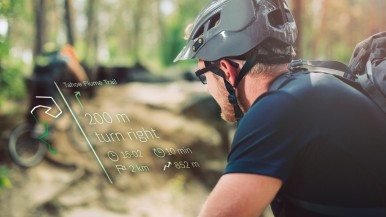
At CES® in Las Vegas, Nevada, Bosch Sensortec launches an innovative optical Light Drive system for smartglasses. The Bosch Smartglasses Light Drive module is a sole source, all-in-one technology stack consisting of MEMS mirrors, optical elements, sensors, and onboard processing. This integrated solution delivers a clean visual experience with bright images that are always in focus – even in direct sunlight.The disruptive Bosch Light Drive technology revolutionizes all-day wearables with perceived total transparency for the user, and with radical social acceptance because it is nearly invisible to others. Additionally, the technology can also be applied to optimize performance of waveguide systems for which integration packages are in development. There is no externally visible display or integrated camera, the two pitfalls that have alienated users of other smartglasses technologies. The smaller size allows designers to overcome the bulky, cumbersome characteristics of many of today’s smartglasses. For the first time, a turnkey system enables smaller, lighter, more stylish smartglasses designs that meet the visual and comfort needs of everyone. The tiny module is also big news for those who wear eyeglasses for vision correction - a significant market, since six out of ten people use corrective lenses every day. The Smartglasses Light Drive system is the smallest and lightest product on the market today and is, therefore, able to turn almost any regular spectacles into smartglasses. By eliminating distracting phone usage, smartglasses can help improve driving safety and reduce the impulse of users to constantly check their mobile devices for notifications or messages....says Dr. Stefan Finkbeiner, CEO of Bosch Sensortec. Bosch Sensortec’s innovative Smartglasses Light Drive solution paves the way for a day without digital fatigue. The system displays the perfect balance of just-in-time hands-free information in a minimalist format, making it ideal for applications including navigation, calls, and notifications such as alarms, calendar reminders, and messaging platforms such as WhatsApp and WeChat. Everyday note-based information like to-do and shopping checklists are exceptionally convenient. To date, these applications have been primarily restricted to devices with physical displays like smartphones or smartwatches. Smartglasses minimize socially unacceptable behavior such as obsessive phone checking, and help improve driver safety by providing hands-free, transparent heads-up navigation directions. The new technology promises to broaden the scope and availability of apps and information, coupled with instant access to relevant data, social media, and intuitive control of audio playback. Innovative technology in a tiny package A microelectromechanical system (MEMS) based collimated light scanner inside the Bosch Smartglasses Light Drive module scans a holographic element (HOE) that is embedded in the lens of the smartglasses. This HOE redirects the light beam onto the human retina surface, directly painting a picture that is always in focus. The technology enables hands-free, secure viewing of practically any data from a connected mobile device, such as a paired smartphone, overlaid in a comfortable viewing position. The projected high-resolution image is crisp, bright, private, and clearly visible even in direct sunlight thanks to its adaptive brightness. The Bosch Light Drive technology is compatible with curved and corrective lenses, making this new tech appealing and available to users who already wear prescription glasses. Older competitor display technologies are hindered by a haze or rainbow glare called stray light that is visible when the system is switched off. The Bosch Light Drive technology provides pleasing all-day optical transparency with minimal stray light sensitivity, meaning the view is always crystal clear, and that distracting internal reflections are a thing of the past. Smallest Smartglasses Light Drive solution on the market The new complete turnkey Light Drive system is the smallest comparable solution available on the market, delivering a depth reduction of 30 percent compared to existing solutions. It measures approximately 45-75 mm x 5-10 mm x 8 mm (L x H x W, depending on customer integration) and weighs less than 10 grams. This makes it easy for glasses manufacturers to flexibly reduce the width of the glasses frame to create a stylish design, and eliminate the visibly chunky design of first-generation smartglasses. Social acceptance and broad adoption have the potential to make retinal Light Drive technologies the next boom for manufacturers of consumer electronics display devices. End-to-end solution for smartglasses manufacturers Bosch Sensortec provides a turnkey Light Drive solution – designed and built in-house to ensure consistent high quality, reliability, and performance, whilst being able to quickly respond to market and customer demands for product modifications. Bosch Sensortec is the only end-to-end system provider of such retinal Light Drive technology and can further leverage this position by offering an extensive range of complementary devices and solutions. The smartglasses module is enriched by several sensor solutions, such as Bosch’s smart sensor BHI260, the barometric pressure sensor BMP388, and the BMM150 magnetometer. The sensors enable intuitive user interface features such as multi-tap functions on the frame to improve convenience while operating the glasses. The Bosch Smartglasses Light Drive solution will be available in 2021 to high-volume manufacturers as part number BML500P.

Bosch puts 5G machines in pole position

26.11.2019

Press release

Business/economy

Bosch puts 5G machines in pole position

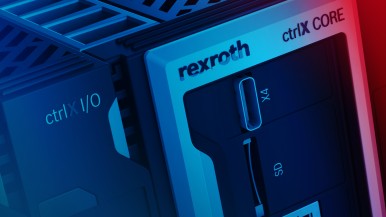
Stuttgart, Germany – 5G is coming. The new communications standard accelerates the internet of things and boosts Industry 4.0. Control systems and sensors of the kind built into facilities, machinery, and logistics chains stand to gain from this fast, reliable real-time wireless data transfer. Preparing machines for state-of-the-art communication involves making them 5G-capable. Now Bosch has the solution: Bosch Rexroth’s new ctrlX AUTOMATION control technology comes with 5G built in and can connect a wide range of industrial devices with the new communications standard. ctrlX AUTOMATION will be showcased at the SPS trade fair in Nuremberg.Bosch opens the door to a new industrial age 5G is set to turbocharge manufacturing. Our new 5G-capable automation platform lays the groundwork and opens the door to a new industrial age,...says Rolf Najork, the member of the Bosch board of management responsible for industrial technology. 5G is the first communications standard designed to enable connectivity for people as well as for the internet of things. The new standard has impressive characteristics: it is up to 20 times faster than 4G, transfers data virtually instantaneously with a latency of one millisecond, and is up to 99.9999 percent reliable – making the receipt of a “digital shipment” as certain as with transmission through a wire. "5G is a revolution and an important building block for the factory of the future", Najork says. Engineers and designers now face the challenges of integrating 5G into their machines and products. Bosch is introducing the solution that meets their needs: the new automation platform’s hardware can be fitted with a 5G module. The operating system and software for ctrlX AUTOMATION are 5G-capable from the outset and support rapid commissioning. Retrofit solutions are also available for adding the new technology to existing machinery. Bosch Rexroth’s new automation platform is scheduled to have its market launch in 2020. 5G will be a competitive factor for connected industry Experts estimate that there will be up to 70 billion connected devices worldwide by 2025. Many of them will be in manufacturing, meaning that 5G will become a competitive factor. The new communications standard will enable applications that require high-power, extremely reliable wireless connections to be integrated securely and efficiently into manufacturing facilities. These include mobile robotics, autonomous transport vehicles, and human-machine interactions. For instance, workers wearing augmented reality glasses can access additional information in their field of vision, optimizing how they monitor and maintain machinery. Combining tasks in the virtual world with those in the real world calls for real-time data flows. And that’s what 5G promises. "This new form of communication eclipses everything we’ve had until now. 5G is the first wireless protocol to truly meet the needs of the manufacturing industry", Najork says. Bosch takes on leadership role in Industry 4.0 and 5G Bosch is developing the factory of the future. In this endeavor, the company is relying on Industry 4.0 . The company first tests and validates products in-house before they are available on the market. Bosch is taking this approach with 5G, too. The company presented its first 5G-capable autonomous transport system, ActiveShuttle , at the Hannover Messe. To support the further development of its factories, Bosch has applied to the German Federal Network Agency for 5G licenses with which to set up local campus networks. Moreover, Bosch has taken on the chair of the global 5G Alliance for Connected Industries and Automation (5G-ACIA) with the aim of shaping the new mobile standard so that it meets the needs of the manufacturing industry from the outset.

Software from Bosch Connected Industry boosts productivity in production

25.11.2019

Press release

Industry 4.0

Software from Bosch Connected Industry boosts productivity in production

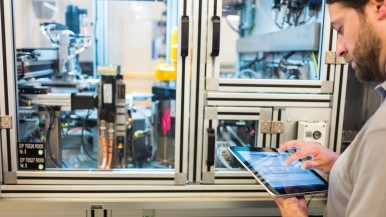
Stuttgart / Nuremberg, Germany – Intelligent software reduces complexity, simplifies processes; the factory of the future is unthinkable without this tool. Bosch Connected Industry is now presenting a solution at the SPS trade fair in Nuremberg that makes production and logistics even more transparent, efficient and productive. The Nexeed Industrial Application System makes data available in a compatible and standardized form and provides information at a glance. NEXEED is the brain of the intelligent factory, in which every employee knows what has to be done when and where,...null says Sven Hamann, Senior Vice President of Bosch Connected Industry. Using open interfaces, the Bosch software can also be easily integrated into common industrial platforms and existing infrastructures. "NEXEED breathes new life into old systems and makes them fit for Industry 4.0," says Hamann. This makes it easier to implement this intelligent form of production and ensures manageable investments. To this end, Bosch Connected Industry uses solutions that successfully optimize production in Bosch plants all over the world.Nexeed Industrial Application System for connected manufacturing With the Nexeed Industrial Application System, Bosch relies on interoperability: "All components of the system speak the same language and work together optimally. NEXEED forms the basis for a fully connected, transparent production process," explains Hamann. The basic functionalities make work easier for users and administrators through simple operation, clear master data management and individually defined access rights. The applications enable, for example, live monitoring of production processes or central management of IIoT devices such as routers, machine controls and sensors. "With our solutions no one has to update the devices individually with the USB stick anymore. This enables us to consistently close security gaps in the factory," explains Hamann. If required, the system can be expanded with additional applications or subject-specific packages. Significant increase in productivity through intelligent software By connecting NEXEED with the new automation platform ctrlX AUTOMATION from Bosch Rexroth, production efficiency can be significantly increased: "Industry 4.0 solutions from Bosch provide a productivity boost. With the new automation platform, we are improving the overall equipment effectiveness of machines by up to ten percent. In conjunction with NEXEED, another ten percent can be added," says Hamann. Bosch software makes a decisive contribution to higher availability, better performance, and higher quality. It enables access to production-relevant information in real time, for example on the status of production or the whereabouts of individual components. In the event of malfunctions, employees can react more quickly or avoid them completely thanks to preventive maintenance. Strong demand for software and services for Industry 4.0 Since its establishment in 2018, Bosch Connected Industry has expanded its business considerably: NEXEED is already used successfully by around 100 international customers, including BMW, Sick and Trumpf. Users benefit from the experience of the Bosch plants and warehouses: all NEXEED solutions are developed, tested and evaluated there, before Bosch offers them to external customers. More than 100 Bosch factories now use solutions from the NEXEED portfolio. Bosch Connected Industry at SPS: November 26-28, 2019, booth 450, hall 7

Bosch applies for local 5G licenses

21.11.2019

Press release

Industry 4.0

Bosch applies for local 5G licenses

Stuttgart, Germany – Bosch believes 5G local area networks are the way forward. The company has applied for 5G operating licenses for selected German locations. “As an IoT company, Bosch began researching into 5G early. The new communications standard is a key to automated and connected driving, and an essential element of the factory of the future,” says Dr. Michael Bolle, the Bosch Group CDO and CTO. Following licensing by the regulatory authorities, Bosch intends to set up these local 5G networks in collaboration with selected partners over the course of 2020 in order to better exploit the potential of Industry 4.0. Over the next few months, 5G trials will be conducted at Bosch plants and at its research campus in Renningen, in preparation for rollout in the company’s manufacturing operations.5G campus networks for Bosch plants The Bundesnetzagentur – the regulatory authority responsible for frequency allocation in Germany – recently changed its policy and now allows companies to obtain licenses for their private use. This will enable Bosch to set up its own 5G networks and thereby improve its competitiveness. "Private campus networks offer a maximum of security and independence. 5G speeds up industrial manufacturing processes. By establishing local 5G networks, we will be able to take a significant leap forward in our ambitions to create the factory of the future", says Rolf Najork, the Bosch management board member responsible for industrial technology. Bosch has initially applied for 5G operating licenses for the lead plant for Industry 4.0 in Stuttgart-Feuerbach and the research campus in Renningen . “The pioneering work done by these selected locations will ultimately benefit the entire Bosch manufacturing network, with its roughly 270 plants worldwide,” Bolle says. 5G will play a central role in the factory of the future “In our vision of the factory of the future, the only fixed elements are floors, walls, and ceilings. Everything else is movable and can be reconfigured at will,” Najork says. Examples include mobile robots, autonomous transportation vehicles, and new assistance systems such as data glasses, which provide associates with optimum support. An important requirement for such flexible systems is a powerful wireless infrastructure enabling efficient communication between human operators, machines, and other equipment. “This calls for a reliable, secure, and high-speed data transmission system with short response times – all of which is possible with 5G,” says Andreas Müller, who works for Bosch as a researcher and is the chairman of the international 5G Alliance for Connected Industries and Automation (5G-ACIA). The advantage of 5G is that it not only provides a means of efficiently connecting mobile devices and wireless sensors, but also provides the basis for entirely new system concepts. For instance, 5G enables a mobile robot to be controlled in real time using data stored in a local manufacturing cloud. This reduces costs, increases flexibility, and simplifies maintenance. It also optimizes operation of the machines. “If you walk into a factory today, you’ll see that almost every machine has an operating console with an emergency off switch. Someone has to press that button to bring the machine to a standstill. With 5G, the operator doesn’t need to be near the machine: an emergency stop and other functions can be executed using a mobile device. This makes the operator’s work easier, and also helps save costs,” Müller says. 5G improves security in production Local 5G networks virtually eliminate dependence on third-party providers. By setting up and operating their own wireless networks, manufacturers can configure them to meet the often highly demanding requirements of industrial communication applications. This solution also gives them full control over relevant security concerns. For instance, if the public network is overloaded, local 5G networks permit factory operations to continue without losing control of the system. “Campus networks allow us to decide for ourselves what architecture and security features best suit our needs, and what equipment we will use to implement them. And we know who has access to specific components and data,” Müller says. This reduces business risks and preserves data sovereignty. Dedicated interfaces are used for connections to the internet and other public networks, and are continuously monitored. Germany takes the lead in 5G For the first time, the introduction of the new 5G standard gives companies in Germany the opportunity to set up and operate their own cellular local area networks. The German regulatory authorities have set aside the frequency band from 3,700 to 3,800 MHz for this purpose. Frequencies will be allocated according to demand, with preference given to Industry 4.0 or agricultural and forestry applications. Licenses will be granted for an initial period of ten years. The fee for each license is the sum of a basic EUR 1,000 fee, the allocated bandwidth (from at least 10 to a maximum of 100 megahertz), the number of years for which it is allocated, and the surface area (in square kilometers) to which the allocation applies (with a distinction being made between built-up areas and transport routes and other areas).