Search & find:
Media, press releases, events for your editorial coverage

For safer roads: Bosch teams up with Microsoft to explore new frontiers with gen ...

28.02.2024

Press release

Automated mobility

For safer roads: Bosch teams up with Microsoft to explore new frontiers with gen ...

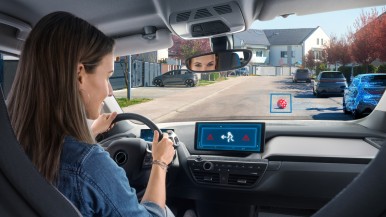
Stuttgart, Germany – It’s a scenario that no driver ever wants to see: a ball rolling out into the road. The chances are it will be followed immediately by a child in hot pursuit, oblivious to any traffic. But while human drivers can assess this situation using their contextual knowledge, today’s assisted and automated driving systems still have to learn how to do it. Bosch is pursuing the use of generative AI in terms to further improve automated driving functions. As part of this, Bosch and Microsoft are exploring opportunities to collaborate and leverage the power of generative AI. “Bosch is working on bringing a new dimension of AI applications into the vehicle,” said Dr. Stefan Hartung, chairman of the Bosch board of management, at this year’s Bosch Connected World (BCW) AIoT industry conference in Berlin. The expectation is that generative AI will enable vehicles to assess situations and react accordingly, and in this way keep road users even safer. Greater safety on the roads is also the wish of 60 percent of respondents to this year’s Bosch Tech Compass, a worldwide representative Bosch survey on the subjects of technology and AI. Bosch is working on bringing a new dimension of AI applications into the vehicle,...says Dr. Stefan Hartung, chairman of the board of management. Generative AI to make road traffic safer The two companies anticipate that a collaboration would take the performance of automated driving functions to the next level. They would like to see generative AI help enhance convenience in the vehicle and to provide greater safety for all road users. To achieve this, Bosch's comprehensive understanding of vehicles and automotive-specific AI expertise will be invaluable, as well as their access to vehicle sensor data to feed the generative AI. “In our unwavering commitment to safer roads, Microsoft is eager to explore collaboration opportunities with Bosch to pioneer the realm of generative AI,” said Uli Homann, Microsoft CVP and Distinguished Architect. Even today, when it comes to training systems for automated driving, AI quickly comes up against its limits. Today’s driver assistance systems can detect people, animals, objects, and vehicles, but in the near future generative AI could help determine whether a situation could potentially lead to an accident. Generative AI utilizes vast amounts of data to train systems for automated driving, enabling them to draw improved conclusions from this data. For example, it could deduce whether an object on the road ahead is a plastic bag or a damaged vehicle part. This information can be used either to communicate directly with the driver – such as by displaying a warning – or to initiate appropriate driving maneuvers, such as braking while switching on the hazard warning lights. Bosch and Microsoft have already partnered to develop a universal software platform for seamlessly connecting cars and the cloud, and are looking forward to work together to identify new opportunities to bring cutting-edge AI technology to their customers and the autonomous vehicle industry. Generative AI as a boost to innovation “Generative AI is a boost to innovation. It can transform industry in much the same way as the invention of the computer,” says Dr. Tanja Rueckert, member of the Bosch board of management and chief digital officer. The new 2024 Bosch Tech Compass shows this as well: 64 percent of respondents believe that AI is the technology with the greatest importance for the future. In comparison, only 41 percent of respondents were of the same opinion just one year ago. Generative AI is a boost to innovation. It can transform industry in much the same way as the invention of the computer,...says Dr. Tanja Rueckert, member of the Bosch board of management and chief digital officer. From manufacturing to everyday office work, generative AI is already being used in many areas at Bosch. In addition to Microsoft, the company is working with several partners, including AWS, Google, and Aleph Alpha. The Bosch Group’s venture capital unit, Bosch Ventures, invested in the AI company Aleph Alpha last year. Bosch also announced it would collaborate with the startup on finding new use cases both for Bosch associates and customers. “Bosch and Aleph Alpha want to learn from each other, benefit from each other’s know-how, and work together on cross-domain use cases,” Rueckert says. This partnership is now bearing its first fruits in North America: in collaboration with Aleph Alpha, Bosch is debuting AI-based speech recognition on behalf of a premium car manufacturer. In this solution, a chatbot understands and answers breakdown service calls with the help of natural language processing, which also recognizes dialects, accents, and moods. The call is taken directly, reducing the driver’s waiting time to a minimum. As many as 40 percent of calls can be processed and resolved automatically; for more complex queries, the bot transmits all relevant information to a service center agent who takes over the case immediately. From the AI search engine to manufacturing AI experts at Bosch are currently working on well over 120 specific applications that these new AI models open up for the company’s associates and customers. Such applications include the generation of software program code or powerful chatbots and voicebots to support technicians or interact with consumers. Another is AskBosch, the in-house AI-assisted search engine launched at the end of 2023. It offers faster natural-language access to a wide variety of data sources – sources scattered over the intranet, say. In addition to externally available data, AskBosch also includes internal data sources, so Bosch associates can research information specific to the company. Generative AI also ensures greater speed in manufacturing: in initial projects in two Bosch plants in Germany, generative AI creates synthetic images in order to develop and scale AI solutions for optical inspection and optimize existing AI models. Bosch expects that this will reduce the time needed for planning, launching, and ramping up AI applications from the current six-to-twelve months to just a few weeks. Following successful piloting, this service for generating synthetic data is to be offered to all Bosch locations. 2024 Bosch Tech Compass: setting the pace in the use of AI As AI is used in more and more areas of life, professional development is becoming increasingly important: 58 percent of respondents to the Bosch Tech Compass are convinced of this. This opinion is particularly prevalent in USA at 63 percent (Germany: 54 percent, China: 52 percent). Here, too, Bosch is setting the pace in the use of artificial intelligence and is getting its associates on board. In 2019, Bosch launched a training program, initially aimed at bringing 30,000 associates up to speed on the subject of AI. Up to now, some 28,000 associates have taken part in the program. Like the Bosch AI code of ethics, which sets ethical guidelines for dealing with artificial intelligence, this program has been supplemented with content about generative AI. For all the results of the 2024 Bosch Tech Compass, click here . About the survey: For the representative survey, people aged 18 and over in seven countries (Brazil, China, Germany, France, India, the U.K., and the U.S.) were polled online on behalf of Robert Bosch GmbH by the market researchers Gesellschaft für Innovative Marktforschung mbH (GIM) in December 2023. In Germany, France, and the U.K., at least 1,000 people were polled per country; in Brazil, China, India, and the U.S., it was at least 2,000 people each. The random samples are representative of their respective countries in terms of region, gender, and age (Brazil, Germany, France, U.K., U.S.: 18 to 69 years / China, India: 18 to 59 years).


Bosch’s new rapid coronavirus test delivers reliable results in 39 minutes

25.09.2020

Press release

Business/economy

Bosch’s new rapid coronavirus test delivers reliable results in 39 minutes

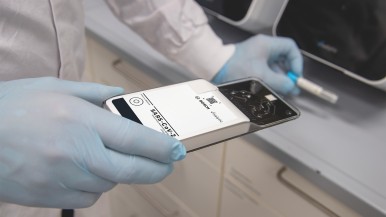
Stuttgart, Germany – Bosch has developed a new rapid test for its Vivalytic analysis device to detect the SARS-CoV-2 pathogen. The test provides a reliable result in 39 minutes and is currently the fastest polymerase chain reaction (PCR) test worldwide. Bosch’s new rapid test is predestined for decentralized use in mobile test centers at freeway service stations or in airports. People who take the test can obtain a reliable result while at the testing site. Available now in Europe, the CE-approved test helps avoid time in quarantine, relieve laboratories, and make travel and work safer again. “One of the keys to fighting the coronavirus pandemic is to rapidly identify sources of infection. That’s why we focused on following up on our first coronavirus test with an even faster one,” says Dr. Volkmar Denner, chairman of the board of management of Robert Bosch GmbH. “This will now enable us to put people’s minds at ease even more quickly.” One of the keys to fighting the coronavirus pandemic is to rapidly identify sources of infection. That’s why we focused on following up on our first coronavirus test with an even faster one....Dr. Volkmar Denner, chairman of the board of management of Robert Bosch GmbH The development of the new Bosch PCR singleplex test is part of a research and development project funded by the German Federal Ministry of Education and Research (BMBF). As the federal minister for education and research Anja Karliczek says, “I believe it’s important that people have clarity about their state of health as quickly as possible. In this respect, insights from science and research can bring people huge benefits. Over the next few months, we will be confronted with the particular challenge of having to test more people. The improved testing procedure developed by Bosch with the BMBF’s support has the potential to be a tremendous help with this complex job. The rapid improvement of our technological capabilities shows what innovative achievements German companies can deliver in times of crisis.” The test has a sensitivity of 98 percent and a specificity of 100 percent. To develop it, the Bosch subsidiary Bosch Healthcare Solutions joined forces with the German biotechnology company R-Biopharm – a leading provider of highly sensitive manual PCR tests. PCR tests are considered the gold standard of test methods.A world first: simultaneous testing of five samples Bosch launched the first rapid test for its Vivalytic analysis device at the end of March, after just six weeks’ development. As a multiplex test, it simultaneously checks samples for the SARS-CoV-2 virus and nine other respiratory diseases in two and a half hours. The new, accelerated test is exclusively for SARS-CoV-2. “With our different coronavirus tests and variable analysis strategies, we open up a range of testing scenarios with a Vivalytic device – from screening all the way to supporting differential diagnosis for diseases with similar symptoms,” says Marc Meier, president of Bosch Healthcare Solutions GmbH. And development work is still in full swing at Bosch: As of early October 2020, it will be possible to simultaneously evaluate five samples in one test cartridge and at a comparable speed – a world first, according to the company. Bosch is thus increasing available testing capacity, enabling fully automated processing of more than 160 samples a day using a Vivalytic device. In addition, optimized software will in the next few weeks further reduce the time to result of the SARS-CoV-2 test on positive samples. Vivalytic analysis device: easy to use at the test site The advantages of Bosch’s rapid test lie not only in speedy analysis, but also in ease of use. A sample is taken from the patient’s nose or throat using a swab, and placed in the test cartridge. Then the test cartridge, which already contains all the reagents required for the test, is inserted into the Vivalytic device for automated analysis. The Vivalytic analysis device is designed to be user-friendly; medical staff require only brief training on how to operate it. The development of the Vivalytic system, which consists of an analysis device and test cartridges, grew out of a long-standing collaboration between Bosch’s corporate research and advance engineering and Bosch Healthcare Solutions. By the end of the year, Bosch wants to reach capacity for one million tests. As demand for the analysis device and the rapid tests remains high, the company is working closely with its suppliers to maximize capacity and further increase supply.

Bosch puts 5G machines in pole position

26.11.2019

Press release

Business/economy

Bosch puts 5G machines in pole position

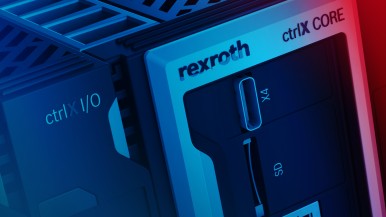
Stuttgart, Germany – 5G is coming. The new communications standard accelerates the internet of things and boosts Industry 4.0. Control systems and sensors of the kind built into facilities, machinery, and logistics chains stand to gain from this fast, reliable real-time wireless data transfer. Preparing machines for state-of-the-art communication involves making them 5G-capable. Now Bosch has the solution: Bosch Rexroth’s new ctrlX AUTOMATION control technology comes with 5G built in and can connect a wide range of industrial devices with the new communications standard. ctrlX AUTOMATION will be showcased at the SPS trade fair in Nuremberg.Bosch opens the door to a new industrial age 5G is set to turbocharge manufacturing. Our new 5G-capable automation platform lays the groundwork and opens the door to a new industrial age,...says Rolf Najork, the member of the Bosch board of management responsible for industrial technology. 5G is the first communications standard designed to enable connectivity for people as well as for the internet of things. The new standard has impressive characteristics: it is up to 20 times faster than 4G, transfers data virtually instantaneously with a latency of one millisecond, and is up to 99.9999 percent reliable – making the receipt of a “digital shipment” as certain as with transmission through a wire. "5G is a revolution and an important building block for the factory of the future", Najork says. Engineers and designers now face the challenges of integrating 5G into their machines and products. Bosch is introducing the solution that meets their needs: the new automation platform’s hardware can be fitted with a 5G module. The operating system and software for ctrlX AUTOMATION are 5G-capable from the outset and support rapid commissioning. Retrofit solutions are also available for adding the new technology to existing machinery. Bosch Rexroth’s new automation platform is scheduled to have its market launch in 2020. 5G will be a competitive factor for connected industry Experts estimate that there will be up to 70 billion connected devices worldwide by 2025. Many of them will be in manufacturing, meaning that 5G will become a competitive factor. The new communications standard will enable applications that require high-power, extremely reliable wireless connections to be integrated securely and efficiently into manufacturing facilities. These include mobile robotics, autonomous transport vehicles, and human-machine interactions. For instance, workers wearing augmented reality glasses can access additional information in their field of vision, optimizing how they monitor and maintain machinery. Combining tasks in the virtual world with those in the real world calls for real-time data flows. And that’s what 5G promises. "This new form of communication eclipses everything we’ve had until now. 5G is the first wireless protocol to truly meet the needs of the manufacturing industry", Najork says. Bosch takes on leadership role in Industry 4.0 and 5G Bosch is developing the factory of the future. In this endeavor, the company is relying on Industry 4.0 . The company first tests and validates products in-house before they are available on the market. Bosch is taking this approach with 5G, too. The company presented its first 5G-capable autonomous transport system, ActiveShuttle , at the Hannover Messe. To support the further development of its factories, Bosch has applied to the German Federal Network Agency for 5G licenses with which to set up local campus networks. Moreover, Bosch has taken on the chair of the global 5G Alliance for Connected Industries and Automation (5G-ACIA) with the aim of shaping the new mobile standard so that it meets the needs of the manufacturing industry from the outset.

Bosch applies for local 5G licenses

21.11.2019

Press release

Industry 4.0

Bosch applies for local 5G licenses

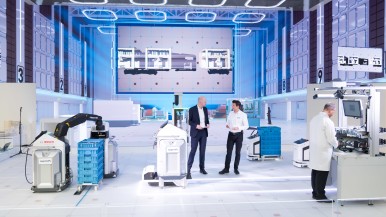
Stuttgart, Germany – Bosch believes 5G local area networks are the way forward. The company has applied for 5G operating licenses for selected German locations. “As an IoT company, Bosch began researching into 5G early. The new communications standard is a key to automated and connected driving, and an essential element of the factory of the future,” says Dr. Michael Bolle, the Bosch Group CDO and CTO. Following licensing by the regulatory authorities, Bosch intends to set up these local 5G networks in collaboration with selected partners over the course of 2020 in order to better exploit the potential of Industry 4.0. Over the next few months, 5G trials will be conducted at Bosch plants and at its research campus in Renningen, in preparation for rollout in the company’s manufacturing operations.5G campus networks for Bosch plants The Bundesnetzagentur – the regulatory authority responsible for frequency allocation in Germany – recently changed its policy and now allows companies to obtain licenses for their private use. This will enable Bosch to set up its own 5G networks and thereby improve its competitiveness. "Private campus networks offer a maximum of security and independence. 5G speeds up industrial manufacturing processes. By establishing local 5G networks, we will be able to take a significant leap forward in our ambitions to create the factory of the future", says Rolf Najork, the Bosch management board member responsible for industrial technology. Bosch has initially applied for 5G operating licenses for the lead plant for Industry 4.0 in Stuttgart-Feuerbach and the research campus in Renningen . “The pioneering work done by these selected locations will ultimately benefit the entire Bosch manufacturing network, with its roughly 270 plants worldwide,” Bolle says. 5G will play a central role in the factory of the future “In our vision of the factory of the future, the only fixed elements are floors, walls, and ceilings. Everything else is movable and can be reconfigured at will,” Najork says. Examples include mobile robots, autonomous transportation vehicles, and new assistance systems such as data glasses, which provide associates with optimum support. An important requirement for such flexible systems is a powerful wireless infrastructure enabling efficient communication between human operators, machines, and other equipment. “This calls for a reliable, secure, and high-speed data transmission system with short response times – all of which is possible with 5G,” says Andreas Müller, who works for Bosch as a researcher and is the chairman of the international 5G Alliance for Connected Industries and Automation (5G-ACIA). The advantage of 5G is that it not only provides a means of efficiently connecting mobile devices and wireless sensors, but also provides the basis for entirely new system concepts. For instance, 5G enables a mobile robot to be controlled in real time using data stored in a local manufacturing cloud. This reduces costs, increases flexibility, and simplifies maintenance. It also optimizes operation of the machines. “If you walk into a factory today, you’ll see that almost every machine has an operating console with an emergency off switch. Someone has to press that button to bring the machine to a standstill. With 5G, the operator doesn’t need to be near the machine: an emergency stop and other functions can be executed using a mobile device. This makes the operator’s work easier, and also helps save costs,” Müller says. 5G improves security in production Local 5G networks virtually eliminate dependence on third-party providers. By setting up and operating their own wireless networks, manufacturers can configure them to meet the often highly demanding requirements of industrial communication applications. This solution also gives them full control over relevant security concerns. For instance, if the public network is overloaded, local 5G networks permit factory operations to continue without losing control of the system. “Campus networks allow us to decide for ourselves what architecture and security features best suit our needs, and what equipment we will use to implement them. And we know who has access to specific components and data,” Müller says. This reduces business risks and preserves data sovereignty. Dedicated interfaces are used for connections to the internet and other public networks, and are continuously monitored. Germany takes the lead in 5G For the first time, the introduction of the new 5G standard gives companies in Germany the opportunity to set up and operate their own cellular local area networks. The German regulatory authorities have set aside the frequency band from 3,700 to 3,800 MHz for this purpose. Frequencies will be allocated according to demand, with preference given to Industry 4.0 or agricultural and forestry applications. Licenses will be granted for an initial period of ten years. The fee for each license is the sum of a basic EUR 1,000 fee, the allocated bandwidth (from at least 10 to a maximum of 100 megahertz), the number of years for which it is allocated, and the surface area (in square kilometers) to which the allocation applies (with a distinction being made between built-up areas and transport routes and other areas).

Machine learning: Bosch sends sensor system to ISS

19.11.2018

Press release

Research

Machine learning: Bosch sends sensor system to ISS

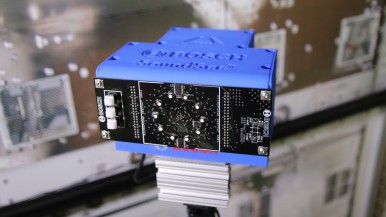
Pittsburgh, USA – Bosch in North America and Astrobotic Technology Inc. today announced a research partnership to send experimental sensor technology to the International Space Station (ISS) as early as May 2019. Bosch’s SoundSee technology is a deep audio analytics capability that uses a custom array of microphones and machine learning to analyze information contained in emitted noises. SoundSee’s analytics will investigate whether audio data from equipment could be learned and understood using advanced software, such that it could be used to improve the operations of the ISS. “Machines, such as motors and pumps, emit noise signatures while they operate,” said Dr. Samarjit Das, principal researcher and SoundSee project lead at Bosch’s Research and Technology Center in Pittsburgh . “Our SoundSee AI (artificial intelligence) algorithm uses machine learning to analyze these subtle acoustic clues and determine whether a machine, or even a single component of a machine, needs to be repaired or replaced.” The SoundSee payload will ride on NASA’s Astrobee Robot, an autonomous free-flying vehicle capable of navigating throughout the ISS. The NASA Ames Research Center’s Astrobee team has also provided support for ground testing. “The support from NASA has been critical,” said Dr. Andrew Horchler, Astrobotic research scientist and director of Future Missions and Technology. “They have provided feedback and requirements that have helped us design our operational plans and understand the challenges of sending a hardware payload to the ISS.” On the ISS, researchers will collect data and send it to Earth for Bosch to study. As research progresses, the team expects to update the software or adjust operational routines to improve data-collection results. “This data should allow us to gain insights into the state of the space station,” said Jon Macoskey, research engineer intern at Bosch. “Our long-term goal is to show that we can detect anomalies in the operation of the station and return that intelligence to crewmembers or ground control.” The research has promise for numerous terrestrial applications and other crewed spacecraft, including missions to the Moon and Mars. “For some time, Bosch has been interested in using audio analytics to monitor critical machines and equipment, such as car engines or HVAC systems,” said Dr. Joseph Szurley, a Bosch research scientist on the project. “The ISS will allow us to study how these techniques can extend to even more challenging and unique environments.” Astrobotic’s Future Missions and Technology team , a space robotics research group, is developing the flight version of the sensor, known as the SoundSee payload. The team will also lead ground testing and preparation for flight. “Conducting research in space, even when you have an asset like the ISS, is significantly more challenging than testing on the ground,” Horchler said. “As a space robotics company, we are able to help Bosch prepare for operating in this highly controlled space environment.” The SoundSee project has been in development since the Center for the Advancement of Science in Space (CASIS) approved funding for launch costs and astronaut time aboard the space station earlier this year. CASIS is the organization tasked by NASA with managing the ISS U.S. National Laboratory. Recently, Bosch and Astrobotic researchers began testing engineering units of the SoundSee payload and added former ISS Commander Dr. Colin “Mike” Foale to the team. “Since meeting the team at Astrobotic in Pittsburgh for the SoundSee preliminary design review, I am convinced that this novel, cutting-edge approach to using machine learning in space will not only have great benefits for troubleshooting ISS problems, but especially throughout industry on Earth,” Foale said. “Commander Foale has provided invaluable operational insights into how the mission might operate within the ISS and helped us complete our preliminary design review this summer,” Bosch’s Das said. “Our test facility at Astrobotic is helping us validate the techniques that we will deploy on the ISS.” The SoundSee payload will launch to the International Space Station as part of NASA’s Astrobee robot, and will be delivered on a future commercial resupply services mission. “We have a dedicated team and clear path to flight,” Horchler said. “We couldn’t be more excited to work with Bosch, NASA and CASIS on this critical work.”

19.11.2018

Factsheet

Research

Bosch AI mission-bound to the ISS

SoundSee The SoundSee module is integrated in NASA’s AstroBee. This autonomous robot will be able to find its way around inside the International Space Station on its own. The device will be transported to the ISS in May 2019. The SoundSee module is a Bosch AI-based system designed to monitor sounds made by ISS’s mission-critical infrastructure. Partners The Bosch Research and Technology Center Pittsburgh and Astrobotic Technology developed the instrument in a joint effort with the NASA Ames Research Center. Function & objective This technology is based on an audio analysis function that will detect and recognize noise signals from machines on board the ISS, such as motors and pumps. Its machine learning capabilities will enable the AI module to eventually understand these sounds. The system will report any acoustical anomalies, with the result that repairs can be made early on, before a machine fails. This means it will be possible to quickly identify any deviation from normal operation, enabling the crew and ground personnel to respond that much faster, and gain deeper insight into the space station’s technical status. Bosch will also use the data collected on the ISS for further research, with the aim of deploying similar modules in other systems, such as car engines. AI CON 2018 Model The Bosch Center for Artificial Intelligence (BCAI) will exhibit a model of this device. An expert from the Bosch Research and Technology Center Pittsburgh will be on hand to answer questions about the project.

Political VIPs at Bosch: chancellor Merkel and prime minister Costa open technol ...

30.05.2018

Press release

Business/economy

Political VIPs at Bosch: chancellor Merkel and prime minister Costa open technol ...

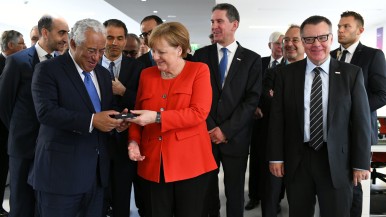
Braga, Portugal – Angela Merkel, the German chancellor, and António Costa, the prime minister of Portugal, today officially opened a new Bosch technology center in Braga together with Bosch board of management member Dr. Dirk Hoheisel . By the end of 2018, over 200 engineers will be working on developing sensors and software functions for automated driving at the location, which is situated about 50 km northeast of the coastal city of Porto. 100 new jobs will be created at the center. Some 100 associates have already transferred to the new 4,500 m2 technology center from the company’s main site, which is located four kilometers away. The German chancellor was in Portugal for talks on the development of German-Portuguese relations. In his speech, Portuguese prime minister Costa welcomed the opening of Bosch’s new technology center in his country, saying, “Portugal stands for innovative strength. Investments like the one Bosch has made here underscore this.” Our associates here will contribute to one of the key projects of future importance – the development of automated driving....Dirk Hoheisel, member of the board of management of Robert Bosch GmbH “Our new technology center in Braga is another indicator of the great potential we see in Portugal. It also reflects our confidence in the expertise of Portuguese engineers,” Hoheisel said, adding: “I am particularly pleased that our associates here will be able to make an even greater contribution to one of the key projects of future importance – the development of automated driving.” In recent years, Bosch has significantly expanded its presence in Portugal: between 2015 and 2017, it spent more than 200 million euros strengthening its activities there in the field of connected and automated mobility. In 2018, investments are expected to match the high levels of previous years. Bosch in Braga: solutions for tomorrow’s mobility The international supplier of technology and services currently employs more than 3,000 associates at its Braga location – around 1,000 more than just five years ago. The majority are involved in the development and manufacture of components for connected mobility, including technology for user-friendly display systems and infotainment. Among these is the eCall automatic emergency notification system for two-wheelers . If the vehicle is involved in an accident, the system automatically places a call for help. Particularly for motorcyclists, who have a much higher risk than car drivers of being involved in an accident, the system can mean the difference between life and death. About ten percent of associates at the Braga location work on developing components for automated mobility. In addition to developing and manufacturing sensors for vehicle safety systems like the ESP electronic stability program, the location also produces sensors that can, for instance, accurately determine the position of self-driving cars. In addition, the Bosch location in Braga has a longstanding research partnership with the local University of Minho, one of the country’s top universities. In a joint project with the university, the new technology center will also conduct research into sensors for automated driving. This partnership is scheduled to commence this year and continue for three years. Bosch Portugal: growing importance in the global engineering and manufacturing network Portugal is a key location within Bosch’s global engineering and manufacturing network. The company has had a presence in Portugal since 1911 and currently employs more than 4,500 associates at four locations. 500 of Bosch’s Portuguese associates work in R&D. In 2017, Bosch generated sales of around 240 million euros in the Portuguese market. Including deliveries to other Bosch companies, the total sales figure was 1.5 billion euros. Opened in 1990, the Braga plant is Bosch’s largest in Portugal. In Aveiro, Bosch’s Thermotechnology division develops and manufactures hot-water heaters, heat pumps, and heating appliances for private households. Ovar, the company’s third location in Portugal, is home to a manufacturing site as well as development activities of Bosch’s Building Technologies division. Video and fire alarm systems are one focus of activity at the site. Bosch’s regional headquarters in Lisbon is home to the company’s administrative as well as sales and marketing activities.