22.04.2021
Presentations
Business/economy
Achieving stability by embracing change: Bosch believes AIoT, electrification, a ...
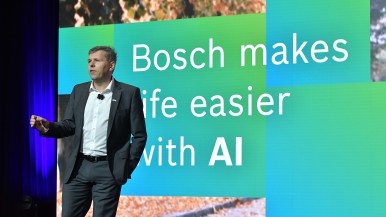
Dr. Volkmar Denner, chairman of the board of management, Robert Bosch GmbH, and Prof. Stefan Asenkerschbaumer, deputy chairman of the board of management, at the annual press conference on April 22, 2021 Check against delivery.Ladies and gentlemen, In today’s turbulent times, everyone is talking about change: business, politics, and society. For us, this change informs all our business activities, and we are pursuing it with great elan. This is one of the most exciting periods in our company’s history. As I speak, yaw-rate and acceleration sensors made by Bosch are on the surface of the Red Planet as part of the latest NASA mission. They’re helping to stabilize the Mars helicopter, which is currently sending back some spectacular images. Down here on earth, I am delighted to welcome you to our annual press conference today. For us, pursuing change is not just about readjusting our core business, but also about turning new challenges into new business. Metaphorically speaking, charting a new course and sticking to it allows us to turn a headwind into a tailwind. Let me give you few examples of what I mean. Our response to climate change? Make our company carbon neutral. To the need for climate-neutral mobility? Electrical powertrains. To the pandemic? Molecular diagnostics as a growth area. To the great strides China and the U.S. are making in the development of IT and AI? Industrial AIoT by Bosch. Bosch has the right responses to the burning questions about our future – responses that will put the company at the forefront of business and technological change. Our company’s embrace of change is what gives it its stability. That’s something we demonstrated in a year of crisis. We responded to the challenges the pandemic threw at us with courage and determination. And at the same time, we continued to press ahead with our transition from existing business to new business, always aware that the former must be able to finance the latter. This makes it all the more important that we closed the past financial year with a clearly positive result despite the pandemic, and that we expect the same for this year. Stefan Asenkerschbaumer will now report on the business situation. Following that, I will turn to the subject of Bosch strategy.The business situation of the Bosch Group: confidence for 2021 Ladies and gentlemen, on this occasion a year ago, I spoke about the huge challenges facing us in the 2020 business year. Today, I can say without fear of contradiction that we handled these challenges well. And this success gives us confidence for the current business year. After all, 2021 will also demand a lot from us. The pandemic continues to pose significant risks. Especially in our automotive operations, moreover, we are noticing the supply shortages of semiconductors, which are very much in demand. In this fraught situation, we are doing all we can to help our customers. For some weeks now, we’ve been working on this problem in task forces involving customers and suppliers. Unfortunately, this situation cannot be expected to improve any time soon. Indeed, it seems likely that the entire industry will be confronted with this unsatisfactory situation for many months to come. Both for us and our customers, this will be a drag on business developments in a phase of economic recovery. In the long run, the automotive industry’s supply chains have to become less prone to disruption, especially when it comes to semiconductors. It is not only Covid-19 that has disrupted them, but natural disasters and fires as well. But even if so many worst-case scenarios coincide, we have to make a concerted effort to keep supply chains open to the greatest possible extent. This is also the subject of talks with our business partners. We are systematically adjusting our Mobility Solutions business sector to areas of future importance such as electromobility, automated driving, and future electronics architectures. This calls for huge upfront investments. We are tackling the challenges of the year ahead with optimism. Indeed, the figures for the first three months give us every reason to be optimistic, with Bosch Group sales growing 17.0 percent. We have to factor the significant impact of the coronavirus pandemic into this result, of course, yet even compared with the same period in 2019, sales increased 8.5 percent. Looking at the business sectors, we can see 13.6 percent growth in Mobility Solutions sales. In Industrial Technology, the 11.6 percent rise is attributable to the recovery of the mechanical engineering market. The Consumer Goods business sector continues to benefit from the sustained high demand for household appliances and power tools, growing by 29.4 percent. Energy and Building Technology is also performing well, with a pleasing 10.0 percent growth in sales. Sales performance varies considerably by region, influenced by three factors: first, the slump caused by the coronavirus pandemic last year, which affected different countries at different times; second, considerable exchange-rate effects; and third, the varying pace of economic recovery in the world’s major regions. Sales in Asia Pacific (including Africa) rose a nominal 37.5 percent, and 54.4 percent in China alone. In other words, sales in China were up by 26.7 percent compared with the same period in 2019. In North America, we see a decline of 3.2 percent. After adjusting for exchange-rate effects, however, sales grew 6.6 percent. In South America, the increase is 16.2 percent. In Europe, we were able to increase sales by 13.8 percent compared to 2020. In the 2021 business year, as things stand, we’re expecting the global economy to grow by just under 4 percent, following a contraction of around 3.8 percent last year. The strongest recovery will be in Asia, followed by North America. Both regions have demonstrated appreciable progress in containing the pandemic. This progress is now also making itself felt in the service sector, and is buoying growth. In the United States, there is the additional effect of the extensive stimulus plan. In Europe, by contrast, where many countries continue to be severely affected by restrictions as a result of the rising number of coronavirus infections, the recovery will remain on hold. The result will be that economic output grows far more slowly, at barely more than 3 percent. While last year’s drop in GDP should be offset globally in 2021, we are unlikely to see a recovery from the pandemic-related losses in Europe until next year. In automotive production, we see a risk that the semiconductor shortages will stifle the recovery that was forecast for 2021. As it is, automotive production will remain considerably below the pre-crisis level of 92 million vehicles in 2019 and the historic high of 98 million vehicles in 2017. The resulting overcapacity is a drag on the industry. Against this backdrop, and assuming that there are no pandemic-related restrictions on a similarly severe scale to those seen in the second quarter of 2020, we currently expect the Bosch Group to grow its sales by roughly 6 percent in 2021. We also expect our Mobility Solutions business sector to grow. Our forecast at present is that growth will be between 5 and 7 percent, even if the semiconductor shortages are making this forecast difficult. For Industrial Technology, we forecast growth of some 6 percent. For Consumer Goods, the continuing positive development means that we currently expect to see sales growth of roughly 5 percent over the record level of the previous year. For Energy and Building Technology, we anticipate growth in the region of 4.5 percent. As I mentioned earlier, 2021 will be another very challenging year as we work to ready the Bosch Group for the requirements that lie ahead. Our comprehensive program to improve our cost structures and competitiveness has put us on a solid footing in this regard, and we are continuing to rigorously apply a raft of measures. However, such measures mean that we will once again have to shoulder considerable burdens as a result of restructuring costs. That said, we’re confident that, year on year, we’ll be able to improve our margin from operations slightly to around 3 percent; excluding restructuring expenses, the margin will be roughly 4 percent. However, the difficulty of foreseeing the effects of the semiconductor bottlenecks and the pandemic means that this forecast is also uncertain. Nonetheless, 2021 will be an important milestone on our path to regaining our target margin of around 7 percent in the next 2 to 3 years. Our positive result in 2020 creates the foundation for this – a result we achieved despite the heavy burdens of the pandemic. In 2020, sales fell 6.4 percent to 71.5 billion euros. The basis for this comparison is the adjusted figure for 2019. In other words, it excludes the activities of our packaging machinery business, which were included in the original figure for 2019. Despite the drop in sales, we achieved an EBIT margin from operations of 2.8 percent. Adjusted for restructuring expenses, which placed a considerable burden on result in 2020, the figure is 4.7 percent. In addition to the upturn in sales in the second half of 2020, extensive cost adjustments helped the company stay in the black – a pleasing result in light of the pandemic. What’s more, with the exception of Mobility Solutions, all our business sectors reported a positive result from operations. And if the costs of the extensive restructuring measures are excluded, Mobility Solutions also posted a positive result. We saw a real highlight in Consumer Goods: benefiting from the sustained high demand for household appliances and power tools, the business sector reported a record high margin from operations of 11.5 percent. Our robust financial structure should also be highlighted. At 44 percent, we retained an excellent equity ratio. And with free cash flow reaching a record level of 5.1 billion euros, liquidity was also gratifying. This gives us a solid foundation from which to turn visions of the future into concrete success. On that note, I’ll now hand back to Volkmar Denner. You can find further details of our 2020 business figures in your press kits.Endurance and speed in times of change – Bosch has both Thank you, Stefan. I’ll now turn to the profound changes in our environment and in the company. But I can’t do that without first mentioning timescales. In this respect, Bosch has to be capable of two things – driving long-term structural change and acting flexibly at short notice. Seizing the opportunities presented by megatrends such as connectivity and climate change requires investment clout and staying power. One striking example of this is the five billion euros we have already invested upfront in electromobility. Long-term thinking is a classic Bosch trait, but it doesn’t mean we can’t be agile in the short term. After all, how else could we be successful in the consumer goods business? Recently, we have seen especially strong growth here in our online business. And we are constantly bringing new products to market in rapid succession. One example is Cookit, a food processor with an integrated cooking function that also opens the door to many digital services. In addition, we demonstrated determination when we entered the market for e-bike drives ten years ago. We soon became the European market leader, and now we’re the world’s leading manufacturer. The most recent example of our agility is the rapid PCR test for coronavirus, which we successfully developed for our Vivalytic platform at the start of the pandemic. This work took us under six weeks. The test can also detect all known mutations of the virus. On a longer timescale, we are opening up further applications for our platform. One area we’re looking at is the fight against multi-resistant germs, which is important for hospitals and care homes. This is a potential area of growth for Bosch. So as we can see, Bosch has endurance and stamina in times of change, but is also capable of speed when needed.Customers becoming integral to development – the logic of AIoT This ability is in evidence in our endeavors – guided by connectivity and artificial intelligence – to develop data-driven business. Until now, such business has been the domain of IT companies outside Europe. Or at least, the heaviest investments in these areas of future importance are being made in China and the United States. On closer inspection, however, we can see that Bosch brings something unique to the table. We can combine broad domain knowledge with expertise in IoT and AI – that is, in the internet of things and artificial intelligence. And the result is AIoT. Connectivity provides knowledge about how things are used. And if we use methods of artificial intelligence to evaluate this knowledge, we can develop new functions and services, which in turn increases the benefits that things offer. This enables us to close the gap in the value-creation cycle between our engineers’ laboratories and our customers’ daily life. One way to look at it is that this daily life becomes a productive part of our development work. For example, in the future we will be able to use cloud algorithms to dynamically estimate an e-biker’s arrival time based on empirical values, rather than just on a static map. Using field data to develop additional customer benefits will become a Bosch core competence. And it is our declared aim to derive service revenue from all product revenue. We are making Bosch into a leading AIoT company. Video security is a good example of what this means from a technological and commercial perspective. AI will be a key driver of its growth in the future – video analysis based on neural networks. For that reason, we are integrating detectors both into new cameras and into an AI box that can be connected to installed devices. We are developing such detectors for video security and for video sensor technology in driver assistance systems – only Bosch is capable of leveraging such synergy effects. The first application in video security is a traffic detector that will be able to detect and locate vehicles precisely in busy traffic situations, even under difficult lighting conditions. This is important when it comes to measuring traffic flows with a high degree of accuracy, for example. As more data flows into the application, the more AI will be capable of – not least detecting accidents accurately. Software updates will make such improvements possible – adding new functions to the product and keeping it up to date. In this way, AIoT has come full circle, with the product business being complemented by software business. We are making great strides here. In 2020, for example, we sold some four million connected devices for the home – household appliances, power tools, heating systems, and smart home devices. In 2021, we will sell twice as many. And over the next few years, our sales of AI-enabled products will reach the one-billion-euro mark. We’re making good progress, having already brought more than 50 product solutions to market. Not least, the catalyst for this development is the Bosch Center for Artificial Intelligence, or BCAI for short. Just three years after its establishment, the center has already achieved a return on investment with its projects, contributing some 300 million euros to our positive EBIT. With AIoT, we are putting our own stamp on the megatrend of digitalization. And in just the same way, we are taking a Bosch approach to climate action. This megatrend challenges the ethos of our research and development like no other: Invented for life. Here, too, Bosch really can provide lasting technological answers to ecological questions, as I’ll show you now.Momentum from within and beyond the company – climate action creates business We are pleased to see that climate action efforts are gaining momentum around the world. Above all, it is encouraging that the U.S. has returned to the Paris Agreement. One especially ambitious program is the European Commission’s Green Deal. For our industries, it has two major consequences: increased electrification and more hydrogen technologies. To achieve the targets it sets, the share of electric cars among new registrations in Europe will have to rise much more sharply than previously forecast – to at least 60 percent in 2030. At the same time, the annual rate of renovation to improve energy efficiency in residential buildings will have to double to about two percent – so there will be a lot to do in the housing sector as well. Most notably, however, there are signs that green hydrogen will be given a boost. The market for green hydrogen in the EU will be worth almost 40 billion euros by 2030 – with annual growth rates of 65 percent. For Bosch, all this means that structural change in our existing businesses will accelerate, and the opportunities for new business will increase. This breach with the past is being driven not only from the outside, but also from within the company – we are not stopping our drive toward carbon neutrality. With our more than 400 locations worldwide, we’ve been carbon neutral since the first quarter of 2020. This has now been officially certified. But although this is a big step, it’s only a first milestone. The reason for this is that we are now turning our attention to what is known as Scope 3, the CO 2 emissions along our entire value chain, from suppliers to customers. To cut these emissions, we have agreed a binding target with the Science-Based Targets initiative – a 15 percent drop from their 2018 level by 2030. That’s a reduction of 67 million metric tons of carbon dioxide emissions, and this alone will reduce our carbon footprint more than 20 times as much as the switch to carbon neutrality in our own facilities. And we’re firming up the target for suppliers and logistics operations, as well as for our own products. This means, for example, that a supplier’s or logistics provider’s carbon footprint will in the future be one of the criteria for awarding new procurement contracts. And, most significantly, it means that we’ll be pushing our product portfolio in the direction of energy efficiency or even technology change.Electric driving, electric heating – Bosch is enjoying market success with electrification Even if climate-friendly mobility is the principal focus, this development is taking place in more than just one of our business sectors. Electrification not only requires solutions for electric driving in cars, but also for electric heating in buildings. Both cases involve a transition – from the combustion technology used at present to electricity-based systems in the future. Bosch is pressing ahead and making progress with both, but both will require hydrogen technologies to be used alongside electric ones. Rather than thinking about this as an “either/or” situation, it’s worth keeping an open mind and regarding these as supplementary, coexisting development routes, rather than as competing ones. But first, let’s look at electrification itself. Electromobility is establishing itself as the core business in Mobility Solutions, our biggest business sector. We’re making heavy upfront investments in this area – a further 700 million euros this year alone. More than 40 percent of our powertrain division’s R&D spending goes into this technology, compared with just over 30 percent two years ago. And this investment is paying off, both technically and commercially. At 96 percent, the efficiency of our e-axle is the best in the market, for instance. And while the market for electrical powertrain components is currently growing by a good 20 percent a year, Bosch is growing by almost 40 percent. We had acquired orders worth over 20 billion euros by the end of 2020. Our annual sales of these components are set to increase fivefold to a total of some five billion euros by 2025. And we’ll break even a year before that. Electromobility has ceased to be a bet on the future. Our upfront investments are now beginning to pay off. In heating systems, too, we are growing much faster than the market with solutions based on electricity. Our sales of heat pumps grew by more than 20 percent in 2020, and are expected to triple by 2025. Still, this strong growth presents a challenge for the industry, and this is where Bosch’s typical strengths come in – financial resources, large-scale production capability, commercialization know-how. To name one example, our highly efficient and low-noise air-to-water heat pumps put us ahead of the game. Unit sales of these devices alone almost doubled in Germany in 2020. Whether in buildings or out on the streets, Bosch is one of the winners in the move toward electrification.Climate neutrality is impossible without hydrogen – Bosch is H 2 -ready The more electrification advances, the more the following question arises: why bother with hydrogen technology as well? Realistically speaking, the answer is because purely electrical solutions have their limits – both for transport and in buildings. In fact, marginal costs rise sharply if electrical solutions alone are used in all stationary and mobile applications. For example, it’s more cost-effective to install heat pumps in new buildings than in existing ones; in the same way, it makes more sense to install battery-electrical powertrains in cars than trucks, little sense in off-highway vehicles, and no sense at all in ships and many aircraft. A good rule of thumb is that the heavier the vehicle, the better suited it is to renewable fuels – and these fuels will be required for chemical and steel plants in the future anyway. If society truly wants climate action, it is essential that we do not play technological approaches off against each other. Instead, we must combine them. Ultimately Europe won’t be able to achieve climate neutrality without a hydrogen economy. It’s good that this realization is catching on. But an opportunity is being missed if renewable synthetic fuel derived from hydrogen and CO 2 remains off-limits in road transport. In any case, climate action is not about the end of the internal-combustion engine. It’s about the end of fossil fuels. And while electromobility makes road transport carbon neutral, so do renewable fuels, and Bosch is encouraging the development of both. It seems, however, that European policymakers are fixated on the short-term objective of putting an end to the internal combustion engine. However, they shy away from talking about the consequences this will have on employment. Instead, the initial plans for the Euro 7 regulation were so unrealistic that they risked turning environmental policy into questionable industrial policy. Meanwhile, things are showing signs of movement, and we’re particularly pleased that the debate has become more objective. After all, diesel and gasoline engines no longer have an appreciable impact on air quality, thanks in part to technological advances made by Bosch. The future limits should be strict, but it would make no sense, ecologically or economically, to comply with them in scenarios that are completely unrelated to clean air in cities, such as cold starts on hills and fully loaded vehicles with trailers. Ladies and gentlemen, using renewable synthetic fuels can make combustion engines just as climate neutral as battery-powered vehicles. Climate-neutral mobility is a goal that’s almost as ambitious as flying to the moon. When Kennedy announced the ambitious goal of putting a man on the moon, he left it up to engineers to decide how to achieve it. The European Commission is running the risk of doing the reverse. With their policy, which in effect amounts to a technology monopoly, the moon landing would not have succeeded. Potential paths to climate action are currently being cut off. Bosch, at least, is keeping its options open – we are electrifying our powertrain systems, but we are also H 2 -ready. The fuel cell, which converts hydrogen into electricity, is making rapid progress toward production-readiness. We’re developing both stationary and mobile fuel-cell solutions. From 2021 to 2024, we plan to invest around 600 million euros in the fuel-cell powertrain and a further 400 million euros in fuel-cell micro power plants. These figures clearly show that Bosch’s response to climate action is not only technology-neutral, but also commercially aggressive. We will be putting almost 100 stationary fuel-cell plants into operation this year alone. They will supply electricity to data centers, industrial manufacturers, and residential areas, among others. Our very first example of one of these plants is now operational in the center of Bamberg in Germany. Our development work for mobile fuel cells is underway in each of the three major economic regions. In recent weeks, we entered into a joint venture with China’s Qingling Motor Group, and a test fleet of 70 trucks is set to be on the roads before the end of this year. In addition, production of fuel-cell components will begin at our Wuxi plant in 2021. By the end of the decade, the market will be worth 18 billion euros worldwide. We have what it takes to be a leader in this market as well.Prospects for our associates – Bosch is building its future in its own plants, not on greenfield sites Despite all these business opportunities, it would be wrong of me to wrap up without addressing what this means for our associates. After all, the transformation of Bosch will be quite a challenge, not least for our associates – it will cost jobs, but will also create new ones. As it moves into the future, the company will remain true to itself and continue to reconcile not only economic and ecological objectives, but also social considerations. Our associates show that they are open to change, and that inspires confidence. Look at the works agreements concluded at our core plants. Although they contain cost cuts, they also pave the way for the future. Clearly, therefore, we’re not building our future on greenfield sites, but instead in our own plants. And while this might not be a textbook approach, we can take skills from the development and production of gasoline and diesel systems and apply them to new technologies. In the last two years alone, we have filled more than half our electromobility-related jobs with associates from the combustion-engine business. And our fuel-cell business is already creating jobs – for mobile applications, the number of associates worldwide has risen from 600 to almost 1,100 this year alone; for stationary applications, the headcount is set to double to nearly 500. We will be able to fill more than 90 percent of these positions internally, again primarily with associates from our powertrain division. In addition, we’ve set up a company-wide job placement platform. This enables us to pursue two goals at once: filling urgent vacancies more quickly and offering new prospects to specialists from our traditional areas of business. For example, we recruited nearly 100 engineers for a major vehicle computer project within just six months, mostly via our platform, almost one-quarter of them from the powertrain division. And just as importantly, our associates are carving out their own paths; now, more than ever before, they see Bosch as a learning organization. Their uptake of digital training opportunities underscores this point. Since the beginning of 2020, our in-house learning portal has been accessed more than 400,000 times. In 2020, more than one in three training sessions were offered online; by 2023, this figure is set to rise to one in two. We have an impressive 1,200 video tutorials available on our intranet’s “BoschTube,” and some 7,000 associates have already enrolled in our e-university. What’s important is that the content of the learning opportunities aligns with Bosch’s roadmap for the future. This is illustrated by the software training courses we offer our Mobility Solutions developers, for example, and most notably by the AI training we offer to more than 25,000 executives. As you can see, ladies and gentlemen, we’re doing a lot to qualify our associates for the future, and to give them jobs that have a future. It is good to know that Bosch’s transformation is more than just a strategic goal. It’s also been part of our associates’ everyday working lives for quite some time. It is this innovative ethos, embodied by our workforce, that will enable us to keep coming up with new and yet invariably distinctive answers to the big questions of the coming years – whether with respect to digitalization or climate action. At the end of this decade, I am certain that Bosch will still be a stable yet dynamic company. Thank you for your time. Now we’re looking forward to hearing your questions!